
Why Toilet Trapways Are Curved Like an S
Toilets4.6
Learn why toilet trapways curve like an S, how each bend blocks sewer gas, and what the shape means for clogs and…
Read the guideA 3.5 GPF toilet from the 1980s or early 1990s can consume more than 20,000 gallons of water per year per household. Replacing it with an EPA WaterSense-certified 1.28 GPF model can cut toilet water use by more than 60 percent and generate real annual savings on your utility bill. Here is exactly how the math works.
Replacing a single 3.5 GPF toilet with a 1.28 GPF EPA WaterSense model saves the average household roughly 13,000 gallons of water and between $90 and $180 per year on combined water and sewer bills. Payback on the toilet cost typically occurs within 2 to 4 years.
GPF stands for gallons per flush. A 3.5 GPF toilet, which was standard in American homes built before 1994, releases 3.5 gallons of water into the bowl every single time the handle is pressed. By comparison, today's EPA WaterSense-certified toilets are required to use no more than 1.28 gallons per flush while still clearing MaP-tested waste loads of at least 350 grams, and most certified models clear 500 to 1,000 grams. That makes a 3.5 GPF toilet more than 2.7 times thirstier than a modern high-efficiency replacement.
Toilets manufactured before the Energy Policy Act of 1992 -- which took effect January 1, 1994 -- were typically rated at 3.5 GPF. Some older or commercial models ran at 5 GPF or even higher. The 1992 law capped new toilets at 1.6 GPF, but millions of pre-1994 toilets remained in service. A second generation of efficiency gains arrived with the EPA WaterSense program in 2006, which certified toilets at 1.28 GPF or less. Today, many WaterSense-labeled models from TOTO, Kohler, American Standard, Woodbridge, Swiss Madison, and Gerber flush reliably at 1.0 or 1.28 GPF while achieving MaP scores of 800 to 1,000 grams.
If your home was built before 1994 and the toilets have never been replaced, there is a high probability you are still flushing with a 3.5 GPF fixture. Check the tank lid underside: most manufacturers stamp the flush volume and date of manufacture directly on the porcelain.
The EPA estimates that toilet flushing accounts for nearly 30 percent of an average American household's indoor water use. In homes with pre-1994 toilets still installed, that share can climb even higher. Replacing just one 3.5 GPF toilet with a WaterSense-certified 1.28 GPF model is among the highest-return water conservation investments a homeowner can make -- typically outperforming low-flow showerheads and aerators on a per-dollar-spent basis.
The average person flushes a toilet about 5 times per day. At 3.5 GPF, one person uses roughly 6,388 gallons per year just from toilet flushing. A household of four therefore uses approximately 25,550 gallons per year through a single 3.5 GPF toilet -- compared to about 9,344 gallons with a 1.28 GPF replacement, saving over 16,000 gallons annually in that household. Actual figures vary by household size and flushing habits.
The table below shows annual water consumption side by side for a range of household sizes, comparing 3.5 GPF, 1.6 GPF, and 1.28 GPF toilets, all calculated at 5 flushes per person per day (a widely used industry benchmark):
| Household Size | 3.5 GPF (gallons/yr) | 1.6 GPF (gallons/yr) | 1.28 GPF (gallons/yr) | Savings vs 3.5 GPF |
|---|---|---|---|---|
| 1 person | 6,388 | 2,920 | 2,336 | 4,052 gallons |
| 2 people | 12,775 | 5,840 | 4,672 | 8,103 gallons |
| 3 people | 19,163 | 8,760 | 7,008 | 12,155 gallons |
| 4 people | 25,550 | 11,680 | 9,344 | 16,206 gallons |
| 5 people | 31,938 | 14,600 | 11,680 | 20,258 gallons |
These figures represent water consumed through a single toilet. A home with two bathrooms and two old 3.5 GPF toilets doubles these numbers. Some large families with three or four toilets all running at 3.5 GPF are consuming 80,000 to 100,000 gallons per year in toilet flushing alone.
Annual dollar savings depend on your combined water and sewer rate, which averages around $0.010 per gallon nationally (about $10 per 1,000 gallons) but ranges from $0.006 to $0.020 depending on your city and utility provider. A family of four replacing one 3.5 GPF toilet with a 1.28 GPF model saves approximately 16,200 gallons per year, translating to roughly $97 to $324 in annual utility savings. In high-rate cities like San Francisco or Atlanta, savings exceed $300 per toilet per year.
| Water + Sewer Rate | 2-person household savings/yr | 4-person household savings/yr | Payback on $300 toilet |
|---|---|---|---|
| $0.006 / gal (low-rate city) | $49 | $97 | 3.1 years |
| $0.010 / gal (U.S. avg) | $81 | $162 | 1.9 years |
| $0.015 / gal (high-rate city) | $122 | $243 | 1.2 years |
| $0.020 / gal (San Francisco, Seattle) | $162 | $324 | 0.9 years |
These estimates use the 8,103-gallon annual savings for a 2-person household and the 16,206-gallon figure for 4 people. Your utility bill should show your combined water and sewer charge per hundred cubic feet (CCF) or per 1,000 gallons, which you can convert directly using these figures.
Sewer charges often exceed water supply charges on municipal utility bills, sometimes by a factor of 1.5x to 2x. When calculating toilet replacement savings, always add both the water supply charge and the sewer or wastewater treatment charge. Homeowners who calculate savings using only the water supply line underestimate real savings by 40 to 50 percent.
Yes. Many water utilities and state water agencies offer toilet rebate programs specifically targeting replacement of pre-1994 high-flow toilets. Rebates typically range from $25 to $200 per toilet for EPA WaterSense-certified models and are most generous in water-stressed regions like California, Arizona, Texas, Florida, and the Pacific Northwest. The EPA WaterSense rebate finder at epa.gov/watersense lists active programs by zip code and can reduce net toilet cost significantly.
Some programs go beyond cash rebates. The Metropolitan Water District of Southern California, for example, has run direct toilet-exchange programs where qualifying households receive a free WaterSense toilet in exchange for their old 3.5 GPF model. The Alliance for Water Efficiency tracks utility rebate programs nationwide and reports that rebate availability has expanded year over year as drought pressure increases in western states.
To qualify for most rebates, the replacement toilet must be EPA WaterSense certified and, in some jurisdictions, carry a MaP score of 500 grams or higher. Models like the TOTO Drake II (1.28 GPF, MaP 1,000g), Kohler Cimarron (1.28 GPF, WaterSense certified), American Standard Champion 4 (1.6 GPF, MaP 1,000g), and Gerber Avalanche (1.28 GPF, WaterSense) all meet typical program requirements. Always verify with your local utility before purchasing.
If rebates are available in your area, the effective payback period for a toilet replacement drops dramatically. A $300 toilet with a $100 rebate and $162 annual savings pays back in under 14 months at the U.S. average utility rate.
The toilets that consistently earn top marks for both water efficiency and flush power are the TOTO Drake II (1.28 GPF, MaP 1,000g), TOTO Aquia IV dual-flush (0.8/1.28 GPF), American Standard Cadet 3 (1.28 GPF, MaP 1,000g), Kohler Cimarron (1.28 GPF), and the Woodbridge T-0001 (1.28 GPF). All carry EPA WaterSense certification and MaP scores of 800 grams or higher, making them effective replacements for 3.5 GPF models without sacrificing clog resistance.
Below are five recommended models that represent the strongest value for homeowners upgrading from a 3.5 GPF toilet, organized by use case:
| Model | GPF | MaP Score | WaterSense | Type | Best For | Check Price |
|---|---|---|---|---|---|---|
| TOTO Drake II | 1.28 | 1,000g | Yes | Two-piece | Best overall | Check price |
| TOTO Aquia IV | 0.8 / 1.28 | 800g | Yes | Dual-flush | Maximum savings | Check price |
| American Standard Cadet 3 | 1.28 | 1,000g | Yes | Two-piece | Budget-friendly | Check price |
| Kohler Cimarron | 1.28 | 800g | Yes | Two-piece | Comfort height | Check price |
| Woodbridge T-0001 | 1.28 | 800g | Yes | One-piece | Modern aesthetics | Check price |
For deeper reviews of these models, see our best flushing toilets guide, which evaluates flush power, MaP scores, and long-term owner satisfaction across all major brands.
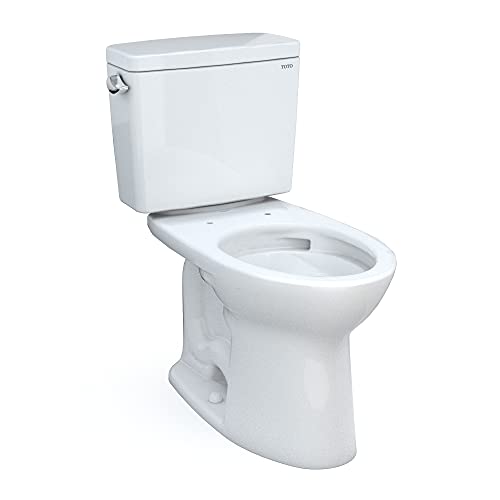
The TOTO Drake II (model MS454CUFG) is the most widely recommended upgrade from an older 3.5 GPF toilet in the plumbing industry. It uses TOTO's G-Max flush system, achieves a MaP score of 1,000 grams (the highest possible in standard testing), and uses 1.28 GPF with EPA WaterSense certification. TOTO's CEFIONTECT glaze on many Drake II configurations reduces waste adherence, which contributes to fewer secondary flushes in practice. Owner reviews consistently note that the Drake II clears waste as reliably as any 3.5 GPF toilet while using 63 percent less water. See our detailed TOTO Drake II review for full specifications.
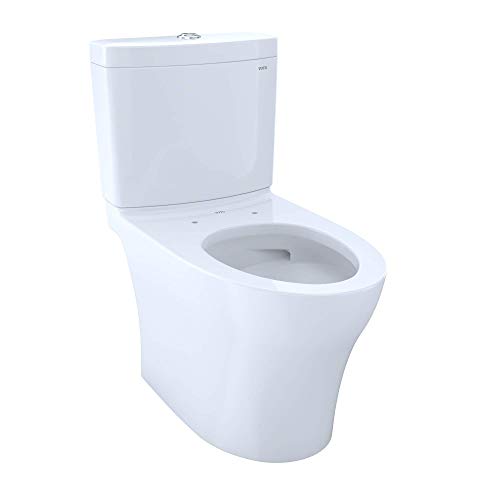
If maximum water reduction is the priority, the TOTO Aquia IV dual-flush uses 0.8 GPF for liquid waste and 1.28 GPF for solid waste. In households where the majority of flushes are liquid-only, real-world GPF often averages below 1.0 GPF across the day. The Aquia IV is WaterSense certified and achieves a perfect 1,000-gram MaP score on the 1.28 GPF flush setting. Replacing a 3.5 GPF toilet with an Aquia IV can reduce toilet water consumption by up to 75 percent in typical use patterns. Our dual-flush toilets guide explains the real-world savings math in detail.
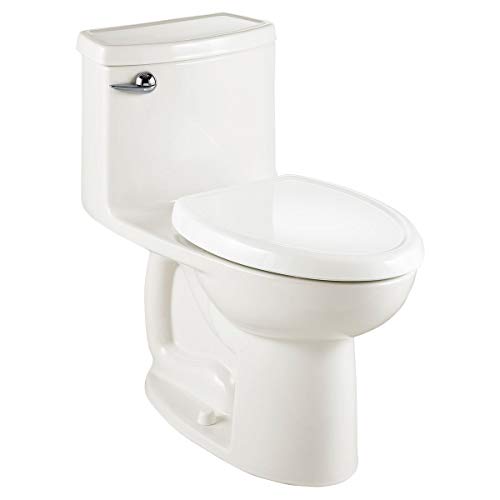
The American Standard Cadet 3 is one of the most popular toilet replacements in North America, largely because it hits the 1.28 GPF and 1,000-gram MaP targets at a lower cost than TOTO equivalents. It uses American Standard's PowerWash rim scrubbing system and a large 3-inch flush valve. Owner reviews highlight consistent performance in high-traffic households and easy DIY installation. WaterSense certified. For comparison shopping, see our American Standard Cadet 3 review.
The Kohler Cimarron uses AquaPiston flush technology, which delivers water from 360 degrees around the flush valve for more thorough bowl coverage. It is rated at 1.28 GPF, WaterSense certified, and achieves a perfect 1,000-gram MaP score. The ADA-compliant comfort height (17 to 19 inches rim height) makes it a popular choice for households with elderly or mobility-limited members. Kohler rates the Cimarron's canister flush valve as 90 percent less likely to leak than flapper-based systems, which reduces waste from internal leaks -- an often overlooked source of additional water waste in older toilets.
The Woodbridge T-0001 is a one-piece skirted toilet that uses 1.28 GPF with dual-flush capability (0.8 / 1.28 GPF) and carries WaterSense certification. MaP scores from independent testing land around 800 grams. Its skirted trapway design makes cleaning significantly easier than exposed-trapway two-piece toilets. Owner reviews note excellent value for the one-piece format and easy installation due to the included wax ring, supply line, and seat.
Flush performance and water savings are not in conflict with each other in modern WaterSense-certified toilets. MaP testing, conducted by Veritec Consulting and IAPMO Research and Testing, proves this directly: the TOTO Drake II and American Standard Cadet 3 both clear 1,000 grams of solid waste at 1.28 GPF -- a load that many old 3.5 GPF toilets with worn flappers and corroded rim jets would struggle to clear. An old high-flow toilet is not necessarily a well-flushing toilet.
To calculate your personal payback period, multiply your household's daily flushes (number of people x 5) by 365, then multiply by the gallon difference between your current toilet and the new model (e.g., 3.5 minus 1.28 = 2.22 gallons saved per flush). Multiply the annual gallon savings by your combined water and sewer cost per gallon, then divide the net toilet cost (purchase price minus any rebate) by the annual dollar savings. The result is your payback period in years.
Here is the formula written out step by step:
Example calculation for a family of 3 in a mid-rate city:
This family recoups the toilet cost in under 20 months and then saves $122 per year thereafter for the life of the toilet -- typically 20 to 30 years. Over a 20-year span, the total water savings from this one replacement exceed $2,400 at that utility rate.
Note that this calculation does not include the additional savings from eliminating internal leaks. Many older 3.5 GPF toilets have worn flappers that allow slow water leakage from tank to bowl -- sometimes 30 to 200 gallons per day, which can add $100 to $700 per year to utility bills beyond normal flushing consumption. A running toilet that goes undetected for a year can waste more than 50,000 gallons. Our guide on detecting toilet leaks explains how to test for a running toilet using a dye test.
When replacing a toilet that is 25 years or older, it is common to find that the flapper or flush valve has been slowly leaking for months or years without the homeowner noticing. An older 3.5 GPF toilet with even a minor flapper leak can easily consume 50 percent more water than its rated capacity. In those cases, the real savings from replacement are substantially higher than the GPF difference alone suggests, and the payback period is correspondingly shorter.
If you are comfortable with basic DIY plumbing, toilet replacement is a manageable project that typically takes 1 to 2 hours. Tools needed are minimal: adjustable wrench, putty knife, new wax ring, and a bucket. Many WaterSense models ship with the wax ring, supply line, and toilet seat included, which reduces incidental costs.
If you hire a plumber, expect to pay $150 to $300 for labor on a straightforward toilet swap, which should be added to your payback period calculation. Even including professional installation at $200, the family-of-3 example above still achieves payback in just over 3 years. Our guide on how much it costs to replace a toilet breaks down the full cost of professional installation by region.
This is the most common concern homeowners raise before upgrading. The short answer, backed by MaP testing data, is yes -- and in many cases, better. MaP (Maximum Performance) testing is an independent program that measures how much solid waste a toilet can clear in a single flush. Both the TOTO Drake II and American Standard Cadet 3 achieve the maximum MaP score of 1,000 grams at 1.28 GPF.
Older 3.5 GPF toilets were designed to clear waste through sheer volume. Modern high-efficiency toilets use engineered flush valves, larger trapways, optimized rim jet configurations, and siphon-jet technology to achieve superior waste clearance with less water. Brands like TOTO use cyclone-action and tornado flush systems; Kohler uses its AquaPiston canister valve; American Standard uses PowerWash scrubbing. The result is that a new 1.28 GPF toilet routinely outperforms a 25-year-old 3.5 GPF toilet that has degraded rim jets, mineral buildup in the rim holes, and a worn flapper that reduces flush velocity.
If you have historically experienced clogging issues with your current toilet, upgrading to a high-MaP WaterSense model is likely to reduce clog frequency as well as water consumption. See our roundup of best no-clog toilets for models with the strongest documented clog resistance.
Check the inside of the tank lid. Most manufacturers stamp the flush volume (in gallons or liters per flush) and the manufacture date on the porcelain. A manufacture date before 1994 almost always means 3.5 GPF or higher. You can also look up the model number printed on the tank at the manufacturer's website.
Owning and operating a 3.5 GPF toilet is not illegal. The Energy Policy Act of 1992 banned the manufacture and sale of new toilets exceeding 1.6 GPF starting January 1, 1994, but existing units in homes were not required to be replaced. Some municipalities with water shortages have enacted local ordinances requiring replacement of old toilets during renovations or property sales.
A 1.6 GPF toilet uses 20 percent more water per flush than a 1.28 GPF model. For a family of four flushing 5 times per day each, that difference amounts to about 2,336 extra gallons per year. EPA WaterSense certification applies to models at 1.28 GPF or less. If water savings is the primary goal, 1.28 GPF WaterSense models are the better choice over standard 1.6 GPF toilets.
MaP (Maximum Performance) testing, conducted by Veritec Consulting and IAPMO Research and Testing, measures how many grams of solid waste a toilet can reliably flush in a single attempt. Scores range from 250 to 1,000 grams. A score of 600 grams or higher is considered good; 800 to 1,000 grams is excellent. When upgrading from a 3.5 GPF toilet, choosing a replacement with a MaP score of 800 grams or higher ensures you do not sacrifice flushing reliability for water savings.
WaterSense certification requires a toilet to use 1.28 GPF or less AND pass a minimum flush performance threshold of 350 grams of solid waste clearance per the MaP protocol. This baseline ensures basic performance, but 350 grams is a relatively conservative minimum. For the most reliable performance, look for WaterSense models with MaP scores of 600 grams or higher -- most top brands now publish these scores for all certified models.
Reliable WaterSense-certified replacement toilets range from around $150 for basic two-piece models like the American Standard Cadet 3 to $400 to $700 for one-piece or feature-rich options from TOTO and Kohler. Smart toilets with integrated bidet functions range from $700 to several thousand dollars. For most homeowners replacing a 3.5 GPF toilet on a water-savings mission, the $200 to $350 range delivers excellent MaP scores and long-term durability.
Toilets themselves -- the porcelain bowl and tank -- routinely last 30 to 50 years or longer with no structural issues. Internal components (flappers, fill valves, flush valves) typically need replacement every 5 to 10 years. If your existing 3.5 GPF toilet has no cracks and flushes reliably with its original internals replaced, the porcelain itself is not the reason to replace it -- the water waste is.
You can reduce flush volume in a 3.5 GPF toilet by displacing water in the tank with a water-filled plastic bottle or by adjusting the fill valve float. However, reducing the water volume in a toilet designed for 3.5 GPF typically results in weak flushes and increased clogging, because the trapway and flush valve were engineered for that volume. This is not a reliable long-term solution and can lead to higher costs from clogs and double-flushing. A purpose-built 1.28 GPF toilet is a far better outcome.
The EPA WaterSense rebate finder at epa.gov/watersense/rebate-finder allows you to enter your zip code and find active rebate and incentive programs from local utilities, state agencies, and water districts. The Alliance for Water Efficiency at allianceforwaterefficiency.org also maintains a searchable database. Rebates are most generous in California, Arizona, Nevada, Texas, and the Pacific Northwest.
In typical use patterns, yes. A dual-flush toilet like the TOTO Aquia IV uses 0.8 GPF for liquid-only flushes and 1.28 GPF for solid waste. Studies from water utilities estimate that liquid-only flushes account for 60 to 70 percent of total daily flushes in a household, meaning average real-world consumption on a dual-flush toilet often falls below 1.0 GPF. This can save an additional 10 to 25 percent of water compared to a standard 1.28 GPF single-flush model.
Yes, measuring your rough-in is essential before buying a replacement toilet. The rough-in is the distance from the wall behind the toilet to the center of the drain flange (the floor bolt). Standard rough-in is 12 inches, which fits the vast majority of toilets on the market. Some older homes have 10-inch or 14-inch rough-ins, which require specifically designed models. Our toilet rough-in guide explains how to measure accurately.
In most cases, no. A toilet replacement is a like-for-like swap using the existing floor flange and supply line connection. You may need to replace the wax ring (most new toilets include one), and if the supply line is older braided steel or plastic, replacing it at the same time is recommended practice. If the floor flange is cracked, corroded, or set below floor level from a flooring renovation, that repair adds cost and labor. Otherwise, a standard swap requires no new plumbing.
Water treatment and distribution is energy-intensive. The Pacific Institute estimates it takes roughly 2,000 kilowatt-hours of electricity to treat and deliver one million gallons of water in California -- a figure that varies by region. Saving 10,000 gallons reduces energy consumption by approximately 20 kWh, which at the U.S. average grid mix equates to roughly 16 pounds of CO2 avoided per year per toilet. Over a 20-year toilet lifespan, that amounts to 320 pounds of CO2 from a single toilet replacement.
These goals address different problems. Replacing the toilet reduces water consumption per flush significantly. A bidet seat reduces toilet paper use but does not reduce flush volume on an existing 3.5 GPF toilet. If water savings is the priority, replacing the toilet is the more impactful move. If you want both benefits, replace the old toilet with a WaterSense-certified model and add a non-electric bidet attachment to the new toilet -- a combination that costs far less than a smart toilet and achieves both goals.
No -- modern WaterSense-certified toilets from established brands like TOTO, Kohler, American Standard, and Gerber are generally no more maintenance-intensive than older 3.5 GPF models. In many cases they require less maintenance because their flush valves and flappers are engineered to modern standards with better sealing materials. Kohler's AquaPiston canister valve, for instance, is rated to eliminate the friction and wear points that cause traditional flapper failures.
This is a concern specific to homes with older, long, or low-slope drain lines. In some cases, very low GPF toilets (1.0 GPF or below) in homes with marginal drain slopes have been associated with solid waste buildup in the sewer line over time. For homes with known drain slope issues, a 1.28 GPF model is a safer choice than 0.8 GPF. Most standard residential plumbing installed to code has adequate slope (1/4 inch per foot) to work well with 1.28 GPF toilets. Consult a plumber if your home has a history of drain line stoppages.
According to EPA WaterSense data, toilet flushing accounts for approximately 27 percent of average indoor household water use, making it the largest single indoor use category ahead of showers (17 percent), faucets (15 percent), and washing machines (22 percent). In homes with 3.5 GPF toilets, that share can rise to 35 to 40 percent of indoor water use. This is why toilet replacement consistently ranks as the most impactful single indoor water efficiency upgrade a homeowner can make.
Yes. EPA WaterSense certification applies to residential and commercial applications. Many commercial building codes in water-stressed states now mandate 1.28 GPF or lower for all new commercial installations. For high-traffic commercial use, pressure-assist 1.28 GPF models or models with MaP scores of 800 to 1,000 grams are preferred because they must perform reliably under heavy use without maintenance staff attention between each flush.
Hard water does not directly change the flush volume, but it does affect long-term performance and effective water use. Mineral deposits (calcium and magnesium scale) progressively clog rim jets, reducing flush velocity over time. This can cause a toilet originally designed to clear waste in one flush to require two flushes, effectively doubling its real-world water consumption per event. Hard-water households should consider TOTO models with CEFIONTECT glaze or models with easier rim-jet access for periodic descaling. See our guide on toilets for hard water.
Replacing the wax ring itself does not consume water; it is a static seal between the toilet base and the floor flange. However, if the existing wax ring has failed or been compromised, water will seep from under the toilet base with each flush, causing floor damage and hidden water waste. If you are replacing the toilet for efficiency reasons, always replace the wax ring at the same time -- it is a $10 to $20 part and a standard part of any toilet swap.
Replacing a 3.5 GPF toilet is one of the highest-return home water efficiency upgrades available, with payback periods as short as 12 to 24 months in many households and lifetime savings exceeding $2,000 per toilet. The TOTO Drake II and American Standard Cadet 3 deliver 1.28 GPF flush performance with MaP scores of 1,000 grams -- proving that modern high-efficiency toilets do not require a trade-off between water savings and flushing reliability. If utility rebates are available in your area, the financial case becomes even stronger. Check your toilet's manufacture date, calculate your household's annual gallon savings using the formula above, and use the EPA WaterSense rebate finder before purchasing.
Learn why toilet trapways curve like an S, how each bend blocks sewer gas, and what the shape means for clogs and…
Read the guideAlmost every US toilet has a left-side handle. Learn the plumbing and mechanical reasons behind the layout and when it actually changes.
Read the guideHome toilets rely on tanks because household water lines lack the pressure that public flushometer systems use to flush straight from the…
Read the guide