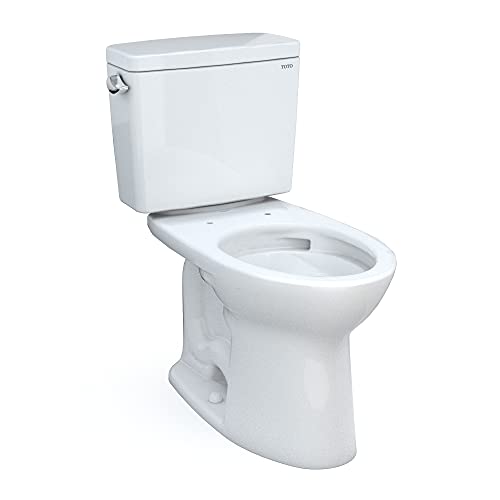
TOTO Drake II
Best for most homes4.8
1,000-gram MaP on 1.28 gallons through a quiet Double Cyclone siphon, with a fully glazed CeFiONtect trapway and cheap, widely available parts.
Check price on AmazonA data-rich breakdown of every toilet flush mechanism on the market today, comparing gravity, dual-flush and pressure-assisted designs on MaP flush-test scores, GPF water use, EPA WaterSense certification, noise, trapway geometry and real repair cost, so you can match the right system to your home before you buy.
The gravity flush is the best fit for most homes: the TOTO Drake II delivers the full 1,000-gram MaP ceiling on 1.28 gallons through a quiet Double Cyclone siphon, with cheap, widely stocked parts. Choose pressure-assisted only for punishing commercial or multi-family use, and dual-flush when every gallon saved on the water bill counts.
Every toilet clears the bowl using one of three meaningful flush mechanisms: gravity, pressure-assisted or dual-flush. Everything else you see on spec sheets (Double Cyclone, Tornado Flush, G-Max, Class Five, AquaPiston, Flushmate) is a branded variation inside one of those three families. Understanding the family first, then the variation, is the fastest way to buy correctly. The mechanism controls four things you cannot change after installation: how many grams of solid waste a single flush clears, how many gallons that takes, how loud the toilet is and how much it costs to repair when a part fails. This guide works through each mechanism with published data, explains the branded sub-types, answers the questions search engines surface most, and pairs each section with specific model recommendations so you can act on the information right away. For the broadest cross-type comparison of outright flush power, the pillar guide to the best flushing toilets ranks them side by side.
Choosing a flush type is also connected to choices about bowl shape, seat height and one-piece versus two-piece construction, since those physical decisions affect which flush mechanism fits a given bathroom. The complete 2026 guide on how to choose a toilet covers those dimensions in full. This page stays tightly focused on the mechanism itself.
We compare published manufacturer specifications, MaP (Maximum Performance) flush-test gram scores from map-testing.com, EPA WaterSense certification lists, flush-valve and trapway dimensions, and aggregated owner ratings across major retailers. We do not install toilets in a lab or conduct hands-on testing. Where one flush type clearly fits a use case better than another, we say so plainly rather than hedging toward a generic winner.
The table below puts one strong representative model against each flush family so the numbers stand still long enough to compare. MaP grams is the only third-party score that measures actual waste clearance rather than manufacturer claims. The tinted row marks the gravity flush as the best all-around choice for most households.
| Flush Type | Best For | Rep. Model | MaP Score | GPF | Noise | Repair Cost | Check Price |
|---|---|---|---|---|---|---|---|
| Gravity flush | Most homes, quiet daily use | TOTO Drake II | 1,000 g | 1.28 | Low | Low ($5-$20 parts) | Check price |
| Pressure-assisted | Heavy traffic, commercial use | Gerber Avalanche | 1,000 g | 1.0-1.6 | High | Medium-High ($80-$200 vessel) | Check price |
| Dual-flush | Water conservation, eco builds | TOTO Aquia IV | 800 g (full) | 0.8 / 1.28 | Low-Med | Medium ($15-$50 valve) | Check price |
| Siphonic (single-flush) | Clean rinse, large water surface | TOTO UltraMax II | 1,000 g | 1.28 | Low | Low ($5-$20 parts) | Check price |
| Washdown | Compact bowls, modern look | Swiss Madison St. Tropez | 600 g | 0.8 / 1.1 | Low | Low-Medium | Check price |
Press the lever on a gravity toilet and a flush valve (usually a flapper or a canister) opens at the bottom of the tank. Water drops by gravity into the bowl. When the volume raises the standing water past the top of the internal trapway bend, a siphon starts: water rushing over the crest pulls everything in the bowl after it in a sustained, low-pressure suction. Air breaks the siphon when the bowl empties, the flapper closes, and the fill valve refills the tank. The entire sequence uses household water line pressure of around 25 to 80 PSI only to fill the tank slowly between flushes. The flush itself is powered by nothing but water weight and bowl geometry.
Flush strength in a gravity toilet comes from how quickly and completely the tank empties and from how well the bowl shape initiates the siphon. Older 2-inch flush valves released water slowly, which is why early low-flow toilets earned a reputation for weak clearing in the 1990s. Modern designs use 3-inch or 4-inch valves that dump the tank in a fast surge, paired with computer-optimized bowl profiles that start the siphon almost instantly. The TOTO Drake II uses a 3-inch valve and a Double Cyclone jet to hit a 1,000-gram MaP score on 1.28 gallons. The American Standard Champion 4 uses a massive 4-inch valve and a 2.375-inch glazed trapway to move bulk that narrower designs sometimes cannot. Understanding which valve size a toilet uses tells you more about real-world flush quality than most of the marketing text on the box.
On any gravity toilet, the flush valve diameter is a fast quality indicator. A 3-inch or 4-inch valve dumps the tank fast enough to start a strong siphon; a legacy 2-inch valve cannot. TOTO's Double Cyclone and G-Max systems, Kohler's AquaPiston canister and American Standard's Champion 4 valve all run at 3 or 4 inches, which is why those models reach 1,000-gram MaP scores. If a spec sheet omits the valve size, it is usually a 2-inch budget design.
The vessel inside a pressure-assisted toilet (most commonly a Flushmate cartridge, widely used in Gerber and American Standard pressure-assist lines) works like a small pneumatic tank. Line water pressure, typically 25 PSI minimum and ideally 45 to 80 PSI, compresses trapped air as the water fills the vessel. When the trip lever releases the valve, that compressed air pushes the full water charge into the bowl at a velocity that gravity alone cannot match. The result is a loud, fast, powerful flush with very little residue left in the bowl.
The trade-offs are significant. Pressure-assisted toilets are distinctly louder than any gravity design, often producing a sharp bang-whoosh that carries through walls. The sealed Flushmate vessel costs $80 to $200 to replace and usually requires the entire cartridge to be swapped when it fails, compared to a $5 flapper on a gravity toilet. They also require adequate incoming water pressure, typically 25 PSI minimum, and can be problematic in homes or buildings with low line pressure. For a well-matched use case, such as a busy office restroom or a household where clogs are a recurring problem, the power is worth these concessions. For a quiet residential master bath or a home near a sleeper's bedroom, a top gravity model reaches the same MaP score while staying silent.
Flushmate vessels need a minimum of 25 PSI at the supply inlet, and they perform best at 45 to 80 PSI. Below 25 PSI the compressed-air charge does not build reliably and the flush weakens significantly. Homes on well systems or at the end of a long municipal run sometimes fall below that threshold. A $10 gauge from any hardware store screws onto a hose bib and reads the actual pressure in two seconds. Check before you buy, not after.
Dual-flush is best understood as a smarter water-delivery strategy layered on top of a gravity or washdown bowl rather than a separate mechanism entirely. The tank contains a two-stage tower valve connected to a split push button or a split lever. Pressing the smaller button releases a partial charge of water for a rinse flush. Pressing the larger button opens the full valve for a complete solids flush. The technology has been available for decades, is dominant in Europe and Australia, and has grown steadily in the United States as water rates rise and EPA WaterSense standards tighten.
The water savings are real, but they depend on household behavior. A family that consistently uses the small flush for liquids can cut toilet water use by 20 to 30 percent versus a fixed 1.28 GPF single-flush. The honest limitation is that many dual-flush bowls use a washdown action rather than a deep North American siphon, which can result in more skid marks on the bowl and occasional need for a brush. The two-stage valve also has more moving parts than a single flapper. For buyers motivated by long-term water savings or green building certification, the format is hard to beat. The complete toilet buying guide for 2026 covers the full cost-benefit calculation for dual-flush in more depth.
Almost every toilet sold in North America is siphonic. The TOTO Drake, Drake II and UltraMax II, the Kohler Highline, Cimarron and Santa Rosa, the American Standard Cadet 3 and the Gerber Viper are all siphonic gravity designs. The narrow trapway on a siphonic toilet fills completely during the flush, at which point air can no longer enter from the drain side, and suction takes over to pull the waste down. This produces the characteristic "whoosh" and gurgle of a North American toilet. Because suction, not just water velocity, does the clearing, siphonic toilets can clear waste efficiently on relatively low water volumes, which is why 1.28 GPF WaterSense siphonic models perform well.
Washdown toilets use a wider, shorter and straighter trapway, typically 4 inches in diameter, that pushes waste straight down without building suction. Because the trapway does not need to fill completely to function, it can be much wider and therefore less prone to physical obstruction. The tradeoff is a smaller water surface in the bowl, which means more visible residue and a greater need for the brush, plus a louder and less elegant-feeling flush to many North American users. The Swiss Madison St. Tropez and the Woodbridge T-0001 are among the dual-flush washdown designs popular in the U.S. market. The one-piece vs two-piece comparison covers how washdown bowls often tie to one-piece construction, since the shorter trapway suits the lower profile of a one-piece frame.
These are manufacturer brand names for engineering refinements within the gravity siphonic family, not separate flush categories. Understanding what each one is prevents marketing language from obscuring a simple comparison.
TOTO G-Max: TOTO's original high-power siphon system, used on the TOTO Drake. Uses a large siphon jet and a wide glazed trapway. Reaches 1,000 grams on 1.28 GPF. TOTO Double Cyclone / Tornado Flush: TOTO's refined system, used on the Drake II, UltraMax II and Vespin II. Replaces the single jet with two or three angled nozzles in the rim that create a centrifugal water swirl inside the bowl, scrubbing the surface more completely before the siphon starts. Also reaches 1,000 grams on 1.28 GPF with a quieter, cleaner rinse. TOTO Dynamax: The newest TOTO siphon system, optimized for even faster tank evacuation. Kohler Class Five / AquaPiston: Kohler's canister valve system, which opens 360 degrees (versus a flapper that lifts from one hinge point), releasing water from all sides of the valve opening simultaneously for a faster, more even tank dump. Used on the Highline, Cimarron and Santa Rosa. American Standard Champion 4: Not a branded flush system but a product line named for its 4-inch flush valve, the largest common flush valve in residential gravity toilets. Pairs that large valve with a 2.375-inch trapway for maximum bulk-pass capability. Woodbridge T-0001/T-0019 and Gerber Viper/Avalanche: Standard siphonic gravity systems (Viper) and pressure-assisted (Ultra Flush) without unique branded flush names, compared on MaP scores and trapway specs directly.
The takeaway is that when you see any of these names, you are still buying a gravity siphonic toilet. Compare them on published MaP grams, GPF and trapway width, because those numbers cross all brands without translation.
MaP (Maximum Performance) testing is the only third-party, independently published measurement of how many grams of solid waste a toilet clears in a single flush. The residential pass threshold is 350 grams. A score of 800 grams is very good. A score of 1,000 grams is the top of the published range, and multiple toilets across gravity and pressure-assisted categories reach it. The score is the most reliable predictor of real-world flush strength because it is measured with a standardized soybean-paste media under controlled conditions, not through marketing copy. Every product recommendation in this guide is accompanied by its published MaP score. If a toilet's MaP score is not publicly listed, treat that as a meaningful warning: most strong performers publish the number because it helps them sell.
Raw force is not the only dimension of flush quality. A toilet that clears 1,000 grams but leaves skid marks, takes 30 seconds to refill or makes noise that wakes the house is not necessarily the right choice. Match MaP score to noise tolerance and repair cost for the complete picture. The round vs elongated toilet comparison also touches on how bowl shape affects where the flush jet contacts the bowl, which influences cleaning efficiency even at the same MaP score.
Clog resistance comes from two things the flush type and bowl design control directly: how much kinetic energy reaches the trapway at the moment of flushing, and how wide and smooth that trapway is. A wide trapway simply passes larger objects; a glazed trapway (like TOTO's CeFiONtect ceramic glaze or American Standard's EverClean surface) prevents partial waste adhesion that builds up over time and gradually narrows the effective passage. Pressure-assisted wins on energy, since the air-propelled water charge never weakens as a flapper does. Among gravity toilets, the Champion 4's 2.375-inch trapway leads the field, but TOTO's 2.125-inch fully glazed CeFiONtect trapway on the Drake II is nearly as effective and considerably quieter.
A high MaP score is the best single predictor of clog resistance, because the test measures exactly the clearance scenario a clog represents. A toilet with a 1,000-gram score is unlikely to clog on normal household waste. Toilets with scores below 600 grams are more vulnerable. If your household has had recurring clog problems, check the MaP score and trapway specs before buying any replacement, regardless of the brand or the price.
EPA WaterSense is the federal efficiency certification that matters for rebates, green building credits and water utility incentives. A WaterSense toilet must flush at 1.28 GPF or less (single-flush) or average below 1.28 GPF on a weighted basis (dual-flush, where the calculation is 0.5x full-flush GPF plus 0.5x reduced-flush GPF). Most TOTO, Kohler and American Standard gravity models currently on the market carry WaterSense certification. The TOTO Aquia IV at 0.8 / 1.28 GPF, the Woodbridge T-0019 at 0.8 / 1.6 GPF and the Swiss Madison St. Tropez at 0.8 / 1.1 GPF all carry the label. Among single-flush gravity toilets, the 1.28 GPF models from TOTO, Kohler and Gerber are WaterSense certified and use roughly 20 percent less water per flush than a legacy 1.6 GPF design.
Water efficiency is best understood by multiplying GPF by your household's actual daily flush count, not by comparing spec-sheet numbers in isolation. A family of four averages 20 to 24 flushes per day. Switching from a legacy 3.5 GPF toilet to a 1.28 GPF WaterSense model saves roughly 46 to 55 gallons per day. Dual-flush saves an additional 5 to 12 gallons over that if the household consistently uses the small flush for liquids. The math is usually in favor of any WaterSense model over the dual-flush premium, unless you are in a high-water-cost market or pursuing a LEED or WaterSense label for a building.
Three models that demonstrate the best of each major flush family, selected on MaP score, owner ratings and honest fit for the use case. Each has a clear reason to be the top of its category rather than a generic strong performer.
1,000-gram MaP on 1.28 gallons through a quiet Double Cyclone siphon, with a fully glazed CeFiONtect trapway and cheap, widely available parts.
Check price on Amazon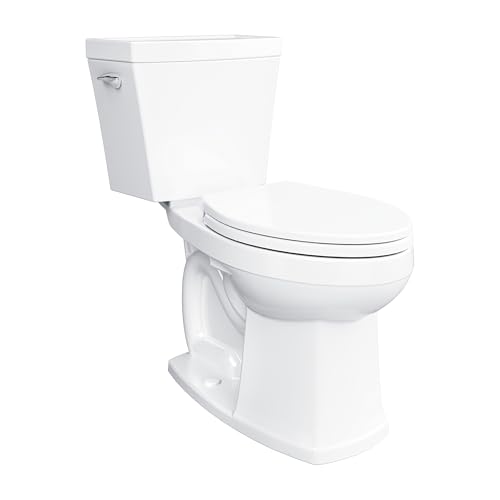
Flushmate compressed-air vessel delivers a forceful 1,000-gram blast that never weakens with use, suited to commercial or multi-family bathrooms where a clog is not acceptable.
Check price on Amazon
0.8 / 1.28 GPF dual-flush with an 800-gram full-flush MaP score, WaterSense certified, and TOTO's skirted one-piece design that makes cleaning easier than most dual-flush alternatives.
Check price on AmazonMatch the mechanism to your use case by working through four questions. Each answer narrows the field significantly.
Usage intensity is the most important factor that most buyers underweight. A toilet used by one or two people in a quiet home has different demands than one used by a family of six or a multi-occupant rental unit. Gravity siphonic toilets handle normal residential use, meaning 8 to 30 flushes per day, reliably for 10 to 20 years with standard part replacements. Pressure-assisted toilets are built for heavier cycles without weakening: the compressed air charge is identical on flush 5 and flush 500, whereas a gravity flapper gradually loses its seal and a worn fill valve fills slower. For a bathroom that functions like a light commercial fixture, the pressure-assisted option earns its higher repair cost. For typical home use, gravity's cheap maintenance wins clearly.
Pressure-assisted toilets produce a loud, forceful "whoosh" that is audible through closed doors and commonly described as startling in a quiet house at night. A top gravity siphonic toilet like the TOTO Drake II or UltraMax II is nearly silent by comparison: the Double Cyclone siphon produces a low hum and brief gurgle that is far less intrusive. If the toilet is near a bedroom, in an open-plan home or in any setting where noise matters, gravity is the only sensible choice. Dual-flush toilets using a washdown mechanism fall in between: the reduced flush is very quiet, the full flush slightly louder than a siphon because there is no sustained siphon suction to muffle the water exit.
If a lower water bill or a green building certification is a primary driver, dual-flush is the logical target. A household averaging 22 flushes per day that shifts to a 0.8 / 1.28 dual-flush model and uses the small flush 70 percent of the time will average approximately 0.94 GPF, compared to 1.28 GPF for a WaterSense single-flush toilet. That is a saving of about 7.5 gallons per day per toilet. Over a year and across two bathrooms, the savings exceed 5,400 gallons per toilet, enough to matter on a metered water bill in a high-rate market. For buyers who primarily want to hit WaterSense certification without the dual-flush complexity, any 1.28 GPF gravity model achieves the label at a lower price and with simpler parts.
Total cost of ownership over a decade looks very different across flush types. A gravity toilet's expected repair parts are a fill valve ($10 to $25), a flapper ($4 to $12) and occasionally a flush handle ($8 to $20), all available in any hardware store and installable by a non-plumber in under 30 minutes. A dual-flush toilet's tower valve costs $15 to $50 to replace and requires slightly more technical disassembly. A pressure-assisted Flushmate vessel costs $80 to $200 to replace and may require a plumber if the water line fittings are not accessible. Over 10 years in a normal home, the gravity toilet often has a lower total cost of ownership even if its purchase price is similar to the alternatives. The decision changes in a high-use commercial setting where the Flushmate's longevity under heavy cycling offsets its higher replacement cost.
The most common buying mistake in this category is choosing a flush type based on which sounds most powerful in a spec description rather than on a specific need. Pressure-assist sounds forceful and important; dual-flush sounds eco-conscious. But 90 percent of buyers are best served by a 1,000-gram gravity siphonic toilet with a 3-inch valve, a glazed trapway and a WaterSense 1.28 GPF rating. The TOTO Drake II, Kohler Highline, Kohler Cimarron and Gerber Viper all fit that profile. They flush as hard as pressure-assist, use less water than a standard single-flush, run nearly silently and cost almost nothing to maintain. Only deviate from that default when you have a concrete reason: a commercial-grade workload, a specific water-saving target or a design requirement for a washdown bowl.
Gravity siphonic is by far the most common flush type in the United States, accounting for the large majority of residential and commercial toilets sold. The siphonic action produces the large water surface and quiet operation that North American buyers expect, and the mechanism is well supported by a wide supply chain of inexpensive parts.
The independent MaP (Maximum Performance) flush test sets a residential pass threshold at 350 grams. A score of 600 grams is adequate for light use. A score of 800 grams is good for most households. A score of 1,000 grams is the published ceiling and means the toilet cleared the maximum test load cleanly. The TOTO Drake II, UltraMax II, Kohler Highline, Kohler Cimarron, American Standard Champion 4, American Standard Cadet 3 and Gerber Viper all publish 1,000-gram scores.
Pressure-assisted toilets are not universally better; they are better for specific high-use scenarios. Both reach the 1,000-gram MaP ceiling. Pressure-assist is louder, costs more to repair and requires adequate water line pressure (at least 25 PSI, ideally 45 to 80 PSI). For most residential bathrooms a top gravity siphonic model delivers identical waste clearance more quietly and at a much lower long-term maintenance cost.
All siphonic toilets are gravity flush toilets. "Gravity flush" describes the power source (falling water, no pump), and "siphonic" describes the bowl action (suction that starts when the trapway fills completely). The terms are often used interchangeably for the same toilet. A washdown toilet is also a gravity flush but uses push force rather than siphon suction to clear the bowl.
A Flushmate cartridge is a sealed plastic vessel that sits inside a ceramic tank. As your water line refills the vessel, incoming water pressure compresses a trapped air pocket inside the cartridge. When you flush, a valve releases that compressed air to push the stored water into the bowl at high velocity. Flushmate vessels are used in Gerber and American Standard pressure-assist lines and require 25 to 80 PSI line pressure to function correctly.
EPA WaterSense is a voluntary federal certification for toilets that flush at 1.28 gallons per flush or less (single-flush) or average below 1.28 GPF on a weighted calculation (dual-flush). Certified toilets must also pass a basic flush performance test. WaterSense models qualify for rebates from many water utilities, and the label appears on most TOTO, Kohler, American Standard, Gerber, Woodbridge and Swiss Madison toilets at 1.28 GPF or lower.
Gravity siphonic is the best flush type for homes with low incoming water pressure. Gravity toilets refill their tank using whatever pressure is available and flush using the potential energy of the stored water, so line pressure does not affect flush strength. Pressure-assisted toilets require at least 25 PSI at the supply inlet and perform poorly or fail to flush correctly below that level. Dual-flush toilets are also gravity-based and work fine at low line pressures.
Dual-flush toilets are worth the extra cost in households where the small flush will actually be used consistently for liquid-only flushes. In an eco-conscious household or in a high-water-rate market, the per-year savings can easily justify the higher upfront cost and slightly more complex valve. In households where everyone defaults to the large flush regardless of waste type, the savings rarely materialize and a 1.28 GPF WaterSense gravity toilet often delivers a better net outcome.
TOTO's Double Cyclone (used on the Drake II and Vespin II) fires water through two angled nozzles set into the rim rather than through a series of small rim holes. The angled jets create a centrifugal rinse that scrubs the bowl more evenly and starts the siphon with less water than a conventional jet. In practice it produces a quieter, cleaner rinse at 1.28 GPF and reaches a 1,000-gram MaP score. It is a refinement on the standard siphon rather than a different mechanism, but the practical results are meaningfully better at the same water volume.
Kohler's AquaPiston is a canister-style flush valve used in the Highline, Cimarron and Santa Rosa. Unlike a conventional flapper that lifts from a single hinge point, the canister opens 360 degrees, releasing water from all sides of the valve at once. This produces a faster, more uniform tank dump than a standard flapper. Kohler's Class Five system combines the AquaPiston with a specific bowl geometry tuned to clear 1,000 MaP grams. It is a gravity siphonic mechanism like any other, but the faster valve release is a real engineering advantage.
Gravity siphonic is the quietest flush type. The siphon suction that pulls waste down produces a sustained low hum rather than a loud water strike. Pressure-assisted toilets are the loudest, with a sharp compressed-air blast that is clearly audible through walls. Washdown and dual-flush toilets (reduced flush) fall between those two, with the small dual flush being very quiet and the full washdown flush moderately louder than a siphon. The TOTO Drake II and UltraMax II are among the quietest toilets tested in this comparison.
CeFiONtect is TOTO's proprietary ceramic glaze applied to the bowl and trapway inner surfaces. It creates an extremely smooth, ion-barrier finish that reduces the adhesion of waste, mold and bacteria to the ceramic. In practical terms it means the trapway is more slippery at a microscopic level, so partial waste deposits that would otherwise gradually narrow the passage and eventually cause a clog wash away more easily. It is a long-term clog-resistance feature rather than a short-term flush power feature.
A single-flush toilet delivers the same water volume on every flush, typically 1.28 GPF on a modern WaterSense model. A dual-flush toilet offers two volumes: a reduced flush (usually 0.8 to 1.1 GPF) for liquid waste and a full flush (usually 1.0 to 1.28 GPF) for solid waste. The practical difference is water use averaged over a household's flush habits, which can be 20 to 30 percent lower with dual-flush if the reduced mode is used consistently for liquids.
A fully glazed trapway of 2.125 inches or wider handles normal residential waste without chronic clogging in most cases. The American Standard Champion 4 uses the widest residential trapway at 2.375 inches and is specifically recommended for households with a clog history or heavy waste volume. TOTO's 2.125-inch CeFiONtect glazed trapway is nearly as effective because the ultra-smooth glaze reduces the adhesion that causes partial blockages. Avoid toilets with unglazed trapways below 2 inches in diameter for any household with children or heavy waste volume.
Yes. Pressure-assisted toilets use standard 12-inch rough-in (or 10- and 14-inch variants) and connect to the same floor flange as a gravity toilet. The footprint and seat height are often similar. The main installation requirements specific to pressure-assist are adequate incoming water line pressure (minimum 25 PSI at the supply stop) and enough space inside the wall cavity behind the toilet for the larger tank, which is slightly taller and heavier than a gravity tank due to the inner vessel. Verify line pressure before purchase.
Yes. Several EPA WaterSense certified dual-flush models offer a reduced flush of 0.8 gallons per flush for liquid waste. The TOTO Aquia IV, Swiss Madison St. Tropez and Woodbridge T-0019 all offer a 0.8-gallon reduced-flush option. Some commercial ultra-high-efficiency toilets (UHETs) flush at 0.8 GPF or even 0.5 GPF in a single-flush format, but most of these are designed for commercial water-conservation contexts rather than residential comfort, and their MaP scores vary widely.
For a rental property, a 1.28 GPF gravity siphonic toilet with a 1,000-gram MaP score is the correct choice. The reasons are practical: cheap, widely available repair parts that a maintenance person or tenant can source at any hardware store; no sealed pressure vessels that require a plumber; no dual-flush confusion for tenants who may default to using the full flush exclusively; and enough flush power to handle varied tenant habits without chronic clogging. The American Standard Cadet 3, Kohler Highline and Gerber Viper are all strong rental-property picks on this basis.
The American Standard Champion 4 is rated at a 1,000-gram MaP score (the maximum published by independent flush testing) and typically flushes at 1.6 gallons per flush. This makes it the most clog-resistant gravity toilet in the residential market but not a WaterSense-certified model at that GPF. American Standard does offer a 1.28 GPF version (the Champion 4 Max) that earns WaterSense certification and still achieves a 1,000-gram MaP score, sacrificing the extra water volume while retaining the wide 4-inch flush valve and 2.375-inch trapway.
A Flushmate pressure vessel typically lasts 5 to 10 years before the internal seals or the vessel body begins to show signs of leakage or pressure loss. In a high-use commercial setting, the lifespan may be shorter. Replacement vessels cost $80 to $200 and are available for most model generations, though some older cartridges are no longer manufactured. Gravity toilet flappers and fill valves, by comparison, typically cost $4 to $25 and last 3 to 7 years before needing replacement, making the annual maintenance cost much lower.
Most plumbers default to gravity siphonic when asked for a recommendation for residential installation. The reasons are consistent: cheap, universally available parts; no special pressure requirements; quiet operation that reduces homeowner callbacks; and a track record of decades of reliable service. Plumbers reserve pressure-assist recommendations for specific situations involving chronic clogs in high-use settings where the louder, more expensive cartridge is justified by the reduction in service calls. Dual-flush recommendations tend to come with caveats about household behavior and valve longevity.
Gravity siphonic is the right flush type for most homes, with the TOTO Drake II setting the standard: 1,000-gram MaP clearance, 1.28 GPF, a quiet Double Cyclone siphon and cheap parts that last for decades. Choose pressure-assist for high-traffic commercial or multi-family settings where raw clog resistance outweighs noise and repair cost. Choose dual-flush when consistent household water savings or green building certification is the primary driver. The mechanism that matches your actual use case will outperform a more expensive toilet with the wrong flush type every time.
When you flush, where does it go? Follow toilet water from the bowl through the trap, drain, and stack to a septic…
Read the guideDo toilets need electricity to flush? Most do not. Learn which toilets use power, how a standard flush works, and how to…
Read the guideFind out how many gallons per flush an old toilet really uses, how to check your own tank, and how much water…
Read the guide