
Best 30-Inch Bathroom Vanities (2026)
Bathroom Remodeling4.6
Thirty inches is the sweet spot between a cramped 24-inch vanity and a full 36-inch cabinet, giving a single-sink bathroom real drawer…
Read the guideA bathroom exhaust fan is the single cheapest defense against the mold, peeling paint and rotting drywall that humid air quietly causes over years, yet most buyers pick one by price alone and end up with a fan so loud they never run it long enough to clear the moisture. We ranked the best bathroom exhaust fans of 2026 by HVI-certified CFM airflow matched to room square footage, tested sone noise level, motor type and build durability, ENERGY STAR efficiency, and the patterns across thousands of aggregated owner reviews, so you can find a fan that genuinely clears the steam, runs quietly enough to actually use and lasts a decade of daily humidity without motor failure.
The best bathroom exhaust fan in 2026 is the Panasonic WhisperCeiling FV-0511VQ1, because its Pick-A-Flow switch covers 50, 80 or 110 CFM in one unit, the sub-0.3 sone rating is near-silent, and the ENERGY STAR DC motor is rated for 30,000 hours, meaning it outlasts the bathroom it serves. For best value, choose the Broan-NuTone AE110; for budget, the Delta BreezGreenBuilder GBR80.
Most bathroom moisture damage happens not because the owner lacks an exhaust fan, but because the fan they have is too loud to run willingly, moves less air than the room needs, or vents into the attic instead of outdoors. A fan that roars at 4.0 sones gets switched off in thirty seconds. An undersized 50 CFM fan in a 100-square-foot master bath never clears the steam regardless of how long it runs. A fan dumping humid air into the attic grows mold in the framing rather than protecting it. Understanding those three failure modes is the whole game, and it is why this ranking weights certified HVI airflow, sone rating and motor durability above features or price.
We do not conduct our own airflow or noise tests. Instead we compare certified Home Ventilating Institute airflow and sone ratings, ENERGY STAR efficiency data, motor type, duct size compatibility, housing depth against typical ceiling cavities, and the patterns across thousands of verified owner reviews. For the wider context of fixtures these fans protect, see our pillar guide to the best flushing toilets, and for a full bathroom remodel coordinate with our guide to Best Bathroom Vanities of 2026.
Every pick here had to satisfy its stated use category convincingly across the four things that determine real-world success: HVI-certified airflow that matches a defined room-size range, a sone rating quiet enough that the fan actually gets used, a motor durable enough to survive daily humidity for years, and a duct size and housing depth that suit a real installation. We favored DC motors and quality permanent-split-capacitor motors over cheap shaded-pole units that wear out fast. We weighted ENERGY STAR certification, 4-inch or 6-inch duct compatibility that preserves rated airflow, and aggregated owner reports about real noise, real clearance and installation difficulty. We do not accept payment for placement.
| Fan | Best For | Airflow | Noise (sone) | Motor | Rating |
|---|---|---|---|---|---|
| Panasonic WhisperCeiling FV-0511VQ1 | Best overall | 50/80/110 CFM | 0.3 sone | ENERGY STAR DC | 4.8 |
| Broan-NuTone AE110 | Best value | 110 CFM | 0.5 sone | ENERGY STAR AC | 4.7 |
| Delta BreezGreenBuilder GBR80 | Best budget | 80 CFM | 0.8 sone | ENERGY STAR DC | 4.6 |
| Panasonic WhisperWarm FV-0511VHL1 | Best with heater | 50/80/110 CFM | 0.7 sone | ENERGY STAR DC | 4.6 |
| Broan-NuTone QTXE110 | Quietest fan | 110 CFM | 0.3 sone | ENERGY STAR PSC | 4.6 |
| Panasonic WhisperGreen Select FV-0511VKL2 | Best with light | 50/80/110 CFM | 0.3 sone | ENERGY STAR DC | 4.7 |
| Delta BreezSignature VFB25ADH | Best humidity sensing | 80 CFM | 0.8 sone | ENERGY STAR DC | 4.6 |
| Broan-NuTone 688 | Best basic replacement | 50 CFM | 4.0 sone | AC shaded-pole | 4.4 |

The Panasonic WhisperCeiling FV-0511VQ1 is the fan that lands all three non-negotiables at once: near-silent sub-0.3 sone operation so people actually leave it running, Pick-A-Flow selectable 50, 80 or 110 CFM that covers almost any bathroom from one SKU, and a 30,000-hour-rated ENERGY STAR DC motor in a galvanized-steel housing that resists the corrosion cheap plastic housings accumulate in years of humid air.
The Pick-A-Flow switch inside the housing lets a single unit cover 50, 80 or 110 CFM simply by sliding a lever before installation, which solves the sizing problem that causes buyers to order the wrong fan for their room. The sub-0.3 sone rating is the critical number: at that level the fan runs at roughly the volume of a whisper, which is why owners consistently report leaving it on long enough to actually clear the steam instead of switching it off because it roars. Panasonic achieves that quiet level by using a DC motor that runs at low speed and a scroll-shaped housing that moves air efficiently without turbulence.
The 30,000-hour motor rating translates to roughly 13 years of running two hours a day, which is far beyond what the shaded-pole motors in budget fans offer. Aggregated owner reviews over many years show unusually low failure rates and repeat purchases after the fan outlives the bathroom renovation it was installed in. The limits are practical: this base WhisperCeiling has no built-in light or heater, so buyers who need those should look at the WhisperGreen Select or WhisperWarm, and the 7-3/8-inch housing depth needs a ceiling cavity deep enough to accommodate it. The galvanized-steel construction also means it weighs more than plastic alternatives, though that same mass contributes to its quiet operation by damping vibration.
The WhisperCeiling is the fan worth recommending by default for any bathroom because it makes the two choices that actually protect the room: the DC motor runs for decades of daily humid air instead of seizing in a few years, and the sub-0.3 sone rating means owners leave it running long enough to clear the moisture. Pick-A-Flow eliminates the guessing at sizing. If you only need one fan and you want it to be right, this is the one, confirmed your ceiling cavity fits the housing and that you do not need an integrated light.

The Broan-NuTone AE110 is the value pick because it combines real 110 CFM airflow, a quiet 0.5 sone rating and ENERGY STAR certification with Broan's Roomside Installation design, which lets you mount the entire unit from inside the bathroom without accessing the attic or crawlspace, a significant advantage in homes where the ceiling sits under a finished floor.
The Roomside Installation system is the differentiator here. A standard ceiling fan install requires someone in the attic or crawlspace to set the housing between joists and secure it before the lower housing drops through the ceiling. The AE110 mounts through the ceiling opening from below, which transforms a two-person attic job into a single-person project with basic tools. It moves a genuine 110 CFM at a quiet 0.5 sone, enough for a bathroom up to about 110 square feet, and the included 4-inch to 3-inch duct adapter means it connects to either common duct diameter.
Owner reviews consistently highlight how much easier the roomside install makes a DIY replacement, the quietness relative to older fans, and the reliable Broan parts availability if anything ever needs service. At 0.5 sone it is slightly louder than the sub-0.3 sone WhisperCeiling and QTXE110, and it carries no integrated heater. But for a buyer who wants strong 110 CFM airflow, quiet operation and a no-attic install at a price well under the premium Panasonic units, it is the clear value winner, and it suits the same rooms as our guide to Best Bathroom Lighting of 2026.
The AE110 is the fan to recommend to any homeowner who does not have attic access above their bathroom and does not want to hire a contractor. The roomside install is a genuinely useful design, the 110 CFM covers any standard bathroom, and 0.5 sone is quiet enough for daily use. You trade a little silence versus the WhisperCeiling but save a meaningful amount and simplify the install. For a DIY bathroom remodel, it is the smart default value pick.

The Delta BreezGreenBuilder GBR80 is the budget pick that refuses to compromise on the part that matters most: it uses a genuine DC brushless motor and earns ENERGY STAR certification while delivering 80 CFM at a quiet 0.8 sone, running far quieter and more efficiently than the builder-grade fans typically sold at this price point.
The GBR80's value is in how Delta prioritizes the motor over everything else. A DC brushless motor at this price is unusual; most fans in this tier use cheap shaded-pole motors that fail within a few years and are much louder. At 0.8 sone the GBR80 is noticeably quieter than the builder-grade fans competing on price, which means people actually run it, and the ENERGY STAR certification keeps electricity cost low over years of daily use. It connects to a standard 4-inch duct and backs the motor with a three-year warranty longer than most budget units carry.
Owner reviews are strong for a product at this price, with the recurring themes being genuine quiet for the cost, easy installation, and no early motor failures. The tradeoffs are scope rather than quality: 80 CFM tops out at about 80 square feet, so a larger master bath should step up to the AE110 or WhisperCeiling, and there are no extras of any kind. For a buyer who wants a quiet, reliable, efficient fan for as little as possible in a standard-sized bathroom, the GBR80 is the smart entry point from a brand with a real track record.
The GBR80 is the budget fan to recommend because Delta refuses to swap the DC motor out for a cheaper shaded-pole unit just to hit a lower price. At 0.8 sone it is genuinely quiet for the money, and the ENERGY STAR brushless motor is what makes it reliable rather than a fan that dies in two years. For a rental, a flip or a small bathroom that needs a working quiet fan without a big budget, this is the honest choice.

The Panasonic WhisperWarm FV-0511VHL1 is the pick for cold-climate bathrooms, building the WhisperCeiling's selectable 50, 80 or 110 CFM and near-quiet operation into a single ceiling unit that also provides an integrated radiant heater and an LED light, so one fixture handles ventilation, warmth and lighting without adding separate appliances or runs.
The WhisperWarm builds the same Pick-A-Flow selectable airflow as the WhisperCeiling onto a platform that also includes a radiant heater on its own switch and a built-in LED light panel with a night-light mode. The fan-only sone rating is 0.7, slightly higher than the base WhisperCeiling because of the added components, but still comfortably below the 1.0 sone threshold most buyers notice. The heater operates on a separate circuit switch so you can run the fan, the light and the heater independently, and Panasonic's DC motor platform provides the same long-life reliability as the fan-only model.
Owners in cold climates value eliminating the chilly step-out from the shower that space heaters poorly address, getting genuinely quiet ventilation alongside the warmth, and the built-in LED light that removes one separate fixture from the ceiling. The tradeoffs are that the heater draws meaningful current and needs a circuit that can carry it, and buyers in warm climates are paying for a heater they will never switch on. For a cold-climate bathroom where one ceiling unit handling three functions is the goal, the WhisperWarm is the standout, and it works alongside the fixtures in our guide to Best Bathroom Mirrors of 2026.
The WhisperWarm is worth its cost specifically for bathrooms in cold regions where winter mornings make stepping out of the shower uncomfortable. Getting the radiant heat, the ventilation and the LED light from a single ceiling unit is genuinely convenient, and you do not give up Panasonic's long-life DC motor to get it. Confirm the circuit can carry the heater load before buying, and skip it if you live somewhere warm enough that you would never switch the heat on.

The Broan-NuTone QTXE110 is the pick for bathrooms adjoining bedrooms or quiet spaces, delivering a full 110 CFM at just 0.3 sone by routing air through a lower-restriction 6-inch duct and a large, slow-spinning blower wheel, a combination that moves serious air volume without the turbulence noise that louder fans produce.
The engineering behind the QTXE110's 0.3 sone at 110 CFM relies on three design choices: a larger blower wheel that moves more air at slower rotational speed, a 6-inch duct that lowers static pressure and lets the blower spin down further, and an insulated galvanized-steel housing that damps vibration noise before it reaches the room. The result is a fan that owners consistently describe as so quiet they check whether it is actually running. At 110 CFM it clears a large master bathroom quickly, meaning even though it is quiet it is not slow.
Owner reviews over years praise the genuine silence at full airflow, the effective clearance that does not trade performance for quiet, and the solid Broan construction. The main installation consideration is the 6-inch duct: buyers with an existing 4-inch run can adapt with a reducer, but the adapter adds restriction and reduces the performance advantage slightly. For a buyer who genuinely prioritizes silence at high airflow, the QTXE110 is the standout, and it coordinates well with the serene spaces in our guide to Best Bathroom Vanities of 2026.
The QTXE110 is the fan for bathrooms where noise genuinely matters, whether because it sits against a bedroom wall or because the house is quiet enough that any fan hum is intrusive. The 6-inch duct is a real requirement to hit 0.3 sone, so plan the duct run before you buy, but for light sleepers, open plans and master suites, the combination of full 110 CFM and near-inaudible operation is the right call.
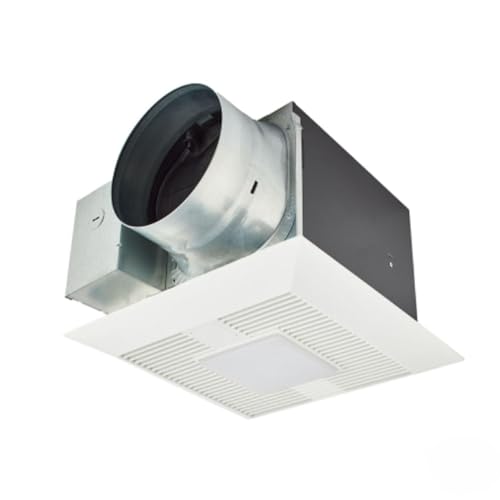
The Panasonic WhisperGreen Select FV-0511VKL2 is the pick when you want one ceiling unit to handle both ventilation and lighting, carrying the WhisperCeiling's selectable 50, 80 or 110 CFM and sub-0.3 sone quietness with an integrated dimmable LED light and a plug-in module system that lets you add humidity sensing, motion sensing or a timer without rewiring.
The WhisperGreen Select adds to the WhisperCeiling platform without degrading its core performance: the Pick-A-Flow airflow, sub-0.3 sone rating and DC motor all carry over, and the integrated dimmable LED light means one ceiling box replaces both the fan and the light fixture in a remodel. Panasonic's modular plug-in system is the unique feature: optional accessories snap in to add a humidity sensor that starts the fan automatically when steam rises, a motion sensor that runs the fan when someone enters the room, or a programmable timer, all without additional wiring. SmartFlow technology adjusts the motor to maintain rated airflow as the duct run ages and gains restriction.
Owners consistently value the combination of near-silent ventilation and a bright, dimmable LED from one unit, and the flexibility to add sensing automation later without rewiring. The tradeoffs are that the additional components make it more expensive than the fan-only WhisperCeiling, and buyers who already have separate lighting do not benefit from the combined unit. For a remodel where one ceiling unit replacing a fan plus a light is the goal, and where humidity or motion automation is appealing, the WhisperGreen Select is the standout combination.
The WhisperGreen Select is the fan to recommend for a bathroom remodel where you are replacing both the fan and the light fixture and want one box to do both jobs quietly. The sub-0.3 sone rating does not slip because of the added light, the LED is genuinely bright, and the plug-in module system means you can add humidity sensing later by snapping in a module rather than rewiring. Buy it for that combination; skip it if you already have good lighting and only need the fan.

The Delta BreezSignature VFB25ADH is the pick for hands-free moisture control, building an adjustable built-in humidity sensor into a quiet 80 CFM ENERGY STAR fan so it starts automatically when steam raises the room's humidity and shuts off once the air dries to a level you set, preventing mold even in households where no one remembers the switch.
The VFB25ADH addresses the most common real-world ventilation failure, which is not technical but behavioral: people forget to run the fan after showering, or they switch it off after one minute. The humidity sensor solves both by reading the room's relative humidity and starting the fan when steam raises it past the threshold you dial in, then running until the air returns to normal. It moves 80 CFM at 0.8 sone from an ENERGY STAR DC brushless motor, which provides the same long-life efficiency Delta uses across its Signature line, and it functions as a normal manually switched fan whenever you want direct control.
Owner reviews praise the automatic operation most, with the recurring observation that mold stopped appearing once the fan handled itself rather than depending on memory. The sensor sensitivity dial reduces nuisance running in humid climates by letting you raise the trigger threshold. At 80 CFM it suits rooms up to about 80 square feet; a large master bath should pair the sensor logic with a higher-CFM fan. For households where the fan gets forgotten and mold keeps appearing, automatic humidity sensing is the feature that actually prevents the damage, and it complements the moisture-prone surfaces in our guide to Best Bathroom Lighting of 2026.
The VFB25ADH solves a behavioral problem more than a technical one. The most mold-prone bathrooms in otherwise well-ventilated homes are the ones where nobody runs the fan long enough because they forget or rush. A humidity sensor eliminates that variable entirely. If your household reliably leaves the fan running for 20 to 30 minutes after every shower, you do not need this. If you honestly do not, it is the most effective upgrade you can make to prevent bathroom moisture damage.

The Broan-NuTone 688 is the right choice only for one specific need: replacing a dead builder-grade fan as cheaply and quickly as possible in a small bathroom, because its 7-1/4 by 7-1/4-inch housing fits the opening countless older fans already use, so it drops in without cutting new drywall or rerouting existing 3-inch duct.
The 688 does exactly one thing well: it gets a non-functioning small bathroom ventilated again without cutting drywall, buying adapters or rerouting duct. Its housing matches the standard opening that many older and builder-grade fans already use, and its 3-inch outlet connects directly to the duct those fans typically used. It moves 50 CFM, which meets the code minimum for a small full or half-bath up to about 50 square feet. That is where the positives end: the shaded-pole AC motor is loud at 4.0 sone, audible from another room, and it will not last as long as a DC or PSC motor in daily humidity.
Owner reviews reflect exactly that reality: buyers value the cheap price and easy like-for-like install, and virtually nothing else. For a homeowner doing a simple swap of a failed fan in a small bathroom and who does not care about noise, it is the practical minimum. For anyone remodeling for comfort, or whose bathroom is larger than 50 square feet, or who lives with a fan that will be heard constantly, spend more and step up to the GBR80 or AE110. The broader bathroom context is covered in our guide to the best flushing toilets.
The 688 earns one recommendation: it is the cheapest fan that restores ventilation code compliance in a small bathroom with a dead fan and an existing standard opening. Be completely honest about the 4.0 sone noise before buying, because it is loud in the way that older builder-grade fans were always loud. If you can hear noise, spend a little more on the GBR80 with its DC motor and 0.8 sone rating. For a rental with a dead fan and a tight budget, the 688 gets the job done.
If one piece of buying advice could save most bathroom buyers from a fan mistake, it would be this: size to CFM first, then sone rating, then motor type, and buy nothing unless the duct routes fully outdoors. A 0.3 sone fan venting into the attic causes mold the same as a loud one switched off early. A properly sized, quiet, DC-motored fan venting outdoors and left running for 20 to 30 minutes after every shower is the entire formula for a bathroom that stays clean and dry for fifteen years. The WhisperCeiling FV-0511VQ1 checks every box for most buyers. The Broan AE110 covers the rest.
The WhisperCeiling wins because it solves the three failures that define a bad fan purchase in one product: it moves enough air for almost any room, it is quiet enough that people actually leave it running, and it has a motor rated to last for decades of daily humid use. Pick-A-Flow eliminates the sizing guesswork. If your bathroom is larger or you need a roomside install without attic access, the Broan AE110's 110 CFM and 0.5 sone combination offers comparable protection at a lower outlay.
Undersizing is the most frequent and consequential fan mistake. An undersized fan keeps running without ever reducing the moisture enough to prevent mold. Measure floor area first, round up rather than down, and consider Pick-A-Flow fans like the WhisperCeiling that cover multiple CFM ratings in one unit. For tight layouts where every square foot is planned, see our guide to Best Bathroom Vanities of 2026 for coordinating moisture-resistant fixtures.
Sone rating is directly tied to usage behavior. A 4.0 sone fan typically gets switched off within seconds of a shower ending, while a 0.3 sone fan gets left running for the full 20 to 30 minutes needed to actually clear humidity. That behavioral difference is why choosing a sub-1.0 sone fan is one of the highest-leverage ventilation decisions a buyer makes.
Venting into the attic is one of the most damaging and common installation mistakes because it appears to work (the bathroom clears) while steadily destroying the framing above. Any duct running through unconditioned space should be insulated to prevent condensation forming inside the duct before the air reaches the outside. Matching the duct diameter to the fan's outlet preserves the HVI-certified airflow; reducing the duct size throttles the rated CFM.
The three conditions that cause mold despite having a fan are undersizing (the fan runs but never clears the humidity fast enough), attic venting (the moisture moves to the attic instead of outside), and short run times (the fan gets switched off before the room dries). Addressing all three with a correctly sized fan, proper duct routing and a timer or humidity sensor eliminates the conditions mold needs to establish.
Choosing a bathroom exhaust fan that actually works comes down to four ordered decisions: match the CFM to your room size, choose a sone rating you will leave running, pick a motor that survives humid daily use, and confirm the duct routes outdoors. Work through these in order and you will eliminate the mistakes that cause fans to fail at their one job.
Measure your bathroom's floor area and calculate one CFM per square foot for an 8-foot ceiling. Round up, never down. Add 50 CFM for a jetted tub or enclosed steam shower. Add proportionally for ceilings over 8 feet. Never buy below 50 CFM for any full bath. A Pick-A-Flow fan like the WhisperCeiling gives you 50, 80 or 110 CFM in one unit, which eliminates the risk of buying the wrong size. If you are building a larger bathroom with high-end fittings, see our guide to Best Bathroom Mirrors of 2026 for coordinating fixtures.
Any fan above 1.0 sone will get switched off before it clears the moisture in daily use, especially in shared households. Aim for 0.3 to 0.5 sone for a fan that runs unnoticed, 0.6 to 1.0 sone for quiet-but-audible, and budget nothing over 1.0 sone for a room people occupy. The sone number must be HVI-certified rather than a marketing estimate to be meaningful.
Motor type predicts longevity more than any other spec. A DC brushless motor or quality permanent-split-capacitor motor runs quieter, uses significantly less power and survives humid daily use for ten to fifteen years. A shaded-pole AC motor, common in budget fans, is louder, less efficient and may fail in three to five years. Every pick in this ranking above the basic Broan 688 uses a DC or quality PSC motor. ENERGY STAR certification is a practical shortcut to verifying motor efficiency.
Check that your duct route terminates outdoors through the roof or an exterior wall with a backdraft damper. Confirm the duct diameter matches the fan's outlet or plan for a short adapter run. Verify the housing depth fits your ceiling cavity: premium fans like the WhisperCeiling run 7-3/8 inches deep and need adequate space. For features, add a built-in heater only if the room genuinely gets cold after showers, an integrated LED only if you are removing the light fixture as well, and a humidity sensor if your household does not reliably leave the fan running for 20 to 30 minutes post-shower. Plan any wider remodel with the products in our guide to Best Bathroom Lighting of 2026.
The most reliable buying framework for a bathroom exhaust fan is to eliminate the failure modes before choosing features. Undersizing eliminates a fan before the motor does; a loud fan eliminates itself because people switch it off; a cheap motor eliminates the fan within a few years of humid daily use; and attic venting eliminates the moisture-protection benefit entirely. Once you have the correct CFM, a sub-1.0 sone rating, a DC or PSC motor and confirmed outdoor venting, every other choice is preference. The WhisperCeiling gets all four right in a single SKU that covers most room sizes, which is why it is the default recommendation for almost every bathroom.
The best bathroom exhaust fan overall is the Panasonic WhisperCeiling FV-0511VQ1. Its Pick-A-Flow switch selects 50, 80 or 110 CFM from one unit so it fits most bathroom sizes, its sub-0.3 sone rating is near-inaudible in daily use, and its ENERGY STAR DC motor is rated for 30,000 hours. For best value with no attic install, the Broan-NuTone AE110 at 110 CFM and 0.5 sone leads. For budget, the Delta BreezGreenBuilder GBR80 delivers a quiet DC motor at the lowest price.
Use roughly one CFM per square foot of floor area for a room with an 8-foot ceiling, with a hard minimum of 50 CFM for any full bath. A 60-square-foot bathroom needs 60 CFM, a 100-square-foot master bath needs 100 CFM or more. Add 50 CFM for a jetted tub or enclosed steam shower, and scale up proportionally for ceilings above 8 feet. Always round up, because undersizing is the most common and consequential fan mistake.
CFM stands for cubic feet per minute, which measures how much air volume the fan moves in a minute. A higher CFM clears moisture faster and suits larger rooms. A 50 CFM fan suits bathrooms up to about 50 square feet, while 110 CFM handles a large master bath. Look for an HVI-certified CFM figure, because certification means the airflow was independently measured rather than self-reported by the manufacturer.
A sone is a unit of perceived loudness used to rate bathroom fans. Lower is quieter: 0.3 sone is near-silent, around a soft whisper; 0.5 to 1.0 sone is quiet but faintly audible; 1.0 to 2.0 sone is noticeable during use; and 3.0 sones or above is clearly loud, comparable to older builder-grade fans. For a fan you will comfortably leave running for 20 to 30 minutes, aim for 1.0 sone or below.
A bathroom exhaust fan must vent fully outdoors through the roof or an exterior wall, never into the attic, crawlspace or the cavity between floors. Venting into an attic deposits humid air on cold framing and insulation, causing condensation, mold and rot over time. Use rigid or insulated flexible duct, keep the run short and straight, and ensure the exterior termination includes a backdraft damper to block cold air and pests.
No. Venting into the attic is one of the most damaging installation mistakes because the fan appears to work while steadily depositing moisture on cold framing and insulation, leading to mold, rot and structural damage over time. The duct must carry humid air all the way outdoors. If the duct passes through an unconditioned attic, insulate it to prevent condensation forming inside the duct before it reaches the exterior.
Run the exhaust fan for at least 20 to 30 minutes after finishing a shower or bath. Steam continues releasing moisture into the air well after the water stops, and switching the fan off immediately leaves enough residual humidity to allow mold growth on walls, ceiling and grout. A timer switch set to 20 to 30 minutes, or a humidity-sensing fan like the Delta BreezSignature VFB25ADH, automates the correct run time reliably.
Most quality bathroom fans use a 4-inch round duct, while some high-airflow and ultra-quiet models like the Broan-NuTone QTXE110 use a 6-inch duct to reduce restriction and lower noise. Older builder-grade fans often used a 3-inch duct. Match the duct diameter to the fan's outlet; connecting a fan's 4-inch outlet to a 3-inch duct throttles the CFM below the rated figure. Keep the run short and straight with rigid or insulated flexible duct.
A humidity sensor is valuable specifically for households that forget to run the fan after showering, and for guest baths and rentals where occupant habits are unpredictable. A sensor-equipped fan like the Delta BreezSignature VFB25ADH switches on automatically when steam raises the room's humidity and off when the air dries, protecting against mold without requiring manual intervention. If your household reliably runs the fan for the full 20 to 30 minutes, a manual fan works equally well.
ENERGY STAR is an EPA program that certifies products meeting defined efficiency standards. An ENERGY STAR bathroom fan must move its rated CFM airflow while drawing significantly less power than a standard motor, typically because it uses a DC or quality permanent-split-capacitor motor instead of a cheap shaded-pole unit. ENERGY STAR fans also tend to run quieter and last longer, making the certification a practical shortcut to identifying efficient, durable motors at any price point.
Most bathroom fan noise comes from a cheap shaded-pole motor, a high published sone rating, or installation problems that force the motor to work harder than it should. Undersized ducts, crushed flexible duct and long runs with multiple bends all add restriction that makes the motor strain and add noise. If a previously quiet fan suddenly becomes loud, check for clogged grilles, dust on the blower wheel, or a loose motor mount. Upgrading to a sub-1.0 sone fan with a DC motor resolves chronic noise permanently.
A like-for-like replacement of an existing fan is manageable for most DIY homeowners with basic tools and about an hour of work. Fans like the Broan-NuTone AE110 with roomside installation simplify this further by mounting from below without attic access. Adding a new fan where none existed is more involved, because it requires cutting the ceiling, running duct outdoors and wiring a new circuit. Electrical work and roof penetrations should follow local building code and may require a permit.
A quality fan with a DC or permanent-split-capacitor motor typically lasts 10 to 15 years of daily use, with premium Panasonic models rated for approximately 30,000 hours. Budget fans with shaded-pole AC motors often fail within 3 to 5 years in daily bathroom humidity. Regular grille cleaning to prevent dust buildup, proper outdoor venting to avoid moisture accumulation in the housing, and correct CFM sizing that keeps the motor from straining all extend working life meaningfully.
A built-in light is worth it when you are removing the existing light fixture during a remodel and want one ceiling box instead of two. A built-in heater is worth it in cold climates where stepping out of the shower is uncomfortably chilly and the bathroom circuit can carry the heater's current draw. In warm climates, or when good separate lighting already exists, a fan-only model like the WhisperCeiling or AE110 is simpler, cheaper and easier to service.
Panasonic, Broan-NuTone and Delta Breez are the three brands with the strongest track records for bathroom exhaust fans. Panasonic leads on quietness and motor longevity, particularly through its WhisperCeiling and WhisperGreen Select lines with DC motors and sub-0.3 sone ratings. Broan-NuTone offers the widest range from basic builder-grade to ultra-silent models and unique roomside installation. Delta Breez delivers quiet DC-motor fans with integrated humidity sensors at strong value. All three offer HVI-certified airflow and ENERGY STAR models.
Not for all rooms. A fan significantly oversized for its bathroom pulls conditioned air out faster than necessary, wastes heating or cooling energy, and can create drafts that feel uncomfortable. The right size is one CFM per square foot of floor area for an 8-foot ceiling, with bumps for jetted tubs and steam showers. Oversizing is far less harmful than undersizing, but matching the CFM to the room is the accurate answer. Pick-A-Flow fans that cover multiple CFM settings make right-sizing easier.
Yes. An exhaust fan removes bathroom odors by exchanging the air in the room with fresh air drawn in under the door gap, moving odorous air out through the duct. The same CFM sizing rule applies: enough airflow to exchange the room's air volume in a reasonable time. Running the fan during and immediately after the bathroom is used handles both moisture and odors simultaneously. The quiet the fan is, the more likely people are to run it, which is why sone rating matters for odor control too.
A standard bathroom fan install requires access above the ceiling from the attic or crawlspace to mount the housing between joists before dropping the lower grille through the ceiling opening from below, typically a two-person job. A roomside install fan like the Broan-NuTone AE110 is designed so the entire unit mounts through the ceiling opening from inside the bathroom without any attic access, which turns the install into a single-person job with basic tools and makes it far more practical in homes where the ceiling sits directly under a finished floor.
Hold a square of toilet paper near the grille with the fan running: it should draw strongly and hold against the grille, indicating real airflow. If it barely moves, the fan may be undersized, the duct may be clogged or kinked, or the motor may be failing. A properly working fan should clear visible steam from a mirror within 15 to 20 minutes after a hot shower in a correctly sized room. Noise that has grown louder over time often indicates dust buildup on the blower wheel or a deteriorating motor bearing.
SmartFlow is Panasonic's constant-airflow regulation technology on the WhisperGreen Select and some other models. It monitors actual airflow and adjusts motor speed to maintain the rated CFM even as the duct ages, accumulates dust or gains restriction from bends in the run. Without SmartFlow, most fans deliver slightly less than their rated CFM in real installations because of duct restriction; SmartFlow compensates for that loss automatically over the fan's lifetime.
The Panasonic WhisperCeiling FV-0511VQ1 is the best bathroom exhaust fan of 2026 because it solves the three failures that define a bad fan in one product: near-silent sub-0.3 sone operation so people leave it running, Pick-A-Flow selectable 50 to 110 CFM so it fits virtually any bathroom from powder room to large master bath, and a 30,000-hour-rated ENERGY STAR DC motor that survives decades of daily humid air. For the best value and no-attic install, choose the Broan-NuTone AE110. For the tightest budget with a quiet DC motor, the Delta BreezGreenBuilder GBR80 holds up. Cold-climate buyers should consider the Panasonic WhisperWarm FV-0511VHL1 for integrated heat and light. The Broan-NuTone QTXE110 is the quietest pick at 110 CFM via a 6-inch duct. The Panasonic WhisperGreen Select FV-0511VKL2 combines near-silent ventilation with a dimmable LED and plug-in automation. The Delta BreezSignature VFB25ADH protects forgetful households with automatic humidity sensing. And the Broan-NuTone 688 covers the single use case of a fast like-for-like dead-fan swap. In every case: size to CFM first, confirm the duct vents outdoors, and choose a sub-1.0 sone DC-motored fan that gets left running long enough to do its job.
Thirty inches is the sweet spot between a cramped 24-inch vanity and a full 36-inch cabinet, giving a single-sink bathroom real drawer…
Read the guide
Cast iron is the material homeowners choose when heat retention and permanence matter more than installation weight, and Kohler remains the brand…
Read the guideStep-by-step fixes for the bathroom vanity problems that show up most often, from misaligned drawers and doors to water damage at the…
Read the guide