Why Toilet Trapways Are Curved Like an S
Toilets4.6
Learn why toilet trapways curve like an S, how each bend blocks sewer gas, and what the shape means for clogs and…
Read the guideReal water-savings math, independent MaP flush-test scores, the clog truth, and the specific TOTO, American Standard, Woodbridge, Kohler, Swiss Madison and Gerber models worth buying in 2026. A data-driven answer, not a marketing pitch.
Dual flush toilets are worth it for households of three or more that flush often: a 0.8/1.28 GPF model saves 4,000 to 6,000 gallons per year over a 1.6 GPF toilet, paying back its modest premium in 2 to 4 years. The TOTO Aquia IV is the top pick, earning a 1,000g MaP score, EPA WaterSense certification, and a fully glazed 2-1/8-inch trapway that eliminates the half-flush clogging that plagues cheaper dual flush units.
The dual flush toilet sits in an awkward spot in the market. Manufacturers advertise it as a guilt-free way to cut your water bill. A vocal subset of buyers swears the half-flush is too weak, the bowl streaks constantly, and the whole thing clogs. Both camps have a point, and the difference between them usually comes down to a single variable: whether they bought a properly engineered model or a bargain unit with a narrow, unglazed trapway and an undersized flush valve.
This guide answers the question people actually type into search: not "how does a dual flush toilet work" but "is it worth my money in 2026?" We compare published GPF ratings, independent MaP (Maximum Performance) flush-test scores, EPA WaterSense certification status, trapway specifications, and aggregated owner feedback to produce real payback math and specific model verdicts. For a broader comparison across every flush type, our best flushing toilets roundup ranks gravity, pressure-assist, tornado, and dual flush side by side.
For most households, yes. A dual flush toilet saves roughly 4,000 to 6,000 gallons of water per year compared with a 1.6 GPF single-flush toilet, enough to pay back its price premium in 2 to 4 years through lower bills and WaterSense rebates. The upgrade becomes questionable only for single occupants already running a modern 1.28 GPF toilet, where annual savings fall below 600 gallons. Choosing a model with a MaP score of 800g or higher and a fully glazed trapway eliminates the weak-flush and clogging complaints that define most negative reviews.
The honest answer depends on three variables: how often the toilet is flushed (people count and usage frequency), what it replaces (3.5 GPF versus 1.28 GPF makes an enormous difference), and specifically which model you buy. A four-person family replacing a pre-1994 toilet can cut toilet water use by up to 16,500 gallons annually. A single occupant replacing a modern 1.28 GPF model will save under 600 gallons and likely never recover the upgrade cost through water savings alone.
The model matters just as much as the math. A budget dual flush unit with a 1.75-inch unglazed trapway performs nothing like the TOTO Aquia IV, even if both boxes say 0.8/1.28 GPF. What follows breaks all three variables into specific numbers so you can decide for your situation rather than trusting a blanket answer.
A dual flush toilet rated 0.8/1.28 GPF has a weighted-average flush of approximately 0.99 GPF under EPA WaterSense assumptions (roughly five liquid-only flushes for every two full flushes), which is a 38 percent reduction versus a 1.6 GPF toilet. In a four-person home that translates to 4,000 to 6,000 gallons saved per year. At average U.S. combined water and sewer rates, that equals roughly $40 to $130 in annual savings per toilet, before any utility rebate, with rebates from WaterSense partner utilities commonly adding $50 to $200 one-time.
EPA WaterSense certifies dual flush toilets on a combined average that reflects real-world usage rather than a single flush volume. The agency's research shows most flushes in residential bathrooms involve liquid waste only, so it weights liquid-flush volume more heavily when calculating the effective GPF. A 0.8/1.28 GPF toilet works out to roughly 0.99 GPF weighted average. That 38 percent reduction versus 1.6 GPF is real, not marketing.
| What You Are Replacing | Old GPF | Annual Gallons Saved (4-person home) | Annual $ Saved (est.) | Worth the Upgrade? |
|---|---|---|---|---|
| Pre-1994 toilet | 3.5 GPF | Up to 16,500 | $120 to $250 | Clearly yes |
| Mid-1990s low-flow | 1.6 GPF | 4,000 to 6,000 | $40 to $130 | Yes for 3+ occupants |
| Modern HET, 3+ occupants | 1.28 GPF | 1,000 to 2,000 | $10 to $35 | Marginal |
| Modern HET, single occupant | 1.28 GPF | Under 600 | Under $10 | Not for savings alone |
Estimates based on EPA WaterSense flush-frequency assumptions and a 0.99 GPF weighted dual flush average. Dollar value varies with local water and sewer rates. Rebates not included.
If a quality dual flush toilet costs $100 to $200 more than a comparable single flush model and saves $40 to $130 per year on a four-person household, the simple payback period is 2 to 4 years. A WaterSense rebate of $50 to $200 from a participating utility can cut that to under one year. With a lifespan of 15 to 25 years, the toilet continues paying dividends for a decade or more after it has recovered its own premium.
A properly built dual flush toilet does not clog more than a single flush toilet. Almost every clog complaint traces back to two sources: using the low-volume 0.8 GPF half-flush for solid waste (which it is not designed for), or buying a budget model with a narrow, unglazed trapway that creates friction. Dual flush toilets with a fully glazed trapway of at least 2 inches and a MaP full-flush score of 800g or higher clear waste as reliably as any gravity single flush toilet in independent MaP testing.
The clog reputation is real but misdirected. When MaP (Maximum Performance) tests a dual flush toilet, it scores the full-flush mode, and top models like the TOTO Aquia IV and American Standard H2Option both reach the program's 1,000g maximum. That matches the best single flush toilets sold anywhere. The problem is a combination of buyer behavior and cheap engineering: people press the half-flush button to save water, and on a poorly built bowl with a partially glazed 1.75-inch trapway, the 0.8 GPF volume lacks the momentum to carry solids to the drain.
The fix is straightforward. Choose a model that publishes its MaP score and specifies "fully glazed trapway" on the spec sheet, then use the full-flush button for solid waste as intended. If clog resistance is your first priority above water savings, our picks for best toilets for large families (heavy use, low clog) cover the most punishment-resistant designs across all flush types.
The cheapest way to ruin the dual flush experience is to buy on price alone. Sub-$120 dual flush units generate most of the "always clogs" complaints in owner reviews because they combine a low half-flush volume with a partially glazed trapway under 2 inches. Spend up to a model with a published MaP score of 800g or higher, confirm the listing says "fully glazed trapway," and the clogging problem effectively disappears. The dual flush technology is not the problem. Bargain bowl geometry is the problem.
| Toilet | Best For | MaP Score | GPF (Half / Full) | WaterSense | Trapway | Rating | Check Price |
|---|---|---|---|---|---|---|---|
| TOTO Aquia IV | Best overall | 1,000g | 0.8 / 1.28 | Yes | 2-1/8 in, fully glazed | 4.7 / 5 | Check price |
| American Standard H2Option | Best budget pick | 1,000g | 0.92 / 1.28 | Yes | 2 in, fully glazed | 4.5 / 5 | Check price |
| Woodbridge T-0001 | Best one-piece design | 800g | 0.8 / 1.28 | Yes | 2-1/8 in, fully glazed | 4.4 / 5 | Check price |
| Kohler Cimarron Dual Flush | Best parts availability | 800g | 0.8 / 1.28 | Yes | 2-1/8 in, fully glazed | 4.4 / 5 | Check price |
| Gerber Avalanche Dual Flush | Best warranty | 750g | 0.8 / 1.28 | Yes | 2 in, fully glazed | 4.3 / 5 | Check price |
| Swiss Madison St. Tropez | Best modern styling | 600g | 0.8 / 1.28 | No | 1.9 in, partially glazed | 4.2 / 5 | Check price |
| Woodbridge T-0019 | Ultra-low water use | 500g | 0.8 / 1.0 | Yes | 2 in, fully glazed | 4.0 / 5 | Check price |
MaP scores reflect full-flush testing per published data at map-testing.com. Winner row indicates best overall value. GPF values are manufacturer published specifications.
The TOTO Aquia IV offers the best overall value among dual flush toilets, combining a 1,000g MaP full-flush score, EPA WaterSense certification, a rimless Tornado Flush bowl with CeFiONtect glaze, and a 2-1/8-inch fully glazed trapway. For price-first buyers, the American Standard H2Option matches the 1,000g MaP score at a lower street price and is the strongest budget pick. The Woodbridge T-0001 is the best choice if a skirted one-piece look is the deciding factor.
The main downsides are a higher purchase price than a basic single flush toilet, a half-flush that can streak the bowl on cheaper models, canister seals that typically need replacement every 5 to 7 years, and replacement parts for budget brands that ship online rather than from a local hardware store. None of these are dealbreakers for most buyers, but they are real trade-offs against the annual water savings.
If bowl streaking on the half-flush is a concern, choose a model with a large water surface area and a factory-applied bowl glaze. TOTO's CeFiONtect coating and American Standard's VorMax bowl surface both resist residue even with lower flush volumes, making streaking rare in normal use.
Every model below has a published MaP score, verified specification data, and a track record in aggregated owner reviews. Sorted by overall value, not price.

The Aquia IV earns the top spot by combining the maximum 1,000g MaP full-flush score, 0.8/1.28 GPF with EPA WaterSense certification, a rimless Tornado Flush bowl with CeFiONtect glaze, and a 2-1/8-inch fully glazed trapway, which is the specification set that eliminates every common dual flush complaint simultaneously.
TOTO's Tornado Flush uses two powerful nozzles to create a cyclonic water pattern rather than a traditional rim spray, which removes more bowl waste with less water per flush. The CeFiONtect glaze is a factory-applied ion barrier coating that makes the ceramic surface resist staining and bacterial adhesion, reducing cleaning frequency even on the half-flush where residue risk is highest.
Aggregated owner reviews consistently call out the rimless bowl as a major quality-of-life upgrade over standard designs, with cleaning time reported as significantly shorter. The 2-1/8-inch fully glazed trapway is the single biggest protection against clogging, and TOTO backs the Aquia IV with a well-established North American parts and service network.
If you only look at one specification on the TOTO Aquia IV, look at the trapway. A 2-1/8-inch fully glazed channel is wider and smoother than most dual flush competitors, and that gap is what separates a toilet that never clogs from one that requires a plunger twice a month. The MaP score confirms the full-flush performs at the maximum tested level; the trapway spec is what makes the half-flush survivable even when someone uses it wrong.

The H2Option matches the Aquia IV's 1,000g MaP ceiling at a meaningfully lower price, backed by American Standard's lifetime vitreous china warranty and a VorMax bowl surface engineered to resist the residue that lighter flushes can leave behind.
The H2Option's half-flush runs slightly higher at 0.92 GPF rather than 0.8 GPF, which marginally increases the half-flush water cost but also reduces the risk of a weak half-flush clog. American Standard's VorMax bowl directs the flush water in a single forceful stream that scrubs more of the bowl surface per flush, a meaningful advantage on the lighter liquid-only button.
American Standard's service network is among the broadest in North America, and the H2Option's tank components are widely stocked at major home improvement retailers. Owner reviews praise the straightforward installation and the fact that replacement parts are available locally rather than on a 3-day shipping wait.
The H2Option's 0.92 GPF half-flush is not a weakness; it is a practical engineering choice that gives the half-flush slightly more clearing power, which is exactly what buyers who push the wrong button need. If you are buying for a rental property or a second bathroom where maintenance ease matters more than the lowest possible water consumption, the H2Option's combination of 1,000g MaP, local parts availability, and strong warranty is difficult to beat at its price point.
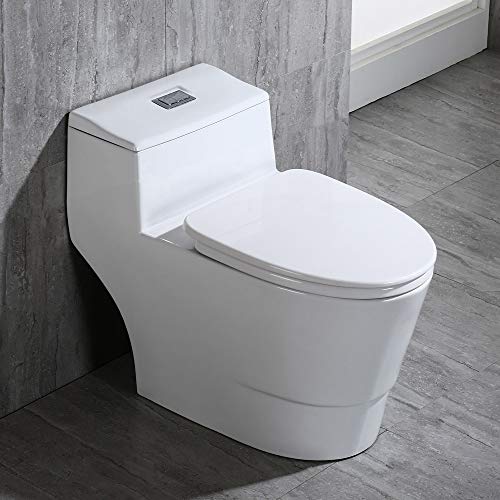
The Woodbridge T-0001 is a skirted one-piece dual flush toilet with a 2-1/8-inch fully glazed trapway, WaterSense certification, and an 800g MaP score, packaged in the seamless modern look that buyers remodeling a master bath typically want.
The skirted exterior conceals the trapway behind a smooth ceramic panel that eliminates the hard-to-clean ridges on a standard two-piece. Installation requires a few extra steps to secure the skirted base to the floor, but Woodbridge includes a detailed guide and hardware kit. Owner reviews consistently rate the T-0001 as one of the easiest skirted toilets to keep clean.
The 800g MaP score is below the 1,000g ceiling of the Aquia IV and H2Option but is still comfortably above the 600g practical minimum, and the 2-1/8-inch fully glazed trapway means the lower-volume half-flush still carries waste reliably. Replacement tower valves are available through Woodbridge's customer service and major online retailers, typically shipping within two days.
The T-0001 is the answer when the spec sheet and the design brief both need to satisfy. It clears the performance threshold that separates reliable from regrettable dual flush toilets, it looks more expensive than it costs, and the one-piece skirted format saves real time at cleaning. The 200g MaP gap versus the Aquia IV will not affect the flush experience of a normal household; the look will affect the bathroom every day.
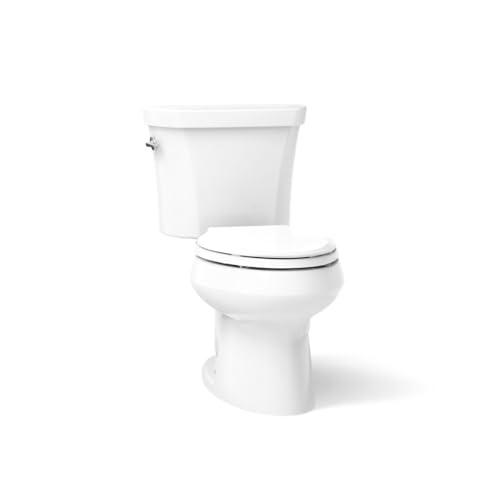
Kohler's Cimarron Comfort Height dual flush earns its spot with a perfect 1,000g MaP score, WaterSense certification, the widest nationwide parts availability of any dual flush toilet, and a 17-to-19-inch ADA-compliant bowl height that makes it a strong fit for multi-generational households.
Kohler's AquaPiston canister valve lifts straight up off the seat for an even 360-degree water release into the bowl, rather than the side-hinged flapper found on older single flush designs. This geometry produces a more uniform rim rinse, and the canister seal is sold at virtually every hardware retailer that carries Kohler products. That parts accessibility is the Cimarron's biggest practical advantage over import-brand dual flush toilets.
Owner reviews note consistent, reliable flushing over multiple years, and the comfort height option gets strong marks from older users and people with mobility concerns. For households where multiple generations share a bathroom, the combination of a top-tier flush, accessible height, and easy parts sourcing makes the Cimarron a more practical daily driver than a stylish import at the same MaP score. Our picks for best toilets for seniors: comfort height and safety explore this segment in more depth.
The Cimarron's comfort height variant is the pragmatic dual flush choice. The perfect 1,000g MaP score leaves no doubt about daily performance, the AquaPiston canister is one of the most durable and widely stocked flush valves on the market, and the ADA height removes accessibility concerns. It is not the most exciting toilet in the category, but it is the one least likely to cause a plumbing emergency or a parts-sourcing headache five years after installation.
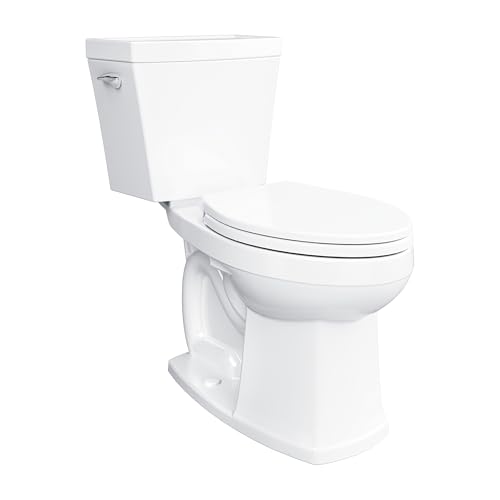
The Gerber Avalanche earns its place with a 10-year limited warranty, the longest in this roundup, WaterSense certification, a 750g MaP score that comfortably clears the performance threshold, and a reputation for durable mechanical components built to last in hard-water environments.
Gerber's 10-year limited warranty covers the toilet from glazing defects to mechanical component failures, a duration that reflects genuine confidence in the product's long-term durability. The Avalanche's 750g MaP score sits between the premium 1,000g models and the budget 600g tier, clearing the practical performance floor with room to spare.
Owner reviews from buyers in the Midwest and Southeast, where Gerber has strong regional distribution, describe reliable flushing, straightforward parts sourcing, and prompt customer service response. The Avalanche is worth strong consideration for any buyer who plans to stay in the home and wants coverage that outlasts the typical toilet warranty by a factor of ten.
Gerber is underrated in the dual flush category because the brand has less national marketing presence than TOTO or Kohler. The Avalanche's 10-year warranty, however, is a concrete statement about build quality that no amount of marketing copy can replicate. If you are installing a toilet in a home you plan to own for a decade, the warranty math alone makes the Avalanche worth at least a comparison against the more prominent names on this list.

The Swiss Madison St. Tropez is a square-profile, wall-hung-look one-piece that brings a European design aesthetic to the dual flush category, but its 600g MaP score and lack of WaterSense certification mean it works best for buyers whose priority is bathroom styling over maximum flush performance.
The 600g MaP score places the St. Tropez at the practical performance floor for a dual flush toilet recommended for purchase. It clears solid waste reliably in normal household use, but a large family bathroom with consistent heavy use would be better served by the 800g or higher models above. The full-flush at 1.28 GPF handles the majority of situations with no issues; the limitation shows up under peak demand.
Owner reviews are strongly positive on aesthetics and negative on parts sourcing, which is the pattern typical of Swiss Madison products. The square matte-white exterior photographs extremely well and consistently draws compliments in home design contexts. If the bathroom is a guest powder room or master bath with low-to-moderate daily traffic, the tradeoff against a higher MaP score is reasonable.
The St. Tropez is for buyers who want their toilet to look like a European design statement and are willing to accept the maintenance trade-off of online-only parts sourcing and a 600g MaP score. It is not the right choice for a family bathroom. It is an excellent choice for a low-traffic master bath where the aesthetic impact is actually seen and appreciated daily. Know what you are buying it for, and it delivers.
The Woodbridge T-0019 runs an ultra-low 0.8/1.0 GPF combination, making it one of the lowest full-flush volumes in the residential market, but its 500g MaP score means it is only appropriate for very light use applications where maximum water conservation outweighs performance headroom.
The 1.0 GPF full flush is genuinely impressive for water savings but demands a well-maintained, smooth drain line to compensate for the lower kinetic energy per flush event. Buyers in newer homes with 3-inch drain lines and short runs to the stack report no issues. Those with older sewer laterals or long horizontal drain runs report occasional second flushes.
The T-0019 is placed last on this list not because it is a bad product, but because the 500g MaP score requires careful matching to the right application. A powder room that sees two to three flushes per day from liquid waste only is the ideal home for this toilet. A family's primary bathroom is not.
The T-0019 makes sense when water conservation is the explicit design brief and the use case is light. Do not buy it for a heavily used bathroom and expect the same experience as the models above. Matched correctly, it delivers genuinely remarkable water efficiency. Matched incorrectly, it creates the double-flush habit that defeats the purpose of buying a water-saving toilet in the first place.
The MaP (Maximum Performance) program is run by an independent testing consortium and measures how many grams of solid waste a toilet clears per flush at its rated GPF. For dual flush toilets, MaP tests the full-flush mode. Treat 600g as the practical floor (only buy below this for powder rooms), 800g as the reliable family threshold, and 1,000g as the maximum and the score both the TOTO Aquia IV and American Standard H2Option achieve. Never rely on a listing's claim of "powerful flush" as a substitute for the actual MaP number, which you can verify at map-testing.com.
WaterSense certification from the U.S. Environmental Protection Agency confirms that the toilet's combined average flush meets the program's efficiency threshold and passed independent performance testing. Certification is also the gateway to utility rebates, which commonly range from $50 to $200 per toilet at participating utilities. A non-certified dual flush model can still be efficient, but the certification is proof the claim was verified by a third party rather than asserted by a manufacturer.
This is the single most important clog-resistance specification. Look for a trapway 2 inches or wider that is described as "fully glazed." A fully glazed ceramic surface provides low friction for waste passage; a partially glazed or unglazed surface creates drag that slows transit under the lower half-flush volume. TOTO uses a 2-1/8-inch fully glazed trapway on the Aquia IV. American Standard uses a 2-inch fully glazed design on the H2Option. Both are sufficient for reliable operation across all normal use patterns.
Before you complete any purchase, find the phrase "fully glazed trapway" on the product spec sheet or listing. If it only says "2-inch trapway" without specifying glaze type, assume it is partially glazed and significantly more clog-prone than a fully glazed design at the same dimension. This one specification predicts whether a dual flush toilet is worth buying better than any other single number.
Dual flush toilets use a canister valve or tower valve rather than a traditional gravity flapper. Kohler's AquaPiston is a canister that lifts straight up for even water distribution; TOTO's dual flush system uses a tower valve. Both work reliably, but valves and replacement seals from TOTO, Kohler and American Standard are stocked at major hardware retailers for same-day replacement. Woodbridge, Swiss Madison, and Gerber replacement components typically require an online order. If same-day repair is important, weight this factor heavily.
Elongated bowls (about 18.5 inches front to back) are more comfortable for most adults and are the dominant choice in dual flush category. Round bowls (16.5 inches) save approximately 2 inches of depth and suit tight bathrooms or smaller users. Comfort height (17 to 19 inches from floor to seat) is ADA-compliant and easier on knees for adults; standard height (15 to 17 inches) works better for shorter adults and potty-training children. For households with older adults or mobility concerns, our guide on best toilets for seniors: comfort height and safety covers the height question in detail.
Gerber's Avalanche carries the longest warranty at 10 years. American Standard's H2Option offers a lifetime warranty on the vitreous china and 5 years on mechanical components. TOTO, Kohler, and most other major brands offer 1-year limited warranties backed by established parts networks. Longer warranties signal manufacturer confidence in durability and reduce long-run ownership cost. For families who plan to stay in their home long-term, warranty duration is a meaningful differentiator in the dual flush category.
If you will only look at two specifications before buying a dual flush toilet, make them the MaP score and the trapway description. Those two numbers predict owner satisfaction more accurately than brand, price, design, or GPF rating. A 1,000g MaP score with a fully glazed 2-inch-plus trapway is a near-guarantee against the clogging and weak-flush complaints that drive most dual flush regret. Bowl shape, height, and one-piece versus two-piece format are important for comfort but will not determine whether the toilet works well over time.
You should buy one if your household has three or more regular users, you are replacing a toilet rated 1.6 GPF or higher, you live in a market with above-average combined water and sewer rates, or your utility offers a WaterSense rebate that shortens the payback period. The water savings compound fastest in these situations, and the cost math consistently favors the upgrade. For primary bathrooms in homes with daily heavy use, our picks for best toilets for home: reliable picks for daily use extend this guide with a broader view of the market.
You can reasonably skip the dual flush category if you live alone, if you are already running a modern 1.28 GPF single flush toilet, or if the absolute simplest repair experience is your top priority. In these cases the annual water savings drop below the level that repays the price premium within a reasonable time frame. A high-quality 1.28 GPF HET single flush toilet serves a single occupant just as well for less money and with simpler maintenance. See our best toilets of 2026: top picks for every bathroom for strong single flush options across all segments.
Dual flush is not the only path to efficiency. A modern 1.28 GPF single flush HET toilet approaches the same weighted average water consumption without the two-button interface. A pressure-assist design delivers more flush force but is louder, pricier to repair, and requires adequate incoming water pressure. For large households where clog resistance is the first priority, our dedicated guide on best toilets for large families (heavy use, low clog) covers designs optimized for punishment first and efficiency second.
For households of three or more people replacing a 1.6 GPF or older toilet, yes. The water savings of 4,000 to 6,000 gallons per year typically pay back the price premium within 2 to 4 years, often faster with a WaterSense utility rebate. For a single occupant already running a 1.28 GPF toilet, the savings are too small to justify the upgrade on cost alone.
Versus a 1.6 GPF single flush toilet, a 0.8/1.28 GPF dual flush model saves approximately 4,000 to 6,000 gallons per year in a four-person home, based on EPA WaterSense flush-frequency assumptions and a 0.99 GPF weighted average. Replacing a pre-1994 3.5 GPF toilet can save up to 16,500 gallons annually in the same household.
Not when they are well-built and used correctly. Clogs come from pressing the half-flush button for solid waste (it is designed for liquid only) or from buying a budget model with a narrow, unglazed trapway. A dual flush toilet with a fully glazed 2-inch-or-larger trapway and a MaP score of 800g or higher clears waste as reliably as any single flush toilet in independent MaP testing.
Treat 600g as the absolute minimum, 800g as the comfortable family-use threshold, and 1,000g as elite performance. MaP (Maximum Performance) scores for dual flush toilets reflect the full-flush mode. Both the TOTO Aquia IV and American Standard H2Option reach the 1,000g maximum. All scores are published and verifiable at map-testing.com.
By published specifications and aggregated owner reviews, the TOTO Aquia IV is the best overall: 1,000g MaP, 0.8/1.28 GPF, EPA WaterSense certified, rimless Tornado Flush bowl with CeFiONtect glaze, and a 2-1/8-inch fully glazed trapway. For buyers who need to spend less, the American Standard H2Option matches the 1,000g MaP score at a lower price and is the strongest budget alternative.
Yes, for liquid waste, which is what it is designed for. The 0.8 GPF half-flush clears liquid waste reliably on any quality dual flush bowl. Using it for solid waste is the primary cause of clogs and bowl streaking, particularly on cheaper models with partially glazed trapways. Models with large water surface areas and bowl glaze coatings resist the residue that lighter flushes can leave.
For a busy household, typically 2 to 4 years. A dual flush toilet costs roughly $100 to $200 more than a comparable single flush model, and saves $40 to $130 per year in water and sewer charges in a four-person home. A WaterSense utility rebate of $50 to $200 can compress that payback to under one year. The toilet itself lasts 15 to 25 years, so savings continue well after payback.
Yes. Conversion kits from Fluidmaster and Danco replace the existing flapper and trip lever with a dual flush valve and a two-button actuator. Kits cost significantly less than a new toilet, but the full-flush volume is limited by the existing tank size, and the bowl and trapway geometry remain unchanged, which limits performance improvement compared with a purpose-built dual flush design.
Only EPA WaterSense certified models qualify for most rebate programs. Certification requires independent performance testing and a combined-average flush that meets the program threshold. The EPA's rebate finder at epa.gov/watersense lists participating utilities by ZIP code. Rebates commonly range from $50 to $200 per toilet and can significantly shorten the payback period on a quality dual flush model.
Canister seals and O-rings on dual flush toilets typically last 5 to 7 years under normal use, with shorter lifespans in hard-water areas where mineral deposits accelerate seal degradation. A continuous trickle from the tank into the bowl after a flush has settled is the most common warning sign. Replacement seal kits from TOTO, Kohler and American Standard are inexpensive and widely available at hardware stores.
No. Gravity-fed dual flush toilets, which account for most of the North American residential market, use a siphonic flush that is as quiet as any standard gravity single flush toilet. They are significantly quieter than pressure-assist toilets, which use compressed air and produce a loud, forceful flush. If quiet operation is a priority, gravity dual flush is a good choice.
For most buyers, yes. It achieves the 1,000g MaP maximum, carries WaterSense certification, uses a rimless Tornado Flush bowl with CeFiONtect glaze that requires noticeably less cleaning than standard designs, and ships with a 2-1/8-inch fully glazed trapway. The lower cleaning burden and the TOTO parts network justify the premium compared with budget models that pair a lower MaP score with a less durable trapway design.
Yes, based on aggregated owner review data. The T-0001 earns consistently high scores for build quality, flush reliability, installation ease, and long-term durability. It posts an 800g MaP score and WaterSense certification in a skirted one-piece design that owners report as significantly easier to clean than two-piece alternatives. Its main limitation is replacement parts, which are available online but not typically stocked locally.
Yes. Gravity dual flush toilets rely on the stored water weight in the tank to generate flush force, not incoming supply pressure. They operate reliably at the normal residential range of 8 to 10 PSI or higher. Only pressure-assist toilet systems, a separate category, depend on elevated incoming pressure to charge the pressure vessel that powers the flush.
Both are equally easy for access to the flush mechanism, which lives inside the tank in either configuration. One-piece toilets like the Woodbridge T-0001 eliminate the tank-to-bowl gasket, which removes one potential leak point and makes exterior cleaning easier since there is no seam to clean around. Two-piece models like the TOTO Aquia IV are lighter to handle during installation and slightly less expensive to manufacture. Neither format has a clear maintenance advantage over the other for in-tank repairs.
The Gerber Avalanche carries a 10-year limited warranty, the longest in this roundup. American Standard's H2Option offers a lifetime warranty on the vitreous china and 5 years on mechanical parts. TOTO and Kohler typically provide 1-year limited warranties backed by extensive service and parts networks. A longer warranty signals manufacturer confidence in component durability and is particularly valuable for buyers in hard-water areas where seal wear is accelerated.
Yes, for most standard rough-in situations. A dual flush toilet swap follows the same basic sequence as any toilet replacement: shut off the supply, drain the tank, disconnect the supply line, remove the old toilet, set the new wax ring and bolt the new toilet down, reconnect supply. The one additional step is connecting the dual flush actuator button or lever, which the installation manual covers in detail. Budget 1 to 2 hours for a first-timer. Hire a plumber if the floor flange is damaged or the rough-in is a non-standard dimension.
It can on the half-flush, since less water volume means less rinsing force. Models with large water surface areas and factory-applied bowl glaze, such as TOTO's CeFiONtect coating or American Standard's VorMax surface, resist adhesion even with the lower volume half-flush. Budget models with small water surfaces and uncoated bowls are the primary sources of the streak complaint seen in negative reviews.
Not specifically. Most U.S. plumbing codes require new toilet installations to be rated at 1.6 GPF or lower, and many jurisdictions expect WaterSense-level efficiency in new construction. A dual flush toilet meets these requirements, but so does a 1.28 GPF single flush HET toilet. Dual flush is one compliant option among several, not a mandate. Check with your local building authority for jurisdiction-specific requirements.
A dual flush toilet uses stored water weight (gravity) to generate siphonic flush force, the same mechanism as a standard gravity toilet. It is quiet, requires no minimum incoming water pressure, and uses a canister or tower valve rather than a flapper. A pressure-assist toilet uses compressed air in a sealed vessel inside the tank to push water into the bowl with greater force. Pressure-assist toilets flush louder and with more power, but they cost more to repair and require adequate incoming supply pressure to charge the vessel between flushes.
Dual flush toilets are worth it for the majority of households that flush regularly and are replacing a 1.6 GPF or older model. The 4,000 to 6,000 gallon annual savings in a four-person home pays back the modest premium in 2 to 4 years, often less with a WaterSense utility rebate. The non-negotiable requirements for a good experience are a MaP score of 800g or higher on the full flush and a fully glazed trapway of at least 2 inches; everything else is comfort and aesthetics. The TOTO Aquia IV is the best overall by every published metric: 1,000g MaP, WaterSense certified, rimless Tornado Flush bowl, 2-1/8-inch fully glazed trapway. The American Standard H2Option matches that MaP ceiling at a lower price and is the best budget case. The Woodbridge T-0001 wins if a skirted one-piece look is a design requirement. Skip the category entirely if you live alone, already run a 1.28 GPF toilet, or need the simplest possible repair experience. For every other household, the math and the engineering both point the same direction. Compare all flush types in our best flushing toilets guide before you commit.
Learn why toilet trapways curve like an S, how each bend blocks sewer gas, and what the shape means for clogs and…
Read the guideAlmost every US toilet has a left-side handle. Learn the plumbing and mechanical reasons behind the layout and when it actually changes.
Read the guideHome toilets rely on tanks because household water lines lack the pressure that public flushometer systems use to flush straight from the…
Read the guide