

Toilet Drainline Carry Explained
Toilets4.6
Drainline carry measures how far solid waste travels in a pipe after one flush. Learn what the MaP test measures and why…
Read the guideRun the numbers on replacing your old toilet. With the right EPA WaterSense model, the average household saves 13,000 gallons and around $130 per year in water and sewer costs, sometimes far more.
Replacing a pre-1994 toilet (3.5 GPF or higher) with a modern 1.28 GPF WaterSense model saves the average family roughly 13,000 gallons per year. At a combined water-plus-sewer rate of $0.01 per gallon, that is about $130 annually per toilet, with most households recouping the purchase cost in two to four years.
Toilets account for approximately 24 to 31 percent of total indoor household water use, making them the single largest water consumer inside most American homes, according to EPA data. A household with older 3.5 GPF or 5 GPF toilets can flush away 18,000 to 26,000 gallons per year per toilet on flushing alone. Upgrading to a 1.28 GPF model cuts that figure by more than half without sacrificing flushing performance.
Indoor water use breaks down across several fixtures: showers, faucets, washing machines, dishwashers, and toilets. The EPA's WaterSense program has consistently shown that toilets are the dominant category. In a typical family of four, each person flushes an average of five to eight times per day, which places a 3.5 GPF toilet at 70 to 112 gallons per day for one fixture alone.
The math becomes striking when you compare toilet generations side by side. Toilets made before 1982 often used 5 gallons or more per flush. Models manufactured between 1982 and 1994 typically used 3.5 GPF. Federal legislation enacted in 1992 (the Energy Policy Act) set a maximum of 1.6 GPF for new toilets sold after January 1994. Today, the EPA's voluntary WaterSense label certifies toilets at 1.28 GPF or less, and some dual-flush models drop to 0.8 GPF on the liquid cycle.
Water utilities price both consumption and sewer treatment, and in most municipalities the sewer charge equals or exceeds the water supply charge. That means every gallon you save at the toilet cuts two line items on your bill simultaneously. Households on septic systems also benefit by reducing tank load and extending the interval between pump-outs, which can cost $300 to $600 each time.
Multiply your toilet's GPF rating by the average daily flushes per person, then by the number of household members, and finally by 365. For a family of four each flushing six times per day on a 3.5 GPF toilet: 3.5 x 6 x 4 x 365 = 30,660 gallons per year. Switching to 1.28 GPF reduces that figure to 11,213 gallons, a savings of 19,447 gallons annually from a single toilet.
Here is the full formula in plain terms:
Annual gallons used = GPF x daily flushes per person x household size x 365
And the savings formula:
Annual savings (gallons) = (Old GPF - New GPF) x daily flushes per person x household size x 365
To convert gallons saved into dollars, multiply by your combined water-plus-sewer rate per gallon. You can find this on your water utility bill. In the United States the combined rate averages roughly $0.009 to $0.013 per gallon depending on the city, but rates in drought-prone western states like California and Arizona can run $0.015 to $0.025 per gallon, making the savings significantly larger.
| Toilet Era / GPF | Gallons Per Year | vs. 1.28 GPF (savings) | Est. Annual Cost at $0.01/gal |
|---|---|---|---|
| Pre-1982 (5.0 GPF) | 43,800 | -32,587 gal saved | $438 |
| 1982-1994 (3.5 GPF) | 30,660 | -19,447 gal saved | $307 |
| Post-1994 (1.6 GPF) | 14,016 | -2,803 gal saved | $140 |
| WaterSense (1.28 GPF) | 11,213 | Baseline | $112 |
| Dual Flush (avg 1.05 GPF) | 9,198 | +2,015 gal vs 1.28 | $92 |
| Ultra HET (0.8 GPF full flush) | 7,008 | +4,205 gal vs 1.28 | $70 |
These are conservative estimates using six flushes per person per day. If your household trends toward eight flushes per person -- common with children or high-traffic guest bathrooms -- multiply the savings figures by 1.33. Multi-bathroom homes should run the calculation for each toilet separately, since each fixture compounds the overall savings.
EPA WaterSense is a voluntary certification program that labels toilets using 1.28 GPF or less while meeting minimum flush performance thresholds of 350 grams under the MaP (Maximum Performance) testing protocol. The label guarantees a toilet saves at least 20 percent more water than the federal 1.6 GPF standard without requiring performance compromises. Many utilities offer rebates of $50 to $200 specifically for WaterSense-certified toilet replacements, which can dramatically shorten the payback period.
The WaterSense label has existed since 2006, and the EPA reports that WaterSense-labeled toilets have collectively saved more than 557 billion gallons of water and approximately $5.3 billion in water and energy bills since program inception. When you see that blue WaterSense label on a toilet box, it means an independent, accredited laboratory has verified both the water use rate and the flush performance rating.
Critically, WaterSense certification does not mean weak flushing. Many certified models carry MaP scores well above the 350-gram threshold. The best flushing toilets on the market -- including the TOTO Drake II and Kohler Cimarron -- are WaterSense certified and routinely earn MaP scores of 800 to 1,000 grams, the highest rating available.
Before you buy, check whether your local water utility offers a WaterSense rebate. The EPA maintains an online rebate finder at epa.gov/watersense. Some programs in California, Texas, and the Pacific Northwest offer rebates that effectively reduce the net cost of a qualifying toilet to under $100. When you stack a utility rebate against five to ten years of water bill savings, the financial case for upgrading is usually decisive.
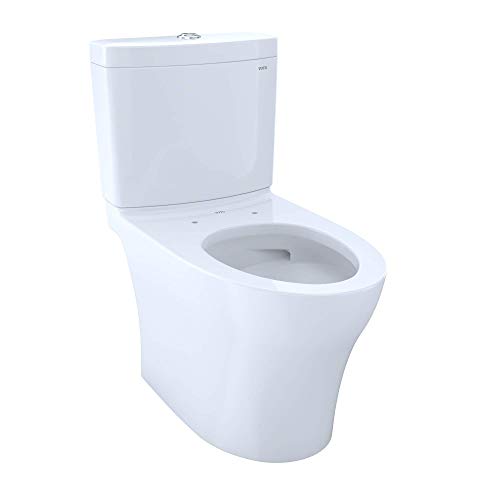
The TOTO Aquia IV leads in water efficiency among two-piece toilets, offering a dual-flush system rated at 1.0 GPF / 0.8 GPF with a MaP score of 1,000 grams on the full-flush cycle. The Kohler Cimarron at 1.28 GPF and the American Standard Cadet 3 at 1.28 GPF both earn MaP scores above 800 grams. For single-flush efficiency at 1.28 GPF, the TOTO Drake II, Gerber Viper, and Woodbridge T-0001 each deliver 1,000-gram MaP performance verified by independent testing.
Here is how the leading WaterSense models compare on GPF and MaP score, the two numbers that matter most for water efficiency without clog risk:
| Model | GPF | MaP Score (grams) | WaterSense | Flush Type | Check Price |
|---|---|---|---|---|---|
| TOTO Aquia IV | 1.0 / 0.8 dual | 1,000 | Yes | Dual flush | Check price |
| TOTO Drake II | 1.28 | 1,000 | Yes | Single flush | Check price |
| TOTO UltraMax II | 1.28 | 1,000 | Yes | Single flush | Check price |
| Kohler Cimarron | 1.28 | 1,000 | Yes | Single flush | Check price |
| Kohler Highline | 1.28 | 800 | Yes | Single flush | Check price |
| American Standard Champion 4 | 1.28 | 1,000 | Yes | Single flush | Check price |
| American Standard Cadet 3 | 1.28 | 1,000 | Yes | Single flush | Check price |
| Woodbridge T-0001 | 1.28 | 1,000 | Yes | Single flush | Check price |
| Swiss Madison St. Tropez | 1.28 | 800 | Yes | Single flush | Check price |
| Gerber Viper | 1.28 | 1,000 | Yes | Single flush | Check price |
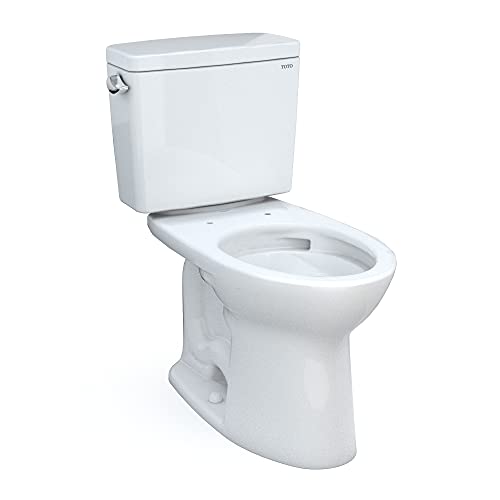
The TOTO Drake is worth a separate mention. The original Drake runs at 1.6 GPF but includes TOTO's Double Cyclone flush technology, which delivers a 1,000-gram MaP score. The Drake II improved on this with 1.28 GPF and maintained the same 1,000-gram score -- an ideal upgrade path. If you currently have a pre-2008 Drake, the Drake II offers meaningful water savings without any performance tradeoff. See our detailed TOTO toilet guide for full model breakdowns.
Payback period depends on three variables: the toilet's purchase price, the GPF of the toilet being replaced, and the local combined water-plus-sewer rate per gallon. Replacing a 3.5 GPF toilet at a $0.01 per gallon combined rate saves roughly $195 per year for a family of four; a qualifying toilet at $250 recoups its cost in about 13 months. In high-rate cities with $0.018 per gallon combined charges, payback shrinks to under eight months for the same scenario.
Use this payback calculator framework:
Annual savings (dollars) = (Old GPF - New GPF) x daily flushes x people x 365 x combined rate
Payback period (years) = Toilet cost / Annual savings
Example scenarios:
| Old Toilet GPF | Rate: $0.008/gal | Rate: $0.010/gal | Rate: $0.015/gal | Rate: $0.020/gal |
|---|---|---|---|---|
| 5.0 GPF (pre-1982) | 9 months | 7 months | 5 months | 4 months |
| 3.5 GPF (pre-1994) | 16 months | 12 months | 8 months | 6 months |
| 1.6 GPF (post-1994) | 6.3 years | 5.1 years | 3.4 years | 2.5 years |
Households replacing pre-1994 toilets almost always achieve payback in under two years, especially when a utility rebate is factored in. The math is less compelling for 1.6 GPF toilets that are otherwise functioning well -- the upgrade is worthwhile at replacement time, but there is no strong financial case to retire a functional 1.6 GPF toilet early. If you are already shopping for a low-flow toilet to replace a broken fixture, choosing 1.28 GPF over 1.6 GPF adds essentially nothing to the purchase price and reduces your annual bill meaningfully over the toilet's 20 to 30 year lifespan.
Multi-toilet homes compound savings in ways that single-fixture calculations obscure. A three-bathroom household replacing three 3.5 GPF toilets with WaterSense models can realistically cut 40,000 to 60,000 gallons per year from total water consumption. At current average rates, that equates to $400 to $600 in annual savings before rebates. Over a 10-year horizon, the three toilets effectively pay for themselves two to three times over.
You do not need a specialized tool to run this calculation. Follow these six steps:
Step 1 - Find your current toilet's GPF. Check the toilet tank lid underside or the manufacturer label inside the tank. Most toilets manufactured after 1994 print the GPF on the tank. If no label is visible, look up the model number at the manufacturer's website. For toilets without identifiable model numbers, assume 3.5 GPF for toilets installed between 1982 and 1994, and 1.6 GPF for toilets installed after January 1, 1994.
Step 2 - Count your household members. Use the total number of people who use that toilet regularly, including regular guests if applicable.
Step 3 - Estimate daily flushes per person. The EPA uses 5 flushes per person per day as a conservative benchmark; plumbing industry data from the Water Research Foundation places the figure closer to 6 to 8. Use 6 as a reasonable default for adult households, or 7 for households with children.
Step 4 - Calculate current annual gallons. Multiply: GPF x daily flushes x people x 365.
Step 5 - Calculate new annual gallons. Replace the GPF figure with 1.28 (standard WaterSense) or 1.0/0.8 (dual-flush average) and run the same formula.
Step 6 - Apply your water rate. Find your combined water-plus-sewer rate per gallon on your utility bill (divide the total charge by total gallons used). Multiply the gallon savings by this rate. This is your estimated annual dollar savings per toilet.
For a household of four adults flushing a 3.5 GPF toilet six times each per day, in a city with a $0.012 combined rate:
That household recoups a $250 toilet in 13 months, before any utility rebate. With a $100 rebate, payback drops to six months.
Running toilets invalidate these calculations dramatically. A toilet with a leaking flapper can waste 200 gallons per day, equivalent to an extra 73,000 gallons annually -- far more than any GPF improvement can offset. Before calculating upgrade savings, perform a dye test: drop a dye tablet or a few drops of food coloring into the tank, wait 15 minutes without flushing, and check whether color appears in the bowl. If it does, a $10 flapper replacement should be your first water-saving move. Read our guide to fixing a running toilet for step-by-step instructions.
In controlled usage assumptions, dual-flush toilets can save more water than single-flush 1.28 GPF models, but real-world savings depend heavily on how consistently users engage the reduced-flush button. Studies from the Water Research Foundation found that 40 to 60 percent of dual-flush users in North American homes default to the full flush for all waste types, effectively using them as single-flush toilets. Households where all members actively use both buttons correctly can reduce average flush consumption to 0.9 to 1.05 GPF, saving an additional 1,000 to 2,000 gallons per year versus a standard 1.28 GPF model.
The TOTO Aquia IV represents the strongest case for dual flush: it operates at 1.0 GPF on the full cycle and 0.8 GPF on the liquid cycle, both of which meet WaterSense standards. More importantly, it achieves a 1,000-gram MaP score on the full-flush cycle, meaning there is no performance penalty for using the lower volume setting appropriately.
Other models to evaluate for dual-flush performance include the American Standard H2Option and the Woodbridge T-0001. Both carry WaterSense certification and earn strong MaP scores. See our best dual-flush toilets guide for a complete breakdown of dual-flush options by MaP performance and water savings.
For households who are uncertain whether they will use dual-flush buttons consistently, a 1.28 GPF single-flush model from TOTO, Kohler, or American Standard is a better choice. The certainty of 1.28 GPF per flush is more predictable than the average consumption of a poorly-used dual-flush system.
The financial case for upgrading to a water-efficient toilet is straightforward, but the environmental case extends further. Water treatment facilities require energy to purify municipal water before it reaches homes, and wastewater treatment requires additional energy after it leaves. According to the EPA, approximately 3 percent of U.S. electricity consumption goes toward pumping and treating water and wastewater. Every gallon conserved at the toilet reduces demand on both systems.
For households on private wells, each flush requires the well pump to cycle, consuming electricity. A 3.5 GPF toilet flushed six times per day by four people runs the pump approximately 25 times daily, at roughly 0.75 kWh per day for a typical 3/4 HP shallow-well pump. Replacing that toilet with a 1.28 GPF model reduces pump cycles by roughly 60 percent, saving approximately $15 to $25 in annual electricity costs above and beyond the water savings calculation.
Households on septic systems gain another benefit: lower flush volume reduces hydraulic loading on the septic tank and drain field. Overloaded drain fields are the primary cause of septic system failure, with repair costs ranging from $3,000 to $20,000. While it is difficult to attribute septic failure to a single fixture, water conservation across the household clearly extends system life and reduces pump-out frequency.
The EPA's WaterSense program estimates that if every American home replaced its older toilets with WaterSense models, the country would save 360 billion gallons of water annually -- equivalent to the water supply of 3.6 million people for a full year.
Water conservation at the toilet compounds meaningfully in drought-affected regions. States like California, Arizona, Nevada, and Texas face tiered water pricing in many municipalities, where consumption above a baseline threshold is charged at progressively higher rates. Households already in a higher tier benefit not only from the savings on each flush but from potentially dropping into a lower pricing tier, creating a multiplier effect on their total utility savings.
Several reliable identification methods exist when no label is visible:
Tank volume method: Turn off the water supply valve behind the toilet. Flush to empty the tank. Use a measured container to refill the tank to its normal water line and record the volume. This is your actual flush volume -- an accurate alternative to the nameplate GPF.
Date code method: Most toilet tanks have a date stamp molded into the porcelain, typically on the underside of the tank lid or on the back inner wall of the tank. If the date is 1982 or earlier, assume 5 GPF. 1982 to 1993 = 3.5 GPF. 1994 or later = likely 1.6 GPF unless it has a WaterSense label.
Model number lookup: The model number is usually stamped into the porcelain inside the tank. Enter it at the brand's website or at MaP's publicly available database at map-testing.com to find the rated GPF and MaP score.
Visual inspection: Toilets from before 1982 typically have large, wide tanks. If your tank is notably bulkier than modern toilets, it is almost certainly a 3.5 GPF or 5 GPF model, and replacement will yield substantial savings.
Once you know your current GPF, run the calculation from Step 4 above. If the annual savings figure exceeds $50 and the toilet is more than 15 years old or showing signs of wear -- recurring clogs, running water, cracked porcelain -- replacement is financially and practically sensible. Our toilet lifespan guide covers the signs that a toilet is due for replacement in detail.
A 1.28 GPF WaterSense toilet used by four people flushing six times each uses approximately 30.7 gallons per day. An older 3.5 GPF toilet used the same way consumes about 84 gallons per day. Pre-1982 toilets at 5 GPF can exceed 120 gallons per day for the same household.
GPF stands for gallons per flush. It is the single most important water efficiency metric for a toilet. Federal law caps new toilets at 1.6 GPF; EPA WaterSense requires 1.28 GPF or less. Lower GPF directly reduces water consumption on every flush for the life of the toilet.
Not with a well-designed model. Clogging is primarily a function of trapway diameter, flush velocity, and bowl shape, not GPF alone. Models like the American Standard Champion 4 at 1.28 GPF and the TOTO Drake II at 1.28 GPF both achieve 1,000-gram MaP scores, outperforming many older 1.6 GPF toilets on clog resistance.
EPA WaterSense data indicates that replacing a pre-1994 toilet with a certified 1.28 GPF model saves the average household approximately 13,000 gallons per year. At a combined water-sewer rate of $0.010 per gallon, that is about $130 annually per toilet. Households with high-rate utilities or multiple old toilets can save $300 to $600 per year total.
MaP (Maximum Performance) scores measure how many grams of solid waste a toilet can clear in a single flush. Scores range from 250 grams (barely adequate) to 1,000 grams (maximum, called MaP Premium). A toilet can be both water-efficient (1.28 GPF) and high-performing (1,000 grams) -- the two metrics are independent. Always look for both when evaluating a new toilet.
The vast majority of utility rebate programs require EPA WaterSense certification. Some programs require specific MaP score minimums (typically 500 to 800 grams) as well. Check the EPA's rebate finder at epa.gov/watersense/rebate-finder before purchasing to confirm your qualifying models and rebate amounts.
Yes, most two-piece and one-piece gravity-flush toilet replacements are DIY-friendly for someone comfortable with basic plumbing. The job requires shutting off the supply valve, draining the tank and bowl, unbolting the old toilet, replacing the wax ring, setting the new toilet, and reconnecting the supply line. Most installations take one to three hours. Wall-hung and pressure-assist toilets are more complex and often benefit from professional installation.
WaterSense toilets at 1.28 GPF are available at essentially all price points, from under $150 for basic two-piece models to several thousand dollars for smart toilets. There is no meaningful price premium for the 1.28 GPF rating versus 1.6 GPF at equivalent quality tiers. The federal 1.6 GPF maximum is considered the baseline; most new toilets at any price point now carry WaterSense certification.
In theory, yes; in practice, it depends on user behavior. Dual-flush toilets achieve maximum savings only when users consistently engage the reduced-flush button for liquid waste. Research from the Water Research Foundation found that many households do not use both flush modes consistently, reducing real-world savings to levels similar to a single-flush 1.28 GPF model. For households committed to using both modes, a dual-flush model like the TOTO Aquia IV or American Standard H2Option offers superior water savings.
Check the inside of the tank for a date stamp on the porcelain -- toilets made before 1982 are typically 5 GPF, 1982 to 1993 models are 3.5 GPF, and post-1994 models are 1.6 GPF unless WaterSense-certified at 1.28 GPF. You can also shut off the supply valve, flush to drain the tank, and measure how many gallons it takes to refill to the water line using a measuring container.
Several 0.8 GPF ultra-high-efficiency toilets are available and WaterSense-certified, including certain dual-flush models on their reduced-flush cycle. The challenge is that 0.8 GPF toilets with high MaP scores are less common -- the TOTO Aquia IV's 0.8 GPF reduced cycle is rated for liquid waste only; its full-flush cycle at 1.0 GPF achieves 1,000 grams. Standalone 0.8 GPF single-flush toilets with strong MaP scores exist but are a niche category.
Yes. In most municipalities, sewer charges are calculated as a percentage of metered water consumption or as a separate per-gallon rate tied to usage. Reducing water consumption by 10,000 to 20,000 gallons per year per toilet reduces both line items simultaneously, effectively doubling the savings compared to water cost alone.
Yes, often more so than metered water customers. Lower flush volume reduces hydraulic loading on the septic tank and drain field, extending system life, reducing pump-out frequency, and lowering the risk of drain field failure. Each pump-out avoided saves $300 to $600; extending drain field life by even a few years can prevent repair costs of $3,000 or more.
The 13,000-gallon estimate is based on the average American household of 2.53 people replacing a pre-1994 toilet and using the new 1.28 GPF model for all flushes. Larger households and households with more old toilets will see larger savings; smaller households or those replacing 1.6 GPF models will see less. The figure is a credible national average but should be adjusted for your specific household size and existing GPF.
Only the rated GPF matters for per-flush water consumption. Tank size is engineered to deliver the correct volume for a proper flush at the rated GPF. A toilet with a physically larger tank may fill to a higher water line but uses the same GPF per flush if that is its rated specification -- the overflow tube height and flapper design control how much water is released, not tank capacity alone.
Quality gravity-flush toilets from brands like TOTO, Kohler, American Standard, and Gerber routinely last 20 to 30 years with normal maintenance. Over a 25-year lifespan, a toilet saving 13,000 gallons per year accumulates 325,000 gallons in total water savings per fixture. At $0.010 per gallon, that is $3,250 in savings over the toilet's life, far exceeding the purchase price of most mid-range models.
No. Water consumption is determined by the rated GPF, not by whether the toilet is one-piece or two-piece. Both styles are available at 1.28 GPF with WaterSense certification. The choice between one-piece and two-piece involves cost, installation ease, cleaning convenience, and aesthetics -- not water efficiency.
Aftermarket tank inserts (displacement bags or fill cycle diverters) can reduce water per flush by 0.5 to 1.0 gallons in older high-GPF toilets, but they often impair flush performance and can cause repeated flushing, negating the savings. Modern fill valve replacements such as the Fluidmaster 400A allow precise adjustment of the water level, but the maximum useful reduction without flushing problems depends heavily on the existing toilet's bowl geometry and trapway. A proper WaterSense toilet replacement is almost always more reliable long-term.
TOTO, Kohler, American Standard, and Gerber consistently lead on both metrics. TOTO's Double Cyclone technology and Kohler's AquaPiston flush valve both achieve 1.28 GPF with 1,000-gram MaP performance. American Standard's PowerWash rim design achieves the same. Woodbridge and Swiss Madison offer WaterSense models at budget price points with MaP scores typically between 800 and 1,000 grams.
The financial answer depends on your water rate. At $0.01 per gallon combined rate, replacing a functioning 1.6 GPF toilet saves about $28 per year for a family of four -- a five to ten year payback on a $150 to $250 toilet. At $0.018 per gallon (common in western states), savings jump to $50 per year and payback shrinks to three to five years. Unless your rate is high or you are doing a bathroom renovation anyway, waiting until the 1.6 GPF toilet needs replacement is a reasonable financial choice.
The numbers are unambiguous: replacing a pre-1994 toilet with a WaterSense-certified 1.28 GPF model is one of the fastest-payback home upgrades available, with most households recovering the purchase cost in 12 to 24 months from water and sewer bill reductions. Models like the TOTO Drake II, TOTO Aquia IV, Kohler Cimarron, American Standard Cadet 3, and Woodbridge T-0001 all deliver the rare combination of maximum water efficiency (1.28 GPF or less) and maximum MaP flush performance (1,000 grams). Run the household calculation in Step 4 above, check your utility's rebate program, and the financially and environmentally correct choice becomes clear.
Drainline carry measures how far solid waste travels in a pipe after one flush. Learn what the MaP test measures and why…
Read the guideToilet floor bolts spinning instead of tightening usually means a broken flange or stripped nut. Here is how to diagnose it and…
Read the guideShould tile run under the toilet or stop at the flange? Learn the right order, why it matters for leaks, and how…
Read the guide