Why Toilet Trapways Are Curved Like an S
Toilets4.6
Learn why toilet trapways curve like an S, how each bend blocks sewer gas, and what the shape means for clogs and…
Read the guideWhether you need a composting unit for a permanent off-grid cabin, a portable chemical toilet for camping weekends, a bucket-flush unit for a construction site, or a self-contained system for a tiny house or backyard structure, finding the right outdoor toilet comes down to waste-handling method, capacity, odor control, local code compliance, and how far the unit sits from any electricity or water supply. This guide covers the best outdoor toilet options across all five major categories, rated by published specs, manufacturer capacity ratings, NSF certifications, and aggregated long-term owner reports.
For a permanent outdoor structure such as a cabin or backyard ADU, the Nature's Head Self-Contained Composting Toilet is the best choice: zero water use, 12V fan, proven five-year reliability, and odor-free performance for two people over a four-to-six week solids cycle. For portable or camping use, the Camco 41541 Portable Travel Toilet offers a reliable 5.3-gallon holding tank and a piston pump flush that empties cleanly at any dump station.
Outdoor toilets cover an unusually wide range of applications and technologies. A composting toilet installed in a permanent off-grid cabin operates on completely different principles from a portable chemical toilet used for weekend camping, and neither shares much with a bucket-flush portable toilet set up for a construction crew. Understanding which category fits your situation is the first decision, because switching technologies mid-project is expensive.
We do not test these units in our own facility. We compare manufacturer-published specifications, NSF/ANSI 41 certification records, EPA WaterSense status where applicable, local code compliance data, and the patterns that emerge from aggregated long-term owner reviews across thousands of reports. For a standard indoor gravity-flush or pressure-assist toilet, see our guide to the best flushing toilets. For those who need a completely waterless solution because no sewer, septic, or water supply is available, read on.
| Toilet | Type | Capacity | Power Needed | NSF/ANSI 41 | Rating |
|---|---|---|---|---|---|
| Nature's Head Self-Contained | Composting | 1-2 people | 12V DC | Yes | 4.6 |
| Separett Villa 9215 AC/DC | Composting | 3-4 people | 12V / 120V | Yes | 4.5 |
| Sun-Mar Excel Non-Electric | Composting | 3 people / seasonal | None | Yes | 4.4 |
| Camco 41541 Portable Travel Toilet | Portable chemical | 5.3-gal tank | None | No | 4.5 |
| Thetford Porta Potti 565E | Portable chemical | 4.0-gal tank | Electric flush | No | 4.4 |
| OGO Origin Composting Toilet | Composting | 1-2 people | 12V DC | No | 4.3 |
| Reliance Products Luggable Loo | Bucket / emergency | 5-gal bucket | None | No | 4.2 |
| Air Head Composting Toilet | Composting | 1-2 people | 12V DC | No | 4.3 |
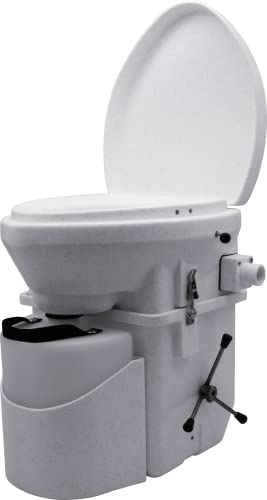
Nature's Head is the composting toilet with the longest and most consistent track record across off-grid cabins, sailboats, and tiny houses, with a urine-diverting design that addresses the root cause of odor rather than masking it with chemicals.
The urine-diverting design is the key mechanism: a shaped seat directs liquid waste forward into a 2.2-gallon bottle and solid waste rearward into the main composting chamber. Keeping those two streams completely separate prevents the anaerobic bacterial activity that causes odor in any mixed-waste system. The spider-handle crank on the side of the housing stirs the solids chamber and mixes in the peat or coco coir bulking medium you add after each solid use. A 12V fan runs continuously, drawing fresh air through the chamber and exhausting through a 2-inch vent hose, maintaining aerobic conditions that decompose material and keep the mass dry.
Aggregated long-term owner reports from cabin and van users consistently describe two to four years of odor-free service when the vent exits correctly and bulking medium is added consistently. The urine bottle needs emptying every two to three days for a couple. The solids chamber runs four to six weeks before the dry, reduced-volume compost is ready to empty into a trash bag or designated compost pile. At higher occupancy those cycles compress substantially, which is the main reason this unit fits one-to-two person households better than it fits families of three or more.
Nature's Head remains the default recommendation for outdoor structures for a practical reason: its failure mode is always visible and always fixable within two minutes. Odor nearly always traces back to insufficient bulking medium, a kinked vent hose, or an overfull liquid bottle. Competing designs that automate mixing or tumbling can fail in ways that are harder to diagnose far from a hardware store.

The Separett Villa 9215 is the composting toilet most comparable to a conventional indoor bathroom fixture in terms of daily use experience, with a rotating drum container system that eliminates the need to add bulking medium or operate any hand crank.
Separett, a Swedish manufacturer with a composting toilet history dating to 1976, designed the Villa 9215 around a rotating drum that holds biodegradable liner bags. When a bag fills, you rotate the drum to expose a fresh bag without handling the waste directly. A 4-inch ventilation fan maintains continuous negative air pressure through a dedicated vent line, and urine is piped to a separate exterior connection rather than stored in an onboard bottle. NSF/ANSI 41 certification means the unit meets the independent sanitation standard that most U.S. permitting authorities require before approving a non-flushing toilet installation in a permanent structure.
Long-term owner reports from off-grid families describe essentially zero odor events when the vent is correctly sized and the urine drain is freely flowing. The rotating drum design is the key operational advantage over units requiring manual agitation: daily use requires nothing more than sitting down and closing the lid. Maintenance consists of rotating the drum when a bag fills, which happens approximately weekly for a family of three or four. The tradeoff is a larger footprint and higher cost versus self-contained units, making it the right choice for outdoor bathrooms in dedicated structures rather than compact installations.
For an outdoor bathroom serving three or more people at a cabin or off-grid home, the Separett Villa 9215 is the most practical recommendation because its continuous-use design rating holds up under the kind of regular family use that overloads most self-contained composting units within weeks.
The Sun-Mar Excel is the most-recommended composting toilet for installations with no electrical supply at all, using a bio-drum tumbler, natural convection ventilation through a 4-inch stack vent, and an evaporating chamber to handle moisture without any fan or heating element.
Sun-Mar's Excel uses a three-chamber system: the bio-drum (a rotating cylinder in the center) handles active composting, a finishing drawer below handles the final breakdown phase, and an evaporation chamber processes liquid. Ventilation relies entirely on natural convection through a 4-inch stack vent that must extend vertically above roofline for adequate draw. Rotating the bio-drum handle a few turns after each use mixes material and introduces air, replicating what a 12V fan does electrically in other designs through manual action and thermal convection instead.
NSF/ANSI 41 certification covers the Excel for most U.S. jurisdictions that allow non-flushing toilets in permanent structures. Owner reports from seasonal cabin users are generally positive, with the common caveat that the unit underperforms in high-humidity environments where the stack vent does not generate sufficient draw to evaporate liquid waste. In those situations, a supplemental 12V fan added to the vent stack resolves the issue. For truly off-grid locations with no power at all, this is the most capable non-electric composting toilet available.
The Sun-Mar Excel earns its NSF/ANSI 41 rating and its recommendation specifically because it offers the same certification and capacity as electric models without requiring any power source. In a remote location where running even a small 12V solar panel is impractical, this is the starting point of the search.
The Camco 41541 is the top-rated portable chemical toilet in its class by aggregated owner reviews, offering a 5.3-gallon lower waste tank, a piston-pump flush mechanism that delivers a consistent spray with every stroke, and a rotating dump spout that empties cleanly at any RV dump station or standard toilet.
The Camco 41541 operates on the same principle as all Porta Potti-style chemical toilets: a fresh-water upper tank supplies a manual-pump flush that rinses the bowl and pushes waste through a sealed valve into the lower holding tank, where chemical deodorant tablets or fluid suppress odor and begin breaking down solids. The rotating dump spout on the lower tank makes emptying straightforward: you twist the spout to unlock, connect it to a dump station port or hold it over a full-size toilet, and the gravity-drain empties cleanly with no hand contact with waste.
A 5.3-gallon lower tank handles approximately 50 to 55 uses before it needs emptying, which typically translates to a long weekend for a couple or family of four. Chemical tablets rated for the Camco platform are widely available at outdoor and RV supply retailers. The seat height matches a standard household toilet seat, which owners frequently cite as a comfort advantage over lower-profile competing units. For purely portable outdoor use with no permanent installation requirement, this is the most consistently recommended option in its category.
The Camco 41541 succeeds where cheaper portable toilets fail because its piston pump delivers enough water volume to actually rinse the bowl rather than just dribbling. That one mechanical difference explains most of the gap between a 4.5-star portable toilet and a 3.2-star one, and it matters enormously on a weekend trip when you cannot rinse with a hose.

The Thetford Porta Potti 565E upgrades the portable chemical toilet formula with a battery-powered electric flush that delivers a stronger, more consistent rinse than any manual pump, making it the preferred choice for outdoor events and locations where comfort is a priority.
Thetford's Porta Potti line has dominated the portable toilet segment for decades, and the 565E is the model that justifies that reputation with a design upgrade that matters: the electric flush motor runs from four standard AA batteries and lasts through several hundred flushes per set, while producing a consistent bowl-rinse volume that piston pumps only approximate when operated with exactly the right stroke count. The sliding cover on the bowl seat, a Thetford trademark feature, contains odor between uses in a way that open-bowl portable toilets do not.
The lower 4.0-gallon tank is slightly smaller than the Camco 41541's 5.3 gallons, but owner reports consistently show the Thetford 565E is chosen for situations where user comfort and ease of operation outweigh raw tank capacity. For an outdoor event where guests unfamiliar with portable toilets will be using the facility, an electric flush removes any confusion about how to operate the rinse mechanism. The dump spout design and sealing valve match the quality of Thetford's RV toilet line, and replacement chemical cartridges are stocked at most outdoor retailers.
The electric flush on the 565E is not a gimmick. For outdoor events where you will hand the portable toilet to guests who have never used one, eliminating the "how do we flush this?" question is worth the battery overhead and the slightly smaller tank.
The OGO Origin is a urine-diverting composting toilet with a modern enclosed design, a built-in agitator motor, and one of the smallest footprints in its category, making it popular for van builds and compact outdoor shower structures where the Nature's Head's bulk is prohibitive.
The OGO Origin separates liquid and solid waste with a shaped urine-diverting seat similar to the Nature's Head but adds an electric agitator motor rather than a manual spider handle, so the solids chamber mixes itself automatically after each use when the lid is closed. The enclosed housing is more aesthetically finished than most composting toilets, which matters in a van or tiny structure where the toilet is in the living space rather than a dedicated bathroom.
The absence of NSF/ANSI 41 certification is a practical limitation for permanent structures in jurisdictions that require it for permit approval. For non-permitted outdoor structures, small sheds, vans, and boats, that restriction does not apply, and the OGO Origin's compact footprint and automated agitator are genuine advantages over older manual designs. Owners report that the electric agitator noticeably reduces the effort required to maintain the composting cycle versus manual designs, particularly useful in installations where the toilet is accessed frequently.
If the primary barrier to installing a composting toilet in a van or compact outdoor shed is the size and industrial look of the Nature's Head, the OGO Origin resolves both objections without sacrificing the urine-diverting principle that makes composting toilets odor-free.
The Reliance Products Luggable Loo is a snap-on toilet seat and lid kit that converts a standard 5-gallon bucket into a functional outdoor or emergency toilet, with waste managed through biodegradable bag liners or standard chemical treatment.
The Luggable Loo seat snaps onto any standard-diameter 5-gallon bucket and provides a seat and lid that make the bucket functional as a toilet. Used with waste-specific bag liners that contain a solidifying powder (sold separately by Reliance and other brands), it provides a complete emergency or short-term outdoor solution that weighs under two pounds including the lid, stores flat when not in use, and requires no chemicals, no power, and no dump station for disposal.
Owner ratings are high in the context of what the product is: a backup or emergency sanitation solution that costs a fraction of any dedicated portable toilet. The seat is rated to 300 lbs. For hunting camps, construction sites, power-outage emergency kits, and one-off remote events where budget is the primary constraint, the Luggable Loo satisfies the minimum requirement at minimum cost. It is not a substitute for a dedicated portable toilet in any situation where odor control or multiple flushes per day are required.
Every emergency preparedness kit and hunting camp first-aid box should have a Luggable Loo. It takes five seconds to set up, handles solid and liquid waste without any mechanical components to fail, and weighs nothing in a pack. It is the lowest-tech solution, and for short-term emergencies that is exactly what you want.
The Air Head composting toilet is a US-manufactured urine-diverting unit built specifically for the dimensional constraints of sailboat heads and van conversions, with a compact profile, a 12V fan, and a five-year warranty that matches Nature's Head on the metrics that matter most for mobile outdoor installations.
The Air Head is dimensionally similar to the Nature's Head but with a slightly lower profile designed around the headroom constraints of boat heads and van bathroom areas. The urine-diverting seat and liquid bottle arrangement follows the same principle as Nature's Head: liquid forward, solids rearward, and a 12V fan venting the solids chamber through a 1.5-inch vent hose. The solids chamber uses coconut coir as the standard bulking medium, which the manufacturer supplies in pre-measured bags.
Owner reports from sailors and van lifers describe performance comparable to Nature's Head when maintained correctly, with the specific advantage that the Air Head's lower profile fits installations where Nature's Head would be too tall. The five-year warranty on all components matches the Nature's Head warranty and stands out in a category where most Chinese-manufactured competitors warranty parts for one year or less. NSF/ANSI 41 certification is not listed for the Air Head, which is a consideration for land-based permanent installations but irrelevant for marine and vehicle applications.
Between Nature's Head and Air Head, the right choice is dimensional: measure the available height in your installation before ordering either unit. If both fit, Nature's Head has the longer owner-review track record. If headroom is tight, Air Head is the established alternative with equivalent warranty coverage and a US manufacturing base.
A composting toilet uses aerobic decomposition to break down solid waste into a dry, reduced-volume material inside the unit itself, requiring no chemicals and no regular emptying at a dump station. A portable chemical toilet stores waste in a sealed holding tank with chemical deodorant fluid and must be emptied at a dump station or toilet, typically after 50 to 100 uses.
Composting toilets are suited to permanent or semi-permanent outdoor structures because they generate no holding-tank waste requiring off-site disposal. Portable chemical toilets are better for short-term, mobile, or event use where a dump station is accessible and the simplicity of a self-contained unit outweighs the need to manage decomposition.
Most composting toilets require no water at all. They are entirely waterless, using urine diversion, bulking medium (peat or coconut coir), and aeration to manage waste without any plumbing connection. Electricity requirements vary: units such as the Nature's Head and Separett Villa 9215 use a small 12V DC fan drawing under 0.5 amps to maintain airflow through the solids chamber, while the Sun-Mar Excel uses natural convection through a passive stack vent and requires no electricity whatsoever.
For outdoor structures with solar power, the 12V fan draw is negligible. For installations with absolutely no power access, the Sun-Mar Excel Non-Electric or a manual-agitation urine-diverting unit operated without a fan are the appropriate choices.
Legality depends entirely on local jurisdiction. In the United States, NSF/ANSI 41 certification is the most widely recognized standard for composting toilet acceptance by state and local health departments, though some jurisdictions have additional requirements or outright prohibitions. Approximately 30 U.S. states formally accept NSF/ANSI 41-certified composting toilets for permitted permanent installations when installed according to manufacturer specifications.
Units including the Nature's Head Self-Contained, Separett Villa 9215, and Sun-Mar Excel carry NSF/ANSI 41 certification, while the OGO Origin and Air Head do not, limiting their legal use in permanent permitted structures in most jurisdictions. Always verify current local code requirements before purchasing for a permanent outdoor structure.
For a urine-diverting composting toilet used by two people, the liquid bottle typically needs emptying every two to four days, while the solids chamber goes four to eight weeks between empties. The solids, once properly composted, are dry and reduced substantially in volume, making disposal straightforward in most cases. Systems using biodegradable liner bags, such as the Separett Villa 9215, simply require bag rotation approximately weekly for a family of three or four.
Non-electric tumbling composting toilets like the Sun-Mar Excel have a finishing drawer that is typically emptied once or twice per season for seasonal-use cabins. Portable chemical toilets with a holding tank need emptying more frequently, typically every 50 to 100 uses or after two to four days for a couple, depending on tank size.
For a cabin or accessory dwelling unit with no sewer or septic connection, a urine-diverting composting toilet with NSF/ANSI 41 certification is the most practical and code-compliant choice. The Nature's Head is the best option for one or two occupants, the Separett Villa 9215 is better for three or four. Both are fully waterless, require no drain connection, and carry NSF/ANSI 41 certification that most state health departments accept for permanent installation approval.
If the structure also lacks electricity, the Sun-Mar Excel Non-Electric is the appropriate alternative, using natural convection ventilation and a manual bio-drum tumbler instead of a 12V fan. All three models have multi-year owner-review track records supporting their real-world performance claims.
The single most common mistake in outdoor toilet selection is treating all composting toilets as equivalent to portable chemical toilets. They are fundamentally different products solving different problems. A composting toilet is a permanent-installation appliance that requires ventilation planning, site-specific positioning, and local code research. A portable chemical toilet is a self-contained short-term unit that requires only a dump station for waste disposal. Choosing the wrong category usually means spending significantly more than necessary or buying a product that does not meet local code requirements for the intended use.
Five variables determine which outdoor toilet category and model is right for your situation.
1. Permanence of installation. For a permanent structure such as a cabin, backyard ADU, or seasonal cottage, a composting toilet with NSF/ANSI 41 certification is the appropriate technology. For temporary, event, or camping use, a portable chemical toilet is simpler and requires no installation. For the comparison between one-piece and two-piece designs in conventional indoor plumbing, see our best one-piece toilets guide.
2. Occupancy and use frequency. Self-contained urine-diverting composting toilets such as the Nature's Head and Air Head are rated for one to two people at full-time use. Central or split composting systems, or larger units such as the Separett Villa 9215, handle three to four people continuously. Portable chemical toilets are sized by tank volume: a 5-gallon tank handles approximately 50 uses before emptying, which suits a couple for a weekend.
3. Electricity availability. Most composting toilets use a 12V DC fan drawing under 0.5 amps. A small solar panel and battery bank handles this load easily. For installations with no power at all, the Sun-Mar Excel Non-Electric or passive-vent units eliminate the electrical requirement. Portable chemical toilets require no power unless you choose the Thetford 565E electric-flush model.
4. Local code compliance. NSF/ANSI 41 certification is the standard required by most U.S. jurisdictions for composting toilet approval in permanent structures. Verify with your local health department before purchasing. Nature's Head, Separett Villa 9215, and Sun-Mar Excel all carry this certification. The OGO Origin and Air Head do not, limiting legal use in permanent permitted buildings.
5. Maintenance tolerance. Composting toilets require consistent maintenance: adding bulking medium after each solid use, emptying the liquid bottle every few days, and periodically emptying the solids chamber. Portable chemical toilets require chemical treatment and tank emptying at a dump station. The Luggable Loo requires only bag disposal. Be honest about the maintenance you will actually perform before choosing a composting system, because neglected composting toilets develop odor problems that basic maintenance prevents entirely.
For those choosing between a standard gravity-flush indoor toilet and a high-efficiency indoor model, our comparison of best low-flow toilets covers EPA WaterSense-certified models that use 1.28 GPF or less. The EPA WaterSense program certifies toilets that meet both the 1.28 GPF efficiency threshold and a 350-gram or higher MaP flush-performance score, ensuring that water savings do not come at the expense of flushing power. For outdoor and off-grid applications, WaterSense certification is not relevant because composting toilets use zero water by design.
One factor that owner reviews consistently underweight when rating composting toilets is vent hose installation quality. A well-maintained Nature's Head with a poorly installed or kinked vent hose will generate odor. The same unit with a straight, properly pitched vent exiting above roofline will be odor-free for years. More odor complaints from composting toilet owners trace back to incorrect vent installation than to any product defect. Review the manufacturer vent specifications before installation, not after an odor problem appears.
For buyers interested in how EPA WaterSense and MaP testing scores apply to standard indoor flush toilets, our best EPA WaterSense toilets guide covers the full certification requirements and lists tested models with verified MaP scores. Outdoor composting toilet buyers do not interact with those certification systems, but the underlying plumbing principles connecting trapway design to flush efficiency are covered in our best no-clog toilets guide for reference on standard flush systems.
Composting activity slows significantly below 55 degrees Fahrenheit because the microbial decomposition process is temperature-dependent. In cold climates, composting toilets used in uninsulated outdoor structures may slow their decomposition cycle without fully stopping. The unit remains functional for waste containment, but the solids may not break down as quickly. Most manufacturers recommend insulating the installation space or adding a small heat source in climates with sustained freezing temperatures.
The end product from a properly maintained composting toilet is a dry, significantly reduced-volume material that resembles potting soil. Most local codes classify it as safe for disposal in a designated compost pile rather than a garden bed directly in contact with edible plants. Check your local regulations: some jurisdictions require it to be bagged for trash disposal, while others allow garden use after a secondary composting period.
Portable chemical toilets produce minimal odor when the holding tank contains adequate chemical deodorant fluid and the valve between the bowl and tank seals properly. The primary odor events occur when the tank is overfull, when the bowl valve fails to close completely, or when insufficient chemical was used. Emptying the tank before it reaches capacity and checking the bowl valve seal are the two maintenance steps that prevent most portable toilet odor problems.
Separate the lower holding tank from the upper fresh-water tank by releasing the locking clips. Carry the lower tank to an RV dump station, campground dump point, or home toilet. Open the rotating dump spout, position it over the drain, and gravity-drain the contents. Rinse the tank with clean water through the dump spout before closing. Add fresh chemical deodorant to the tank before reattaching the upper section.
Coconut coir (coco coir) is the most widely recommended bulking medium because it is pH-neutral, absorbs moisture efficiently, and decomposes slowly enough to remain effective throughout the composting cycle. Peat moss is the traditional alternative and works equivalently but has sustainability concerns that make coco coir the more common recommendation. Sawdust from untreated wood is an effective low-cost substitute. Avoid garden soil, which compacts and reduces aeration.
Yes. The urine-diverting seat in units like Nature's Head and Air Head is designed for use by both sexes. The shaped front of the seat directs urine forward regardless of seated posture. Manufacturer literature and owner reviews from mixed-gender households confirm that the diversion mechanism functions correctly for women when the seat is properly positioned and the forward urine funnel is clean.
The Nature's Head fan draws 0.17 amps at 12V DC, which is approximately 2 watts continuously. Over 24 hours, that is about 48 watt-hours per day. A 50-watt solar panel with a 20-amp-hour battery provides substantial margin above this requirement. The Separett Villa 9215 fan draw is similar. Even the smallest entry-level 12V solar setups handle composting toilet fan loads with capacity to spare.
NSF/ANSI 41 is an independent American National Standard that certifies non-liquid-carrying plumbing products, including composting toilets, for safe reduction of pathogenic organisms in waste. It requires that the end product of the composting process meets specific pathogen-reduction levels validated by independent laboratory testing. Most U.S. state health departments and local building departments use NSF/ANSI 41 certification as the primary basis for approving composting toilet installations in permitted permanent structures.
A portable chemical toilet can be used indoors temporarily, such as during a renovation when the home toilet is inaccessible, as long as the ventilation is adequate and the tank is emptied regularly. Odor is the primary concern: the chemical treatment suppresses but does not eliminate odor entirely, and a sealed indoor room with an overfull tank will develop noticeable odor quickly. Near an open window or in a well-ventilated bathroom, short-term indoor use is practical.
Well-maintained composting toilets from established manufacturers routinely last ten to twenty years. The fan and any agitator motors are the primary wearing components. Nature's Head and Air Head fans are replaceable standard 12V DC components available through the manufacturer. The housing, liquid bottle, and mechanical components of units like Nature's Head and Separett are built to last the lifetime of the installation when kept clean and dry.
In an off-grid setting with no municipal water supply, a composting toilet eliminates water use for sanitation entirely and produces no sewage requiring treatment. By comparison, a 1.28 GPF EPA WaterSense-certified flush toilet uses approximately 4,600 gallons per person per year for toilet flushing alone. The composting toilet end product, when properly processed, returns organic matter to the soil rather than routing it through a wastewater treatment plant. For off-grid and remote applications, the environmental case for composting toilets is clear.
Portable toilet chemicals fall into two main categories: formaldehyde-based products and formaldehyde-free biocidal products. Formaldehyde-based chemicals are highly effective odor suppressants but are prohibited in some dump stations and campground facilities due to their environmental persistence. Formaldehyde-free alternatives using quaternary ammonium compounds or enzyme-based formulas are now the default recommendation for campground and RV use. Thetford Aqua-Kem and Camco TST are the most widely available compatible products for their respective unit lines.
Yes, but in limited quantities. Composting toilet manufacturers generally recommend using single-ply toilet paper and limiting the amount per use, as paper decomposes more slowly than organic waste and can reduce the composting chamber's aeration over time. Rapid-dissolving RV or marine toilet paper decomposes fastest. Standard double-ply household toilet paper works but should be used sparingly. Biodegradable wipes are not recommended as they do not break down within the composting cycle timeframe.
Yes, with parental supervision and a toilet training seat insert for younger children. The urine-diverting seat in units like Nature's Head is adult-sized, so young children sitting on the unit may not align with the urine diverter correctly, which is the most common practical issue. Composting toilet manufacturers including Nature's Head sell child seat adapter inserts that correct the positioning. For portable chemical toilets, the standard seat height and open bowl are typically fine for school-age children.
For a composting toilet in an outdoor structure not used during winter, empty the solids chamber fully, drain and store the liquid bottle indoors, and leave the fan running if power is available to prevent moisture accumulation. If power is unavailable, remove the fan unit to prevent freeze damage and cover the vent hose opening with hardware cloth to prevent animal entry. Adding a small amount of insulation around the housing reduces freeze risk in sustained sub-zero conditions.
Most portable chemical toilets including the Camco 41541 and Thetford Porta Potti 565E are rated to support 330 to 400 lbs on the seat and lid assembly. The Reliance Products Luggable Loo seat is rated to 300 lbs on the bucket. Composting toilets like Nature's Head are designed for standard residential seat weight loads and do not specify a separate weight rating but are built to the same structural standards as residential toilet seats.
In most U.S. jurisdictions, installing a composting toilet in a permanent outdoor structure requires a plumbing or sanitation permit, and the unit must carry NSF/ANSI 41 certification for approval. Some rural counties and unincorporated areas have no permitting requirement for composting toilets in outbuildings. Always contact your local building and health department before installation to verify current requirements, as regulations vary significantly between states and even between counties within the same state.
Yes. Composting toilets are a popular RV upgrade for full-time or long-term travelers who want to eliminate the gray-water black-tank disposal requirement at dump stations. The Nature's Head, Air Head, and OGO Origin are all designed with the dimensional and 12V power constraints of RV installations in mind. The primary installation requirement is a vent hose exit point through an exterior wall or roof vent. NSF/ANSI 41 is not a relevant consideration for RV use.
The most common result of inadequate maintenance in a composting toilet is odor development, which almost always traces to one of three causes: an insufficient amount of bulking medium in the solids chamber, a liquid bottle that is overfull or not draining freely, or a vent hose that is kinked, undersized, or not properly sealed. A composting toilet that goes without bulking medium for multiple uses accumulates wet, anaerobic conditions in the solids chamber that produce hydrogen sulfide odor. Correcting the maintenance issue and adding fresh coco coir typically resolves the odor within one to two days.
For permanent outdoor structures such as cabins, sheds, and off-grid ADUs, the Nature's Head Self-Contained Composting Toilet remains the most reliable choice for one or two occupants, backed by a 5-year warranty and the longest consistent owner-review track record in the category. Families of three or four are better served by the Separett Villa 9215, which carries NSF/ANSI 41 certification and a rotating drum system that manages higher-occupancy loads without increasing maintenance frequency. For portable and camping use, the Camco 41541 is the portable chemical toilet with the best combination of tank capacity and flush mechanism for weekend outdoor use. If electricity is unavailable for any installation, the Sun-Mar Excel Non-Electric is the NSF/ANSI 41-certified composting option that requires no power of any kind.
Learn why toilet trapways curve like an S, how each bend blocks sewer gas, and what the shape means for clogs and…
Read the guideAlmost every US toilet has a left-side handle. Learn the plumbing and mechanical reasons behind the layout and when it actually changes.
Read the guideHome toilets rely on tanks because household water lines lack the pressure that public flushometer systems use to flush straight from the…
Read the guide