Why Toilet Trapways Are Curved Like an S
Toilets4.6
Learn why toilet trapways curve like an S, how each bend blocks sewer gas, and what the shape means for clogs and…
Read the guideWe ranked the most eco friendly toilets you can buy by published flush volume, independent MaP flush-test scores, EPA WaterSense certification, dual flush options and aggregated owner reviews, so you can shrink your water footprint without ever sacrificing a clean, single-push flush.
The most eco friendly toilet is the TOTO Aquia IV, because its 0.8 gallon liquid flush plus 1.28 gallon solid flush gives the lowest realistic yearly water use while still earning a perfect 1,000 gram MaP score, so a single push clears the bowl and no water is wasted on a second flush. It is WaterSense certified and pairs the deepest savings with a genuinely strong flush.
An eco friendly toilet is one that does the most for your household with the least water and the least waste over its lifetime. The federal standard caps a new toilet at 1.6 gallons per flush, but a truly green toilet goes further: it carries EPA WaterSense certification at 1.28 gallons or less, often adds a dual flush mode that drops liquid flushes to around 0.8 gallons, and uses a durable flush mechanism that will not leak away your savings for decades. Because the toilet is usually the single largest water user inside a home, swapping an older 3.5 or 5 gallon model for a modern eco toilet can cut indoor water use by a quarter or more on its own.
The mistake people make is treating eco friendly as a single number on the box. A toilet that sips water but flushes weakly forces a second push, and two weak flushes use more water than one strong flush would, which erases the green benefit entirely. That is why this roundup ranks the best eco friendly toilets of 2026 by their independent MaP (Maximum Performance) flush-test gram score first, then their flush volume, WaterSense status, flush mechanism durability and aggregated owner reviews. Every model here saves real water and still clears solids cleanly. For the widest comparison of flush power across all toilet types, our pillar guide to the best flushing toilets goes broader, while this page stays focused on cutting your water footprint the smart way.
For the greenest bathroom, choose the dual flush TOTO Aquia IV for the lowest yearly water use, the TOTO UltraMax II for a flat 1.28 gallon flush with a 1,000 gram MaP score, the Kohler Cimarron for the best WaterSense value, and the Swiss Madison St. Tropez for the lowest 0.8 gallon light flush. Every pick here is WaterSense certified or offered in a certified variant.
A side-by-side look at the best fit, full-flush MaP score, flush volume, WaterSense status and owner ratings for our top picks. A lower gallons-per-flush number shrinks your water footprint, while a higher MaP score means more waste cleared in a single flush. The greenest toilets score well on both at once.
| Toilet | Best For | MaP | GPF | WaterSense | Rating | Check Price |
|---|---|---|---|---|---|---|
| TOTO Aquia IV | Lowest yearly water use | 1,000 g | 0.8 / 1.28 | Yes | 4.7 | Check price |
| TOTO UltraMax II | Strongest eco flush | 1,000 g | 1.28 | Yes | 4.8 | Check price |
| Kohler Cimarron | Best value WaterSense | 1,000 g | 1.28 | Yes | 4.6 | Check price |
| Swiss Madison St. Tropez | Lowest light flush | 800 g | 0.8 / 1.28 | Yes | 4.4 | Check price |
| Woodbridge T-0019 | Best designer eco look | 800 g | 1.0 / 1.6 | 1.28 variant | 4.6 | Check price |
| American Standard Cadet 3 | Budget eco flush | 1,000 g | 1.28 | Yes | 4.5 | Check price |
| TOTO Drake (1.28) | Most repairable, longest life | 1,000 g | 1.28 | Yes | 4.7 | Check price |
| Gerber Avalanche | Best dual flush value | 1,000 g | 1.1 / 1.6 | Yes | 4.5 | Check price |
| Kohler Santa Rosa | Best compact one-piece | 800 g | 1.28 | Yes | 4.6 | Check price |
Ranked by water savings and flush strength together. Each entry explains how much water the toilet uses, how cleanly it clears the bowl, the warranty behind it, and where it falls short.

The Aquia IV is the most eco friendly toilet most homes can buy, because its 0.8 gallon partial flush handles the many liquid-only uses each day while a 1.28 gallon full flush clears solids at a perfect 1,000 gram MaP score, pulling the household average well below any flat single flush model without sacrificing any clearing power.
It uses TOTO's Dynamax Tornado flush, which feeds water through dual jets to create a swirling rinse that scrubs the bowl rather than just dumping water down the front, so the full flush hits a perfect 1,000 grams and clears solids cleanly on a single push. The skirted two-piece body has smooth sides with no contoured trapway bumps, and the CeFiONtect glaze helps waste slide away between cleanings.
Aggregated owner reviews run deep and consistently praise the low water use and quiet, capable flush, with only a small share noting the push-button takes guests a moment to learn. Because the bulk of daily flushes are liquid-only, the 0.8 gallon mode is what drives the real savings, and that is why it tops this list. For a deeper look at this style, see our guide to the best low flow toilets at 1.28 GPF and under.
If your single goal is the greenest bathroom, a dual flush almost always beats a flat single flush on yearly water use, and the Aquia IV is the cleanest execution of that idea from a brand with a long flush-engineering record. Buy it over a cheaper dual flush when you want the swirl rinse to do the work, not your second push.

The UltraMax II proves an eco toilet does not have to flush weakly, pairing a flat 1.28 gallon flush with a 1,000 gram MaP score, the practical maximum, so it almost never forces a wasteful second flush.
It uses TOTO's Double Cyclone flush, which feeds water through two side jets to create a swirling rinse that scrubs the whole bowl instead of dumping water down the front. As a glazed one-piece there is no tank-to-bowl seam to clean, and the CeFiONtect coating helps waste and minerals slide away.
Owner reviews are some of the strongest in the category, repeatedly citing a powerful flush and almost no clogs at the low 1.28 gallon volume. The trade-offs are a higher price than value WaterSense models and the weight of a one-piece during installation. For a household that wants the greenest toilet that never makes you push twice, this is the default choice.
Choose the UltraMax II over the Aquia IV when certainty matters more than squeezing out the last gallon. Both reach the same 1,000 gram MaP ceiling, but a flat 1.28 gallon flush with no button to choose is, in practice, more reliably eco friendly than a dual flush that gets pressed on the wrong setting in a busy household.

The Cimarron is Kohler's mainstream WaterSense toilet and the best balance of water savings, price and nationwide parts support on this list, using 1.28 gallons per flush while reaching a 1,000 gram MaP score.
Its AquaPiston canister releases water into the bowl from all sides rather than a single point, giving a strong, even rinse on a low water volume, so a single flush clears the bowl reliably. Because Kohler is sold in every big-box store, replacement seals and valves are easy to find locally for years.
Owner reviews praise the dependable flush and the ease of repair, with the main gripe being that the two-piece seam and base contours need occasional wiping since it is not skirted. For a dependable eco toilet with the easiest parts availability of any pick here, the Cimarron is the smart value buy and a frequent name in our roundup of the best EPA WaterSense certified toilets.
For a multi-bathroom remodel where you want the same eco toilet in every room and zero parts headaches a decade from now, the Cimarron is the most sensible choice on this list. Repairability is an underrated form of sustainability.

The St. Tropez is Swiss Madison's sleek skirted one-piece, and its dual flush pairs a very low 0.8 gallon partial flush, among the lowest available anywhere, with a 1.28 gallon full flush for solids.
For the many liquid-only uses in a typical day it draws the least water of almost any toilet here, while the full flush still reaches an 800 gram MaP score, enough to clear solids cleanly without pressing the button twice. The fully skirted base wipes clean in seconds and the seat and button plate are included.
Swiss Madison is a newer brand than the established names, so its long-term track record and parts depth are not as deep, and a few owners note the compact tank can refill a little slowly between flushes. For a water-minded buyer who wants a modern look, it is a strong eco value and a regular pick among the best water saving toilets of 2026.
Pick the St. Tropez when style and the lowest possible light flush both matter and you are comfortable sourcing parts online rather than at a local store. Its 0.8 gallon mode is the standout eco number on this page.

The T-0019 is the skirted dual flush one-piece that built Woodbridge's reputation, offering a designer body that looks far more expensive than it costs while still trimming water with a low partial flush.
It uses a siphon dual flush with a 1.0 gallon partial and 1.6 gallon full flush in the standard version, reaching an 800 gram full-flush MaP score, and Woodbridge also sells a 1.28 gallon WaterSense variant for buyers who want the lower full flush. The seamless skirted shape hides the trapway entirely and wipes clean fast.
Owner reviews run deep and consistently praise a clean flush, a quiet refill and the included soft-close seat. Woodbridge sells under several similar model numbers, so confirm the exact number and flush volume before ordering, and note that parts are easiest to source online. For designer styling with real water savings, it is a standout.
Buy the explicitly 1.28 gallon WaterSense version of the T-0019 if green credentials are the priority; the standard 1.6 gallon full flush is fine, but the certified variant is the more honest eco choice for the same body.

The Cadet 3 proves you do not have to spend a lot to get a powerful eco friendly toilet, using 1.28 gallons per flush and reaching a 1,000 gram MaP score through a large 3 inch flush valve.
The wide 3 inch valve dumps water into the bowl faster and harder than a standard 2 to 2.5 inch valve, giving a forceful single flush that clears heavy loads as strongly as toilets costing far more, all at the WaterSense water limit. The glazed EverClean trapway resists the buildup of stains and odor-causing bacteria.
Owner reviews highlight the strong flush per dollar and a fresher bowl between cleanings, with the main note being that the fast flush is a touch louder than a quiet siphonic model. For the strongest WaterSense flush per dollar, the Cadet 3 is the clear budget answer.
If your budget is the deciding factor, the Cadet 3 is the eco toilet we would steer most people to. A 1,000 gram MaP flush at 1.28 gallons for a low price beats buying a cheaper, weaker low-flow toilet that you end up flushing twice.

The Drake is one of the most widely owned toilets in North America, and the 1.28 gallon WaterSense version brings that proven flush into the efficient range while reaching a 1,000 gram MaP score.
Its deep owner-review history runs into the thousands and consistently reports a reliable, powerful flush with very few clogs. Because the Drake has been in production so long, its internal parts are standard and easy to source, making it one of the most repairable toilets you can own.
That longevity is itself a form of saving, since a toilet that lasts decades without replacement conserves the water and material a swap would cost. It is a two-piece with a seam to wipe, and the bowl is sold separately from the tank on some listings, so confirm you are ordering the complete 1.28 gallon set.
The greenest toilet is often the one you never replace. The Drake's parts-forever durability makes it our pick for anyone who thinks about sustainability across a 25-year horizon rather than a single spec sheet.
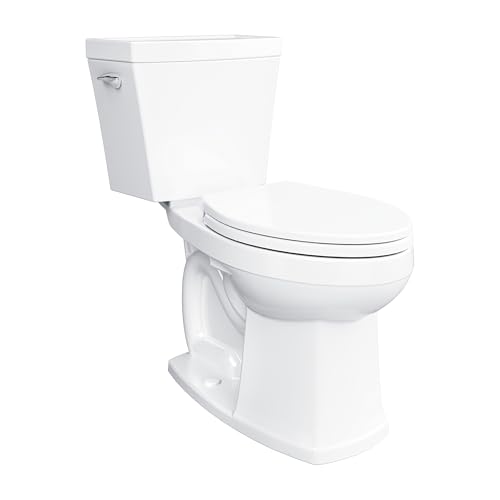
The Avalanche is Gerber's value dual flush workhorse, pairing a 1.1 gallon partial flush with a 1.6 gallon full flush and reaching a strong 1,000 gram MaP score, so it trims daily water use without sacrificing clearing power.
Gerber is a long-established commercial and residential plumbing brand, and the Avalanche reflects that with a sturdy, no-nonsense build and a dependable dual flush valve. The 1,000 gram full flush is among the strongest of any dual flush toilet on this page, so solids clear on one push.
Owner reviews praise the reliable flush and the brand's plumbing pedigree, with the main note being that the 1.1 gallon light flush is not as low as the 0.8 gallon modes on the Aquia IV or St. Tropez. For an affordable dual flush with serious clearing power, it is a smart pick.
The Avalanche is the dual flush to buy when you refuse to trade flush strength for water savings. A 1,000 gram full flush in a dual flush body at a fair price is a rare combination, and Gerber's plumbing roots make it dependable.

The Santa Rosa is Kohler's compact comfort-height one-piece, using 1.28 gallons per flush with the AquaPiston canister to deliver an efficient, even flush in a space-saving footprint.
Its AquaPiston canister feeds water into the bowl from all sides for a strong, even single flush at the WaterSense water limit, and the compact elongated bowl gives elongated comfort in a footprint close to a round bowl. The one-piece body has no seam to clean.
Owner reviews praise the space-saving design and reliable flush, with the main note being an 800 gram MaP score that is strong but below the 1,000 gram leaders. For a small or powder-room bathroom that still wants low water use and a clean one-piece look, the Santa Rosa is a sensible eco pick. For more on fit, our pillar guide to the best flushing toilets covers sizing in detail.
The Santa Rosa is the eco toilet we recommend for tight powder rooms where a full-size elongated one-piece will not fit. You get the cleaner seamless body and Kohler parts support without the floor space penalty.
Across this entire list, the single biggest driver of how green a toilet really is over its life is whether it clears the bowl on the first flush. A dual flush like the Aquia IV wins on paper, but a strong flat 1.28 gallon flush like the UltraMax II wins in a busy household where buttons get pressed twice. Match the toilet to how your home actually flushes, not to the lowest number printed on the box.
A toilet only saves water if it clears the bowl in one flush. Understand these factors and you can pick a green model that shrinks your water footprint without ever forcing a second flush.
The number on the box that everyone notices is gallons per flush, but the number that decides whether a toilet actually saves water is its MaP score. MaP (Maximum Performance) is an independent test that measures how many grams of solid waste a toilet clears in a single flush. A 1.28 gallon toilet with a 1,000 gram MaP, like the UltraMax II or Cadet 3, clears solids in one push and locks in its savings. A low-volume toilet with a weak MaP forces a second flush, and two flushes of 1.28 gallons use more water than a single 1.6 gallon flush would. Buy clearing power first, then enjoy the low volume. To see how the two numbers interact, our breakdown of 1.28 GPF vs 1.6 GPF toilets and which to choose covers it in depth.
There are two paths to a greener bathroom. A dual flush toilet like the Aquia IV uses a tiny 0.8 gallon flush for the many liquid uses each day, dropping your yearly average below any single flush model. A strong single flush toilet like the UltraMax II uses a flat 1.28 gallons but guarantees a clean clear every time, so you never waste water on a second push. If most of your household's uses are liquid, the dual flush saves more on paper. If you value the certainty of one strong flush, the single flush is simpler. Both beat an old 3.5 or 5 gallon toilet by a wide margin.
The EPA WaterSense label is the simplest way to know a toilet is genuinely eco friendly. It means an independent body has verified the toilet uses 1.28 gallons or less while still passing flush performance standards, so you are not trading clearing power for the low number. WaterSense toilets use at least 20 percent less water than the federal 1.6 gallon maximum, and many local water utilities offer rebates when you replace an older toilet with a certified model, which can offset much of the purchase. Some toilets are sold in both a 1.6 and a 1.28 gallon version, so read the listing and pick the certified variant if savings is your goal. For models chosen specifically for this label, see our roundup of the best EPA WaterSense certified toilets.
The quietest water waster in any bathroom is a leaking flush valve or flapper that lets water trickle from the tank into the bowl around the clock. A slow leak can waste hundreds of gallons a day, far more than even the most efficient flush volume ever saves, so a quality flush mechanism matters as much as the gallons-per-flush rating. Canister flush systems like Kohler's AquaPiston seal more reliably over time than a cheap rubber flapper. Longevity counts too: a toilet that lasts decades, like the TOTO Drake, conserves all the water and material that a replacement would cost. When you shop, weigh the durability of the flush mechanism and the body alongside the water number.
Even the most efficient toilet is useless if it does not fit your bathroom. Rough-in is the distance from the finished wall to the center of the floor drain bolts, and most homes use 12 inches, though some older houses have a 10 or 14 inch rough-in. Comfort-height bowls sit around 17 to 19 inches off the floor and suit most adults, while standard height saves a little space. An elongated bowl is more comfortable for most people, while a round or compact bowl fits a tighter room. Confirm all three before buying so your eco toilet installs cleanly. For broader fit and flush advice across the whole category, our pillar guide to the best flushing toilets covers it in detail, and our roundup of the best water saving toilets of 2026 goes deeper on cutting use the smart way.
If you remember one rule when shopping for a green toilet, make it this: a high MaP score is non-negotiable. The single most common eco mistake is buying the lowest-gallon toilet on the shelf, discovering it needs two flushes, and quietly using more water than the old toilet ever did. Pair low volume with a proven 800 to 1,000 gram flush and the savings are real.
The TOTO Aquia IV is our top eco pick. Its 0.8 gallon partial flush handles liquid-only uses while a 1.28 gallon full flush clears solids at a perfect 1,000 gram MaP score, giving the lowest realistic yearly water use without forcing a second flush. For a flat single flush at that same 1,000 gram MaP score, the TOTO UltraMax II pairs 1.28 gallons with zero button to choose, and the Kohler Cimarron is the best value WaterSense option.
A lot, because the toilet is usually the largest single water user inside a home. Replacing an older 3.5 gallon toilet with a 1.28 gallon WaterSense model cuts that use by more than 60 percent per flush, and swapping a very old 5 gallon toilet saves even more. Over a year that adds up to thousands of gallons for a typical household, and a dual flush model pushes the average lower still.
Yes. WaterSense is an EPA program that independently verifies a toilet uses 1.28 gallons or less while still passing flush performance standards, so you are not trading clearing power for a low number. Certified toilets use at least 20 percent less water than the federal 1.6 gallon maximum, and many local utilities offer rebates when you install one, which can offset much of the cost.
For most homes, yes. A dual flush like the TOTO Aquia IV uses a small 0.8 gallon flush for the many liquid-only uses each day, which lowers your yearly average below any single flush model. The savings depend on people actually using the light button, so in a busy household where guests push the wrong button, a strong flat single flush can match or beat it in practice.
Not the good ones. The weak 1.6 gallon toilets of the 1990s earned that reputation, but today's best eco models reach a 1,000 gram MaP score at just 1.28 gallons, matching dedicated power toilets. The key is choosing a high MaP score and a glazed trapway rather than buying on the gallons number alone. A well-designed eco toilet clears the bowl as cleanly as any older high-volume model.
The lowest practical flush is the 0.8 gallon partial mode found on dual flush toilets like the TOTO Aquia IV and Swiss Madison St. Tropez. For solids, those models use 1.28 gallons. Single flush toilets bottom out around 1.0 to 1.28 gallons. Going below 0.8 gallons risks weak clearing and double flushing, which wastes the savings, so 0.8 gallons is the sensible floor.
Often, yes. Many local water utilities and municipalities offer rebates when you replace an older toilet with an EPA WaterSense certified model, since it reduces demand on their water supply. The amount and rules vary by region, so check your water provider's website before buying. To qualify, the toilet must carry the WaterSense label, which every certified pick in this guide does or offers in a certified variant.
Neither is inherently greener on water; the flush volume and MaP score decide that. A one-piece like the UltraMax II has no tank-to-bowl seam, so it uses fewer materials at the joint and is faster to clean, which can mean less cleaning product over time. A two-piece is easier to carry and repair. Choose based on cleaning and fit, then make sure whichever you pick is WaterSense certified.
It can, easily. A silent flapper or flush valve leak can waste hundreds of gallons a day, far more than even the lowest flush volume ever saves. That is why a durable, leak-resistant flush mechanism like Kohler's AquaPiston canister is part of being truly eco friendly. Fixing a running toilet promptly and choosing a quality valve protects all of your water savings.
TOTO leads on flush engineering and efficiency, with the Aquia IV, UltraMax II and Drake all strong eco picks. Kohler offers excellent value and nationwide parts with the Cimarron and Santa Rosa. American Standard's Cadet 3 is the budget power flush, while Woodbridge, Swiss Madison and Gerber offer competitive dual flush models. Look for WaterSense certification and a high MaP score from any of them.
On yearly average water use, yes, because the Aquia IV's 0.8 gallon light flush handles the many liquid uses each day, while the UltraMax II uses a flat 1.28 gallons every flush. Both reach the same 1,000 gram MaP ceiling on their full flush, so the UltraMax II does not have a raw clearing-power edge, only the certainty of a single flush setting. Pick the Aquia IV for the lowest average, or the UltraMax II if you would rather not rely on guests choosing the right button.
A quality eco toilet body can last several decades, and durability is itself a green benefit because a long-lived toilet avoids the water and material cost of replacement. The TOTO Drake is famous for parts that stay available for years, making it one of the most repairable choices. The flush valve and seals are the wear parts; choosing a canister flush and a major brand keeps repairs cheap and easy.
Not necessarily. Budget WaterSense models like the American Standard Cadet 3 cost about the same as a basic standard toilet while flushing more efficiently. Designer skirted dual flush models cost more, but utility rebates and lower water bills often offset the difference over a few years. The real cost trap is buying a cheap, weak low-flow toilet that you flush twice, which raises both water use and frustration.
Swirling rinse systems like TOTO's Tornado and Double Cyclone and Kohler's AquaPiston canister clear the bowl efficiently at low water volumes by spreading water around the bowl rather than dumping it down the front. A large 3 inch flush valve, as on the American Standard Cadet 3, drives a fast, forceful flush. Any of these can hit a high MaP score at 1.28 gallons, which is what matters.
Yes, if you choose a high MaP model. A large family flushes often and may flush heavier loads, so a 1,000 gram MaP toilet like the UltraMax II, Cimarron or Cadet 3 is the safer choice than a borderline low-MaP model. A dual flush can save more water overall, but in a busy household the certainty of a strong flat single flush often wins in real use.
Composting toilets use no flush water and suit off-grid cabins, RVs and tiny homes, so on water alone they are the greenest option. For a normal home connected to sewer or septic, though, a WaterSense gravity or dual flush toilet is far more practical, requires no maintenance routine, and still cuts water use dramatically compared with an old toilet. For most bathrooms, a certified low-flush toilet is the realistic eco choice.
If your current toilet uses 3.5 gallons or more per flush, replacing it with a 1.28 gallon WaterSense model usually pays back in water savings within a few years, especially with a utility rebate, and the new toilet keeps saving for decades. If you already have a modern 1.6 gallon toilet that flushes well, the savings from upgrading are smaller, so the case is weaker unless it is clogging or leaking.
For the greenest bathroom, the dual flush TOTO Aquia IV is the pick, pairing a 0.8 gallon light flush with a 1.28 gallon full flush and a perfect 1,000 gram MaP score for the lowest realistic yearly water use with zero clearing compromise. Choose the TOTO UltraMax II if you want that same 1,000 gram MaP score in a flat single flush with no button to choose, the Kohler Cimarron for the best WaterSense value and easiest parts, the American Standard Cadet 3 for the strongest eco flush on a budget, or the Swiss Madison St. Tropez for the lowest 0.8 gallon light flush in a modern body. Confirm your rough-in, bowl height and the WaterSense variant, then check the current price on Amazon.
Learn why toilet trapways curve like an S, how each bend blocks sewer gas, and what the shape means for clogs and…
Read the guideAlmost every US toilet has a left-side handle. Learn the plumbing and mechanical reasons behind the layout and when it actually changes.
Read the guideHome toilets rely on tanks because household water lines lack the pressure that public flushometer systems use to flush straight from the…
Read the guide