Why Toilet Trapways Are Curved Like an S
Toilets4.6
Learn why toilet trapways curve like an S, how each bend blocks sewer gas, and what the shape means for clogs and…
Read the guideA spec-driven, honest comparison of 1.28 gallon-per-flush and 1.6 gallon-per-flush toilets, weighing EPA WaterSense certification, published MaP flush-test scores, real water-bill savings and aggregated owner reviews, so you can decide which standard fits your home, your drain line and your budget.
For nearly every home in 2026, choose a 1.28 GPF WaterSense toilet like the TOTO Drake. Modern 1.28 GPF designs match older 1.6 GPF flush power on MaP testing while saving thousands of gallons a year. Pick 1.6 GPF only for a problem drain line on a long, low-slope waste run.
GPF stands for gallons per flush, and it is the single number that defines how much water a toilet uses every time you push the handle. For decades, 1.6 GPF was the federal standard in the United States, set by the Energy Policy Act of 1992 and effective in 1994. More recently, 1.28 GPF has become the modern efficiency benchmark, driven by the EPA WaterSense program and adopted as the mandatory maximum in water-conscious states like California, Texas, Colorado and Georgia. The two numbers look close on paper, a difference of only 0.32 gallons per flush, but that small gap adds up fast across thousands of flushes a year, and it sits at the center of a real buying decision.
The old assumption was simple: less water meant a weaker flush. That was true in the 1990s, when the first low-flow toilets clogged constantly and earned a bad reputation that still lingers. It is no longer true. Today's best 1.28 GPF toilets use redesigned trapways, larger flush valves and engineered bowl geometry to clear the same waste load as a 1.6 GPF toilet, and the published MaP (Maximum Performance) flush-test scores prove it. Many 1.28 GPF models post the same 1,000 gram MaP ceiling as their 1.6 GPF predecessors. This guide compares the two standards on the data that actually matters, then names the specific models worth buying. For the broadest cross-standard ranking of flush power, the pillar guide to the best flushing toilets places both alongside every major brand.
We do not test toilets in a lab. We compare manufacturer specifications, published MaP (Maximum Performance) flush-test gram scores, EPA WaterSense listings, flush-valve and trapway dimensions, and aggregated owner ratings across major retailers. Where one standard clearly suits a use case better, we say so plainly rather than declaring one number universally correct.
A side-by-side look at the two standards using representative high-performing models from each: the 1.28 GPF TOTO Drake (CST744E) and the older 1.6 GPF TOTO Drake (CST744S). Both are two-piece, elongated, gravity-flush toilets, which makes for a fair comparison of the water standard itself. The tinted cell shows which standard leads on that row.
| Spec | 1.28 GPF (modern WaterSense) | 1.6 GPF (legacy standard) |
|---|---|---|
| Water per flush (GPF) | 1.28 gal | 1.6 gal |
| MaP flush score (top models) | 800 to 1,000 g | 800 to 1,000 g |
| EPA WaterSense certified | Yes | No |
| Water used per person per year | ~2,340 gal | ~2,920 gal |
| Est. annual savings vs 1.6 GPF | ~580 gal per person | Baseline |
| Bowl geometry | Redesigned, larger valve common | Older or carried-over design |
| Legal to install new (CA, TX, CO, GA) | Yes | No |
| Rebate eligible (many utilities) | Often yes | Rarely |
| Drain-line carry on low slope | Good with strong-flush models | Slightly more margin |
| Typical owner rating (top models) | 4.6 / 5 | 4.5 / 5 |
The table makes the central point clearly: on flush power, the two standards are tied at the top. A well-engineered 1.28 GPF toilet clears the same MaP gram load as a 1.6 GPF toilet, so you are not trading flush performance for water savings the way buyers had to in the past. Where 1.28 GPF wins decisively is water use, WaterSense certification, legal eligibility in efficiency-mandated states and utility rebates. The only genuine advantage left for 1.6 GPF is a sliver of extra drain-line carry water, which matters in a narrow set of older homes with long, low-slope waste lines. For everyone else, the modern 1.28 GPF standard is the smarter buy.
The modern WaterSense standard is the right default for the vast majority of homes, new construction and remodels in 2026.
The math is straightforward and it favors 1.28 GPF every time. A 1.6 GPF toilet uses 0.32 gallons more per flush. The EPA estimates a typical person flushes about five times a day, so across a four-person household that is roughly 20 flushes daily, or about 6.4 gallons saved per day with 1.28 GPF. Over a year that is more than 2,300 gallons for that household, and the EPA puts the lifetime savings of switching from older fixtures into the tens of thousands of gallons. On a metered water and sewer bill, that is a recurring saving you feel every month, not a one-time perk. For a deeper look at the lowest-water options, the roundup of the best water saving toilets of 2026 ranks the most efficient models that still flush hard.
WaterSense is the EPA's voluntary certification, and a toilet earns it only by using 1.28 GPF or less while passing independent flush-performance testing. A 1.6 GPF toilet, by definition, cannot carry the WaterSense label because it exceeds the water threshold. That label is not just a badge: many municipal water utilities offer rebates of meaningful value for installing a WaterSense toilet, and some states require it for new installs. If a rebate is available in your area, it can offset a large share of the toilet's cost. The roundup of the best EPA WaterSense certified toilets lists models that qualify and flush at the top of the MaP charts.
This one is not optional in much of the country. California, Texas, Colorado, Georgia and several other states have made 1.28 GPF the mandatory maximum for new toilet installations. If you are in one of those states, a 1.6 GPF toilet is simply not a legal new-install choice, and big-box retailers in those markets no longer stock them for residential sale. Even where 1.6 GPF remains legal, building a new home or doing a full remodel is the moment to standardize on the efficient fixture, since you gain the water savings for the entire life of the home with zero performance penalty from a good model.
The 1.28 GPF number guarantees water use, not flush power. A cheap 1.28 GPF toilet with a small flush valve and a mediocre MaP score can still clog. The fix is simple: buy a 1.28 GPF model with a MaP score of 800 grams or higher and a 3-inch or larger flush valve. At that spec, the efficiency standard costs you nothing in performance.
There is a small, legitimate set of situations where the extra water of a 1.6 GPF toilet still earns its keep.
The one real engineering argument for 1.6 GPF is drain-line carry. A flush has to move solid waste not just out of the bowl but all the way down the building drain to the sewer or septic line. In an older home with a long horizontal run, a low slope (below the ideal quarter-inch-per-foot pitch), or a history of slow drains, the extra 0.32 gallons of carry water can provide a margin that prevents waste from stalling partway down the pipe. This is a real but narrow scenario. If your home has never had drain-carry problems on a 1.28 GPF or even an older fixture, it is not your situation, and a strong-flushing 1.28 GPF toilet will carry waste just fine.
If you live where 1.6 GPF remains legal and you are matching an existing pair of toilets, some buyers prefer to keep the standard consistent for predictable behavior and shared spare parts. This is a convenience argument, not a performance one, and it grows weaker every year as 1.28 GPF becomes the default everywhere. We would still steer most of these buyers to a high-MaP 1.28 GPF model, because the water savings compound for years while the flush performance is identical.
Some pressure-assisted toilets, which use building water pressure to force a powerful flush, are built at 1.6 GPF for the most demanding commercial-adjacent residential use. If you genuinely need that level of flush force, for example a high-traffic bathroom that punishes gravity toilets, a 1.6 GPF pressure-assist model is a defensible choice. That said, 1.28 GPF pressure-assisted models now exist and perform extremely well, so the water standard is rarely the deciding factor even here.
A dual-flush toilet gives you two buttons: a reduced flush near 0.8 to 1.0 GPF for liquid waste and a full flush at 1.28 or 1.6 GPF for solids. If you want maximum water savings but worry about occasional heavy loads, a 1.28 GPF dual-flush model lets you use less water most of the time while keeping a full flush in reserve. It is often the best of both standards in one fixture.
If you have decided which standard fits your home, these are the three workhorse models to start with. Each posts a strong MaP score, so flush power is never the weak link.
A 1.28 GPF version that clears a 1,000 gram MaP load with a 3-inch flush valve and TOTO's G-Max system. Proof that efficient and powerful are no longer a trade-off.
Check price on AmazonA dual-flush 0.8 / 1.28 GPF toilet with the CeFiONtect glaze and Dynamax Tornado wash. Uses well under 1 gallon on most flushes while keeping a full flush in reserve.
Check price on AmazonA 1.6 GPF gravity toilet with a huge 4-inch flush valve and 2-3/8-inch trapway that clears a 1,000 gram MaP load with maximum drain-line carry for older waste lines.
Check price on AmazonThe honest reality in 2026 is that the 1.28 versus 1.6 debate is mostly settled. A decade of engineering has erased the flush-power gap, and the data shows it: the same Drake and Champion families hit a 1,000 gram MaP ceiling at both water levels. So the decision is no longer about performance, it is about water cost, certification and law. Default to 1.28 GPF and only reach for 1.6 GPF if you have a documented drain-carry problem on a low-slope line. If you are unsure, a high-MaP 1.28 GPF model is the choice you will not regret.
Below are the specific toilets worth buying, with the data and the honest trade-offs spelled out. Every model here flushes hard enough that the water standard never holds it back.

The 1.28 GPF Drake is the toilet that retired the low-flow stigma, clearing a 1,000 gram MaP load on less water than the old federal standard required.
The Drake's G-Max flushing system pairs a wide 3-inch flush valve with a fully glazed, computer-designed trapway, so a small volume of water leaves the tank fast and creates a strong siphon. That is the engineering reason a 1.28 GPF toilet can match a 1.6 GPF flush on MaP testing.
Owner reviews are overwhelmingly positive on flush strength and clog resistance, with the brand's reputation for reliability a recurring theme. The most common note is that the two-piece styling is plain and the standard seat is sold separately on some configurations.
If someone asks for one toilet that settles the 1.28 vs 1.6 question, this is it. It proves you can have the lower water bill and the strong flush at the same time, which is exactly why we make it the default recommendation across the site.
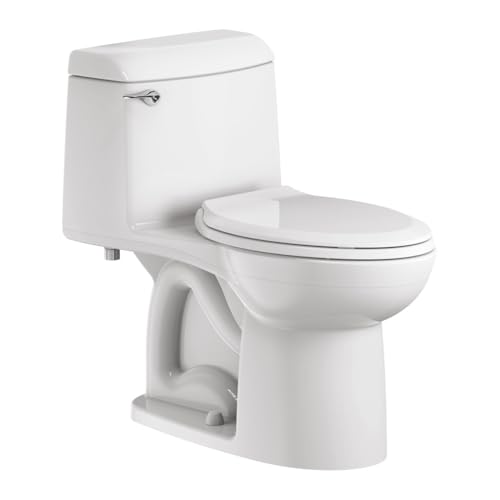
The Champion 4 is the model to buy when you genuinely need 1.6 GPF, pairing the most carry water with a huge valve for older, troubled waste lines.
The Champion 4 uses an oversized 4-inch flush valve and a wide 2-3/8-inch fully glazed trapway, which together push a large slug of water with serious force. With 1.6 gallons behind it, the drain-line carry margin is about as high as a residential gravity toilet gets.
Owner reviews praise its near-unclogggable reputation and ease of use, with the main reminders being that 1.6 GPF cannot earn WaterSense and is not a legal new install in efficiency-mandated states. Where it is allowed, it is a workhorse.
We only recommend a 1.6 GPF toilet for a specific reason, and a documented drain-carry problem is that reason. The Champion 4 is the model we point those buyers to, because if extra water is going to solve the issue, this is the fixture that delivers it with the most force.

The Aquia IV uses two buttons to default to a 0.8 GPF flush for liquids and a 1.28 GPF flush for solids, beating both fixed standards on average water use.
The Aquia IV's Dynamax Tornado wash uses two angled nozzles instead of rim holes to swirl water around the bowl, which keeps the bowl clean on the lower water volumes a dual-flush demands. The CeFiONtect glaze resists waste sticking, further reducing the water needed to keep it spotless.
Owner reviews highlight the genuine water savings and the clean, skirted styling, with the main caution being that the reduced flush is for liquids only, so households need to use the full button for solids to avoid streaking.
For the buyer who wants the absolute lowest water use without the clog anxiety of a single low-flow flush, dual-flush is the smartest answer. The Aquia IV gives you sub-1-gallon flushes most of the day and a full 1.28 GPF flush whenever you need it, which sidesteps the whole 1.28 vs 1.6 dilemma.
The short, direct answers to the comparisons people search for most.
The GPF conversation does not stop at 1.28.
Below the 1.28 GPF standard sits an even more efficient tier. A growing number of toilets now flush at 1.0 GPF or even 0.8 GPF while still passing MaP testing, which is the frontier of water efficiency. If saving the most water possible is your goal, the roundup of the best low flow toilets (1.28 GPF and under) ranks the models that push below the WaterSense threshold without clogging. For buyers focused on overall environmental impact, including manufacturing and longevity, the guide to the best eco friendly toilets for a greener bathroom takes a wider view. Across all of these, the same brands lead: TOTO sets the flush-engineering benchmark, Kohler leads on design and finish with models like the Highline and Cimarron, American Standard and Gerber deliver strong flushing per dollar with the Cadet 3 and Avalanche, and Woodbridge and Swiss Madison bring modern styling at value prices. The water standard you choose matters less than picking a model from a reliable brand with a high MaP score.
Here is the buying-guide shortcut we would give a friend. First, decide your water standard: 1.28 GPF unless you have a real drain-carry problem, in which case consider 1.6 GPF. Second, ignore the GPF number after that and filter by MaP score, buying nothing below 600 grams. Third, pick a model from TOTO, Kohler or American Standard with a 3-inch-or-larger flush valve. Do those three things and the 1.28 vs 1.6 debate stops mattering, because your toilet will flush hard and sip water either way.
The water-efficiency argument that once required a real trade-off no longer does. Modern 1.28 GPF toilets match the flush power of 1.6 GPF models on the data that matters, the MaP flush test, while using nearly 20 percent less water on every flush. That means lower water and sewer bills, eligibility for utility rebates, the EPA WaterSense label and compliance with the laws in a growing list of states, all for no loss in performance from a well-chosen model. The only buyers who should still consider 1.6 GPF are those with a documented drain-line carry problem on a long, low-slope waste line, and even many of them are well served by a high-MaP 1.28 GPF toilet or a dual-flush model. For everyone else, choose 1.28 GPF, buy a model with a MaP score of 800 grams or higher, and check the current price on Amazon for the exact model you pick.
Choose 1.28 GPF for nearly every home and start with the TOTO Drake, which clears a 1,000 gram MaP load on less water than the old standard. Step up to the dual-flush TOTO Aquia IV for maximum savings. Reserve 1.6 GPF and the American Standard Champion 4 for a genuine drain-carry problem on an older, low-slope line. The flush-power gap is gone, so let water savings and your local law decide.
GPF stands for gallons per flush, the amount of water a toilet uses each time you flush. It is the core water-efficiency number on the spec sheet. A 1.6 GPF toilet uses 1.6 gallons, a 1.28 GPF toilet uses 1.28 gallons, and ultra-efficient models go as low as 0.8 GPF. Lower GPF means a smaller water bill, but it has to be paired with a good flush design to clear waste reliably.
Yes, in a well-engineered toilet. The 1.28 GPF standard guarantees water use, not flush power, so the design matters. A 1.28 GPF toilet with a 3-inch or larger flush valve and a MaP score of 800 grams or more, like the TOTO Drake, clears solid waste as effectively as any 1.6 GPF model. The early 1990s low-flow toilets that clogged constantly used outdated designs that modern engineering has long since fixed.
The Energy Policy Act of 1992 set 1.6 GPF as the federal maximum for new toilets in the United States, taking effect in 1994. It was a major cut from the 3.5 to 7 gallons older toilets used. For two decades it was the default, but flush engineering kept improving, and the EPA's WaterSense program introduced the stricter 1.28 GPF benchmark, which many states have since made mandatory.
The savings come from both lower water use and lower sewer charges, which are often billed on water consumed. A four-person household saves more than 2,000 gallons a year by choosing 1.28 GPF over 1.6 GPF. The dollar amount depends on your local water and sewer rates, but over the years-long life of a toilet it adds up to a meaningful recurring saving, and some utilities add a rebate on top.
Not for a new residential installation. California, Texas, Colorado, Georgia and several other states require 1.28 GPF or less for new toilets, so retailers in those states do not sell 1.6 GPF models for residential install. If you live in one of these states, your choice is effectively 1.28 GPF or lower, which is not a hardship given how well modern efficient toilets flush.
Only in a narrow case. The single genuine advantage of 1.6 GPF is extra drain-line carry water, which helps move waste down a long, low-slope or troubled waste line in some older homes. If your home has a documented history of slow drains or partial clogs in the pipe rather than the bowl, the extra 0.32 gallons can provide margin. For the vast majority of homes with normal drains, a strong-flushing 1.28 GPF toilet works just as well.
WaterSense is the EPA's voluntary water-efficiency certification. A toilet earns the WaterSense label only by using 1.28 GPF or less while passing independent flush-performance testing. A 1.6 GPF toilet cannot carry the label because it exceeds the water threshold. The label is useful because it signals both efficiency and verified performance, and it is often required for utility rebates.
MaP, or Maximum Performance, is an independent flush test that measures how many grams of solid waste a toilet clears in a single flush. It is the best apples-to-apples measure of flush power, separate from water use. GPF tells you how much water the toilet uses; MaP tells you how well it flushes. A great toilet has a low GPF and a high MaP, ideally 800 grams or more.
If your current toilet works fine, there is no urgency. But if you are remodeling, the old toilet is leaking or wasting water, or your utility offers a rebate, switching to 1.28 GPF makes sense because the water savings recur for the life of the new toilet. A reliable 1.28 GPF model with a high MaP score flushes just as well, so you lose nothing in performance by upgrading.
Not when you choose a good one. Clogging is driven by flush design and trapway diameter far more than by the half-gallon difference in water. A 1.28 GPF toilet with a high MaP score and a large, glazed trapway resists clogs as well as a 1.6 GPF model. The clogging reputation comes from poorly designed early low-flow toilets, not from the modern efficient standard.
A standard 1.28 GPF toilet uses the same 1.28 gallons on every flush. A dual-flush toilet gives you two buttons: a reduced flush around 0.8 to 1.0 GPF for liquid waste and a full flush at 1.28 or 1.6 GPF for solids. Dual-flush can deliver a lower average water use than a fixed 1.28 GPF toilet, which is why models like the TOTO Aquia IV appeal to buyers chasing maximum savings.
TOTO leads on flush engineering, with the Drake, Drake II and UltraMax II all available in strong 1.28 GPF versions. Kohler offers excellent 1.28 GPF models like the Highline and Cimarron, American Standard has efficient Cadet 3 versions, and Woodbridge and Swiss Madison bring modern styling at value prices. Across all of them, the rule is the same: pick a model with a MaP score of 800 grams or higher.
Often, but not always. Many 1.28 GPF toilets use a similar tank size to 1.6 GPF models but release the water faster through a larger flush valve to create a strong siphon. The water volume per flush is what differs. What matters for performance is not tank size but the flush system design, valve diameter and trapway, which together determine how forcefully that water moves waste.
It can if the bowl design is poor, but quality models avoid it. Toilets with rim-wash systems, full-bowl rinse channels or nozzle-based washes like TOTO's Tornado, plus a smooth anti-stick glaze such as CeFiONtect, keep the bowl clean on lower water volumes. Streaking is a sign of a cheap design, not an inevitable result of using 1.28 gallons. Choose a high-MaP model with a good glaze and it stays clean.
Many are. A large number of municipal and regional water utilities offer rebates for installing a WaterSense-certified toilet, which by definition means 1.28 GPF or less. The amount and availability vary by location, so check your local water provider's conservation program before you buy. A 1.6 GPF toilet does not qualify because it is not WaterSense certified, which is one more reason the efficient standard often costs less in the end.
Not in a purpose-built design. A small but growing group of toilets flush reliably at 1.0 GPF or even 0.8 GPF while still passing MaP testing, using optimized bowl geometry and fast water release. They are the most efficient tier available. The key is buying a model specifically engineered for that volume with a verified MaP score, rather than assuming any ultra-low-flow toilet will perform.
Not directly. Flush noise is driven by the flush technology, not the water volume. Gravity-flush toilets, whether 1.28 or 1.6 GPF, are relatively quiet. Pressure-assisted toilets, which often run at 1.6 GPF, are noticeably louder because they use building water pressure to force the flush. If a quiet flush matters, choose a gravity model at either water standard rather than a pressure-assist fixture.
Yes. Both standards use the same standard 12-inch rough-in in most homes, the same water supply connection and the same drain. Switching from a 1.6 GPF toilet to a 1.28 GPF model is a straightforward swap with no plumbing changes needed. Always measure your rough-in before buying, since 10-inch and 14-inch layouts exist, but the GPF standard itself does not change the fit.
In most cases yes. A 1.28 GPF toilet may cost slightly more than a bargain 1.6 GPF model, but the water and sewer savings recur for the full life of the fixture, and a utility rebate can erase the difference at purchase. Add in WaterSense certification and legal compliance in efficiency-mandated states, and the efficient standard usually wins on total cost of ownership.
Learn why toilet trapways curve like an S, how each bend blocks sewer gas, and what the shape means for clogs and…
Read the guideAlmost every US toilet has a left-side handle. Learn the plumbing and mechanical reasons behind the layout and when it actually changes.
Read the guideHome toilets rely on tanks because household water lines lack the pressure that public flushometer systems use to flush straight from the…
Read the guide