TOTO UltraMax II
Seamless cleaning, max MaP4.7
The one piece benchmark: 1,000-gram MaP, WaterSense 1.28 GPF and a seamless skirted shell that is faster to clean than any two piece alternative in its class.
Check price on AmazonOne piece toilets fuse tank and bowl into a single vitreous china casting. Two piece toilets bolt a separate tank to the bowl with a gasket. The choice affects cleaning, cost, installation weight and long-term repairs, but does not change flush power, MaP scores or water use. This guide compares both designs on real published specs, EPA WaterSense data and aggregated owner review patterns so you can pick the right body style with confidence.
For primary bathrooms where cleaning matters, the TOTO UltraMax II one piece is the top pick: seamless vitreous china, 1,000-gram MaP score and no tank-to-bowl gasket to leak. For budget-driven rooms or rentals, the TOTO Drake two piece delivers near-identical flush power and MaP performance at a significantly lower purchase price with easier solo installation.
Walk into any plumbing showroom and every floor model is built one of two ways. The two piece toilet is the design most homes have used for a century: a vitreous china bowl bolted to the floor with a separate tank resting on top, the two joined by a rubber gasket and a pair of tank bolts. The one piece toilet casts both tank and bowl as a single continuous piece of vitreous china, with no seam between them and no exposed bolt heads where they meet.
From across a bathroom both styles flush the same way and rely on the same gravity or pressure-assist mechanics. Yet the two body styles diverge sharply on cleaning, upfront cost, installation weight, long-term repair costs and the visual weight they carry in a room. The good news is that flush performance, the thing most buyers care about most, is not controlled by body style at all. Flush strength, clog resistance and water use come from the trapway diameter, the flush valve design and the bowl's water dynamics, none of which depend on whether the tank is cast with the bowl or bolted to it. That means you can choose the body style on cleaning, cost and looks, and then choose the specific model on its MaP score and GPF. For a full spec-by-spec look at every factor that affects how a toilet performs, our complete toilet buying guide covers the numbers in order.
One structural decision, whether the tank and bowl are fired together or bolted together, ripples into cleaning ease, cost, weight and the number of potential leak points.
In a two piece toilet the tank and bowl are manufactured and shipped as separate units, then assembled at installation using a sponge-rubber tank-to-bowl gasket and two or three tank bolts that compress the gasket into a watertight seal. This configuration has dominated toilet manufacturing for well over a century because it is less expensive to produce, simpler to ship in standard-sized boxes and light enough that one person can carry each part separately. The practical tradeoff is the visible horizontal seam where the tank meets the bowl, plus the bolt caps on either side, which collect grime and require deliberate cleaning.
A one piece toilet is fired as a single mass of vitreous china in a mold that shapes the tank and bowl as one continuous unit. The result is a seamless outer shell with no horizontal joint, no gasket and no exposed tank bolts at the tank-to-bowl connection. The seamless shell is the entire value proposition: it wipes clean without reaching into crevices, has one fewer internal connection to eventually leak and presents a lower, more streamlined profile. The costs are real as well: one piece units are considerably heavier, carry higher list prices and, when the china itself cracks, require replacing the entire fixture rather than swapping a single tank or bowl.
Key point: Body style is independent of bowl shape and bowl height. You can find a one piece and a two piece toilet in every combination of round or elongated bowl and standard or comfort height. Decide on body style here, then confirm the specific model comes in the bowl shape and seat height your bathroom needs.
How the two body styles compare on every factor buyers ask about most. Flush performance figures assume the same flush technology applied in both body styles.
| Factor | One Piece Toilet | Two Piece Toilet |
|---|---|---|
| Cleaning ease | Seamless, no seam or bolt heads | Seam and bolt caps collect grime |
| Typical price range | Higher upfront cost | Lower upfront cost |
| Potential leak points | No tank-to-bowl gasket | Gasket can harden and weep over time |
| Weight and handling | 85 to 120+ lbs as one unit | 40 to 60 lbs per part, carried separately |
| DIY installation ease | Needs two people to lift safely | One person can manage each part |
| Repair flexibility | Whole fixture if china cracks | Replace tank or bowl independently |
| Profile and aesthetics | Lower, sleek, modern silhouette | Taller, traditional look |
| MaP flush score potential | Same as two piece models | Same as one piece models |
| EPA WaterSense availability | Yes, widely available at 1.28 GPF | Yes, widely available at 1.28 GPF |
| Skirted option availability | Common in this style | Less common, available in some lines |
| Best applications | Primary baths, modern remodels, accessible design | Rentals, budget projects, secondary baths, DIY installs |
This is where the one piece earns its price premium, and for many buyers this single question closes the decision.
The cleaning advantage of a one piece toilet is the single most cited reason buyers choose it over a two piece, and it shows up consistently across aggregated owner reviews for models like the TOTO UltraMax II, Kohler Santa Rosa and Woodbridge T-0001. The seamless outer shell means no horizontal gap for hair and grime to accumulate, no recessed bolt caps to work around and, on skirted models, no exposed trapway curves on the side of the bowl. A one piece skirted toilet can be wiped clean front, back, top and both sides without moving the brush or cloth into awkward angles.
A two piece toilet is manageable to clean and most people have done it for years without complaint. The tank-to-bowl seam, the bolt caps and the exposed trapway on an unskirted two piece do require a little extra time and deliberate attention each week. Over a toilet's ten-to-twenty-year lifespan those extra minutes add up. If reducing bathroom cleaning time is a priority, or if the toilet is in an accessible bathroom where awkward reaching is a concern, the one piece is the straightforward answer. Pairing a one piece with a skirted design removes the last difficult cleaning zone, and our comparison of skirted versus exposed trapway toilets covers which models carry that option.
Two piece wins on upfront purchase price and on the cost of any future repairs, which is why it still dominates new construction and rental installs.
Body style is the second-largest driver of toilet price after the flush mechanism and bowl engineering. Two piece toilets require less raw material per unit and can be fired in two smaller molds, shipped in two standard boxes and stocked in larger quantities, all of which reduce manufacturing and logistics costs. That efficiency is why the vast majority of builder-grade installs, rental units and secondary baths use two piece toilets, and why brands like American Standard, Gerber and Kohler offer their most value-focused models, the Cadet 3, Viper and Highline respectively, as two piece designs.
The value gap extends into ownership. A two piece toilet's separate tank and bowl means that a cracked tank or a bowl with a hairline fracture can sometimes be addressed by replacing only the damaged unit, provided parts are still available in the model line. A one piece toilet with a cracked tank or bowl requires replacing the entire fused fixture. For rentals, primary-floor bathrooms serving multiple users and any project where budget is a deciding factor, the two piece remains the sensible value pick. For buyers who want the best flush per dollar spent across both body styles, our roundup of the best flushing toilet for the money ranks strong performers with verified MaP scores.
Value tip: Do not pay the one piece premium for a guest bathroom or a rental. Put that budget into flush performance instead: a higher MaP score, a proven 3-inch flush valve or a siphon-jet trapway, and choose a strong two piece. Reserve the one piece premium for a primary bathroom you clean at least weekly and want to look modern.
Body style has no effect on flush strength. The numbers that predict flushing power are MaP score, flush valve size and trapway diameter.
It is a persistent misconception that a one piece toilet flushes harder because it looks more solid or that a two piece performs better because the separate tank creates a longer water drop. Neither holds up under MaP testing data. The critical flush physics, the water volume released per flush, the speed at which the flush valve opens, and the siphon created in the trapway, are all functions of the internal mechanism and bowl design rather than the external casting style.
TOTO's Tornado Flush system delivers the same rotational rinse action in the two piece Drake II and the one piece UltraMax II. American Standard's Champion 4 flush, with its 4-inch flush valve and 2 3/8-inch fully glazed trapway, appears in both body style configurations. Kohler's AquaPiston flush valve, which opens a full 360 degrees for a more forceful water release, is available across multiple one piece and two piece Kohler models including the Cimarron and Highline lines. If you want to understand what actually separates the strongest-flushing models from average performers, focus on MaP scores, flush valve diameter and trapway size, and check our complete ranking of the best flushing toilets for real verified data.
Clog resistance is a function of trapway size and flush technology, not body style. The specs to check are the same in both one piece and two piece toilets.
Clogs happen when the water velocity and volume released during a flush are insufficient to clear a large waste load through the trapway. The two specs that predict this most reliably are the trapway inside diameter and the flush valve opening. A 2-inch or larger fully glazed trapway allows waste to pass without snagging on unglazed ceramic roughness. A 3-inch or larger flush valve releases water quickly enough to create the siphon needed to pull waste through the trap. Both of these engineering choices are available in both body styles.
American Standard's Champion 4 two piece uses a 4-inch flush valve and a 2 3/8-inch fully glazed trapway that the brand rates as being able to clear 70 percent more waste per flush than a standard toilet, and it backs this with strong MaP test results. TOTO's UltraMax II one piece uses the Double Cyclone system with twin nozzles that create a powerful rotating bowl rinse, combined with a large trapway and a 1.28 gallon flush. Gerber's Avalanche two piece and the Woodbridge T-0019 one piece are strong mid-price performers with fully glazed trapways. If clog resistance is your primary requirement, our guide to the best no-clog toilets ranks the top performers by trapway size and MaP score verified through independent testing.
MaP testing is the most reliable predictor of real-world flush performance, and a 500-gram minimum is functional while 800 grams and above is the threshold for confident clog resistance in a busy household.
MaP testing, administered by an independent organization and published at map-testing.com, measures how many grams of a standardized solid waste simulant a toilet can clear in a single flush without requiring a second flush or a plunger. The protocol runs each toilet multiple times, and published scores represent a consistent pass rate. A score of 500 grams is the minimum threshold for inclusion in the MaP database, meaning toilets that score below this are not published. A score of 600 to 800 grams is solid everyday performance. Scores above 800 grams indicate a toilet that will handle even heavy waste loads reliably, and models rated at 1,000 grams have passed the maximum weight class the test administers.
Both one piece and two piece toilets appear throughout the MaP score spectrum from 500 grams to the 1,000-gram maximum. The TOTO Drake two piece and the TOTO UltraMax II one piece both score at or near the 1,000-gram ceiling. The Kohler Cimarron two piece and the Kohler Santa Rosa one piece each post scores well above 800 grams. The American Standard Cadet 3 two piece scores consistently above 800 grams, as does the Woodbridge T-0001 one piece. EPA WaterSense certification, which requires a minimum 350-gram MaP performance while using 1.28 GPF or less, is the baseline guarantee that a toilet conserves water without sacrificing flush capability. High MaP scores and WaterSense certification can coexist, and the best models achieve both.
The two piece is more manageable for a solo DIY installer because of weight. Both use identical rough-in and connection standards once the fixture is in place.
The installation sequence is mechanically the same for both body styles. You set a wax ring or a no-wax seal over the floor flange, lower the bowl onto the two closet bolts, level and secure it, then connect the water supply. The difference between a one piece and a two piece is entirely in the lifting step. A two piece toilet lets you carry the lighter bowl, typically 40 to 60 pounds, into the bathroom, set and bolt it, and then bring in the tank separately. Many installers and homeowners complete a two piece install comfortably without a second person for most of the work.
A one piece toilet's single dense casting means the full weight of 85 to 120 or more pounds must be maneuvered through doorways, over the wax ring and set exactly on the closet bolts in one movement. Dropping a one piece toilet onto a hard floor at the wrong angle can crack the china irreparably, so most plumbers and experienced DIYers bring a helper for this step. If you are doing a solo install, a two piece is the more forgiving choice. If you have a helper, the weight issue disappears and the one piece's cleaning advantages take over as the deciding factor. Our detailed toilet installation guide covers the full step-by-step process for both body styles.
The most straightforward way to choose between these two body styles is to separate the cleaning decision from the flush decision entirely. Choose the body style based on how often you clean the bathroom and what your budget allows: one piece for a primary bath you maintain regularly and want to look sleek, two piece for rentals, secondary baths and any budget-driven project. Then, once the body style is settled, choose the specific model based on its MaP score and GPF rating. A one piece with a mediocre MaP score is a worse toilet than a two piece with a 1,000-gram MaP score. The seam is a cleaning detail; the flush is a performance spec. Do not mix the two decisions.
Strong performers from verified MaP data, one for each major use case across both body styles, with real specs and honest analysis.

The TOTO UltraMax II is the one piece toilet most often cited as the benchmark for combining seamless cleaning, top-tier MaP performance and EPA WaterSense efficiency in a single fixture.
TOTO's Double Cyclone flush, which uses two nozzles to generate a rotating water motion that rinses the full bowl surface on every flush, produces a 1,000-gram MaP result, the highest achievable rating in the Maximum Performance testing protocol. The 1.28 GPF figure meets the EPA WaterSense threshold, meaning it is certified to conserve water while still passing the 350-gram minimum MaP standard, though the actual performance far exceeds that floor.
Aggregated owner reviews consistently note that the UltraMax II's seamless vitreous china shell cuts cleaning time compared to any two piece toilet they had previously, with particular mention of the skirted base removing the last awkward zone on a traditional toilet. The elongated comfort-height bowl at 17.25 inches suits most adults for seated comfort and is ADA accessible. TOTO's CeFiONtect glaze, an optional nano-coating on select finishes, reduces ionic adherence of waste to the bowl surface, which further extends the interval between full scrubs.
The UltraMax II earns the top one piece recommendation because it does not ask buyers to choose between cleaning ease and flush power. The 1,000-gram MaP score is the best available in independent testing, and the seamless skirted shell delivers on the core promise of one piece ownership. If you are going to pay the one piece premium, this is where to spend it.
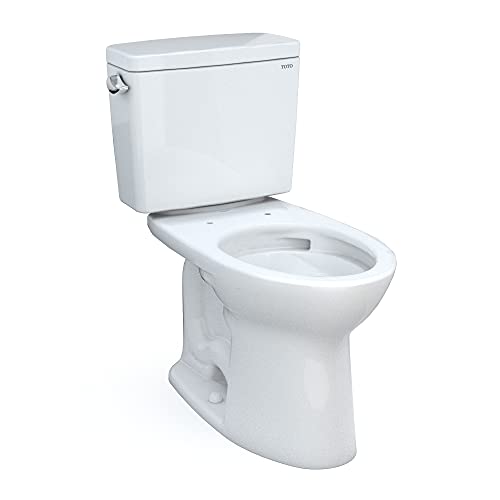
The TOTO Drake II delivers two piece construction with the Double Cyclone flush technology and MaP scores that match the one piece competition, making it the strongest two piece value for households that prioritize flush power without the one piece price tag.
The Drake II uses the same Double Cyclone flush technology as the UltraMax II one piece, which means twin nozzles produce a powerful rotating rinse of the bowl interior on each flush. The resulting MaP score of 1,000 grams is identical to the one piece sibling, confirming that no flush performance is sacrificed by choosing the two piece format. At 1.28 GPF with WaterSense certification, the Drake II meets current federal efficiency standards while posting the highest MaP performance available.
As a two piece design, the Drake II arrives as two separately packaged units totaling significantly less than the one piece equivalent, making it practical for solo DIY installation. The bowl ships first, sets onto the wax ring, and bolts down; the tank attaches after with the included gasket and bolts. Owner reviews highlight the flush reliability and the lower entry point compared to TOTO's one piece line. The tank-to-bowl seam is the one cleaning trade-off compared to the UltraMax II, but for buyers who are neutral on this point the Drake II is the harder value to beat.
The Drake II is the rational choice for anyone who wants the best verifiable flush performance in a two piece format. It scores identically to the premium UltraMax II one piece on independent MaP testing, costs measurably less and installs more easily. The tank seam is real, but if you clean the bathroom routinely it is a minor inconvenience, not a meaningful defect.

The Kohler Santa Rosa delivers a compact one piece silhouette with the AquaPiston flush valve in a streamlined elongated design that suits smaller bathrooms and contemporary aesthetics better than most full-size one piece models.
Kohler's AquaPiston flush valve opens a full 360 degrees to release water from all sides rather than from a single entry point at the bottom of the tank, which creates a more consistent and forceful flush than a standard flapper. In the Santa Rosa's single-piece casting this translates to consistent MaP results above 800 grams, which is strong performance that handles a typical household's daily volume without clogging concerns. The compact design is the distinguishing factor among one piece toilets: the Santa Rosa's footprint is smaller than many elongated one piece competitors, making it genuinely better suited to bathrooms where depth is a constraint.
Kohler backs the vitreous china shell with a limited lifetime warranty, which is more comprehensive than the one-year limited warranty typical of TOTO's toilet bodies. Internal mechanical parts, the AquaPiston canister and fill valve, carry a standard one-year term but are widely available for DIY replacement. The matching soft-close seat is often included, depending on the specific configuration, and the elongated bowl at comfort height suits most users for seated comfort.
The Santa Rosa is the one piece to recommend when the bathroom is smaller, the budget is moderate for a one piece and the buyer values Kohler's china warranty over the highest possible MaP ceiling. It sits genuinely lower and shorter than most one piece alternatives, which is a real benefit in tight spaces, not just a marketing claim.
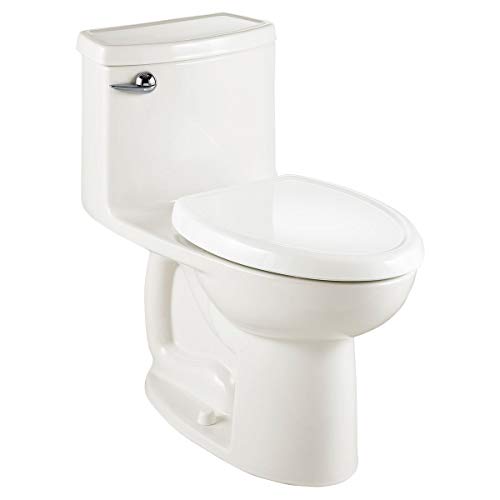
The American Standard Cadet 3 is the two piece toilet most consistently recommended for budget-conscious buyers who need reliable clog-resistance and a WaterSense GPF without approaching premium price points.
The Cadet 3 uses American Standard's EverClean surface treatment, an antimicrobial additive bonded to the china during firing that inhibits the growth of mold, bacteria and algae on the bowl interior. Combined with the 3-inch flush valve that releases water faster than a standard 2-inch valve, the Cadet 3 produces MaP scores above 800 grams while holding to 1.28 GPF. American Standard backs both the bowl and tank with a limited lifetime warranty on the vitreous china, which is above average for a toilet in this price range.
Parts for the Cadet 3 are among the most widely stocked in hardware stores and online, so a fill valve or flapper replacement is a straightforward same-day fix rather than a special order. The elongated comfort-height bowl is ADA compliant and fits standard 12-inch rough-in. Aggregated owner reviews frequently note the Cadet 3's uncomplicated installation and consistent flush reliability over years of service, with no recurring complaints about MaP-level clog problems in typical residential use.
For any two piece toilet installation where budget is the primary constraint, the Cadet 3 is the honest recommendation. The 800-plus MaP score is genuinely good for daily residential use, the EverClean surface adds real maintenance value and American Standard's parts network makes repairs convenient. It is not the most exciting toilet, but it is one of the most dependable at its price point.

The Woodbridge T-0001 brings the seamless one piece format and a skirted modern profile to a lower price point than TOTO or Kohler equivalents, making it the entry point for buyers who want the one piece cleaning advantage without the premium brand price.
Woodbridge has built the T-0001 into a widely reviewed entry-level one piece with a modern rectangular tank profile and a fully skirted trapway. The dual-flush actuator plate sits flush with the top of the tank for a clean visual finish. At 1.0 GPF on the partial flush and 1.6 GPF on the full flush, the effective water use depends on user behavior, but typical dual-flush usage at roughly 30 percent full flushes and 70 percent partial flushes averages below the WaterSense 1.28 GPF threshold.
The MaP score range for the T-0001, verified across published testing results, sits in the 600 to 800 gram band. This is solid everyday performance that handles normal residential waste loads without recurring clog issues. It does not match the 1,000-gram ceiling of TOTO's models, so for households that regularly push the limits of a toilet's capacity the premium models are a more confident choice. For moderate use and moderate budgets, the T-0001 delivers the seamless one piece cleaning advantage and a contemporary look at a more approachable price.
The Woodbridge T-0001 is the honest recommendation when a buyer wants a skirted one piece for a guest bathroom or a bathroom remodel and the TOTO or Kohler premium is not in the budget. Understand that its MaP score sits below the top tier, so set expectations accordingly. For a light-to-moderate use bathroom it performs well; for a busy family bathroom, spend up to the TOTO UltraMax II.
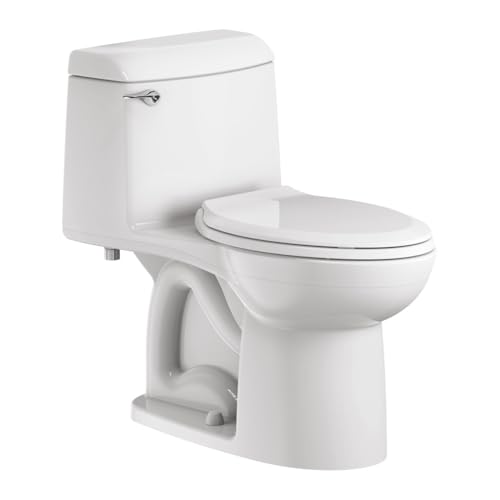
The American Standard Champion 4 is the two piece toilet specified most often in high-volume and problem-prone bathrooms, with a 4-inch flush valve and a 2 3/8-inch fully glazed trapway that form the largest-opening drain path in any gravity-fed residential toilet.
The Champion 4 uses American Standard's Accelerator flush, named for its 4-inch flush valve that opens fully to release the entire 1.6-gallon tank volume nearly instantaneously. This creates an exceptionally fast and powerful siphon through the 2 3/8-inch fully glazed trapway, which is more than twice the internal opening of a standard trapway. American Standard claims this design can clear 70 percent more waste per flush than a standard toilet, and the 1,000-gram MaP score confirms the claim in independent testing.
The trade-off is water use. The Champion 4 operates at 1.6 GPF rather than the 1.28 GPF WaterSense threshold, which means it is not EPA certified and uses more water per flush than a high-efficiency toilet. In chronic-clog households or high-volume bathrooms this is a trade-off many buyers willingly make. The traditional two piece construction, with the tank seam and bolt caps, is a cleaning concession compared to a one piece, but the Champion 4 is not sold as a cleaning-ease toilet. It is sold as a toilet that does not clog, and the MaP data supports that positioning.
Recommend the Champion 4 specifically when a household has a documented clog history or when the bathroom serves many users daily and the current toilet requires a plunger more than occasionally. The 4-inch valve and 2 3/8-inch trapway form the most capable gravity flush drain path in the residential market. Accept the 1.6 GPF as the cost of that capability.

The Swiss Madison St. Tropez is the most visually striking one piece option in its category, with a dual-flush actuator, a dual-nozzle bowl rinse and a rectangular profile that suits minimalist and spa-inspired bathrooms that most traditional toilet brands do not address.
Swiss Madison designed the St. Tropez around a rectangular tank and bowl profile that departs from the rounded form language of traditional toilet design. The dual-flush actuator plate sits centrally on the top of the tank for a clean, hardware-free surface. At 0.8 GPF on the partial flush, it offers some of the lowest per-flush water consumption available in a residential toilet without entering the specialty 0.8 GPF single-flush category. For a guest bathroom or a powder room with light use, this translates to meaningful water savings over a year's use.
The MaP score range for the St. Tropez, where published data is available, sits in the 500 to 700 gram range depending on configuration. This is functional performance for light-to-moderate use. It is not the toilet to choose if the bathroom handles six or more daily users or if the household has experienced clogging with standard 1.6 GPF toilets. For a design-forward bathroom with moderate use, the St. Tropez delivers on its core promise: a striking one piece form with dual-flush water management at a price below the premium Japanese-brand alternatives.
Recommend the St. Tropez to buyers for whom the bathroom's visual design is the deciding factor and who accept that MaP scores below 800 grams are appropriate for the use case. For light-traffic guest baths the performance is fully adequate. Be direct about the MaP ceiling if the buyer is asking for clog-resistance specifications.

The Kohler Cimarron is the most broadly useful two piece in Kohler's lineup: AquaPiston flush technology, strong MaP performance and WaterSense certification, with a classic profile that suits transitional and traditional bathroom designs equally well.
Kohler's AquaPiston canister valve in the Cimarron opens a full 360 degrees rather than swinging from one side like a traditional flapper, which exposes a larger opening and allows a faster, more uniform water release from all sides of the valve simultaneously. This produces reliable MaP results above 800 grams while holding to the 1.28 GPF WaterSense threshold. The result is a toilet that passes EPA certification without the flush-performance trade-offs that plagued early high-efficiency designs.
The Cimarron is sold in a wider variety of rough-in sizes and bowl configurations than most competitors, including 10-inch, 12-inch and 14-inch rough-in versions and both round and elongated bowls. Kohler's limited lifetime warranty on the vitreous china applies across these configurations. Parts availability is excellent through Kohler's retail and e-commerce network, and the AquaPiston canister is a user-serviceable part for fill valve or seal replacements. For a balanced two piece that covers most household needs without the one piece premium, the Cimarron is the recommendation that ages well.
The Cimarron is the Kohler two piece for most buyers: not the flashiest option, not the cheapest and not the absolute highest MaP ceiling, but a consistently reliable performer backed by a comprehensive warranty and a genuine parts network. If a buyer is choosing between Kohler and TOTO in the two piece category, performance data puts them close; the tie-breaker is typically design preference and the strength of the warranty terms.
After comparing MaP scores, EPA WaterSense data, warranty terms and aggregated owner review patterns across both body styles, the clearest guidance is this: choose the body style based on cleaning habits and budget, then let the MaP score and flush technology determine the model. The one piece format earns its premium only in bathrooms where the daily cleaning advantage and the missing gasket justify the additional cost. In every other installation, a two piece with a verified MaP score above 800 grams is an equally capable toilet at a lower price. Do not let the seamless aesthetics of a one piece sell you on flush performance it does not uniquely offer.
Four questions that structure the right choice for almost every bathroom.
This question closes the decision for many buyers. A primary bathroom cleaned three or more times a week by someone who values speed and ease tilts strongly toward a one piece. The seamless shell and the absence of a tank seam reduce active cleaning time measurably over years of use. A secondary bathroom, a basement bath or a guest bathroom cleaned less frequently or by multiple occupants shifts the value equation back toward the two piece, where the seam is a minor inconvenience rather than a weekly frustration. The full scope of toilet selection factors, including bowl shape, rough-in distance and flush technology, is covered in our how to choose a toilet guide.
The one piece premium over a comparable two piece from the same brand can range from modest to significant depending on the model line. Weigh this against the bathroom's expected lifespan in the home. In a primary bathroom you plan to live with for ten or more years, the one piece premium amortizes to a small per-year difference. In a rental property or a room being renovated before a home sale, the two piece is the rational financial choice. Also consider that a cracked tank on a two piece can sometimes be replaced without replacing the bowl, while a one piece requires full fixture replacement if the china fails.
If you are installing solo, the two piece's separate-part handling is a genuine practical advantage. If you have a helper, or if a plumber is handling the installation, the weight difference is irrelevant and the one piece's cleaning advantage takes precedence. Both styles use identical standard rough-in dimensions, wax rings and water supply connections, so there is no specialized tool or skill requirement for either.
Contemporary and minimalist bathrooms favor the seamless one piece silhouette, particularly in skirted versions that remove the trapway curves from view entirely. Traditional and transitional bathrooms accommodate the two piece's familiar tank-and-bowl profile without tension. Neither style is inherently dated or inappropriate; they carry different aesthetic weights that suit different design intentions. For the complete picture of how bowl shape interacts with bathroom size and aesthetics, our round versus elongated toilet comparison covers the dimension decisions that follow body style.
Tip: One factor that genuinely matters beyond body style: rough-in distance. Measure from the finished wall to the center of the floor drain before buying any toilet. Most homes have a 12-inch rough-in, but 10-inch and 14-inch rough-ins exist, and the wrong rough-in measurement means the toilet will not fit regardless of whether it is one piece or two piece. Our toilet buying guide covers rough-in measurement in full detail.
Three focused picks that cover the most common scenarios buyers face when deciding between one piece and two piece.
The one piece benchmark: 1,000-gram MaP, WaterSense 1.28 GPF and a seamless skirted shell that is faster to clean than any two piece alternative in its class.
Check price on AmazonIdentical 1,000-gram MaP score to the UltraMax II one piece, at a lower purchase price and lighter two-part handling that suits solo DIY installation.
Check price on AmazonThe Cadet 3 posts 800-plus MaP scores at the most accessible price point in the two piece category, with a limited lifetime china warranty and the widest parts network in the market.
Check price on AmazonTwo short checklists that settle the body style decision for most bathrooms without overcomplifying the choice.
You clean the main bathroom often and want the fastest, seamless wipe-down with no seam or bolt heads to work around. You want a lower, modern profile, particularly in a primary suite or a small room where a skirted one piece reduces visual bulk. You want to eliminate the tank-to-bowl gasket as a potential future leak source. You value a streamlined contemporary look and are willing to pay the price difference over a comparable two piece. You have a helper for installation or are hiring a professional. Strong one piece picks by use case: TOTO UltraMax II for maximum performance, Kohler Santa Rosa for compact rooms, Woodbridge T-0001 for value, Swiss Madison St. Tropez for modern design.
Budget is a real factor, or you are buying for a rental, a secondary bath, a basement or multiple bathrooms at once. You want to install solo and manage the weight yourself. You want simpler and potentially cheaper repairs over the toilet's lifespan, with the option to replace the tank or bowl as separate parts. You prefer the traditional taller-tank look that suits classic and transitional bathrooms without a design statement. Strong two piece picks by use case: TOTO Drake II for maximum MaP performance, American Standard Cadet 3 for value, American Standard Champion 4 for chronic-clog households, Kohler Cimarron for Kohler buyers wanting the lifetime china warranty.
A one piece toilet casts the tank and bowl as a single seamless vitreous china unit with no joint between them. A two piece bolts a separate tank onto the bowl with a rubber gasket. Both flush identically; the difference is the seam, the weight, the price and how easy each style is to clean.
Neither is universally better. A one piece is easier to clean, has no tank-to-bowl gasket to eventually leak and carries a lower, more modern profile. A two piece costs less upfront, installs more easily as a solo DIY project and is cheaper to repair. Flush performance is equal in both styles, so choose based on cleaning habits, budget and aesthetics.
No. Flush power is determined by the flush valve size, trapway diameter and bowl water dynamics, not the body style. TOTO's Drake II two piece and UltraMax II one piece both post 1,000-gram MaP scores using the same Double Cyclone flush technology, confirming that body style does not affect flush performance.
Yes, significantly. A one piece has no seam between the tank and bowl and no exposed bolt caps, so there are no crevices to trap grime. The entire fixture wipes down in seconds. A two piece has a horizontal seam and bolt heads that require more deliberate attention during routine cleaning.
Generally yes, and by a meaningful margin within the same brand and model family. Two piece toilets cost less to manufacture as two separate castings, less to ship in two standard boxes and less to repair because the tank and bowl can be replaced as individual parts. The cost gap varies by brand but is consistent across all major manufacturers.
A two piece is easier for most DIYers. It arrives as two lighter parts you set separately: bowl first, tank after. A one piece arrives as one heavy fused unit, often 85 to over 100 pounds, which needs two people to lift and position safely without cracking the china. Both use identical rough-in and supply connection standards.
One piece toilets typically weigh 85 to over 100 pounds as a single fused casting. By comparison, a two piece toilet bowl weighs roughly 40 to 60 pounds and the tank weighs an additional 25 to 40 pounds. The one piece weight is why most installers recommend having a second person present for the placement step.
They eliminate one specific leak point. A one piece has no tank-to-bowl gasket, which is the connection that can harden and weep on an aging two piece toilet. Internal parts, the flapper or canister, the fill valve and the supply line, are the same in both styles and require the same routine maintenance.
You can service all internal parts of a one piece toilet, including the fill valve, flapper or canister, and supply line, exactly as you would a two piece. The limitation is that if the vitreous china tank or bowl of a one piece cracks, you replace the entire fused fixture. With a two piece, a cracked tank or bowl can sometimes be replaced as an individual part.
Yes. Water efficiency depends on the gallons-per-flush rating and flush design, not the body style. Both styles are widely available with EPA WaterSense certification at 1.28 GPF, and some models in each style go as low as 1.0 or 0.8 GPF. Check the GPF and the WaterSense label on the spec sheet, not the body style, to assess water efficiency.
A MaP score of 500 grams is the minimum threshold for a functional residential toilet per the Maximum Performance testing protocol. A score of 800 grams or above provides a meaningful margin for heavy household use and clog resistance. Top performers like the TOTO Drake II, TOTO UltraMax II and American Standard Champion 4 score at the 1,000-gram maximum, which is the highest rating the protocol measures.
A one piece toilet, particularly a skirted model with a compact footprint like the Kohler Santa Rosa, often works better in small bathrooms because the lower profile and seamless sides reduce visual bulk. That said, the physical fit is driven by the rough-in distance and bowl dimensions, so always verify specs before choosing. Both body styles are available in compact elongated configurations.
Yes. Body style is independent of bowl shape and seat height. One piece toilets are widely available in elongated bowls at comfort height, including the TOTO UltraMax II at 17.25 inches, the Kohler Santa Rosa at 16.5 inches and the Woodbridge T-0001 at 16.5 inches. Confirm the specific model's bowl shape and height on the manufacturer spec sheet.
TOTO leads the one piece category with the UltraMax II and Vespin II, both posting maximum MaP scores with WaterSense certification. Kohler's Santa Rosa and Memoirs are strong performers with lifetime china warranties. Woodbridge and Swiss Madison offer well-reviewed skirted one piece designs at lower price points. Each brand's one piece lines carry the same flush technology as their two piece equivalents.
TOTO's Drake and Drake II dominate independent MaP testing in the two piece category with 1,000-gram scores and WaterSense certification. Kohler's Cimarron and Highline offer strong AquaPiston performance with lifetime china warranties. American Standard's Cadet 3 and Champion 4 are the most widely available budget and clog-resistance picks. Gerber's Viper and Avalanche are solid value performers at mid-range prices.
It is worth it in a primary bathroom you clean regularly and want to keep looking modern, where the seamless cleaning advantage and the missing gasket deliver measurable daily value. For a rental, a secondary bath or a project where multiple toilets are being replaced at once, the two piece delivers equal flush performance for less money with no meaningful trade-off in clog resistance or water efficiency.
It varies by model and configuration. Many premium one piece toilets, including several TOTO and Kohler models, include a matched soft-close seat in the box. Many two piece models and some one piece budget models sell the seat separately. Always check the product listing or manufacturer spec sheet to confirm whether a seat is included before purchase.
Both body styles last 15 to 20 or more years with routine maintenance. The vitreous china shell is equally durable in both styles. Internal parts like the fill valve, flapper and supply line typically need replacement every 5 to 10 years regardless of body style. The one piece eliminates the gasket as a failure point; the two piece allows independent tank or bowl replacement if the china is damaged.
Most plumbers find two piece toilets easier to carry and set solo, simpler to repair with standardized parts and more cost-effective to replace in commercial or rental settings. One piece toilets are recommended by plumbers for primary bathrooms where the client values easy cleaning and a modern aesthetic and has a budget that supports the premium. Both styles use identical standard plumbing connections and rough-in requirements.
Yes, as long as the new one piece toilet matches the existing rough-in distance, typically 12 inches from the finished wall to the center of the floor flange. Both body styles use the same standard wax ring and closet bolt pattern. Measure the rough-in before purchasing any replacement toilet, regardless of body style, to confirm the new fixture fits the existing flange location.
Body style does not change how a toilet flushes or how much water it uses, so base this decision entirely on cleaning habits, budget and how the bathroom is used. For a primary bath cleaned regularly where modern aesthetics and zero seams matter, the TOTO UltraMax II one piece is the top pick: maximum 1,000-gram MaP performance, WaterSense 1.28 GPF and a seamless skirted shell that is faster to clean than any two piece alternative. For every other scenario, including rentals, secondary baths and any budget-driven project, the TOTO Drake II two piece delivers an identical 1,000-gram MaP score and WaterSense certification at a meaningfully lower price with easier solo installation. When budget is the primary filter, the American Standard Cadet 3 two piece posts 800-plus MaP scores with a lifetime china warranty at the most accessible price in the category. Choose the body style on cleaning and budget; choose the model on MaP score and GPF.
Home / Guides / Toilet Flush Valve Size: 2-Inch vs 3-Inch Difference Toilet Flush Valve Size: 2-Inch vs 3-Inch Difference Straight answers…
Read the guideHome / Guides / Is a 1000g MaP Score Always Better? The Truth Is a 1000g MaP Score Always Better? The Truth…
Read the guideHome / Guides / Comfort Height vs Standard Height Toilet: What to Know Comfort Height vs Standard Height Toilet: What to Know…
Read the guide