Where Does Toilet Water Go After You Flush
Buying Guides4.6
When you flush, where does it go? Follow toilet water from the bowl through the trap, drain, and stack to a septic…
Read the guideA spec-driven, honest comparison of skirted and exposed trapway toilets, weighing cleaning effort, installation difficulty, flush performance, published MaP scores, EPA WaterSense efficiency and aggregated owner reviews, so you can decide which trapway design fits your bathroom, your budget and how much time you want to spend scrubbing.
For most modern bathrooms, choose a skirted trapway toilet like the TOTO Drake II, which hides the bowl plumbing behind a smooth flat side that wipes clean in seconds. Pick an exposed trapway model like the original TOTO Drake only if you want the lowest price or the simplest two-bolt installation on a standard floor flange.
The trapway is the curved channel inside a toilet that carries waste from the bowl into the drain line, and it is the part of the toilet you almost never think about until you are cleaning around it. On a traditional toilet, that S-shaped trapway is visible as a series of bumps and contours molded into the outside of the bowl, which is why it is called an exposed trapway. On a skirted toilet, the manufacturer extends the porcelain outer wall straight down to the floor in a smooth, flat skirt that conceals all of those contours, leaving nothing but a clean vertical surface. The flush channel still exists inside, it is simply hidden from view.
That single design choice changes the toilet in three real ways: how easy it is to clean, how it looks, and how it installs. Skirted toilets have surged in popularity precisely because the exposed trapway is the single hardest part of a toilet to keep clean, a maze of crevices that traps dust and grime. But skirts come with their own trade-offs at installation time and at the cash register. This guide compares the two designs on the data that actually matters, then names the specific models worth buying. For the broadest cross-design ranking of flush power, the pillar guide to the best flushing toilets places both styles alongside every major brand.
We do not test toilets in a lab. We compare manufacturer specifications, published MaP (Maximum Performance) flush-test gram scores, EPA WaterSense listings, trapway dimensions, mounting hardware and aggregated owner ratings across major retailers. Where one design clearly suits a use case better, we say so plainly rather than declaring one style universally correct.
A side-by-side look at the two designs. Note that the trapway style is a body shape, not a flush system, so both can be paired with strong gravity flushing and high MaP scores. The tinted cell shows which design leads on that row.
| Spec | Skirted trapway | Exposed trapway |
|---|---|---|
| Outer bowl surface | Smooth flat skirt | Contoured, ridged |
| Cleaning effort around base | Wipe in seconds | Scrub the crevices |
| Modern, streamlined look | Yes | Traditional |
| Installation difficulty | Often a mounting plate | Simple two-bolt |
| Works with standard floor flange | Yes, with bracket | Yes, directly |
| Flush power (MaP, top models) | 800 to 1,000 g | 800 to 1,000 g |
| EPA WaterSense available | Yes | Yes |
| Typical price level | Higher | Lower |
| Model selection (budget tier) | Narrower | Very wide |
| Typical owner rating (top models) | 4.6 / 5 | 4.6 / 5 |
The table makes the central point clearly: on flush power, the two designs are tied. The trapway skirt is a styling and cleaning feature on the outside of the bowl, and it does nothing to the flush channel inside, so a skirted toilet and an exposed toilet from the same family can post identical MaP scores. Where skirted wins decisively is cleaning ease and modern appearance. Where exposed wins is price, simpler installation and a far wider selection at the budget end. For most buyers who hate scrubbing around the toilet base, the skirted design is worth the modest premium. For landlords, basic bathrooms and the tightest budgets, the exposed trapway is still a smart buy.
The smooth concealed design is the right default for most modern bathrooms, remodels and anyone who values a low-maintenance fixture.
This is the number one reason buyers move to a skirted toilet, and it is a genuinely good one. An exposed trapway is a sculpted series of ridges, valleys and tight crevices on both sides of the bowl, and those crevices are magnets for dust, hair, splashes and grime. Cleaning them properly means working a rag or brush into each contour, which most people skip until the buildup is obvious. A skirted toilet replaces all of that with a single flat vertical surface that you wipe in one pass. For households with limited time, anyone with mobility limits that make floor-level scrubbing painful, or a bathroom that simply has to look spotless, the cleaning advantage is real and felt every week.
Beyond cleaning, the skirt changes the visual weight of the toilet. The flat, continuous side gives a clean architectural line that suits contemporary bathrooms, floating vanities and minimalist design. Many one-piece toilets are skirted for exactly this reason, and the look reads as higher-end even on mid-priced models. If you are remodeling and the rest of the room leans modern, an exposed trapway toilet with its visible plumbing contours can look dated next to newer fixtures. For a deeper look at this style on its own, the roundup of the best skirted toilets ranks the cleanest-lined models that still flush hard.
Skirted designs cluster in the mid-range and premium tiers, where brands like TOTO, Kohler, Woodbridge and Swiss Madison build them with strong flush systems and quality glazes. If you are already shopping at that level, the skirt usually adds only a small premium over the equivalent exposed model, and you get the cleaning and styling benefits at little extra cost. The TOTO Drake II, for instance, is essentially the skirted sibling of the standard Drake, with the same G-Max flush family and a 1,000 gram MaP ceiling, plus the concealed trapway. At that point, the question is less about cost and more about whether you want the smooth side.
A common worry is that hiding the trapway somehow compromises performance. It does not. The skirt is purely an outer porcelain wall added around the existing flush channel, so the siphon, flush valve and MaP score are determined by the same engineering as any toilet. Skirted models from TOTO, Kohler and Woodbridge post the same top MaP scores as their exposed counterparts. Buy on MaP score, not on whether the trapway is hidden.
The traditional design still makes the most sense for budget buyers, rental properties and the simplest DIY installs.
The exposed trapway is the default, mass-market design, which means it dominates the budget and value tiers. If you need to outfit several bathrooms, replace a toilet in a rental, or simply spend as little as possible, exposed trapway toilets give you the widest selection at the lowest prices. Reliable workhorses like the TOTO Drake, the American Standard Cadet 3 and the Gerber Viper all use exposed trapways and flush hard for their price. You give up the smooth skirt, but you keep the strong flush and pay less for it.
This is the practical advantage that surprises people. A standard exposed trapway toilet bolts to the floor flange with two visible bolts and sits directly on a wax ring, which is the installation almost every plumber and DIYer already knows. Many skirted toilets, by contrast, hide those bolts behind the skirt, which means they mount with a separate floor bracket or mounting plate that you install first, then lower and slide the toilet onto. That extra step is not hard, but it is unfamiliar, and a few skirted designs are fussier about lining up with a standard flange. If you want to swap a toilet in an afternoon with no surprises, exposed is the more forgiving choice.
For landlords and rental properties, durability and cost matter more than a designer silhouette, and tenants are not scrubbing trapway crevices to a showroom shine anyway. An exposed trapway toilet from a reliable brand delivers strong flushing and easy, cheap parts replacement at the lowest cost, which is exactly the priority for a property you do not live in. The same logic applies to a utility bathroom, a garage half-bath or a basement toilet where looks are secondary. For more on outfitting these spaces, see the guide to the toilet buying guide for 2026, which walks through matching a toilet to its room and budget.
Watch the wording on spec sheets. A fully skirted toilet has a flat side all the way to the floor. A concealed trapway or smooth-sided toilet may hide only the bumps while still having a slightly contoured base. A standard exposed trapway shows the full S-curve. If your goal is the easiest cleaning, look specifically for fully skirted or concealed trapway in the description, not just a generic claim of a smooth design.
If you have decided which trapway style fits your bathroom, these are the three workhorse models to start with. Each posts a strong MaP score, so flush power is never the weak link.
The skirted sibling of the classic Drake, pairing a smooth concealed trapway with the same G-Max flush and a 1,000 gram MaP ceiling. Easy to wipe clean and hard to clog.
Check price on AmazonThe benchmark exposed trapway workhorse, with a 3-inch flush valve, G-Max siphon and a 1,000 gram MaP score. Simple two-bolt install and a lower price than its skirted twin.
Check price on AmazonA fully skirted one-piece with a sleek modern silhouette, dual-flush efficiency and a smooth side that wipes clean. Brings the concealed-trapway look at a value price.
Check price on AmazonThe honest reality is that the skirted versus exposed decision is almost entirely about cleaning and cost, not performance. The flush channel is identical in design, which is why the Drake and Drake II hit the same 1,000 gram MaP ceiling. So ask yourself one question: how much do you hate scrubbing the trapway crevices? If the answer is a lot, pay the small premium for skirted and never look back. If you are watching every dollar or filling a rental, the exposed Drake flushes just as hard for less.
Below are the specific toilets worth buying, with the data and the honest trade-offs spelled out. Every model here flushes hard enough that the trapway style never holds it back.
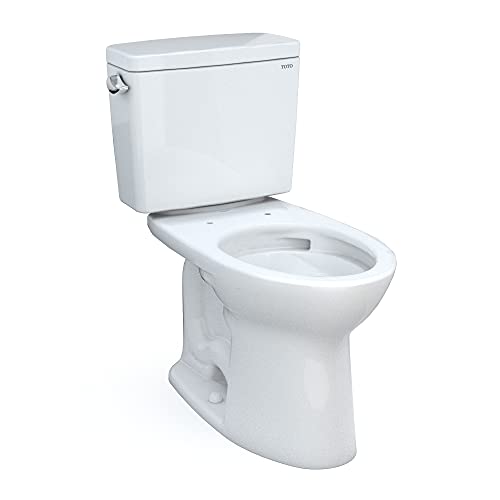
The Drake II takes everything that made the original Drake a benchmark and wraps it in a fully skirted body, so you get the same hard flush with a side that wipes clean in one pass.
The Drake II uses TOTO's G-Max flushing system, a wide 3-inch flush valve feeding a fully glazed computer-designed trapway, which is why a 1.28 GPF skirted toilet clears a 1,000 gram MaP load. The skirt is added porcelain around that channel and does nothing to slow the siphon.
Owner reviews consistently praise how little effort the smooth sides take to clean compared with an exposed trapway, along with strong flush and clog resistance. The most common note is that the skirted design uses a mounting bracket, so installation has one extra step versus a standard two-bolt toilet.
If someone asks for one skirted toilet that does everything right, this is it. It proves you can have the showroom-clean flat side and a 1,000 gram flush at the same time, which is exactly why we make it our default skirted recommendation across the site.
The original Drake is the exposed trapway benchmark, delivering the same 1,000 gram flush as its skirted sibling at a lower price and with the simplest possible installation.
The Drake's exposed trapway shows the classic S-curve contours on the outside of the bowl, the part that takes more effort to clean. Inside, the same G-Max siphon and 3-inch flush valve drive a strong flush, which is why it matches the skirted Drake II gram for gram on MaP testing.
Owner reviews are overwhelmingly positive on flush strength, reliability and value, with the brand's reputation a recurring theme. The most common caution is exactly the trade-off this guide is about: the exposed trapway needs more careful cleaning than a flat skirt.
When a buyer wants maximum flush per dollar and does not mind cleaning a contoured base, the exposed Drake is the toilet we point them to. It is the same proven flush as the skirted version, so the only thing you trade for the lower price is the easy-wipe side.

The T-0019 brings the fully skirted, concealed-trapway look in a sleek one-piece body at a value price, with dual-flush efficiency and a smooth side that wipes clean.
The T-0019 is a one-piece toilet, which means the tank and bowl are a single seamless casting, and combined with the skirted trapway it has the fewest crevices of any common design to clean. The dual-flush siphon jet system clears an 800 gram MaP load while letting you use less water on liquid flushes.
Owner reviews highlight the modern look, the soft-close seat included in the box and the genuinely easy cleaning, with the main cautions being that Woodbridge is a value brand rather than a heritage name and that the flush, while strong, is a notch below TOTO's 1,000 gram models.
For the buyer who wants the clean, flat-sided modern look without paying premium-brand money, the T-0019 is the smart pick. A one-piece skirted body is the easiest toilet shape there is to keep clean, and getting that at a value price is a genuinely good deal even if the warranty is shorter than the heritage brands.
The short, direct answers to the comparisons people search for most.
The trapway skirt is one of several body choices you make when buying a toilet.
Trapway style sits alongside the other body decisions worth thinking through together. The one-piece versus two-piece choice overlaps closely with skirting, since most one-piece toilets are also skirted or smooth-sided, giving the fewest crevices of all; the comparison of one piece vs two piece toilets covers that trade-off in full. Bowl shape is a separate decision again, and the guide to round vs elongated toilets explains how comfort and footprint differ. To bring all of these choices together, the complete walkthrough in how to choose a toilet for 2026 sequences every spec in the order that matters. Across all of these, the same brands lead: TOTO sets the flush-engineering benchmark with skirted and exposed Drakes alike, Kohler leads on design with skirted models like the Santa Rosa and Cimarron, American Standard and Gerber deliver strong value flushing with the Cadet 3 and Viper, and Woodbridge and Swiss Madison bring modern skirted styling at value prices.
Here is the buying-guide shortcut we would give a friend. First, decide how much you care about cleaning: if scrubbing the base annoys you, go skirted, ideally a one-piece skirted model for the fewest crevices. Second, ignore the skirt question entirely when judging performance and filter by MaP score, buying nothing below 600 grams. Third, pick from TOTO, Kohler or Woodbridge. Do those three things and the skirted versus exposed debate becomes purely a cleaning-and-budget call, because your toilet will flush hard either way.
The trade-off here is refreshingly clear because it does not involve flush power at all. A skirted trapway and an exposed trapway from the same family post the same MaP scores, since the skirt is only an outer porcelain wall around an unchanged flush channel. So the decision comes down to three real things: a skirted toilet is dramatically easier to clean and looks more modern, while an exposed toilet costs less, installs with a simpler two-bolt method and offers a wider budget selection. For most buyers who value a low-maintenance, good-looking bathroom, the skirted design is worth the modest premium and pays it back every cleaning day. For landlords, basic bathrooms and the tightest budgets, a strong-flushing exposed model is still the smart buy. Either way, choose a model with a MaP score of 800 grams or higher and check the current price on Amazon for the exact model you pick.
Choose a skirted trapway for most modern bathrooms and start with the TOTO Drake II, which clears a 1,000 gram MaP load behind a flat side that wipes clean in seconds. Step down to the Woodbridge T-0019 for the same easy-clean look at a value price. Reserve the exposed trapway and the original TOTO Drake for the lowest cost, the simplest install or a rental. The flush is identical, so let cleaning and budget decide.
The trapway is the curved, S-shaped channel inside a toilet that carries waste from the bowl down into the drain line. It holds the standing water that seals out sewer gas and is the path the flush pushes waste through. Its diameter is a key factor in clog resistance, and whether it is visible on the outside of the bowl defines whether the toilet is exposed or skirted.
A skirted trapway means the manufacturer has extended the porcelain outer wall of the bowl straight down to the floor in a smooth, flat skirt that hides the curved flush channel. The trapway still exists inside, it is simply concealed. The result is a clean vertical side with no ridges or crevices, which is much faster to wipe clean than a traditional contoured bowl.
It depends on your priorities. A skirted toilet is easier to clean and looks more modern, which most buyers value highly. An exposed trapway toilet costs less, installs more simply and offers a wider budget selection. Neither flushes better, since the internal channel is the same. For a low-maintenance bathroom, skirted wins; for the lowest cost, exposed wins.
No. The skirt is only an outer wall and does not change the trapway diameter or flush system, which are what actually determine clog resistance. A skirted toilet with a high MaP score and a wide glazed trapway resists clogs exactly as well as an exposed model with the same internals. Clog risk comes from a small trapway and weak flush, not from the skirt.
Skirted toilets cost more because they require more porcelain and more precise casting to form the flat outer wall, and they cluster in the mid-range and premium tiers where brands add stronger flush systems and better glazes. The skirt itself is a modest premium over the equivalent exposed model. The added cost buys cleaning ease and a modern look, not a stronger flush.
Yes, though it adds one step over a standard install. Most skirted toilets hide the floor bolts, so you first attach a mounting bracket or plate to the floor flange, then lower and slide the toilet onto it. The instructions are clear and the job is well within DIY range, but it is unfamiliar compared with the standard two-bolt method, so read the directions before starting.
In nearly all cases yes. Skirted toilets are designed to work with the same standard 12-inch rough-in and floor flange as other toilets, using their included mounting bracket. A few designs are fussier about alignment, so always confirm the rough-in measurement and read the mounting instructions before buying. The skirt does not require special plumbing, only the bracket-based mounting method.
The terms overlap but are not identical. A fully skirted toilet has a flat side all the way to the floor. A concealed trapway toilet hides the bumps of the S-curve but may still have a slightly contoured base rather than a perfectly flat skirt. A standard exposed trapway shows the full curve. If easy cleaning is the goal, look for fully skirted or concealed trapway in the spec sheet.
Most are, but not all. One-piece toilets fuse the tank and bowl into a single casting, and the majority are also skirted or smooth-sided, giving the fewest crevices of any design. A handful of one-piece models still show some trapway contour. If you want the absolute easiest toilet to clean, a one-piece skirted model combines the seamless tank-to-bowl join with the flat side.
No. MaP, the Maximum Performance flush test, measures how many grams of solid waste a toilet clears in one flush, and it depends on the internal flush system, valve and trapway diameter, none of which the outer skirt changes. Skirted and exposed versions of the same toilet family post the same MaP scores. Use MaP to judge flush power and treat the skirt as a separate cleaning-and-style choice.
TOTO leads with skirted models like the Drake II, UltraMax II and Vespin II, all carrying strong MaP scores. Kohler offers excellent skirted designs such as the Santa Rosa and Cimarron, Swiss Madison and Woodbridge bring modern skirted styling at value prices, and American Standard has skirted options in its lineup. Across all of them, choose a model with a MaP score of 800 grams or higher.
The exposed trapway dominates the value tier, so almost every brand offers strong options. The TOTO Drake and Entrada, the American Standard Cadet 3, the Kohler Highline, the Gerber Viper and the Swiss Madison and Woodbridge value lines all include exposed models that flush hard for the price. As always, judge them on MaP score rather than the trapway style, and 800 grams or higher is the high-performance range.
Essentially yes. The Drake II is the skirted member of the Drake family, sharing the same G-Max flush system, 3-inch flush valve and 1,000 gram MaP performance as the exposed original Drake. The main differences are the concealed trapway, the universal-height comfortable seat and a slightly higher price. If you like the Drake but want the easy-clean flat side, the Drake II is the direct upgrade.
No. A skirted toilet uses the same standard seats and the same flush valves, fill valves and flappers as any other toilet of its bowl shape. The only design-specific hardware is the floor-mounting bracket that comes in the box. When buying a replacement seat, match the bowl shape, round or elongated, exactly as you would for an exposed toilet. Parts availability is not a concern with skirted designs.
This is a fair concern. Because the skirt encloses the base, a slow leak at the wax ring is less visible than on an exposed toilet where you might see water at the base sooner. The risk is small with a correct installation, but it is a reason to install carefully, set the toilet right the first time and check the floor around the base periodically. A proper seal lasts for years regardless of the skirt.
Not meaningfully. The skirt follows roughly the same footprint as the bowl above it, so a skirted toilet occupies about the same floor area as the exposed version of the same model. The dimension that matters for fit is still the rough-in and the overall bowl length, round or elongated. Measure those before buying and the skirt will not create a space problem in a normal bathroom layout.
Not at all. The exposed trapway is the traditional design and remains the most common and most affordable, found on many of the best-flushing toilets available. It looks more classic than a skirt, which some buyers prefer, and it installs more simply. It is a perfectly good choice, especially for budget builds and rentals. Skirted is a newer style trend, not a performance upgrade that makes exposed obsolete.
For a rental, an exposed trapway toilet usually makes more sense. It costs less, installs with the simple two-bolt method any handyman knows, and parts are cheap and universal. Tenants are not maintaining a skirt to a showroom finish anyway, so the cleaning advantage of skirted is largely lost. Spend the savings on a reliable brand with a high MaP score, like the TOTO Drake or American Standard Cadet 3.
The skirt itself does not affect water use, but skirted toilets are widely available in WaterSense-certified 1.28 GPF and dual-flush versions. WaterSense certification depends on the toilet using 1.28 gallons per flush or less while passing flush-performance testing, which is about the internal design, not the skirt. So you can absolutely get a skirted toilet that is WaterSense certified and saves water, such as the TOTO Drake II.
When you flush, where does it go? Follow toilet water from the bowl through the trap, drain, and stack to a septic…
Read the guideDo toilets need electricity to flush? Most do not. Learn which toilets use power, how a standard flush works, and how to…
Read the guideFind out how many gallons per flush an old toilet really uses, how to check your own tank, and how much water…
Read the guide