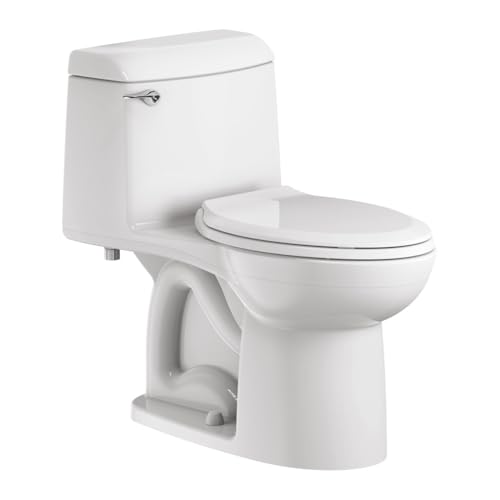
Quick Answer
Pick pressure assist only for a specific job. A Flushmate-equipped pressure toilet like the Kohler Highline Pressure Lite delivers the strongest, most clog-proof flush for high-traffic or chronic-clog bathrooms. For everyone else, a dual-flush model such as the TOTO Aquia IV is quieter, saves more water, and clears a full load on its 1,000-gram MaP full flush.
These two toilet technologies sit at opposite ends of the design spectrum, and that is exactly why buyers compare them. A pressure-assisted toilet hides a sealed air vessel inside the ceramic tank and fires water into the bowl with a force gravity cannot match, putting raw clearing power first. A dual-flush toilet, which is a gravity toilet under the surface, gives you two buttons instead: a reduced flush for liquid waste and a full flush for solids, putting water savings and quiet operation first. One is engineered for brute force, the other for efficiency. The choice decides how loud your bathroom is, how much water your home uses, and how confidently the toilet handles a heavy load.
This guide settles the pressure assist vs dual flush question head to head using published MaP (Maximum Performance) flush-test gram scores, EPA WaterSense certifications, gallons-per-flush ratings, flush-valve and trapway dimensions, and aggregated owner ratings across major retailers. The short version is that pressure-assist is a focused tool for the punishing jobs gravity sometimes struggles with, while dual-flush covers the broad middle of the market where water savings, quiet and strong-enough flushing all matter at once. For the widest cross-type ranking, the pillar guide to the best flushing toilets ranks every system together; this page stays locked on the pressure-assist versus dual-flush decision.
How we research and compare
We do not test toilets in a lab. We compare manufacturer specifications, published MaP flush-test gram scores, EPA WaterSense listings, gallons-per-flush ratings, flush-valve and trapway dimensions, and aggregated owner ratings across major retailers. Where one flush system clearly suits a use case better, we say so plainly rather than crowning a single universal winner.
At a glance
Pressure assist vs dual flush compared
A side-by-side look using a strong representative of each system: a Flushmate-equipped pressure-assisted toilet (such as the Kohler Highline Pressure Lite) against a top dual-flush model (the TOTO Aquia IV). The tinted cell shows which system tends to lead on that row.
Which is better, pressure assist or dual flush?
For most homes, dual flush is better. It saves the most water through its reduced liquid flush, runs quietly, works on any water pressure, and still delivers a strong full flush that reaches up to 1,000 grams MaP on top models. Pressure assist is the better choice only in high-traffic, commercial-style or chronic-clog settings where its forceful air-driven blast is worth the noise, the fixed water use and the higher service cost.
The honest answer depends on what you value most. If you can point to a punishing high-use environment, or clogs have defeated every gravity-based toilet you have owned, pressure-assist earns its trade-offs and is the surest fix. If instead you rank water savings, quiet operation and a wide selection of models at the top, dual-flush wins clearly and covers the broad middle of the market. Once buyers list their real priorities, most find a strong dual-flush model covers them, which is exactly why pressure-assist stays a focused niche while dual-flush keeps gaining share.
That balance was not always so even. A generation ago, when low-flow gravity toilets often flushed weakly, pressure-assist was the only reliable way to clear a heavy load on reduced water, and it earned a loyal following. Engineering has since closed the gap. Oversized flush valves, computer-modeled bowls and advanced rinse systems now let a dual-flush toilet deliver a powerful full flush while sipping water on the liquid setting. The old reason to accept pressure-assist noise, raw power on low water, has mostly evaporated for ordinary home use, leaving pressure-assist as a specialist rather than a default.
How does a pressure-assisted toilet work?
A pressure-assisted toilet hides a sealed plastic vessel inside the ceramic tank. As the tank refills, incoming water-line pressure compresses a captive pocket of air inside that vessel. When you flush, the compressed air blasts the water into the bowl with far more force than gravity alone, clearing the bowl in a fast, forceful surge. The result is the strongest flush and excellent clog resistance, traded against a loud whoosh, one fixed volume per flush, and a sealed cartridge that costs more to service.
The heart of nearly every residential pressure-assisted toilet sold in North America is a Flushmate cartridge, made by the Sloan-owned brand whose name has become shorthand for the technology. The Flushmate vessel sits inside the toilet's ceramic tank but holds water and air separately. As the toilet refills after a flush, the home's water-supply pressure, anywhere from about 25 to 80 psi, squeezes a pocket of trapped air. Pressing the flush button releases that pressurized water through a wide opening straight into the bowl, where it arrives as a sudden, violent rush rather than the gentle pour of a gravity or dual-flush toilet.
Because the water enters under pressure, a pressure-assisted toilet does not rely on bowl geometry to build a siphon; the blast does the work. That is why pressure-assist excels at clearing bulk and resisting clogs even at low water volumes, and why these toilets are the default in busy commercial restrooms, offices and high-use public buildings. The trade-off is unmistakable the instant you flush: a loud, compressed whoosh that no one confuses for a quiet home toilet. The sealed vessel is also a specialized part, so when something fails you replace the Flushmate cartridge rather than a generic flapper from any hardware store. And unlike a dual-flush toilet, a pressure unit gives you one fixed volume every time, with no reduced setting for liquids.
How does a dual-flush toilet work?
A dual-flush toilet is a gravity-fed toilet with two flush volumes, set by a split button or lever: a reduced flush near 0.8 to 1.0 gallons for liquids and a full flush near 1.28 gallons for solids. The weight of falling water starts a siphon, with no air pressure, pump or electricity. By using less water for the most frequent trips, a dual-flush toilet averages well below a fixed 1.28-gallon single-flush model over real use.
When you press a dual-flush button, a top-mount flush valve releases either a partial or a full charge of tank water into the bowl. The reduced setting opens the valve briefly, sending just enough water to wash liquid waste and paper through the trapway. The full setting dumps the entire stored volume to start a strong siphon that clears solids in one pass. Everything below the surface is ordinary gravity flushing, so a dual-flush toilet stays quiet and mechanically simple, with no sealed pressure vessel to fail.
The engineering that separates a strong dual-flush toilet from a weak one lives in the same places it does for any gravity toilet: a wide flush valve that dumps water fast, a computer-modeled and fully glazed bowl and trapway, and an effective rinse pattern that scours the bowl. Models like the TOTO Aquia IV pair a 0.8 and 1.28 gallon set of flushes with a Dynamax Tornado rinse and a glazed CeFiONtect trapway, while Kohler dual-flush designs in the Cimarron and Santa Rosa families and the Swiss Madison St. Tropez deliver the same two-volume convenience. Get the valve, bowl and rinse right and a dual-flush toilet flushes its full setting as hard as a strong single-flush gravity model while saving water on every liquid trip.
Tip: pair the flush system with the MaP score
Neither system guarantees a strong flush on its own. Even a pressure unit can underperform if the bowl is poorly matched, and a cheap dual-flush toilet with a narrow valve can flush weakly on the full setting. Always check the model's MaP (Maximum Performance) gram score, an independent flush test. Anything above 600 grams handles a typical household; the best models in both categories reach 1,000 grams. Buy on the MaP number, not the marketing.
Which toilet has the strongest flush?
Pressure-assisted toilets deliver the strongest raw flush because compressed air fires water through the bowl far faster than gravity can. However, the best dual-flush toilets like the TOTO Aquia IV reach 800 to 1,000 grams on the MaP test with their full flush, so both clear a heavy household load in one pass. Pressure assist wins on sheer blast and bulk-clearing margin; top dual-flush models match measured performance on the full setting while staying far quieter and saving water on liquids.
This is the question that pulls many buyers toward pressure-assist, and the honest answer has two layers. On pure physics, pressure-assist hits harder. The compressed-air surge moves water through the bowl at a speed gravity simply cannot reach, so it blasts bulk waste out in a single forceful event with margin to spare. In a setting where the toilet sees constant heavy use, that extra headroom is genuine insurance against a backed-up bowl, and it is the reason pressure-assist remains the standard in commercial buildings.
But the MaP flush test, which measures how many grams of solid waste a toilet clears in one flush, tells the more practical story. The ceiling is 1,000 grams, and a Flushmate-equipped pressure toilet posts that 1,000-gram score, matched against the 800 to 1,000 grams the strongest dual-flush models reach on the full setting. For a normal household, that means both flush a heavy load in one pass, every time, as long as you use the dual-flush toilet's full button for solids. The pressure unit holds more theoretical margin above what any home actually demands, while the top dual-flush unit delivers all the clearing power a family needs without the noise and with real water savings on top. So pressure-assist flushes harder, but for most homes, a strong dual-flush model flushes hard enough. For the toughest gravity flushers ranked head to head, the TOTO Drake vs UltraMax II comparison shows how two of the strongest gravity models stack up.
What is the best toilet for preventing clogs?
Pressure-assisted toilets have a slight edge for chronic clog problems because their forceful air-driven blast pushes bulk waste through the trapway with extra margin. That said, a dual-flush toilet with a wide, fully glazed trapway used on its full setting resists clogs nearly as well while staying quiet and saving water. For most homes, a high-MaP dual-flush toilet is enough; for a bathroom that clogs no matter what, pressure-assist is the surest fix.
Clog resistance depends on two things working together: how forcefully water moves through the bowl, and how wide and smooth the trapway is for waste to pass. Pressure-assist wins the first half outright, since its blast simply has more energy to drive solids out. That is why it stays popular in settings where clogs would be a constant headache, like heavily used public restrooms and busy offices, and why a household that has fought recurring backups often finds peace with a Flushmate unit.
Dual-flush competes on the second half, with one caveat: you have to use the full flush for solids. A wide trapway physically passes more bulk in a single flush, and a fully glazed surface stops waste from catching on the way through. A dual-flush TOTO with a glazed CeFiONtect trapway clears a heavy load cleanly on the full button, while gravity workhorses like the American Standard Champion 4, with its oversized 2.375-inch trapway and 4-inch flush valve, set the bar for clog resistance. So for a household that fights recurring clogs, pressure-assist is the surest fix, but a wide-trapway dual-flush toilet used correctly usually solves the problem too. Our guide to the best toilet for frequent clogs covers both routes, the American Standard Champion 4 vs Cadet 3 comparison shows how trapway width changes clog resistance within one brand, and the best pressure-assisted toilets roundup ranks the strongest Flushmate models.
Why are pressure-assisted toilets so loud?
Pressure-assisted toilets are loud because they release compressed air along with the water, producing a sharp, forceful whoosh as the pressurized charge empties into the bowl. Dual-flush toilets only pour water and start a quiet siphon, so they run far quieter on either setting. The noise is inherent to how pressure-assist works and cannot be fully eliminated, which is why these toilets are rarely chosen for bedrooms or quiet homes.
The sound comes directly from the mechanism. In a pressure-assisted toilet, the captive air that was compressed during refill is released all at once, and that rapid expansion of air pushing water into the bowl makes the characteristic bang or whoosh. It is the same reason a pressure release on any system is louder than a gentle pour. In a dual-flush toilet, by contrast, water simply falls and a siphon forms, so the loudest thing you hear is the gurgle at the end and the refill afterward, no different from any quiet gravity toilet.
For many buyers this single factor decides the matter. A pressure-assisted toilet in a master bathroom that shares a wall with the bedroom, or in an open-plan home or a small apartment, can be genuinely disruptive at night. A dual-flush toilet stays quiet on both buttons, which makes it a natural fit for bedrooms and living spaces. In a commercial restroom or a basement utility bath where noise is irrelevant, the whoosh is a non-issue and the clearing power is pure upside. If quiet ranks high, our roundup of the best quiet flush toilets leans heavily toward gravity and dual-flush for exactly this reason.
Which toilet saves the most water?
Dual-flush toilets save the most water because their reduced liquid-only flush, often near 0.8 to 1.0 gallons, handles the majority of daily trips while the full flush stays in reserve for solids. Over real household use a dual-flush toilet averages well below 1.28 gallons, while a pressure-assisted toilet uses its single fixed volume every time. Both can be EPA WaterSense certified, but dual-flush delivers the lower real-world average.
Water use is where these two systems separate most clearly, and it is the heart of the matchup. A pressure-assisted toilet fires its single charge every flush, whether you flushed a tissue or a heavy load. Many pressure units are EPA WaterSense certified at 1.28 gallons or even lower, so they are far from wasteful, but they cannot vary their volume from trip to trip the way a dual-flush toilet can.
A dual-flush toilet's reduced setting cuts water on the majority of flushes, because most toilet trips are for liquid waste. A model rated 0.8 and 1.28 gallons might average somewhere around one gallon per flush across a real household, depending on how often the full button gets used, which beats any fixed single-volume toilet over a year of use. If trimming the water bill and qualifying for utility rebates rank high, dual-flush is the stronger water saver. Our roundup of the best dual-flush toilets ranks the most efficient models, and the deeper 1.28 GPF vs 1.6 GPF comparison explains what the water numbers mean for your bill and your drains.
Which is cheaper to repair and maintain?
Dual-flush toilets are cheaper to repair than pressure-assisted toilets. While their top-mount flush valve is slightly more complex than a basic flapper, parts are brand-stocked and a homeowner can usually swap them. Pressure-assisted toilets rely on a specialized Flushmate cartridge that costs more, is harder to source, and usually means replacing the whole pressure vessel rather than a single washer.
Over a toilet's 15 to 20 year life, maintenance cost is where the two systems diverge. Pressure-assist is the harder of the two to service. The Flushmate vessel is sealed and pressurized, so when it fails you replace the entire cartridge rather than a single component, and those cartridges are pricier and less widely stocked than common gravity parts. There have also been past Flushmate recalls tied to the pressure vessel, worth knowing even though current units are redesigned, so keep the model number handy for ordering the correct cartridge.
A dual-flush toilet is the simpler proposition. It uses a top-mount flush valve and dual-button assembly, which is marginally more involved than a single flapper but still a gravity component you can buy from the manufacturer and replace yourself. Seals on the flush valve can wear and occasionally cause a slow leak, the one quirk worth watching, but the fix is inexpensive and the rest of the toilet is as simple as any gravity model. None of this makes pressure-assist a bad buy, but if long-term simplicity and cheaper repairs rank high on your list, dual-flush is the easier toilet to live with.
Tip: check water-line pressure before buying pressure-assist
A Flushmate unit needs a minimum supply pressure, typically around 25 psi, to recharge its air pocket properly. In homes with low or fluctuating water pressure, a pressure-assisted toilet can underperform or fail to build a full charge. Dual-flush toilets have no such requirement and work on any supply. If your house is on a well or known for weak pressure, a dual-flush toilet is the safer bet.
Are both systems WaterSense certified?
Yes. Both pressure-assisted and dual-flush toilets are widely available in EPA WaterSense-certified versions, so both can qualify for local utility rebates. Pressure-assisted toilets meet WaterSense at a fixed 1.28 gallons or lower, while dual-flush toilets average the lowest real water use thanks to their reduced liquid flush. Either system in a certified model cuts water use meaningfully versus an old 1.6-gallon toilet.
Both systems carry the EPA WaterSense label across most current models, so both can qualify for the water-utility rebates that often require it. The difference is in how they get there. A pressure-assisted toilet meets the standard with a single fixed volume, usually 1.28 gallons, that applies to every flush. A dual-flush toilet earns its certification and then beats it in practice, because the reduced liquid flush pulls the real-world average below the rated full-flush volume.
For a buyer focused purely on the lowest possible water bill, the dual-flush averaging advantage is real and adds up over years of use. For a buyer who simply wants to clear the rebate bar and use far less than an old 1.6-gallon toilet, either system does the job. If you want to dig into the efficiency side, our roundup of the best EPA WaterSense certified toilets lists strong certified models across systems, and the best low-flow toilets guide ranks the most water-thrifty designs of both types.
Editorial TakeIf we had to hand one rule to a buyer choosing between these systems, it would be this: only reach for pressure-assist if you can name the specific problem it solves. A high-traffic restroom, a rental that punishes its plumbing, or a bathroom that clogs no matter what you install, those are the cases where the air-driven blast genuinely earns its noise, its fixed water use and its higher repair cost. For a water-conscious home, a normal family bathroom, a bedroom-adjacent bath, or a remodel chasing the lowest water bill, a top dual-flush model like the Aquia IV is the smarter default, and you will not miss the margin you never needed.
Choose a pressure-assisted toilet if
A pressure-assisted toilet earns its place when raw blast solves a real problem. Choose pressure-assist if the toilet sits in a high-traffic or commercial-style setting, like a busy office, a rental with heavy turnover, or a household that simply punishes its plumbing, where the extra clearing margin pays for itself. Choose it if you have fought chronic clogs that a wide-trapway dual-flush or gravity toilet has not fixed, since the air-driven surge is the surest way to drive bulk through. Choose it if an aggressive bowl scour matters to you. And choose it accepting the trade-offs: a loud flush, one fixed water volume per flush, a higher repair cost tied to the Flushmate cartridge, and a need for adequate supply pressure of around 25 psi or more.
Solid pressure-assisted models center on Flushmate-equipped designs, including the Kohler Highline Pressure Lite, American Standard pressure-assisted lines and Gerber pressure models. Because the niche is small, our best Flushmate pressure toilets roundup focuses on the units worth owning. If you are weighing American Standard against another value brand for this duty, the Kohler vs American Standard toilets comparison is a useful next read.
Choose a dual-flush toilet if
A dual-flush toilet is the right pick for the broad middle of the market. Choose dual flush if cutting your water bill matters, since the reduced liquid flush trims water on most daily trips and averages well below a fixed 1.28-gallon single-flush toilet. Choose it if quiet operation matters at all, because its gravity siphon is dramatically quieter than any pressure-assisted whoosh, which makes it the obvious choice for bedrooms, apartments and open-plan homes. Choose it if your home has low or variable water pressure, since gravity works on any supply while pressure-assist needs a minimum to recharge. And choose it knowing the top models flush their full setting as hard as a strong single-flush gravity toilet, reaching up to the 1,000-gram MaP ceiling.
Strong dual-flush models to look at include the TOTO Aquia IV (quiet two-button flushing with a glazed trapway), Kohler dual-flush designs in the Cimarron and Santa Rosa families (reliable value), the Woodbridge T-0019 for a sleek one-piece, the Swiss Madison St. Tropez for modern style, and brand dual-flush lines from American Standard and Gerber for trade-grade value. For the full ranking, see the best dual-flush toilets guide.
Top recommendations
Three picks that settle the choice
One true pressure-assist for high-traffic duty, one clog-busting gravity workhorse, and one quiet water-saving all-rounder for most homes. Each is a proven model with a strong MaP score.
Best Pressure-Assist
Kohler Highline Pressure Lite
High-traffic, commercial-style duty
A Flushmate air-charged blast clears the bowl with maximum force and margin, the right tool when raw clearing power outranks quiet operation and water savings.
Check price on Amazon
Most Clog-Free (Gravity)
American Standard Champion 4
Households that fight clogs
A 2.375-inch trapway, the widest in the class, plus a 4-inch flush valve clear bulk waste in a single pass without the noise of a pressure unit.
Check price on Amazon
Best Overall (Dual Flush)
TOTO Aquia IV
Quiet water savings for most homes
A 0.8 and 1.28 gallon dual flush with a quiet Dynamax Tornado rinse and a glazed CeFiONtect trapway, pairing strong clearing on the full button with real water savings on liquids.
Check price on Amazon
Is a pressure-assisted toilet worth it for a home?
For most homes, no. A pressure-assisted toilet delivers more flush force than a household actually needs, and you pay for it with a loud whoosh, a fixed water volume every flush, and a costlier sealed cartridge to service. It becomes worth it only when a specific problem, like a high-traffic bathroom or a chronic clog a gravity toilet cannot fix, justifies the trade-offs. Otherwise a strong dual-flush model is the more livable choice.
The case against pressure-assist for an ordinary home is not about performance, which is excellent, but about fit. Flush power above 1,000 grams MaP is margin no normal household uses, so the extra force buys insurance you rarely cash in, while the noise, the fixed volume and the higher repair cost are costs you pay on every flush and every service call. For a busy commercial-style setting or a bathroom that clogs no matter what, that math flips, and the headroom is exactly what you want.
The honest trade-off, then, is matching the tool to the job. If your toilet lives a normal home life, a quiet dual-flush or gravity model used correctly clears everything you throw at it while saving water and keeping the bathroom peaceful. If your toilet lives a hard life, pressure-assist is the surest way to keep it clear. For buyers still mapping the broader decision, the best flushing toilets pillar guide and the brand-level TOTO vs Kohler toilets comparison walk through every spec that matters.
How to decide between the two systems
The cleanest way to choose is to rank your priorities before you shop. If the toilet lives in a punishing high-use environment, or clogs have defeated every gravity-based toilet you have tried, pressure-assist is worth its trade-offs, and you should confirm your home has at least 25 psi of supply pressure and keep the Flushmate model number handy. If water savings, quiet operation and broad model selection sit at the top, dual-flush is your answer, and you should filter for a strong full-flush MaP score, ideally 800 grams or higher, in a body style you like. Most buyers, once they list their priorities honestly, find that a strong dual-flush model covers them, which is exactly why it keeps gaining ground while pressure-assist stays a focused niche.
Editorial TakeThe mistake we see most often is buying pressure-assist for a normal home bathroom because someone wanted the strongest flush on paper, then regretting the noise every night and the wasted water on every liquid trip for a decade. The flip side is just as real: buyers in genuinely high-traffic or chronic-clog situations who keep installing quiet gravity toilets and keep reaching for the plunger. Read your own bathroom honestly. If you cannot name a high-traffic or chronic-clog reason, buy the quiet dual-flush toilet, use the full button for solids, and enjoy the lower water bill. If you can name one, buy the pressure unit and stop fighting your plumbing.