Why Toilet Trapways Are Curved Like an S
Toilets4.6
Learn why toilet trapways curve like an S, how each bend blocks sewer gas, and what the shape means for clogs and…
Read the guidePressure assisted toilets use compressed air to blast water through the bowl, delivering the most forceful flush you can install in a home. These picks are ranked on MaP flush-test scores, flush technology, water use, clog resistance and aggregated owner reviews so you get raw power without buying the wrong fixture.
The strongest pressure assisted toilet is the American Standard pressure assisted line built on the Flushmate 503 vessel, posting a 1,000-gram MaP score at just 1.0 gallon per flush. For a budget powerhouse the Gerber Viper pressure model is the value pick, while the Zurn EcoVantage leads commercial-grade installs.
A pressure assisted toilet works on a different principle from the gravity toilet in most homes. Instead of relying on the weight of falling water to pull waste out of the bowl, it stores household water line pressure inside a sealed plastic vessel in the tank, compressing a pocket of air as the vessel fills. When you press the flush, that compressed air releases all at once and fires the water through the bowl in a hard, fast surge. The result is the closest thing to a commercial flush you can legally install in a residential bathroom, which is exactly why pressure assist is the answer for households that fight recurring clogs or run a single bathroom hard.
This guide treats pressure assist as a real engineering trade-off rather than a magic upgrade. We lean on the MaP (Maximum Performance) test, an independent benchmark that measures how many grams of solid waste a toilet clears in a single flush, where 600 grams is very good and 1,000 grams is the maximum the test awards. We weigh that against water use in gallons per flush, EPA WaterSense status, flush noise, the trapway design and the pattern of aggregated owner reviews across major retailers. Nearly every pressure assist toilet on this list is built on a Flushmate or comparable sealed-vessel cartridge, so we explain how that part behaves over years of use. For the wider view across every flush type, see our pillar guide to the best flushing toilets.
The best pressure assisted toilet is an American Standard model built on the Flushmate 503 vessel, because it pairs the strongest commonly available pressure flush with a perfect 1,000-gram MaP score and uses as little as 1.0 to 1.28 gallons per flush. The Gerber Viper pressure model is the best value alternative, and the Zurn EcoVantage is the top choice for commercial-grade durability in a high-traffic bathroom.
Almost every residential pressure assist toilet sold in North America uses a Flushmate vessel, the sealed black tank-within-a-tank you see when you lift the lid. That means the flush force is largely consistent across brands, and the real differences come down to the bowl and trapway the manufacturer wraps around it, the MaP score that combination achieves, and how much water the vessel is tuned to use. American Standard offers the widest, best-reviewed range of Flushmate-equipped bowls, which is why it leads, but a Gerber, Kohler or Zurn pressure model built on the same cartridge flushes nearly as hard.
Eight real models chosen for flush force, clog resistance and value, sorted by how well they balance raw power, water use and long-term owner satisfaction. A higher MaP score means more waste cleared in one flush.
| Toilet | Best For | MaP | GPF | Rating | Check Price |
|---|---|---|---|---|---|
| American Standard FloWise (Flushmate) | Best overall | 1,000 g | 1.0 | 4.5 | Check price |
| Gerber Viper Pressure | Best value | 1,000 g | 1.28 | 4.4 | Check price |
| Zurn EcoVantage | Commercial grade | 1,000 g | 1.28 | 4.4 | Check price |
| American Standard Champion PRO | Strongest flush | 1,000 g | 1.6 | 4.5 | Check price |
| Kohler Highline Pressure Lite | Best brand support | 1,000 g | 1.0 | 4.4 | Check price |
| American Standard Yorkville | Best ADA height | 1,000 g | 1.1 | 4.5 | Check price |
| Gerber Avalanche Pressure | Best two-piece value | 1,000 g | 1.28 | 4.3 | Check price |
| American Standard Cadet PRO Round | Best compact pick | 1,000 g | 1.1 | 4.4 | Check price |
The strongest residential flush comes from a 1.6-gallon pressure assisted toilet such as the American Standard Champion PRO, because more water under the same compressed-air pressure clears more waste. It and the other Flushmate-equipped models on this list all reach a perfect 1,000-gram MaP score, the highest the test awards, and a pressure flush moves waste more forcefully than any gravity toilet at the same gallon rating.
Flush force in a pressure assist toilet is a product of two things: the air pressure the sealed vessel builds from your home water line, and the volume of water that pressure pushes through the bowl. Because the Flushmate vessel pressurizes the same way regardless of bowl, the higher-volume 1.6-gallon models deliver the most raw force, while the 1.0 and 1.1-gallon versions trade a little of that for water savings and still hit the 1,000-gram MaP ceiling. Either way, a pressure flush clears the bowl in a single hard surge that a gravity toilet cannot match at equal water use, which is the entire reason to buy one.
Pressure assisted toilets are among the most clog-resistant toilets you can buy, because the forceful air-driven surge pushes waste fully through the trapway instead of letting it settle. The American Standard Champion PRO and Cadet PRO pressure models lead, pairing a 1,000-gram MaP score with a wide, fully glazed trapway, so a large load clears on the first flush with little chance of catching.
Clogs happen when waste stalls in the trapway because the flush ran out of energy before it finished the job. A pressure flush attacks that problem directly: the compressed-air surge keeps water moving fast all the way through the trap, so waste does not get the chance to settle and bridge. Pair that surge with a fully glazed trapway, which coats the exit path in the same slick finish as the bowl, and you get a toilet that very rarely needs a plunger. For a heavier average load, this combination is the strongest clog insurance on the market. Our roundup of toilets that never clog covers gravity alternatives if noise is a concern.
The Gerber Viper pressure model offers the best value in pressure assisted toilets, delivering a perfect 1,000-gram MaP flush built on a proven sealed-vessel cartridge at a lower price than the premium brands. The American Standard Cadet PRO pressure round bowl is the best value for a compact space, combining strong clog clearance with an efficient 1.1-gallon flush.
Value in a pressure assist toilet is not only the purchase price, because the Flushmate vessel is a serviceable, replaceable part. A pressure model from a major brand like American Standard, Kohler, Gerber or Zurn keeps that cartridge and its seals available for years, which matters when the toilet is run hard daily. Spending a little more on a proven bowl and a brand that stocks the vessel kit usually costs less over the life of the toilet than chasing the cheapest unit, since the flush mechanism is the part that eventually needs a refresh. For a quieter, lower-maintenance option, compare our best toilet for heavy waste picks.
Each pick below is ranked on raw flush force and clog clearance first, then water efficiency, noise and serviceability, cross-checked against aggregated owner reviews.

The American Standard FloWise pressure assisted line is the model to beat, pairing the strongest commonly available pressure flush with the lowest water use on this list. Built on the Flushmate 503 vessel inside an elongated comfort-height bowl, it earns a perfect 1,000-gram MaP score while using just 1.0 gallon per flush, an efficiency-to-power ratio no gravity toilet can match.
The flush uses the sealed Flushmate vessel, which compresses air as the tank fills and releases it in a single hard surge through a fully glazed trapway. That surge keeps water moving fast all the way through the trap, so waste does not stall, and the EverClean glaze slows stain and odor buildup in a bowl that gets used hard.
Owner reviews consistently praise how rarely it clogs and how little water it uses, with the standout complaint being the loud whoosh that every pressure assist toilet shares. The vessel needs at least 25 psi of supply pressure to recharge fully, so confirm your home pressure before buying. The 10-year limited warranty on the porcelain is reassuring for a fixture run this hard.
If you want the single most powerful flush you can install with the least water, this is it. Just be honest about the noise. Put it in a main or guest bathroom rather than an ensuite next to a bedroom, confirm your supply pressure clears 25 psi, and it will clear loads for years that defeat a gravity toilet.
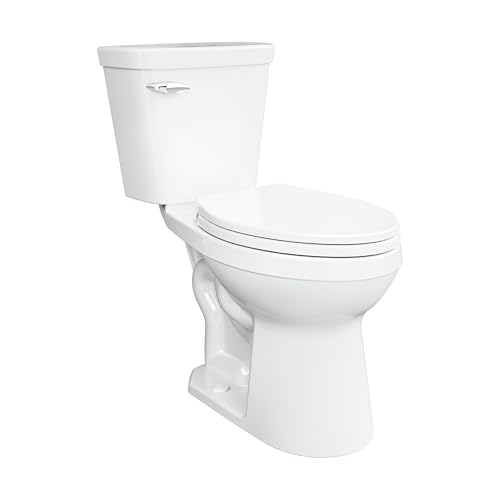
Gerber is a plumber-grade brand most people meet through their contractor rather than a showroom, and the Viper pressure model is its strong-flushing value pick. It is built on the same class of sealed-vessel cartridge as the premium names and posts a perfect 1,000-gram MaP score at 1.28 gallons, usually at a noticeably lower price than American Standard or Kohler.
The pressure flush gives the Viper a hard, decisive surge that clears the bowl in one push, and the gravity Viper sibling shows up in our guide to the strongest flushing toilets for the same clearance. The body is a no-frills floor-mounted two-piece that feels solid and serviceable.
Owner reviews highlight the strong flush and durable build at a lower price than the marquee brands, with most complaints about plain styling and the noise that all pressure assist toilets carry. Because Gerber sells more through trade supply houses than big-box stores, replacement vessel parts and seats can take a little more searching, but the flush performance is genuinely top tier.
The Viper proves you do not have to overspend for a commercial-strength flush. If budget is the constraint and you can live without showroom styling, this is the most flush-for-the-money pressure assist toilet here, and the trade-grade cartridge holds up to hard daily use.

Zurn is a commercial plumbing specialist, and the EcoVantage pressure assist toilet brings that institutional toughness into the home. It is built for bathrooms that get hammered with use, posting a perfect 1,000-gram MaP score at 1.28 gallons on a sealed-vessel flush engineered to survive years of constant cycling.
The EcoVantage is the pick when the toilet will be used like a public restroom fixture, in a busy household, a basement apartment or a workshop bathroom. The pressure flush keeps water moving fast through the trapway so waste clears completely, and the heavy-duty construction resists the wear that ends cheaper toilets.
Owner and contractor reviews describe it as a workhorse that simply keeps flushing, with the usual pressure assist caveat about noise. Like Gerber, Zurn sells mostly through plumbing supply channels, so styling is purely functional and parts are easiest to source through a supply house, but the core performance is built to commercial standards.
When the toilet will see near-commercial traffic, the EcoVantage is the durability pick. It is overbuilt for a typical home, which is exactly the point: in a basement suite, a large family or a hard-use bathroom, that institutional toughness is what keeps it flushing strong for years.

If your toilet clogs no matter what you do, the Champion PRO pressure assist version is built to end that for good. It combines the Flushmate vessel with American Standard's widest, most aggressive bowl and trapway design, running a full 1.6 gallons per flush for the maximum raw force on this list while still earning a perfect 1,000-gram MaP score.
The extra water volume is the whole point: under the same air pressure, 1.6 gallons moves more waste than a 1.0-gallon model, so this is the toilet for the household that has tried everything and still fights clogs. The wide glazed trapway carries even a large load out with room to spare.
The trade-off is water use, since the 1.6-gallon flush is not WaterSense certified and costs a little more to run than the efficient picks. For a home that values never touching a plunger over a slightly higher water bill, that is an easy call, and the 10-year warranty backs it up. It also features in our guide to the best toilet for heavy waste.
Choose the Champion PRO pressure model when clog resistance is the single priority and the extra water use is acceptable. It is the most forceful flush you can buy for a home, full stop. Reserve it for a problem bathroom rather than a quiet ensuite, because the combination of 1.6 gallons and air pressure is genuinely loud.

The Highline Pressure Lite brings Kohler's enormous parts and service network to the pressure assist category. It takes the familiar, widely stocked Highline bowl and fits it with Kohler's Pressure Lite sealed-vessel flush, reaching the full 1,000-gram MaP ceiling at an efficient 1.0 gallon per flush.
The advantage here is the brand behind it. Kohler stocks Pressure Lite vessel kits and seals through every home center and plumbing supplier, so when the cartridge eventually needs a refresh after years of service, the part is easy to find. The Highline body is one of the most common in American homes, which makes seats and trim easy to match.
Owner reviews praise the strong, efficient flush and the reassurance of Kohler support, with the usual note about pressure assist noise. The shorter base warranty is the main caveat against the American Standard picks, but the depth of available parts offsets it for owners who plan to keep the toilet for the long haul.
If your worry about pressure assist is being stuck with an orphaned part down the road, the Highline Pressure Lite answers it. Kohler's parts depth means the vessel is serviceable for the life of the toilet, which is the reassurance that makes pressure assist a comfortable long-term choice.

The Yorkville pairs a powerful Flushmate pressure flush with an accessible Right Height bowl, putting the seat in the 16.5-inch range that meets ADA guidelines and is far easier to stand from. It earns a perfect 1,000-gram MaP score at an efficient 1.1 gallons, making it the best pressure assist pick for seniors or anyone who values an easy-rise seat.
The Yorkville is a longtime favorite in commercial and accessible installations precisely because it combines a strong, reliable flush with an easy-rise seat height. The pressure surge clears the bowl forcefully on every use, and the durable body is built for the constant cycling of a shared or public-style bathroom.
Owner reviews are strong on the flush power, the accessible height and the 10-year warranty, with the noise being the only consistent caution. For a household with mobility needs that also wants the clog insurance of pressure assist, this is the standout pairing, and it overlaps with our picks for the best flushing toilets on raw clearance.
The Yorkville is the pick when an easy-rise, ADA-height seat matters as much as flush power. It is rare to get a true accessible height and a commercial-strength pressure flush in one fixture, and the 10-year warranty makes it a confident long-term buy.
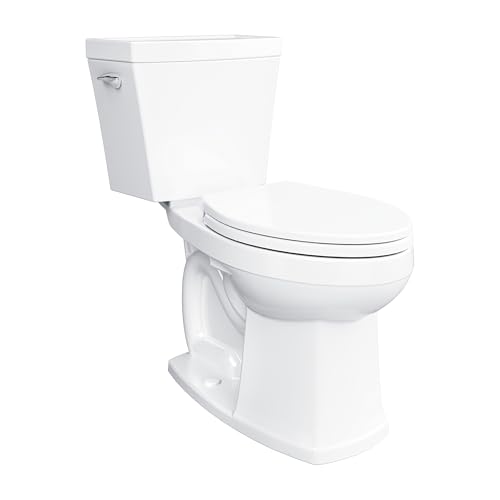
The pressure assist version of Gerber's Avalanche is a strong, sensible value for a secondary or basement bathroom that needs serious flush force without a premium price. It posts a perfect 1,000-gram MaP score at 1.28 gallons on a sealed-vessel flush, in a sturdy floor-mounted two-piece body that is easy to handle during installation.
The Avalanche pressure model gives a secondary bathroom the same hard, clog-clearing surge as the premium picks for less money. The two-piece design is lighter to maneuver than a one-piece, which makes it a friendlier DIY install, and the standard 12-inch rough-in fits most homes.
Owner reviews praise the strong flush and value, with the main cautions being plain styling, an exposed trapway that takes a little more wiping, and the narrower retail availability typical of Gerber. For a basement, garage or guest bath that needs pressure assist power on a budget, it delivers the core performance reliably.
The Avalanche pressure model is the smart secondary-bathroom pick. You get a perfect MaP score and a commercial-style surge for less than the marquee brands, trading only showroom looks and the wide availability that you do not really need for a basement or guest bath.

The round-bowl Cadet PRO pressure model puts a commercial-strength flush into a compact footprint, making it the best pressure assist pick for a tight powder room or small bathroom. The round bowl saves a couple of inches of projection over an elongated one, yet it still earns a perfect 1,000-gram MaP score at an efficient 1.1 gallons.
Where most pressure assist toilets come only in elongated comfort-height forms, this round Cadet PRO is the rare compact option, which makes it the answer for a small bathroom that still needs the clog insurance of a pressure flush. The surge clears the bowl forcefully despite the smaller footprint, and the EverClean glaze keeps it tidy.
Owner reviews are strong on the powerful flush in a space-saving body, with the trade-offs being the less roomy round bowl and the noise common to every pressure assist toilet. For an apartment powder room or a half-bath where space is the constraint, it is the standout pick. It pairs well with our guide to the best flushing toilets for whole-home comparison.
If you want pressure assist power but a tight room rules out an elongated bowl, the round Cadet PRO is the answer that few brands offer. You give up a little seat comfort for a footprint that actually fits, and the 1.1-gallon flush still clears like a commercial fixture.
Across all eight, the pattern is clear: the flush force differences between brands are small because almost every residential pressure assist toilet rides on a Flushmate or near-identical sealed vessel. What really separates the picks is the bowl, the water rating and the brand's parts network. Choose a 1.0 to 1.1-gallon model for the best efficiency, step up to 1.6 gallons only if you fight stubborn clogs, and favor a brand like American Standard or Kohler that stocks the vessel kit so the toilet stays serviceable for the long haul.
The spec sheet and your home plumbing answer most questions before you buy. Focus on these four factors and you will pick a pressure assist toilet that flushes hard, fits your space and stays serviceable.
A pressure assisted toilet does not have a pump; it borrows the pressure already in your water line to charge the sealed vessel. Most Flushmate and comparable vessels need a minimum of around 25 psi of supply pressure to recharge fully between flushes, and 20 to 80 psi is the typical usable range. Before you buy, check your home water pressure with an inexpensive gauge that threads onto a hose bib. If your pressure runs low, on a well system or at the end of a long municipal run, a pressure assist toilet may not recharge properly, and a strong gravity toilet is the better choice. This single check prevents the most common pressure assist disappointment.
Noise is the defining trade-off of pressure assist. The forceful air-driven surge produces a distinct loud whoosh that is noticeably louder than any gravity toilet, and it is the number one complaint in owner reviews across every brand. That noise is not a defect; it is the sound of the compressed air doing its job. For a main bathroom, a guest bath, a basement or a workshop, most owners stop noticing it within days. For an ensuite that shares a wall with a bedroom, or a household sensitive to sound, a high-MaP gravity toilet delivers strong clearance much more quietly. Be honest about where the toilet lives before you commit. For the quiet alternative, see our strongest flushing toilets roundup, where top gravity models reach the same 1,000-gram MaP ceiling.
Pressure assist toilets span 1.0 to 1.6 gallons per flush, and the right number depends on your clog history. A 1.0 or 1.1-gallon model like the FloWise or Yorkville hits the 1,000-gram MaP ceiling with the least water and usually earns WaterSense certification, which makes it the efficient default for most homes. Step up to a 1.6-gallon Champion PRO only if you battle stubborn clogs no matter what, since the extra volume under the same air pressure delivers more raw force at the cost of a higher water bill. Because the MaP score is already maxed across the range, water use is really a choice between efficiency and extra clog insurance.
Even the strongest pressure flush is useless if the toilet does not fit. Rough-in is the distance from the finished wall to the center of the floor drain bolts; most homes use 12 inches, but older houses sometimes have 10 or 14 inches, so measure before you buy. Comfort or Right Height bowls sit around 16.5 inches off the floor and are easier to stand from, while a few models like the round Cadet PRO come in a space-saving standard height. Choose an elongated bowl for everyday comfort, or a round bowl, as on the compact Cadet PRO, when a tight powder room cannot fit the extra length. Confirm all three before ordering so your powerful flusher installs cleanly. For tight spaces, also see our best toilet for heavy waste picks, which weigh trapway width heavily.
A good MaP score is 800 grams or higher, and 1,000 grams is the maximum the test awards. Pressure assisted toilets almost universally hit the 1,000-gram ceiling because the air-driven surge clears waste so forcefully, so among pressure models the MaP score rarely separates the picks. Instead, weigh water use, noise, bowl fit and the brand's parts support, since flush strength is already maxed.
If you can only verify one thing before buying a pressure assist toilet, verify your water pressure, not the MaP score. Every model here already maxes the MaP test, so the flush will be strong on paper. What actually determines whether you are happy is whether your supply line clears 25 psi to recharge the vessel and whether you can live with the noise. Get those two right and any pick on this list will serve you well.
For most buyers the American Standard FloWise pressure assisted toilet is the one to buy: a perfect 1,000-gram MaP flush at just 1.0 gallon, a fully glazed trapway and a 10-year warranty. Choose the Gerber Viper pressure model for the best value, the American Standard Champion PRO for the most forceful flush against stubborn clogs, or the Zurn EcoVantage for commercial-grade durability. Confirm your water pressure clears 25 psi and your rough-in, then check the current price on Amazon.
A pressure assisted toilet stores your home water line pressure inside a sealed plastic vessel in the tank, compressing a pocket of air as the vessel fills. When you flush, that compressed air releases all at once and fires the water through the bowl in a hard, fast surge, clearing waste far more forcefully than a gravity toilet at the same water use.
They are worth it for households that fight recurring clogs, run a single bathroom hard, or need near-commercial flush force at home. The main trade-off is noise, since the air-driven surge is loud, so they suit main, guest or basement baths better than a quiet ensuite. If clogs are not a problem, a strong gravity toilet is quieter and simpler.
The loud whoosh is the sound of compressed air releasing to drive the flush, which is exactly the mechanism that makes the flush so powerful. It is normal, not a defect, and most owners stop noticing it within a few days. If quiet is essential, choose a high-MaP gravity toilet instead, since those reach the same clearance more quietly.
Most Flushmate and comparable vessels need at least 25 psi of supply pressure to recharge fully, with 20 to 80 psi being the usable range. Test your pressure with an inexpensive hose-bib gauge before buying. On a low-pressure well system or the end of a long municipal run, a pressure assist toilet may not recharge properly and a gravity toilet is the better choice.
Generally yes. The forceful air-driven surge keeps water moving fast all the way through the trapway, so waste does not stall and bridge the way it can in a weaker gravity flush. Paired with a fully glazed trapway, a pressure assist toilet is among the most clog-resistant fixtures you can install in a home.
Flushmate is the sealed pressure vessel found in most residential pressure assist toilets, the black tank-within-a-tank you see when you lift the lid. American Standard, Gerber, Kohler and others build bowls around Flushmate or near-identical cartridges, which is why flush force is fairly consistent across pressure assist brands.
Yes. The sealed vessel is a serviceable, replaceable part rather than a reason to scrap the toilet, and it typically lasts many years. Buy the correct vessel and seal kit matched to your exact model from a brand that stocks them, such as American Standard, Kohler, Gerber or Zurn, and keep your model number on file for the future.
The best ones are very efficient. Models like the American Standard FloWise and Yorkville hit the 1,000-gram MaP ceiling at just 1.0 to 1.1 gallons per flush and often carry EPA WaterSense certification. Higher-volume 1.6-gallon pressure toilets trade some efficiency for extra raw force against stubborn clogs.
The 1.6-gallon American Standard Champion PRO pressure model delivers the most raw force here, because more water under the same air pressure clears more waste. It and the efficient 1.0 to 1.28-gallon picks all reach a perfect 1,000-gram MaP score, so the higher water volume is what adds the extra muscle for stubborn clogs.
Because the water is held inside the sealed vessel rather than against the porcelain tank walls, pressure assist toilets actually resist the condensation, or tank sweat, that drips from gravity toilets in humid rooms. A worn vessel seal can let pressure escape over time, which shows up as a weak flush and signals it is time for a replacement seal kit.
Yes, they are a strong basement choice because the forceful flush helps move waste through long or low-slope drain runs that gravity toilets struggle with. Just confirm the basement bathroom still receives at least 25 psi of supply pressure, since pressure can drop at the far end of a home plumbing system.
A gravity toilet relies on the weight of falling water to pull waste out, while a pressure assist toilet uses compressed air to blast water through the bowl. Pressure assist clears more forcefully at the same water use and clogs less, but it is louder and uses a replaceable vessel, whereas gravity is quieter and simpler.
Yes. Most pressure assist models, including the American Standard FloWise, Yorkville and Champion PRO, come in comfort or Right Height around 16.5 inches, which is easier to stand from. A few, like the round Cadet PRO, offer a space-saving standard height for tight powder rooms.
It can, as long as the well pump and pressure tank reliably keep the line above the roughly 25 psi minimum the vessel needs to recharge. Many well systems run at 30 to 50 psi, which is fine, but a system that drops low between pump cycles may give a weak flush, so test pressure at the bathroom first.
Most residential pressure assist toilets are two-piece designs, because the bulky sealed vessel fits more easily in a separate tank. Two-piece units are also lighter to install and make the vessel easier to service, so the two-piece format is standard rather than a drawback for this category.
Yes. Pressure assist models that use 1.28 gallons per flush or less and pass the minimum flushing-performance standard can earn WaterSense certification, just like gravity toilets. The efficient 1.0 and 1.1-gallon pressure picks frequently carry the label, proving strong flush force and low water use can coexist.
American Standard leads for range and reviews, with Kohler strong on parts support, Gerber the plumber-grade value pick, and Zurn the commercial-durability choice. Sticking with these brands keeps the Flushmate or comparable vessel kit available for years, which is the key to long-term reliability in this category.
The porcelain body lasts decades like any quality toilet, while the sealed pressure vessel is the wear part, typically lasting many years before a seal or vessel kit refresh is needed. Choosing a major brand that stocks that kit ensures the toilet stays serviceable for the full life of the bathroom.
Day to day they need no special care, but the sealed vessel is a pressurized component, so always relieve the pressure by flushing and shutting off the supply before any tank work. The vessel and its duckbill seal are the parts that eventually wear after years of use and can be replaced as a kit rather than swapping the whole toilet.
Learn why toilet trapways curve like an S, how each bend blocks sewer gas, and what the shape means for clogs and…
Read the guideAlmost every US toilet has a left-side handle. Learn the plumbing and mechanical reasons behind the layout and when it actually changes.
Read the guideHome toilets rely on tanks because household water lines lack the pressure that public flushometer systems use to flush straight from the…
Read the guide