

Why Toilet Trapways Are Curved Like an S
Toilets4.6
Learn why toilet trapways curve like an S, how each bend blocks sewer gas, and what the shape means for clogs and…
Read the guideToilets account for nearly 30% of indoor household water use. These six practical, data-backed methods can cut that figure substantially without sacrificing flush performance or spending a fortune.
The single most impactful step is replacing a pre-1994 toilet (3.5 to 7 GPF) with an EPA WaterSense-certified model at 1.28 GPF or lower, saving up to 13,000 gallons per person per year. Short-term fixes such as fill-valve adjustment, leak repair, and dual-flush conversion add meaningful savings for far less cost.
According to the EPA WaterSense program, the average American household flushes about 24 gallons of water every day, which works out to roughly 8,760 gallons per person per year attributed to toilet use alone. For a family of four, that is more than 35,000 gallons annually just from flushing.
The problem compounds with older plumbing. Toilets manufactured before 1994 -- before federal law required a 1.6 gallon-per-flush (GPF) maximum -- commonly used 3.5 GPF or even 5 to 7 GPF per flush. A household still running a 1980s-era toilet wastes three to five times more water per flush than modern EPA WaterSense models require. At typical U.S. utility rates, that excess shows up directly on the water bill every month.
Beyond the household budget, water scarcity is a documented concern in dozens of U.S. states. The EPA estimates that if every American home replaced its pre-1994 toilets with WaterSense-certified models, the nation would save more than 520 billion gallons of water per year. Understanding how toilets use water, and where the waste occurs, is the first step toward fixing it.
Each flush empties the tank into the bowl to push waste through the trapway and into the drain. The fill valve then refills the tank from the supply line. Water is consumed in two phases: the flush itself (controlled by the flapper or tower-style flush valve) and any continuous loss from leaks or misadjusted floats. A running toilet -- one where the flapper fails to seal completely -- can waste 200 gallons per day silently, more than the average person drinks in six months.
A single leaking flapper wasting 200 gallons per day costs the average U.S. household roughly $270 per year at current water rates, based on EPA utility cost estimates. Fixing that leak costs less than $10 in parts and about 20 minutes of time. No other water-conservation measure in the home delivers a faster payback on such a low initial investment.
Modern toilets sold after 1994 must flush at 1.6 GPF or less under federal law. EPA WaterSense-certified toilets must flush at 1.28 GPF or less while still clearing at least 350 grams on MaP flush tests. Replacing a 3.5 GPF toilet with a 1.28 GPF WaterSense model saves up to 2.2 gallons per flush, which translates to roughly 13,000 gallons per person per year assuming five flushes per day.
Here is a quick comparison of GPF tiers and their annual water consumption for a single user at five flushes per day:
| Toilet Era / Type | GPF | Annual Gallons (1 person) | Annual Savings vs. 3.5 GPF | WaterSense? |
|---|---|---|---|---|
| Pre-1980 fixture | 5.0 to 7.0 | 9,125 to 12,775 | -- | No |
| 1980 to 1994 fixture | 3.5 | 6,388 | Baseline | No |
| Post-1994 standard | 1.6 | 2,920 | ~3,468 saved | No |
| High-efficiency toilet (HET) | 1.28 | 2,336 | ~4,052 saved | Yes |
| Ultra-HET / Dual-flush (half-flush) | 0.8 | 1,460 | ~4,928 saved | Yes (many) |
Annual gallons = GPF x 5 flushes/day x 365 days. Dual-flush half-flush figure assumes 80% liquid, 20% full flushes.
The most overlooked source of toilet water waste is not the flush -- it is continuous leakage from a worn or misaligned flapper. The EPA estimates that 20 to 30% of toilets in the United States leak at any given time, with most leaks going undetected because they are silent.
The dye test is the standard diagnostic. Drop one or two dye tablets (or several drops of food coloring) into the toilet tank without flushing. Wait 15 minutes. If color appears in the bowl without flushing, water is seeping past the flapper or flush valve. If the water level in the tank is visibly above the overflow tube, the fill valve float is set too high and water is running continuously into the overflow.
Flappers typically last three to five years before the rubber degrades. Hard water accelerates degradation. If the flapper feels slimy, warped, or brittle when you press it, replacement is overdue. Universal flappers from Korky or Fluidmaster are available for under $10 and install without tools in under 20 minutes.
The Fluidmaster 400A fill valve is the most-installed aftermarket fill valve in the U.S. Its adjustable float allows precise water level control, and its anti-siphon design meets all state plumbing codes. When combined with a new flapper, the pair restores correct water usage to virtually any 1.6 GPF toilet.
Before investing in a new toilet, check whether the existing unit is simply leaking. Many 1.6 GPF toilets that appear to waste water are actually running silently past a degraded flapper, doubling or tripling their effective GPF. A $7 flapper swap will often cut the household water bill by 5 to 10% immediately -- a return that even a new WaterSense toilet cannot match for that spend level.
Most toilet tanks are filled to a water level mark inside the tank, typically one inch below the top of the overflow tube. Lowering the float by a quarter to half inch reduces the amount of water stored and released per flush by 0.1 to 0.3 gallons without affecting flush performance in most cases. On a ball-cock style float, bend the arm slightly downward or turn the adjustment screw. On modern fill valves like the Fluidmaster 400A, squeeze the clip and slide the float down the valve shaft.
This method is purely free -- no parts required. The risk is reduced flush power if the water level drops too low, so reduce in small increments and verify flush performance with a full bowl after each adjustment. If the toilet starts double-flushing or fails to clear waste, return the level to the factory mark. For most homes, a quarter-inch reduction is safe and saves roughly 0.1 to 0.15 gallons per flush, or 180 to 275 gallons per person per year.
An alternative approach that predates modern hardware is placing a displacement device in the tank. A sealed, water-filled plastic bottle reduces tank volume by 0.5 gallons without affecting mechanical parts. This was a common water-conservation recommendation from the 1980s through the 2000s and remains valid today. Do not use a brick, which can deteriorate and damage the fill valve or flapper over time.
A dual-flush conversion kit replaces the existing flush valve and handle with a two-button or two-mode system that offers a half-flush for liquid waste (typically 0.8 to 1.0 GPF) and a full flush for solid waste (1.28 to 1.6 GPF). Kits such as the Korky 528MP are compatible with most standard toilet tanks and install in about 30 minutes without professional plumbing. Based on the estimate that 75 to 80% of household flushes are liquid-only, a dual-flush conversion can reduce effective water use by 25 to 30% over a single-flush 1.6 GPF toilet.
The Korky 528MP is the most widely reviewed aftermarket dual-flush kit in this segment. It replaces the tower-style flush valve and fits most two-piece tanks with a 2-inch flush valve opening. Owner reviews across hardware retailers aggregate at 4.1 to 4.3 out of 5 stars, with the most common praise noting ease of installation and reliable sealing. The main criticism is occasional difficulty with manufacturer-specific tank shapes.
Dual-flush conversion is particularly cost-effective for households that are not yet ready to replace the entire toilet but want immediate water savings. The effective GPF when accounting for a realistic flush mix -- 75% liquid, 25% solid -- drops from 1.6 GPF to approximately 1.1 GPF, saving roughly 1,820 gallons per person per year versus a single-flush 1.6 GPF toilet.
| Method | Approximate Cost | Estimated Annual Savings (1 person) | Effort Level |
|---|---|---|---|
| Flapper replacement (leak fix) | $6 to $12 | Up to 73,000 gal (if leaking 200 gpd) | Very low |
| Float adjustment | Free | 180 to 275 gallons | Very low |
| Tank displacement device | Free | 900 to 1,800 gallons | Very low |
| Dual-flush conversion kit | $25 to $60 | 1,500 to 2,500 gallons | Low (DIY 30 min) |
| WaterSense HET toilet (1.28 GPF) | $150 to $500+ | 4,000 to 13,000 gallons | Medium (install) |
| Touchless/pressure-assist HET | $300 to $800+ | 4,000 to 13,000 gallons | Medium to high |
EPA WaterSense certification requires toilets to flush at 1.28 GPF or less while achieving a minimum MaP flush-test score of 350 grams. Many certified models achieve 500 to 1,000 grams on the MaP scale at 1.28 GPF, meaning they flush more waste with less water than older 1.6 GPF toilets. Replacing a 3.5 GPF toilet with any WaterSense-certified model eliminates more than half the water used per flush.
Several standout models demonstrate that high efficiency and flush performance are not mutually exclusive.
TOTO Drake II (CST454CEFG): One of the most tested and most cited WaterSense-certified toilets in the residential market. The Drake II uses TOTO's Tornado Flush system at 1.28 GPF and consistently achieves MaP scores of 800 to 1,000 grams, placing it among the best-performing 1.28 GPF toilets available. It carries the TOTO CEFIONTECT glaze on select versions, which reduces particle adhesion and helps maintain bowl cleanliness with less cleaning water. Aggregated owner reviews across major retail platforms average 4.6 to 4.8 out of 5 stars, with tens of thousands of verified reviews. The two-piece design keeps costs reasonable while maintaining the brand's reliability record. Check on Amazon
TOTO Aquia IV (dual-flush): The Aquia IV is TOTO's dual-flush flagship, offering 1.28 GPF for solids and 0.8 GPF for liquids. On the MaP scale it reaches the 1,000-gram ceiling at full flush. Its TORNADO FLUSH technology uses two nozzles to create a centrifugal rinsing action that cleans the bowl more thoroughly than gravity-only designs. For households prioritizing maximum water efficiency, the 0.8 GPF half-flush brings effective per-person consumption to one of the lowest figures achievable in a residential toilet without moving to composting or non-flushing systems. Check on Amazon
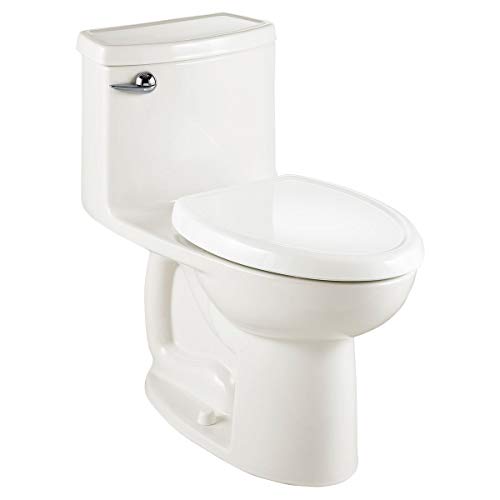
American Standard Champion 4 (1.6 GPF) vs. Cadet 3 (1.28 GPF): The Cadet 3 with WaterSense certification at 1.28 GPF outperforms the older Champion 4 platform in water efficiency while maintaining competitive MaP scores in the 600 to 800 gram range. American Standard's Cadet 3 is a strong mid-market choice for homeowners replacing 1.6 GPF toilets who want meaningful savings without a premium-tier price point. Check on Amazon
Kohler Highline / Cimarron (1.28 GPF AquaPiston): Kohler's AquaPiston flush valve delivers water from 360 degrees around the canister, producing a more forceful and consistent flush than traditional flapper designs at the same GPF. The Cimarron at 1.28 GPF reaches the 1,000-gram MaP ceiling, while the Highline generally scores in the 600 to 800 gram range. The Highline remains one of Kohler's best-selling residential models, with deep availability at home improvement retailers and a wide range of finish and height options. Check on Amazon
Woodbridge T-0001 (1.28 GPF): The Woodbridge T-0001 is one of the best-value one-piece skirted toilets at 1.28 GPF. Its concealed trapway and skirted design make cleaning easier, and the rimless bowl prevents the buildup that often requires additional cleaning water. MaP testing results for the T-0001 are generally in the 500 to 700 gram range. With aggregated owner ratings typically around 4.4 to 4.6 stars across thousands of reviews, it represents strong value for buyers who want a modern aesthetic with genuine efficiency. Check on Amazon
Gerber Viper / Ultra Flush (1.28 GPF): Gerber's Viper and Ultra Flush lines offer WaterSense-certified options with oversized 3-inch flush valves that increase flush speed and waste-clearing power. This larger valve opening compensates for the reduced water volume, helping the toilet evacuate waste effectively at 1.28 GPF. Gerber is well-regarded in the plumbing trade for reliability and parts availability, making it a practical choice for rental properties and high-use installations. Check on Amazon
For a comprehensive ranking of the most effective flushing models, see our guide to the best flushing toilets organized by MaP score, flush type, and efficiency tier.
The "if it's yellow, let it mellow" practice -- flushing only after solid waste -- reduces daily flush frequency by 60 to 80% for liquid-only uses. For a household of four flushing five times per person per day at 1.6 GPF, selective flushing can save 3,000 to 5,000 gallons per month. This approach requires no investment and no plumbing work, though it is more culturally accepted in some households than others.
Beyond selective flushing, avoiding the toilet as a wastebasket prevents unnecessary flushes. The EPA documents that flushing facial tissues, cotton balls, hair, and other non-waste items accounts for a meaningful share of excess flushes in many households. Each unnecessary flush at 1.6 GPF wastes water and increases strain on municipal water treatment systems.
Teaching children to use only the amount of toilet paper needed per use is another behavioral lever. Excessive toilet paper use forces double-flushes on toilets with less powerful flush systems, effectively doubling the water consumption per bathroom visit.
More than 40 U.S. states and hundreds of municipal water utilities offer rebate programs for replacing older toilets with EPA WaterSense-certified models. Rebate amounts range from $25 to $200 per toilet, with some California and Southwest utilities offering $100 to $150 per unit for pre-1994 replacements. The EPA's WaterSense website maintains a rebate finder tool at epa.gov/watersense/rebate-finder that locates current programs by ZIP code.
In California, the Metropolitan Water District of Southern California has offered rebates of $100 per qualifying toilet as part of ongoing drought response programs. Arizona cities including Tucson and Scottsdale have run similar programs. Texas Municipal Utility Districts frequently offer $50 to $100 rebates per WaterSense toilet. New York City's Department of Environmental Protection has historically provided rebates of up to $125 per toilet for pre-1994 replacements.
These rebates materially change the payback calculation for toilet replacement. A 1.28 GPF WaterSense toilet costing $180 after a $100 rebate pays back its effective $80 net cost in water savings within one to three years at average utility rates, depending on household size and current GPF. The replacement then delivers ongoing savings for the 10 to 25-year life of the fixture.
For information on how to document your existing toilet's age for rebate purposes, check local utility program requirements -- most accept a photograph of the date stamp typically found inside the tank or on the back of the toilet.
State and municipal rebate programs are significantly underutilized. According to EPA WaterSense program data, fewer than 15% of eligible households apply for available toilet rebates annually. For households in drought-prone states replacing a pre-1994 3.5 GPF toilet, the combined rebate plus water bill savings can return the full cost of a quality WaterSense toilet within 12 to 18 months, making it one of the highest-ROI home improvement decisions available.
Reducing tank water volume slightly -- by 0.1 to 0.3 gallons through float adjustment -- has minimal effect on flush performance in most modern toilets, because flush force is determined primarily by the flush valve size, bowl design, and trapway geometry rather than total water volume alone. However, reducing volume beyond the manufacturer's recommended water level mark can cause incomplete flushes, double-flushing, or clog risk. Always test flush performance after any adjustment before making it permanent.
MaP flush testing measures performance precisely: a toilet must clear at least 350 grams of simulated waste in a single flush to earn WaterSense certification, though most leading models achieve 600 to 1,000 grams at their rated GPF. This means a well-designed 1.28 GPF toilet outperforms a poorly designed 1.6 GPF toilet on actual waste clearance -- a point many consumers miss when evaluating efficiency claims.
The TOTO Drake and Drake II are frequently cited examples: both achieve 800 to 1,000 grams on MaP testing at 1.28 GPF, exceeding the waste-clearance performance of many 1.6 GPF toilets from lesser manufacturers. Flush performance and water efficiency are not trade-offs when the toilet is engineered correctly.
For households experiencing weak or incomplete flushes on existing toilets, the issue is often not insufficient water but rather a worn flapper opening too slowly, a partially blocked rim jet, or a scaled trapway. Addressing these mechanical factors often restores performance without any increase in water per flush. See our article on how to improve toilet flush power for a step-by-step diagnostic guide.
The TOTO Drake II (1.28 GPF, MaP 1,000g), TOTO Aquia IV dual-flush (1.28/0.8 GPF, MaP 1,000g), Kohler Cimarron (1.28 GPF, MaP 1,000g), and American Standard Cadet 3 (1.28 GPF, MaP 600 to 800g) are consistently the highest-rated WaterSense-certified toilets in independent testing. All four exceed the 350-gram WaterSense minimum by a wide margin, proving that 1.28 GPF can deliver powerful, reliable flushing when paired with correct trapway and bowl geometry.
The Swiss Madison St. Tropez and Woodbridge T-0001 are additional well-reviewed options in the 1.28 GPF category, particularly for buyers who prioritize modern aesthetics. Both use rimless or skirted bowl designs that simplify cleaning. For buyers interested in zero-water flushing alternatives, composting toilets represent a different category entirely -- appropriate for off-grid or vacation properties but not typical residential applications.
For more detail on selecting between these models, see our guides on best low-flow toilets and best water-saving toilets, which compare MaP scores, owner reviews, and efficiency certifications side by side.
Modern toilets manufactured after 1994 use a maximum of 1.6 gallons per flush (GPF) under federal law. EPA WaterSense-certified models use 1.28 GPF or less. Older pre-1994 toilets typically used 3.5 GPF, and some pre-1980 fixtures used 5 to 7 GPF per flush.
The EPA estimates that toilets account for approximately 24 to 30% of total indoor residential water use, making them the single largest water-consuming fixture in a typical American home ahead of showers, faucets, and laundry.
Yes, when the toilet is designed correctly. Many 1.28 GPF WaterSense models achieve MaP flush scores of 800 to 1,000 grams, well above the 350-gram minimum. The TOTO Drake II and Kohler Cimarron are two widely tested examples that clear waste reliably at 1.28 GPF.
Use the dye test: add food coloring or a dye tablet to the tank and wait 15 minutes without flushing. If color appears in the bowl, the flapper is leaking. Also check whether the water level in the tank sits above the overflow tube -- if it does, the fill valve float is set too high and water runs continuously to waste.
A running toilet with a leaking flapper wastes approximately 200 gallons per day, or about 73,000 gallons per year, according to EPA estimates. This is a continuous, silent loss that appears directly on the water bill. Replacement of a worn flapper resolves the problem for under $10.
EPA WaterSense toilets must use 1.28 GPF or less AND achieve at least 350 grams on the MaP flush test, ensuring both efficiency and adequate performance. Standard 1.6 GPF toilets meet the legal maximum but carry no efficiency certification and are not independently performance-tested as part of the specification.
In most cases yes. Aftermarket dual-flush conversion kits such as the Korky 528MP replace the flush valve and actuator in standard tanks, adding a 0.8 to 1.0 GPF half-flush for liquid waste. Compatibility depends on tank dimensions and flush valve diameter (usually 2 inches for standard tanks). Installation typically takes 30 minutes without professional help.
Lowering the float slightly -- a quarter to half inch below the factory water line mark -- is safe and reduces water per flush by 0.1 to 0.3 gallons. Going below the manufacturer's recommended minimum can cause incomplete flushes or double-flushing. Always test after adjusting and return to the original setting if performance is affected.
Most utility rebate programs are targeted specifically at replacement of pre-1994 or pre-1980 toilets, as that is where the greatest water savings occur. New construction rebates are less common but do exist in some jurisdictions. Check the EPA WaterSense rebate finder at epa.gov/watersense for programs in your ZIP code.
Maximum Performance (MaP) testing, conducted by independent laboratories and published at map-testing.com, measures how many grams of simulated solid waste a toilet can clear in a single flush. A higher MaP score at a lower GPF means the toilet uses less water to clear more waste. Toilets scoring 800 to 1,000 grams at 1.28 GPF are considered high performers and rarely require double-flushing.
Replacing four 3.5 GPF toilets (one per person) with 1.28 GPF WaterSense models saves approximately 2.22 gallons per flush per toilet. At five flushes per person per day, a family of four saves over 16,200 gallons per year. If replacing pre-1980 toilets at 5 GPF, savings can exceed 60,000 gallons per year for the household.
Pressure-assist toilets typically use 1.0 to 1.28 GPF and achieve powerful flush performance through compressed air in the tank. They are at least as water-efficient as gravity WaterSense models, often exceeding gravity designs in single-flush clearance. The trade-off is higher noise during flushing and higher purchase cost. Brands like Sloan Flushmate power pressure-assist systems found in American Standard and Kohler models.
Manufacturers typically recommend replacing the flapper every three to five years as preventive maintenance. In areas with hard or heavily chlorinated water, replacement may be needed more frequently -- every one to two years -- because minerals and chlorine accelerate rubber degradation. Running an annual dye test takes about two minutes and identifies leaks before they become significant water losses.
Trapway size affects waste clearance and clog risk rather than water volume per flush. A larger trapway -- 2 inches or more fully glazed -- allows waste to exit more freely, reducing the need for double-flushing. Since double-flushes effectively double water use per event, choosing a toilet with a large, fully-glazed trapway indirectly reduces real-world water consumption by eliminating the need for repeat flushes.
For rental properties, 1.28 GPF WaterSense-certified toilets with high MaP scores (600 grams or above) offer the best balance of water efficiency, clog resistance, and low maintenance. Models like the Gerber Viper and American Standard Cadet 3 are popular choices among property managers because of their robust flush performance and widely available replacement parts.
Yes. A toilet leaking 200 gallons per day wastes 73,000 gallons per year. At a typical combined water and sewer rate of $0.008 to $0.015 per gallon, that is $584 to $1,095 per year in direct utility cost, far above the $7 to $12 cost of a replacement flapper. EPA calculations confirm that fixing toilet leaks is one of the highest-return water conservation actions available to homeowners.
Yes, with the right product. The TOTO Aquia IV's 0.8 GPF half-flush mode for liquid waste is designed specifically for daily home use. At full flush (1.28 GPF), it reaches the 1,000-gram MaP ceiling. The half-flush is intended for liquid waste only and performs reliably in that use case. Attempting to use the half-flush for solid waste would cause problems on any dual-flush toilet regardless of brand.
CEFIONTECT is TOTO's proprietary ceramic glaze applied to the interior bowl surface. The nano-coating reduces surface porosity, making it harder for waste and mineral deposits to adhere. This keeps the bowl cleaner with less cleaning effort and reduces the need for forceful secondary flushes to clean the bowl, which contributes indirectly to lower real-world water use over time.
If the 1.6 GPF toilet is not leaking and functions correctly, replacement is a matter of cost-benefit rather than urgency. Upgrading to a 1.28 GPF WaterSense toilet saves approximately 2,192 gallons per person per year over a 1.6 GPF baseline. At typical rates, the annual savings per person is $17 to $33. With a rebate, a quality replacement toilet can pay back in five to eight years, which is reasonable given a 15 to 25-year fixture lifespan.
The original TOTO Drake is available in both 1.6 GPF and 1.28 GPF (Eco Drake) configurations. The Drake II is available only in 1.28 GPF and uses TOTO's E-Max flushing system, which is slightly more efficient in bowl rinse coverage than the original Drake's G-Max system. For maximum water efficiency within the Drake line, the Drake II or the Eco Drake at 1.28 GPF are equivalent in GPF, with the Drake II generally preferred for its updated flush technology. See our Drake vs Drake II comparison for full details.
Reducing toilet water usage starts with the lowest-hanging fruit: a dye test to identify leaks and a $7 flapper if you find one. From there, float adjustment and a dual-flush conversion kit deliver meaningful savings at minimal cost. For the largest long-term reduction, replacing a pre-1994 3.5 GPF toilet with a WaterSense-certified 1.28 GPF model from TOTO, Kohler, American Standard, or Gerber eliminates more than half the water used per flush, often paying back within three to five years -- faster when utility rebates are applied. Every method in this guide is backed by published data, independent MaP testing, and real owner experience. None requires professional plumbing skill to implement.
Learn why toilet trapways curve like an S, how each bend blocks sewer gas, and what the shape means for clogs and…
Read the guideAlmost every US toilet has a left-side handle. Learn the plumbing and mechanical reasons behind the layout and when it actually changes.
Read the guideHome toilets rely on tanks because household water lines lack the pressure that public flushometer systems use to flush straight from the…
Read the guide