Why Toilet Trapways Are Curved Like an S
Toilets4.6
Learn why toilet trapways curve like an S, how each bend blocks sewer gas, and what the shape means for clogs and…
Read the guideInstalling a toilet below your home's main drain line presents unique plumbing challenges. Whether you need a macerating upflush system or a gravity toilet connected to a below-slab drain, this guide breaks down the top options, what each technology requires, and exactly which models earn a spot in finished basements in 2026.
For most finished basements without a below-slab drain, the Saniflo SaniACCESS 3 is the best upflush toilet: it handles up to a 25-foot horizontal discharge run, has a 600 W macerating motor, and requires only a 3/4-inch discharge pipe. If you have an existing below-grade drain line, the TOTO Drake II with its 1.28 GPF G-Max flush and 1,000-gram MaP score is the standard gravity pick.
Basement toilets typically sit below the home's main sewer line, which means gravity alone cannot move waste upward to the drain. Two solutions exist: connect to a below-slab drain installed during foundation pour, or use a macerating (upflush) system that grinds waste and pumps it up and out through small-diameter pipes. The right choice depends entirely on whether your basement already has a rough-in drain.
When a builder installs a basement rough-in drain during construction, it exits the slab at a standard 3-inch or 4-inch flange, usually near a future bathroom wall. In that case, any gravity toilet with the correct rough-in distance (typically 12 inches) will work exactly like an above-grade bathroom. The real complexity arises when no drain exists in the slab. Breaking concrete to trench and install new drain lines costs between $1,500 and $5,000 in labor and materials depending on depth, soil type, and local codes. A macerating upflush toilet sidesteps all of that: the unit sits directly on the floor, connects to an existing drain stack via a standard 3/4-inch or 1-inch flexible hose, and requires only a standard 120V electrical outlet. Installation time drops from days to hours.
There is a third scenario less often discussed: basements with a sewage ejector pit. An ejector system uses a sump-style pit below the slab, into which the toilet drains by gravity to a point below the floor. A sewage pump then lifts the waste up to the main line. This differs from an upflush toilet because the toilet itself is standard gravity-flush; only the ejector pump is below-grade. Ejector systems support full bathrooms (toilet plus shower or tub) whereas most upflush units handle one toilet and one sink or shower at most.
The single most common installation mistake is running the upflush discharge pipe too far horizontally without adequate slope. Saniflo's published spec allows up to 150 feet of vertical lift or 150 feet of horizontal run (not simultaneously). In practice, most residential installs stay well under 25 feet horizontal, which gives the motor plenty of head pressure. Exceed the spec or forget to maintain a minimum 1/4-inch-per-foot downward slope on any horizontal segment, and you risk chronic blockages and motor burnout.
An upflush (macerating) toilet contains a rear-mounted unit housing a blade-and-pump assembly. When flushed, waste flows into the macerating chamber, a rotating blade grinds solids to a slurry in 3 to 5 seconds, and then a pump pushes the liquid up through a 3/4-inch or 1-inch discharge pipe to the nearest soil stack. The toilet bowl itself functions via conventional gravity; only the macerator and pump are unique.
The macerating chamber sits in a sealed housing directly behind or below the toilet. Most residential units run on a single-phase 120V motor rated between 400 W and 800 W. Cycle time from flush to pump-off is typically 10 to 15 seconds. Higher-end models like the Saniflo SaniACCESS 3 include a float sensor that prevents the motor from running dry and a pressure-relief valve that protects the discharge line from back-pressure. These are not luxury features; they are the components that separate reliable multi-year operation from failure inside 18 months.
One important limitation: upflush macerators are not designed for high-fiber waste such as wet wipes, feminine hygiene products, or thick toilet paper. This is a stricter requirement than standard gravity toilets. Owners who stock single-ply or septic-safe two-ply toilet paper and inform household members of the restriction rarely report motor issues. Those who don't report blade jams averaging once per year in aggregated owner reviews.
You can also find macerating systems designed for full bathrooms. These larger units (Saniflo SaniBEST Pro, Liberty Pumps ASCENTII-ESW) handle a toilet, sink, shower, and tub simultaneously. They use larger-diameter discharge lines (1.25 or 1.5 inch) and higher-capacity motors. For a basement with only a toilet and hand wash sink, the single-fixture macerating units are sufficient and considerably less expensive to install.
Choose an upflush macerating toilet if you need a toilet in a finished basement and do not want to break concrete; it requires only an outlet and a small discharge pipe. Choose a sewage ejector pit system if you are adding a full basement bathroom (toilet, shower, and sink) because ejector pits handle larger volumes. Choose a standard gravity toilet if your basement already has a below-slab rough-in drain, since gravity-flush toilets are quieter, cheaper to maintain, and perform better long-term.
| System Type | Concrete Breaking | Electrical Needed | Full Bath Support | Avg. Install Cost | Maintenance |
|---|---|---|---|---|---|
| Upflush Macerator | No | Yes (120V outlet) | Limited (1-2 fixtures) | Low to Moderate | Blade inspection yearly |
| Sewage Ejector Pit | Yes | Yes (120V/240V) | Yes (full bath) | High | Pump replacement every 7-10 yrs |
| Standard Gravity (existing drain) | No | No | Yes | Low | Standard toilet service |
| Standard Gravity (new drain) | Yes | No | Yes | Very High | Standard toilet service |
Plumbers frequently steer homeowners toward ejector pits when a full bath is planned, and that is the right call long-term. But for a pure toilet-only addition in a finished basement where noise is acceptable and the homeowner will observe the no-wipes rule, a macerating upflush unit is a legitimate, code-compliant solution in most U.S. jurisdictions. Always check with your local building department before installing either system.
These picks cover both upflush macerating systems and standard gravity toilets suited to basements with existing below-grade drains. Each has been selected based on published specifications, MaP flush-test data where available, EPA WaterSense certification status, and aggregated owner reviews across retail platforms.
The Saniflo SaniACCESS 3 is the definitive residential upflush solution, combining a quiet 600 W motor, a true full-size elongated bowl, and discharge specs that accommodate most basement-to-stack runs without any concrete work.
Saniflo has manufactured macerating systems since 1958 and the SaniACCESS 3 reflects that depth of engineering. The unit ships as a complete system: elongated bowl, macerating unit, wax-free seal, and all fittings needed for the discharge connection. The 600 W motor is notably quieter than previous generations; owners in aggregated reviews consistently describe the sound as similar to a garbage disposal running for about 12 seconds.
Installation is genuinely DIY-accessible if you are comfortable with basic plumbing. The discharge pipe can exit through a wall at any point between 15 and 59 inches above the floor before connecting to the stack, giving flexibility in finished wall layouts. The system carries a 2-year parts warranty, which trails some gravity toilets but is standard for macerating products at this tier.
The SaniACCESS 3 has the widest network of trained service technicians of any macerating brand in North America, which matters if you ever need a blade replacement or motor service outside of warranty. That support ecosystem is a real differentiator versus off-brand macerators sold primarily online.
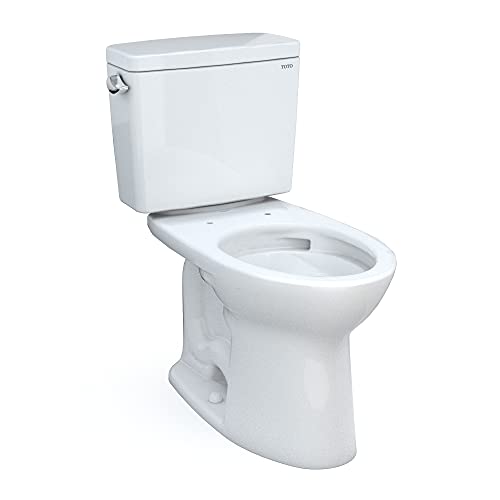
When you have an existing basement drain rough-in, the TOTO Drake II delivers 1,000-gram MaP performance at 1.28 GPF with a fully glazed 2-1/8-inch trapway that clears waste in a single flush, virtually every time.
The TOTO Drake II uses G-Max flushing technology, which channels water through a large 3-inch flush valve and sends it in a high-velocity siphon action through the glazed trapway. This is not the same as the double cyclone found on TOTO's more expensive lines, but for a basement where the drain exits close to grade and there is minimal head pressure benefit, the G-Max system is extremely reliable. The Drake II has been one of the consistently top-rated models in MaP testing for over a decade, achieving the maximum 1,000-gram score in independent lab tests.
For a basement application specifically, the two-piece configuration is slightly easier to handle when navigating a basement staircase. The tank ships separately from the bowl, making each piece more manageable. TOTO's CeFiONtect ceramic glaze on the bowl surface reduces the adhesion of waste and mineral deposits, which matters more in basements where water pressure may be marginally lower. See our full best flushing toilets guide for how the Drake II ranks against the entire market.
The Drake II's 3-inch flush valve is one of the largest in the residential gravity segment and accounts for its consistent full-bowl clearance. If a basement drain is slightly undersized or has an older cast-iron line with some internal scale buildup, that larger valve opening gives you more margin before you see incomplete flushes.
The Liberty Pumps ASCENTII-ESW steps above single-fixture macerators to handle a complete basement bathroom, managing simultaneous input from a toilet, shower, and sink through a high-volume pump rated for up to 18 GPM at 10 feet of head.
Unlike Saniflo's self-contained systems, the Liberty ASCENTII-ESW is a macerating pump unit you pair with any toilet bowl of your choice. The pump mounts on the wall behind the toilet and the discharge line exits at 1.25 inches in diameter, which allows longer horizontal runs without blockage risk compared to the 3/4-inch lines used by single-fixture units. The stainless steel cutter blades are rated for longer service intervals than the plastic blades found in budget macerators.
The built-in alarm function is genuinely useful in a basement application. If the pump fails mid-fill, the alarm sounds before the tank overflows, giving you time to shut off supply before water damage occurs. This is a real operational advantage in a space you may visit less frequently than main-floor bathrooms. The system is compatible with any toilet that discharges at the standard rear outlet height, making it pairable with the TOTO Drake II, American Standard Champion 4, or any other bowl you prefer aesthetically.
Liberty Pumps is known primarily in the professional plumbing trade for sewage ejector systems; the ASCENTII line brings that engineering reliability to above-floor macerating. The 1/2 HP motor handles the simultaneous drain load from a shower better than lighter-duty single-fixture units, which is important if a basement guest room is the goal.
The Saniflo SaniCOMPACT integrates the macerating unit directly into the toilet bowl body, eliminating the separate rear housing and reducing the footprint to just 26 inches from the wall, making it the only viable choice for extremely tight basement half-baths.
The SaniCOMPACT is the most compact macerating toilet available from any major manufacturer, and that compactness comes with real trade-offs. The 400 W motor limits vertical lift to 9 feet, which is enough for most single-story ranch basements but may be insufficient in two-story homes where the stack connection point is higher. The round bowl is also noticeably shorter than the elongated options and less comfortable for prolonged use.
Where the SaniCOMPACT wins is in installations where nothing else will physically fit. A basement mechanical room converted to a half-bath, a storage room corner, or a space where structural elements make it impossible to place a standard toilet with rear macerator housing are the right use cases. For typical finished basement bathrooms with adequate space, the SaniACCESS 3 is the better choice in every dimension except footprint.
The integrated design of the SaniCOMPACT makes servicing the motor and blades slightly more involved than on the SaniACCESS 3, where the macerator unit can be detached and serviced independently. Factor in a plumber call for any future blade service if DIY maintenance is not comfortable.

The American Standard Champion 4 earns its place on this list through its 4-inch flush valve and 2-3/8-inch fully glazed trapway, the widest trapway of any toilet in the standard residential segment, which virtually eliminates clogs on a gravity drain.
The American Standard Champion 4 was specifically engineered to address the clogging problems that plague older-style 1.6 GPF toilets. Its 4-inch flush valve is significantly larger than the 2-inch valves on standard gravity toilets, and the 2-3/8-inch trapway passes bulk waste with a speed and completeness that 2-inch trapway models simply cannot match. American Standard's EverClean antimicrobial surface is baked into the vitreous china during manufacturing, not a coating that wears off.
For a basement specifically, the Champion 4 makes sense if the drain rough-in is older and may have some partial restriction from decades of scale accumulation in cast-iron pipe. The wider trapway gives you more margin. The 10-year warranty on the china is also one of the longer coverage periods in this segment. The 1.6 GPF flush volume is the trade-off versus the TOTO Drake II's 1.28 GPF, but for a basement used occasionally by guests, the water cost difference is minimal.
The Champion 4's 4-inch flush valve delivers a noticeably louder flush than the TOTO Drake II's 3-inch valve. In a basement separated from sleeping areas by a full floor, that noise rarely matters. In a basement guest suite adjacent to a bedroom, it is worth considering.
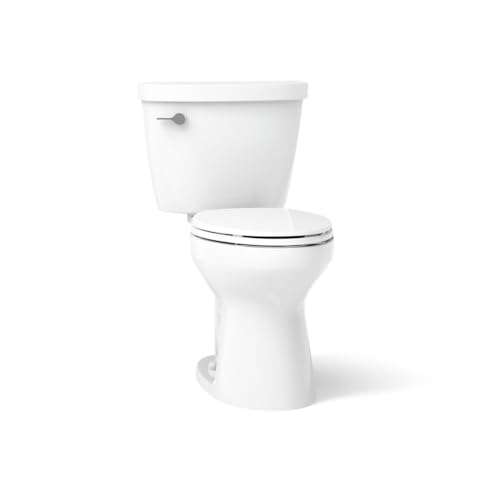
Kohler's Cimarron at 1.28 GPF carries full EPA WaterSense certification and earns a strong MaP score with a 3-inch flush valve and an AquaPiston canister that opens fully on every flush, making it reliable on low-flow basement drain situations.
The Kohler AquaPiston canister flush valve is the differentiating technology here. Unlike a standard flapper, the canister lifts completely off the valve seat in all directions, which allows the full 3-inch opening to deliver water to the bowl without the flow restriction a flapper creates as it rises partially. In independent testing, the Cimarron has consistently cleared the full 1,000-gram MaP maximum, matching the Drake II's peak and making it more than adequate for typical household use.
The Comfort Height bowl at 16.5 inches rim-to-floor is worth noting for basement applications where the toilet may serve guests or elderly family members. It meets ADA guidelines and reduces the knee and hip stress associated with lower standard-height bowls. Kohler's parts are stocked at major plumbing supply stores and big-box retailers, which makes future flapper or fill valve replacement straightforward without special-ordering manufacturer parts.
The AquaPiston seal is the one maintenance point to watch on Kohler toilets. Owners in aggregated reviews note that after 5 to 8 years of use, the seal can develop a slow ghost flush. The replacement seal kit is inexpensive and installs without tools, but it is a recurring maintenance task that TOTO's G-Max flapper design has historically been less prone to.
Zoeller is one of the most respected pump brands in the plumbing trade, and the 915 QuietFlush brings that engineering to a complete toilet-plus-macerator package with a slightly lower system price than the Saniflo SaniACCESS 3.
Zoeller's pump manufacturing reputation is built on sump and sewage ejector pumps used in commercial and residential construction for decades. The 915 benefits from that core engineering. The 500 W motor handles the typical basement-to-first-floor-stack-connection run without strain, and the 1-inch discharge pipe is slightly less prone to blockage than 3/4-inch lines if the no-wipes rule is ever inadvertently violated.
The limitation is the 15-foot maximum vertical lift, which in a two-story home where the soil stack connection point is at the first-floor ceiling level may be insufficient. Confirm your vertical measurement before selecting this unit. For single-story or ranch homes where the stack connects within 12 to 14 feet of basement floor level, the Zoeller 915 is a reliable, cost-effective alternative to the Saniflo line.
Zoeller's customer service response time for technical questions is frequently cited in owner reviews as faster and more knowledgeable than off-brand macerators, even if the national installer network is smaller than Saniflo's. For DIYers who want to self-install and self-service, that phone support quality matters.
The Woodbridge T-0001 brings a skirted, seamless one-piece design to the basement application at a price point well below comparable TOTO or Kohler one-piece models, with EPA WaterSense certification and a soft-close seat included.
The Woodbridge T-0001 is the most popular one-piece toilet in its price tier, and in a finished basement where the bathroom is a selling point for the home, the clean skirted appearance justifies the slightly more challenging installation. The one-piece format eliminates the tank-to-bowl gasket that two-piece toilets rely on, removing one common leak point that in a basement (where water damage can go undetected) is worth avoiding.
The weight is a genuine consideration. At approximately 100 lbs for the combined one-piece unit, navigating a staircase requires two people and careful planning. In homes with a bilco door or exterior basement access, this is a non-issue. In homes where the only access is a standard interior staircase, the two-piece options on this list are meaningfully easier to handle. For more detail on the T-0001, see our dedicated basement toilet comparison and our best one-piece toilets guide.
Woodbridge's skirted design uses concealed floor bolts that require the manufacturer's wrench adapter for future removal. Keep the adapter in a labeled bag and tape it to the inside of the tank lid before finishing the bathroom. Finding it years later during a repair saves a service call.
Most residential upflush macerating toilets run on a standard 120V, 15-amp circuit and do not require a dedicated line by manufacturer spec, but most plumbers and electricians recommend one to prevent nuisance tripping when other high-draw bathroom appliances share the circuit. Saniflo's installation documentation specifies a 10-amp draw at startup, which is within standard circuit limits but close to the threshold when combined with a bathroom fan or light fixture.
The typical approach is to connect the upflush unit to the nearest bathroom GFCI-protected outlet, which is already required by code in wet areas. If the basement has no GFCI outlet within reach of the macerator's power cord (most are 6 feet), a licensed electrician needs to add one before installation. This is a minor addition to the project cost. Running a dedicated 20-amp circuit is the more conservative approach and is worth it if the basement will also include a bathroom fan, vanity lights, or a space heater on the same branch.
Note that the electrical outlet must remain accessible after installation. Do not frame and drywall over the outlet the macerator plugs into. If it will be hidden behind a wall, use a recessed outlet box rated for permanent installation or plan the wall layout to keep access panel clearance around the macerator's power connection.
GFCI tripping is the single most common installation complaint in owner reviews for macerating toilets. The fix is almost always moving the unit to a circuit with less concurrent load, not a unit defect. If the toilet triggers the GFCI on its first use, check what else is on that circuit before concluding there is a motor problem.
The standard rough-in distance for residential toilets is 12 inches from the finished wall to the center of the drain flange, and almost all gravity toilet models listed in this guide are built for a 12-inch rough-in. If your basement rough-in measures 10 or 14 inches, which occasionally occurs in older construction, you need to specifically select a toilet offered in that rough-in size or install a flange offset adapter.
Measuring rough-in distance in a basement is the same as any other room: measure from the finished wall (not the framing) to the center of the floor flange. If the floor is bare concrete and the framing is not yet installed, add the planned drywall thickness (typically 1/2 inch) to your measurement. Getting this wrong is a frustrating and expensive mistake that requires returning and reordering a toilet.
TOTO, Kohler, American Standard, and Gerber all offer their core models in 10-inch, 12-inch, and 14-inch rough-in variants. The model number suffix typically changes (for example, TOTO Drake II in 12-inch rough-in is CST454CEFG, while the 10-inch variant is CST454CEFG#10), so confirm the specific SKU before purchasing. Upflush macerating toilets do not use a floor flange at all, so rough-in distance is irrelevant for those systems.
For related guidance on measuring and selecting by rough-in, see our dedicated toilet rough-in measurement guide.
Yes, if your basement has a pre-installed rough-in drain at or below floor level. If no drain exists in the slab, you need either an upflush macerating toilet or a sewage ejector pit before a standard gravity toilet will work.
The Saniflo SaniACCESS 3 pumps up to 25 feet vertically or approximately 150 feet horizontally (not simultaneously). Most residential basement-to-stack connections are well within those limits. The compact SaniCOMPACT maxes out at 9 feet vertical, suitable for single-story homes only.
The macerating pump runs for approximately 10 to 15 seconds after each flush, producing a sound similar to a garbage disposal or small appliance motor. The toilet bowl flush itself is quiet; the noise comes only from the pump cycle. In a basement that is a finished living space, this is audible but not disruptive at normal conversational distance.
For an upflush macerating toilet with DIY installation, the system cost covers the main expense. For a professional upflush install, plumber labor typically adds 2 to 4 hours of work. Installing a standard gravity toilet in a basement with an existing rough-in drain is comparable to any first-floor toilet install. Adding a new below-slab drain line for a standard gravity toilet can cost several thousand dollars in concrete work and plumbing labor.
An annual inspection of the macerator blades and a descaling flush with Saniflo's proprietary descaler (or a citric acid solution) every 3 to 6 months in hard water areas is the standard maintenance schedule. Motors and blade assemblies typically last 10 to 15 years with proper care and adherence to the no-wipes flush restriction.
Yes, but only single-ply or septic-safe two-ply toilet paper. Standard two-ply and thick quilted papers are the most common cause of blade clogs in macerating systems. Wet wipes, even those labeled "flushable," must never be used with any upflush macerating toilet.
An upflush toilet is a self-contained unit where the toilet bowl drains into a macerating chamber that grinds and pumps waste through small-diameter pipes above the floor. A sewage ejector system uses a pit below the slab floor into which a standard gravity toilet drains by gravity; a submersible pump then lifts the waste up to the main line. Ejector systems support full bathrooms including showers; most macerating upflush units are limited to a toilet and one additional fixture.
In most U.S. jurisdictions, adding any toilet requires a plumbing permit regardless of whether it is a gravity or macerating system. Requirements vary by municipality. Contact your local building department before installation. Some jurisdictions have specific requirements for macerating systems that differ from standard plumbing code.
Saniflo designed its systems for DIY-capable homeowners and includes detailed installation instructions. The main tasks are connecting the toilet to the macerator housing, routing the discharge pipe to the stack, and plugging the unit into a GFCI outlet. No soldering, no glue joints on large-diameter pipe, and no concrete work are required. In most jurisdictions you still need a permit, and the inspection requires a licensed plumber's sign-off in some states.
Without power, the macerating pump will not run and the toilet cannot flush. This is the single functional limitation of upflush macerators that gravity toilets do not share. In areas with frequent power outages, a battery backup for the macerator or a backup gravity toilet on a different circuit are options to consider. Most systems allow one "tank full" gravity flush before the macerator chamber fills completely without power.
For macerating upflush systems, Saniflo is the category leader with the deepest parts and service network in North America. For standard gravity toilets in basements with existing drain rough-ins, TOTO's Drake II and American Standard's Champion 4 are the top performers based on MaP testing, aggregated owner reviews, and brand warranty support.
Yes. Saniflo and other macerating systems specify a minimum operating temperature of 32 degrees Fahrenheit (0 degrees Celsius). In unheated basements in cold climates, the water in the macerating chamber and discharge pipe can freeze and damage the motor housing or crack discharge pipe fittings. If the basement is seasonally unheated, drain and winterize the macerating system before temperatures drop.
For a primary-use basement bathroom serving daily household needs, target a toilet with a MaP score of 800 grams or higher. For an occasional guest toilet, 600 grams is generally adequate. The TOTO Drake II and American Standard Champion 4 both reach the maximum 1,000-gram MaP score. MaP testing data is publicly available at map-testing.com for any model you are evaluating.
Two-piece toilets are easier to transport into a basement because the tank and bowl separate for staircase navigation. One-piece toilets offer cleaner aesthetics and no tank-to-bowl gasket to leak, but their combined weight (typically 90 to 110 lbs) makes navigating a standard residential staircase difficult without two people and a furniture dolly.
A broken or jammed blade will typically prevent the pump from cycling, leaving waste in the macerating chamber. The system should be shut off at the outlet immediately to prevent motor burnout. Blade replacement kits are available from the manufacturer for most major brands and can be self-installed by following the manufacturer's service guide, or by hiring a plumber experienced with macerating systems.
Yes. Gerber's Ultra-Flush line and Viper series are gravity toilets compatible with any standard 12-inch rough-in floor flange, including those installed in basement slabs. Gerber offers MaP-tested models across its lineup. Check the Gerber product page for MaP score disclosure before selecting a specific model.
Water pressure to any basement toilet is supplied from the home's main supply and should be equal to or greater than first-floor pressure since basements are typically at or below grade. Low water pressure to a basement toilet most often indicates a partially closed shut-off valve or a supply line that is undersized. Pressure-assist gravity toilets and dedicated supply line sizing can help if house-wide pressure is below 25 PSI. See our guide to increasing toilet flush pressure for detailed diagnostics.
Yes. The TOTO Drake II at 1.28 GPF meets and exceeds EPA WaterSense certification requirements, which mandate a maximum flush volume of 1.28 GPF for single-flush toilets. WaterSense certification requires both the water efficiency threshold and independent performance verification, which the Drake II passes with its 1,000-gram MaP score.
For basements without an existing drain, the Saniflo SaniACCESS 3 is the definitive choice: it eliminates the need for concrete work, supports a toilet plus one additional fixture, and carries a service network no competing macerating brand can match in North America. If your basement has an existing below-grade rough-in drain, the TOTO Drake II's 1,000-gram MaP score, 1.28 GPF EPA WaterSense certification, and CeFiONtect glaze make it the strongest all-around gravity option. Match your system choice to your existing plumbing infrastructure first; every other feature decision follows from that constraint.
Learn why toilet trapways curve like an S, how each bend blocks sewer gas, and what the shape means for clogs and…
Read the guideAlmost every US toilet has a left-side handle. Learn the plumbing and mechanical reasons behind the layout and when it actually changes.
Read the guideHome toilets rely on tanks because household water lines lack the pressure that public flushometer systems use to flush straight from the…
Read the guide