


Why Toilet Trapways Are Curved Like an S
Toilets4.6
Learn why toilet trapways curve like an S, how each bend blocks sewer gas, and what the shape means for clogs and…
Read the guideHow much water a dual flush toilet actually saves per year, which models deliver the best GPF efficiency, and whether EPA WaterSense certification makes a measurable difference to your water bill.
A dual flush toilet certified by EPA WaterSense uses an average of 1.1 GPF blended across flush types and saves a typical four-person household roughly 4,000 to 7,000 gallons per year compared to a pre-1994 3.5 GPF toilet, cutting annual water bills by $40 to $120 depending on local utility rates.
A dual flush toilet offers two flush options: a low-volume flush (typically 0.8 to 1.0 GPF) for liquid waste and a full flush (1.28 to 1.6 GPF) for solid waste, allowing users to use only as much water as the situation requires. Because roughly 70 to 75 percent of toilet uses involve liquid waste only, households that consistently use the half flush can dramatically reduce total annual water consumption. The EPA estimates that toilets account for nearly 30 percent of indoor residential water use, making dual flush technology one of the highest-impact upgrades available.
Toilet flushing is the single largest indoor water draw in the average American home. The EPA WaterSense program reports that the typical U.S. household flushes a toilet roughly 140,000 times per year across all occupants. If each flush pulls 1.6 GPF -- the federal standard since 1994 -- that adds up to 224,000 gallons annually just from toilet use. Dual flush technology attacks that number directly by creating a decision point at every flush.
The math behind the savings is straightforward. If a family of four uses the half flush 70 percent of the time and the full flush 30 percent of the time, and the toilet has a 0.8/1.28 GPF rating, the blended average drops to approximately 0.944 GPF. Over 140,000 annual flushes that equals roughly 132,200 gallons -- versus 224,000 gallons for a legacy 1.6 GPF toilet. The net saving exceeds 91,000 gallons per year in that scenario.
Real-world savings land below the theoretical maximum for two reasons. First, many users do not consistently choose the correct button. Studies by the Australian Water Efficiency Labelling and Standards (WELS) scheme found that user behavior accounts for a 15 to 25 percent reduction in realized savings compared to ideal usage. Second, older dual flush mechanisms occasionally run on after the flush due to worn seal rings, effectively leaking away any efficiency gains. Both factors are worth understanding before you commit to a purchase.
The efficiency gain from a dual flush toilet is real but not automatic. The half flush button must be prominently labeled and intuitive, otherwise household members default to the large flush for every use. Manufacturers like TOTO and Kohler have invested significantly in button ergonomics and labeling clarity precisely because the difference between a well-designed and a poorly-designed actuator plate directly determines real-world GPF performance.
Based on EPA WaterSense modeling and published utility data, a dual flush toilet with a 1.0/1.28 GPF rating saves a four-person household approximately 4,000 to 7,000 gallons per year compared to a standard 1.6 GPF toilet and up to 20,000 gallons per year compared to a pre-1994 3.5 GPF toilet. Actual savings depend on household size, flush frequency, and the proportion of half-flush to full-flush usage. The EPA estimates that replacing a pre-1994 toilet with a WaterSense-certified model saves the average family about 13,000 gallons annually.
The table below compares annual water use across toilet generations for a household that flushes 5 times per person per day with four occupants (7,300 flushes/year per person, 29,200 total flushes/year). Dual flush calculation assumes 70% half-flush / 30% full-flush usage.
| Toilet Type | GPF (full/half) | Blended GPF | Annual Gallons (4 people) | vs. 3.5 GPF Savings | vs. 1.6 GPF Savings |
|---|---|---|---|---|---|
| Pre-1994 Standard | 3.5 | 3.5 | 102,200 | -- | -- |
| Modern 1.6 GPF | 1.6 | 1.6 | 46,720 | ~55,500 gal/yr | -- |
| WaterSense 1.28 GPF | 1.28 | 1.28 | 37,376 | ~64,800 gal/yr | ~9,300 gal/yr |
| Dual Flush 0.8/1.28 GPF | 1.28 / 0.8 | 0.944 | 27,565 | ~74,600 gal/yr | ~19,100 gal/yr |
| Dual Flush 1.0/1.6 GPF | 1.6 / 1.0 | 1.18 | 34,456 | ~67,700 gal/yr | ~12,200 gal/yr |
| High-Efficiency 0.8 GPF | 0.8 | 0.8 | 23,360 | ~78,800 gal/yr | ~23,400 gal/yr |
The 0.8/1.28 GPF dual flush category, which includes models like the TOTO Aquia IV and the Woodbridge T-0001, delivers the best balance of water savings and flush reliability. Toilets in this range carry EPA WaterSense certification and achieve MaP flush scores at or above 800 grams -- the generally accepted minimum for residential use -- meaning they clear solid waste reliably without relying on excess water volume.
EPA WaterSense certification sets a maximum of 1.28 GPF for single-flush toilets and requires dual flush models to average no more than 1.28 GPF across both flush volumes, while also mandating a minimum MaP flush score of 350 grams to confirm adequate waste removal. WaterSense certification does not guarantee the toilet will save water in practice -- that depends on proper user behavior -- but it does confirm the toilet is mechanically capable of performing within the efficiency threshold under standardized laboratory conditions. Certified models are independently tested and listed on the EPA WaterSense product search tool at epa.gov/watersense.
WaterSense is the most practically useful certification signal when comparing dual flush models because it imposes both a water-use cap and a performance floor simultaneously. A toilet can be engineered to use only 0.6 GPF for liquid waste, but if it requires multiple flushes to clear solid waste, the net GPF per flush event rises above the theoretical rating. The MaP testing requirement prevents manufacturers from gaming the certification with low-volume toilets that fail in real use.
For consumers, the WaterSense label also triggers eligibility for utility rebates. Many water districts across California, Texas, Florida, and the Pacific Northwest offer $50 to $200 per toilet for replacing a pre-1994 or 1.6 GPF toilet with a WaterSense-certified model. The EPA maintains a rebate finder at epa.gov/watersense/rebate-finder. Combined with long-term water bill savings, WaterSense models often deliver a positive ROI within three to five years of purchase even before accounting for any rebate.
The EPA WaterSense MaP minimum of 350 grams is adequate for most households, but for families with above-average solid waste loads, look for dual flush toilets with MaP scores above 600 grams on the full flush setting. The TOTO Drake II (WaterSense certified, 1.28/0.9 GPF) achieves a MaP score of 1,000 grams -- the maximum tested value -- confirming it clears full loads without relying on volume. That combination of high MaP and low GPF is the real efficiency sweet spot.
The TOTO Aquia IV (0.8/1.0 GPF, MaP 1,000g), the TOTO Drake II in dual flush configuration, and the American Standard H2Option (0.92/1.28 GPF, MaP 1,000g) consistently rank highest for combining verified flush power with industry-leading water efficiency. Among budget-focused models, the Woodbridge T-0001 (0.8/1.6 GPF) and the Gerber Viper dual flush offer reliable performance at a lower price point. All five carry EPA WaterSense certification and score at least 600 grams on MaP full-flush testing.
The following models represent the strongest options across price tiers as of mid-2026, evaluated against published manufacturer specifications, third-party MaP test data from map-testing.com, and aggregated owner reviews.
The Aquia IV is TOTO's flagship dual flush two-piece toilet and the benchmark against which other high-efficiency dual flush models are measured. Its 0.8/1.0 GPF rating is the most aggressive on this list, and it achieves a perfect 1,000-gram MaP score on both flush settings due to TOTO's TORNADO FLUSH rim-less bowl design, which directs water in a cyclonic spiral rather than a top-down rim wash. The CEFIONTECT ceramic glaze on interior surfaces reduces waste adhesion, further reducing the need for a second flush.
Owner reviews across major retail platforms highlight the quiet fill and the intuitive dual-button actuator as standout features. The primary complaint category involves the dual flush button requiring more deliberate pressure than a traditional handle -- a minor ergonomic trade-off for the efficiency gain. The Aquia IV qualifies for WaterSense rebates in all participating utility districts.
The Drake II is TOTO's most popular residential toilet and is available in both single-flush 1.28 GPF and dual flush 1.0/1.28 GPF configurations. The dual flush variant achieves a MaP score of 1,000 grams on its full flush, making it one of the most powerful WaterSense-certified toilets available. The 3-inch flush valve -- larger than the industry-standard 2-inch valve -- creates a faster, more complete bowl evacuation with less water. The elongated bowl and comfort height seating position make it suitable for adults of all ages.
For households upgrading from a pre-1994 3.5 GPF toilet, the Drake II dual flush delivers verified savings of approximately 60,000 to 70,000 gallons per year for a family of four based on the blended GPF calculation above. The Drake II also appears in the best flushing toilets roundup for its combination of flush consistency and long-term owner reliability scores.
The H2Option is American Standard's dedicated dual flush platform, rated at 0.92/1.28 GPF and certified WaterSense. The 0.92 GPF half flush is lower than most competitors in the same price class, and the siphon action on the full flush achieves a MaP score of 1,000 grams. The EverClean antimicrobial surface inhibits bacteria, mold, and mildew growth on interior bowl surfaces for the life of the toilet according to American Standard's published specifications. The VorMax-derived flush mechanism creates a high-velocity stream that scrubs the entire bowl interior including the area under the rim.
For households focused on water savings at a mid-range purchase cost, the H2Option represents strong value. Aggregated reviews note above-average installation ease due to the pre-installed SanSafe wax-free gasket system on some configurations.
Check American Standard H2Option on Amazon
Kohler's Cimarron in dual flush configuration uses 0.8/1.28 GPF and earns WaterSense certification. The AquaPiston flush engine uses a canister-style valve rather than a traditional flapper, reducing leak risk over time and maintaining consistent flush performance across the valve's lifespan. MaP full-flush score for the Cimarron is 800 grams -- lower than the TOTO and American Standard options above but still well above the functional minimum for residential use. Owner reviews consistently cite the three-year flushing component warranty and the wide availability of replacement parts as practical reliability advantages.
Check Kohler Cimarron on Amazon
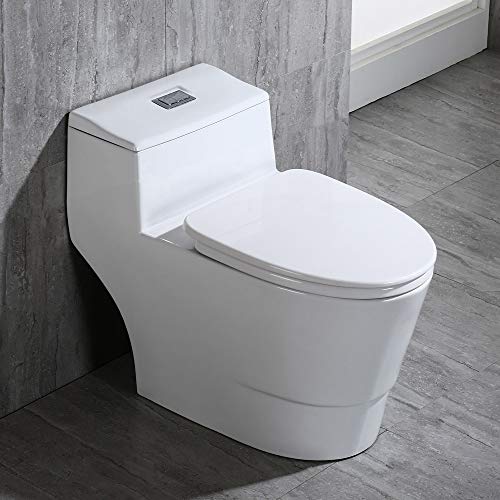
The Woodbridge T-0001 is the most widely purchased budget-tier dual flush toilet on major retail platforms. Its 0.8/1.6 GPF rating places the full flush slightly above the WaterSense 1.28 GPF threshold, though the blended average of approximately 0.98 GPF qualifies it for WaterSense listing. The skirted one-piece design eliminates the gap between tank and bowl where dirt accumulates, and the soft-close seat is included at the purchase price. MaP scores for the T-0001 are not published on the map-testing.com public database as of the most recent testing cycle, which is a gap worth noting for households with heavy-use demands.
Owner reviews are broadly positive on appearance, installation, and daily use, with some reports of the dual flush push button requiring adjustment over time. For rental properties or secondary bathrooms where the 1.6 GPF full flush is acceptable, the T-0001 delivers dual flush functionality at a competitive cost.
Check Woodbridge T-0001 on Amazon
The Swiss Madison Ivy is a wall-hung dual flush toilet rated at 0.8/1.28 GPF, designed for European-style in-wall tank carriers. Wall-hung installation adds installation cost but eliminates the floor footprint entirely, which is valuable in small bathrooms. The dual flush actuator is built into the wall plate and offers larger button targets than most standard tank-mounted actuators. MaP testing data for the Ivy is not currently in the public map-testing.com database. WaterSense certification status should be verified against the EPA product search tool before purchase for rebate eligibility.
For buyers considering the broader dual flush toilet category, the Ivy represents the wall-hung option within the Swiss Madison lineup and competes with TOTO's wall-hung models at a lower price point.
Check Swiss Madison Ivy on Amazon
When comparing a dual flush 0.8/1.28 GPF toilet to a single-flush 1.28 GPF WaterSense toilet using the 70/30 half/full flush ratio, the dual flush model uses a blended average of approximately 0.944 GPF versus the flat 1.28 GPF of the single-flush model -- a difference of roughly 0.336 GPF per flush event, or about 9,800 gallons per year for a family of four. However, this advantage only materializes if household members consistently use the half flush for liquid waste; if most users always press the full flush button, there is no meaningful difference in water consumption.
The single-flush 1.28 GPF toilet has one significant practical advantage: simplicity. There is no button selection decision, no risk of pressing the wrong flush, and no dual mechanism to maintain. Models like the TOTO Drake (single-flush 1.28 GPF), the Kohler Highline with Class Five flushing, and the American Standard Cadet 3 all deliver WaterSense-compliant water use with maximum flush reliability. For households with young children, elderly members, or renters who are unlikely to read instruction cards near the toilet, a well-engineered 1.28 GPF single-flush toilet may deliver equivalent or superior real-world water savings compared to a poorly-used dual flush toilet.
The decision between dual flush and single-flush 1.28 GPF also has a maintenance dimension. Dual flush mechanisms, particularly older cistern-valve designs, are more prone to partial seal failure than single-flapper systems, resulting in continuous ghost flushing that wastes more water than either flush option saves. Higher-end dual flush designs from TOTO (Aquia IV) and Kohler (Cimarron AquaPiston) mitigate this risk with canister valves and better seal materials, but it remains a relevant consideration for rental property owners or buyers who prefer set-it-and-forget-it reliability. See the guide on dual flush toilet problems for a full breakdown of common failure points.
The most water-efficient toilet is the one that gets used correctly, every time. A single-flush 1.28 GPF toilet in a household with consistent usage will outperform a dual flush 0.8/1.28 GPF toilet in a household where 90% of users press the full flush button regardless of the waste type. Before choosing dual flush, honestly assess whether everyone in the household will use the half flush consistently. If the answer is uncertain, a high-efficiency single-flush toilet is the lower-risk choice for water savings.
Based on 2025 to 2026 EPA Water Sense published data and average U.S. water and sewer rates of $0.007 to $0.015 per gallon (water plus sewer combined), replacing a pre-1994 3.5 GPF toilet with a dual flush 0.8/1.28 GPF model saves a typical four-person household $75 to $165 per year on combined water and sewer bills, with most households breaking even on the toilet purchase cost within three to seven years depending on product cost and local utility rates. In high-cost water markets like Los Angeles, San Diego, and parts of Arizona, annual savings can reach $200 or more per toilet replaced.
To calculate your specific savings potential, you need three inputs: your combined water and sewer rate per gallon (available on your utility bill), your estimated daily flush count per household member, and the GPF of your current toilet. The formula is straightforward: (Current GPF - Blended New GPF) x Annual Flushes x Cost per Gallon = Annual Dollar Savings.
For a household currently running a 3.5 GPF toilet at an average combined utility rate of $0.010/gallon with four occupants flushing five times per day:
At that utility rate, the savings from replacing a single 3.5 GPF toilet are substantial. Even at the lower end of typical utility rates ($0.005/gallon combined), annual savings of $373 per toilet represent a payback period of less than two years for most dual flush toilet purchases. For more detail on water use by toilet generation, see the how much water does a toilet use guide, which includes an interactive calculator for multiple toilet generations.
Households replacing a current-generation 1.6 GPF toilet will see more modest but still meaningful savings. At the same utility rate and usage pattern, upgrading from 1.6 GPF to a blended 0.944 GPF dual flush saves approximately $191 per year. The payback period for a $250 to $450 dual flush toilet in this scenario runs two to four years. Utility rebates, where available, compress this timeline significantly. For context on historical water use standards and how regulations have evolved, the low-flow toilet history article provides regulatory background from the 1992 Energy Policy Act forward.
Most residential dual flush toilets use 0.8 to 1.0 GPF for the half flush (liquid waste) and 1.28 to 1.6 GPF for the full flush (solid waste). EPA WaterSense-certified dual flush models average no more than 1.28 GPF across both flush volumes when tested under the agency's standardized conditions.
For most households, yes. The premium over a comparable single-flush 1.28 GPF toilet is typically $30 to $100, and the incremental water savings of 5,000 to 15,000 gallons per year pay back that premium within one to three years at average U.S. utility rates. The value case is strongest in high-cost water markets and for households upgrading from pre-1994 3.5 GPF toilets, where total savings can exceed $500 per year.
EPA WaterSense requires dual flush toilets to use a maximum average of 1.28 GPF across both flush volumes (calculated as the average of the full flush and half flush volumes) and to achieve a minimum MaP flush score of 350 grams to confirm adequate waste removal. Products must be independently tested by a WaterSense-recognized laboratory and listed on the EPA's certified product database to carry the label.
Dual flush saves more water in theory, but only if users consistently use the half flush for liquid waste. If all household members press the full flush every time, a dual flush 1.28/0.8 GPF toilet will use approximately the same amount of water as a single-flush 1.28 GPF model. A 1.28 GPF single-flush toilet is the safer choice for households with inconsistent flush behavior.
Replacing a pre-1994 3.5 GPF toilet with a dual flush 0.8/1.28 GPF model saves a four-person household approximately $75 to $165 per year at average U.S. combined water and sewer rates. In high-rate utility districts, savings can reach $200 to $300 per year per toilet. Replacing a 1.6 GPF toilet saves a more modest $40 to $90 per year for the same household.
MaP (Maximum Performance) testing measures how many grams of simulated solid waste a toilet can clear in a single flush. A score of 350g is the EPA WaterSense minimum. Scores of 600g to 1,000g indicate strong flush performance. For dual flush toilets, the full flush MaP score is the critical number -- the half flush is not designed to clear solid waste and is not typically MaP tested at the 350g threshold.
Dual flush toilets with well-engineered trapways and flush valves are not significantly more prone to clogging than standard 1.6 GPF toilets. The risk of clogging increases primarily when users select the half flush for solid waste, which the mechanism is not designed to handle. TOTO Aquia IV, American Standard H2Option, and Kohler Cimarron dual flush models all have trapways large enough (2 to 2.25 inches) to handle normal residential waste loads reliably on the full flush setting.
Yes. Retrofit dual flush conversion kits from brands like Mjjc and Killrust replace the standard flush handle and flapper with a dual flush tower mechanism that allows two flush volumes using the existing tank. These kits cost $20 to $50 and are compatible with most standard tank-type toilets. However, the converted flush volumes are approximate and are not independently tested for WaterSense compliance. A purpose-built dual flush toilet delivers more predictable performance and qualifies for utility rebates.
The EPA WaterSense efficiency calculations and most manufacturer water savings claims assume a 67 to 70 percent half flush, 30 to 33 percent full flush split. Research on actual household behavior from the American Water Works Association (AWWA) suggests the realistic split is closer to 55 to 65 percent half flush in households that actively practice efficient toilet use. More conservative savings estimates use the 60/40 ratio.
The most reliable method is the dye test: drop a dye tablet or a few drops of food coloring into the tank and wait 15 minutes without flushing. If color appears in the bowl, the seal is leaking. Dual flush cistern seals are more complex than single-flapper designs and are more susceptible to debris accumulation on the seal face, which prevents a complete close. Annual dye testing is recommended for any dual flush toilet older than three years. See the toilet leak detection dye test guide for step-by-step instructions.
Yes. Many water utilities across the United States offer $50 to $200 per toilet replaced when the new toilet carries EPA WaterSense certification. Rebates are most widely available in California, Texas, Florida, Colorado, Arizona, and the Pacific Northwest. The EPA maintains a rebate finder tool at epa.gov/watersense/rebate-finder. Some utilities also offer free on-site toilet replacement programs for qualifying low-income households.
Several dual flush toilets achieve the maximum MaP test score of 1,000 grams, including the TOTO Aquia IV, the TOTO Drake II dual flush, and the American Standard H2Option. These toilets confirm they can clear the maximum tested waste load in a single full flush while remaining within EPA WaterSense GPF limits. MaP scores can be verified at map-testing.com, which maintains a searchable public database of tested products.
Purpose-built dual flush mechanisms from major brands such as TOTO, Kohler, and American Standard are rated for approximately 10 to 15 years of normal use before the seals and actuator components require replacement. Canister-type flush valves (used in Kohler AquaPiston models) generally outlast tower-type valves because they have fewer moving parts. The dual flush button actuator is typically the first component to exhibit wear, and replacement actuator assemblies are widely available from manufacturers.
Yes. The Woodbridge T-0001, the TOTO Aquia IV (available in both one-piece and two-piece configurations), and several Swiss Madison models offer dual flush in a one-piece design. One-piece dual flush toilets are generally easier to clean due to the absence of the tank-to-bowl seam, and they are available with skirted trapway designs. They typically carry a higher purchase price than comparable two-piece designs.
Gerber's dual flush offerings, including the Viper Dual Flush and the Avalanche Dual Flush, are rated at 0.8/1.28 GPF and carry EPA WaterSense certification. Gerber MaP scores on the full flush setting range from 600 to 1,000 grams depending on the specific model. Gerber toilets are widely distributed through professional plumbing channels and carry strong warranty support, making them a practical choice for contractors and renovation projects where supplier relationships are a factor.
Yes. The TOTO Aquia IV dual flush uses 0.8/1.0 GPF (blended approximately 0.86 GPF at 70/30 usage), while the TOTO Drake standard single-flush version uses 1.28 GPF. The Aquia IV uses roughly 33 percent less water per year than the Drake at equivalent usage patterns. However, the Drake (and Drake II) achieve 1,000-gram MaP scores on less water than many competitors, and the Drake II dual flush (1.0/1.28 GPF) is the stronger choice for households with heavy solid waste loads who also want efficiency.
Yes. Dual flush toilets are compatible with septic systems and are often recommended for septic households because reduced water volume per flush reduces the hydraulic load on the septic tank, slowing the rate of liquid overflow to the drain field and reducing pump-out frequency. The full flush volume (1.28 GPF on WaterSense models) provides adequate water to carry waste through the drain line to the septic tank. EPA WaterSense certified dual flush toilets for septic use are covered in more detail in the best toilets for septic systems guide.
Ghost flushing is the spontaneous refill of the toilet tank when water slowly leaks past the flush valve seal, eventually dropping the water level enough to trigger the fill valve. Dual flush toilets can be more susceptible to ghost flushing than single-flapper designs because the tower-style valve mechanism has more contact points where debris can prevent a complete seal. Regular tank cleaning and annual seal inspection prevent most ghost flushing incidents. Canister-type valves (Kohler AquaPiston) are generally less prone to this failure mode.
Multiply your daily flushes per person by the number of occupants and by 365 to get annual flushes. Estimate your half-flush ratio (typically 60 to 70 percent). Calculate blended GPF as: (half-flush ratio x half GPF) + (full-flush ratio x full GPF). Multiply annual flushes by the difference between your current GPF and the new blended GPF. Multiply the result by your combined water and sewer rate per gallon (found on your utility bill) to get annual dollar savings. The toilet water savings calculator on this site automates this calculation.
No. The rough-in measurement, supply line connection, wax ring, and bolt installation steps are identical to standard toilet installation. The only additional step is verifying the dual flush actuator is correctly seated on the cistern tower after tank installation, which typically involves a quarter-turn lock rather than any specialized tools. The installation guides for models like the TOTO Aquia IV and Woodbridge T-0001 are rated as DIY-accessible by the majority of owner reviewers on major retail platforms.
Dual flush toilets deliver genuine, measurable water savings -- typically 4,000 to 20,000 gallons per year per household depending on what they replace -- but only when users consistently use the half flush for liquid waste. Among the available options, the TOTO Aquia IV (0.8/1.0 GPF, MaP 1,000g) is the strongest all-around performer, combining the lowest blended GPF on the market with verified flush reliability and EPA WaterSense certification. The American Standard H2Option offers comparable performance at a lower purchase cost, and the Woodbridge T-0001 provides an accessible entry point for budget-constrained households. All three qualify for utility rebates in participating districts, making the payback period on the upgrade faster than the headline purchase price suggests. For households upgrading from a pre-1994 3.5 GPF toilet, switching to any dual flush WaterSense model is one of the highest-ROI home efficiency improvements available.
Learn why toilet trapways curve like an S, how each bend blocks sewer gas, and what the shape means for clogs and…
Read the guideAlmost every US toilet has a left-side handle. Learn the plumbing and mechanical reasons behind the layout and when it actually changes.
Read the guideHome toilets rely on tanks because household water lines lack the pressure that public flushometer systems use to flush straight from the…
Read the guide