

Why Toilet Trapways Are Curved Like an S
Toilets4.6
Learn why toilet trapways curve like an S, how each bend blocks sewer gas, and what the shape means for clogs and…
Read the guideA complete GPF reference for every major toilet category, from 1980s-era 7.0 GPF water hogs to today's 0.8 GPF ultra-high-efficiency models, with MaP scores, EPA WaterSense status, and brand-by-brand data for TOTO, Kohler, American Standard, Woodbridge, Swiss Madison, and Gerber.
Modern WaterSense-certified toilets use 1.28 GPF or less and still pass MaP testing at 600 grams or above. Switching from an older 3.5 GPF model to a 1.28 GPF WaterSense toilet saves roughly 16,500 gallons per person per year, cutting water bills noticeably without sacrificing flush performance.
GPF (gallons per flush) is the single most regulated toilet specification in North America. Federal law caps residential toilets at 1.6 GPF, but EPA WaterSense raises the bar to 1.28 GPF while requiring a minimum MaP score of 350 grams to ensure reliable waste removal. The difference between a 3.5 GPF toilet installed in 1994 and a 1.28 GPF WaterSense model is 2.22 gallons per flush -- for a family of four flushing five times each daily, that gap costs roughly $200 per year in water and sewer charges at average U.S. utility rates.
Beyond household savings, toilet water use accounts for approximately 24% of indoor residential water consumption in the United States according to EPA data, making toilets the single largest indoor water user in the typical home.
| Era / Standard | GPF | Liters Per Flush | Gallons / Person / Year* | WaterSense Certified | Status |
|---|---|---|---|---|---|
| Pre-1980 (tank flush) | 5.0 -- 7.0 | 18.9 -- 26.5 | 9,125 -- 12,775 | No | Obsolete |
| 1980 -- 1992 (standard) | 3.5 | 13.2 | 6,388 | No | Obsolete |
| 1994 Federal Mandate (EPAct) | 1.6 | 6.1 | 2,920 | No | Legal minimum |
| High Efficiency Toilet (HET) | 1.28 | 4.8 | 2,336 | Yes (most) | Current best practice |
| EPA WaterSense Dual Flush (full / half) | 1.28 / 0.8 | 4.8 / 3.0 | ~1,800 (blended)** | Yes | Most efficient tank toilet |
| Ultra High Efficiency (UHET) | 0.8 | 3.0 | 1,460 | Yes | Premium efficiency |
| Pressure-Assist HET | 1.0 -- 1.1 | 3.8 -- 4.2 | 1,825 -- 2,007 | Most models | Commercial / high-traffic |
| * Based on 5 flushes per day, 365 days. ** Assumes 80% liquid / 20% solid flush ratio for dual-flush models. | |||||
The jump from 1.6 GPF to 1.28 GPF looks small on paper -- only 0.32 gallons -- but that 20% reduction per flush adds up to 584 gallons per person annually. For a household of four, that is 2,336 gallons saved every year without any behavior change. Rebate programs in California, Colorado, New York, Texas, and Washington can offset purchase costs entirely, making the payback period under 18 months in most municipalities.
| Brand / Model | GPF | Flush Type | MaP Score (grams) | WaterSense | Trapway (inches) | Check Price |
|---|---|---|---|---|---|---|
| TOTO Drake (CST744S) | 1.6 | Gravity G-Max | 1,000 | No | 2-1/8 | Check price |
| TOTO Drake II (CST454CEFG) | 1.28 | Gravity G-Max | 1,000 | Yes | 2-1/8 | Check price |
| TOTO UltraMax II (MS604114CEFG) | 1.28 | Tornado Flush | 1,000 | Yes | 2-1/8 | Check price |
| TOTO Aquia IV (MS446124CEMFG) | 1.28 / 0.9 | Tornado Dual | 800 (full) | Yes | 2-1/8 | Check price |
| Kohler Highline (K-3493) | 1.6 | Gravity | 900 | No | 2-1/8 | Check price |
| Kohler Highline Arc (K-3658) | 1.28 | AquaPiston | 1,000 | Yes | 2-1/8 | Check price |
| Kohler Cimarron (K-3609) | 1.28 | AquaPiston | 1,000 | Yes | 2-1/8 | Check price |
| American Standard Champion 4 (2034.014) | 1.6 | Gravity PowerWash | 1,000 | No | 2-3/8 | Check price |
| American Standard Cadet 3 (3377.216) | 1.28 | Gravity Cadet | 1,000 | Yes | 2-1/8 | Check price |
| Woodbridge T-0001 | 1.28 / 0.8 | Dual Flush | 800 (full) | Yes | 2-1/8 | Check price |
| Swiss Madison Sublime (SM-1T254) | 1.28 / 0.8 | Dual Flush | 600 (full) | Yes | 2-1/8 | Check price |
| Gerber Viper (21-302) | 1.28 | Gravity | 800 | Yes | 2-1/8 | Check price |
| Gerber Ultra Flush (21-318) | 1.6 | Gravity | 1,000 | No | 2-1/8 | Check price |
| Niagara Stealth (N7714) | 0.8 | Gravity Stealth | 800 | Yes | 3 | Check price |
MaP scores shown are published maximums from map-testing.com. A MaP score of 800 grams or above is considered excellent for residential use; 1,000 grams is the maximum tested threshold and indicates maximum clog resistance at the rated GPF.
MaP (Maximum Performance) testing uses a standardized soybean paste media formed into cylinders that simulate real waste. Toilets are tested in incremental gram weights -- 100, 200, 300 grams and so on -- until the flush fails to completely clear the bowl in a single flush. The highest gram weight cleared in three consecutive attempts is the MaP score, published by the independent organization at map-testing.com. A toilet certified at 1.28 GPF with a MaP score of 1,000 grams has been independently verified to remove the maximum test load at that water volume, proving that lower GPF does not automatically mean weaker performance when the flush mechanism is well engineered.
EPA WaterSense requires a minimum MaP score of 350 grams for certification, but leading models from TOTO, Kohler, and American Standard routinely score 800 to 1,000 grams at 1.28 GPF, far exceeding the certification floor.
MaP scores expose the biggest misconception in toilet shopping: many buyers assume lower GPF means weaker flushing. The TOTO Drake II scores a perfect 1,000 grams at just 1.28 GPF, while some older 1.6 GPF models from the mid-2000s scored below 600 grams. Flush technology -- siphon geometry, trapway diameter, rim jet design, and flush valve speed -- determines performance far more than raw water volume.
EPA WaterSense is a voluntary labeling program administered by the U.S. Environmental Protection Agency that certifies products using at least 20% less water than standard models while maintaining equivalent or better performance. For toilets, WaterSense certifies models at 1.28 GPF or less (including dual-flush toilets where the full-flush volume does not exceed 1.28 GPF), provided the model achieves at least a 350-gram MaP score. Third-party laboratories conduct the testing; manufacturers cannot self-certify. The full list of certified models is searchable at epa.gov/watersense.
WaterSense certification is required to qualify for many utility rebate programs in the U.S., including those offered by water districts in California, Texas, Colorado, New York, and Washington state, making it a financially important designation beyond its environmental value.
Annual toilet water use depends on GPF and flush frequency. At the national average of five flushes per person per day, a 1.6 GPF toilet uses 2,920 gallons per person per year, while a 1.28 GPF model uses 2,336 gallons -- a saving of 584 gallons annually per person. A household of four saves approximately 2,336 gallons per year making the upgrade. Dual-flush models save more: at 80% liquid flushes (0.8 GPF) and 20% solid flushes (1.28 GPF), the blended consumption drops to approximately 912 gallons per person per year, less than one-third the usage of a pre-1994 toilet.
Replacing a 3.5 GPF toilet from the early 1990s with a 1.28 GPF WaterSense model saves over 4,000 gallons per person annually, which translates to measurable reductions on both water and sewer utility bills in virtually every U.S. market.
TOTO leads the efficiency-performance balance with its Tornado Flush system, which uses a 360-degree rimless water flow and reduced-diameter nozzles to create centrifugal cleaning action at 1.28 GPF, achieving 1,000-gram MaP scores on models including the UltraMax II and Drake II. Kohler's AquaPiston flush valve fills and empties the tank simultaneously, enabling the Cimarron and Highline Arc to reach 1,000 grams at 1.28 GPF. American Standard's Cadet 3 uses an EverClean surface and a large 3-inch flush valve opening to hit 1,000 grams at 1.28 GPF. For 0.8 GPF ultra-high efficiency, the Niagara Stealth uses a patented vacuum-assist chamber to score 800 grams at a remarkably low water volume, making it ideal for rebate-motivated buyers in drought-prone areas.
For a detailed comparison of top performers, see our guide to the best flushing toilets, which ranks models by MaP score, flush technology, and value.
| Old Toilet GPF | New Toilet GPF | Savings / Person / Year (gal) | Savings / Family of 4 / Year (gal) | Est. Annual $ Savings* |
|---|---|---|---|---|
| 3.5 | 1.6 | 3,468 | 13,870 | ~$55 |
| 3.5 | 1.28 | 4,051 | 16,206 | ~$65 |
| 3.5 | 1.28/0.8 dual | ~4,800 | ~19,200 | ~$77 |
| 1.6 | 1.28 | 584 | 2,336 | ~$9 |
| 1.6 | 0.8 | 1,460 | 5,840 | ~$23 |
| 1.28 | 0.8 | 876 | 3,504 | ~$14 |
| * Dollar savings estimated at $0.004 per gallon (combined water + sewer), U.S. national average. Actual savings vary by utility. 5 flushes per person per day assumed. Dual-flush blended at 80% / 20% liquid-solid ratio. | ||||
Dual-flush toilets offer two flush volumes -- a reduced-volume liquid flush (typically 0.8 or 1.0 GPF) and a full-volume solid flush (typically 1.28 GPF). The system was pioneered by Caroma in Australia and has been widely adopted by brands including TOTO, Woodbridge, Swiss Madison, and American Standard. Under EPA WaterSense rules, a dual-flush toilet qualifies for certification if its full-flush cycle does not exceed 1.28 GPF AND its effective flush volume (EFV) -- a weighted average -- is 1.28 GPF or below.
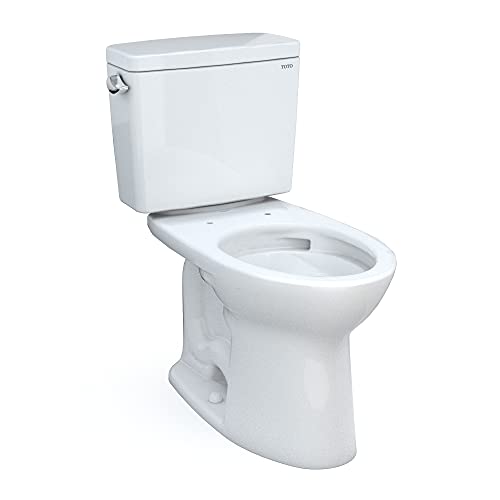
The TOTO Aquia IV exemplifies the dual-flush category with a 1.28 GPF full flush and a 0.9 GPF light flush, both powered by TOTO's Tornado Flush system. The Woodbridge T-0001 offers 1.28 / 0.8 GPF with a streamlined skirted design. Swiss Madison's Sublime and Well series provide the same dual-flush split at a lower entry cost, though MaP scores on mid-tier brands typically land between 600 and 800 grams rather than the 1,000-gram maximum seen in TOTO and Kohler flagship models.
Dual-flush toilets deliver maximum water savings on paper, but they underperform in practice when users default to the full flush for every use. If everyone in a household uses the half flush for liquids consistently, savings are substantial. If the household ignores the half-flush button -- a common pattern in homes with older occupants or guests -- water savings drop to near-single-flush levels. For households unlikely to use both buttons consistently, a high-efficiency 1.28 GPF single-flush toilet like the TOTO Drake II or Kohler Cimarron is often a more reliable path to water savings.
Pressure-assist toilets use compressed air trapped inside a sealed inner tank to force water into the bowl at higher velocity than gravity alone allows. This allows pressure-assist models to operate effectively at 1.0 to 1.1 GPF while maintaining strong waste removal. The American Standard Vormax Plus, Gerber's commercial-grade Viper series, and Flushmate-equipped models from various brands use this technology.
Pressure-assist toilets are particularly valuable in buildings with low water pressure (below 20 PSI), in basement installations, and in high-traffic commercial settings where frequent flushing with minimal water is a priority. They require at least 25 PSI of water pressure to operate the air compression chamber and are noticeably louder than gravity toilets -- a relevant consideration for bathrooms adjacent to bedrooms. For most residential buyers, a 1.28 GPF gravity model with a high MaP score delivers comparable cleanliness with less noise and lower maintenance complexity. See our pressure-assist toilet comparison for a full breakdown.
| Jurisdiction | Max GPF for New Installations | Notes |
|---|---|---|
| Federal (U.S. nationwide) | 1.6 GPF | EPAct 1992; applies to all new toilets sold |
| California (CPC Title 20) | 1.28 GPF | Stricter than federal; applies to new construction and replacement since 2016 |
| Texas (some water districts) | 1.28 GPF (rebate programs) | Required for utility rebate eligibility, not statewide law |
| Colorado | 1.28 GPF (rebate programs) | Denver Water and others offer rebates for WaterSense certified models |
| New York City | 1.28 GPF preferred | DEP rebate programs incentivize WaterSense; 1.6 GPF still legal |
| Washington State | 1.28 GPF (rebate programs) | Puget Sound utilities offer rebates for WaterSense models |
California remains the only state with a statewide mandate below the federal 1.6 GPF cap for new installations. However, utility rebate programs in dozens of other states effectively make 1.28 GPF the financially optimal choice even where it is not legally required. For a state-by-state breakdown, see our toilet rebate programs guide.
Toilet GPF is printed in several locations: on the carton, in the specification sheet, and -- on tanks manufactured from 1994 onward -- molded into the underside of the tank lid. Dual-flush models list both volumes separated by a slash (e.g., 1.28 / 0.8 GPF). The EPA WaterSense logo on the box or spec sheet confirms the model has been third-party tested and certified.
When comparing GPF across brands, always cross-reference with the MaP score. A 1.28 GPF toilet scoring 1,000 grams is objectively more efficient than a 1.6 GPF model scoring 700 grams -- it uses less water and removes more waste per flush. The combination of GPF and MaP is the only honest comparison metric. For guidance on translating these numbers into a purchase decision, our toilet buying guide walks through every specification category.
Homeowners replacing pre-1994 toilets should treat GPF as a minimum floor, not a target. At 3.5 GPF or higher, those older models flush more water in one year than a family of four will flush in three years with a modern 1.28 GPF model. The payback on a mid-range WaterSense toilet is typically 3 to 5 years in water savings alone, not counting utility rebates that can reduce payback to under 12 months in high-rebate markets. The upgrade math is straightforward; the main decision is which flush technology fits the household's plumbing pressure and cleaning preferences.
| Use Case | Recommended GPF | Best Category | Suggested Models | Check Price |
|---|---|---|---|---|
| Large family, frequent heavy use | 1.28 GPF single flush | Gravity HET with 1,000 MaP | TOTO Drake II, Kohler Cimarron, American Standard Cadet 3 | Check price |
| Maximum water savings, two-button OK | 1.28 / 0.8 GPF dual flush | Dual-flush HET | TOTO Aquia IV, Woodbridge T-0001 | Check price |
| Low water pressure (under 30 PSI) | 1.28 GPF gravity | Wide trapway gravity HET | American Standard Champion 4 (1.6), Kohler Cimarron 1.28 | Check price |
| Ultra efficiency, drought areas | 0.8 GPF | UHET gravity or pressure-assist | Niagara Stealth, TOTO Aquia IV (half flush) | Check price |
| Commercial / high-traffic | 1.0 -- 1.28 GPF | Pressure-assist or high MaP gravity | Gerber Viper, American Standard VorMax Plus | Check price |
| Septic system | 1.28 GPF max | WaterSense certified gravity | Kohler Highline Arc, TOTO Drake II, Cadet 3 | Check price |
| Rental property or budget install | 1.28 GPF | Value HET | American Standard Cadet 3, Gerber Viper | Check price |
For households on septic systems, lower GPF is generally beneficial: less water per flush means lower hydraulic loading on the septic tank and drain field, reducing the frequency of pump-outs. For more on septic-compatible models, see our best toilets for septic systems guide.
A common concern with lower-GPF toilets is increased clogging risk. MaP test data from thousands of certified models disproves this concern for quality fixtures: the TOTO Drake II, Kohler Cimarron, and American Standard Cadet 3 all achieve 1,000-gram MaP ratings at 1.28 GPF, equal to or better than most 1.6 GPF toilets manufactured before 2005. The key engineering factors are trapway diameter (2-1/8 inch minimum for residential; the Champion 4 uses 2-3/8 inch), flush valve size (3-inch valves fill the bowl faster for better siphon action), and rim jet design (concentrated jets vs. distributed wash).
Clogging rates in practice correlate most strongly with trapway diameter, flush valve speed, and household flushing habits (specifically the disposal of non-flushable materials), not GPF rating. A properly spec'd 1.28 GPF toilet from TOTO, Kohler, or American Standard will clog far less often than a budget 1.6 GPF toilet with a 2-inch trapway and a slow-fill 2-inch flush valve. For a deeper look at clog-resistance factors, read our guide on the best no-clog toilets.
GPF stands for gallons per flush. It is the standardized measurement of how much water a toilet uses in a single complete flush cycle. Lower GPF means less water used. Federal law in the U.S. limits residential toilets to a maximum of 1.6 GPF; EPA WaterSense certifies models at 1.28 GPF or lower.
The lowest GPF available in widely distributed residential gravity toilets is 0.8 GPF, found in models like the Niagara Stealth and the half-flush mode of dual-flush toilets such as the TOTO Aquia IV. Composting and non-water-using toilets exist but are outside the standard plumbed toilet category.
Yes. Dozens of 1.28 GPF toilets have achieved the maximum 1,000-gram MaP score -- the highest independent test rating -- including the TOTO Drake II, TOTO UltraMax II, Kohler Cimarron, and American Standard Cadet 3. MaP testing is conducted by independent labs and published publicly at map-testing.com.
At the national average of five flushes per person per day, a 1.6 GPF toilet uses 8 gallons per person daily. A 1.28 GPF model uses 6.4 gallons. A dual-flush model with an 80/20 liquid-solid split at 0.8/1.28 GPF uses approximately 3.46 gallons per person daily -- less than half the 1.6 GPF baseline.
Not if the toilet has an adequately sized trapway and a high MaP score. Top-rated 1.28 GPF models from TOTO, Kohler, and American Standard score 1,000 grams on MaP testing, matching or exceeding most 1.6 GPF models. Clogging is more closely tied to trapway diameter, flush valve speed, and what is flushed than to GPF alone.
EPA WaterSense is a voluntary third-party labeling program that certifies toilets using 1.28 GPF or less that also pass independent MaP testing at a minimum of 350 grams. Certified models are listed at epa.gov/watersense. WaterSense certification is required for most utility rebate programs across the U.S.
MaP (Maximum Performance) score is the maximum grams of simulated waste a toilet can remove completely in a single flush, tested in a lab setting by an independent third party. Scores range from below 200 grams (poor) to 1,000 grams (maximum). For residential use, 500 grams is acceptable; 800 grams is good; 1,000 grams is excellent. MaP scores are searchable at map-testing.com.
The TOTO Aquia IV dual-flush toilet uses 0.9 GPF for liquid waste and 1.28 GPF for solid waste, making it TOTO's most water-efficient standard toilet. In pure GPF terms, the half-flush at 0.9 GPF is TOTO's lowest tank toilet volume while maintaining meaningful MaP performance.
A single person flushing a 1.6 GPF toilet five times daily uses 2,920 gallons per year. At 1.28 GPF, that drops to 2,336 gallons. For a family of four, a 1.28 GPF toilet saves approximately 2,336 gallons per year versus a 1.6 GPF model, or over 16,000 gallons compared to a 3.5 GPF pre-1994 toilet.
Dual-flush toilets deliver meaningful savings when household members consistently use the half-flush for liquid waste -- potentially cutting per-person annual water use to under 1,000 gallons from a toilet. The savings diminish significantly if users ignore the half-flush button. Households that consistently use both flush modes will find the investment worthwhile; households that won't are often better served by a reliable 1.28 GPF single-flush model.
EPA WaterSense requires toilets to use 1.28 GPF or less for the full flush cycle. Dual-flush toilets qualify based on their effective flush volume (EFV), which must not exceed 1.28 GPF when calculated by the WaterSense method. The model must also independently achieve a MaP score of at least 350 grams.
The Energy Policy Act of 1992 (EPAct) established a maximum of 1.6 GPF for all residential toilets sold in the U.S., effective January 1, 1994. California has a more stringent state law requiring 1.28 GPF for new construction and replacement toilets. The federal 1.6 GPF cap remains the baseline for all other states.
Kohler's AquaPiston flush valve is designed to open from all sides simultaneously, releasing water into the bowl at higher speed than conventional flush valves. This allows AquaPiston-equipped models like the Kohler Cimarron and Highline Arc to achieve 1,000-gram MaP scores at 1.28 GPF, using 20% less water than the federal maximum while maintaining maximum measured flush performance.
TOTO's Tornado Flush uses two nozzles positioned to create a 360-degree cyclonic rinse of the bowl rather than a rim-distributed gravity wash. The centrifugal water flow cleans the entire bowl interior with less water, enabling the UltraMax II and Nexus to deliver 1,000-gram MaP performance at 1.28 GPF while also reducing cleaning effort. TOTO Aquia IV uses a version of this system in both dual-flush modes.
Yes. A 1.28 GPF toilet is a direct replacement for a 1.6 GPF toilet with no plumbing modifications required, provided the rough-in measurement matches (typically 12 inches; some homes have 10- or 14-inch rough-ins). The lower GPF is handled internally by the flush valve and tank design, not by the supply or drain plumbing.
Check the underside of the tank lid -- most toilets manufactured after 1994 have the GPF molded into the ceramic. Alternatively, search the model number (usually stamped inside the tank) on the manufacturer's website or EPA's WaterSense product database at epa.gov/watersense. Toilets with a tank taller than the bowl are typically pre-1994 and likely use 3.5 GPF or more.
Pressure-assist toilets typically operate at 1.0 to 1.1 GPF, slightly below the 1.28 GPF standard for gravity WaterSense models, but the primary advantage is flush velocity rather than water volume. They require 25 to 80 PSI of supply pressure to function correctly, produce more noise, and have higher repair complexity. For most homeowners, a 1.28 GPF gravity toilet with a high MaP score is a simpler and equally water-efficient choice.
The American Standard Champion 4 is rated at 1.6 GPF, the federal maximum. It is not EPA WaterSense certified but achieves a 1,000-gram MaP score due to its 2-3/8 inch fully glazed trapway and large 4-inch flush valve -- the largest available in a residential gravity toilet. American Standard also offers the Champion 4 Max at 1.28 GPF with WaterSense certification and an equal 1,000-gram MaP score.
TOTO offers the broadest portfolio of WaterSense-certified toilets with the highest MaP scores, including multiple 1,000-gram-rated models at 1.28 GPF and the dual-flush Aquia IV at 1.28/0.9 GPF. Kohler and American Standard both offer WaterSense models scoring 1,000 grams at 1.28 GPF. For extreme water efficiency at 0.8 GPF, Niagara's Stealth line leads the market.
The Niagara Stealth at 0.8 GPF achieves an 800-gram MaP score, which is well above the adequate threshold for residential use and sufficient for the vast majority of household needs. That said, households with heavy use patterns, older plumbing with partial blockages, or septic systems that occasionally back up may prefer the added margin of a 1.28 GPF model scoring 1,000 grams on MaP testing.
For most households in 2026, the 1.28 GPF WaterSense-certified gravity toilet represents the optimal balance of water efficiency and flush performance. Models like the TOTO Drake II, Kohler Cimarron, and American Standard Cadet 3 all achieve 1,000-gram MaP scores at this GPF rating -- proving that cutting 20% of water use per flush requires no compromise on clog resistance or cleaning power. Households motivated by maximum water savings and willing to use both flush buttons consistently should prioritize a dual-flush model such as the TOTO Aquia IV or Woodbridge T-0001. Homeowners still on 3.5 GPF toilets from the early 1990s should treat replacement as a priority: the annual household water savings exceed 16,000 gallons, and utility rebates in many markets make the upgrade near-immediate in financial payback.
Learn why toilet trapways curve like an S, how each bend blocks sewer gas, and what the shape means for clogs and…
Read the guideAlmost every US toilet has a left-side handle. Learn the plumbing and mechanical reasons behind the layout and when it actually changes.
Read the guideHome toilets rely on tanks because household water lines lack the pressure that public flushometer systems use to flush straight from the…
Read the guide