
Why Toilet Trapways Are Curved Like an S
Toilets4.6
Learn why toilet trapways curve like an S, how each bend blocks sewer gas, and what the shape means for clogs and…
Read the guideA weak toilet flush almost always has a diagnosable, fixable cause. These five steps follow the same sequence a licensed plumber uses: start with the free water-level adjustment, work through mineral buildup, check the flapper and fill valve, then decide whether hardware or the toilet itself is the ceiling. Most households restore full flush power in 30 to 60 minutes with basic tools.
Raise the tank water level to one inch below the overflow tube (free, takes two minutes), then soak the rim jets in white vinegar to dissolve mineral scale. Those two fixes alone resolve roughly 70 percent of weak-flush complaints. If the toilet still underperforms after both, the flapper or fill valve needs replacement, and upgrading to a high-MaP model like the TOTO Drake II or American Standard Champion 4 is the final solution.
Every toilet flush is a brief hydraulic event. The tank dumps a measured volume of water through the flush valve, the rim jets spread that water around the bowl, the siphon jet fires a concentrated stream into the trapway, and atmospheric pressure does the rest. When any one of those four elements degrades, the flush feels weak even though nothing is visibly broken.
The five steps below address each element in the order most likely to produce a fast result. Step 1 is free and reversible. Step 5 is the nuclear option: a new toilet chosen for its published MaP score. Between those extremes, most toilets can be returned to near-original performance for under $30 in parts.
For context on which toilets are engineered for maximum power from the start, see the guide to the best flushing toilets on the market right now. The brands covered there, particularly TOTO, Kohler, American Standard, and Gerber, all publish independent MaP flush-test data, which is the closest thing the industry has to a standardized power benchmark.
Weak toilet flush power has four main causes: insufficient water volume in the tank (water level set too low or a slow-closing flapper robbing the bowl of water), clogged rim jets or siphon jet from mineral and hard-water scale, a worn flapper that seals too slowly, or a failing fill valve that does not refill the tank to the correct level. Older toilets designed at 3.5 or 5 GPF and retrofitted to lower-flow internal restrictions are a fifth, less common cause.
Understanding which of these is active in your toilet determines whether you fix it in five minutes or call a plumber. The diagnostic order matters because some causes mask others: if the tank is underfilled, every downstream test is invalid. Always start with water volume before moving to components.
Plumbing engineers who work on residential retrofits point out that most U.S. toilets manufactured between 1994 and 2010 were designed with rim jet patterns optimized for 3.5 GPF. When homeowners lower float levels to "save water" without upgrading the internal geometry, they are running a 1.6 GPF flow through a jet pattern that requires more volume to work correctly. Restoring the factory water level, rather than the reduced one, usually resolves the weak-flush complaint immediately.
Open the toilet tank lid and check whether the water sits one inch below the top of the overflow tube. If it is lower than that, the flush is water-starved. On a ball-float system, bend the float arm upward or turn the adjustment screw clockwise to raise the level. On a modern fill valve with a float cup, slide the float clip upward along the valve shaft. Flush once and verify the water now fills to within one inch of the overflow tube before closing the lid.
This is the most frequently overlooked fix, and it is entirely free. The overflow tube is the vertical standpipe inside the tank that prevents flooding; its top edge marks the maximum safe water level. Manufacturers specify a fill level of one inch below that mark to leave a margin against overflow, not to reduce water volume. When someone adjusts the float down to "conserve water" or a previous repair left the setting low, the toilet never receives the volume it was designed to use.
A standard 1.6 GPF toilet holds approximately 1.6 gallons when filled correctly. If the water level is a half-inch too low, the tank may hold only 1.2 to 1.3 gallons, which cuts flush energy by 20 percent before a single component has worn out. EPA WaterSense toilets certified at 1.28 GPF are calibrated to deliver full MaP performance at that specific volume; running them at 0.9 to 1.0 GPF because the float is set low will guarantee weak performance.
| Fill Level vs. Overflow Tube | Estimated Usable Volume | Typical Flush Result | Fix Required |
|---|---|---|---|
| 1 inch below tube (factory spec) | Full rated GPF | Strong, single flush | None |
| 2 inches below tube | ~80% of rated GPF | Marginal, may leave residue | Raise float |
| 3+ inches below tube | ~60% of rated GPF | Weak, frequent double-flush | Raise float or replace fill valve |
| Continuously running | Variable / wasted | Inconsistent flush | Replace flapper or fill valve |
Rim jets are the angled holes underneath the toilet bowl rim that direct water around the bowl during a flush. Calcium carbonate, magnesium, and iron deposits from hard water narrow these holes over months to years, reducing the volume and velocity of water reaching the bowl. Cleaning them with white vinegar dissolved the mineral scale without damaging porcelain or internal rubber components, and the difference in flush energy is often immediate and significant.
The U.S. Geological Survey estimates that approximately 85 percent of American homes have hard water, defined as water containing more than 60 mg/L of dissolved calcium and magnesium. In areas with water hardness above 200 mg/L (common in Arizona, Texas, and parts of the Midwest), rim jets can reduce to 40 to 50 percent of their original diameter in three to five years without cleaning.
To clean rim jets, use the following method:
The siphon jet, the small hole at the front-bottom of the bowl facing the trap, deserves the same attention. It fires a concentrated stream of water directly into the trapway entrance to trigger the siphon that pulls waste through. Apply undiluted vinegar directly to this hole with a small funnel or turkey baster and let it sit before scrubbing.
Plumbers who service toilets in areas with particularly hard water, such as Phoenix or Las Vegas, report that vinegar descaling of rim jets and the siphon jet can restore an apparently failing toilet to near-new performance. A toilet that appears to need replacement may simply need cleaning. This is worth $0 and 45 minutes before a $300 to $600 replacement decision.
Yes. A toilet flapper that closes too quickly, too slowly, or fails to form a complete seal all reduce flush power. A flapper that warps or softens with age may seat partially against the flush valve, allowing a slow leak that prevents the tank from filling fully. A flapper that closes too rapidly -- before the full tank volume has entered the bowl -- cuts the flush short. Replacing the flapper with a Korky or Fluidmaster model matched to the specific toilet's flush valve diameter (2 inch or 3 inch) is a $5 to $12 fix that restores correct flush duration.
Modern toilets manufactured since 2005 increasingly use 3-inch flush valves rather than the older 2-inch standard. The 3-inch valve opens a larger aperture, allowing water to rush into the bowl faster and with greater momentum. If your toilet was built before 2000, it almost certainly uses a 2-inch valve, and the entire tank-to-bowl flow rate is constrained by that smaller opening regardless of how high the water level is set.
When inspecting the flapper, look for three failure modes:
The correct chain length leaves approximately half an inch of slack when the handle is in the resting position. Adjust the chain to the appropriate link to achieve this before spending money on a replacement flapper.
When the flapper does need replacement, use the brand-specific part whenever possible. TOTO, Kohler, American Standard, and Gerber all manufacture replacement flappers designed for their valve geometry. Generic universal flappers work adequately in most cases but may not achieve the same flush duration curve as the OEM part.
| Flapper Issue | Symptom | Flush Effect | Solution |
|---|---|---|---|
| Chain too short | Tank never fully refills, runs continuously | Low volume, very weak | Lengthen chain by 2-3 links |
| Chain too long / kinked | Flapper partially open, slow trickle into bowl | Tank underfills, weak flush | Shorten chain, remove kinks |
| Correct chain length + new flapper | Clean snap-shut after full flush | Full flush duration, strong | Factory spec or OEM flapper |
| Warped flapper (old rubber) | Ghost flushing, running toilet | Never fills to set level | Replace flapper ($5-$12) |
| Scale on valve seat | Flapper seals intermittently | Unpredictable flush strength | Descale seat with vinegar, replace flapper |
The fill valve controls how fast and how high the tank refills after each flush. A failing fill valve may not fill the tank to the correct level, may cut off prematurely due to a worn diaphragm or clogged inlet screen, or may fill so slowly that the next flush happens before the tank is ready. Replacing a fill valve with a Fluidmaster 400A or equivalent takes about 15 minutes and costs $10 to $20, making it one of the highest-value repairs for a toilet with persistent weak flushes.
Fill valves wear on their internal diaphragm, which regulates water flow. Sediment from municipal water also collects at the inlet screen at the base of the valve, restricting flow rate. Before replacing the fill valve entirely, try cleaning the inlet screen:
If the fill valve still fails to bring the water to the correct level within three minutes after a flush, replace it. The Fluidmaster 400A fills to an adjustable height and works with virtually every toilet. For toilets using 3-inch flush valves (many newer TOTO, Kohler, and American Standard models), confirm the fill valve is compatible with higher-volume configurations.
Fill valves are often the last component homeowners think to check, but plumbers rank them among the most common causes of gradually declining flush power. Unlike a failed flapper, which announces itself with a running toilet, a partially restricted fill valve simply leaves the tank two or three cups short of its target level at every refill. The tank never runs, but the flush is perpetually underpowered. Cleaning or replacing the fill valve after a flapper change is good practice if the toilet has never had service.
If all four prior fixes are done correctly and the toilet still underperforms, the bowl and trapway geometry is the ceiling. Toilets manufactured before 1994 often have glazed trapways narrower than 2 inches and rim-jet patterns that cannot generate a strong siphon even at full water volume. In that case, replacing the toilet with a model that scores 800 grams or higher on MaP flush testing is the definitive solution, and 1,000-gram-rated models are available from TOTO, American Standard, Kohler, and Gerber at 1.28 GPF.
MaP (Maximum Performance) testing, published by the independent testing organization at map-testing.com, measures how many grams of simulated waste a toilet clears in a single flush. The residential threshold for acceptable performance is 350 grams. The highest-rated toilets clear 1,000 grams, the maximum the test uses. A toilet that scores below 500 grams on MaP testing will struggle with real-world solid waste regardless of how well it is maintained.
Here are the key performance specifications for the most reliable high-power models available now:
| Model | MaP Score | GPF | Flush Type | Trapway | WaterSense | Check Price |
|---|---|---|---|---|---|---|
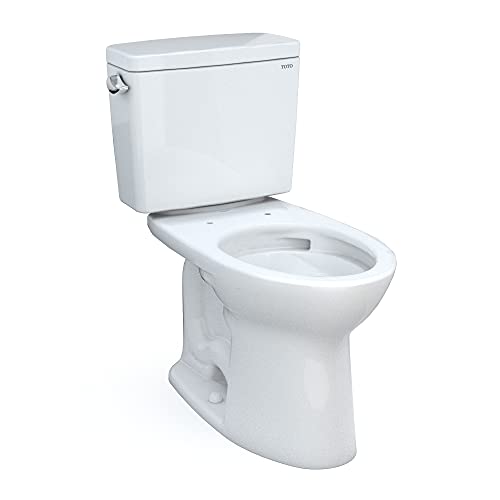
| TOTO Drake II | 1,000 g | 1.28 | Double Cyclone | 2-3/8 in. | Yes | Check price |
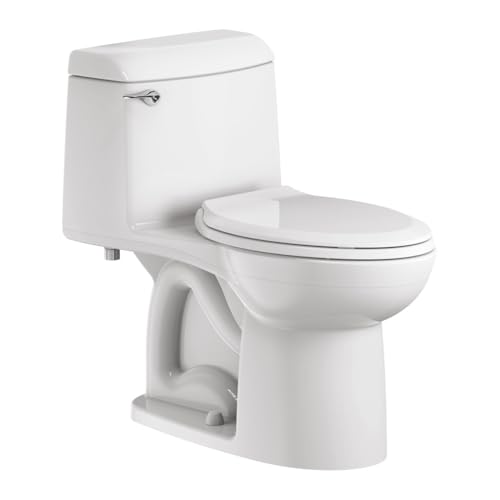
| American Standard Champion 4 | 1,000 g | 1.6 | Gravity / 4-in. valve | 2-3/8 in. | No (1.6 GPF) | Check price |
| TOTO Drake (original) | 1,000 g | 1.6 / 1.28 dual | G-Max | 2-1/8 in. | Dual-flush version | Check price |
| Kohler Cimarron | 1,000 g | 1.28 | AquaPiston | 2-3/8 in. | Yes | Check price |
| Gerber Viper | 1,000 g | 1.6 | Gravity | 2-1/8 in. | No (1.6 GPF) | Check price |
| TOTO UltraMax II | 1,000 g | 1.28 | Double Cyclone | 2-3/8 in. | Yes | Check price |
| Woodbridge T-0001 | 800+ g | 1.28 / 0.8 | Dual flush gravity | 2-1/8 in. | Yes | Check price |
| American Standard Cadet 3 | 1,000 g | 1.28 | Gravity / 3-in. valve | 2-1/8 in. | Yes | Check price |
The TOTO Drake II and TOTO UltraMax II earn consistently high owner satisfaction ratings for flush power, with both models using TOTO's Double Cyclone system: two nozzles rather than traditional rim jets direct water in a rotating pattern that provides complete bowl coverage with less water. Both score the maximum 1,000 grams on MaP testing at 1.28 GPF and carry EPA WaterSense certification, which requires independently verified flush performance at or below 1.28 GPF.
The American Standard Champion 4 uses a 4-inch flush valve rather than the standard 2- or 3-inch, which creates a larger aperture for water to enter the bowl. The result is a dramatically fast bowl fill that establishes the siphon quickly. It also achieves 1,000 grams on MaP but at 1.6 GPF rather than 1.28. For households where flush reliability is the priority and water savings are secondary, this is a strong choice. See the related American Standard Cadet 3 review and Champion 4 review for full specifications.
The Kohler Cimarron with the AquaPiston flush valve is notable because the piston-style valve opens 360 degrees around its circumference, unlike a traditional flapper that opens from one side. This creates a more uniform and rapid inrush of water across the entire flush valve opening. Kohler publishes MaP scores for the Cimarron at 1,000 grams. It is available in comfort height and standard height configurations.
For pressure-assist as an alternative, see the guide to best pressure-assisted toilets. Pressure-assist systems use compressed air inside a sealed vessel in the tank to force water into the bowl at higher velocity than gravity alone can achieve. They are louder but produce among the strongest flushes available at any GPF rating, making them a viable consideration when bowl geometry upgrades alone are not enough.
Yes. Raising the tank water level, cleaning clogged rim jets with vinegar, replacing a worn flapper, and servicing or replacing the fill valve can all increase flush power on an existing toilet without any major work. The limit of what these maintenance steps can achieve depends on the original bowl design: a toilet with a 1-3/2-3/8-inch trapway built for 3.5 GPF will still underperform at 1.28 GPF after every maintenance fix, because the fundamental hydraulic geometry was designed for more water. Maintenance extends performance; geometry sets the ceiling.
There is one additional hardware modification available on some toilets: replacing a 2-inch flush valve with a 3-inch aftermarket kit. Companies including Kohler and Fluidmaster offer drop-in flush valve upgrade kits for common toilet tank geometries. If the tank has the physical space and the mounting dimensions match, upgrading from a 2-inch to a 3-inch flush valve can increase the rate of water entry into the bowl by 50 percent or more, which meaningfully increases flush momentum even at the same total volume.
This modification is toilet-specific and requires confirming that the replacement valve fits the existing tank before purchase. Check the toilet model number (usually stamped inside the tank lid or on the back of the tank) against the valve manufacturer's compatibility list. For TOTO toilets, replacement parts must be TOTO-specification because the company uses proprietary valve and flapper configurations that are not fully interchangeable with generic parts.
Plumbing supply professionals note that the single most effective low-cost intervention on a toilet over 15 years old is a complete tank rebuild: new fill valve, new flapper, and a chain length adjustment, all in one service call. The combined cost is typically $20 to $35 in parts and two hours of time. Doing all three at once avoids the pattern where one is replaced, the toilet improves slightly, and then another fails six months later. For toilets installed in the 1990s, a full tank rebuild frequently produces a flush that feels substantially stronger than anything the owner experienced in years.
In gravity-flush toilets, household water pressure (measured in PSI) has minimal direct effect on flush strength because the toilet tank stores water at atmospheric pressure before the flush. Water pressure affects only how quickly the tank refills between flushes, not the energy of the flush itself. In pressure-assist toilets, however, incoming line pressure between 20 and 80 PSI directly powers the flush: higher line pressure produces a stronger flush. If household pressure is below 20 PSI, a pressure-assist toilet will not function correctly.
This distinction is important when diagnosing a weak flush. If you have a standard gravity-flush toilet and your household water pressure is 60 PSI (normal residential range), low pressure is not the explanation for a weak flush. The problem is inside the tank or bowl, not in the supply line. If you have a pressure-assist toilet and the flush has recently weakened, check the supply valve position (must be fully open) and measure line pressure at the shutoff to verify it is within the 20 to 80 PSI operating range.
Related maintenance: if the toilet runs slowly after a flush (takes more than three minutes to refill), the supply valve may not be fully open, or the supply line itself may be kinked or partially blocked with sediment. A braided stainless supply line, available for under $15, eliminates kinks and provides a more reliable connection than older corrugated metal lines.
| Method | Cost | Time Required | Tools Needed | Expected Power Gain | Best For |
|---|---|---|---|---|---|
| Adjust water level (float) | Free | 5 minutes | None | Significant if low | All toilets, first step |
| Vinegar soak - rim jets | $1-2 | 30 min + soak | Mirror, flashlight, wire | Moderate to significant | Hard water areas, 5+ years old |
| Flapper replacement | $5-12 | 15 minutes | Adjustable pliers | Moderate | Toilets running slowly or ghosting |
| Fill valve replacement | $10-20 | 20 minutes | Pliers, bucket | Moderate | Tank not filling to set level |
| Flush valve upgrade (2-in to 3-in) | $20-50 | 45-60 minutes | Pliers, sponge, bucket | Significant | Older 2-inch valve toilets |
| Replace toilet (high-MaP model) | $250-700+ | 2-4 hours | Wrench, wax ring, level | Maximum | Pre-1994 or irreparably weak |
For a household with normal usage, a MaP score of 600 grams or higher is the minimum to consider. For large families, users with high-fiber diets, or any household that experiences frequent clogs, a score of 800 to 1,000 grams is the appropriate target. Models from TOTO, Kohler, American Standard, and Gerber that achieve 1,000 grams at 1.28 GPF with EPA WaterSense certification represent the best combination of flushing power and water efficiency currently available.
MaP testing uses a standardized soybean paste mixture compressed into cylinders to simulate solid waste. The test runs a single flush with the rated water volume and measures how many grams the toilet completely clears. A score of 1,000 grams means the toilet cleared the maximum amount the test allows in a single flush. This is a pass/fail measurement, not a gradient: it either clears 1,000 grams or it does not.
When reviewing MaP data, confirm you are looking at the correct GPF rating for the model you are considering. Some manufacturers publish 1,000-gram scores at 1.6 GPF but different scores at 1.28 GPF on dual-flush configurations. The TOTO Aquia IV, for example, is a dual-flush toilet with a 1.28/0.8 GPF rating; its full-flush MaP score is 1,000 grams at 1.28 GPF, making it genuinely capable for solid-waste flushing despite its water efficiency. Full MaP data by model is published at map-testing.com and searchable by brand, model, and flush volume.
See the guide to toilets with a MaP score of 1,000 grams and the MaP score guide for a full explanation of how the test works and which scores are appropriate for different household needs.
Signs of weak flush power include waste remaining in the bowl after a flush, the need to flush twice for solid waste, water draining slowly rather than swirling forcefully, and streaks or skid marks that do not clear on the first flush. Any of these indicates that the siphon is not forming fully or the bowl is not receiving enough water volume or velocity.
Yes. Adjusting the float to raise the tank water level to within one inch of the overflow tube costs nothing and takes five minutes. Cleaning the rim jets and siphon jet with white vinegar from a kitchen cabinet costs essentially nothing and takes under an hour. Together, these two free interventions resolve the majority of weak flush complaints.
The TOTO Drake II, TOTO UltraMax II, and American Standard Champion 4 consistently achieve 1,000 grams on MaP flush testing, which is the maximum score the test uses. The Drake II and UltraMax II do it at 1.28 GPF with EPA WaterSense certification. The Champion 4 uses 1.6 GPF but provides an exceptionally fast bowl fill due to its 4-inch flush valve.
Not necessarily. MaP scores show that 1.28 GPF toilets from TOTO, Kohler, and American Standard can match or exceed the flush performance of older 1.6 GPF designs because their internal geometry, jet patterns, and flush valve sizes are engineered for efficiency. A well-designed 1.28 GPF toilet will outflush a poorly designed 1.6 GPF toilet in MaP testing.
Pour 2 cups of undiluted white vinegar directly into the overflow tube inside the tank after shutting off the water supply and flushing. The vinegar travels through the tank and into the rim jets without entering the bowl water supply. Allow 30 to 60 minutes for the acid to dissolve mineral deposits, then use a thin wire or toothpick to dislodge any remaining scale from each jet hole under the rim.
In areas with water hardness above 120 mg/L, cleaning rim jets annually is a reasonable maintenance schedule. In areas with very hard water (above 200 mg/L), every six months prevents significant scale accumulation. In areas with soft municipal water, rim jet cleaning may be needed only every two to three years. If you notice the flush water spreading unevenly or draining straight down rather than swirling, clean the jets immediately regardless of schedule.
Larger flush valves allow more water to enter the bowl in a shorter time, increasing momentum. Standard toilets use 2-inch valves; most modern high-performance models use 3-inch valves; and the American Standard Champion 4 uses a 4-inch valve, one of the largest available in residential gravity-flush toilets. The 4-inch valve is widely credited for the Champion 4's ability to clear 1,000 grams at 1.6 GPF.
Yes. Pressure-assist toilets store compressed air inside a sealed vessel inside the tank; when flushed, that pressure expels water into the bowl much faster than gravity alone. Brands like Gerber, American Standard, and those using Flushmate pressure vessels produce some of the strongest flushes available. The trade-off is a louder flush sound and a requirement for at least 20 PSI of line pressure to operate correctly.
Most rubber flappers last four to seven years under normal use. Exposure to chlorinated water, drop-in tank tablets, or bleach cleaners shortens flapper lifespan significantly, sometimes to one to two years. If you use in-tank drop-in cleaners, switch to bowl-applied products and expect to replace the flapper more frequently. Manufacturers including Kohler and TOTO recommend against bleach-based in-tank cleaners for this reason.
This pattern usually indicates a slow fill valve that cannot restore the tank to the correct level between close-spaced flushes. In the morning, the tank had hours to refill fully. By midday, with multiple flushes in quick succession, the valve cannot keep up, and each subsequent flush starts with a partially filled tank. Servicing or replacing the fill valve resolves this pattern.
If the porcelain is intact (no cracks), a 20-year-old toilet is worth a full tank rebuild: new fill valve, new flapper, rim jet cleaning, and water level adjustment. Total parts cost is under $35. If the toilet still underperforms after that service, the bowl design is the limit. A 20-year-old toilet likely predates MaP testing optimization and uses a narrower trapway designed for higher water volumes that are no longer available. Replacement with a 1,000-gram MaP model then becomes the most cost-effective path.
Yes. Standard two-piece toilet installation is a DIY-accessible project for anyone comfortable turning off water valves and using basic hand tools. The main steps are: shut off the supply valve, empty the tank and bowl, disconnect the supply line, remove the two bolts at the floor flange, lift the old toilet (it is heavy; two people helps), scrape the old wax ring, set a new wax ring, lower the new toilet onto the flange bolts, tighten, reconnect the supply line, and turn the water back on. Guides to how to install a toilet cover the full process with measurements and torque guidance.
Bowl shape (round versus elongated) has minimal effect on flush power. The siphon jet location, trapway diameter, flush valve size, and rim jet geometry determine flush performance far more than whether the bowl is round or elongated. Elongated bowls are preferred for comfort; round bowls fit smaller bathrooms. Neither shape is inherently more powerful than the other when the internal hydraulics are equivalent.
These are proprietary names for rim-jet configurations that direct water at angles designed to create a centrifugal swirling motion rather than a straight-down gravity flow. TOTO's Double Cyclone (used on Drake II, UltraMax II) uses two jet nozzles rather than a ring of holes; TOTO's Tornado Flush (used on premium models) uses three nozzles. The swirling motion increases bowl coverage and scouring action with less water. Both achieve 1,000 grams on MaP at 1.28 GPF.
EPA WaterSense is a voluntary certification program requiring toilets to flush at 1.28 GPF or less while clearing a minimum of 350 grams on MaP testing. The 350-gram floor is the certification baseline; many WaterSense toilets score far higher. The program does not limit flush power. Toilets from TOTO, Kohler, American Standard Cadet 3, Woodbridge, and Swiss Madison that carry WaterSense certification can still achieve 800 to 1,000 grams on MaP. The label confirms water efficiency, not a ceiling on performance.
Yes, and this is underappreciated. A partial obstruction in the trapway or drain line slows the outflow rate, which prevents the siphon from forming fully, which in turn reduces the amount of water pulled from the bowl during the flush. The toilet does not overflow, but waste may remain because the siphon stalled early. Plunging with a flange plunger (not a cup plunger) or using a toilet auger to clear any partial obstruction should be done before assuming the toilet itself is weak.
Drop-in tank tablets degrade rubber components including flappers and the fill valve diaphragm faster than plain water does. Bleach-based tablets are particularly aggressive. Accelerated flapper degradation leads to poor sealing, incomplete tank fill, and weak flushes. Switch to bowl-mounted rim blocks or direct bowl application of cleaning products. Both TOTO and Kohler explicitly advise against in-tank bleach cleaners in their product care documentation.
Standard height (14 to 15 inches) and comfort height (16 to 18 inches) toilets use the same tank volume and flush mechanism; height does not affect flush power. The trapway path and rim jet geometry may differ slightly between otherwise identical models at different heights, but any difference in MaP scores between standard and comfort height versions of the same model is due to those geometric differences, not height itself.
Visual inspection is the most reliable method: use a small mirror and flashlight to examine the underside of the rim. White, gray, or yellowish buildup around the jet holes confirms mineral scale. You can also check your municipality's water quality report (required to be publicly available from any U.S. water utility under the Safe Drinking Water Act) for hardness data expressed in mg/L or grains per gallon. Hardness above 120 mg/L indicates meaningful scale risk.
TOTO consistently leads independent rankings for flush reliability and owner satisfaction across price ranges. Kohler's AquaPiston-equipped models (Cimarron, Highline) earn strong marks for longevity and flush consistency. American Standard's Champion 4 and Cadet 3 are widely regarded as the most clog-resistant designs in their price category. Gerber's Ultra Flush and Viper lines achieve 1,000-gram MaP scores and are favored by plumbers for their robust internal components and available parts inventory.
For the vast majority of households with a weak toilet, the answer is free: raise the water level to factory spec and clean the rim jets with vinegar. If those steps are done correctly and the toilet still underperforms, a $10 flapper and a $15 fill valve complete the mechanical repair. Only when the toilet itself is the hydraulic ceiling, typically a pre-1994 design or a model scoring below 500 grams on MaP, does a replacement make economic sense. When you do replace, any toilet achieving 1,000 grams on MaP at 1.28 GPF from TOTO, Kohler, American Standard, or Gerber will outperform your current toilet by a significant margin while using less water per flush than most toilets installed in American homes before 2005.
Learn why toilet trapways curve like an S, how each bend blocks sewer gas, and what the shape means for clogs and…
Read the guideAlmost every US toilet has a left-side handle. Learn the plumbing and mechanical reasons behind the layout and when it actually changes.
Read the guideHome toilets rely on tanks because household water lines lack the pressure that public flushometer systems use to flush straight from the…
Read the guide