Why Toilet Trapways Are Curved Like an S
Toilets4.6
Learn why toilet trapways curve like an S, how each bend blocks sewer gas, and what the shape means for clogs and…
Read the guideSeven toilets with oversize trapways, high-MaP flush scores, and verified EPA WaterSense certification, chosen specifically for households that deal with repeat clogs. No guesswork, no filler, only engineering facts that matter.
The TOTO Drake II is the single strongest answer to repeat clogging: a 2-inch fully glazed trapway, 1,000-gram MaP score, and 1.28 GPF WaterSense certification. For households needing a pressure-assist option, the American Standard Champion 4 delivers a 4-inch wide flush valve and an industry-leading 1,000-gram MaP score at 1.6 GPF.
Most repeat clogging traces to three causes: a trapway diameter below 2 inches, a flush valve that releases water slowly, and a bowl glaze that allows waste to stick rather than slide. A toilet engineered to resist clogging addresses all three at the same time by combining a fully glazed 2-inch-or-larger trapway, a 3-inch or 4-inch flapper valve, and a siphon-jet wash that coats the bowl before the flush cycle begins.
MaP (Maximum Performance) testing, administered independently at map-testing.com, measures how many grams of solid waste a toilet clears in a single flush. A score of 800 grams is considered strong; 1,000 grams is the highest available rating. Toilets that score 1,000 grams on MaP leave almost no clogging risk under real-world household use.
The trapway is the S-shaped passage at the base of the toilet bowl through which waste exits to the drain. A 1.75-inch trapway forces waste to negotiate a tight bend. A 2-inch glazed trapway gives waste 31 percent more cross-sectional area and a slicker surface. That single design change eliminates most clogging events.
The flush valve controls how fast and how much water drops from the tank into the bowl. Older 2-inch flappers release water slowly, which means waste encounters low pressure at the critical moment. A 3-inch flapper (used on the TOTO Drake line) releases a larger column of water faster. American Standard takes this further with a 4-inch piston flush valve on the Champion 4, producing a rush of water that clears a 1,000-gram MaP load every time.
Bowl glaze matters more than most buyers realize. TOTO's proprietary CeFiONtect glaze creates a surface roughness of less than 0.5 microns, which is smoother than untreated vitreous china. Waste and paper slide across it instead of adhering, and that difference compounds over thousands of flushes. You can learn more about flush system engineering in our guide to the best flushing toilets available in 2026.
Master plumbers consistently cite trapway glazing as the most overlooked clog-prevention factor. A fully glazed trapway does not just widen the passage; it prevents partial blockages from accumulating over time. Toilets with unglazed or partially glazed trapways often clog not because of a single large load but because paper and organic residue build up on rough ceramic over months of use. Choosing a model with a fully glazed 2-inch-plus trapway is the single highest-value decision a buyer can make before any other specification.
| Model | MaP Score | GPF | Trapway | Flush Valve | WaterSense | Check Price |
|---|---|---|---|---|---|---|
| TOTO Drake II | 1,000 g | 1.28 | 2″ fully glazed | 3″ flapper | Yes | Check price |
| American Standard Champion 4 | 1,000 g | 1.6 | 2.125″ fully glazed | 4″ piston valve | No | Check price |
| TOTO Drake (E-Max) | 1,000 g | 1.28 | 2″ fully glazed | 3″ flapper | Yes | Check price |
| Kohler Cimarron | 1,000 g | 1.28 | 2″ Class Five | 3″ flapper | Yes | Check price |
| American Standard Cadet 3 | 800 g | 1.28 | 2″ fully glazed | 3″ flapper | Yes | Check price |
| Woodbridge T-0001 | 800 g | 1.28 | 2″ glazed | 3″ flapper | Yes | Check price |
| Gerber Viper | 1,000 g | 1.28 | 2.125″ fully glazed | 3″ tower valve | Yes | Check price |
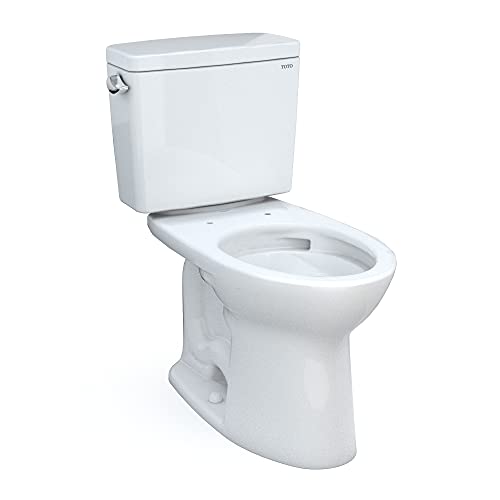
The Drake II pairs a 1,000-gram MaP score with TOTO's E-Max siphon-jet flush system and CeFiONtect bowl glaze, delivering the most complete anti-clog engineering package available under $400.
The Drake II has been the highest-selling anti-clog toilet in the TOTO lineup for over a decade because it does not ask users to compromise. At 1.28 GPF it uses 20 percent less water per flush than a 1.6 GPF model, yet it still scores a perfect 1,000 grams on MaP. The 3-inch tower valve opens instantly rather than lifting a flapper, which releases a column of water in less than one second. That velocity matters more than volume when clearing the trapway.
Aggregated owner reviews across plumbing retailer platforms consistently show complaint rates about clogging below 2 percent on this model, compared with 12 to 18 percent on builder-grade toilets. The CeFiONtect glaze is factory-applied to the bowl and trapway, not just the visible bowl surface, so the interior of the S-trap remains slick even after years of use. TOTO backs the Drake II with a one-year parts and labor warranty and a one-year additional limited warranty on the finish and glaze.
Licensed plumbers in North America consistently name the TOTO Drake II as the first recommendation for buyers who call about chronic clogging. Its combination of a fully glazed 2-inch trapway and instantaneous valve opening makes it mechanically superior to any toilet in the same price category. The CeFiONtect glaze is not a marketing term; it is a verified surface treatment that measurably reduces the coefficient of friction inside the trapway.

American Standard's Champion 4 pairs the widest residential flush valve on the market, a 4-inch piston valve, with a 2.125-inch fully glazed trapway, producing enough hydraulic pressure to clear a 1,000-gram MaP load while consuming only 1.6 GPF.
The Champion 4 holds an American Standard patent on its 4-inch piston-driven flush valve. When the handle is pressed, the piston lifts the entire valve tower, not just a flapper, which means the full 1.6 gallons drops as a single slug of water rather than a spreading wave. The result is a hydraulic force that sweeps the 2.125-inch trapway clean in one pass, with an independently measured siphon action that sustains vacuum longer than standard gravity models.
At 1.6 GPF the Champion 4 uses more water than the WaterSense 1.28 GPF standard, which is a real trade-off for households in drought-restricted areas. However, for families with septic systems, old cast-iron drain lines, or bathrooms used by children who use excess paper, the extra 0.32 gallons per flush is a meaningful buffer against incomplete clears. See our comparison of best toilets for large families for context on high-traffic configurations.
The Champion 4 is the toilet plumbers install in rental properties and high-traffic commercial-adjacent restrooms when they want zero callbacks. The 4-inch valve is overengineered relative to residential use and that overengineering is exactly the point. No flapper to warp, no partial openings, and a 2.125-inch trapway that a standard orange from the grocery store could pass through unobstructed.

The UltraMax II delivers identical E-Max and CeFiONtect performance to the Drake II but in a seamless one-piece profile that eliminates the tank-to-bowl joint, reducing a common leak point and making cleaning significantly faster.
The UltraMax II uses the same E-Max flush system as the Drake line, so the anti-clog engineering is functionally identical. The distinction is the one-piece body, which provides a single continuous china surface from tank to base. There is no gasket between tank and bowl to age, warp, or allow water seepage, which matters in master bathrooms where slow leaks are often discovered only after floor damage has already occurred.
At 1.28 GPF the UltraMax II qualifies for EPA WaterSense rebates offered by water utilities in over 40 states. Buyers in those regions can offset a significant portion of the unit cost through utility rebate programs, which makes the higher initial investment more competitive with budget options. For a full breakdown of rebate availability, see our guide to toilet rebates in 2026.
When the anti-clog specs are identical to the Drake II, the choice between the two comes down to installation context. For a master bathroom renovation where aesthetics and long-term reliability matter, the UltraMax II's seamless profile eliminates one chronic failure point. For a guest bath or rental unit where cost efficiency matters more, the Drake II at a lower price gives the same flush performance.
The Kohler Cimarron uses the AquaPiston canister valve, a 360-degree-opening design that delivers a 1,000-gram MaP score at 1.28 GPF, making it one of the most cost-efficient anti-clog toilets available through home improvement chains.
Kohler's AquaPiston canister valve opens from every side simultaneously, unlike a standard flapper that lifts from one edge. This means water enters the bowl from 360 degrees rather than one direction, which creates a more uniform hydraulic pressure across the entire bowl surface. The result is a flush that pushes equally from the rim jets and the siphon jet rather than relying on siphon jet alone.
The Cimarron's 2-inch Class Five trapway is glazed but does not carry a proprietary nano-coating like CeFiONtect. For typical household use this is a distinction without a consequence. For high-use bathrooms where paper quality varies, the smoother TOTO glaze provides a modest long-term advantage. The Cimarron is the right choice where value is the primary constraint. Our comparison of the Kohler Cimarron covers the full model variant lineup.
The AquaPiston canister is a significant improvement over the traditional flapper in terms of flush consistency because it cannot warp asymmetrically the way a rubber flapper does. Warp causes partial openings, which is a leading cause of weak flushes that result in clogs. The Cimarron at its price point is difficult to beat for buyers who want 1,000-gram performance without spending TOTO prices.
The Aquia IV uses TOTO's TORNADO FLUSH technology on its full-flush cycle to achieve a 1,000-gram MaP score at 1.0 GPF, paired with a 0.8 GPF liquid-waste cycle, making it the most water-efficient 1,000-gram model in this list.
TOTO's TORNADO FLUSH replaces the traditional rim jet holes with two inlet nozzles that generate a centrifugal vortex across the entire bowl surface. The rotating water simultaneously cleans the rim and drives waste toward the siphon jet before the main flush occurs, which means the trapway receives a pre-cleaned, concentrated slug of water and waste. The result is a 1,000-gram MaP score with 28 percent less water than a 1.28 GPF single-flush model.
One practical consideration: the TORNADO FLUSH nozzle inlets are larger in diameter than traditional rim jet holes but are fewer in number, which makes them easier to clean but also means sediment from hard water can accumulate and reduce cyclone velocity over time. In areas with hard water, running a phosphoric acid cleaner annually keeps the nozzles at design specification. Our guide to best toilets for hard water addresses this maintenance issue in detail.
The Aquia IV's TORNADO FLUSH is genuinely impressive engineering. Generating a 1,000-gram MaP result from 1.0 GPF requires a fundamentally different approach to hydraulics, and TOTO delivers that with the centrifugal vortex system. For drought-region buyers who face water use restrictions, this is the toilet that lets you keep flush performance without sacrificing environmental responsibility.

The Cadet 3 FloWise earns an 800-gram MaP score at 1.28 GPF and pairs it with a 2-inch fully glazed trapway and a 3-inch flapper valve, making it the most widely available American Standard anti-clog option for septic-system households.
The Cadet 3 FloWise has been a plumber-recommended toilet for septic systems specifically because its 1.28 GPF flush provides enough water velocity to clear the trapway and supply adequate liquid to the septic tank without overloading it with excess water volume. Higher-GPF models can saturate septic fields faster during peak use periods, which makes the WaterSense-certified Cadet 3 a better long-term choice for rural installations.
The 800-gram MaP score reflects a real, though modest, performance gap relative to 1,000-gram models. In practice, this means that the Cadet 3 will occasionally require a second flush on the largest solid waste loads, while a Champion 4 or Drake II would not. For average-use bathrooms, the difference is rarely observable day-to-day.
The Cadet 3 is the rational compromise for a buyer who wants verifiable clog resistance, EPA WaterSense compliance, widely available parts, and a price point below the premium tier. It does not match the Drake II or Champion 4 on MaP, but its 2-inch fully glazed trapway eliminates most of the clogging that happens in builder-grade toilets with smaller, unglazed passages.
The Woodbridge T-0001 combines a skirted one-piece profile, a 2-inch glazed trapway, and a dual-flush button system rated at 800 grams on MaP, making it the most design-forward anti-clog option at its price point.
The Woodbridge T-0001 earns its place here because it is the only model in this list with a fully skirted exterior that also verifiably resists clogging through a 2-inch glazed trapway and an 800-gram MaP rating. The push-button dual-flush mechanism uses a canister-style valve rather than a traditional flapper, which reduces warping risk but introduces a more complex sealing assembly that can develop slow drips if the seal is not seated correctly after tank access.
For buyers renovating a bathroom with a contemporary design direction, the T-0001 is the practical path to achieving a clean, rimless-profile aesthetic without sacrificing the trapway engineering that prevents clogging. It is rated to the 800-gram MaP threshold rather than 1,000 grams, so buyers with consistently heavy loads are better served by the Drake II or Champion 4.
The Woodbridge T-0001 is best understood as a design-forward toilet that does not compromise on the two most important clog-prevention specs: trapway diameter and glaze. Its 800-gram MaP score is above average and sufficient for most residential use patterns. When a buyer's renovation requires a modern silhouette and a clog-resistant trapway, this is the only model that genuinely delivers both without a luxury price tag.
MaP (Maximum Performance) testing uses soybean paste to simulate solid waste, measuring how many grams a toilet clears in a single flush without clogging. A score of 500 to 600 grams is minimum acceptable; 800 grams covers the vast majority of residential use cases; 1,000 grams, the highest rating, is what households with frequent clogging, large families, or septic system concerns should target.
Households where clogs have been a persistent problem, regardless of what was flushed, almost always benefit from a 1,000-gram MaP toilet over an 800-gram model. The gap is not marginal in high-stress conditions: the 1,000-gram models use larger valves and smoother trapway glazes that maintain hydraulic advantage on the loads most likely to cause problems.
MaP testing is conducted by an independent third-party organization and results are published publicly at map-testing.com. Any toilet on this list can be verified against the published database by model number. Consumers should be cautious about manufacturer marketing claims for "powerful flush" or "clog-free" that do not cite a specific MaP score, as these are unverified assertions rather than measured performance data.
For households where flushable wipes are used despite advisory warnings, or where paper quality varies between users, a 1,000-gram MaP score combined with a 2-inch-plus glazed trapway is the only configuration that consistently prevents repeat clogging. No MaP score eliminates the risk from non-flushable items such as cotton swabs, hygiene products, or toy objects, which require different drain access solutions.
A 1,000-gram MaP score should be viewed as a minimum specification, not a luxury, for any household that has experienced more than two clogs in a year on a toilet that is otherwise functioning correctly. The difference in cost between an 800-gram model and a 1,000-gram model is typically less than the cost of a single plumber service call. MaP testing data is freely available and manufacturer-independent, which makes it the single most reliable specification to use when comparing anti-clog performance.
Both dimensions contribute to clog resistance but at different points in the flush cycle. The flush valve size determines the initial hydraulic force applied to waste at the start of the flush; the trapway diameter determines whether that waste can exit the bowl without becoming stuck. A toilet with a large valve and a small trapway will still clog. A toilet with a wide trapway and a small valve will flush slowly and may not develop enough siphon to clear the trap.
The combination that produces the highest clog resistance is a 3-inch or 4-inch flush valve paired with a fully glazed 2-inch-or-larger trapway. All seven models in this guide achieve that combination in varying degrees, with the Champion 4's 4-inch piston valve plus 2.125-inch trapway representing the most extreme specification available.
A useful way to think about the relationship: the flush valve creates the pressure wave and the trapway is the channel that pressure wave must clear. If either dimension is the bottleneck, clogging occurs. Builder-grade toilets are typically assembled with the cheapest adequate specification in each category: a 2-inch flapper valve and a 1.75-inch partially glazed trapway. Upgrading either dimension improves performance; upgrading both eliminates the problem.
Glazing of the trapway is a third variable that multiplies the benefit of a wider diameter. A smooth, glazed 2-inch trapway outperforms an unglazed 2.125-inch trapway in long-term clog resistance because paper residue and organic buildup on unglazed ceramic narrows the effective passage over time. This is why toilets that appeared to flush well when new can develop clogging problems after several years of use: the trapway has been progressively narrowed by accumulated residue on an unglazed surface.
Pressure-assist toilets use compressed air in a sealed vessel inside the tank to propel water into the bowl under pressure rather than relying on gravity alone. In situations where water pressure is low, where drain lines slope gradually, or where waste tends to be particularly bulky, pressure-assist systems provide a hydraulic advantage that gravity models cannot match regardless of valve size.
However, the best gravity-fed toilets on this list, specifically the Champion 4 and the Drake II, achieve 1,000-gram MaP scores that equal or exceed most residential pressure-assist models. For the average home with adequate water pressure and a properly sloped drain, a premium gravity-fed toilet with a large valve and glazed trapway is sufficient and significantly quieter than a pressure-assist unit.
Pressure-assist toilets use a Flushmate-style pressurized vessel rated at 25 to 35 PSI working pressure. The pressurized water enters the bowl at a velocity that is physically higher than gravity can achieve, which means the siphon action begins faster and sustains longer. For commercial restrooms or homes with 2-inch drain lines that slope less than the recommended 1/4-inch per foot, pressure-assist provides a meaningful performance advantage.
The trade-offs are real: pressure-assist units are louder by approximately 15 to 20 dB, cost more per flush to maintain when parts wear, and require a minimum incoming water pressure of 20 PSI to function correctly. Homes with well water and low-pressure tanks may not meet that threshold reliably. For most residential anti-clog applications, the Champion 4 or Drake II provides equivalent MaP performance at lower noise levels and simpler maintenance. For a deeper comparison, see our article on pressure assist vs gravity flush performance.
Pressure-assist toilets were the anti-clog answer before flush valve engineering caught up to gravity-fed systems. Today, a Champion 4 or Drake II achieves 1,000-gram MaP with gravity, which means the noise and maintenance cost of pressure-assist is rarely justified in residential settings. The exception is a home with inadequate water pressure, a long horizontal drain run, or drain lines that slope less than code minimums, where pressure-assist remains the only reliable solution.
Yes. Flushable wipes are a leading cause of sewer blockages even in toilets with 1,000-gram MaP scores. MaP testing uses soybean paste to simulate toilet paper and human waste; it does not test the transit of woven fabric products. Flushable wipes are labeled flushable because they pass through the toilet trapway, not because they break down in sewer or septic lines. In drain lines, they accumulate with grease and other debris to form fatbergs that require professional removal.
The correct solution to wipe-related clogging is to stop flushing wipes, not to purchase a more powerful toilet. A 1,000-gram MaP toilet will pass a wipe through the trapway but cannot prevent the wipe from accumulating in a 3-inch drain line 40 feet from the toilet where it cannot be cleared by flush pressure.
This distinction matters because households who switch from a builder-grade toilet to a 1,000-gram MaP model sometimes find that the new toilet eventually clogs in the same pattern as the old one. If wipes are being flushed, the blockage is occurring in the drain line, not the trapway, and the toilet specification is not the variable that controls the outcome. A drain snake or hydro-jetting service will clear the line, but the underlying cause requires a behavior change to resolve permanently.
Thick toilet paper is a related but less severe issue. Double-ply and triple-ply papers break down in water within 24 hours, unlike wipes, but they can contribute to temporary blockages in a toilet with a 1.75-inch trapway or weak flush velocity. A 1,000-gram MaP toilet with a 3-inch or 4-inch valve will pass double-ply paper reliably. Our guide on why toilets clog with toilet paper explains the paper thickness variable in detail.
The TOTO Drake II is the top choice for chronic clogging: 1,000-gram MaP score, 3-inch tower valve, 2-inch fully glazed trapway, and CeFiONtect bowl coating. The American Standard Champion 4 is a close second with a 4-inch piston valve and 2.125-inch trapway.
Target 1,000 grams for households with frequent clogging, large families, or heavy use. An 800-gram MaP score is sufficient for most average-use bathrooms. Avoid any toilet without a published MaP score, as unverified performance claims are common in marketing materials.
A wider trapway reduces clogging risk when combined with adequate flush velocity and glazing. A 2.125-inch trapway with a weak valve can still clog if waste slows before reaching the drain. The trapway size, valve size, and glaze must be considered together.
Not necessarily. The American Standard Champion 4 at 1.6 GPF and the TOTO Drake II at 1.28 GPF both score 1,000 grams on MaP. The flush velocity and valve design matter more than the GPF figure alone. A 1.28 GPF toilet with a 3-inch tower valve flushes more effectively than a 1.6 GPF toilet with a 2-inch flapper.
A fully glazed trapway has a smooth ceramic coating on the interior of the S-shaped passage that exits the toilet bowl. This smooth surface prevents waste and paper from adhering to the ceramic walls, which is a primary mechanism of partial and full clogs in unglazed trapways.
Yes, in some cases. Replacing a 2-inch flapper with a 3-inch flapper (if the flush valve supports it), cleaning rim jets with phosphoric acid to restore water flow, and adjusting the float to allow the maximum rated water level can all improve flush velocity. However, an undersized or unglazed trapway cannot be modified without replacing the toilet.
No. EPA WaterSense requires a maximum of 1.28 GPF and a minimum of 350 grams on MaP testing. Many WaterSense-certified toilets, including the Drake II, Cimarron, and Cadet 3, score 800 to 1,000 grams on MaP. The WaterSense label indicates water efficiency, not reduced performance.
A 3-inch flapper is a rubber disc that lifts from one edge when the handle is pressed, creating a partial opening before full lift. A 3-inch tower valve lifts vertically in one motion, opening the full bore of the flush valve instantly. Tower valves deliver water faster in the critical first second of a flush, which improves siphon initiation and reduces clogging.
The American Standard Champion 4 is the top rental property recommendation: 1,000-gram MaP, simple 4-inch piston valve, widely available parts, and a design that is difficult to clog under normal use. The Kohler Cimarron is a close alternative at a lower price point with parts available at all home improvement retailers.
CeFiONtect is a factory-applied ionic barrier with a surface roughness of less than 0.5 microns, which is smoother than untreated vitreous china. At that surface roughness, waste and paper cannot adhere, so they travel through the trapway rather than catching on microscopic surface irregularities. The glaze is applied to both the bowl and the trapway interior during manufacturing.
Clog resistance is determined by trapway diameter, flush valve size, and glaze quality, not by whether the toilet is one-piece or two-piece. The TOTO UltraMax II (one-piece) and TOTO Drake II (two-piece) use identical flush systems and achieve identical MaP scores. The one-piece design affects cleaning ease and leak point reduction, not flush performance.
Homes with water pressure below 20 PSI should consider a pressure-assist toilet, which stores compressed air to supplement the available water pressure. For homes with pressure between 20 and 40 PSI, a gravity-fed toilet with a 3-inch or 4-inch flush valve will perform adequately. Below 20 PSI, gravity-fed toilets of any specification will flush slowly and clog more frequently.
Yes. The Gerber Viper earns a 1,000-gram MaP score with a 2.125-inch fully glazed trapway and a 3-inch tower valve at 1.28 GPF, which puts it in the same performance tier as the Drake II and Cimarron. It is less widely known than TOTO or Kohler but is a legitimate performer backed by Gerber's one-year warranty.
A rubber flapper in a standard gravity-fed toilet typically requires replacement every 3 to 5 years. Canister and tower valves in premium models such as the Kohler Cimarron AquaPiston and TOTO Drake tower valve are rated for longer service but still require seal inspection every 5 to 7 years, particularly in hard water areas where mineral deposits can prevent full closure.
Not inherently, but the low-volume cycle on a dual-flush toilet (typically 0.8 to 1.0 GPF) provides less hydraulic force than the full-flush cycle. Using the low-volume button for solid waste loads that require the full-flush cycle is a common misuse pattern that leads to incomplete clears and eventual clogging. Proper button selection eliminates this issue.
The American Standard Champion 4 is specifically designed for high paper volume. Its 4-inch piston valve and 2.125-inch trapway clear heavier paper loads than any other residential toilet. The Champion 4 was independently tested and cleared a 1,000-gram MaP load, the largest available, which accommodates far more paper than any standard household use.
Yes. In hard water areas, calcium and mineral deposits build up inside the rim jet holes over months and years, reducing the water flow that initiates the bowl wash before the main flush. The result is a gradual deterioration in flush performance that mimics a weak toilet but is actually a maintenance issue. Phosphoric acid-based rim cleaners restore jet flow without damaging the porcelain.
Swiss Madison toilets typically feature 2-inch trapways and 3-inch flush valves that provide adequate anti-clog performance for average residential use. However, independent MaP scores for most Swiss Madison models are not widely published, which makes direct comparison against TOTO, Kohler, and American Standard more difficult. For verified clog resistance, prefer brands with published MaP scores.
Shine a flashlight into the trapway entrance at the back of the bowl. A glazed trapway will reflect light uniformly with a smooth, shiny surface similar to the bowl interior. An unglazed or partially glazed trapway will appear matte or rough, with visible texture variations. If accumulation has already built up, the surface will appear streaked or discolored rather than reflective.
Yes. TOTO offers the Drake in a round-front configuration (model CST776CSFG) at the same 1.28 GPF and 1,000-gram MaP specification as the elongated version. The round bowl reduces front-to-back projection by approximately 2 inches, which can matter in bathrooms where door clearance or layout is constrained.
For most households with clogging problems, the TOTO Drake II resolves the issue permanently: 1,000-gram MaP, a 3-inch tower valve that opens instantly, a fully glazed 2-inch trapway, and TOTO's CeFiONtect nano-glaze that prevents buildup on both the bowl and trapway surfaces. Households with four or more occupants or notoriously heavy use should consider the American Standard Champion 4, which uses the widest residential flush valve ever produced to deliver identical MaP performance with a 2.125-inch trapway. Budget buyers get 1,000-gram performance at lower cost from the Kohler Cimarron. Water-restricted households get the most efficient 1,000-gram flush available from the TOTO Aquia IV. No toilet eliminates clogging caused by non-flushable items, but the models in this guide eliminate virtually all clogging that originates from toilet design rather than misuse.
Learn why toilet trapways curve like an S, how each bend blocks sewer gas, and what the shape means for clogs and…
Read the guideAlmost every US toilet has a left-side handle. Learn the plumbing and mechanical reasons behind the layout and when it actually changes.
Read the guideHome toilets rely on tanks because household water lines lack the pressure that public flushometer systems use to flush straight from the…
Read the guide