Why Toilet Trapways Are Curved Like an S
Toilets4.6
Learn why toilet trapways curve like an S, how each bend blocks sewer gas, and what the shape means for clogs and…
Read the guideGPF stands for gallons per flush, the single most important water efficiency figure on any toilet spec sheet. Modern toilets use 1.28 GPF or less, meeting the EPA WaterSense standard and saving thousands of gallons per year compared with older 3.5-gallon models. But GPF only tells you how much water the tank holds -- it says nothing about how well the toilet clears the bowl. This guide explains exactly what GPF means, why 1.28 GPF became the benchmark, how GPF interacts with MaP flush-test scores, and which real models from TOTO, Kohler, American Standard, Gerber and Woodbridge prove that low GPF and a powerful flush now go together.
GPF is gallons per flush. The EPA WaterSense target is 1.28 GPF, and the standout model at that number is the TOTO Drake II: it posts a perfect 1,000-gram MaP flush score at exactly 1.28 GPF with a glazed trapway that resists clogs, proving that a lower GPF now means more efficient engineering, not a weaker flush.
If you have flipped over a toilet spec sheet, searched a plumber's catalog or stood in a home improvement aisle wondering what the acronyms mean, GPF is the one number you need to understand first. It is short for gallons per flush, and it describes how many gallons of water leave the tank and enter the bowl with every flush. That figure appears on every new toilet sold in the United States, and federal law sets its upper limit.
Understanding GPF matters for two separate reasons. The first is water cost: toilets are the single largest source of indoor water use in a typical home, so GPF directly determines how much you spend on water each month and how many gallons your household sends down the drain each year. The second reason is engineering: a lower GPF does not automatically mean a weaker flush. The best 1.28 GPF toilets from TOTO, Kohler, American Standard, Gerber and Woodbridge clear the bowl as effectively as older 1.6-gallon models, or better, because they pair the lower volume with redesigned bowls, wider trapways and faster flush valves. GPF is the efficiency number; MaP score is the power number. You need both to make a smart buying decision.
We do not test toilets in a lab or install them ourselves. Everything in this guide is based on published manufacturer specifications, independent MaP (Maximum Performance) flush-test data, EPA WaterSense certification records and the patterns that emerge across thousands of aggregated owner reviews. For the performance-first rankings of the models that score highest on both measures, start with our guide to the best flushing toilets, and for a broader spec-by-spec buying framework, see our Toilet Buying Guide (2026): Everything You Need to Know.
The full phrase is gallons per flush, and it works exactly as it reads: one flush moves that many gallons from the tank into the bowl to clear waste. On a 1.28 GPF toilet, every flush uses 1.28 gallons, period. The number is printed on the toilet itself (usually inside the tank lid or on the underside of the tank near the waterline mark), on the product box and in every manufacturer spec sheet. In some international spec sheets you will see LPF (liters per flush) or lpf alongside GPF. 1.28 GPF converts to approximately 4.8 liters per flush (LPF), and 1.6 GPF converts to approximately 6.1 LPF.
The number became important as a shopping criterion in 1994, when the federal Energy Policy Act of 1992 took effect and made 1.6 GPF the legal maximum for every new toilet sold in the United States. Before that law, common residential toilets used 3.5, 5.0 or even 7.0 gallons per flush. When the EPA launched WaterSense in 2006 and began certifying toilets from 2007, it set the qualifying threshold at 20 percent below the 1.6-gallon maximum, which is 1.28 GPF. That is why 1.28 GPF has become the modern benchmark and why it appears so prominently on labels, spec sheets and listings today.
| Toilet | Best For | MaP Score | GPF | WaterSense | Rating | Check Price |
|---|---|---|---|---|---|---|
| TOTO Drake II | Best overall efficiency + power | 1000 g | 1.28 | Yes | 4.8 | Check price |
| TOTO Drake | Maximum clog-clearing force | 1000 g | 1.28 | Yes | 4.8 | Check price |
| Kohler Highline | Reliable everyday value | 1000 g | 1.28 | Yes | 4.7 | Check price |
| American Standard Cadet 3 | Budget-friendly power | 1000 g | 1.28 | Yes | 4.5 | Check price |
| Gerber Viper | Strong flush, low profile | 1000 g | 1.28 | Yes | 4.4 | Check price |
| TOTO Aquia IV | Dual-flush water savings | 800 g | 0.9 / 1.28 | Yes | 4.6 | Check price |
| Woodbridge T-0019 | Modern design, dual flush | 800 g | 0.8 / 1.6 | No | 4.4 | Check price |
| American Standard Champion 4 | Clog-proof household workhorse | 1000 g | 1.6 | No | 4.5 | Check price |
| Kohler Cimarron | Comfort height + power | 1000 g | 1.28 | Yes | 4.6 | Check price |
| Swiss Madison St. Tropez | Sleek skirted dual flush | 600 g | 0.8 / 1.28 | Yes | 4.3 | Check price |
Each tier tells a different story about when the toilet was made and what engineering trade-offs it represents.
Toilets installed before the 1994 federal standard often used 3.5, 5.0 or 7.0 gallons per flush. If your home has an original fixture from the 1980s or earlier, the GPF is almost certainly at this level. Replacing a 3.5 GPF toilet with a 1.28 GPF model saves over 2.2 gallons on every single flush, which compounds to tens of thousands of gallons per household each year. These are the toilets where a GPF upgrade delivers the most dramatic water savings and often a meaningful improvement in flush reliability, since older designs lacked modern siphon-jet and double-cyclone bowl engineering.
Since 1994, every new toilet sold in the U.S. must use no more than 1.6 gallons per flush. Most pre-WaterSense models sold in the late 1990s and 2000s land exactly at 1.6 GPF. The standard is still legally permissible, and some powerful toilets like the American Standard Champion 4 use 1.6 GPF because that extra volume supports an exceptionally wide trapway and a large flush valve. But 1.6 GPF is not the efficiency target; it is the legal floor. WaterSense starts at the next tier down.
This is the modern benchmark. The EPA's WaterSense program certifies toilets that use 1.28 GPF or less while still passing independent flush performance tests. Every major brand now offers WaterSense-certified models at this level, and the best of them -- the TOTO Drake II, TOTO Drake, Kohler Highline, Kohler Cimarron, American Standard Cadet 3, and Gerber Viper -- reach a 1,000-gram MaP flush score at 1.28 GPF. That combination proves the efficiency and the power are not in conflict. WaterSense toilets also qualify for many local utility rebates, so the upfront purchase price can be partially offset.
Dual-flush toilets offer two buttons or two levers. The full flush typically uses 1.28 GPF for solid waste, while the light flush uses 0.8 to 1.0 GPF for liquid waste. Because most real-world flushes are liquid only, the actual average daily water use on a dual-flush toilet can fall below 1.0 GPF across a year. Models like the TOTO Aquia IV, the Woodbridge T-0019 and the Swiss Madison St. Tropez operate this way. The key check is always the MaP score on the full-flush setting: confirm it is strong enough, typically 600 grams or higher, to clear solids in one flush without relying on the heavier tank volume of a 1.6-gallon model.
The GPF tier alone does not predict flush quality. A 1.6 GPF toilet with a narrow, unglazed trapway can clog more often than a well-engineered 1.28 GPF model with a siphon-jet action. When comparing models across GPF tiers, always look at the MaP score alongside the GPF figure. A toilet that hits 1,000 grams on the MaP test at 1.28 GPF is genuinely more efficient than one that needs 1.6 gallons to clear the same load.
Both numbers appear on spec sheets and comparison guides, and both are necessary to fully evaluate a toilet, but they measure completely different things. GPF is set by the tank design. It tells you how many gallons flow from the tank to the bowl per flush, nothing more. It says nothing about what happens to that water once it enters the bowl, whether it rinses the entire bowl surface, moves waste efficiently through the trapway or leaves residue behind.
MaP testing answers the power question. The Maximum Performance test, run by an independent laboratory and published at map-testing.com, loads a toilet with a specific weight of soybean paste (a standardized waste simulant) and measures the maximum grams cleared in a single flush. A score of 600 grams is considered adequate for light use. A score of 800 grams is strong. A score of 1,000 grams is the highest tier the test awards and represents about as powerful a flush as a residential gravity toilet can achieve. The test is the same for every brand, which makes it the most useful apples-to-apples comparison tool available.
The reason both numbers matter together is that GPF sets the water budget and MaP tells you what that budget buys. A toilet can use 1.6 GPF and still post only a 600-gram MaP score if the bowl geometry is inefficient. Conversely, several WaterSense toilets post a 1,000-gram MaP score at 1.28 GPF because their bowl shape, siphon jet placement and flush valve are engineered to move water more effectively. When you shortlist toilets, filter first by GPF to rule out models above your efficiency target, then sort by MaP score to find the ones with real flush power within that budget.
| MaP Score | Power Level | Best Suited For | Example Models at 1.28 GPF |
|---|---|---|---|
| Under 500 g | Weak, avoid for busy use | Light-use powder rooms only | Some budget imports |
| 500-799 g | Adequate | Single-person or occasional use | Swiss Madison St. Tropez (600 g) |
| 800-999 g | Strong | Most family bathrooms | TOTO UltraMax II, TOTO Aquia IV |
| 1000 g | Maximum residential power | Busy homes, heavy use, clog-prone | TOTO Drake II, Kohler Highline, Cadet 3, Gerber Viper |
The straightforward answer for a new purchase is 1.28 GPF. That is the EPA WaterSense ceiling, the figure at which the largest number of high-MaP-score models are designed, and the GPF that most local utility rebate programs reward. It saves about 20 percent more water than a 1.6 GPF model per flush, and it is now available at every price point from budget two-piece toilets like the American Standard Cadet 3 to premium one-piece designs like the TOTO UltraMax II.
For households with two or more occupants, a dual-flush toilet rated 0.8 / 1.28 GPF can average as low as 0.9 to 1.0 GPF in practice, since most flushes are liquid waste and use the lighter setting. The TOTO Aquia IV and the Woodbridge T-0019 are well-reviewed examples at that combination. The caution here is to verify the full-flush MaP score: on these models, the 1.28 GPF full flush must be strong enough to clear solid waste without a second activation, because a second flush immediately wipes out the savings from the light flush.
If you are replacing a pre-1994 fixture, even stepping down to a 1.6 GPF modern toilet is a meaningful improvement in water use. Going all the way to 1.28 GPF is better. For a detailed breakdown of exactly how many gallons and dollars the step from 1.6 to 1.28 GPF saves over a year, see our comparison of how much water a toilet uses.
Toilets account for roughly 24 to 30 percent of all indoor water use in a typical U.S. home, according to EPA WaterSense data, making them the single largest individual source of residential indoor water consumption ahead of showers, faucets and dishwashers. Because GPF determines exactly how much water moves on every flush, even a modest per-flush reduction multiplies into large annual savings across a family's daily use.
Here is a simple way to see the math. A household of four people flushing five times each per day makes 20 flushes daily. Switching from 1.6 GPF to 1.28 GPF saves 0.32 gallons per flush, which equals 6.4 gallons per day across those 20 flushes and roughly 2,336 gallons per year. That is a meaningful number on any monthly water bill. If the toilet being replaced uses 3.5 GPF, the math is even more striking: that same household saves 2.22 gallons on every flush, or about 16,206 gallons per year from a single toilet switch. Households in areas with tiered water pricing or drought surcharges may see even larger financial returns from the GPF reduction.
Several local utilities offer WaterSense rebates to encourage high efficiency toilet upgrades, which can partially or fully offset purchase costs. The rebate amounts vary widely by region, but a WaterSense toilet's 1.28 GPF certification is typically the qualifying criterion. Check your local utility's conservation programs before purchasing, because those credits can make a difference in the total investment calculation.
The reputation that low-GPF toilets flush poorly comes from a real but dated period in plumbing history. When the 1.6 GPF federal standard took effect in 1994, many manufacturers simply reduced the tank size on existing designs rather than engineering the bowl and trapway to work with less water. Those early 1.6 GPF models did flush weakly compared with the high-volume toilets they replaced, and the complaints were legitimate. When the WaterSense standard pushed further to 1.28 GPF around 2007, there was understandable skepticism that the flush would get even worse.
What changed the outcome was engineering, not marketing. A toilet's flush strength is primarily determined by bowl geometry (the curvature that directs water into the waste stream), the size and glaze quality of the trapway (the channel waste travels through), and the speed and volume of the siphon action created by the flush valve. Modern 1.28 GPF toilets like the TOTO Drake II use a large double-cyclone system that creates a powerful swirling water stream. The TOTO Drake uses a G-Max siphon flush. The Kohler Highline and Kohler Cimarron use a Class Five flushing system. The American Standard Cadet 3 uses an EverClean-coated PowerWash trapway. All of these reach a 1,000-gram MaP score at 1.28 GPF. The engineering, not the volume, determines the power.
If you are skeptical, the MaP score is the easiest way to verify the claim. Every toilet on the MaP public database has been tested in an independent laboratory setting. A 1.28 GPF toilet with a 1,000-gram MaP score has been confirmed to clear one kilogram of solid waste in a single flush, using just 1.28 gallons of water to do it. That is not a marketing claim; it is a measured result from a standardized test that applies the same methodology to every toilet regardless of brand or price.
When shopping by GPF, the most useful cross-check is to look at each model's MaP score in the same search. A toilet rated at 1.28 GPF with a 1,000-gram MaP score outperforms one rated at 1.6 GPF with only a 600-gram MaP score -- it clears more waste using less water. Do not let GPF be the sole figure you optimize; pair it with MaP and you have a complete picture of real-world toilet performance.
A single-flush toilet uses the same GPF on every flush, regardless of what it needs to clear. The best single-flush models at 1.28 GPF are the most straightforward to evaluate: one MaP score tells you everything about flush power, and one GPF figure tells you everything about water use. The TOTO Drake, TOTO Drake II, Kohler Highline, Kohler Cimarron, American Standard Cadet 3, and Gerber Viper are the most frequently cited single-flush 1.28 GPF toilets with 1,000-gram MaP scores. For a busy household that wants simplicity and maximum flush confidence, a single-flush 1.28 GPF model with a 1,000-gram MaP score is the lowest-complexity, highest-performance option.
Dual-flush toilets offer a partial (light) flush and a full flush. The spec sheet usually lists both figures, such as 0.8 / 1.28 GPF. The light flush handles liquid waste only and uses far less water. The full flush handles solid waste. The practical average daily GPF depends on the ratio of liquid-to-solid flushes in a real household, but a commonly cited assumption is that roughly 75 to 80 percent of daily flushes are liquid only, which pulls the effective daily average well below 1.28 GPF for most households. The TOTO Aquia IV (0.9 / 1.28 GPF), Woodbridge T-0001 (0.8 / 1.28 GPF), and Woodbridge T-0019 (0.8 / 1.6 GPF) are well-reviewed dual-flush options. Always confirm the full-flush MaP before buying; some dual-flush designs trade power for the water savings on the partial flush.
Pressure-assisted toilets use compressed air trapped in a sealed tank to force water into the bowl under higher pressure than a gravity-fed model. Some pressure-assisted models achieve their flush power at 1.0 GPF or lower, because the pressure amplifies the force of the water rather than relying on volume alone. The tradeoff is noise: a pressure-assisted flush is noticeably louder than a standard gravity toilet, which matters in bedrooms, guest baths or shared walls. For most residential use, a well-engineered 1.28 GPF gravity toilet with a 1,000-gram MaP score provides equivalent clog resistance at lower noise levels.
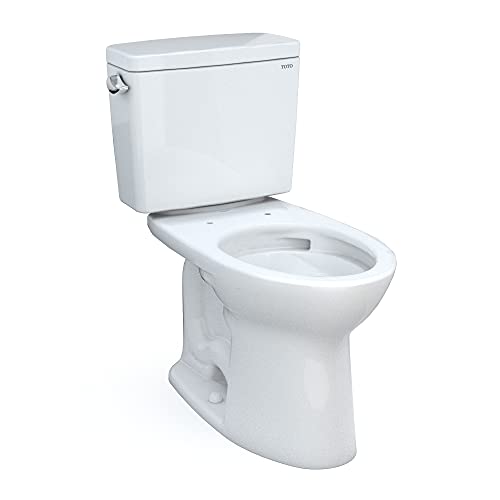
The TOTO Drake II is the clearest proof that 1.28 GPF and 1,000-gram MaP flush power are not in conflict: it achieves the maximum residential flush test score while meeting the EPA WaterSense standard, and its double-cyclone bowl rinse covers the bowl surface more thoroughly than a standard siphon-jet design.
The Drake II uses TOTO's Double Cyclone technology, which creates a swirling water flow around the bowl rim rather than relying only on a siphon jet. The result is more thorough bowl coverage per flush without increasing water volume. Published specs confirm it qualifies for WaterSense at 1.28 GPF and has earned 1,000 grams on the MaP flush test, which is the top tier for a residential gravity toilet.
Owner reviews consistently highlight three things: almost no clogging in normal use, a noticeably cleaner bowl surface compared with previous toilets, and satisfaction that it performs as described without double-flushing. The comfort-height seat position at around 17 inches is also frequently mentioned as a comfort improvement for adults over 50. Two-piece design means it is easier to ship and install than a one-piece but does have a seam at the tank-to-bowl joint to wipe.
If you are trying to understand whether 1.28 GPF sacrifices flush power, the TOTO Drake II is the clearest empirical answer. Its 1,000-gram MaP score at 1.28 GPF is not a marketing position; it is a published third-party test result. It is the benchmark against which other 1.28 GPF models are measured, and it holds up in real-world owner experience.
The original TOTO Drake remains one of the most recommended toilets by plumbers because its G-Max siphon jet moves a large volume of water in a powerful, targeted stream, and owner reports confirm an unusually low clog rate even in households with heavy use.
The Drake's G-Max flush uses a large siphon-jet orifice and a fast-acting flush valve to concentrate water pressure into the waste stream at the base of the bowl. At 1.28 GPF it achieves the 1,000-gram MaP ceiling, which means in a standardized laboratory test it cleared one kilogram of waste simulant in a single flush. That is not a claim the brand made up; it is the test result on file at map-testing.com.
Plumbers and facility managers recommend the Drake regularly for rental properties and high-traffic guest bathrooms because of its demonstrated low maintenance record. Some versions are available with TOTO's CeFiONtect glaze, an ion-barrier coating that fills microscopic surface pores so waste and mineral deposits have less to grip onto. The standard version ships without the glaze coating, which is one of the few meaningful spec differences between the Drake and Drake II.
The Drake is the toilet that repair technicians reach for when a buyer has tried multiple cheaper options and still keeps clogging. It is not the quietest or the sleekest, but it solves the core problem with a verified MaP score, reliable parts availability and a long owner track record that few other models can match at 1.28 GPF.

The Kohler Highline hits the WaterSense 1.28 GPF target with a 1,000-gram MaP score using Kohler's Class Five flushing system, and its long availability as a stocked item at major home improvement retailers means parts and seat replacements are straightforward to find anywhere in the country.
The Class Five flushing system uses a large canister-style flush valve that opens fully rather than relying on a standard flapper. This faster, wider valve opening releases water more quickly into the bowl, which improves the siphon action and contributes to the 1,000-gram MaP score at 1.28 GPF. The canister design is also more durable than traditional rubber flappers, which degrade over time and cause running-toilet issues in older designs.
Owner reviews for the Highline are among the most favorable in the category, consistently noting a clean bowl after each flush, no double-flushing in normal use, and ease of installation for a DIY project. The comfort height bowl at around 17 inches sits higher than a standard toilet and is preferred by most adults. Kohler's wide distribution network means local stores almost always carry compatible replacement seats and repair parts.
The Highline is the safe default recommendation for most first-time toilet buyers because it is genuinely well-engineered at a realistic price, widely stocked and documented. Its Class Five canister valve is more durable than a standard flapper and contributes directly to the strong MaP score at 1.28 GPF. If you are unsure which 1.28 GPF toilet to buy and want broad support behind your choice, the Highline is the most defensible pick.

The American Standard Cadet 3 delivers a 1,000-gram MaP score at 1.28 GPF with an EverClean surface that resists stain and odor-causing bacteria, making it the strongest argument that EPA WaterSense efficiency and serious flush power do not require a premium budget.
The Cadet 3 uses American Standard's PowerWash rim design, which directs water along the bowl walls from the rim down to the trapway, combined with a fully glazed, fully skirted trapway that resists debris buildup. The 1,000-gram MaP score is a legitimate third-party result at 1.28 GPF, not a projection. The EverClean antimicrobial surface is silver-ion based and is applied at the factory, not as a post-production coating.
Owner feedback consistently shows satisfaction with flush power in daily use and low maintenance costs over time. Several reviewers specifically note that switching from a 1.6 GPF older model to the Cadet 3 at 1.28 GPF did not require any adjustment period or reveal any flush weakness. The plainer two-piece aesthetics are the most common point of criticism from owners who prioritize design, but for pure function the Cadet 3 is a reliable performer at an accessible entry point.
For anyone who wants to see empirically that 1.28 GPF does not mean a weaker flush, the Cadet 3 is a budget-accessible proof point. It matches the MaP score of toilets that cost three times as much, with a well-documented track record in rental and residential use.

The TOTO Aquia IV is the dual-flush model that best balances water savings with real flush confidence, offering 0.9 GPF for liquid waste and 1.28 GPF for solid waste, with a 1,000-gram MaP score on the full-flush setting that confirms it can clear solid waste without relying on a second flush.
The Aquia IV carries WaterSense certification based on the higher 1.28 GPF setting, but its practical average in real household use is lower because the 0.9 GPF setting handles liquid waste, which represents the majority of daily flushes for most people. The full-flush setting achieves an 800-gram MaP score, which is solidly in the strong tier, not at the top 1,000-gram tier. For most households, 800 grams on the full flush is more than adequate for daily solid waste; the trade-off against the water savings is typically worthwhile.
TOTO's SanaGloss / CeFiONtect ceramic glaze is available on several Aquia IV versions. It fills surface pores at the microscopic level to reduce mineral deposit and stain adhesion. Owners who have lived with an unglazed toilet for years frequently note the difference in cleaning frequency after switching. The dual-flush button is top-mounted, and several reviewers initially found it less intuitive than a standard lever, though most adapt quickly.
The Aquia IV is the right dual-flush pick if your priority is the lowest real-world average GPF without sacrificing too much on full-flush power. Its 800-gram MaP score on the full-flush cycle is confirmed strong, and its WaterSense certification is backed by a verifiable test. The step down from 1,000 to 800 grams on full flush is the clear trade-off for the water savings on the partial flush.

The Woodbridge T-0019 brings a fully skirted, one-piece contemporary design with a top-mounted dual-flush button at a price point well below comparable TOTO or Kohler one-piece models, making it a compelling option for bathrooms where aesthetics matter alongside efficiency.
The T-0019 uses a 0.8 GPF partial flush for liquid waste and a 1.6 GPF full flush for solid waste, which is a different split from the WaterSense-certified 0.8 / 1.28 GPF dual-flush models. The 1.6 GPF full flush provides more tank volume for heavy loads, which contributes to its 800-gram MaP score, but it does not qualify for WaterSense certification since the full flush exceeds the 1.28 GPF threshold. Buyers who use the partial flush consistently in daily use will still see meaningful average water savings. For a broader look at one-piece versus two-piece design trade-offs, see our guide to one-piece vs two-piece toilets.
Owner reviews highlight the skirted one-piece design as a significant cleaning advantage over exposed two-piece models, and the included soft-close seat is frequently mentioned as a bonus. A minority of reviews note that the dual-flush button on the tank lid requires some getting used to, and that finding replacement internal parts is more involved than with TOTO or Kohler models.
The T-0019 is the option for buyers who want a genuinely contemporary skirted profile without the premium pricing of TOTO or Kohler one-piece lines. The 1.6 GPF full flush is the main trade-off against WaterSense eligibility, but for households that reliably use the partial flush for liquid waste, the practical daily average can still be competitive with single-flush 1.28 GPF models.
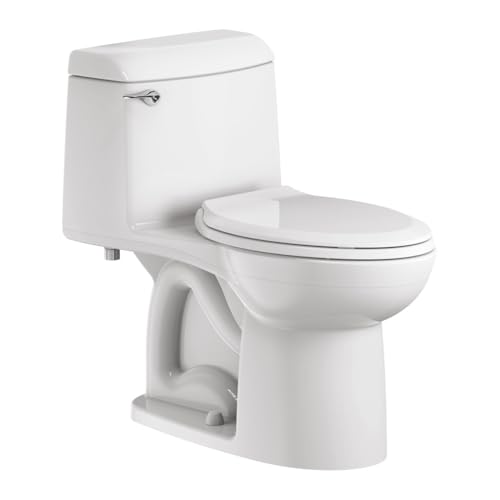
The Champion 4 uses 1.6 GPF rather than 1.28 GPF deliberately, because its 4-inch flush valve and oversized 2.3-inch trapway depend on that extra tank volume to move large loads in a single pass, and the result is a toilet with one of the most documented clog-resistance records of any residential model.
American Standard built the Champion 4 around a flush valve diameter of 4 inches, which is roughly double the valve size in many standard toilets. A wider valve opens fully faster and releases water at higher velocity into the bowl, amplifying the siphon effect in the trapway. The 2.3-inch trapway diameter is also unusually wide, which means solid waste has significantly less resistance in the channel. At 1.6 GPF, the tank volume supports the wider opening without leaving waste behind.
Owner reviews over many years consistently report an almost total absence of clogging. Households that had gone through multiple lower-priced models while still reaching for the plunger regularly describe the Champion 4 as the first toilet that retired the plunger entirely. The trade-off is clear: it uses 1.6 GPF rather than 1.28 GPF, so it does not qualify for WaterSense, and it will use more water than a 1.28 GPF model over a year. For a household that has weighed that trade-off and accepted it in exchange for clog elimination, the Champion 4 delivers what it promises.
The Champion 4 is the one toilet in this comparison that deliberately uses 1.6 GPF, and there is a sound engineering reason for it: the wider valve and trapway depend on that volume to function as designed. If clog resistance is your primary concern and you have already tried 1.28 GPF options without success, the Champion 4 at 1.6 GPF is a legitimate upgrade, not a step backward.
GPF appears in several places on a toilet and its packaging. The most reliable location is inside the tank itself, usually stamped or molded into the porcelain near the waterline mark or on the underside of the tank lid. Federal regulations require this information to be present on the fixture. On the packaging and spec sheet it appears in the water use or specifications section, sometimes alongside the metric equivalent in liters per flush (LPF or lpf). On a product listing page, look for the specifications or details tab rather than the main product title, since some listings emphasize GPF in the title and others bury it in the spec table.
For dual-flush toilets, the spec sheet will show two GPF figures, typically separated by a forward slash (such as 0.8 / 1.28 GPF or 0.9 / 1.28 GPF). The first is the partial flush for liquid waste; the second is the full flush for solid waste. The WaterSense certification for dual-flush models is based on an average effective flush volume calculation, so a toilet can carry the label even if neither individual setting is exactly 1.28 GPF, as long as the calculated average falls at or below 1.28 GPF.
One practical check when reading GPF labels: confirm whether the figure you see is for a single-flush or dual-flush model. A listing that says "1.28 GPF" for a dual-flush toilet may be showing only the full-flush setting, not the partial setting that handles most of the daily use. Always look for both numbers. For a full walkthrough of every specification that appears on a toilet spec sheet and what each means, our complete 2026 guide to choosing a toilet covers them in the right decision order.
WaterSense is an EPA partnership program that certifies household water products meeting specific efficiency and performance standards. For toilets, a product earns the WaterSense label by using 1.28 GPF or less AND passing an independent flush performance test. The certification is voluntary for manufacturers but verifiable by consumers: the EPA maintains a public database at epa.gov/watersense listing every certified toilet by brand and model number, so you can confirm a specific toilet's WaterSense status before buying.
The two-part nature of the certification is important. Some toilets advertise "eco" or "efficient" without WaterSense certification, meaning their water use and performance claims have not been independently verified. A WaterSense toilet must demonstrate both: actual per-flush water volume at or below 1.28 gallons (confirmed by test), and adequate flush performance (confirmed by independent test). That combination is what makes the label a reliable shortcut rather than just a marketing term.
WaterSense certification also enables utility rebates in many areas. Dozens of water utilities and municipal conservation programs offer rebates of a set dollar amount per WaterSense toilet installed, which can range from a modest discount to a rebate that exceeds the toilet's own cost in water-scarce regions. The WaterSense website includes a rebate finder tool to check what is available in your zip code. For households replacing older 3.5 GPF or higher models, those rebates can make WaterSense toilets among the most financially smart home efficiency upgrades available.
GPF is one number among several that matter when choosing a toilet. Here is how to fit it into a practical decision sequence based on the specs that actually determine whether a toilet serves a household well for ten to fifteen years.
Step 1: Measure the rough-in first. The rough-in (wall to drain center) determines which toilets will physically fit in your bathroom. Most homes are 12 inches, but 10 and 14 inch rough-ins exist in older houses. No GPF figure matters if the toilet does not fit. Our guide to round vs elongated toilets also covers how bowl shape affects fit in tight spaces.
Step 2: Set a GPF target. For most new purchases, 1.28 GPF is the right target. It qualifies for WaterSense, enables rebates and is where the best flush power and efficiency intersect. If water savings are the absolute priority, choose a dual-flush model at 0.8 / 1.28 GPF. If clog resistance outweighs water efficiency for your household, the American Standard Champion 4 at 1.6 GPF is worth considering.
Step 3: Filter by MaP score at your GPF target. Once you have a GPF tier, sort by MaP score within that tier. For single-flush 1.28 GPF models, aim for 800 grams as a minimum and prefer 1,000 grams where the budget allows. For dual-flush models at 0.8 / 1.28 GPF, confirm the full-flush MaP score specifically, since some dual-flush models post lower MaP numbers than equivalent single-flush designs.
Step 4: Choose bowl shape and height. These decisions affect comfort but not flush power. Elongated bowls (about 2 inches longer front-to-back) are more comfortable for most adults. Round bowls save space in small bathrooms. Comfort height (16.5 to 18 inches from floor to rim) is preferred by most adults and anyone with knee or hip concerns. Standard height (14 to 16 inches) is better suited for children or shorter users.
Step 5: Verify parts availability and warranty. TOTO, Kohler and American Standard all have wide distribution networks for replacement parts, which matters over a fifteen-year fixture life. Smaller brands like Woodbridge and Swiss Madison have narrower parts networks. A one-year limited warranty is standard across residential toilets at most price points; some brands offer longer coverage on the porcelain itself. Confirm what the warranty covers specifically, since some limit coverage to manufacturing defects rather than finish or mechanical wear.
The most common buying mistake is optimizing for GPF alone without checking MaP. A buyer who selects the lowest available GPF figure (say, 0.8 GPF on a partial flush) without verifying the full-flush MaP score can end up with a toilet that double-flushes on solid waste -- effectively using 1.6 GPF twice as often as expected and erasing the water savings. Always pair GPF with MaP score to make a fully informed purchase.
GPF stands for gallons per flush. It is the volume of water a toilet uses in a single flush cycle, measured in U.S. gallons. Every new toilet sold in the United States is required to display its GPF on the fixture and packaging. The current federal maximum is 1.6 GPF, and the EPA WaterSense efficiency standard is 1.28 GPF.
For most homes, 1.28 GPF is the best target. It meets the EPA WaterSense standard, qualifies for utility rebates and is the level at which the best residential toilets (TOTO Drake II, Kohler Highline, American Standard Cadet 3) achieve a 1,000-gram MaP flush score. Dual-flush models at 0.8 / 1.28 GPF can average lower in daily use and save more water overall.
Yes, 1.28 GPF is excellent for a modern toilet. It is the EPA WaterSense standard, 20 percent below the federal 1.6 GPF maximum, and multiple models at this level achieve a 1,000-gram MaP flush score. A 1.28 GPF toilet with a high MaP score clears waste as effectively as an older 1.6 GPF toilet while using significantly less water per year.
No. Modern 1.28 GPF toilets from TOTO, Kohler and American Standard achieve the same 1,000-gram MaP flush scores as older 1.6 GPF designs, using engineered siphon-jet bowls, wider flush valves and glazed trapways to move waste more efficiently with less water volume. The weak-flush reputation of early low-flow toilets from the mid-1990s came from designs that reduced tank size without redesigning the bowl mechanics.
A 1.28 GPF toilet uses 0.32 gallons less per flush than a 1.6 GPF model, which saves roughly 2,300 to 6,000 gallons per year for a typical household depending on household size and flushing frequency. The 1.6 GPF standard is still legal but is not WaterSense-certified. Most modern high-MaP toilets are designed for 1.28 GPF; 1.6 GPF models like the American Standard Champion 4 use the higher volume intentionally to support a wider trapway.
A dual-flush toilet has two separate flush settings: a partial (light) flush for liquid waste and a full flush for solid waste. The spec sheet lists both figures, such as 0.8 / 1.28 GPF. The first number is the partial flush, the second is the full flush. Because most daily flushes are liquid-only, the real-world average GPF across a full day is often closer to 0.9 to 1.0 GPF, lower than either single number alone.
MaP (Maximum Performance) is an independent test that loads a toilet with a standardized waste simulant and measures the maximum grams cleared in a single flush. It is the power metric; GPF is the water efficiency metric. A toilet can have a low GPF (efficient) and a high MaP score (powerful) simultaneously. The best residential combination is 1,000 g MaP at 1.28 GPF, achieved by the TOTO Drake II, Kohler Highline, Gerber Viper and American Standard Cadet 3 among others.
Look inside the toilet tank. The GPF is usually stamped or molded into the porcelain near the waterline mark, or printed on a label on the underside of the tank lid. It may also appear as LPF (liters per flush) alongside the GPF figure. If neither is visible, search the toilet's model number (usually printed on the tank or under the bowl) against the manufacturer's spec sheet online.
Toilets installed before the 1994 federal standard commonly used 3.5 GPF, and some earlier models used 5.0 GPF or 7.0 GPF. Between 1994 and the WaterSense era, the standard was 1.6 GPF. If your home has a pre-1994 toilet, replacing it with a 1.28 GPF WaterSense model can save over 20,000 gallons per year for a family of four.
Yes, EPA WaterSense certification for toilets requires 1.28 GPF or less on a single-flush toilet, and a weighted average flush volume at or below 1.28 GPF for dual-flush models. Certification also requires passing an independent flush performance test, confirming the toilet can clear waste adequately at that lower water volume. Certification is verified in the public EPA WaterSense database at epa.gov/watersense.
Many local water utilities and state conservation programs offer rebates for WaterSense-certified toilets, which use 1.28 GPF or less. Rebate amounts vary widely by region, from a small discount to a significant dollar amount in water-scarce areas. Use the EPA WaterSense rebate finder at epa.gov/watersense to check available programs in your zip code before purchasing.
Yes, 1.6 GPF is still the federal maximum for new toilets, meaning a manufacturer can legally sell a 1.6 GPF toilet in the U.S. However, some states have adopted stricter local standards. California, Colorado, Georgia, Hawaii, Nevada and Texas among others require WaterSense (1.28 GPF or less) for new construction in some categories. Check your local code before specifying a 1.6 GPF model for new construction.
The TOTO Drake II, TOTO Drake, Kohler Highline, Kohler Cimarron, American Standard Cadet 3 and Gerber Viper all achieve a 1,000-gram MaP score at 1.28 GPF with WaterSense certification. This is the best achievable combination in residential gravity toilets: maximum MaP flush power at the EPA WaterSense efficiency standard, verified by third-party testing.
The TOTO Drake is rated at 1.28 GPF in its current production version, meeting the EPA WaterSense standard. It achieves a 1,000-gram MaP flush score at that water volume using G-Max siphon-jet technology. An older TOTO Drake model used 1.6 GPF before TOTO redesigned the flush system to match the WaterSense standard; confirm the spec sheet of the specific version you are purchasing.
Any toilet at 1.6 GPF or below is broadly considered low flow compared with pre-1994 toilets using 3.5 GPF or more. The term "high efficiency toilet" or HET specifically refers to 1.28 GPF or less. Ultra-high-efficiency toilets use 0.8 to 1.0 GPF. In common usage, "low flow" can mean any of these tiers, though technically it encompasses everything from 1.6 GPF downward since the 1994 federal mandate took effect.
Yes, the Gerber Viper is rated at 1.28 GPF and achieves a 1,000-gram MaP flush score, making it one of the few budget-accessible models to hit the top flush tier at the WaterSense efficiency standard. It is frequently overlooked in comparison shopping but performs identically to higher-priced models on the two most important metrics, GPF and MaP.
Yes, in specific situations. The American Standard Champion 4 at 1.6 GPF is a genuinely excellent toilet for households with chronic clogging, because its 4-inch flush valve and 2.3-inch trapway are sized to function with that extra tank volume. The trade-off against WaterSense eligibility and utility rebates is real, but so is the clog-resistance record. For most households, a 1.28 GPF toilet with a high MaP score is the better overall choice.
LPF stands for liters per flush, the metric equivalent of GPF. 1.28 GPF converts to approximately 4.8 LPF, and 1.6 GPF converts to approximately 6.1 LPF. You will see LPF in Canadian spec sheets and on some products certified under international standards. The two figures measure exactly the same thing in different unit systems.
Several Kohler models use 1.28 GPF: the Highline, the Cimarron, the Santa Rosa, and the Memoirs all offer 1.28 GPF versions with WaterSense certification. The Highline and Cimarron both achieve 1,000-gram MaP scores at 1.28 GPF. Always confirm the specific model variant since Kohler sells some models in both 1.28 GPF and 1.6 GPF versions, and the spec sheet distinguishes them clearly.
For a 1.28 GPF toilet, a good MaP score is 800 grams or higher, and the best available score is 1,000 grams. Multiple models achieve 1,000 grams at 1.28 GPF, including the TOTO Drake II, TOTO Drake, Kohler Highline and American Standard Cadet 3. A MaP score below 600 grams at any GPF level is considered weak for regular household use and should be avoided in a busy bathroom.
GPF is gallons per flush, and the right target for almost every new toilet purchase in 2026 is 1.28 GPF with a WaterSense label. At that level, models like the TOTO Drake II, Kohler Highline and American Standard Cadet 3 achieve a 1,000-gram MaP flush score, proving that efficiency and maximum flush power are no longer a trade-off. If water savings are the first priority, add a dual-flush model like the TOTO Aquia IV at 0.9 / 1.28 GPF to your shortlist. If clog resistance outweighs efficiency for your household, the American Standard Champion 4 at 1.6 GPF is the one deliberate exception worth making.
Learn why toilet trapways curve like an S, how each bend blocks sewer gas, and what the shape means for clogs and…
Read the guideAlmost every US toilet has a left-side handle. Learn the plumbing and mechanical reasons behind the layout and when it actually changes.
Read the guideHome toilets rely on tanks because household water lines lack the pressure that public flushometer systems use to flush straight from the…
Read the guide