
Why Toilet Trapways Are Curved Like an S
Toilets4.6
Learn why toilet trapways curve like an S, how each bend blocks sewer gas, and what the shape means for clogs and…
Read the guideA data-driven look at how tank volume, water pressure, trapway diameter, and bowl geometry work together to determine whether your toilet clears waste on the first flush every time.
A bigger tank does not automatically mean a more powerful flush. What matters is how fast water exits the tank, not how much sits in it. Flush power comes from the combination of tank volume, flush valve size, trapway diameter, bowl rim design, and water pressure working together as a system.
When you press the flush lever, a flapper or canister valve opens and gravity pulls water from the tank into the bowl through the rim holes and a siphon jet. The sudden surge of water creates hydraulic pressure that initiates a siphon in the trapway, pulling waste down the drain. The speed of this water transfer -- not the total volume stored -- is what generates flushing energy.
Most residential toilets manufactured after 1994 are legally limited to 1.6 gallons per flush (GPF) in the United States under the Energy Policy Act. High-efficiency toilets (HETs) use 1.28 GPF or less and carry the EPA WaterSense label. Dual-flush models offer a 0.8 GPF option for liquid waste and 1.28 GPF for solids.
The tank on a 1.6 GPF toilet holds roughly 1.6 to 1.8 gallons (some have a small reserve). A 1.28 GPF tank holds proportionally less. Yet many 1.28 GPF toilets outscore older 1.6 GPF models on MaP testing. That counterintuitive result points directly at engineering, not raw volume.
A larger tank provides more water volume but only improves flush performance if the rest of the system -- flush valve, trapway, and bowl geometry -- can use that extra volume effectively. In modern toilets, the flush valve diameter and trapway size are almost always the limiting factor, not tank capacity. Adding a gallon of water to a tank with a narrow 2-inch flush valve produces negligible improvement compared to upgrading to a 3-inch flush valve with the same gallon.
The relationship between tank size and flush power is best understood through three variables:
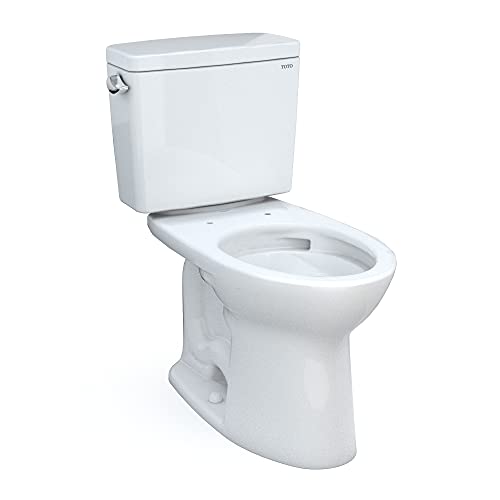
Manufacturers optimize these three variables as a package. A tower-style canister flush valve with a 3-inch opening on a 1.28 GPF TOTO Drake II delivers water to the bowl so quickly that MaP testing scores top out at the maximum 1,000 grams of solid waste cleared per flush. Meanwhile, older 1.6 GPF toilets with 2-inch flappers can score as low as 350 to 500 grams on the same test.
The flush valve is the engine, and the trapway is the exhaust. If either one is undersized, you are leaving flushing performance on the table regardless of how much water you store in the tank. Plumbing engineers consistently find that a 3-inch flush valve paired with a fully glazed 2-1/8-inch trapway clears waste more reliably than a large-tank toilet with a 2-inch valve and a 1-3/2-3/8-inch trapway.
Maximum Performance (MaP) testing is an independent protocol developed in partnership with water utilities across North America that measures the maximum weight of solid waste a toilet can clear in a single flush. Scores run from 250 to 1,000 grams, with 600 grams considered the minimum for heavy-use environments and 800+ considered premium performance. MaP testing removes marketing claims from the equation and gives consumers a reproducible, engineering-based measure of flush effectiveness regardless of tank size.
MaP scores are published openly at map-testing.com and are searchable by manufacturer, model, and GPF rating. When comparing toilets, MaP score is a more reliable predictor of real-world clog resistance than tank volume alone.
Here is how leading models score, along with their tank configurations:
| Model | GPF | Flush Valve | Trapway | MaP Score | WaterSense | Check Price |
|---|---|---|---|---|---|---|
| TOTO Drake II (MS454124) | 1.28 | 3-inch tower | 2-1/8 in. | 1,000 g | Yes | Check price |
| TOTO UltraMax II (MS604114) | 1.28 | 3-inch tower | 2-1/8 in. | 1,000 g | Yes | Check price |
| TOTO Drake (CST744SL) | 1.6 | 3-inch tower | 2-1/8 in. | 1,000 g | No | Check price |
| American Standard Champion 4 (2034) | 1.6 | 4-inch accelerator | 2-3/8 in. | 1,000 g | No | Check price |
| Kohler Cimarron (K-6418) | 1.28 | 3-inch canister | 2-1/8 in. | 1,000 g | Yes | Check price |
| American Standard Cadet 3 (2383) | 1.28 | 3-inch | 2-1/8 in. | 800 g | Yes | Check price |
| Kohler Highline (K-78079) | 1.28 | 3-inch canister | 2 in. | 800 g | Yes | Check price |
| Woodbridge T-0001 | 1.0 / 1.6 | Dual-flush button | 2 in. | 700 g | Yes | Check price |
| Gerber Avalanche (21-302) | 1.28 | 3-inch | 2 in. | 800 g | Yes | Check price |
| Swiss Madison Sublime (SM-1T803) | 1.1 / 1.6 | Dual-flush button | 2 in. | 600 g | Yes | Check price |
Source: map-testing.com and manufacturer published specifications. MaP scores as of latest available test cycle.
The flush valve controls how fast water exits the tank, while the trapway controls how fast waste and water exit the bowl. These two dimensions need to be matched: a large flush valve dumping water rapidly into a narrow trapway creates turbulence rather than a clean siphon, which can actually reduce effective waste removal. Optimal performance comes from a balanced system where tank volume, flush valve opening, and trapway diameter are all sized to complement one another.
Understanding the differences between flush valve sizes helps explain why two toilets with identical tank capacities can have vastly different flushing power:
When a homeowner reports a weak-flushing toilet, the first diagnostic question is not "how big is the tank?" but "what size is the flush valve and when was this toilet manufactured?" Pre-2000 toilets with 2-inch flappers almost always benefit more from replacement than from any DIY volume modification. A modern 1.28 GPF toilet with a 3-inch valve will outperform them while cutting water use by 20 to 25 percent.
Residential water supply pressure affects how quickly the tank refills between flushes but has almost no effect on flush power itself, because the flush draws entirely from the stored water in the tank and not from the supply line. This is different from pressure-assisted toilets, which use pressurized air inside a sealed inner tank to boost water velocity into the bowl. In gravity-flush toilets -- the vast majority of residential installations -- the height of water in the tank (pressure head) is fixed by the toilet's design, and home water pressure is irrelevant to flushing energy.
There is one exception worth noting: pressure-assisted toilets such as the Kohler Wellworth Pressure Lite or American Standard Vormax Plus use a pressure vessel inside the tank that pre-charges to roughly 25 psi from the supply line. These toilets do leverage home water pressure, and they are noticeably louder because of it. For most residential bathrooms, gravity-flush models with large flush valves achieve similar MaP scores without the noise penalty.
Pre-1994 toilets with 3.5-gallon (or even 5-gallon) tanks nearly always score lower on MaP testing than modern 1.28 GPF toilets because older designs combined large tank volume with small flush valves, unglazed trapways, and rim-only bowl cleaning. Modern 1.28 GPF toilets with 3-inch flush valves, fully glazed 2-1/8-inch trapways, and dedicated siphon jets routinely achieve 1,000-gram MaP scores that older 3.5-gallon models cannot match even with nearly three times the water volume.
This is one of the most counterintuitive findings in residential plumbing: upgrading from an older large-tank toilet to a current HET nearly always improves flush performance while reducing water use by 55 to 70 percent per flush. The EPA WaterSense program estimates that replacing a pre-1994 toilet with a WaterSense-certified model saves an average household about 13,000 gallons per year.
| Era | Typical Tank Size | Flush Valve | Trapway | Typical MaP | Annual Water Use (1 toilet / family of 4) |
|---|---|---|---|---|---|
| Pre-1980 | 5 to 7 gal. | 2-inch flapper | 1-1/2 in. unglazed | 250 to 500 g | 30,000 to 42,000 gal. |
| 1980 to 1994 | 3.5 gal. | 2-inch flapper | 1-3/4 in. partial glaze | 300 to 600 g | 21,000 gal. |
| 1994 to 2010 | 1.6 gal. | 2-inch flapper | 2-inch partial glaze | 350 to 700 g | 9,600 gal. |
| 2010 to present (HET) | 1.28 gal. | 3-inch tower/canister | 2-1/8 in. fully glazed | 800 to 1,000 g | 7,680 gal. |
Water use estimates based on 5 flushes per person per day per EPA baseline assumptions.
If your current toilet has weaker-than-expected performance, there are several interventions to consider before replacing it. The effectiveness of each depends on the toilet's age and design.
Most toilet tanks have an adjustment screw or float arm that sets the water fill level. The standard setting leaves about 1 inch of clearance below the overflow tube. If someone adjusted the float down to save water, raising it back to the manufacturer's recommended level restores the intended flush volume. Check the inside lid of the tank for the manufacturer's fill-line marking.
A flapper that closes too early reduces the water volume delivered per flush. Aftermarket flappers vary significantly in quality. If your toilet has a 2-inch valve seat, consider an upgrade kit that replaces the entire flush valve assembly with a 3-inch tower valve where compatible. Fluidmaster and Korky both offer retrofit kits for common toilet brands.
Calcium and mineral deposits from hard water frequently block the rim holes that direct water around the bowl. Blocked rim holes reduce turbulence in the bowl and weaken the siphon. A bent coat hanger or specialized rim-hole pick, combined with a white vinegar soak overnight, typically restores full flow to the rim jets.
An unglazed or partially glazed trapway accumulates waste buildup over time that narrows the effective passage and increases the chance of partial clogs. This condition is not repairable without replacement. If your toilet has an older unglazed trapway, upgrading to a fully glazed model like the TOTO Drake or American Standard Champion 4 is the only lasting solution.
In a large majority of weak-flush complaints, the root cause is either a misadjusted float reducing volume, a partially closed supply stop valve, or mineral buildup in rim holes. These are all fixable in under an hour with no special tools. If the toilet passes all three diagnostic checks and still underperforms, the trapway design is almost certainly the culprit, and replacement is the most cost-effective path forward.
All residential toilets fall into one of two flush categories, and understanding the difference clarifies why "bigger tank" is not always the answer:
The standard type found in the vast majority of American homes. Water fills a ceramic or porcelain tank, and gravity pulls it into the bowl when the flush valve opens. Flushing energy is determined by water volume, flush valve speed, and pressure head. These toilets are quieter, easier to repair, and compatible with standard supply lines. All models referenced in this guide are gravity-flush unless noted otherwise.
Use a sealed plastic vessel inside the ceramic tank that fills with water and traps compressed air. When flushed, pressurized air pushes water into the bowl at much higher velocity than gravity alone. Pressure-assisted models like the Kohler Wellworth Pressure Lite or American Standard Vormax Plus can achieve 1,000-gram MaP scores with relatively small tank volumes, but they are significantly louder (some owners describe the sound as a shotgun blast), require higher minimum supply pressure (typically 25 psi), and the inner pressure vessel must be replaced every 10 to 15 years.
For most homeowners, a modern gravity-flush toilet with a 3-inch or 4-inch flush valve achieves equivalent MaP performance without the noise and maintenance trade-offs of pressure-assisted systems.
Tank size discussion often overshadows three bowl-level design factors that have an equal or greater impact on real-world flush performance:
The siphon jet is a directed opening at the bottom-front of the bowl that fires a stream of water directly into the trapway entrance to initiate the siphon. Toilets with large, well-positioned siphon jets establish the siphon faster and more reliably than rim-wash-only designs. TOTO's G-Max and Tornado Flush systems, for example, prioritize siphon jet design alongside flush valve engineering.
A fully glazed trapway has the same smooth ceramic finish inside as the visible bowl surfaces. This dramatically reduces friction and waste adhesion compared to unglazed interiors. MaP testing consistently shows that fully glazed 2-1/8-inch trapways outperform unglazed 2-inch trapways with the same tank volume. This is why models like the TOTO Drake II, Kohler Cimarron, and American Standard Cadet 3 -- all certified under EPA WaterSense at 1.28 GPF -- achieve scores between 800 and 1,000 grams.
Traditional toilet rims have holes spaced around the underside that spray water into the bowl during a flush. Some advanced designs, including TOTO's Tornado Flush (Aquia IV and others), replace the rim holes with two or three angled nozzles that create a cyclonic water flow, providing more thorough bowl cleaning with less water. This design also eliminates the mineral-buildup problem that affects traditional rim holes over time.
For a detailed look at which current models best combine these elements, see our guide to the best flushing toilets available today.
If you had to choose between a toilet with a large tank and traditional rim design versus a toilet with a smaller tank, a 3-inch flush valve, a fully glazed 2-1/8-inch trapway, and a dedicated siphon jet, the latter will outflush the former almost every time. Bowl and valve engineering have advanced far enough that modern 1.28 GPF toilets simply do not need large tanks to perform at the top of the MaP scale.
Dual-flush toilets have become increasingly common as water conservation requirements tighten across the western United States and other water-stressed regions. Models like the TOTO Aquia IV, Woodbridge T-0001, and Swiss Madison Sublime use a two-button system that delivers 0.8 GPF for liquid waste and 1.0 to 1.28 GPF for solid waste.
The concern many buyers have -- that the reduced full-flush volume on a dual-flush model will result in more clogs -- is partially validated by MaP testing. Most dual-flush toilets in the 1.0 to 1.28 GPF full-flush range score between 500 and 800 grams, somewhat below the 1,000-gram maximum achieved by the best single-flush 1.28 GPF designs. However, for the majority of households, a 600 to 800-gram MaP score represents more than adequate performance for daily use.
The TOTO Aquia IV is a notable exception: its dual-flush 0.8/1.28 GPF configuration achieves 1,000 grams on the full flush, making it competitive with single-flush designs while saving additional water on liquid-only flushes.
For households with young children, heavy users, or older sewer lines, a high-MaP single-flush 1.28 GPF design is the safer choice over a dual-flush model with a lower full-flush MaP score.
For more on water efficiency comparisons, see our articles on 1.28 GPF vs. 1.6 GPF toilets and are dual-flush toilets worth it.
TOTO uses proprietary G-Max (1.6 GPF), Double Cyclone (1.28 GPF), and Tornado Flush (dual-flush) systems across its lineup. The Drake and Drake II use a 3-inch tower flush valve and a 2-1/8-inch fully glazed trapway. The UltraMax II is a one-piece version of the Drake II platform. All three achieve 1,000-gram MaP scores and carry EPA WaterSense certification where applicable. TOTO does not rely on large tanks; its designs prioritize delivery speed and bowl engineering.
Kohler's AquaPiston canister flush valve technology, used on the Cimarron, Highline, and other models, delivers 360-degree water flow around the valve seat, which Kohler claims improves water delivery speed compared to traditional flapper designs. The Cimarron 1.28 GPF achieves 1,000 grams on MaP testing. The Highline scores 800 grams. Both use relatively standard tank volumes with the design emphasis on valve geometry rather than water quantity.
American Standard takes a different approach with the Champion 4, using a 4-inch accelerator flush valve -- the largest in residential toilets -- paired with a 2-3/8-inch fully glazed trapway. This combination achieves 1,000-gram MaP scores at 1.6 GPF and gives the Champion 4 an outsized reputation for clog resistance. The Cadet 3 uses a more conventional 3-inch flush valve at 1.28 GPF and achieves 800 grams. For households with a history of clogging, the Champion 4 remains one of the most recommended options by plumbers.
Gerber's Avalanche series uses a 3-inch flush valve at 1.28 GPF and achieves 800-gram MaP scores. Gerber toilets are frequently specified in commercial construction and have a strong reputation for reliability and parts availability. The brand is less visible in consumer retail but widely available through plumbing supply houses.
Both brands offer contemporary one-piece and wall-mounted designs at lower price points. The Woodbridge T-0001 and Swiss Madison Sublime are WaterSense certified dual-flush models that achieve 600 to 700 grams on MaP testing -- acceptable for most users, but below the 800 to 1,000-gram tier. Owners report satisfactory performance for typical household use, with occasional double-flushes in high-demand situations.
For a deeper look at how these models compare head-to-head on clog resistance and owner satisfaction, see our guides to best toilets for large waste and American Standard Champion 4 review.
Rather than shopping by tank size, use this decision framework:
Tank capacity is relevant only as a check: confirm the toilet is a 1.28 GPF or 1.6 GPF model (not a non-conforming import) and that the tank fill line is marked clearly inside the tank so the toilet operates at its rated volume.
Not necessarily. Tank size is one of several factors that determine flush power. The flush valve diameter, trapway size, bowl geometry, and siphon jet design all play equal or greater roles. Many modern 1.28 GPF toilets with small tanks outperform older 3.5-gallon models because of superior flush valve and trapway engineering.
MaP (Maximum Performance) testing is an independent protocol that measures the maximum solid waste a toilet can clear in a single flush, rated in grams from 250 to 1,000. Scores are publicly available at map-testing.com, searchable by brand, model number, and GPF rating. A score of 600 grams or higher is recommended for most residential applications.
A 3-inch flush valve is the current standard for quality gravity-flush toilets and delivers significantly faster water transfer than the 2-inch flappers common in pre-2000 designs. The American Standard Champion 4 uses a 4-inch accelerator valve, the largest available for residential use. Avoid toilets that do not specify flush valve size in their documentation.
Yes, in many cases. Start by checking the tank fill level against the manufacturer's marked line. Then inspect for a partially closed supply stop valve, a worn or early-closing flapper, and mineral buildup in the rim holes. Clearing these three issues resolves the majority of weak-flush complaints without any parts replacement.
EPA WaterSense is a voluntary partnership program that certifies toilets using 1.28 GPF or less that also meet a minimum MaP flush performance threshold. WaterSense-certified toilets use at least 20 percent less water than the 1.6 GPF federal maximum. The certification label appears on the product box and in the manufacturer's specification sheet.
Almost certainly not. Despite the larger tank volume, pre-1994 toilets used 2-inch flapper valves and unglazed trapways that limited effective flushing power. Modern 1.28 GPF toilets with 3-inch flush valves and fully glazed 2-1/8-inch trapways routinely achieve 1,000-gram MaP scores that older high-volume models cannot match. Replacing a pre-1994 toilet typically improves flush performance and cuts water use by 55 to 70 percent per flush.
A fully glazed trapway has the same smooth ceramic coating on its interior surface as the outside of the toilet bowl, reducing friction and waste adhesion. An unglazed trapway has a rough interior that accumulates mineral deposits and waste over time, gradually narrowing the effective passage and increasing clog frequency. Fully glazed trapways are standard on most mid-range and premium toilets made after 2005.
A pressure-assisted toilet uses a sealed vessel inside the ceramic tank that traps pressurized air from the supply line. When flushed, compressed air drives water into the bowl at higher velocity than gravity alone, producing a more powerful but significantly louder flush. These toilets require a minimum supply pressure of about 25 psi and the inner pressure vessel needs periodic replacement. Gravity-flush toilets with large flush valves achieve comparable MaP scores with less noise and simpler maintenance.
A 2-inch trapway is the minimum for standard residential use. A 2-1/8-inch fully glazed trapway is the sweet spot for most households, achieving 800 to 1,000-gram MaP scores. The American Standard Champion 4 uses a 2-3/8-inch trapway for maximum clog resistance. Larger trapways are particularly beneficial in households with young children, multiple users, or older cast-iron drain lines prone to slow-clearing.
Generally, dual-flush models score 500 to 800 grams on MaP testing for the full flush, compared to 800 to 1,000 grams for the best single-flush 1.28 GPF designs. The TOTO Aquia IV is an exception at 1,000 grams for a 1.28 GPF full flush. For most households, dual-flush MaP scores are adequate. For heavy users or households with clog history, a single-flush 1,000-gram model is the safer choice.
G-Max is TOTO's gravity-flush system used in its 1.6 GPF models, including the classic Drake (CST744SL). It pairs a 3-inch tower flush valve with a large siphon jet and a 2-1/8-inch fully glazed trapway, achieving 1,000-gram MaP scores with a notably quiet flush. G-Max toilets remain popular with plumbing professionals for their reliability and serviceability over decades.
The most common causes are low water level in the tank, a flapper that closes before delivering the full tank volume, mineral blockage in the rim holes, a worn or degraded trapway, or an undersized flush valve. Systematically checking each of these resolves the vast majority of double-flush problems without replacing the toilet. If all components check out and the problem persists, a poor-performing trapway design is likely the root cause.
Add food coloring to the tank and observe how long the tank drains into the bowl during a flush. If the color stops flowing into the bowl well before the tank is empty, the flapper is closing prematurely. Adjusting the chain length to give the flapper slightly more slack, or replacing it with an adjustable aftermarket flapper (Fluidmaster and Korky both offer options), typically resolves this.
Kohler's AquaPiston canister valve opens from all sides rather than just the top, which Kohler claims creates a more uniform and complete water evacuation from the tank. In practice, MaP testing results for Kohler Cimarron (1,000 grams) and Kohler Highline (800 grams) are consistent with competitors using standard 3-inch tower valves. The AquaPiston design has a good durability track record and is straightforward to replace when needed.
Toilet height (standard 14 to 15 inches versus comfort height 16 to 18 inches) has a marginal effect on pressure head because the water level in the tank is slightly higher relative to the bowl on taller models. However, this difference is small enough that MaP scores between standard and comfort-height versions of the same model are typically identical. Height should be chosen for user comfort and accessibility rather than flush performance.
A fully skirted or concealed trapway design covers the external curves of the trapway with a smooth ceramic skirt, making the toilet easier to clean but having no effect on the internal trapway dimensions or flush performance. The MaP score for a skirted model is determined by the same internal valve and trapway specifications as its non-skirted counterpart. The Woodbridge T-0001 and Swiss Madison Sublime are popular examples of skirted designs.
A standard rubber flapper valve typically lasts 3 to 5 years before it warps or degrades and begins leaking or closing prematurely. Silicone flappers last longer, often 5 to 10 years. Tower and canister-style valves, which use sealing discs rather than rubber flappers, have longer service lives and fewer adjustment issues. Regardless of type, inspecting and replacing the flush valve is the single most impactful low-cost maintenance step for maintaining consistent flush performance.
Many municipal water utilities offer rebates of $50 to $200 for replacing pre-1994 toilets with EPA WaterSense-certified models. Programs vary significantly by location. The EPA WaterSense website (epa.gov/watersense) maintains a rebate finder tool organized by zip code. Some California and Texas water districts have offered rebates of up to $500 per toilet during drought periods.
The EPA WaterSense certification floor is 350 grams, but independent plumbing professionals and water utility engineers typically recommend a minimum of 600 grams for any actively used bathroom. For a family of four with young children, 800 grams is a more practical minimum, and 1,000 grams provides the most reliable clog-free performance across all users and waste loads.
Bigger tank volume is not the key to a more powerful flush. The research and independent MaP testing data are clear: flush valve diameter, trapway size and glaze quality, and siphon jet design are the variables that separate 1,000-gram performers from 350-gram underperformers. A modern 1.28 GPF toilet with a 3-inch flush valve and a fully glazed 2-1/8-inch trapway -- such as the TOTO Drake II, Kohler Cimarron, or American Standard Cadet 3 -- will outflush any pre-1994 3.5-gallon model while cutting water use dramatically. When shopping for a new toilet, prioritize MaP score, flush valve size, and WaterSense certification over tank volume. Those three data points tell you everything the tank size number cannot.
Learn why toilet trapways curve like an S, how each bend blocks sewer gas, and what the shape means for clogs and…
Read the guideAlmost every US toilet has a left-side handle. Learn the plumbing and mechanical reasons behind the layout and when it actually changes.
Read the guideHome toilets rely on tanks because household water lines lack the pressure that public flushometer systems use to flush straight from the…
Read the guide