

Why Toilet Trapways Are Curved Like an S
Toilets4.6
Learn why toilet trapways curve like an S, how each bend blocks sewer gas, and what the shape means for clogs and…
Read the guideEverything contractors, homeowners, and building managers need to know about LEED water-efficiency credits, EPA WaterSense certification, and the specific flush-performance thresholds that unlock certification points in 2026.
For LEED v4.1 Water Efficiency credits, toilets must not exceed 1.28 gallons per flush (GPF) and carry EPA WaterSense certification. The sweet spot for both strong performance and maximum certification points is a 1.0 GPF or 1.28 GPF WaterSense model with a MaP score of 800 grams or higher -- TOTO Drake II, Kohler Cimarron, and American Standard Cadet 3 all qualify cleanly.
Under LEED v4.1 (Building Design and Construction / Operations and Maintenance), toilet fixtures must not exceed 1.28 GPF to qualify as high-efficiency plumbing fixtures for the Water Efficiency (WE) prerequisite and credit. Earning additional WE credit points requires demonstrating a percentage reduction -- typically 10% to 50% or more -- below the LEED baseline, which is set at 1.6 GPF for toilets. Dual-flush toilets are evaluated using a weighted average of 1/3 full-flush and 2/3 half-flush volumes under the LEED calculation method.
Green building certification programs tie water savings directly to toilet flush volume because toilets account for approximately 24% to 30% of total indoor water use in a typical commercial or residential building, according to EPA data. That makes the toilet the single largest consumer of indoor water -- ahead of faucets, showers, and appliances -- and therefore the highest-impact fixture to address in a LEED certification strategy.
The LEED rating system, administered by the U.S. Green Building Council (USGBC), uses a tiered structure for WE credits. The WE Prerequisite sets the floor: all plumbing fixtures, including toilets, must meet or beat specific GPF thresholds. The WE Credit then rewards projects for exceeding that floor, with more percentage reduction earning more credit points. For toilets specifically:
A 1.28 GPF toilet represents a 20% reduction from the 1.6 GPF baseline. A 1.0 GPF toilet yields a 37.5% reduction. A 0.8 GPF flush volume -- found in some ultra-high-efficiency models -- reaches 50% reduction. When combined with similarly efficient faucets, showerheads, and urinals, these reductions compound to push a project toward the higher WE credit tiers.
Green building consultants consistently flag the toilet selection decision as the one with the highest certification leverage per dollar spent. Moving from a standard 1.6 GPF toilet to a 1.28 GPF WaterSense-certified model costs very little incremental money at point of purchase but contributes meaningfully to the water-use baseline calculation that determines how many WE credit points a project can claim. Dual-flush models at 1.0/0.8 GPF push the math even further.
Energy Star does not certify toilets directly -- EPA's WaterSense program is the relevant third-party certification for water-efficient toilets. Energy Star focuses on energy-consuming products; since gravity-flush toilets consume no electricity, they fall outside its scope. However, smart toilets and bidet-integrated units with heated seats and dryers may be evaluated under Energy Star's residential electronics criteria if they draw significant wattage.
This is one of the most common points of confusion in green building projects. Architects and general contractors frequently ask whether a toilet needs Energy Star certification to qualify for LEED points. The short answer: no. For toilet fixtures, the relevant programs are:
For a conventional two-piece or one-piece toilet -- which covers the vast majority of fixtures installed in LEED projects -- WaterSense certification is the only third-party program that matters for certification credit calculations.
When reviewing submittals on LEED projects, the documentation team needs to see the WaterSense certification number and the GPF value for each toilet model. The MaP score is not a LEED requirement, but specifying a model with a MaP score above 500 grams -- ideally 800 or higher -- prevents the common post-occupancy problem of tenants or residents double-flushing to compensate for weak performance, which negates all the theoretical water savings.
WaterSense is a product-level certification from the EPA that a specific toilet model meets a 1.28 GPF or lower flush volume AND passes third-party performance testing (minimum 350-gram MaP score). LEED is a building-level rating system from USGBC that uses WaterSense certification as an input to calculate the project's overall water-use reduction percentage and award credit points. WaterSense certifies the product; LEED evaluates the building.
WaterSense was launched by the EPA in 2006 modeled after the Energy Star program. To earn the WaterSense label, a toilet model must:
In practice, every major brand -- TOTO, Kohler, American Standard, Gerber, Woodbridge, Swiss Madison -- offers WaterSense-certified models at 1.28 GPF and 1.0 GPF. The label is so widespread that the more useful differentiator among certified models is the actual MaP score, which ranges from the 350-gram minimum up to the 1,000-gram maximum that the MaP testing protocol measures.
LEED builds on WaterSense by requiring that all toilets in a project carry WaterSense certification (or equivalent) as a prerequisite, then uses the actual GPF values to calculate the project's percentage improvement over the LEED baseline. A project where every toilet is 1.28 GPF WaterSense-certified earns the prerequisite plus some credit points. A project where every toilet is 1.0 GPF or dual-flush at 1.0/0.8 GPF earns more points.
| Model | GPF | MaP Score | WaterSense | LEED Reduction vs 1.6 GPF | Best For | Check Price |
|---|---|---|---|---|---|---|
| TOTO Drake II | 1.28 | 1,000 g | Yes | 20% | Max flush power + certification | Check price |
| TOTO Aquia IV (dual-flush) | 1.0 / 0.8 | 800 g | Yes | Up to 50% | Dual-flush LEED credit maximization | Check price |
| TOTO UltraMax II | 1.28 | 1,000 g | Yes | 20% | One-piece design, commercial lobbies | Check price |
| Kohler Cimarron | 1.28 | 1,000 g | Yes | 20% | Residential green remodel | Check price |
| Kohler Highline | 1.28 | 1,000 g | Yes | 20% | Budget-conscious LEED project | Check price |
| American Standard Champion 4 | 1.28 | 1,000 g | Yes | 20% | Clog resistance + certification | Check price |
| American Standard Cadet 3 | 1.28 | 1,000 g | Yes | 20% | Versatile residential specification | Check price |
| Gerber Viper | 1.28 | 1,000 g | Yes | 20% | Contractor-favorite value | Check price |
| Woodbridge T-0001 | 1.28 | 1,000 g | Yes | 20% | Modern skirted design, new builds | Check price |
| Swiss Madison Ivy | 1.1 / 0.8 | 600 g | Yes | Up to 50% | Contemporary dual-flush aesthetic | Check price |
LEED WE credit calculations require totaling the water volume consumed by all regulated fixtures (toilets, urinals, faucets, showerheads) under a defined usage pattern, then comparing that total to the LEED baseline for the same fixture types. The percentage reduction from baseline determines which credit tier -- 10%, 20%, 30%, 40%, or 50% -- the project achieves, and each tier earns a specific number of LEED points. Toilets are weighted heavily in this calculation because they represent the largest share of fixture water use.
The formal calculation uses LEED's Water Use Reduction Calculator (or equivalent third-party tool). Here is the simplified methodology for the toilet portion:
Worked example for a 50-person office with equal male/female split:
This toilet savings percentage is then blended with savings from other fixtures to determine total percentage reduction and which WE credit tier the project qualifies for. Projects targeting LEED Silver, Gold, or Platinum often need to push toilet savings as high as possible to compensate for fixtures where options are more limited.
One of the most overlooked strategies in LEED WE credit optimization is specifying dual-flush toilets with a 1.0 GPF full flush and 0.8 GPF half flush rather than a single-flush 1.28 GPF model. The weighted average effective GPF drops to approximately 0.867, which represents a 45.8% reduction from the 1.6 GPF baseline for that fixture type alone. Combined with low-flow faucets and showerheads, this can push a project from a 30% reduction tier to a 40% or 50% tier without any structural changes.
The highest-performing WaterSense-certified toilets for green building projects are those scoring 1,000 grams on MaP testing while flushing at 1.28 GPF or less. The TOTO Drake II (1.28 GPF, 1,000-gram MaP), Kohler Cimarron (1.28 GPF, 1,000-gram MaP), and American Standard Champion 4 (1.28 GPF, 1,000-gram MaP) consistently appear on green building spec lists because they eliminate the double-flushing behavior that undermines real-world water savings. For maximum LEED points, the TOTO Aquia IV dual-flush (1.0/0.8 GPF) adds water-reduction depth while maintaining strong MaP performance.
MaP testing -- Maximum Performance testing, conducted by an independent laboratory and published at map-testing.com -- measures how many grams of simulated waste a toilet can flush in a single flush without carry-over. The scale runs from 0 to 1,000 grams. A score of 1,000 grams means the toilet successfully cleared the full 1,000-gram test load -- the maximum the test measures.
Why does MaP matter in a green building context? Because a low-flushing toilet that requires double-flushing in real use does not deliver the theoretical water savings. Two flushes of a 1.28 GPF toilet equals 2.56 GPF per event -- worse than a standard 1.6 GPF toilet. The EPA WaterSense minimum MaP requirement of 350 grams prevents the worst performers from earning certification, but 350 grams is a low bar. In practice, specifiers on best flushing toilets lists look for 600 grams minimum, with 800 to 1,000 grams being the commercial and high-traffic standard.
Here is how the top LEED-qualifying models compare on the metrics that actually determine whether theoretical savings become real savings:
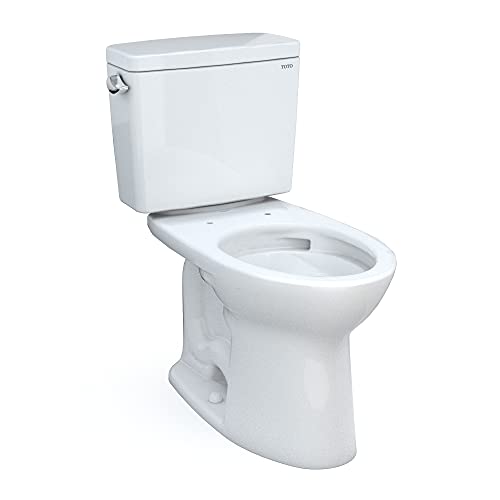
TOTO Drake II (CST454CEFG): 1.28 GPF, 1,000-gram MaP, WaterSense certified. TOTO's Double Cyclone flush technology uses two nozzles rather than multiple rim holes, directing water more forcefully through the trapway. The 2-1/8 inch fully glazed trapway is among the wider available in a two-piece configuration. For commercial LEED projects specifying two-piece toilets, the Drake II is one of the most-specified models in the country. See also our TOTO Drake II review for full performance detail.
TOTO UltraMax II (MS604114CEFG): 1.28 GPF, 1,000-gram MaP, WaterSense certified, one-piece. The one-piece design eliminates the tank-to-bowl gasket -- a potential maintenance leak point in high-traffic commercial settings. TOTO's CEFIONTECT ion-barrier glaze reduces surface adhesion, which cuts cleaning chemical use alongside water savings. Useful in green building projects where cleaning supply reduction is also a project goal.
TOTO Aquia IV (dual-flush): 1.0 GPF full / 0.8 GPF half, WaterSense certified, 1,000-gram MaP on full flush. The weighted-average effective GPF of approximately 0.867 is among the lowest of any retail toilet passing real-world performance testing. For LEED v4.1 calculations, this model creates the largest reduction from the 1.6 GPF baseline in the standard toilet category. The dual-flush actuator is a top-mounted button -- a format with lower user confusion than side-lever dual-flush systems. See our TOTO Aquia IV review for details.
Kohler Cimarron (K-3609): 1.28 GPF, 1,000-gram MaP, WaterSense certified. Kohler's AquaPiston canister flush valve releases water in a 360-degree pattern, improving bowl wash consistency versus traditional flapper systems. The Cimarron is widely stocked through major distribution channels, simplifying specification and procurement on multi-unit residential LEED projects. A strong choice where water-efficient bathroom upgrades are being done at scale.
American Standard Champion 4 (2034.014): 1.28 GPF, 1,000-gram MaP, WaterSense certified. The Champion 4's 4-inch flush valve and 2-3/8 inch trapway are physically larger than most competitors, designed to move high-volume waste without restriction. Owner reviews consistently mention low clog frequency -- the real-world outcome of the large trapway. In student housing, family housing, and other high-use LEED projects, clog resistance is often the primary operational concern after water savings.
American Standard Cadet 3 (2383.216): 1.28 GPF, 1,000-gram MaP, WaterSense certified. More compact than the Champion 4 with a smaller footprint useful in constrained bathroom layouts. The EverClean antimicrobial surface finish inhibits bacterial growth -- relevant in green building contexts where reducing cleaning chemical use is part of a broader sustainability strategy.
Gerber Viper: 1.28 GPF, 1,000-gram MaP, WaterSense certified. The Gerber Viper is a contractor-community staple that regularly appears in LEED multifamily projects because of its competitive price point, consistent availability, and strong MaP performance. Gerber offers the Viper in multiple rough-in sizes (10-inch, 12-inch, 14-inch), which simplifies specification across older building stock with non-standard rough-in distances.
Woodbridge T-0001: 1.28 GPF, 1,000-gram MaP, WaterSense certified. A one-piece skirted-trapway design that has gained traction in higher-end LEED residential and boutique commercial projects where aesthetics matter alongside performance. The fully skirted exterior eliminates the exposed trapway contour that accumulates dust and requires cleaning -- a minor but measurable contribution to reduced cleaning effort.
Swiss Madison Ivy (dual-flush): 1.1 GPF full / 0.8 GPF half, WaterSense certified. Swiss Madison's contemporary European-influenced design suits modern commercial interiors. The dual-flush weighted average of approximately 0.9 GPF qualifies for strong LEED reduction percentages. MaP scores on full flush are lower than the TOTO and American Standard benchmarks above -- a trade-off to evaluate in high-use applications versus aesthetic-priority settings.
LEED WE prerequisite and credit documentation for toilets typically requires: the EPA WaterSense certification number or equivalent documentation for each fixture model, the manufacturer-published GPF value, cut sheets identifying the specific model number, and a completed Water Use Reduction Calculator showing the baseline-versus-design comparison. Dual-flush models need both flush volumes documented. LEED Online (the USGBC's project portal) provides downloadable templates for each documentation requirement.
Documentation is where LEED toilet credits most commonly fail at review. The specific pieces of evidence needed are:
For LEED Operations and Maintenance (O+M) projects -- existing buildings pursuing certification -- the documentation approach shifts to metered water use data and fixture inventories rather than design submittals. Building managers in this context need to physically verify the GPF of every installed toilet, which sometimes involves checking the flush valve or toilet tank for manufacturer markings, since older installations may lack readily accessible documentation.
A common documentation error on multifamily LEED projects is using a WaterSense-certified model number in the specification but allowing installers to substitute a non-certified model from the same brand. Brand-level WaterSense certification does not exist -- certification is model-specific. Always verify the full model number, including finish suffix codes, against the EPA's online database before accepting delivery of toilet fixtures on a LEED project.
Toilets must flush at 1.28 GPF or less to meet the LEED v4.1 Water Efficiency prerequisite. This matches the EPA WaterSense standard. Higher-efficiency toilets at 1.0 GPF or dual-flush configurations help earn additional WE credit points by increasing the percentage reduction from the 1.6 GPF LEED baseline.
No. Energy Star certifies energy-consuming products; conventional toilets consume no electricity and are not eligible. EPA WaterSense is the relevant certification for water-efficient toilets, requiring 1.28 GPF or less plus third-party MaP performance testing. Smart toilets with integrated bidet seats and dryers may qualify for Energy Star under the electronics program based on standby power consumption.
Yes. LEED uses a weighted average formula for dual-flush toilets: (1/3 x full-flush GPF) + (2/3 x half-flush GPF). The assumption is that 67% of uses are liquid-waste half-flushes. This weighted average often results in an effective GPF well below 1.0, creating a larger reduction from the 1.6 GPF baseline and earning more WE credit points than an equivalent single-flush 1.28 GPF model.
MaP (Maximum Performance) is an independent laboratory test measuring how many grams of simulated solid waste a toilet clears in a single flush, on a scale of 0 to 1,000 grams. It matters in green building because a low-scoring toilet causes double-flushing, negating theoretical water savings. LEED does not require a specific MaP score beyond the WaterSense minimum of 350 grams, but specifiers should target 800-1,000 grams for commercial and high-use applications.
No. The LEED WE prerequisite requires toilets to meet or exceed the performance threshold, which for toilets is 1.28 GPF. Installing 1.6 GPF toilets causes the project to fail the prerequisite, making LEED certification impossible regardless of performance in other categories. There is no variance or exception for toilet flush volume under the current LEED v4.1 standard.
LEED v4.1, the current standard, updated the WE credit structure to use a percentage-reduction model rather than fixed GPF tiers, making it more flexible in how projects reach target credit levels. The 1.28 GPF prerequisite threshold remained the same between v4 and v4.1. The v4.1 calculation framework better rewards ultra-high-efficiency fixtures like 0.8 GPF half-flush dual-flush toilets by crediting the full reduction they achieve rather than capping credit at a fixed tier threshold.
WaterSense certification is the standard mechanism for demonstrating compliance, but LEED also accepts "equivalent" documentation if a WaterSense-certified model is not available for a specific application. In practice, the EPA WaterSense database is comprehensive enough that virtually every standard toilet category has multiple certified options, making the equivalence pathway rarely necessary for conventional fixtures.
Toilets contribute to the Water Efficiency (WE) credit, which awards 1 to 6 points (depending on LEED version and project type) based on percentage reduction across all regulated fixtures. Since toilets are the largest water consumer among fixtures, optimizing toilet GPF -- especially with dual-flush models -- can be the deciding factor in whether a project earns 2 versus 4 WE credit points, which can be the difference between LEED Silver and Gold certification.
Yes. TOTO offers multiple WaterSense-certified models that exceed LEED prerequisites. Key models include the Drake II (1.28 GPF, 1,000-gram MaP), UltraMax II (1.28 GPF, 1,000-gram MaP), and Aquia IV dual-flush (1.0/0.8 GPF, WaterSense certified). TOTO's CEFIONTECT glaze on select models also reduces cleaning chemical use, contributing to broader sustainability goals beyond water efficiency.
The Kohler Highline is available in multiple configurations; the WaterSense-certified version flushes at 1.28 GPF with a 1,000-gram MaP score. When specifying for LEED projects, confirm the specific model suffix (not just "Kohler Highline") against the EPA WaterSense product database to ensure the exact unit ordered carries certification -- Kohler makes multiple Highline variants at different flush volumes.
The American Standard Champion 4 at 1.28 GPF is WaterSense certified and qualifies for LEED WE calculations. It achieves a 1,000-gram MaP score -- the maximum -- due to its large 4-inch flush valve and 2-3/8 inch trapway. It is one of the most reliable performers for high-use LEED projects where clog prevention is a priority alongside water efficiency.
Yes. Pressure-assist toilets are evaluated using the same GPF and WaterSense criteria as gravity-flush models. Several pressure-assist models -- including the Flushmate-equipped American Standard Cadet variants -- flush at 1.1 GPF or 1.0 GPF and carry WaterSense certification, potentially earning more LEED reduction credit than a 1.28 GPF gravity model. They are more common in commercial LEED applications due to their consistent flush force under variable water pressure conditions.
Yes, though the applicable LEED rating system differs. Residential homes typically pursue LEED BD+C: Homes rather than LEED BD+C: New Construction. The WE prerequisite and credit structure is similar, requiring 1.28 GPF or lower WaterSense-certified toilets. The usage multipliers in the baseline calculation differ (residential use patterns differ from commercial), but the fixture threshold is the same.
Substituting a specified toilet model for a different one during construction requires updating the LEED documentation to reflect the actual installed model. If the substitution lowers the specified GPF below what was calculated (e.g., upgrading from 1.28 GPF to 1.0 GPF), the water savings increase. If the substitution raises the GPF or removes WaterSense certification, the project may fail the WE prerequisite and should be flagged to the LEED project administrator immediately.
Yes. The Woodbridge T-0001 at 1.28 GPF carries WaterSense certification and achieves 1,000-gram MaP scores in third-party testing. Its one-piece skirted design makes it popular in high-end residential LEED projects and boutique commercial interiors where aesthetics are part of the sustainability narrative.
LEED's WE Indoor Water Use Reduction credit includes a separate pathway for projects using non-potable water sources -- including greywater or rainwater -- for toilet flushing. When a greywater system supplies toilet flush water, LEED applies a 100% reduction factor for that fixture's potable water consumption in the calculation, significantly boosting achievable WE credit points. The toilet must still be WaterSense certified to qualify for the base prerequisite.
LEED Platinum projects need to maximize WE credit points, which means selecting toilets with the lowest achievable effective GPF combined with reliable performance that prevents double-flushing. Dual-flush models with 1.0/0.8 GPF configurations -- such as the TOTO Aquia IV -- combined with low-flow faucets and showerheads typically position a project to reach the 40% to 50% reduction tiers needed for Platinum. A MaP score above 800 grams on full flush is essential to protect real-world savings.
Yes. Gerber offers multiple WaterSense-certified toilet lines at 1.28 GPF, including the Viper, Maxwell, Avalanche, and Ultra Flush series. The Gerber Viper in particular is widely specified on multifamily LEED projects in the United States because of its consistent MaP performance (1,000 grams), competitive contractor pricing, and availability in multiple rough-in sizes -- including the 10-inch and 14-inch options needed in older building renovations.
Toilet water efficiency connects to LEED's WE prerequisite and credit but also indirectly supports the Energy and Atmosphere (EA) category: reduced water demand means less energy consumed by municipal water treatment and distribution systems. In buildings with on-site hot water systems, reducing total water use also lowers water-heating energy loads. LEED recognizes these system-level benefits through its Integrative Process credit, which rewards early coordination between water and energy systems.
Toilets are the highest-leverage fixture in any LEED Water Efficiency strategy. For the WE prerequisite, any 1.28 GPF WaterSense-certified model qualifies -- the TOTO Drake II, Kohler Cimarron, American Standard Champion 4, and Gerber Viper all earn 1,000-gram MaP scores that prevent the double-flushing that undermines theoretical savings. For projects chasing Gold or Platinum and needing maximum WE credit points, dual-flush models at 1.0/0.8 GPF -- led by the TOTO Aquia IV -- deliver the deepest reduction from the 1.6 GPF LEED baseline while still meeting real-world performance standards. Always verify the exact model number against the EPA WaterSense database before accepting delivery, and document the WaterSense certification number in your LEED submittal rather than relying on brand-level marketing claims.
Learn why toilet trapways curve like an S, how each bend blocks sewer gas, and what the shape means for clogs and…
Read the guideAlmost every US toilet has a left-side handle. Learn the plumbing and mechanical reasons behind the layout and when it actually changes.
Read the guideHome toilets rely on tanks because household water lines lack the pressure that public flushometer systems use to flush straight from the…
Read the guide