Why Toilet Trapways Are Curved Like an S
Toilets4.6
Learn why toilet trapways curve like an S, how each bend blocks sewer gas, and what the shape means for clogs and…
Read the guideA data-rich, head-to-head comparison of gravity-fed and pressure-assisted toilets using published MaP flush-test scores, EPA WaterSense certifications, trapway specs and aggregated owner reviews, so you can pick the right flush system before you spend a dollar.
For most homes, a gravity-fed toilet is the better choice. The TOTO Drake II achieves a 1,000-gram MaP score on just 1.28 GPF, matching the top pressure-assist units while running nearly silent and requiring only cheap universal parts. Choose pressure-assist only for high-traffic or chronic-clog settings where raw air-driven force is worth the noise and higher repair cost.
Walk into any plumbing showroom and nearly every toilet you see flushes one of two ways. The vast majority are gravity-fed, the design that has powered household toilets for more than a century, relying entirely on the weight of falling water to create a siphon that pulls waste down and out. A smaller but loyal group are pressure-assisted, using a sealed air vessel inside the tank to build compressed air during the fill cycle, then releasing that stored energy as a powerful blast when the flush lever is pressed. The two mechanisms clear waste in fundamentally different ways, and choosing between them shapes how loud your bathroom is, how often you need to call a plumber, what parts you can buy at any hardware store, and how confidently the toilet handles large loads in daily use.
This guide compares gravity-fed and pressure-assist toilets head to head using published MaP (Maximum Performance) flush-test gram scores, EPA WaterSense listings, trapway dimensions, flush-valve specs and aggregated owner ratings across major retailers. The honest short answer is that modern gravity toilets have closed the performance gap that once made pressure-assist the only serious choice for flushing power. But pressure-assist still wins in specific situations no gravity model can fully match. For a broader cross-type ranking, the pillar guide to the best flushing toilets covers both systems together. This page focuses entirely on the mechanism decision so you leave knowing which system fits your bathroom, your budget and your household.
We do not test toilets in a lab. We compare manufacturer-published specifications, MaP flush-test gram scores from the Maximum Performance database, EPA WaterSense certification records and aggregated owner ratings across major retailers. Where one flush system clearly beats the other on a specific metric, we say so plainly rather than splitting the difference.
The table below uses a strong gravity-fed representative (TOTO Drake II, 1.28 GPF) and a well-documented pressure-assist representative (Kohler Highline Pressure Lite with Flushmate). Tinted cells show which system leads on that spec.
| Spec | Gravity-Fed (TOTO Drake II) | Pressure Assist (Kohler + Flushmate) |
|---|---|---|
| Flush mechanism | Falling water creates siphon | Compressed air drives water blast |
| Raw flush force | Strong on top models | Highest available |
| MaP score (top models) | 1,000 g | 1,000 g |
| Noise level | Quiet siphon | Loud whoosh |
| GPF (WaterSense models) | 1.28 GPF | 1.1 GPF (some models) |
| EPA WaterSense certified | Yes (most models) | Yes (most models) |
| Water supply pressure needed | 25 PSI minimum | 25-80 PSI, performs best 45+ PSI |
| Repair cost and complexity | Low; standard universal parts | Higher; sealed Flushmate cartridge |
| Parts availability | Any hardware store | Specialty supply or online only |
| Tank water visible | Yes | Minimal (vessel inside tank) |
| Best for | Residential, bedrooms, wide use | High-traffic, commercial-style |
| Market share (approx.) | ~95% of residential toilets | ~5% of residential toilets |
A gravity-fed toilet stores water in an open tank above the bowl. When the flush handle is pressed, a flapper or tower flush valve opens and water drops rapidly into the bowl through the rim holes and jet. The sudden inrush of water raises the bowl level past the trap's cutoff point, starting a siphon that pulls all contents through the trapway and into the drain. Once the bowl empties, the siphon breaks, and the fill valve refills the tank. The mechanism has zero pressurized components; it relies entirely on gravity, water volume and trapway geometry.
Modern gravity toilets have evolved significantly from the sluggish 3.5-gallon models of the 1980s. Today, brands like TOTO, Kohler and American Standard engineer large-diameter flush valves (TOTO's G-Max uses a 3-inch valve versus the old 2-inch standard), wide 2.125-inch fully glazed trapways and optimized rim-jet channels that direct water precisely to create a faster, stronger siphon on as little as 1.28 gallons. The TOTO Drake II, Kohler Cimarron and American Standard Champion 4 each earn 1,000-gram MaP scores, meaning they can flush 1,000 grams of solid waste in a single flush. That puts them at the absolute ceiling of the MaP scale.
One key advantage is repairability. The fill valve, flapper, handle and flush valve in a gravity toilet are standard parts available at any hardware store, typically costing $5 to $20 each. Homeowners can replace them without special tools or expertise. This is one reason that gravity-fed designs dominate roughly 95 percent of the residential toilet market in North America.
A pressure-assisted toilet contains a sealed plastic vessel (most commonly a Flushmate unit) mounted inside the porcelain tank. During the fill cycle, incoming water compresses air already trapped in the vessel to roughly 25-35 PSI. When the flush is triggered, that pressurized air forces water into the bowl at high velocity, creating an aggressive jet that scours the bowl and drives waste through the trapway far faster than gravity alone. Because the pressure vessel does all the work, even a modest water supply produces a powerful flush on as little as 1.0 to 1.1 GPF on some models.
The Flushmate system, manufactured by Sloan Valve Company, is the dominant pressure vessel brand in the U.S. residential market. Kohler installs it in models like the Highline Pressure Lite and the Wellworth Pressure Lite. American Standard has used it in select lines as well. The compressed-air flush is noticeably different in sound, producing the distinctive loud "whoosh" that gives pressure-assist toilets a recognizable acoustic signature. That noise is the most common complaint in owner reviews. Pressure-assist toilets do not sweat (no condensation on the outer tank) because the porcelain tank holds no standing water, which is one genuine advantage in humid climates.
The chief maintenance concern is cost. Flushmate cartridges are not universal hardware-store parts. When the vessel fails (typically after 10 to 15 years), replacement requires the correct model-specific cartridge, which may cost $80 to $150 or more. Flushmate also issued a significant recall (Series 503 and 504) in 2014 related to tank cracking under pressure. All recalled units have since been covered by replacement programs, but the history illustrates the higher risk profile of pressurized components. For more on how these mechanisms operate, see how different flush types work.
At their best, both gravity-fed and pressure-assist toilets achieve the MaP maximum of 1,000 grams, meaning neither system has a performance ceiling advantage over the other. The difference is in the path to that score: a pressure-assist toilet reaches 1,000 grams by brute air-driven force on as little as 1.1 GPF, while a gravity model like the TOTO Drake II or American Standard Champion 4 reaches the same score through large-diameter valves (3-inch), wide fully glazed trapways (2 to 2.25 inches) and optimized siphon geometry on 1.28 GPF. For raw bowl-scouring aggression, pressure-assist still feels more powerful at the bowl surface, which is why it dominates commercial and high-traffic settings.
MaP scores are published by the Maximum Performance (MaP) testing program and represent grams of solid waste flushed successfully in a single attempt. The EPA WaterSense program requires a minimum MaP score of 350 grams for certification, but premium gravity models routinely score 800 to 1,000 grams. The TOTO Drake II (CST744SL) scores 1,000 grams at 1.28 GPF. The American Standard Champion 4 scores 1,000 grams at 1.6 GPF. The Kohler Cimarron scores 1,000 grams at 1.28 GPF. Pressure-assist models like the Kohler Highline Pressure Lite also achieve 1,000 grams, but on 1.0 GPF in some configurations.
The practical performance difference for a typical household is smaller than the noise difference. In homes with normal waste loads and standard plumbing, a 1,000-gram gravity toilet is indistinguishable from a pressure-assist unit in day-to-day use. Pressure-assist shows its clearest advantage when supply pressure is high (45+ PSI), waste loads are heavy and frequent, or the drain line has a shallow pitch that benefits from high-velocity flushing. For a deeper look at selecting by flush power, the complete toilet buying guide walks through every relevant specification.
If you are deciding purely on flush power, do not assume pressure-assist automatically wins. The 2026 MaP database shows more than 50 gravity-fed models scoring 1,000 grams. Unless you specifically need the bowl-scouring aggression of an air-driven jet for a high-traffic bathroom or know your drain line needs it, a TOTO Drake II or Kohler Cimarron gives you the same MaP ceiling score with far lower ownership costs over ten years.
For clog prevention, a fully glazed, wide-trapway gravity toilet is the better long-term choice for most homes, while pressure-assist wins specifically in bathrooms with chronic clogging caused by shallow drain slope or unusually heavy waste loads. The key gravity spec to check is trapway diameter: a 2.125-inch fully glazed trapway (TOTO Drake, Kohler Cimarron, American Standard Champion 4) passes solid material far more reliably than older 1.75-inch openings. Pressure-assist drives waste through any trapway with greater velocity, which helps when the toilet or drain geometry is less than ideal.
Clogging has two main causes: a trapway too narrow to pass the waste, and insufficient water velocity to clear the drain line. Modern gravity toilets address the first cause with larger, smoother trapways. A fully glazed 2.125-inch trapway has almost no friction surface and a clear interior diameter large enough to pass virtually any normal household waste. The American Standard Champion 4 pairs this with a 4-inch accelerator flush valve and 1,000-gram MaP score, making it one of the most clog-resistant gravity toilets available. For more specific recommendations, see how to choose a toilet based on your specific bathroom needs.
Pressure-assist addresses the second cause, velocity, directly. The air-driven flush delivers significantly higher water velocity into the bowl and trapway than gravity alone, which helps move waste down shallow-pitched drain lines that gravity toilets struggle with. In rental properties, older buildings with minimal drain pitch, or commercial restrooms with heavy use, pressure-assist's velocity advantage translates into meaningfully fewer clogs. If chronic clogging is your specific problem, a Kohler Wellworth Pressure Lite or a Gerber Avalanche (pressure-assist version) may be worth the trade-off in noise and repair cost.
Pressure-assist toilets can operate on slightly less water per flush (1.0 to 1.1 GPF on some models) compared to most gravity toilets certified at 1.28 GPF, giving pressure-assist a marginal edge on water use per flush. However, both types qualify for EPA WaterSense certification (which requires 1.28 GPF or less), and the difference between 1.1 GPF and 1.28 GPF amounts to roughly 6,000 gallons per year for a family of four, an annual saving of about $15 to $25 depending on local water rates. Neither system requires more than a single flush on modern high-MaP models, so double-flush behavior typically matters more to daily consumption than the per-flush GPF number.
The EPA WaterSense label requires 1.28 GPF or less and a minimum MaP score of 350 grams. Most top gravity models, including the TOTO Aquia IV (0.8/1.0 GPF dual flush), TOTO Drake II (1.28 GPF), TOTO Entrada (1.28 GPF), Kohler Highline (1.28 GPF), and Woodbridge T-0001 (1.28 GPF) all carry EPA WaterSense certification. Pressure-assist units like the Kohler Highline Pressure Lite (1.0 GPF) also carry it. The dual-flush gravity segment, represented by TOTO's Aquia IV with a 0.8/1.0 GPF split, can save more water than any single-flush pressure-assist unit when the half flush is used consistently for liquid waste.
For households focused on water conservation, a dual-flush gravity toilet like the TOTO Aquia IV or the Woodbridge T-0019 often delivers greater real-world savings than a single-flush pressure-assist model. The calculation shifts only if you currently have a gravity toilet that requires frequent double-flushing; in that case, switching to pressure-assist can reduce your actual flush count and total water use meaningfully.
Pressure-assist toilets are significantly louder than gravity-fed models. The compressed-air release produces a forceful "whoosh" sound that owner reviews consistently rate as one of the top complaints about the system, with noise levels that can be audible two or more rooms away. Gravity-fed toilets, including powerful models like the TOTO Drake II or Swiss Madison St. Tropez, flush with a comparatively soft gurgle. If your bathroom is adjacent to a bedroom, living room or home office, noise is a practical reason to avoid pressure-assist regardless of its flush power advantages.
The sound difference is structural, not a design flaw. Compressed air at 25 to 35 PSI releases into the bowl in under a second, and the acoustic result is unavoidable. Manufacturers of pressure-assist toilets do not claim quiet operation; they compete on power and bowl cleanliness instead. Gravity toilets, by contrast, produce the quietest flush possible because the flush relies on a siphon rather than a blast. TOTO's SanaGloss (CeFiONtect) glaze on models like the Drake II and UltraMax II reduces flush noise further by allowing water to sheet off the bowl surface cleanly, reducing turbulent splashing.
On maintenance, the contrast is stark. A gravity toilet's fill valve, flapper, handle and flush tower are all generic parts, costing $5 to $25 each, stocked at every Lowe's, Home Depot and ACE Hardware in North America. A homeowner can replace a flapper in ten minutes. A Flushmate pressure vessel cartridge, by contrast, must be ordered specifically for the toilet's model series, costs $80 to $150 or more and requires following the manufacturer's specific procedure due to the pressurized components. Annual maintenance probability is similar for both systems (both fail roughly every 7 to 15 years), but the cost-per-repair difference is substantial. For a full breakdown of what to check when comparing options, the one piece vs two piece toilet comparison covers configuration trade-offs that apply to both flush systems.
Noise is the deal-breaker that most buyers underestimate. A pressure-assist toilet flushed at 2am in a house with thin walls will wake sleeping family members. Every aggregated owner review set for pressure-assist models shows noise as the top negative, often outranking every other complaint combined. If your bathroom shares a wall with a bedroom, take noise off the table first and evaluate flush power second. A gravity toilet is the right answer for most residential scenarios.
These models represent the strongest gravity-fed options by MaP score, water efficiency and owner-review performance. All carry EPA WaterSense certification.
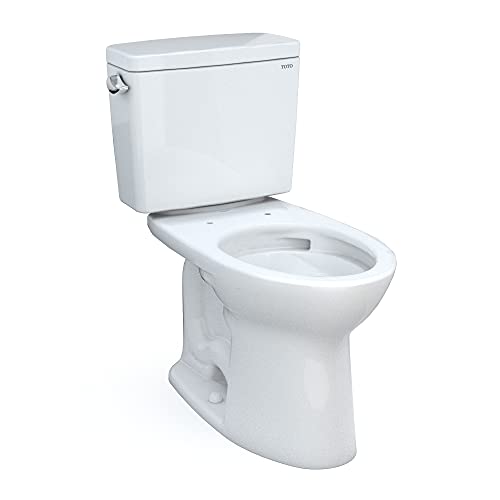
The TOTO Drake II is the benchmark gravity-fed toilet, earning a 1,000-gram MaP score on 1.28 GPF through TOTO's Tornado Flush system, a 3-inch wide-diameter flush valve and a 2.125-inch fully glazed trapway.
The Drake II is a two-piece toilet with a SanaGloss (CeFiONtect) glazed option (CST744SLG) that creates a near-frictionless surface reducing buildup between cleanings. Owner reviews across major retailers are overwhelmingly positive, with high marks for installation ease, flushing consistency and longevity. The 3-inch flush valve delivers significantly more water flow in the first second of the flush cycle than older 2-inch designs, which is how TOTO achieves the 1,000-gram score without exceeding 1.28 GPF.
This model is WaterSense certified and complies with CALGreen water standards, making it legal in all water-restricted states including California. Replacement parts (flappers, fill valves, trip levers) are widely available, commonly from TOTO's own supply chain and from generic brands, making future repairs inexpensive and DIY-friendly. For anyone choosing between the Drake and Drake II, the Drake II adds SanaGloss glaze and the updated E-Max flush system as standard equipment.
The Drake II remains the reference-point gravity toilet because it earns maximum MaP on minimum water with a track record of long service life. It is not the flashiest toilet in TOTO's lineup, but it is the one we would install first in any house where long-term reliability and easy maintenance matter more than aesthetics.
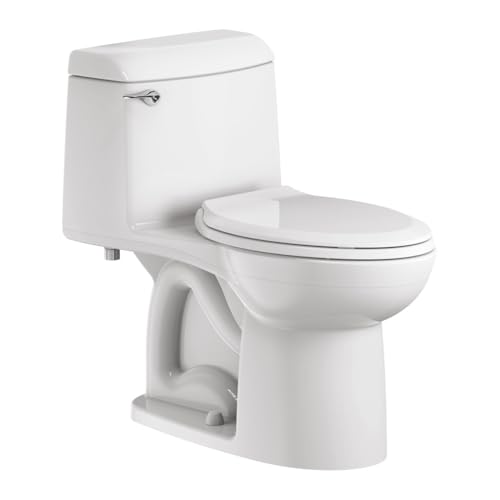
The American Standard Champion 4 pairs a 4-inch wide accelerator flush valve and a 2.3125-inch fully glazed trapway with a 1,000-gram MaP score, making it arguably the most clog-resistant gravity toilet on the market.
The Champion 4's trapway diameter of 2.3125 inches is the widest fully glazed trapway in the gravity-fed segment, wider even than the TOTO Drake II's 2.125 inches. American Standard's 4-inch flush valve (compared to the industry-standard 2 to 3 inches) opens fully in a single motion, releasing the tank volume into the bowl almost instantaneously. This combination is what earns its 1,000-gram MaP score and the near-universal owner praise for handling heavy loads without a second flush.
The trade-off is the 1.6 GPF rating, which does not qualify for EPA WaterSense certification (which caps at 1.28 GPF). In water-metered areas or states with low-flow mandates, the Champion 4 may not be compliant. American Standard's ten-year limited warranty is one of the most generous in the gravity-fed segment. Owner reviews consistently award it four to five stars for flushing reliability, with the most common complaint being that the tank takes slightly longer to refill than some competitors due to the larger volume required.
If clogging is your specific problem and you have a standard 1.6 GPF region, the Champion 4 is the gravity answer to what most buyers consider a pressure-assist problem. The 2.3125-inch trapway simply does not get blocked by normal household waste, and the ten-year warranty suggests American Standard stands behind that claim.

The Kohler Cimarron delivers a 1,000-gram MaP score at 1.28 GPF with EPA WaterSense certification, ADA-compliant comfort height and Kohler's Class Five flushing technology, all at a mid-range price that makes it accessible to most bathroom remodels.
Kohler's Class Five flushing system uses a 3.25-inch flush valve and a precision-engineered tank-to-bowl gasket that minimizes water loss during the flush cycle, channeling all available water into a single powerful wave. The 2-inch fully glazed trapway is narrower than American Standard's Champion 4 but handles normal household loads without issue. Owner reviews consistently rate it four to five stars with high marks for installation quality and bowl cleanliness between flushes.
The Cimarron is available in both round and elongated bowl configurations and in a range of Kohler colors beyond basic white and biscuit. It competes directly with the TOTO Drake II on performance while often undercutting it on retail price, which makes it the first recommendation for buyers who want 1,000-gram performance without paying a premium. Compatible with Kohler's C3 bidet seat line if a future upgrade is planned.
The Cimarron is the gravity-fed toilet we recommend most often to buyers who are replacing a builder-grade toilet on a renovation budget. At 1,000 grams MaP and 1.28 GPF, it hits every performance benchmark that matters, and Kohler parts are stocked at almost every major plumbing supply chain in the country.
These represent the top pressure-assist options for buyers who specifically need the air-driven flush advantage. All use the Flushmate system and carry EPA WaterSense certification or near-equivalent efficiency ratings.

The Kohler Highline Pressure Lite pairs Kohler's proven tank design with a Flushmate pressure vessel, delivering a 1,000-gram MaP flush on 1.0 GPF, the lowest water use of any toilet reviewed here, while providing the aggressive bowl-scouring power that pressure-assist is known for.
At 1.0 GPF with a 1,000-gram MaP score, the Highline Pressure Lite is one of the most water-efficient high-performance toilets available anywhere in the market. The Flushmate vessel charges to operating pressure within 30 to 60 seconds of the fill cycle completing, meaning consecutive flushes can be used in quick succession in high-traffic situations without the extended wait that some low-flow gravity models require.
Owner reviews give it strong ratings for flush power and bowl cleanliness but consistently flag noise as the top complaint. Users in apartments and houses with shared walls note that the flush is audible in adjacent rooms. The Kohler Highline tank shape and styling are traditional rather than modern, which suits bathrooms matching that aesthetic. The lack of condensation on the tank (because the porcelain holds no water) is a genuine advantage in humid bathrooms where sweating tanks leave moisture on floors.
The Highline Pressure Lite is the toilet we would specify for a basement apartment, rental property with a history of clogging, or any bathroom where you are paying for water by volume and need 1,000-gram performance on 1.0 GPF. Everywhere else, the noise cost is real enough that gravity wins.
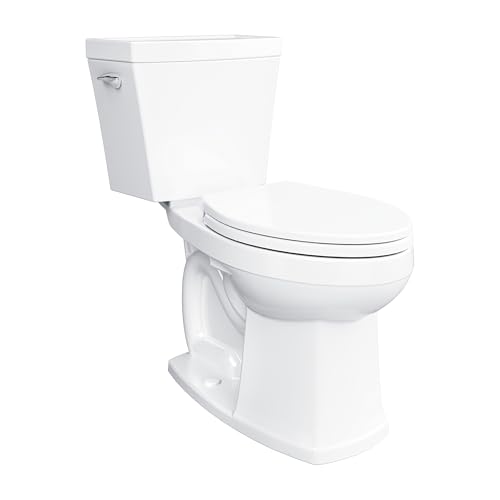
The Gerber Avalanche in its pressure-assist configuration brings Flushmate-powered flushing at a lower retail entry point than the Kohler Highline equivalents, making it the most accessible option for buyers who need air-driven power without paying a significant premium.
Gerber is a lesser-known but North American-manufactured brand with a strong track record in both the commercial and residential segments. The Avalanche pressure-assist line uses Flushmate's Series 504 vessel (post-recall units only, manufactured after the 2014 remedy program), achieving 1,000-gram MaP on 1.0 to 1.1 GPF depending on the specific model and flush valve configuration. Gerber's five-year limited warranty on the vitreous china exceeds Kohler's and TOTO's one-year standard warranty, making it an appealing choice for landlords and property managers.
Owner reviews praise the flushing consistency but echo the noise complaints universal to pressure-assist. Bowl cleanliness scores are high, and clogging-related reviews are extremely rare, which is the point of the pressure-assist system. Parts and service for Flushmate cartridges follow the same supply chain regardless of which toilet brand houses them, so the Gerber name does not create a separate service ecosystem. For readers comparing one-piece and two-piece configurations, the one piece vs two piece toilet guide covers both layouts in detail.
The Gerber Avalanche is the option we reach for when a landlord needs pressure-assist economics: it costs less upfront than the Kohler Highline Pressure Lite, carries a stronger warranty, and flushes at identical MaP and GPF specs. The Gerber name adds nothing and removes nothing from the Flushmate performance story.
Choose gravity-fed if your bathroom is in a residential home with normal water pressure (25+ PSI), standard drain slope, and typical household waste loads. Choose pressure-assist if you have a high-traffic bathroom, a history of clogging that a wide-trapway gravity toilet has not resolved, shallow drain slope, or a basement bathroom where drain velocity is inherently lower. For bedrooms, guest baths and any noise-sensitive location, gravity is always the better choice regardless of flush power comparisons.
Dual-flush gravity models like the TOTO Aquia IV (0.8 GPF liquid / 1.0 GPF solid) and the Woodbridge T-0019 offer a third path: gravity-fed reliability combined with water savings that beat even most pressure-assist units when the half-flush is used consistently. If water conservation is your main goal, a dual-flush gravity toilet is typically a better choice than switching to pressure-assist. See the round vs elongated toilet guide for bowl-shape considerations that apply to both dual-flush and single-flush gravity models.
A good MaP score for a toilet is 600 grams or higher for typical household use, and 800 grams or higher if you want strong performance confidence. The MaP maximum is 1,000 grams, and any toilet scoring 1,000 grams has passed the most demanding flush test available. The EPA WaterSense program requires only 350 grams minimum, which is adequate for light loads but leaves little margin. For a family bathroom, target 800 to 1,000 grams regardless of whether you choose gravity or pressure-assist.
MaP (Maximum Performance) testing was developed by a coalition of water utilities to give consumers and specifiers an objective, independent measurement of toilet flushing performance. Each test uses a standardized soybean-paste waste substitute in specific gram increments. The toilet must flush the measured amount completely in a single attempt to pass at that level. The 1,000-gram mark is the highest increment tested.
Not all toilets are MaP tested. Manufacturers submit their products voluntarily, and many budget or off-brand toilets lack MaP data. If a toilet has no published MaP score, treat it with caution for anything beyond the most basic light-use application. The full MaP database is publicly searchable at map-testing.com and is updated periodically as new models are submitted. All of the models reviewed in this article have published MaP scores available in that database.
EPA WaterSense certification is a separate program from MaP. WaterSense certifies water efficiency (1.28 GPF maximum) and requires a minimum 350-gram MaP score. A toilet can be WaterSense certified at 350 grams, which is far below what most buyers would consider acceptable flush power. Always check both the GPF and the MaP score independently when evaluating any toilet.
Do not confuse EPA WaterSense certification with high flush performance. WaterSense means the toilet uses no more than 1.28 GPF and passes a 350-gram minimum test. That minimum is genuinely low. A toilet can be WaterSense certified and still struggle with normal household loads. Always look for a MaP score of 800 grams or higher from a brand you recognize, then check WaterSense status second. The TOTO Drake II and Kohler Cimarron are examples of toilets that earn both top MaP scores and WaterSense certification together.
Pressure-assist is better than gravity only for specific situations: high-traffic bathrooms, chronic clogging, shallow drain lines and basement installations. For the vast majority of residential bathrooms, a high-MaP gravity toilet like the TOTO Drake II or American Standard Champion 4 performs equally well while running quietly and requiring cheaper repairs.
Pressure-assist toilets are significantly louder than gravity models. The compressed-air release produces a forceful "whoosh" sound audible through walls and across hallways. Owner reviews consistently rate noise as the top complaint. If your bathroom is adjacent to a bedroom or home office, the noise is a practical disqualifier.
Most pressure-assist toilets require a minimum household water supply pressure of 25 PSI to operate, and perform optimally above 45 PSI. Low-pressure water supplies (common in some older buildings or homes on well water) may not allow the Flushmate vessel to charge fully, reducing flush effectiveness. Gravity toilets have no minimum pressure requirement beyond what fills the tank.
Yes. Pressure-assist toilets require model-specific Flushmate cartridges when the pressure vessel fails, which are not available at most hardware stores and cost significantly more than standard gravity toilet parts. Gravity toilet parts (flappers, fill valves, handles) cost $5 to $25 each and are available at any Lowe's, Home Depot or ACE Hardware.
On published MaP scores, yes. Multiple gravity toilets including the TOTO Drake II, Kohler Cimarron and American Standard Champion 4 earn a 1,000-gram MaP score, which is the same maximum achieved by top pressure-assist units. In terms of bowl-surface aggression and raw water velocity, pressure-assist still feels more forceful, which matters most in commercial-style high-traffic use.
Some pressure-assist models operate at 1.0 GPF compared to the 1.28 GPF common on most WaterSense gravity models, giving a marginal water savings advantage. However, dual-flush gravity toilets like the TOTO Aquia IV (0.8/1.0 GPF) can use equal or less water when the half-flush is used consistently, eliminating the pressure-assist water savings argument in those comparisons.
MaP (Maximum Performance) is an independent third-party flush test that measures the maximum grams of solid waste a toilet can clear in a single flush, using standardized soybean-paste test media. Scores range from below 250 grams to a maximum of 1,000 grams. A score of 800 grams or higher indicates strong performance for household use. It is the most objective single-number comparison of flush performance available to consumers.
Pressure-assist reduces clogging caused by insufficient flush velocity, particularly in shallow drain lines. However, a gravity toilet with a 2.125-inch or wider fully glazed trapway (TOTO Drake II, American Standard Champion 4) eliminates most trapway-caused clogs without the noise and repair trade-offs. Clogs in normal residential use are typically a trapway size and water volume issue, not a gravity vs pressure-assist issue.
Yes. Pressure-assist toilets use standard rough-in dimensions (typically 12 inches from wall to center bolt, or 10/14 inch variants) and connect to standard water supply lines and drain flanges. The swap is a like-for-like plumbing replacement. The only requirement is sufficient household water pressure (minimum 25 PSI, ideally 45 PSI or above) for the Flushmate vessel to function correctly.
The loud whoosh is caused by the release of air compressed to 25-35 PSI inside the Flushmate vessel. When the flush lever is pressed, that stored pressure releases into the bowl in under one second. This is a designed feature, not a defect. There is no adjustment or modification that meaningfully reduces the noise; it is inherent to how the pressure-assist system works.
Yes. Gravity toilet tanks hold cold standing water, which causes condensation on the outside of the porcelain tank in humid conditions. This "sweating" can drip onto floors and cause mold or water damage. Pressure-assist tanks hold no water (only the sealed pressure vessel), so the outer tank stays at room temperature and does not condense. In a humid bathroom without air conditioning, this is a genuine advantage for pressure-assist.
Flushmate is a brand of pressure vessel manufactured by Sloan Valve Company, used to create pressure-assist toilets. It is installed inside the porcelain tank by the toilet manufacturer. Kohler uses Flushmate in its Highline Pressure Lite and Wellworth Pressure Lite models. American Standard has used it in select lines. Gerber uses it in the Avalanche pressure-assist line. Flushmate is the dominant pressure-vessel technology in the North American residential toilet market.
EPA WaterSense is a voluntary certification program that requires toilets to use no more than 1.28 GPF and pass a minimum 350-gram MaP flush test. Both gravity-fed and pressure-assist toilets can and do qualify. Most top gravity models (TOTO Drake II, Kohler Cimarron, Woodbridge T-0001) carry WaterSense certification. Most pressure-assist models also qualify given their low GPF ratings. WaterSense certification on its own does not guarantee strong flushing; always check the MaP score separately.
A Flushmate vessel typically lasts 10 to 20 years with normal residential use, though the actual lifespan depends on water quality, usage frequency and supply pressure. When it fails, replacement requires the correct series-specific Flushmate cartridge. Kohler, Gerber and other brands using Flushmate provide model-specific replacement part numbers. Flushmate issued a major recall on Series 503 and 504 vessels manufactured before 2014; all affected units have been covered by a free replacement program.
For elderly or mobility-limited users, the flush mechanism (gravity vs pressure-assist) is less important than toilet height and flush handle design. Both systems are available in ADA-compliant comfort-height configurations (16.5 to 17.5 inches seat height). Gravity toilets are typically easier to flush because the flush lever requires less force than some pressure-assist trip mechanisms. TOTO and Kohler both offer comfort-height gravity models with large, ergonomic flush levers well-suited to users with limited grip strength.
One-piece pressure-assist toilets exist but are less common than two-piece configurations. The sealed Flushmate vessel requires a specific tank geometry that some one-piece designs cannot accommodate easily. Most pressure-assist models from Kohler and Gerber are two-piece. For one-piece options with strong flush performance, most buyers are better served by one-piece gravity models like the TOTO UltraMax II or the Swiss Madison St. Tropez, both of which achieve high MaP scores.
No. GPF (gallons per flush) measures water volume, not flush effectiveness. The TOTO Drake II flushes 1,000 grams on 1.28 GPF while some older 3.5 GPF toilets scored far lower on MaP tests because they used more water less efficiently. Flush effectiveness depends on flush valve diameter, trapway geometry, siphon design and water delivery speed, not just raw volume. Always check MaP scores alongside GPF ratings when comparing toilets.
For rental properties, the right answer depends on clogging history. If previous tenants have caused chronic clogs and your drain lines have shallow pitch, pressure-assist (Kohler Highline Pressure Lite or Gerber Avalanche) reduces the frequency of those service calls significantly. If clogging is not a documented problem, a wide-trapway gravity toilet (American Standard Champion 4) provides the same clog resistance with lower repair costs and universal replacement parts available at any hardware store, making it the easier choice for property managers.
TOTO, Kohler and American Standard are the three top brands for gravity-fed toilets based on MaP scores, EPA WaterSense certifications, owner review aggregates and warranty coverage. TOTO leads in engineering quality and glaze technology (CeFiONtect), Kohler leads in style variety and widespread availability, and American Standard leads in trapway diameter with the Champion 4. Woodbridge and Swiss Madison offer credible alternatives at mid-range prices, with the Woodbridge T-0001 earning strong owner ratings and published MaP scores.
Gravity-fed toilets are the right choice for the overwhelming majority of residential bathrooms. A TOTO Drake II or Kohler Cimarron achieves the same 1,000-gram MaP ceiling as a Flushmate pressure unit, runs quietly, requires only cheap universal parts and works at any standard water pressure. Pressure-assist earns its place in high-traffic settings, basement bathrooms with shallow drain slopes and chronic-clog rental properties, and nowhere else. Buy the quiet gravity toilet for your home, and reserve pressure-assist for the specific scenarios where its air-driven force is genuinely needed.
Learn why toilet trapways curve like an S, how each bend blocks sewer gas, and what the shape means for clogs and…
Read the guideAlmost every US toilet has a left-side handle. Learn the plumbing and mechanical reasons behind the layout and when it actually changes.
Read the guideHome toilets rely on tanks because household water lines lack the pressure that public flushometer systems use to flush straight from the…
Read the guide