

Toilet Drainline Carry Explained
Toilets4.6
Drainline carry measures how far solid waste travels in a pipe after one flush. Learn what the MaP test measures and why…
Read the guideEverything homeowners need to cut bathroom water use by 30 to 50 percent -- with certified products, GPF benchmarks, MaP scores, and fixture-by-fixture savings data so you can act with confidence.
Replacing a pre-1994 toilet, a standard faucet aerator, and an older showerhead with EPA WaterSense-certified alternatives can cut a household's bathroom water use by 30 to 50 percent annually -- saving the average family more than 18,000 gallons per year without sacrificing performance.
The bathroom accounts for roughly 65 percent of all indoor water use in a typical American home, and the toilet alone is responsible for nearly 30 percent of that total, according to EPA research. If your home still runs pre-1994 toilets flushing at 3.5 or even 7 gallons per flush (GPF), or fixtures installed before the federal 1.5 GPM standard for faucets and 2.5 GPM standard for showers, you are paying a measurable premium every month for water your plumbing does not need.
This guide covers all three major bathroom water users -- toilets, faucets, and showers -- using published EPA WaterSense data, MaP flush-test results, and manufacturer-verified specifications so you can make a fact-based decision on where to invest first.
For a starting point on the best overall performers, see our best flushing toilets guide, which benchmarks MaP scores, GPF ratings, and owner satisfaction side by side.
The EPA estimates that the average American uses about 80 to 100 gallons of water per day indoors, with the bathroom responsible for roughly 65 of those gallons. Toilet flushing alone accounts for 24 to 30 gallons per person per day in homes with older 3.5 GPF models, while faucets add 10 to 15 gallons and showering contributes another 15 to 20 gallons. Switching to WaterSense-certified fixtures across all three categories can reduce bathroom use to as low as 35 to 45 gallons per person daily.
Federal law since 1994 has capped toilets at 1.6 GPF, but EPA WaterSense certification requires 1.28 GPF or less. MaP testing confirms that WaterSense-labeled toilets at 1.28 GPF must still flush a minimum of 350 grams of solid waste in a single flush -- with top performers like the TOTO Drake II and TOTO Aquia IV clearing 1,000 grams consistently. Dual-flush models certified by WaterSense achieve 1.28 GPF on the full flush and as low as 0.8 GPF on the liquid cycle.
Yes. The EPA calculates that WaterSense-certified toilets save the average family nearly 13,000 gallons per year compared to a 3.5 GPF model, and about 4,000 gallons per year versus a standard 1.6 GPF unit. Over a 10-year product life, that translates to meaningful utility bill savings and a reduced environmental footprint. Many utilities also offer rebates of $50 to $200 for installing WaterSense-labeled toilets, further shortening the payback period.
They target different usage patterns, so both matter. A WaterSense faucet aerator reduces flow from the federal 2.2 GPM maximum to 1.5 GPM or less, saving roughly 700 gallons per person per year in bathroom sink use. A WaterSense showerhead caps flow at 2.0 GPM (down from the federal 2.5 GPM standard), saving about 2,900 gallons per person per year assuming an eight-minute daily shower. Because showers account for more water per event, a showerhead upgrade typically yields greater absolute savings.
MaP (Maximum Performance) testing, conducted by independent laboratories, directly measures a toilet's ability to flush solid waste at its rated GPF. Toilets earning MaP Premium status (1,000 grams cleared at 1.28 GPF or less) include the TOTO Drake II, TOTO UltraMax II, American Standard Champion 4 Max, Kohler Cimarron, and Woodbridge T-0001, all of which have received MaP scores of 800 to 1,000 grams while meeting EPA WaterSense criteria. Owners of these models report fewer clogs than with older 3.5 GPF toilets, largely because modern bowl geometries and trap designs are optimized for high-velocity flush performance.
The single largest lever in bathroom water savings is the toilet. Here is how the GPF tiers compare in real-world impact:
| Flush Rate | Era / Standard | Gallons/Year (4-person home) | WaterSense Certified | MaP Score (Typical) |
|---|---|---|---|---|
| 7.0 GPF | Pre-1980 | ~102,200 | No | N/A |
| 3.5 GPF | 1980 to 1994 | ~51,100 | No | N/A |
| 1.6 GPF | 1994 to present (federal max) | ~23,360 | No | 500 to 1000g |
| 1.28 GPF | WaterSense standard | ~18,688 | Yes | 600 to 1000g |
| 0.8 / 1.28 GPF dual | Dual-flush WaterSense | ~14,000 to 16,000 (blended) | Yes (if labeled) | 700 to 1000g |
| 0.8 GPF | Ultra-HET / commercial crossover | ~11,680 | Yes (if labeled) | 350 to 800g |
Note: Annual gallons calculated at 5 flushes per person per day, 4 people, 365 days. Dual-flush blended figure assumes 70 percent liquid and 30 percent full flushes, a typical household split per EPA data.
EPA WaterSense is a voluntary partnership program, modeled after Energy Star, that certifies fixtures meeting efficiency AND performance standards. For toilets, a product must:
WaterSense does not certify based on manufacturer claims alone. Every listed product has passed independent laboratory verification. You can search the full product list at epa.gov/watersense.
MaP scores above 800 grams at 1.28 GPF represent the intersection of efficiency and real-world clog resistance. The TOTO Drake series and American Standard Champion 4 Max consistently appear at the top of MaP test results in this category, and aggregated owner reviews over three to five years show meaningfully lower clog-related service calls compared to standard 1.6 GPF units. For households with septic systems, a lower GPF also reduces hydraulic load on the tank -- a benefit that compounds over time.
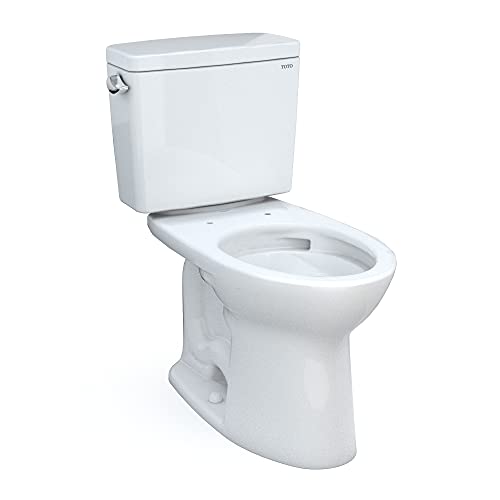
Best overall efficiency + performance: TOTO Drake II (1.28 GPF, MaP 1000g) -- Two-piece design, G-Max flushing system, CEFIONTECT glaze, WaterSense certified. Published MaP score: 1,000 grams.
Best dual-flush efficiency: TOTO Aquia IV (0.8 / 1.28 GPF) -- Dual cyclone flushing with rimless design and CEFIONTECT glaze. WaterSense certified. Published MaP score on full flush: 1,000 grams. See our dedicated TOTO Aquia IV review for detailed analysis.
Best one-piece efficiency: TOTO UltraMax II (1.28 GPF) -- One-piece skirted design, same G-Max flushing platform, 1,000g MaP score.
Best value efficiency: American Standard Champion 4 Max (1.28 GPF) -- 4-inch piston action flush valve, 2-3/8 inch fully glazed trapway, MaP score of 1,000 grams. WaterSense certified.
Best elongated comfort height efficiency: Kohler Cimarron (1.28 GPF) -- AquaPiston flush technology, comfort height seat, WaterSense certified, published MaP score of 1,000 grams. See our Kohler Cimarron review for owner feedback summary.
Best budget-friendly efficient model: Woodbridge T-0001 (1.28 GPF) -- One-piece skirted design, WaterSense certified, MaP score: 1,000 grams.
Best ultra-low flush: Gerber Avalanche Dual Flush (0.8 / 1.6 GPF) -- Tower-style flush valve, WaterSense certified on the liquid cycle.
Bathroom faucets are the easiest and lowest-cost place to improve water efficiency. The federal standard caps faucets at 2.2 GPM, but a WaterSense-labeled bathroom faucet must flow at 1.5 GPM or less. The technology behind the reduction is the aerator -- a small threaded insert at the tip of the spout that mixes air into the water stream, maintaining pressure feel while cutting actual volume.
If your faucet flows at the old 2.2 GPM standard, a $5 to $15 aerator replacement can cut that to 1.0 or 1.5 GPM with no change to perceived pressure. The EPA estimates that WaterSense-labeled faucets and aerators save an average of 700 gallons per year per person compared to the standard 2.2 GPM baseline. For a family of four, that is 2,800 gallons annually from a hardware-store swap that takes two minutes.
Aerators are labeled with their flow rate in GPM. For bathroom use, common options are:
| Flow Rate | Standard | Gallons Saved vs 2.2 GPM (4-person, 5 min/day) | WaterSense Eligible |
|---|---|---|---|
| 2.2 GPM | Federal max (older fixtures) | Baseline | No |
| 1.5 GPM | WaterSense standard | ~1,277 gal/yr | Yes |
| 1.0 GPM | Ultra-low flow | ~2,190 gal/yr | Yes |
| 0.5 GPM | Sensor/touchless faucets | ~3,102 gal/yr | Yes (varies) |
Note: Savings calculated at 5 minutes of daily bathroom faucet use per person, 4 people, 365 days.
Several major brands produce WaterSense-certified bathroom faucets. Look for the EPA label on the packaging or product page:
For a deeper comparison of faucet brands, see our bathroom faucet buying guide.
Flow rate alone does not determine perceived performance. Laminar-flow aerators (which produce a clear, solid stream) feel strong at 1.0 GPM because they concentrate the stream rather than spreading it. Aerated (bubbly) streams at the same GPM can feel less satisfying. If water pressure is already low in your home, choose laminar aerators to maintain the sense of adequate flow at reduced volume. Most plumbing supply stores stock both types in standard faucet thread sizes (15/16 inch male for older faucets, 55/64 inch for newer ones).
Motion-activated or touchless faucets eliminate the habit of leaving water running while brushing teeth or washing hands. Studies from institutions including the Pacific Institute have documented that hands-free faucets reduce flow duration by 30 to 50 percent compared to manually operated faucets in bathroom settings. Combined with a 1.0 GPM aerator, a touchless faucet can reduce bathroom sink water use by 60 percent or more annually.
Kohler Touchless Bathroom Faucets and Moen Sensor Faucets offer battery-operated sensors that require no dedicated wiring, making retrofits straightforward.
Showers account for nearly 17 percent of all indoor home water use, according to the EPA -- roughly 40 gallons per household per day at the national average shower length of eight minutes with a 2.5 GPM showerhead. Switching to a WaterSense-certified showerhead (2.0 GPM or less) cuts that to 32 gallons daily, saving approximately 2,900 gallons per person per year.
| Flow Rate | Standard | Gallons per 8-min Shower | Annual Gallons (1 person) | WaterSense |
|---|---|---|---|---|
| 5.0+ GPM | Pre-1992 | 40+ | 14,600+ | No |
| 2.5 GPM | Federal max (1992 to present) | 20 | 7,300 | No |
| 2.0 GPM | EPA WaterSense | 16 | 5,840 | Yes |
| 1.8 GPM | California/Colorado standard | 14.4 | 5,256 | Yes |
| 1.5 GPM | Ultra-low flow | 12 | 4,380 | Yes |
The criticism most often raised about low-flow showerheads -- a thin, unsatisfying stream -- is valid for older designs that simply restricted flow without optimizing spray geometry. Modern WaterSense-certified showerheads use one or more of the following approaches to maintain perceived performance at 1.5 to 2.0 GPM:
For households on well water or in areas with low municipal pressure, a pressure-compensating showerhead is especially important. Look for models rated down to 20 PSI minimum operating pressure.
Kohler WaterSense Showerheads -- The Kohler Flipside (2.0 GPM) and Forte series offer four spray modes including a dedicated massage setting. WaterSense certified.
Moen WaterSense Showerheads -- The Moen Attract and Engage series offer magnetic docking for handheld configurations at 1.75 GPM. WaterSense certified.
Delta WaterSense Showerheads -- The Delta H2Okinetic series uses sculpted water channels to generate larger droplets at reduced flow, maintaining warmth perception at 1.75 GPM.
Hot water accounts for a disproportionate share of shower energy cost. At 2.5 GPM, an eight-minute shower uses approximately 20 gallons, of which roughly 12 to 14 are heated -- requiring significant gas or electric energy input. Dropping to 1.5 GPM cuts heated water demand by 40 percent per shower, making water heater efficiency improvements compound with showerhead efficiency. If your household showers daily across multiple people, the combined fixture plus water heating savings from a WaterSense showerhead can exceed the unit cost in 6 to 12 months.
Hardware alone does not capture all available savings. EPA data shows that reducing shower duration from 10 minutes to 7 minutes saves more water than switching from a 2.5 GPM showerhead to a 2.0 GPM showerhead at a 10-minute shower duration. The two interventions together -- shorter showers AND a WaterSense showerhead -- produce compounding savings that no single upgrade can match.
Simple digital shower timers (available for under $20) mounted to the showerhead or wall have been documented in utility pilot programs to reduce average shower duration by 1 to 2 minutes per session.
The cumulative savings from upgrading all three fixture categories in a four-person household are substantial:
| Fixture Upgrade | Old Standard | New WaterSense | Annual Savings (4-person home) |
|---|---|---|---|
| Toilet (2 units) | 3.5 GPF | 1.28 GPF | ~31,900 gallons |
| Bathroom faucets (2 units) | 2.2 GPM | 1.0 GPM | ~4,380 gallons |
| Showerhead (1 unit) | 2.5 GPM | 1.75 GPM | ~6,205 gallons |
| Total combined | ~42,485 gallons/year |
At a national average water and sewer rate of approximately $0.006 per gallon (combined, per American Water Works Association data), 42,485 gallons in annual savings represents roughly $255 in reduced utility costs per year -- plus additional water heater savings on the heated portion of that water.
Many regional utilities offer cash rebates for replacing old toilets with WaterSense-certified models. Common rebate structures include:
The EPA WaterSense website maintains a searchable database of rebate programs by zip code. Check epa.gov/watersense before purchasing to identify applicable local incentives -- a $150 toilet rebate can cover the entire product cost on a mid-tier WaterSense model.
Dual-flush toilets offer liquid-only (0.8 to 1.0 GPF) and full (1.28 GPF) flush options, giving users control over per-flush water use. The savings case depends on household flushing behavior. In a four-person home with a typical 70/30 liquid-to-solid flush ratio, a 0.8 / 1.28 GPF dual-flush toilet uses approximately 1.03 GPF on a weighted average -- saving an additional 2,500 to 3,000 gallons per year per toilet versus a single-flush 1.28 GPF model.
The tradeoff is flushing power on the liquid cycle. MaP scores at 0.8 GPF are inherently lower than at 1.28 GPF. Choose dual-flush models with strong full-flush MaP scores (800g or above) to ensure the full flush handles solids reliably. The TOTO Aquia IV, with its 1,000g MaP score on the full flush, is a benchmark in this category. See also our guide on whether dual-flush toilets are worth it for a household-by-household analysis.
These terms are often used interchangeably but have specific meanings in industry and regulatory contexts:
For homeowners with septic systems, the lower hydraulic load from HET or dual-flush toilets is a meaningful secondary benefit beyond water bill savings. Septic systems are typically sized for 50 gallons per person per day of wastewater; switching from 3.5 GPF to 1.28 GPF toilets alone reduces toilet-generated wastewater by 63 percent, extending the interval between pumping cycles.
Use this checklist to evaluate your current bathroom and prioritize upgrades by savings potential:
Homeowners often underestimate the combined impact of water heating costs on their utility bill. The U.S. Department of Energy reports that water heating accounts for 18 percent of average home energy use. Every gallon of hot water eliminated through low-flow fixtures also reduces the energy required to heat it -- so a showerhead and faucet upgrade has a double-sided return: lower water costs AND lower gas or electric costs. This secondary savings is frequently overlooked in simple GPM-only calculations.
Among widely available residential toilets, dual-flush models at 0.8 / 1.28 GPF such as the TOTO Aquia IV represent the most efficient option with proven MaP performance. Some commercial-grade toilets flush at 0.5 GPF but are impractical for residential installation due to pressure and drain requirements.
Look for the EPA WaterSense label on the packaging, on the toilet tank, or in the product documentation. You can also search the complete list of certified products at epa.gov/watersense. If you cannot find documentation, look up your model number on the manufacturer's website -- WaterSense status is typically listed in the specifications tab.
Not necessarily. MaP testing shows that many 1.28 GPF toilets outscore 1.6 GPF models on solid waste removal because the bowl and trap geometry are optimized for high-velocity, efficient flush dynamics. The TOTO Drake II, American Standard Champion 4 Max, and Kohler Cimarron all achieve 1,000g MaP scores at 1.28 GPF -- better than many older 1.6 GPF designs.
EPA WaterSense is a voluntary labeling program administered by the U.S. Environmental Protection Agency that certifies water-efficient products meeting strict performance AND efficiency criteria. Unlike Energy Star (which covers energy use), WaterSense focuses on water savings in plumbing fixtures including toilets, faucets, showerheads, and irrigation controllers.
The EPA estimates that replacing a 3.5 GPF toilet with a WaterSense-certified 1.28 GPF model saves approximately 13,000 gallons per person per year. For a family of four with two toilets, the annual savings can exceed 26,000 gallons. Even replacing a 1.6 GPF toilet saves roughly 4,000 gallons per person annually at the same flush frequency.
MaP (Maximum Performance) is an independent testing protocol that measures how many grams of solid waste a toilet can flush completely in a single flush. Scores range from 100g to 1,000g, with 1,000g representing MaP Premium status. Higher MaP scores indicate better clog resistance. The test uses a soybean paste surrogate that simulates real waste density and consistency.
For most bathroom hand-washing uses, 1.0 GPM is sufficient. Laminar aerators at 1.0 GPM produce a solid, clear stream that feels adequate for rinsing and washing. If you frequently fill containers from your bathroom sink, a slightly higher flow rate (1.5 GPM) may be more practical. For tooth brushing and hand washing alone, 1.0 GPM performs as well as 2.2 GPM in user studies.
EPA WaterSense certifies showerheads that flow at 2.0 GPM or less. Some state programs, including California Title 20 regulations, require 1.8 GPM or less for all showerheads sold in-state. Ultra-low-flow showerheads achieve 1.5 GPM or below while maintaining acceptable spray quality through air-injection and optimized nozzle geometry.
Yes, many utilities offer cash rebates for WaterSense toilet purchases. Rebates typically range from $50 to $200 per toilet depending on the local utility and model. The EPA WaterSense website (epa.gov/watersense) maintains a searchable rebate finder tool organized by zip code. Some programs offer mail-in rebates; others require purchase receipt submission through an online portal.
Dual-flush toilets use a different flush mechanism -- typically a tower-style cartridge valve rather than a traditional rubber flapper -- that controls both flush volumes. These cartridges are generally durable, but replacement parts are less universally available than standard flapper kits. Brands like TOTO, Kohler, and Geberit offer cartridge replacement kits, but the specific cartridge must match your model. Owner reviews note that dual-flush buttons occasionally require adjustment after several years of use.
Reducing flow rate can affect the temperature of water reaching the showerhead if your hot water delivery system has a long pipe run between the heater and the shower. Less flow means heated water travels more slowly through the pipe, increasing the time to reach temperature. An on-demand (tankless) water heater or a hot water recirculation pump eliminates this issue entirely and pairs well with a 1.5 GPM showerhead upgrade.
TOTO, Kohler, American Standard, Woodbridge, Swiss Madison, and Gerber all produce WaterSense-certified toilets with MaP scores of 800g or above. TOTO is particularly noted for its Double Cyclone and G-Max flushing systems, which deliver 1,000g MaP performance at 1.28 GPF. American Standard's Champion 4 Max uses a piston-action flush valve that similarly achieves 1,000g at 1.28 GPF.
Low-flow is a broad term covering any toilet at or below the 1.6 GPF federal standard. High-efficiency toilet (HET) is a more specific designation for models flushing at 1.28 GPF or less -- the EPA WaterSense threshold. All EPA WaterSense-certified toilets are HETs, but not all HETs carry WaterSense certification (they must complete third-party testing to use the label).
Gravity-flush toilets (the most common residential type) rely on the weight and velocity of water released from the tank, not incoming line pressure. They perform similarly across typical residential line pressures (20 to 80 PSI). Pressure-assist toilets do require adequate incoming pressure (typically 25 PSI minimum) to compress the air vessel, but they are a separate category from standard gravity-flush WaterSense models.
The EPA estimates that WaterSense fixture upgrades (toilet, faucet, showerhead) save the average household more than 30,000 gallons per year. At national average combined water and sewer rates of approximately $0.006 per gallon, that translates to roughly $180 per year in direct water bill savings -- plus additional savings on water heating costs for the hot water portion of that usage.
CEFIONTECT is TOTO's proprietary ceramic glaze that creates an ultra-smooth, ion-barrier surface on the bowl interior. While it does not directly change GPF, it reduces organic particle adherence, allowing the bowl to stay cleaner with each flush. This means the same 1.28 GPF flush cleans the bowl more thoroughly, reducing the need for repeated flushing -- which contributes to lower per-use water consumption in practice.
For a standard toilet replacement (same rough-in distance, same floor flange), no modifications are needed. The supply line, shutoff valve, floor bolts, and drain are all reused. If the rough-in measurement differs from the new toilet's specification, an offset flange adapter can accommodate differences of 2 inches in most cases. Full drain or floor modifications are rarely required for a like-for-like toilet upgrade.
MaP scores of 600g or above indicate reliable performance for most households. MaP scores of 800g to 1,000g (MaP Premium) indicate excellent solid waste removal and low clog risk. The MaP Premium designation requires a 1,000g score at the toilet's tested flush volume. For households with multiple users or heavy use, MaP Premium (1,000g) is the safest benchmark.
Yes. If your faucet body is in good condition but the aerator flows at more than 1.5 GPM, swapping the aerator alone achieves the WaterSense flow rate for faucets. Note that the WaterSense label certifies the completed faucet fixture as a unit -- an aftermarket aerator alone does not make the fixture "WaterSense certified" for rebate purposes, though the water savings are identical. Check your utility's rebate requirements before purchasing.
The toilet offers the largest absolute water savings in the bathroom, especially if you are replacing a 3.5 GPF or older model. If your existing toilet is already at 1.28 GPF, showerhead replacement typically yields the next-largest savings given the volume of water used per shower event. Faucet aerator replacement is the lowest cost and fastest return investment and should be done alongside either of the other upgrades.
A WaterSense-certified toilet at 1.28 GPF with a MaP Premium score is the single highest-impact bathroom upgrade most households can make, saving 10,000 to 30,000 gallons annually depending on the fixture being replaced. Pair that with a 1.0 to 1.5 GPM faucet aerator and a 2.0 GPM WaterSense showerhead and a four-person home can reduce bathroom water use by 40 percent or more without any sacrifice in daily comfort. TOTO Drake II, TOTO Aquia IV, Kohler Cimarron, American Standard Champion 4 Max, and Woodbridge T-0001 are the benchmark products to evaluate in the toilet category. Rebates from local utilities can offset much of the upgrade cost -- search epa.gov/watersense before purchasing.
Drainline carry measures how far solid waste travels in a pipe after one flush. Learn what the MaP test measures and why…
Read the guideToilet floor bolts spinning instead of tightening usually means a broken flange or stripped nut. Here is how to diagnose it and…
Read the guideShould tile run under the toilet or stop at the flange? Learn the right order, why it matters for leaks, and how…
Read the guide