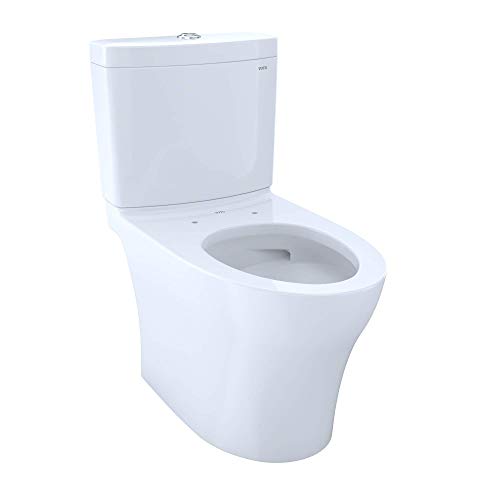


Best French Toilets (2026)
Toilets4.6
Refined, softly curved one-piece and skirted silhouettes with a polished, Parisian-elegant profile, paired with verified MaP flush scores rather than a stylist's…
Read the guideA complete breakdown of how laboratories measure gallons per flush, what MaP testing reveals, which GPF ratings actually perform well, and why the numbers on a spec sheet do not always tell the full story.
Research updated June 2026.
GPF (gallons per flush) is measured by filling a toilet's tank to a calibrated water line, then triggering one full flush while collecting all discharge into a calibrated vessel. Labs such as MaP also load each toilet with soybean paste media to stress-test real-world clearing ability alongside flow-rate verification, so a low-GPF toilet can still outscore a higher-GPF model in actual waste removal.
GPF stands for gallons per flush and measures the precise volume of water a toilet uses during a single, complete flush cycle. Federal law (the Energy Policy Act of 1992) capped toilets at 1.6 GPF; EPA WaterSense certification requires 1.28 GPF or less while still meeting minimum performance standards. A toilet rated at 0.8 GPF uses exactly half the water of a 1.6 GPF model over time, which translates to roughly 4,000 to 6,000 gallons saved per household annually according to EPA estimates.
GPF is the single most cited number in toilet marketing, yet it is also one of the most misunderstood. The rating reflects how much water the toilet is designed to use per flush, but it does not automatically tell you whether that water is used effectively. A poorly designed 1.6 GPF toilet can fail to clear waste that a well-engineered 1.28 GPF or even 0.8 GPF toilet handles with ease.
Understanding how the rating is generated, which independent bodies verify it, and what secondary metrics you should care about puts you in a much stronger position when comparing models from best flushing toilets across TOTO, Kohler, American Standard, Woodbridge, Swiss Madison, and Gerber.
GPF is a design intent number, not a performance guarantee. A toilet engineered to use 1.28 gallons through a large-diameter trapway and a well-profiled flush valve will outperform a toilet rated at 1.6 gallons with a restrictive trapway every time. Always pair the GPF rating with MaP score data before making a purchase decision.
Certified testing laboratories measure GPF by filling a toilet tank to its manufacturer-specified water line, then triggering a single flush while collecting all water that exits the bowl into a calibrated collection vessel; the collected volume is weighed or volumetrically measured and divided by 3.785 to convert liters to gallons. Multiple flush cycles are averaged to account for minor variability in valve actuation. This method is standardized under ASME A112.19.2/CSA B45.1, which is the American and Canadian plumbing performance standard that all certified toilets must meet.
The formal procedure follows several tightly controlled steps:
For EPA WaterSense certification, laboratories must hold third-party accreditation. The protocol is further governed by the WaterSense High-Efficiency Toilet (HET) Specification, which requires an effective flush volume of 1.28 GPF or less and mandates concurrent waste-clearing performance testing so that a toilet cannot earn the label purely on water savings.
| GPF Category | Federal / Certification Threshold | Typical Models | Annual Water Use (10 flushes/day) | WaterSense Eligible |
|---|---|---|---|---|
| Standard (old pre-1994) | 3.5 GPF (no longer sold) | Legacy pre-law models | ~12,775 gal/yr | No |
| Standard HET | 1.6 GPF federal max | American Standard Champion 4, Kohler Highline Classic | 5,840 gal/yr | No |
| WaterSense HET | 1.28 GPF or less | TOTO Drake II, Kohler Cimarron, American Standard Cadet 3 | 4,672 gal/yr | Yes |
| Ultra HET (dual flush) | 1.0 / 0.8 GPF (avg 1.0 or less) | TOTO Aquia IV, Woodbridge T-0001, Swiss Madison dual-flush | 3,650 gal/yr | Yes (if avg meets 1.28) |
| Ultra-low flush | 0.8 GPF single-flush | Niagara Stealth, select Gerber Ultra-Flush | 2,920 gal/yr | Yes |
MaP (Maximum Performance) testing is an independent program run by Veritec Consulting and IAPMO Research and Testing that measures how many grams of soybean paste media -- a material calibrated to approximate the density and consistency of human solid waste -- a toilet can completely clear in a single flush. MaP scores range from 100 to 1,000 grams, and a score of 500 grams is considered the minimum for residential performance; models scoring 800+ grams are recommended for households with heavy use. MaP testing is conducted at the same time as GPF verification, meaning a toilet must prove both water efficiency and waste-clearing power simultaneously.
MaP testing was developed specifically because GPF figures alone created a performance problem. When the 1992 Energy Policy Act forced manufacturers to cut from 3.5 GPF to 1.6 GPF practically overnight, many early models failed to clear waste reliably, leading to double-flushing that eliminated any water savings. MaP filled the gap by creating an objective, repeatable bulk-media test that consumers and specifiers could reference.
The test media -- 100% soybean paste wrapped in latex casings -- is loaded into the bowl in specific weights (100g, 200g, 300g increments up to 1,000g maximum). Each weight increment is tested up to four times. The highest load weight the toilet clears on all four attempts is its published MaP score. Partial credit is not given; a toilet that clears 900g three times but fails on the fourth attempt does not earn a 900g rating.
MaP 1,000g is the ceiling of the current test protocol, not a claim that the toilet can handle unlimited loads. TOTO Drake II, TOTO UltraMax II, and American Standard Champion 4 all publish MaP 1,000g scores. What this actually tells you is that those models reliably cleared the maximum test load on every attempt -- an extremely strong performance signal for high-demand households and rental properties.
Dual-flush toilets undergo separate GPF measurements for each flush mode: the reduced flush (typically 0.8 to 1.0 GPF for liquid and paper waste) and the full flush (typically 1.28 to 1.6 GPF for solid waste). For EPA WaterSense certification, the effective flush volume (EFV) is calculated as a weighted average assuming two reduced flushes for every one full flush, a ratio derived from real-world use-pattern data; that EFV must be 1.28 GPF or less. MaP testing is performed using only the full-flush mode because the solid-waste clearing test is irrelevant for the reduced-flush button by design.
Dual-flush technology adds a layer of complexity to consumer comparisons because the two GPF numbers published on spec sheets (for example "1.28 / 0.8 GPF" on the TOTO Aquia IV) reflect different use cases. The lower number applies only to liquid waste and paper, where clearing force is naturally easier to achieve. Comparing a dual-flush toilet's low-flush GPF to a single-flush toilet's GPF as though they represent the same performance scenario is a common consumer mistake.
For practical shopping, focus on the full-flush GPF number and that model's MaP score to assess solid-waste performance. The low-flush number then represents your water savings opportunity across the majority of daily flushes. The Woodbridge T-0001, for instance, is rated 1.28 / 0.8 GPF dual-flush and carries a strong MaP score that confirms the full-flush mode handles real household loads reliably.
| Model | Flush Type | GPF Rating | MaP Score | WaterSense | Flush Technology | Check Price |
|---|---|---|---|---|---|---|
| TOTO Drake II | Single | 1.28 GPF | 1,000g | Yes | Double Cyclone | Check price |
| TOTO Aquia IV | Dual | 1.28 / 0.8 GPF | 1,000g (full) | Yes | TORNADO FLUSH | Check price |
| TOTO UltraMax II | Single | 1.28 GPF | 1,000g | Yes | Double Cyclone | Check price |
| Kohler Cimarron | Single | 1.28 GPF | 1,000g | Yes | AquaPiston | Check price |
| American Standard Champion 4 | Single | 1.6 GPF | 1,000g | No | Champion Flushing System | Check price |
| American Standard Cadet 3 | Single | 1.28 GPF | 1,000g | Yes | EverClean / PowerWash | Check price |
| Woodbridge T-0001 | Dual | 1.28 / 0.8 GPF | 800g+ (full) | Yes | Siphon Jet | Check price |
| Gerber Ultra-Flush | Single | 1.28 GPF | 800g | Yes | Pressure-assist / gravity | Check price |
Several installation and design variables cause a toilet's real-world flushing performance to diverge from its published GPF rating: incoming water pressure (below 15 psi starves even a well-designed valve), actual fill-line position in the tank (homeowners often lower the float to save water, reducing hydraulic head below design spec), trapway diameter and smoothness (a 2-inch glazed trapway moves waste more efficiently than a 1.75-inch unglazed one at the same GPF), and flush valve diameter (a 3-inch valve releases water faster than a 2-inch valve, creating stronger siphon action even at identical GPF volumes). These variables interact, so a MaP score achieved in a controlled lab at 45 psi supply pressure may not replicate in a home with 20 psi municipal supply.
This is why professional plumbers consistently advise checking both the GPF rating and the MaP score rather than relying on either alone, and also why reading understanding MaP scores before shopping will save you from returning a toilet that was perfectly rated on paper.
Homeowners in older homes with aging galvanized supply lines often see actual supply pressure well below 30 psi at the toilet shut-off valve. Running a simple pressure gauge test on the supply stop before purchasing a new toilet can reveal whether the home's infrastructure will support the toilet's design intent. Pressure-assist toilets from brands like Gerber are engineered to compensate for low incoming pressure by pre-pressurizing a vessel inside the tank, but they trade quiet operation for additional clearing power.
Most major toilet manufacturers run internal prototype testing during the engineering phase, then submit production samples to independent accredited third-party laboratories for final certification before a model ships. TOTO, Kohler, and American Standard each maintain in-house test facilities where engineers run hundreds of flush cycles per prototype, measure flow volumes, observe bowl clearing with dye tablets and media loads, and check for bowl water-surface recovery to design specification. However, these internal tests only earn the product its market GPF claim after an accredited lab repeats the protocol under the applicable ASME or WaterSense standard and issues a certification report. EPA WaterSense additionally conducts periodic market surveillance to verify that production units sold in retail still match their certified performance.
Third-party testing laboratories accredited by IAPMO or ANSI perform the following checks before certification is granted:
The MaP program publishes all results in a publicly searchable database at map-testing.com, which means any consumer can look up the exact MaP score for a specific toilet model and flush rating before purchasing. This transparency is a significant advantage over GPF ratings alone, which are self-reported on many lower-cost models and are not always independently verified.
| Testing Standard / Body | What It Measures | Who Conducts It | Consumer Lookup |
|---|---|---|---|
| ASME A112.19.2 / CSA B45.1 | Structural, dimensional, flush volume | IAPMO/ANSI-accredited labs | Product spec sheets |
| MaP Testing (Veritec / IAPMO) | Waste-clearing performance (grams) | Independent accredited labs | map-testing.com (free, public) |
| EPA WaterSense HET Spec | GPF efficiency + clearing performance | WaterSense-licensed verifiers | epa.gov/watersense product list |
| IAPMO Green Plumbing Standard | Water efficiency + sustainability | IAPMO | IAPMO product directory |
| Manufacturer in-house testing | Engineering prototype performance | Brand engineering teams | Not public; internal only |
Two toilets both rated at 1.28 GPF can deliver dramatically different real-world results because the GPF number is a ceiling, not a floor. A toilet that uses exactly 1.28 gallons per flush AND has a 3-inch flush valve, a 2-inch fully glazed trapway, and a well-profiled siphon jet will outperform a toilet using a full 1.6 gallons through a 1.75-inch unglazed trapway and a 2-inch flapper valve. This is why head-to-head comparisons using only published GPF numbers mislead consumers into thinking the higher number always indicates better performance.
Real-world validation comes from aggregated owner reviews, which consistently reveal patterns that GPF numbers obscure. American Standard's Champion 4, rated at 1.6 GPF, carries a near-universal owner reputation as a clog-proof toilet because of its massive trapway -- not because of its GPF rating. Meanwhile, several 1.28 GPF models from lesser-known brands with MaP scores below 500g collect consistent owner complaints about double-flushing and partial clearing, precisely the problem the 1992 law inadvertently created with early 1.6 GPF models.
For in-depth breakdowns of how flush technology translates to real results, see our guide on toilet flush types explained and our analysis of what GPF means for water bills.
Clog resistance is not directly tested by any GPF certification program. MaP testing addresses bulk waste clearing, but not the kind of multi-item, toilet-paper-heavy load that causes most residential clogging events. Trapway diameter and glaze quality are the primary engineering variables that determine clog resistance beyond MaP score.
Standard trapway diameters run from 1.75 inches on budget models to 2.375 inches on the American Standard Champion 4. Fully glazed trapways -- those where the ceramic glaze extends through the entire interior passage rather than stopping at the visible bowl surface -- reduce friction and allow waste and paper to travel more freely. Kohler's Cimarron and Highline lines advertise fully glazed trapways at their respective trapway widths. TOTO uses a smaller but very smooth passage combined with high-velocity water flow to achieve similar clog resistance via hydraulic force rather than sheer diameter.
This is discussed in detail in our trapway size guide.
If you are buying a toilet for a household with young children who flush excessive toilet paper, or for a vacation rental where you cannot control what gets flushed, prioritize trapway diameter and MaP score over GPF rating. A 1.6 GPF toilet with a 2.375-inch glazed trapway and a MaP score of 1,000g will cost you slightly more water annually but significantly less in plumber call-out fees compared to a 1.28 GPF model with a restrictive trapway.
Federal law caps all new residential toilets at 1.6 GPF, but several states have adopted stricter standards. California, Colorado, Georgia, Texas, and New York all require 1.28 GPF or lower for new construction and replacement installations, effectively mandating WaterSense-certified models as the legal minimum. Hawaii requires 1.28 GPF statewide. Some California water districts in drought-prone areas have additionally incentivized 0.8 GPF single-flush or dual-flush models through rebate programs that offset the higher upfront cost.
Before purchasing, confirm your local and state requirements. A toilet purchased from an online retailer and shipped to California that is rated at 1.6 GPF cannot legally be installed in new construction under state plumbing code, though replacement of an existing fixture typically follows the same rule in code-compliant renovations. Checking the EPA WaterSense product list at epa.gov/watersense confirms both the certified GPF and the model's compliance with federal and state requirements in one step.
GPF stands for gallons per flush. It is the volume of water the toilet uses during one complete flush cycle. Federal law limits new toilets to 1.6 GPF, while EPA WaterSense certification requires 1.28 GPF or less.
Not necessarily. A lower GPF saves water, but the toilet still needs to clear waste effectively in a single flush. Always check the MaP score alongside the GPF rating. A poorly designed 0.8 GPF toilet that requires two flushes uses more water than a well-designed 1.28 GPF toilet that clears on the first flush.
MaP (Maximum Performance) is an independent test that loads soybean paste media into the toilet in increasing gram increments and records the maximum weight the toilet clears on all test attempts. Scores range from 100g to 1,000g. A score of 500g is the residential minimum; 800g+ is recommended for family use.
EPA WaterSense requires a toilet to flush at 1.28 GPF or less. For dual-flush models, the effective flush volume (a weighted average of reduced and full flush) must be 1.28 GPF or less. WaterSense also mandates passing a minimum waste-clearing performance test alongside the water efficiency check.
Not always. Flush power is a product of water volume, valve diameter, trapway size, and bowl geometry working together. TOTO's 1.28 GPF Drake II outperforms many 1.6 GPF budget models in MaP testing because its 3-inch flush valve releases water faster despite using less of it.
California requires 1.28 GPF or less for new construction and replacement installations. A 1.6 GPF toilet does not meet California's current plumbing code requirements and cannot be legally installed in the state, regardless of where it was purchased.
At 10 flushes per day, a 1.28 GPF toilet uses 4,672 gallons annually versus 5,840 gallons for a 1.6 GPF model -- a savings of approximately 1,168 gallons per person per year. For a family of four, that is over 4,600 gallons annually or roughly 15% of total household water use attributed to toilets.
The TOTO Drake II is rated at 1.28 GPF and carries EPA WaterSense certification. It uses TOTO's Double Cyclone flush technology and holds a MaP score of 1,000g, meaning it cleared the maximum test load on every attempt in independent testing.
Each flush mode on a dual-flush toilet is measured separately. The reduced flush (for liquid waste) and the full flush (for solid waste) each undergo individual GPF measurement. For WaterSense certification, a weighted average called the effective flush volume must be 1.28 GPF or less, using a two-to-one ratio of reduced to full flushes based on real-world usage data.
There is no federal minimum GPF -- the law sets a maximum of 1.6 GPF. Some state programs and WaterSense specifically reward lower GPF values. Toilets as low as 0.8 GPF are available and legal to sell and install nationally.
For EPA WaterSense-certified models, yes. Third-party laboratories accredited by IAPMO or ANSI must verify the GPF claim before the WaterSense label can be applied. For non-certified toilets, the GPF rating may be manufacturer self-reported and is not independently verified unless a model has also undergone voluntary MaP testing.
The American Standard Champion 4 is rated at 1.6 GPF -- the federal maximum. It is not EPA WaterSense certified, but it holds a MaP score of 1,000g and is widely regarded as one of the most clog-resistant residential toilets available due to its 2.375-inch fully glazed trapway.
Water pressure affects the fill rate after each flush and influences flush valve performance in some designs, but it does not change the GPF volume in a gravity-flush toilet. The flush volume is determined by the water line level in the tank at the moment of flushing, not by incoming supply pressure. However, very low pressure (below 15 psi) can cause the flush valve to underperform, effectively reducing the usable head pressure and weakening the flush.
The Kohler Cimarron is available in 1.28 GPF (WaterSense certified) and 1.0 GPF Comfort Height versions. The 1.28 GPF model holds a MaP score of 1,000g in independent testing and uses Kohler's AquaPiston tower-style flush valve for consistent performance across its advertised GPF range.
Several single-flush models are rated at 0.8 GPF, including the Niagara Stealth and select Gerber models. Among mainstream brands, the TOTO Aquia IV dual-flush at 0.8 / 1.28 GPF averages approximately 0.9 to 1.0 effective GPF under typical household use patterns while maintaining MaP 1,000g performance on the full-flush mode.
Go to map-testing.com and use the searchable product database. Enter the brand name or model number and the database returns the published MaP score, the GPF at which the test was conducted, and the test date. The database is free and publicly accessible without registration.
Yes. Lowering the float ball or adjusting a float cup reduces the water level in the tank below the manufacturer's calibrated fill line, which reduces the effective flush volume below the rated GPF. This saves water but also reduces flushing power and may cause clearing failures. Raising the float above the fill line increases water use above the rated GPF and may cause overflow into the overflow tube, wasting water continuously.
Yes. Many municipal water authorities and state programs offer rebates for replacing a pre-1994 toilet (3.5 GPF or higher) with a WaterSense-certified 1.28 GPF or lower model. The EPA WaterSense rebate finder at epa.gov/watersense/rebate-finder allows you to search by zip code. Rebates typically range from $25 to $200 per toilet depending on the utility provider and current budget availability.
Drain-line carry is the ability of the flushed waste to travel the full length of the drain pipe from the toilet to the main stack without stalling. Lower-GPF toilets move less water total, which can sometimes result in solid waste stopping before it reaches the main sewer line in long drain runs. MaP testing at Veritec includes a 40-foot drain-line carry test specifically because this problem appeared in early low-GPF models that cleared the bowl but deposited waste in the pipe.
TOTO uses two primary flush technologies. The Double Cyclone (used in the Drake II and UltraMax II) generates a swirling pattern using two nozzles instead of traditional rim holes, directing water efficiently toward the trapway. The TORNADO FLUSH (used in the Aquia IV, Nexus, and higher-end lines) uses a fully rimless bowl with two powerful cyclonic jets that coat the entire bowl surface and direct maximum hydraulic force into the outlet, achieving exceptional clearing performance at 1.28 GPF or lower.
GPF measures water volume, but MaP testing measures what actually matters: whether the toilet reliably clears waste in one flush. The most trustworthy toilet purchases combine a WaterSense-certified GPF rating of 1.28 or less with a MaP score of 800g or higher. TOTO's Drake II, UltraMax II, and Aquia IV, Kohler's Cimarron, and American Standard's Cadet 3 all satisfy both criteria and represent the strongest performance-per-gallon options across price tiers. Never rely on the GPF number alone -- consult the MaP database at map-testing.com to verify what the toilet actually clears before you buy.
How we rank & our data sources
We do not run physical lab tests. Rankings are built from published, verifiable data and real owner feedback, never paid placement.
Researched by Marcus Bell · Last updated June 28, 2026 · Our review method
Refined, softly curved one-piece and skirted silhouettes with a polished, Parisian-elegant profile, paired with verified MaP flush scores rather than a stylist's…
Read the guide
Clean, low-profile silhouettes with real MaP-verified flush performance and efficient dual-flush water use, sized for a minimalist Nordic bathroom without sacrificing function.
Read the guide
Classic two-piece toilets with tall tanks and elegant, understated proportions, the quiet country-house look that suits a traditional English bathroom without tipping…
Read the guide