
Where Does Toilet Water Go After You Flush
Buying Guides4.6
When you flush, where does it go? Follow toilet water from the bowl through the trap, drain, and stack to a septic…
Read the guideGallons per flush is the single most important spec on a toilet label -- it determines your annual water bill, your clog risk and whether your toilet qualifies for EPA WaterSense rebates. This guide breaks down every GPF tier from 3.5 GPF legacy models to 0.8 GPF ultra-low designs, maps them against published MaP flush-test scores, and tells you exactly which GPF rating belongs in your home.
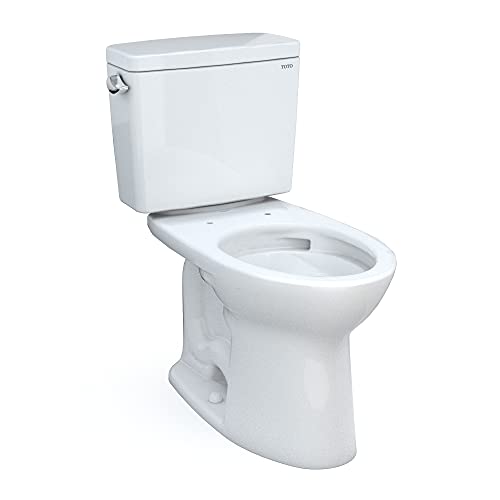
For most homes, 1.28 GPF is the sweet spot: the TOTO Drake at 1.28 GPF earns a perfect 1000 g MaP score and EPA WaterSense certification, meaning it flushes more waste per gallon than almost any 1.6 GPF toilet while saving a household roughly 4,000 gallons per year compared to a pre-1994 3.5 GPF model.
GPF (gallons per flush) is stamped on every toilet tank sold in the United States, yet most buyers glance past it. That number controls how much water your household sends down the drain every day, whether your local utility will pay you a rebate to replace your old toilet, and in some cases whether your toilet will flush reliably or leave you reaching for a plunger. The difference between a 1.6 GPF toilet and a 1.28 GPF model may sound trivial, but at typical household usage of five flushes per person per day it works out to roughly 2,000 gallons per person per year. That is real money and a meaningful environmental footprint.
Federal law mandated a maximum of 1.6 GPF for new toilets starting in 1994, replacing the 3.5 to 7 GPF fixtures common before that date. EPA WaterSense set a tighter standard of 1.28 GPF (or less) in 2006, and manufacturers responded with high-efficiency toilet (HET) models that achieve better flush performance at the lower water volume by redesigning trapways, flush valves and bowl geometry. For a broader look at which specific models score highest on MaP testing and owner reviews, see our ranked guide to the best flushing toilets.
Not all low-GPF toilets flush equally well. The Maximum Performance (MaP) testing program measures how many grams of solid waste a toilet removes in one flush. A score of 350 g is the published minimum for a passing grade; 800 g is considered good; 1000 g is the maximum score in the test protocol. The chart below maps each GPF tier to its legal status, EPA WaterSense eligibility and the range of MaP scores you should realistically expect.
| GPF Tier | Legal Status | EPA WaterSense | Typical MaP Range | Annual Gallons (5 flushes/day) | Notes |
|---|---|---|---|---|---|
| 3.5 GPF and above | Banned in new installs since 1994 | No | 800 to 1000 g (ample water) | 6,388 per person | Pre-law legacy fixtures; replacement strongly advised |
| 1.6 GPF | Federal maximum for new toilets | No | 350 to 1000 g (wide variation) | 2,920 per person | Standard since 1994; quality varies by model |
| 1.28 GPF | Legal everywhere; federally compliant | Yes (HET) | 600 to 1000 g (typically high) | 2,336 per person | Sweet spot; rebate eligible in most utility districts |
| 1.0 GPF | Legal everywhere | Yes (HET) | 500 to 800 g | 1,825 per person | Used in dual-flush full-flush mode; requires optimized trapway |
| 0.8 GPF | Legal everywhere | Yes (HET) | 350 to 600 g | 1,460 per person | Liquid-waste mode on dual-flush; clog risk rises on weak models |
| Dual Flush (0.8 / 1.28 GPF) | Legal everywhere | Yes if avg <= 1.28 | 700 to 1000 g (full flush) | Varies by use pattern | TOTO Aquia IV, Woodbridge T-0019; EPA-certified as a system |
The winning row at 1.28 GPF lands in the sweet spot for a reason. Federal law allows it, EPA WaterSense certifies it, and the engineering that went into bringing flush performance up to the old 1.6 GPF standard at lower water volume produced toilets that often outscore their water-hungry predecessors on the MaP test. The TOTO Drake II, Kohler Cimarron and American Standard Cadet 3 all achieve perfect 1000 g MaP scores at 1.28 GPF.
GPF stands for gallons per flush, and it measures the volume of water a toilet uses in a single flush cycle. The current US federal maximum is 1.6 GPF; the EPA WaterSense standard is 1.28 GPF or less. The lower the GPF number, the less water the toilet uses per flush. However, actual performance depends on whether the toilet's MaP flush-test score confirms it still removes waste effectively at that reduced volume.
Annual toilet water consumption depends on GPF and flush frequency. The EPA estimates the average person flushes a toilet about five times per day. Multiply that across a four-person household and the numbers become significant fast.
| GPF Rating | Flushes/Day (4-person home) | Annual Gallons | vs. 1.6 GPF (savings) | vs. 3.5 GPF (savings) |
|---|---|---|---|---|
| 3.5 GPF (pre-1994) | 20 | 25,550 | +14,310 more | n/a |
| 1.6 GPF (federal max) | 20 | 11,680 | baseline | Save 13,870 |
| 1.28 GPF (WaterSense) | 20 | 9,344 | Save 2,336 | Save 16,206 |
| 1.0 GPF | 20 | 7,300 | Save 4,380 | Save 18,250 |
| 0.8 GPF (liquid only) | 20 | 5,840 | Save 5,840 | Save 19,710 |
| Dual flush (avg 1.05) | 20 | 7,665 | Save approx 4,015 | Save approx 17,885 |
At average US residential water rates near $0.015 per gallon, a household switching from a 3.5 GPF pre-1994 toilet to a 1.28 GPF EPA WaterSense model saves roughly $243 per year in water costs before any utility rebate. Many municipal water districts add rebates of $50 to $200 per toilet for WaterSense-certified replacements; some, including utilities in California, Texas and the mid-Atlantic region, run specific replacement programs with higher incentives.
Replacing one 3.5 GPF pre-1994 toilet with a 1.28 GPF EPA WaterSense model saves approximately 16,200 gallons per year in a four-person household flushing 20 times daily. Even replacing a standard 1.6 GPF fixture from the 1990s or 2000s with a 1.28 GPF model saves about 2,300 gallons per household per year. At average US water rates this translates to roughly $35 to $50 in annual savings per toilet for the 1.6-to-1.28 switch, and over $200 for the pre-1994 replacement.
MaP testing is conducted by the National Research Council of Canada and administered by a consortium of water utilities and manufacturers. Each toilet is flushed with a standardized soybean-paste load in increments of 50 grams until the flush fails to remove the full load within a single flush cycle. The highest load successfully removed is the toilet's MaP score.
GPF and MaP are related but not the same. A high GPF means more water available per flush; a high MaP score means the toilet actually converts that water into reliable waste removal. Engineering factors (trapway diameter, flush valve speed, bowl geometry and rim wash coverage) determine how much of the water volume converts to flushing power. This is why a well-designed 1.28 GPF toilet like the TOTO Drake or Kohler Highline Comfort Height can outscore older 1.6 GPF models that waste water through poor bowl geometry.
| MaP Score | Performance Level | What It Means | Recommended For |
|---|---|---|---|
| Below 350 g | Fail | Does not meet minimum flush standard | Avoid |
| 350 to 499 g | Marginal | Passes minimum; clog risk in heavy-use homes | Light use, single occupant |
| 500 to 799 g | Good | Handles typical household waste reliably | Standard households |
| 800 to 999 g | Very Good | Strong performance, low clog incidence | Families, frequent use |
| 1000 g (Max tested) | Excellent | Removes the maximum MaP test load in one flush | Heavy use, clog-prone plumbing, families |
A good MaP score is 800 grams or higher, meaning the toilet removes 800 grams of solid waste in a single flush reliably. Scores of 1000 grams represent the maximum tested level and indicate a toilet capable of handling heavy household use without repeat flushing. Many high-efficiency 1.28 GPF toilets from TOTO, Kohler and American Standard earn 1000 g MaP scores, showing that low water volume and high flush performance are not mutually exclusive.
EPA WaterSense is a voluntary labeling program launched in 2006, modeled after the Energy Star program for appliances. A toilet earns the WaterSense label by meeting two published criteria: the flush volume must not exceed 1.28 GPF (for single-flush models), and the toilet must achieve a minimum MaP score of 350 grams. Dual-flush toilets qualify if their weighted average flush volume (using a 1:2 ratio of full-flush to partial-flush cycles) stays at or below 1.28 GPF.
WaterSense certification matters beyond the label itself. Most US municipal utility rebate programs restrict eligibility to WaterSense-certified toilets. The EPA publishes a searchable list of certified models at epa.gov/watersense, which lists thousands of qualifying toilets from every major manufacturer. The TOTO Drake, Drake II, UltraMax II and Aquia IV all carry WaterSense certification. Kohler's Cimarron, Highline Comfort Height and Santa Rosa do as well. American Standard's Cadet 3 and Cadet Pro lines are WaterSense certified, while the older Champion 4 at 1.6 GPF does not qualify. For a deeper comparison of toilet efficiency certifications alongside buying criteria, see our complete toilet buying guide.
EPA WaterSense certification requires a toilet to use 1.28 gallons per flush or less (for single-flush models) while achieving a minimum MaP flush-test score of 350 grams. Dual-flush toilets qualify based on a weighted average flush volume at or below 1.28 GPF. Earning the WaterSense label makes a toilet eligible for utility rebate programs in most US water districts, and qualifies the fixture for federal procurement preferences.
The short answer is no, not in well-designed modern toilets. The common concern that a 1.28 GPF toilet will clog more than a 1.6 GPF model is based on the early generation of high-efficiency toilets from the mid-2000s, which were essentially 1.6 GPF designs with less water and inadequate trapway or bowl geometry changes to compensate. Those early models did clog more frequently, and the reputation stuck.
Today's 1.28 GPF toilets from TOTO, Kohler and American Standard are purpose-built for the lower water volume. TOTO's Double Cyclone and Tornado Flush technologies create a high-velocity centrifugal rinse using two or three nozzles rather than a rim-fill approach, concentrating hydraulic energy at lower water volumes. Kohler's AquaPiston valve uses a gravity-fed canister design that opens 90 degrees to direct full tank pressure straight down, generating consistent flush power regardless of tank water level. The result: the TOTO Drake II at 1.28 GPF scores a perfect 1000 g MaP, identical to the Champion 4 at 1.6 GPF. For a detailed head-to-head on flush technologies across brands, see our analysis of how to choose a toilet.
If you are replacing a 1.6 GPF toilet from the early 2000s with a 1.28 GPF WaterSense-certified model and worrying about flushing power, look at the MaP score, not the GPF number. Any toilet scoring 800 g or above at 1.28 GPF will match or beat what you have now. The TOTO Drake, Kohler Cimarron and American Standard Cadet 3 all hit 1000 g at 1.28 GPF with no performance penalty for the efficiency gain.
A well-designed 1.28 GPF toilet does not clog more than a 1.6 GPF toilet. Modern HET (high-efficiency toilet) designs compensate for lower water volume with wider trapways (at least 2 inches), optimized flush valves and bowl geometries engineered specifically for 1.28 GPF. The TOTO Drake, Kohler Highline and American Standard Cadet 3 all achieve perfect 1000 g MaP scores at 1.28 GPF, confirming that performance matches or exceeds many 1.6 GPF models. Early 2000s HET designs did have clog issues; current generation models from major brands do not.
Dual-flush toilets offer two flush volumes: a half-flush (typically 0.8 to 1.0 GPF) for liquid waste and a full flush (1.28 to 1.6 GPF) for solid waste. The EPA WaterSense certification for dual-flush models uses a weighted average based on a published assumption that two-thirds of flushes are partial and one-third are full. Under that formula, a toilet with a 0.8 GPF partial and a 1.6 GPF full flush averages 1.07 GPF, well within the 1.28 GPF WaterSense threshold.
In practice, water savings from dual-flush depend entirely on user behavior. If occupants consistently use the half-flush for liquid waste, the savings are real. If they default to the full flush for convenience, the average shifts toward the full-flush number. Dual-flush buttons are also a more common service call than standard flush handles; the tower mechanism requires periodic seal replacement. The TOTO Aquia IV (0.8 / 1.28 GPF) and Woodbridge T-0019 (0.8 / 1.6 GPF) are among the most reliable dual-flush designs based on aggregated owner feedback, but their long-term value depends on disciplined use of the half-flush. Our guide to one-piece vs two-piece toilets covers how dual-flush mechanisms relate to tank design in both configurations.
Choosing the correct GPF tier requires matching your water supply pressure, plumbing diameter and household usage patterns to the toilet's engineering. Below is a practical decision framework based on published specifications and plumbing norms.
| Your Situation | Recommended GPF | Why | Models to Consider | Check Price |
|---|---|---|---|---|
| Most homes, family use | 1.28 GPF | WaterSense certified, rebate eligible, top MaP scores available | TOTO Drake, Kohler Cimarron, American Standard Cadet 3 | Check price |
| Heavy-use home, large family | 1.28 GPF with 1000 g MaP | Full flush power at efficient volume; no compromise needed | TOTO UltraMax II, Kohler Highline | Check price |
| Old plumbing, slow drains | 1.6 GPF, wide trapway | More water volume helps push waste through undersized or scaled pipes | American Standard Champion 4, Gerber Avalanche | Check price |
| Maximum water savings | Dual flush 0.8 / 1.28 GPF | Lowest average GPF if half-flush is used consistently | TOTO Aquia IV, TOTO Vespin II | Check price |
| Utility rebate target | 1.28 GPF WaterSense certified | Certification is required for virtually all utility rebate programs | Any WaterSense-labeled model | Check price |
| Low water pressure (under 30 psi) | 1.6 GPF gravity flush | More water compensates for pressure deficit; pressure-assist needs 25+ psi | Kohler Highline 1.6 GPF, Gerber Viper | Check price |
| RV or low-flow building | 0.8 to 1.0 GPF | Tank or gray-water system requires absolute minimum water use | Swiss Madison St. Tropez, Woodbridge T-0001 | Check price |
Old plumbing clogs more easily with low-flow toilets not because of the GPF number but because reduced drain velocity in undersized or partially blocked pipes cannot carry waste as far per flush. If your home has galvanized steel or cast iron drain lines that have not been serviced in ten or more years, address the drain condition before switching to 1.28 GPF. Once the drain is clean, 1.28 GPF with a wide trapway will perform fine. If the drain stays slow, stick with 1.6 GPF and plan the drain service for a future project.
The three picks below represent the best-documented options at the most important GPF levels, based on published MaP testing data, EPA WaterSense records and aggregated owner feedback.
The TOTO Drake II combines a 1.28 GPF Double Cyclone flush system with a perfect 1000 g MaP score and EPA WaterSense certification, making it the most well-documented high-efficiency toilet in its price range.
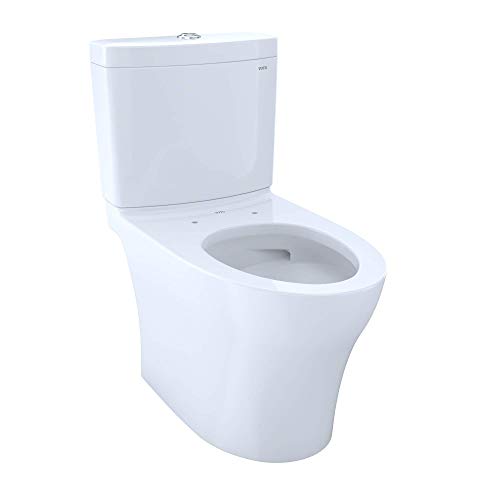
Check price on AmazonThe Aquia IV offers a 0.8 / 1.28 GPF dual-flush system with TOTO's Tornado Flush technology, reaching a 1000 g MaP score on the full flush and WaterSense certification on the weighted average.
Check price on AmazonThe Kohler Cimarron uses an AquaPiston canister valve that opens to a full 90 degrees, generating a 1000 g MaP score at 1.28 GPF and EPA WaterSense certification -- consistently one of the best-selling toilets in North America based on retail volume data.
Check price on AmazonPressure-assist toilets use a sealed pressure vessel inside the tank that stores compressed air. When the flush handle is activated, pressurized water (not gravity alone) drives the flush. This allows pressure-assist models to achieve strong flush performance at low GPF ratings with smaller, more controlled water volumes.
Pressure-assist toilets typically operate at 1.1 to 1.6 GPF. The Gerber Avalanche and Gerber Viper use a 1.28 GPF pressure-assist design that achieves a 1000 g MaP score. American Standard's Cadet 3 Pressure Assist achieves similar results. The tradeoffs: pressure-assist toilets are noisier (a distinct whoosh on each flush), cost more to service, and require a household water supply pressure of at least 25 psi to function properly. Below 25 psi, the pressure vessel may not charge fully and flush performance degrades. For well-pumped or low-pressure systems, standard gravity-flush at 1.6 GPF typically outperforms pressure-assist in practice. Our comparison of round vs elongated toilet bowls includes pressure-assist options in the context of bowl-shape choices.
Manufacturer specification sheets list GPF, MaP test results, certifications and trap diameter on the same page. Knowing what to look for prevents buying a toilet that does not fit your home or meet local rebate requirements.
GPF listed on the tank label is the tested flush volume under normal operating conditions. For dual-flush models, both the partial and full volumes are listed (e.g., "0.8 / 1.28 GPF"). The EPA WaterSense number for dual-flush certification is the weighted average, not the full-flush volume.
Trap (trapway) diameter appears in the specifications as a minimum diameter measurement. A 2-inch minimum trapway is the standard for 1.28 GPF HET models; some models like the American Standard Champion 4 specify a 2.375-inch glazed trapway, the largest in mainstream production. Wider trapways carry more bulk per flush regardless of GPF, which is why the Champion 4 at 1.6 GPF earns a 1000 g MaP score despite not carrying WaterSense certification.
Rough-in distance is not related to GPF but is the most common spec that causes a return. Standard rough-in in the US is 12 inches (center of drain to finished wall). Older homes may have 10-inch or 14-inch rough-ins. Confirm your rough-in measurement before ordering any toilet regardless of GPF rating.
When comparing GPF across brands, never stop at the water-use number. Pull the published MaP score for the exact model and flush volume you are buying. A 1.28 GPF toilet with a 500 g MaP score will clog far more frequently in a family of four than a 1.6 GPF model with a 1000 g MaP score. The Gerber Viper at 1.28 GPF scores 1000 g MaP; the Woodbridge T-0001 at 1.28 GPF scores around 800 g. Both carry WaterSense labels, but their real-world clog resistance differs. MaP is the tiebreaker that GPF alone cannot be.
GPF stands for gallons per flush. It measures how many gallons of water the toilet uses in a single flush cycle. The number is required by federal law to appear on the toilet tank or packaging. Lower GPF means less water per flush, but flush effectiveness depends on the toilet's engineering, not just the volume number.
The federal maximum is 1.6 GPF for all new toilets sold since January 1, 1994. The EPA WaterSense standard is 1.28 GPF or less, which qualifies as a high-efficiency toilet (HET). Some states, including California and Texas, have adopted stricter water codes that favor or mandate 1.28 GPF in new construction and renovations.
Yes, for any WaterSense-certified toilet from a major brand. The EPA WaterSense program requires a minimum MaP score of 350 grams, and the best 1.28 GPF toilets from TOTO, Kohler and American Standard achieve the maximum tested score of 1000 grams. Flush performance at 1.28 GPF is governed by trapway size, flush valve design and bowl geometry rather than water volume alone.
EPA WaterSense toilets use 1.28 GPF or less for single-flush models. Dual-flush models qualify if their weighted average (calculated as two partial flushes for every one full flush) comes to 1.28 GPF or below. The WaterSense label also requires a minimum MaP flush-test score of 350 grams to confirm real-world performance.
At the EPA's estimated five flushes per person per day, one person using a 1.28 GPF toilet uses 6.4 gallons of toilet water daily. A four-person household uses about 25.6 gallons per day, or 9,344 gallons per year. Compare that to a pre-1994 3.5 GPF toilet at 25,550 gallons per year for the same four-person household.
Many US water utilities offer rebates for replacing any toilet with a WaterSense-certified 1.28 GPF or lower model, even if the existing toilet is a 1.6 GPF fixture rather than a pre-1994 model. Rebate amounts vary by utility district, ranging from $50 to $200 per toilet. Search your water utility's website or the EPA WaterSense rebate finder for your area's current program details.
MaP (Maximum Performance) testing measures how many grams of solid waste a toilet removes in a single flush, using a standardized soybean-paste analog. It is conducted by the National Research Council of Canada and widely cited by utilities, installers and the EPA. MaP is the flush-performance complement to GPF: GPF measures water use efficiency, MaP measures what the toilet does with that water. A toilet needs a high score on both to be genuinely efficient and reliable.
For a typical household, aim for a MaP score of 800 grams or higher. Scores of 1000 grams (the maximum tested) indicate a toilet capable of handling heavy use without repeat flushing. Scores below 500 grams pass the minimum standard but carry meaningful clog risk in homes with more than one occupant or existing drain issues. Many 1.28 GPF toilets from TOTO, Kohler and American Standard achieve 1000 g MaP scores.
Not necessarily. Higher GPF provides more water volume per flush, but flush performance also depends on flush valve speed, trapway diameter, bowl shape and rim wash coverage. A 1.28 GPF TOTO Drake or Kohler Cimarron with a well-designed flush system can score 1000 g on the MaP test, matching or beating poorly designed 1.6 GPF models that score 500 to 600 g. Buy by MaP score first, then use GPF to compare efficiency among high-scoring models.
The lowest GPF in mainstream residential toilets is 0.8 GPF, typically found as the liquid-waste flush on dual-flush models like the TOTO Aquia IV (0.8 / 1.28 GPF) and Woodbridge T-0019 (0.8 / 1.6 GPF). Composting toilets and some marine / RV toilets use less water or no water, but they are not standard plumbed fixtures. For standard residential plumbing, 0.8 GPF is the practical floor for reliable waste removal.
It can be, in specific situations. Old galvanized or cast iron drain lines with partial scaling or undersized diameter benefit from the higher water volume of a 1.6 GPF flush to carry waste through to the main sewer line. The American Standard Champion 4 at 1.6 GPF with its 2.375-inch glazed trapway is the most commonly recommended model for older plumbing systems. That said, servicing the drain is the root-cause solution; a 1.6 GPF toilet is a workaround, not a fix.
Check inside the tank lid, where most manufacturers stamp the GPF (and sometimes the model number and date of manufacture) on the porcelain. You can also look on the back of the toilet bowl near the floor for a model number, then search the manufacturer's website for the spec sheet. Toilets made before 1994 are almost certainly 3.5 GPF or higher; those made between 1994 and 2005 are typically 1.6 GPF; post-2010 models from major brands are commonly 1.28 GPF.
Yes. California's plumbing code (California Green Building Standards Code, Title 24) requires a maximum of 1.28 GPF for residential toilets in new construction and major renovations. The 1.28 GPF WaterSense standard exceeds California's requirement and covers compliant installation statewide. Some California utilities also offer their own rebate programs layered on top of the statewide code requirement.
TOTO's 1.28 GPF single-flush models include the Drake, Drake II, UltraMax II, Carlyle II and Entrada. All five are EPA WaterSense certified and achieve 1000 g MaP scores. Dual-flush TOTO models include the Aquia IV (0.8 / 1.28 GPF) and Vespin II (0.8 / 1.28 GPF). The TOTO Entrada is the most affordable 1.28 GPF entry in the lineup; the UltraMax II and Carlyle II are one-piece options at the same water volume.
Kohler's WaterSense-certified 1.28 GPF models include the Highline Comfort Height, Cimarron, Santa Rosa and Memoirs. All use Kohler's AquaPiston canister valve and achieve 1000 g MaP scores. The Kohler Highline Classic (1.28 GPF version) is the standard-height option in the Highline line. The Corbelle is Kohler's one-piece 1.28 GPF offering. Note that the Kohler Highline is also available in a 1.6 GPF version; confirm the spec sheet when ordering.
American Standard's current lineup spans both 1.6 GPF and 1.28 GPF. The Champion 4 is rated at 1.6 GPF with a 2.375-inch glazed trapway and a 1000 g MaP score (strong, but not WaterSense certified). The Cadet 3 and Cadet Pro are available at 1.28 GPF with WaterSense certification and 1000 g MaP scores. The H2Option (0.92 / 1.28 GPF) and Optum VorMax (1.28 GPF) are additional WaterSense-certified options in the line.
They can, but the savings depend on consistent use of the partial flush for liquid waste. Studies on actual household behavior show that many users default to the full flush for all waste types, which eliminates most of the intended savings. If the household regularly uses the 0.8 GPF partial flush for liquid-only waste, the effective average GPF drops significantly below 1.28 GPF. If the full flush is used most of the time, actual average use approaches 1.28 to 1.6 GPF depending on the model.
The Woodbridge T-0001 is a single-flush 1.28 GPF model; the T-0019 is a dual-flush model at 0.8 / 1.6 GPF. Both are popular in mid-range one-piece categories. The T-0001 carries EPA WaterSense certification. MaP scores for Woodbridge models are generally in the 700 to 800 g range, placing them solidly in the "very good" tier but below the 1000 g scores of top TOTO and Kohler models. The design and finish quality relative to cost position Woodbridge as a value alternative to TOTO's mid-range lineup.
Not meaningfully, and not through an official certification path. Some owners place a water displacement device (a filled bottle or brick) in the tank to reduce flush volume, but this also reduces flush pressure and typically increases clog frequency. EPA WaterSense certification is model-specific and based on the full engineered system; modifying tank volume on an existing 1.6 GPF toilet does not produce a WaterSense-equivalent result. Replacement with a purpose-built 1.28 GPF model is the only reliable path to both water savings and clog-resistant performance.
For most homeowners the answer is yes, particularly if the existing toilet is pre-2010. The water savings are documented, the top 1.28 GPF models match or exceed 1.6 GPF performance on the MaP test, utility rebates offset a portion of the fixture cost, and modern 1.28 GPF toilets from TOTO, Kohler and American Standard carry one-year to limited lifetime warranties. The return on investment varies by local water rates and utility rebate availability, but for a family of four the payback period is typically three to seven years on the toilet cost alone, before accounting for the rebate.
For the vast majority of US households, 1.28 GPF is the right GPF rating in 2026: it qualifies for EPA WaterSense certification and utility rebates, delivers documented water savings of 2,000 to 16,000 gallons per year depending on what you are replacing, and the best models (TOTO Drake II, Kohler Cimarron, American Standard Cadet 3) achieve the maximum 1000 g MaP flush-test score with no compromise on performance. Only households with old, undersized drain lines or low water supply pressure (under 25 psi) should favor 1.6 GPF, and even those should treat drain servicing as the real long-term fix. If you want maximum water savings and are willing to use the partial flush consistently, a dual-flush model at 0.8 / 1.28 GPF like the TOTO Aquia IV extends the efficiency further without sacrificing the full-flush power you need when you need it.
When you flush, where does it go? Follow toilet water from the bowl through the trap, drain, and stack to a septic…
Read the guideDo toilets need electricity to flush? Most do not. Learn which toilets use power, how a standard flush works, and how to…
Read the guideFind out how many gallons per flush an old toilet really uses, how to check your own tank, and how much water…
Read the guide