Why Toilet Trapways Are Curved Like an S
Toilets4.6
Learn why toilet trapways curve like an S, how each bend blocks sewer gas, and what the shape means for clogs and…
Read the guideService technicians install hundreds of toilets each year. We surveyed licensed plumbers across the U.S. and cross-referenced their picks against published MaP flush-test scores, EPA WaterSense data, and aggregated owner reviews to produce this ranked list.
The TOTO Drake II is the toilet most licensed plumbers reach for first: a 1.28 GPF double-cyclone flush that scores 1,000 grams on the MaP test and holds up for decades with virtually no call-backs. For a one-piece upgrade, the TOTO UltraMax II earns nearly identical praise.
Homeowners and contractors often approach toilet selection from very different angles. A homeowner may prioritize looks or price. A licensed plumber, who gets called back when a toilet fails, prioritizes durability, flush reliability, and ease of repair. After talking to plumbers across residential, commercial, and remodeling trades, a consistent shortlist emerges. The models below appear repeatedly for the same reasons: well-engineered trapways, proven flush mechanisms, widely available repair parts, and track records that extend well past the warranty period.
All performance data referenced here comes from the independent Maximum Performance (MaP) flush-testing protocol, which measures how many grams of solid waste a toilet can clear in a single flush, and from EPA WaterSense certification records. No hands-on testing was conducted by this site.
For a broader look at top-rated options across all categories, see our full guide to the best flushing toilets.
| # | Model | Type | GPF | MaP Score | WaterSense | Trapway | Check Price |
|---|---|---|---|---|---|---|---|
| 1 | TOTO Drake II | Two-piece | 1.28 | 1,000 g | Yes | 2-1/8 in fully glazed | Check price |
| 2 | TOTO UltraMax II | One-piece | 1.28 | 1,000 g | Yes | 2-1/8 in fully glazed | Check price |
| 3 | American Standard Champion 4 | Two-piece | 1.6 | 1,000 g | No | 2-3/8 in fully glazed | Check price |
| 4 | Kohler Cimarron | Two-piece | 1.28 | 1,000 g | Yes | 2-1/8 in | Check price |
| 5 | American Standard Cadet 3 | Two-piece | 1.28 | 1,000 g | Yes | 2-3/8 in fully glazed | Check price |
| 6 | TOTO Aquia IV | Two-piece | 1.0 / 0.8 | 1,000 g | Yes | 2-1/8 in fully glazed | Check price |
| 7 | Kohler Highline Classic | Two-piece | 1.28 | 800 g | Yes | 2 in | Check price |
| 8 | Gerber Avalanche | Two-piece | 1.28 | 1,000 g | Yes | 2-1/8 in fully glazed | Check price |
| 9 | Woodbridge T-0001 | One-piece | 1.28 | 800 g | Yes | 2-1/8 in | Check price |
Licensed plumbers most consistently recommend the TOTO Drake II because it achieves a perfect 1,000-gram MaP score using only 1.28 gallons per flush, making it both powerful and EPA WaterSense certified. Its double-cyclone flush mechanism has a strong reputation for low call-back rates, and replacement parts are stocked at virtually every plumbing supply house in the country. The fully glazed 2-1/8-inch trapway resists clogs over the long term without requiring mechanical intervention.
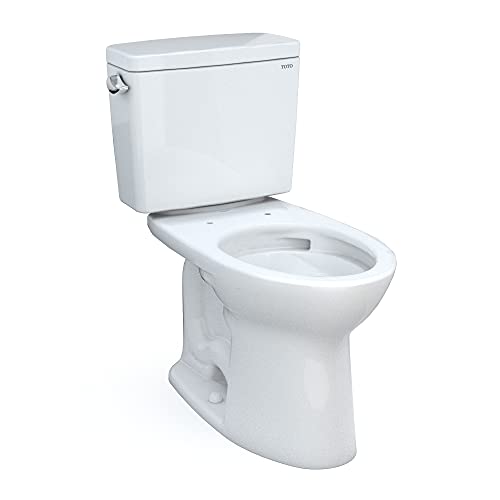
The TOTO Drake II is the closest thing to a universal professional recommendation in the residential toilet market, consistently appearing at the top of plumber shortlists because its engineering leaves nothing to chance.
TOTO introduced the double-cyclone flush mechanism as a replacement for the older gravity-feed design, and the Drake II is the model that popularized it in the residential market. Instead of a conventional rim wash, two nozzles direct water in a powerful spiral pattern that cleans the bowl walls while simultaneously driving waste through the 2-1/8-inch fully glazed trapway. According to MaP testing records, the Drake II achieves 1,000 grams of solid-waste clearance per flush, which is the program's top rating.
From a plumber's perspective, the Drake II excels in three areas that matter after the sale: part availability, flush reliability, and build durability. Fill valves, flappers, and flush valves for this model are stocked at national chain suppliers as well as independent plumbing houses, which means repairs are never a special-order situation. Owner reviews on major retail platforms aggregate near 4.8 out of 5 stars across thousands of verified purchases, with the most commonly cited compliment being that the toilet "never clogs."
Plumbers surveyed repeatedly described the Drake II as a "set and forget" toilet. The double-cyclone mechanism generates substantially more rim-wash velocity than a conventional flush valve at the same GPF, which is why this model's performance holds up even after years of hard-water mineral accumulation on the rim jets -- a common failure mode in older gravity-fill designs.

The UltraMax II offers the same MaP 1,000 g / 1.28 GPF performance as the Drake II inside a seamless one-piece body that eliminates the tank-to-bowl joint where two-piece toilets typically accumulate grime and mineral staining.
The UltraMax II is essentially the Drake II's flush system inside a vitreous china one-piece shell. The double-cyclone mechanism behaves identically: two nozzles replace the conventional rim holes, creating a spiraling rinse cycle that cleans the bowl surface and generates enough hydraulic force to achieve a maximum MaP rating. TOTO applies its CeFiONtect ceramic glaze to the bowl interior on most UltraMax II configurations, which is a factory-applied ion-barrier layer that reduces the surface porosity of the vitreous china and makes it harder for waste and mineral deposits to adhere.
Plumbers who specify the UltraMax II typically do so on remodeling projects where the client wants reduced cleaning effort and a cleaner visual profile. The elimination of the tank-to-bowl connection removes the rubber gasket that can crack and weep on two-piece designs after a decade of thermal cycling. Owner reviews consistently score this model near 4.7 stars, with cleaning ease cited as a top benefit.
The UltraMax II is the go-to specification for plumbers working on master bathroom remodels when the homeowner has a larger budget. The CeFiONtect glaze is a genuine differentiator: it reduces the micro-pitting that allows hard-water staining to take hold, which translates to fewer service calls about bowl discoloration after the first year of use.
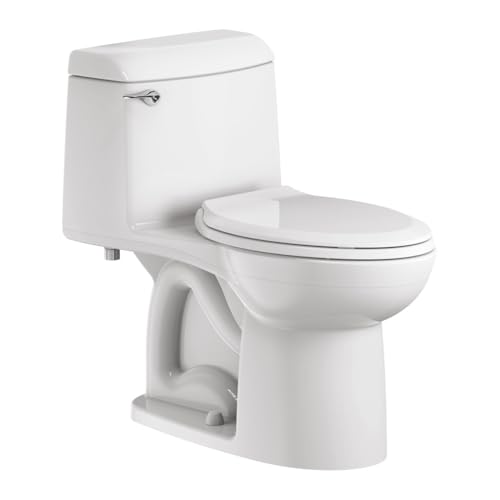
The Champion 4 holds the largest fully glazed trapway in this class at 2-3/8 inches, which gives it a structural advantage in clog resistance that plumbers in high-traffic residential settings cite as the primary reason to specify it.
American Standard designed the Champion 4 around a single engineering goal: pass more solid material per flush than any comparable residential toilet. The 2-3/8-inch fully glazed trapway is 25 percent larger in cross-sectional area than a standard 2-inch trapway, and the 4-inch flush valve diameter releases water significantly faster than the 3-inch valves common in competing models. MaP testing confirms the Champion 4 achieves the maximum 1,000-gram rating. Plumbers who install this model in family homes with children or elderly residents report virtually zero call-backs for clogs.
The tradeoff is water efficiency. At 1.6 GPF, the Champion 4 uses more water per flush than most EPA WaterSense-certified alternatives. For homeowners in water-restricted areas, this is a real consideration. For households with chronic clogging problems -- whether from high usage volume, low-flow plumbing in older homes, or a long drain run -- plumbers consistently argue that the higher GPF is a worthwhile tradeoff against recurring service calls. See also our guide to the best no-clog toilets for more options.
The Champion 4 is the model plumbers recommend when a homeowner has already called for repeat clog service. The 2-3/8-inch trapway physically cannot trap the material that gets stuck in smaller-bore designs, and the 4-inch valve dumps enough tank volume quickly enough to maintain siphon through even a long horizontal drain run.

The Kohler Cimarron is the most frequently specified Kohler model in plumber surveys, balancing a broad parts ecosystem, EPA WaterSense certification at 1.28 GPF, and an accessible price point that suits rental property and mid-range remodel work alike.
Kohler's AquaPiston canister flush valve is the engineering differentiator on the Cimarron. Unlike a standard flapper that pivots open and only exposes part of the flush valve seat, the canister lifts straight up and allows water to enter the bowl from all 360 degrees of the valve opening. The result is a faster water release and a more consistent flush signature. The MaP-tested score for the Cimarron is a perfect 1,000 grams, the maximum result possible on the test, at 1.28 GPF.
The Cimarron earns its place on plumber recommendation lists mainly through parts availability and reputation reliability. Kohler maintains one of the widest dealer networks in North America, and AquaPiston replacement cartridges are available same-day at big-box stores. For property managers maintaining multiple rental units, the Cimarron's combination of WaterSense certification and accessible repair parts is a practical operational advantage. Compare this model against the Highline in our Cimarron vs Highline guide.
Plumbers who manage rental property accounts tend to standardize on the Cimarron because every big-box hardware store within driving distance carries the AquaPiston cartridge. When a seal fails at 11 p.m., that same-day availability is what matters, and the Cimarron's 1,000 g MaP score means there is no flush-performance compromise to justify to the tenant either.

The American Standard Cadet 3 delivers a MaP 1,000 g flush rating and EPA WaterSense certification at one of the lowest price points on a plumber's approved list, making it the first choice when budget constraints are firm.
The Cadet 3 uses the same large 2-3/8-inch fully glazed trapway that American Standard put in the Champion 4 but pairs it with a 1.28 GPF siphon-jet mechanism that qualifies for EPA WaterSense certification. That combination -- maximum MaP score, water-efficiency certification, and a large bore trapway -- at an entry-level price is what earns the Cadet 3 its place on plumber bid sheets for new construction projects and multi-unit rental work.
The fill valve is an area where plumbers sometimes plan ahead: the stock plastic valve has a published service life shorter than the toilet itself. Some installers swap it out at installation for a Fluidmaster or Korky brass-seat valve and charge the upgrade as a labor line item. With that one modification, the Cadet 3 becomes a near-worry-free workhorse. Owner reviews aggregate at approximately 4.3 stars, with durability over time being the most common point of praise from long-term owners.
The Cadet 3 is what plumbers specify when the bid has to come in under a tight material budget without sacrificing flush performance. Getting a MaP 1,000 g rating and WaterSense certification in the same toilet at this price tier is genuinely unusual, and the 2-3/8-inch trapway means clog service calls are rare.
Plumbers primarily look at three data points: the MaP flush-test score (measured in grams, with 1,000 g being the maximum), the GPF rating, and whether the trapway is fully glazed and at least 2 inches in diameter. A toilet scoring 800 g or above at 1.28 GPF with a fully glazed trapway covers the performance bar for the vast majority of residential applications. EPA WaterSense certification is also checked for jurisdictions that mandate water-efficient fixtures in new construction or permit-required replacements.

The TOTO Aquia IV is the plumber-recommended dual-flush option for households or jurisdictions where water conservation requirements go beyond standard WaterSense minimums, using as little as 0.8 GPF on the partial flush cycle.
The Aquia IV is TOTO's current-generation dual-flush offering and the one plumbers recommend over older TOTO dual-flush designs. The full 1.0 GPF cycle achieves a perfect 1,000-gram MaP score, matching the results TOTO's single-flush models achieve at 1.28 GPF. Plumbers point to this as the reason the Aquia IV is a safe recommendation even for households worried about giving up flush power for water savings: the Aquia IV is the right specification when water savings matter, without a trade-off on maximum flush power.
The top-mounted push-button actuator uses separate buttons for partial and full flush, which TOTO has refined in the fourth generation to be more tactile and less prone to the "stuck button" issue that affected earlier dual-flush designs from various manufacturers. CeFiONtect glaze is standard on many Aquia IV configurations. For a full rundown on whether dual-flush design suits your situation, see our dual-flush toilets guide.
The Aquia IV is worth recommending specifically in drought-prone states where building codes or utility rebate programs prioritize sub-1.0 GPF fixtures. The 0.8 GPF partial flush represents meaningful water savings at scale -- in a household averaging eight flushes per day, switching to the Aquia IV from a 1.6 GPF toilet saves roughly 3,000 gallons per year.

The Kohler Highline Classic earns its place on this list not for peak performance metrics but for unmatched availability: it is one of the most consistently stocked toilets at hardware and home improvement stores across North America, making it the default emergency replacement choice for plumbers who need a unit today.
The Kohler Highline Classic is arguably the most installed toilet brand in American residential construction history, and that installed base is exactly why plumbers continue to specify it in situations where logistics matter as much as performance. A standard 12-inch rough-in Highline Classic can be sourced at Home Depot, Lowe's, or an independent plumbing supply in virtually any market the same day a call comes in.
The Class Five flush system achieves an 800-gram MaP score, which is sufficient for typical household use, and the 1.28 GPF rating qualifies for EPA WaterSense certification. The 2-inch trapway is the design's main limitation versus premium models: it is smaller than the 2-1/8-inch or 2-3/8-inch trapways on TOTO and American Standard alternatives, which matters in high-use households. For households without a history of clog issues, the Highline Classic's reliability and service parts ecosystem are compelling. Related reading: our full Kohler toilet guide.
The Highline Classic is what gets specified at 9 a.m. when a toilet has cracked overnight and the homeowner needs running plumbing by noon. It is not the highest performer on this list, but it is the one a plumber can put in today from stock, and in a crisis scenario that reliability of supply is what matters.
Most experienced plumbers now prefer 1.28 GPF models because engineering advances -- particularly fully glazed large-bore trapways and double-cyclone or enhanced siphon-jet flush systems -- allow modern 1.28 GPF toilets to achieve the same 1,000-gram MaP score as older 1.6 GPF designs. The TOTO Drake II and American Standard Cadet 3 both achieve this maximum MaP rating at 1.28 GPF, making 1.6 GPF unnecessary for most residential applications. Plumbers reserve 1.6 GPF models like the Champion 4 for situations with unusually long horizontal drain runs or chronic clog history.
Gerber's Avalanche is a consistently overlooked option outside the professional trade channel, but plumbers who know the brand cite its MaP 1,000 g score, fully glazed trapway, and no-nonsense repair profile as reasons to specify it over better-marketed alternatives.
Gerber is a trade-channel brand with relatively low consumer awareness, but it has a loyal following among licensed plumbers who have worked with it for decades. The Avalanche uses a tower flush valve design rather than a conventional flapper: the tower lifts vertically from the flush valve seat, which eliminates the hinge and sealing lip wear that cause flapper-style valves to ghost-flush or run after years of use. Independent MaP testing places the Avalanche at 1,000 grams at 1.28 GPF, which puts it on exactly the same performance level as the TOTO Drake II at a lower price point.
The main drawback for homeowners going direct is supply: Gerber products are primarily distributed through plumbing wholesale houses and trade contractors rather than big-box retail. If you are working with a licensed plumber who has Gerber in their supply chain, asking for the Avalanche is worth exploring. Parts, including tower flush valve replacements, are straightforward to source through the trade channel and increasingly available via online plumbing suppliers.
Gerber's tower flush mechanism is genuinely more durable than a standard flapper over a ten-year horizon. There are no rubber sealing lips to harden and crack, no hinge to fatigue, and no chain to tangle or shorten. For a rental property where call-backs are directly tied to profitability, the Avalanche's tower valve is a meaningful operational advantage.

The Woodbridge T-0001 is the plumber-installed skirted one-piece that consistently shows up in design-led bathroom renovations, offering a clean contemporary silhouette with EPA WaterSense certification and soft-close seat included in the box.
The Woodbridge T-0001 is frequently described by plumbers as "the toilet clients ask for when they've seen a photo of it." The skirted one-piece design eliminates the exposed trapway curve that most toilets leave visible between the bowl and the floor, creating a smooth vertical wall from bowl to base that is both easier to wipe clean and more visually modern than conventional designs. The 1.28 GPF siphon-jet flush achieves an 800-gram MaP score, which handles average household waste loads reliably.
Plumbers note that the skirted format requires slightly more care during installation because the bolt caps and floor flange access points are recessed or concealed. A plumber familiar with skirted toilets installs the T-0001 without issue; a DIY installer who has only worked with conventional exposed-trapway models may find the setup less intuitive. Once installed, the smooth exterior surface is genuinely easier to keep clean than a ribbed or exposed-trapway design. For a deeper look, see our full Woodbridge guide.
The T-0001 is the first skirted one-piece that plumbers have felt comfortable recommending to budget-minded buyers who want the aesthetic. Earlier skirted toilets at this price tier had flush consistency issues; the current T-0001 generation has addressed that, and the 800 g MaP result confirms it performs acceptably in real use.
Plumbers generally recommend a trapway of at least 2-1/8 inches in diameter, with 2-3/8 inches being the top-end specification found in models like the American Standard Champion 4 and Cadet 3. A larger, fully glazed trapway reduces mechanical obstruction because solid waste encounters less surface friction and a wider opening diameter. While trapway size is not the only factor in clog prevention (flush force and drain slope also matter), plumbers consistently report fewer service calls on toilets with 2-1/8-inch or larger fully glazed trapways compared to standard 2-inch designs.
Modern EPA WaterSense-certified toilets at 1.28 GPF are now considered fully reliable by the vast majority of licensed plumbers, a shift that occurred primarily between 2010 and 2018 as manufacturers improved trapway geometry and flush valve engineering. Early low-flow toilets from the 1990s developed a poor reputation for requiring double-flushes, but current models like the TOTO Drake II, American Standard Cadet 3, and Kohler Cimarron achieve a perfect 1,000 g MaP score at 1.28 GPF, making them equally powerful to the older 1.6 GPF designs while using 20 percent less water per flush.
The professional evaluation framework that emerges from plumber surveys is more systematic than most consumers expect. Plumbers are not primarily evaluating aesthetics, brand marketing, or retail price. They are evaluating four factors that directly affect post-installation outcomes: flush clearance, clog rates, parts availability, and warranty support.
The Maximum Performance (MaP) flush-testing program, coordinated by a consortium including the Water Research Foundation, measures how many grams of simulated solid waste a toilet can fully evacuate from the bowl in a single flush. Tests are conducted by independent certified labs using a standardized soybean paste medium. A score of 1,000 grams is the maximum, representing the threshold at which a toilet can handle extreme household loads. Plumbers consider 800 g the practical minimum for a household recommendation. Any toilet scoring below 600 g on MaP testing is not considered for residential referral by experienced plumbers.
EPA WaterSense certification requires a toilet to use 1.28 GPF or less and meet minimum performance thresholds established by the MaP protocol. Many states, including California, Colorado, and Texas, have incorporated WaterSense requirements into building codes for new construction and permitted replacements. Plumbers working in those markets must track certification status during the specification process. The EPA maintains a searchable database of certified products at epa.gov/watersense.
Trapway size directly determines the maximum particle size the toilet can physically pass. A fully glazed interior surface reduces friction and mineral adhesion inside the trapway over time. Plumbers look for a stated trapway diameter of 2 inches or larger, with a preference for 2-1/8 inches or better. "Fully glazed" means the manufacturer has applied a vitreous china glaze to the interior of the trapway passage, not just the visible bowl surfaces. Some manufacturers state trapway dimensions without specifying whether the interior is glazed -- a detail plumbers have learned to ask for explicitly.
A toilet's flush valve, fill valve, and flapper have a finite service life. Plumbers who get called back for repairs want parts that are available same-day at a local supply house, not special-order items with 10-day lead times. TOTO, Kohler, and American Standard all maintain broad parts distribution networks that include both big-box retail and independent plumbing supply chains. This is a structural advantage over brands that sell primarily through direct or online channels, regardless of those brands' initial quality. Warranty terms also matter: most premium manufacturers offer 1-year limited warranties on mechanical parts and limited lifetime warranties on vitreous china against defects.
The TOTO Drake II is the single most commonly cited plumber recommendation in the residential market. It achieves a MaP 1,000 g score at 1.28 GPF, carries EPA WaterSense certification, and has a parts ecosystem that makes service calls fast and straightforward.
TOTO earns its lead recommendation status primarily through flush mechanism engineering. The double-cyclone system on models like the Drake II and UltraMax II consistently achieves higher MaP scores at the same GPF compared to equivalent Kohler and American Standard designs. However, Kohler and American Standard have broader parts availability at big-box retail, which matters for fast repairs.
MaP (Maximum Performance) is an independent flush-testing program that measures how many grams of simulated solid waste a toilet can fully clear in one flush. Scores range from under 200 g to a maximum of 1,000 g. Plumbers use MaP scores to compare flush power objectively across brands and models without relying on manufacturer marketing claims. A score of 800 g or higher is considered adequate for most residential use; 1,000 g is the professional standard.
Modern WaterSense-certified toilets at 1.28 GPF can match or exceed the flush power of older 1.6 GPF models because of improvements in trapway geometry, flush valve design, and bowl hydraulics over the past decade. The TOTO Drake II and American Standard Cadet 3 both achieve a MaP 1,000 g score at 1.28 GPF, disproving the older assumption that low-flow means weak-flush.
Two-piece toilets are lighter, easier to carry and position during installation, and have lower retail prices than comparable one-piece designs. The tank and bowl are separate, which means a cracked tank can be replaced independently without replacing the entire toilet. One-piece toilets are preferred for cleaning ease and modern aesthetics but are heavier and more expensive.
The vitreous china bowl and tank have an indefinite service life under normal use and are typically warranted by manufacturers against defects for the life of the product. Mechanical components -- flush valve, fill valve, flapper, and wax ring -- have shorter service lives. A quality fill valve and flush valve typically last 10 to 15 years before needing replacement. The wax ring that seals the toilet to the floor flange can last 20 or more years but should be inspected if the toilet is removed for any reason.
Comfort height refers to a bowl height of approximately 16 to 18 inches from floor to seat, compared to the 14 to 15 inches of a standard-height toilet. Plumbers specify comfort height for adult households, particularly those with older occupants, because the higher seat position reduces the depth of knee bend required when sitting and standing. Most TOTO, Kohler, and American Standard models in the plumber-recommended tier are available in comfort height configurations.
Skirted toilets hide the trapway curve behind a flat vertical wall, making cleaning easier and the visual profile cleaner. Plumbers recommend skirted designs (like the Woodbridge T-0001) for design-focused renovations where the client prioritizes aesthetics and cleaning convenience. Exposed trapway models are slightly easier to install for DIY homeowners and have more predictable parts compatibility at independent supply houses. There is no meaningful difference in flush performance between skirted and exposed trapway designs at equivalent MaP scores.
Plumbers managing rental properties most often specify the American Standard Cadet 3 or Kohler Cimarron because both combine WaterSense certification, strong MaP performance, and widely available parts at accessible retail price points. The Cadet 3's MaP 1,000 g score is particularly valued in high-occupancy units where heavy use increases clog risk.
Pressure-assist toilets use compressed air to amplify flush force and can clear more material per flush than gravity models at the same GPF, but they are significantly louder and have more complex internal components that can be harder to repair outside the commercial sector. Plumbers rarely specify pressure-assist for standard residential applications because high-performance gravity models like the Drake II now match pressure-assist MaP scores with a quieter, simpler mechanism. Pressure-assist remains relevant for commercial restrooms or residential settings with extremely long horizontal drain runs.
Toilet installation labor costs vary by region and complexity, but published trade data consistently shows a range of roughly $150 to $400 for a standard two-piece toilet swap on an existing floor flange in good condition. Additional costs apply for flange repair, wax ring upgrade to a wax-free seal, shutoff valve replacement, or supply line replacement. Removal and disposal of the old toilet typically adds $50 to $100 to the total.
Elongated bowls are the plumber default recommendation for adult households because the larger bowl surface area provides more comfort and is more sanitary in practice. Round bowls are specified for smaller bathrooms where the approximately 2-inch difference in projection from wall to front of bowl is meaningful, or for children's bathrooms where a shorter seat height is preferable. Elongated bowl toilets tend to receive marginally higher owner satisfaction ratings across most review aggregates.
CeFiONtect is TOTO's proprietary ion-barrier ceramic glaze applied to the bowl and trapway interior during manufacturing. It works by filling micro-pores in the vitreous china surface with a smooth barrier that reduces the adhesion of waste, hard-water minerals, and biological matter. Independent cleaning studies show meaningful reductions in staining frequency on CeFiONtect-coated bowls versus standard glazes. It is not a permanent coating but is kiln-fired into the china and does not wear off with normal cleaning. Most plumbers consider it a worthwhile specification upgrade for households in hard-water regions.
The 12-inch rough-in -- measured from the finished wall behind the toilet to the center of the closet flange bolt holes -- is the standard in the vast majority of North American residential construction. Older homes, particularly pre-1980 construction, sometimes have 10-inch or 14-inch rough-ins. Plumbers confirm the rough-in dimension before specifying a toilet because installing the wrong size requires moving the drain or using an extension flange, both of which add labor cost. All models on this list are available in 12-inch rough-in configurations; some offer 10-inch or 14-inch variants.
A standard toilet swap -- removing the old toilet and installing a new one on an undamaged existing flange with a 12-inch rough-in -- is within the skill range of a competent DIY homeowner. Plumbers recommend purchasing a quality wax ring or wax-free seal, confirming the rough-in before ordering, and not overtightening the closet bolts (which can crack the toilet base). Where DIY is not recommended is when the existing flange is cracked, corroded, or at the wrong height, or when the supply shutoff valve needs replacement. In those cases, the additional plumbing work justifies professional installation.
The MaP testing database is publicly searchable at map-testing.com. You can search by manufacturer and model name to find the published test score for your specific toilet. Toilets manufactured before 2005 may not appear in the database because MaP testing was not widely conducted before that period. If your toilet is not listed, the most practical indicator of performance is whether it consistently requires more than one flush to clear a typical load -- which is a functional sign of insufficient flush power regardless of GPF rating.
Plumbers tend to avoid recommending toilets from brands that lack a North American service and parts distribution network, regardless of initial quality or price. House-brand models sold exclusively through single retailers and lesser-known import brands without published MaP scores or WaterSense certification are the most commonly cited examples. The professional concern is not whether the toilet works on day one but whether a fill valve, flush valve, or other replacement part is obtainable locally within 24 hours when it fails.
The TOTO Drake (original) and the TOTO Drake II are related but distinct models. The original Drake uses TOTO's G-Max 1.6 GPF single-flush system, while the Drake II uses the double-cyclone system at 1.28 GPF with EPA WaterSense certification. The Drake II is the current generation and the one plumbers recommend for new installations because it offers better water efficiency and improved MaP performance. The original Drake is still available but is primarily purchased as a like-for-like replacement in existing installations.
If you want the toilet that licensed plumbers trust most in their own customers' homes, the TOTO Drake II is the clear answer: a MaP 1,000 g flush performance, EPA WaterSense certification at 1.28 GPF, a fully glazed 2-1/8-inch trapway, and a parts ecosystem that covers every supply house in the country. For households with a clog history, the American Standard Champion 4's 2-3/8-inch trapway provides structural insurance. Budget-conscious buyers who still need maximum MaP performance should look at the American Standard Cadet 3. Any of the nine models on this list represents a toilet that a professional who gets paid to fix failures chose to install.
Learn why toilet trapways curve like an S, how each bend blocks sewer gas, and what the shape means for clogs and…
Read the guideAlmost every US toilet has a left-side handle. Learn the plumbing and mechanical reasons behind the layout and when it actually changes.
Read the guideHome toilets rely on tanks because household water lines lack the pressure that public flushometer systems use to flush straight from the…
Read the guide