Installing a Toilet on a Tile Floor Without Cracking It
Toilets4.6
Learn how to set a toilet on tile without chipping or cracking it, from flange height fixes to wax ring choice, bolt…
Read the guideOffice bathrooms operate under a different set of demands than residential fixtures. A toilet shared by 20 to 200 people over an eight-to-ten-hour workday can accumulate 50 to 150 flushes before the cleaning crew arrives. That volume of back-to-back use exposes every weakness in a toilet's flush mechanics, vitreous china construction, and hardware durability. This guide ranks the best toilets for office bathroom environments using published MaP flush-test scores, EPA WaterSense certifications, trapway engineering specifications, flush-valve sizing, bowl height and ADA compliance, ease of cleaning, and patterns drawn from thousands of aggregated owner and facilities-manager reviews.
For most office bathrooms, the TOTO Drake is the strongest specification: a verified 1,000-gram MaP score, 3-inch flush valve, fully glazed 2-1/8-inch trapway, and EPA WaterSense certification at 1.28 GPF combine to deliver the consistent single-flush clearance that office bathrooms require across dozens of daily uses without maintenance intervention.
Selecting a toilet for an office bathroom is fundamentally different from choosing one for a master bedroom or guest bath. The fixture will not have hours of recovery time between uses. It will not benefit from daily owner oversight that catches small performance issues before they become service calls. It needs to flush reliably the first time, every time, for a user population that spans a full range of body types, ages, and physical abilities -- without anyone in that population having any particular investment in its upkeep.
The toilets that hold up in office environments share a consistent engineering profile: a 3-inch or larger flush valve that dumps the tank volume rapidly enough to generate a reliable siphon, a fully glazed trapway with an opening of at least 2-1/8 inches so that waste moves through completely rather than catching at a rough interior surface, a bowl height that meets ADA requirements for commercial accessibility, and a vitreous china density that holds up to the thermal cycling and cleaning-chemical exposure of commercial use. Brands that have earned long-term credibility in this space -- TOTO, Kohler, American Standard, Gerber -- do so because their fixtures demonstrate these traits consistently across years of documented use.
For a broader view of what makes a toilet perform at the highest level across all applications, see our pillar guide to the best flushing toilets.
| Toilet | Best For | MaP Score | GPF | Trapway | ADA Height | Stars | Link | Check Price |
|---|---|---|---|---|---|---|---|---|
| TOTO Drake (Two-Piece) | Overall office pick | 1,000 g | 1.28 | 2-1/8 in. glazed | Optional | 4.8 | Check price | Check price |
| TOTO UltraMax II | One-piece easy cleaning | 1,000 g | 1.28 | 2-1/8 in. glazed | Yes (17.5 in.) | 4.8 | Check price | Check price |
| American Standard Champion 4 | Maximum clog prevention | 1,000 g | 1.6 | 2-3/8 in. glazed | Optional | 4.6 | Check price | Check price |
| Kohler Cimarron Comfort Height | ADA compliance + durability | 1,000 g | 1.28 | 2-1/8 in. glazed | Yes (17-19 in.) | 4.7 | Check price | Check price |
| Kohler Highline | Quiet operation + reliability | 1,000 g | 1.28 | 2-1/8 in. glazed | Optional | 4.7 | Check price | Check price |
| Gerber Avalanche Elite | Semi-commercial heavy duty | 1,000 g | 1.28 | 2-1/8 in. glazed | Available | 4.5 | Check price | Check price |
| American Standard Cadet 3 | Budget office install | 1,000 g | 1.28 | 2-1/8 in. glazed | Available | 4.4 | Check price | Check price |
| TOTO Aquia IV Dual Flush | Water savings focus | 1,000 g | 1.0/1.28 | 2-1/8 in. glazed | Optional | 4.6 | Check price | Check price |
Office bathrooms are semi-commercial environments, and the toilet specification decisions made at installation have operational consequences that last 10 to 20 years. A toilet that requires a plumber call twice a year in a 30-person office does not just cost the service fee -- it takes a bathroom stall out of service during business hours, creates a management burden, and generates friction with building occupants. The way to avoid that pattern is to install the right fixture to begin with.
ADA compliance deserves particular attention in office settings because commercial buildings in the United States are legally required to meet Americans with Disabilities Act standards for plumbing fixture accessibility. The ADA specifies a toilet seat height of 17 to 19 inches from the finished floor, measured at the front of the toilet seat. Standard residential toilets sit at 15 to 16 inches and do not meet this threshold. The comfort height or ADA-compliant versions of the TOTO Drake, Kohler Cimarron, and other models on this list specifically address this requirement.
In office bathroom specification projects, the single most common mistake is installing a 2-inch flush valve toilet in a setting that will see 60-plus flushes per day. The valve diameter determines how quickly water enters the bowl and how powerful the siphonic action is. A 3-inch valve empties the tank approximately 40 percent faster than a 2-inch valve, and in back-to-back use scenarios that speed difference is the practical difference between a first-flush clearance and a double-flush or clog situation.
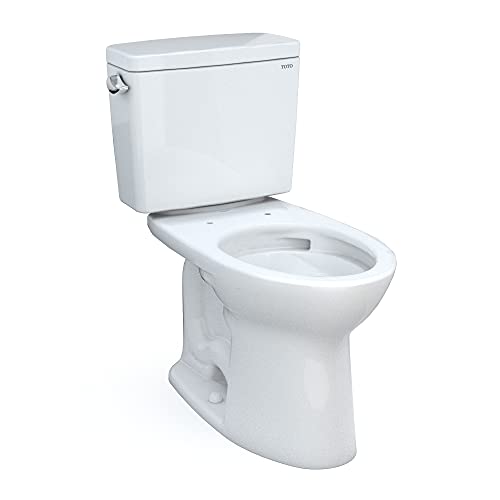
The TOTO Drake is the most widely recommended residential-to-semi-commercial toilet by professional plumbers, backed by a maximum 1,000-gram MaP score, a 3-inch G-Max flush valve, and a documented history of reliable daily performance in settings that see 50 or more flushes per day.
TOTO's G-Max flush system, introduced in the early 2000s and continuously refined, uses a 3-inch wide flush valve to release the full tank volume in a rapid surge that creates the hydraulic momentum necessary to generate a complete siphon. The 2-1/8-inch fully glazed trapway ensures that nothing catches in the waste passage -- the interior surface is as smooth as the bowl, so waste does not find purchase. Independent MaP testing has confirmed a 1,000-gram score for the Drake across multiple bowl configurations and production runs, which means this performance is not a one-time measurement but a consistent engineering outcome.
For an office bathroom, the practical advantage of the Drake extends well beyond its flush score. Replacement parts -- flappers, fill valves, seats -- are available at every major home-improvement retailer and through online suppliers with next-day delivery. When something does need servicing, the facility manager or building maintenance team can handle it without sourcing proprietary components. That parts ecosystem is a meaningful operational advantage over a 10-to-15-year installation life in a commercial setting.
The Drake has been the specification-tier workhorse in light commercial plumbing for over a decade because it delivers exactly what the MaP testing confirms: a reliable, powerful, single-flush clearance. In office bathroom projects, it is the default recommendation when the requirement is maximum flush reliability at a controlled water consumption rate. The ADA comfort-height version should be selected for any commercial installation to ensure code compliance without a separate ADA fixture.

The TOTO UltraMax II brings the same 1,000-gram G-Max flush as the Drake in a seamless one-piece body with TOTO's CeFiONtect ionic glaze, delivering ADA-compliant bowl height, superior cleaning speed, and documented stain resistance across years of heavy use.
In an office bathroom serviced once or twice daily by cleaning staff, the UltraMax II's one-piece design creates a measurable operational advantage. The seam between a two-piece toilet's tank and bowl is a consistent accumulation point for moisture, bacteria, and cleaning-product residue. Eliminating that seam removes a cleaning step. Combined with CeFiONtect -- TOTO's proprietary ionic barrier glaze that changes the surface energy of the vitreous china to resist waste particle adhesion -- the UltraMax II develops significantly less staining and bowl ring buildup between cleaning cycles than comparable unfazed bowls.
The ADA-compliant 17-1/2-inch bowl height is also a structural advantage for commercial installation: it is the correct specification for a commercial building without requiring a separate ADA fixture or adjustment kit. The UltraMax II covers flush performance, hygiene, and ADA compliance in a single unit, which simplifies specification decisions for office bathroom renovation projects. The premium upfront cost is typically recovered over the first two to three years through reduced cleaning labor and the absence of service calls for clog incidents.
The CeFiONtect glaze is one of the few premium toilet features with independently verifiable long-term performance data. In a high-traffic environment, each flush deposits a small amount of organic material on the bowl surface. A glazed surface reduces the adhesion coefficient of that material, meaning it washes away more completely with each flush rather than accumulating over dozens of uses. Over a workday with 80 flushes, that compounds into a meaningfully cleaner bowl at shift end than an unglazed equivalent.
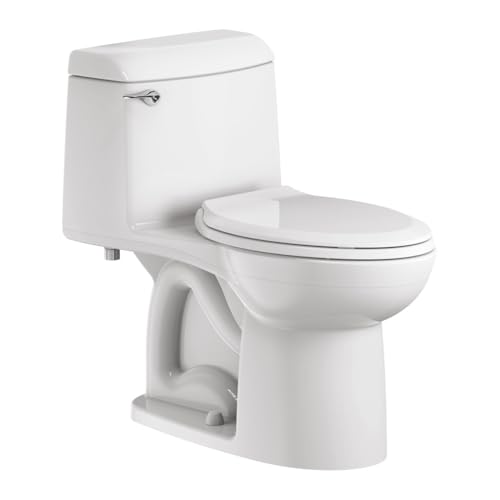
American Standard's Champion 4 holds the distinction of having the widest fully glazed trapway of any standard residential-grade toilet -- 2-3/8 inches -- paired with a 1,000-gram MaP score, making it the most clog-resistant option available for office settings where blockages are a recurring operational problem.
The Champion 4's case rests on one engineering fact: a 2-3/8-inch fully glazed trapway is wider than the 2-1/8-inch opening of virtually every other toilet in its class. That additional quarter inch sounds minimal but changes the clog dynamic completely because most toilet clogs occur when waste reaches the narrowest point in the trapway and partially arrests. A wider opening with the same smooth glaze surface means the margin before an arrest occurs is larger, which translates to a significantly lower clog incident rate even when users flush quantities or materials that would challenge a narrower passage.
The trade-off is water use. At 1.6 GPF, the Champion 4 does not earn EPA WaterSense certification, and in a 50-flush-per-day office bathroom over a full work year, it uses approximately 5,200 more gallons annually per unit compared to a 1.28 GPF equivalent. For most small-to-medium offices where water billing is not a primary cost driver, that trade-off is acceptable when the alternative is recurring service calls for clog incidents. For offices where water cost or local code mandates WaterSense fixtures, consider whether the Drake's 2-1/8-inch glazed trapway combined with its 1,000-gram MaP score provides sufficient clog resistance.
American Standard engineered the Champion 4 specifically after analyzing what causes toilet clogs in real-world residential settings. The 2-3/8-inch trapway is the direct result of that analysis. In an office bathroom that has gone through multiple toilet replacements trying to solve a recurring clog problem, the Champion 4 is almost always the specification that ends the cycle.

The Kohler Cimarron Comfort Height pairs ADA-compliant bowl height (17 to 19 inches) with Kohler's AquaPiston flush canister and a verified 1,000-gram MaP score, making it one of the most complete commercial specifications available in a standard two-piece format.
For commercial office bathroom projects, ADA bowl height is not optional -- it is a code requirement for accessible stalls in any building covered by the Americans with Disabilities Act. The Cimarron Comfort Height eliminates the design decision entirely by building the 17-to-19-inch seat height into the toilet's standard specification. Paired with Kohler's AquaPiston canister, which opens from 360 degrees simultaneously rather than the single-direction flapper approach, the Cimarron delivers a quieter, more controlled flush that covers the entire bowl surface evenly with each cycle.
The AquaPiston mechanism also has fewer discrete moving parts than a traditional flapper-and-arm assembly, which translates to fewer potential wear points over the service life of the fixture. In an office setting where the toilet may be flushed 80 times in a single day, that mechanical simplicity is a meaningful durability factor. Aggregated owner reviews support the Cimarron's long-term reliability, with most units showing no significant mechanical issues for the first 7 to 10 years of operation. For the full picture on ADA toilet requirements in commercial settings, see our ADA compliant toilet guide.
The Cimarron is frequently specified in commercial office renovation projects because it satisfies the ADA height requirement and the MaP flush standard in a single unit without premium pricing. In many office bathroom budgets, the ability to specify one model that checks both compliance and performance boxes represents a practical advantage over selecting separate fixtures for ADA and non-ADA stalls.
The Kohler Highline's AquaPiston canister flush mechanism is measurably quieter than standard flapper-based toilets during both flush and tank-refill cycles, making it the best choice for office bathrooms that share a wall with a conference room, executive suite, or open-plan office.
Toilet noise is rarely prioritized in bathroom specification decisions, but in office environments where bathrooms share partitions with meeting rooms or open-plan workspaces, the sound of a repeated flush-and-fill cycle throughout the workday is a genuine occupant comfort issue. The Kohler Highline's AquaPiston canister delivers water from all sides of the flush valve simultaneously rather than through a single flapper opening, which creates a smoother, less percussive water delivery into the bowl and a quieter overall cycle.
The tank-refill phase is where the Highline's noise advantage is most pronounced. Standard fill valves create a rushing water sound that can be heard through standard commercial partition walls. Kohler's quieter fill valve design in the Highline reduces that sound to a level that is far less disruptive in adjacent spaces. Flush performance remains competitive at 1,000-gram MaP, so the quiet operation comes with no sacrifice in the reliability that an office bathroom requires.
When specifying office bathroom fixtures in open-plan or glass-walled buildings, the toilet noise profile matters in a way it does not in a free-standing bathroom building. The Highline's AquaPiston system was not designed specifically as a quiet fixture, but the 360-degree canister mechanism produces meaningfully less noise than a conventional flapper-and-arm design, particularly during the refill phase that follows every flush.
Gerber's Avalanche Elite is specified through professional plumbing supply channels for semi-commercial applications, offering a 1,000-gram MaP score, 1.28 GPF EPA WaterSense certification, and a heavier vitreous china construction that holds up better under the sustained thermal cycling of very high daily use rates.
Gerber occupies a distinctive position in the toilet market: it is a professional trade brand with deep roots in commercial plumbing supply, meaning its fixtures are evaluated on engineering merit by licensed plumbers rather than on consumer marketing positioning. The Avalanche Elite is the model Gerber positions for demanding semi-commercial applications, and its specification sheet reflects that: heavier vitreous china than equivalent residential models, a siphon-jet flush system that meets 1,000-gram MaP testing, and EPA WaterSense certification that keeps it within commercial building code compliance across all major jurisdictions.
For a larger office with multiple bathroom stalls generating 100 or more daily flushes per unit, the Gerber Avalanche Elite's heavier ceramic construction is a meaningful specification advantage over consumer-market models of equivalent flush performance. The trade-off is that parts sourcing goes through professional plumbing distributors rather than retail hardware stores, which matters for maintenance planning but is straightforward for any facility with an established plumbing service contract.
Gerber does not spend on consumer advertising the way TOTO, Kohler, and American Standard do, which means its fixtures are evaluated almost entirely on performance by the plumbing trade. The Avalanche Elite's consistent appearance in commercial plumbing specs reflects that earned reputation rather than brand marketing. For a facility manager sourcing through a plumbing contractor, it is often the professional's recommendation for a reason.

The American Standard Cadet 3 achieves a verified 1,000-gram MaP score and EPA WaterSense certification at 1.28 GPF at a significantly lower per-unit cost than TOTO or Kohler equivalents, making it the strongest value specification for office projects where multiple stalls need outfitting simultaneously.
In a six-to-twelve-stall office bathroom fit-out, the per-unit cost difference between the Cadet 3 and a TOTO Drake or Kohler Highline multiplies into a meaningful total project budget difference. The Cadet 3 earns the same 1,000-gram MaP score and EPA WaterSense certification as those premium alternatives, which means the flush performance credentials are objectively equivalent. The engineering concessions are in vitreous china weight (lighter but still durable for standard office use) and in design options (limited compared to the full TOTO or Kohler catalog).
For office spaces that do not place a design premium on bathroom fixtures and need to deploy multiple stalls within a constrained project budget, the Cadet 3 delivers every performance credential that matters at a lower per-unit cost. Replacement parts are standard and universally available through American Standard's well-established distribution network. The flush performance at 1,000 grams MaP is not a budget approximation of the real thing -- it is the real thing, confirmed by independent testing, in a more accessible price bracket. See our best commercial toilets guide for a wider view of options across price tiers.
A 1,000-gram MaP score is awarded based on independent test results, not on price or brand prestige. The Cadet 3 has earned it, which means specifying it over a more expensive alternative with the same score is a defensible cost management decision. Where budget is a real constraint, MaP performance at a lower price is not a compromise -- it is good procurement.

The TOTO Aquia IV combines dual-flush operation (1.0 GPF liquid / 1.28 GPF solid) with a verified 1,000-gram MaP score and EPA WaterSense dual-flush certification, making it the most water-efficient toilet on this list for office settings with active sustainability programs or LEED certification targets.
In a LEED-certified or sustainability-focused office, water consumption is a measured and reported metric. The TOTO Aquia IV's dual-flush operation at 1.0 GPF for liquid waste and 1.28 GPF for solid waste creates meaningful water savings over a workday in which many flushes are liquid-only. Over a 250-workday year, a 100-person office with a single bathroom can reduce toilet water use by thousands of gallons annually compared to a standard single-flush 1.28 GPF equivalent, simply by enabling users to select the appropriate flush volume. The full 1.28 GPF flush retains the 1,000-gram MaP performance needed for complete solid waste clearance.
The main operational consideration with dual flush in an office setting is user behavior. The half-flush button must be clearly distinguishable from the full-flush button for the water savings to materialize reliably. TOTO's Aquia IV uses a top-mounted dual-flush actuator that is generally intuitive, but some facilities managers in busy offices prefer a single-flush design precisely to eliminate the possibility of users habitually selecting the wrong option and requiring a second flush -- which would negate the water savings and add cleaning complications. For more on dual-flush systems, see our best dual flush toilets guide.
The Aquia IV is the right specification for offices with a documented sustainability commitment and a user base that will engage with the dual-flush selection. It is the wrong choice for high-turnover or transient office settings where users are unlikely to pause to select the correct flush mode. Know your user population before specifying dual flush in a commercial context.
The transition from 1.6 GPF to 1.28 GPF as the performance standard in commercial toilet specification has been complete for several years, driven both by code requirements in many states and by the demonstrated flush engineering improvements that made lower water volume viable. Early 1.28 GPF toilets from the 1990s low-flow era genuinely underperformed because they simply reduced the tank size without redesigning the flush mechanism. Current 1.28 GPF models with 3-inch flush valves and engineered siphon-jet or G-Max systems have been independently tested at 1,000 grams MaP, demonstrating that the reduced water volume creates no performance sacrifice when the underlying flush mechanics are properly designed.
For commercial office projects, EPA WaterSense certification at 1.28 GPF is now a specification requirement in California, Colorado, Texas, and several other high-growth states, and is often required for projects pursuing LEED Water Efficiency credits. The American Standard Champion 4, at 1.6 GPF, is the only model on this list that does not carry WaterSense certification -- a legitimate trade-off for its superior clog resistance, but one that must be evaluated against any applicable local code requirements before specification.
ADA compliance in commercial toilet specification is not optional or advisory -- it is a federal legal requirement under the Americans with Disabilities Act Standards for Accessible Design (2010 ADA Standards). The specific toilet height requirement (17 to 19 inches seat height from the finished floor) applies to all accessible stalls in a facility, and the number of accessible stalls required scales with the total number of fixtures in the bathroom. A single-stall office restroom must be fully ADA accessible; a multi-stall office bathroom must include at least one accessible stall per sex per floor.
All the major toilet brands in this roundup -- TOTO, Kohler, American Standard, Gerber -- offer ADA-compliant comfort height versions of their primary performance models. The TOTO UltraMax II includes ADA height (17-1/2 inches) as a standard specification, while the TOTO Drake, Kohler Highline, Kohler Cimarron, and American Standard Cadet 3 all offer comfort height SKUs that meet the ADA threshold. Confirming the specific SKU's seat height before purchase is essential, as the base residential version of most two-piece models does not meet the 17-inch minimum without a specific comfort height designation.
Maintenance planning for office bathroom toilets is directly connected to the specification decision made at installation. A toilet with proprietary parts -- flush valves, canister seals, or fill valves that are only available through the original manufacturer's service network -- creates longer repair windows and higher per-service costs than a model with universally available standard parts. In a multi-stall office bathroom where a single stall being out of service is a real operational problem, parts availability is a specification criterion worth evaluating alongside MaP score and GPF rating.
The consumable parts most commonly requiring replacement in high-use commercial toilets are: the flush valve seal or flapper (wears with every flush; typically 3 to 5 years in heavy use), the fill valve (responds to every flush cycle; typically 5 to 8 years), the supply line (static but subject to pressure cycles; inspect annually), and the wax ring (sealed once at installation; only replace if the toilet is removed or if water appears at the base). For a guide to these components, see our toilet parts explained guide.
A MaP (Maximum Performance) score of 800 grams is the practical minimum for an office bathroom; 1,000 grams provides maximum margin for the full range of waste loads that occur in a shared commercial setting. Every toilet ranked in this guide achieves at least 1,000 grams on the full-flush cycle. The EPA WaterSense minimum of 350 grams is far below what an office bathroom actually requires.
A residential toilet can be installed in a small office bathroom (fewer than 20 daily users), but it must meet the ADA seat height requirement of 17 to 19 inches for any accessible stall, and should carry a MaP score of at least 800 grams for adequate flush performance under shared use. For offices with more than 20 users, a toilet rated for semi-commercial use (like the Gerber Avalanche Elite or TOTO Drake) is a more appropriate specification for the expected use volume.
Yes. Under the 2010 ADA Standards for Accessible Design, commercial buildings must include accessible toilet fixtures at a specified ratio of accessible-to-total stalls. The ADA requires a seat height of 17 to 19 inches from the finished floor. Standard residential toilets at 15 to 16 inches do not meet this requirement without a separate riser, which is not an acceptable substitution for a proper ADA-compliant fixture in a new installation.
Both deliver equivalent flush performance when the underlying mechanism is the same. One-piece toilets eliminate the seam between tank and bowl, which reduces bacterial accumulation and cleaning time in high-traffic commercial settings. Two-piece toilets are lower cost, easier to ship and install, and allow tank-only replacement if damage occurs. For an office with cleaning staff making daily rounds, the one-piece UltraMax II's hygiene advantage is often worth the premium; for budget-constrained multi-stall installations, two-piece models are practical and fully capable.
Commercial gravity-flush toilets must meet 1.6 GPF or less in all U.S. jurisdictions, and 1.28 GPF in states with stricter water-efficiency codes (including California, Colorado, and Texas). EPA WaterSense certification, which requires 1.28 GPF or less with a minimum 350-gram MaP score, is mandated for new installations in some states and recommended for LEED-seeking projects in all others. Check your specific jurisdiction's plumbing code before finalizing a specification.
Well-engineered residential models from TOTO, Kohler, and American Standard with 1,000-gram MaP scores and 3-inch flush valves are rated for residential use but perform reliably in office settings generating 50 to 100 flushes per day. Above 100 daily flushes per unit, a semi-commercial specification (Gerber Avalanche Elite, or TOTO models with heavier commercial vitreous china) is more appropriate. The mechanical components -- fill valves, flappers, canister seals -- will reach service intervals sooner in very high-flush environments regardless of toilet grade.
Pressure-assist toilets use compressed air to generate a very powerful, fast flush and are highly resistant to clogs even in heavy commercial use. The trade-off is significant noise: a pressure-assist flush is substantially louder than a gravity-fed equivalent, which is disruptive in office environments adjacent to workspaces or meeting rooms. Pressure-assist is most appropriate for office bathrooms in isolated locations where noise is not a concern and absolute clog prevention is the primary requirement.
A fully glazed trapway of at least 2-1/8 inches is the recommended minimum for office bathroom use. The glazing is as important as the diameter: an unglazed interior surface has microscopic roughness that progressively accumulates deposits and can narrow the effective opening over years of use. All eight toilets in this guide meet the 2-1/8-inch fully glazed standard; the American Standard Champion 4's 2-3/8-inch glazed trapway is the widest available in production for maximum clog resistance.
Slow-close commercial-grade toilet seats with quick-release hinges are the most appropriate choice for office bathrooms. The slow-close mechanism prevents seat slamming, which cracks seats over time and is disruptive in shared spaces. Quick-release hinges allow the seat to be removed completely in under a minute for thorough cleaning -- a practical advantage in a shared office facility. Avoid wooden seats in commercial settings due to their lower resistance to cleaning chemicals and moisture from repeated use.
EPA WaterSense certification confirms that a toilet uses 1.28 GPF or less and achieves a minimum MaP score of 350 grams. For office bathroom specification, the certification matters primarily for code compliance (required by law in several states and for LEED credit eligibility) and for operational water cost management. WaterSense certification does not guarantee the high MaP scores (800 to 1,000 grams) needed for actual office bathroom performance -- always verify the specific MaP score in addition to the certification status.
Dual-flush toilets can deliver meaningful water savings in office settings where users reliably engage with the flush selection, particularly the TOTO Aquia IV's 1.0 GPF / 1.28 GPF configuration. In high-turnover or transient office settings where users are unlikely to pause to make a selection, a single-flush 1.28 GPF toilet with a strong MaP score typically results in less water waste than a dual-flush system where users habitually choose the wrong mode and flush twice. The effectiveness of dual flush is strongly dependent on user population behavior.
TOTO, Kohler, American Standard, and Gerber have the best-documented long-term reliability records in commercial and semi-commercial office applications. TOTO leads in bowl cleanliness and stain resistance through CeFiONtect glazing. American Standard leads in clog-resistance engineering through the Champion 4 trapway. Kohler leads in quiet operation through the AquaPiston canister system. Gerber leads in professional-channel commercial specification credibility. All four maintain broad domestic parts availability essential for commercial service contracts.
A properly specified toilet from a major brand in a standard office setting (50 to 80 daily flushes) should provide 15 to 20 years of service before significant performance degradation requires replacement. In high-volume settings (100-plus daily flushes), 10 to 15 years is a more realistic service life estimate before mechanical wear and china surface degradation become cumulative performance factors. Regular part replacement (flappers, fill valves) at appropriate intervals extends the fixture life to the upper end of these ranges.
An annual inspection for commercial office toilets should cover: the flush valve seal or flapper for signs of deformation or mineral buildup; the fill valve for slow refill or running behavior; the supply line for corrosion, kinking, or mineral deposits at the connection points; the base of the toilet for any signs of wax ring failure (moisture or discoloration at the floor); and the bowl surface for staining patterns that indicate the glaze is wearing and cleaning frequency should be increased. Catching any of these issues early prevents them from becoming service calls that take a stall out of commission.
Yes. TOTO, Kohler, and American Standard all manufacture bidet seats (TOTO Washlet, Kohler C3, American Standard) that are compatible with their respective toilet models. In progressive office environments, adding a bidet seat to each stall can reduce toilet paper use and improve occupant satisfaction. The primary installation requirement is a grounded electrical outlet near each toilet for the bidet seat's electronics -- a factor to address at the design stage of an office bathroom renovation project.
Skirted toilets enclose the exterior trapway in a smooth ceramic panel, eliminating the contoured exposed-trapway surface that traps dust, bacteria, and cleaning product residue in standard designs. In an office setting where cleaning crews need to turn bathrooms over quickly, the reduced external surface area of a skirted toilet can meaningfully reduce per-stall cleaning time over hundreds of weekly cycles. The installation requires a skirted mounting kit rather than a standard wax ring, which adds a modest installation cost that is typically recovered in cleaning labor savings within the first year.
Professional installation by a licensed commercial plumber adds cost above the fixture price that varies significantly by region, stall configuration, and whether rough-in plumbing meets the toilet's specifications. Multi-unit installations in a single project typically command a lower per-unit labor rate than single-unit residential replacements. Facilities managers with established plumbing service contracts can often negotiate preferred rates for multi-stall commercial projects. Confirm the rough-in measurement (typically 12 inches in standard office construction) before ordering fixtures to avoid return costs.
The TOTO Drake (G-Max siphon-jet) and the TOTO Drake II both post the same 1,000-gram maximum MaP score, so neither has an edge in raw waste clearance for heavy-load office use. The TOTO Drake II's Double Cyclone flush system provides a more thorough bowl wash with each flush, which reduces staining and cleaning frequency in high-use settings. For an office where cleaning access is limited or infrequent, the Drake II's superior bowl wash is the deciding factor; for offices that prefer the original exposed-trapway two-piece profile, the Drake performs identically on flush power.
Yes. The TOTO Drake is available in both round and elongated bowl configurations. The elongated bowl (approximately 2 inches longer than a round bowl) provides added seating comfort for adult users and is the standard specification in commercial office applications where user comfort is a priority. The round bowl version is appropriate for space-constrained office bathrooms where the additional bowl length would compromise turning radius or stall dimensions. Both configurations earn the same 1,000-gram MaP score and EPA WaterSense certification.
For most office bathrooms, the TOTO Drake (ADA comfort height version) is the single strongest specification: a 1,000-gram MaP score, 3-inch flush valve, fully glazed 2-1/8-inch trapway, EPA WaterSense certification at 1.28 GPF, and a parts ecosystem that makes long-term maintenance straightforward for any facilities team. When cleaning efficiency is also a priority and budget permits, upgrade to the TOTO UltraMax II for its one-piece design, CeFiONtect stain-resistant glaze, and built-in ADA height. When persistent clogging is the driving problem, specify the American Standard Champion 4 and its 2-3/8-inch glazed trapway. For offices pursuing water efficiency goals or LEED credits, the TOTO Aquia IV dual flush brings the lowest operational water consumption without sacrificing flush performance. All four specifications are independently MaP-verified, supported by long-term parts availability, and appropriate for standard commercial office use under ADA requirements.
Learn how to set a toilet on tile without chipping or cracking it, from flange height fixes to wax ring choice, bolt…
Read the guideNo flange, just a bare pipe in concrete? Here is how to install a toilet flange on a raw drain stub the…
Read the guideYes, you can clean a toilet with hydrogen peroxide. Learn what 3 percent peroxide removes, what it leaves behind, and how to…
Read the guide