Why Toilet Trapways Are Curved Like an S
Toilets4.6
Learn why toilet trapways curve like an S, how each bend blocks sewer gas, and what the shape means for clogs and…
Read the guideHigh-traffic bathrooms demand a toilet that performs consistently under real pressure: dozens to hundreds of flushes per day, back-to-back use with no recovery time, heavy waste loads, and years of hard service without needing replacement parts constantly. Whether the application is a busy family home, a rental property, a gym locker room, or a small commercial setting, the toilets that hold up share a clear profile. We ranked the best options using published MaP flush-test scores, EPA WaterSense certifications, trapway engineering, flush-valve sizing, and patterns across thousands of aggregated owner reviews.
For most high-traffic settings, the TOTO Drake is the top choice: a verified 1,000-gram MaP score, a 3-inch flush valve, and a fully glazed 2-1/8-inch trapway deliver consistent single-flush clearance at 1.28 GPF. It is the fixture plumbers most frequently recommend for demanding, high-use bathrooms where reliability is non-negotiable.
A toilet in a high-traffic bathroom is not doing the same job as a guest-bath fixture used twice a week. It flushes all day. It handles every kind of waste load. It gets skipped over for cleaning cycles. It has to work the first time, every time, or the whole room grinds to a halt. That combination of demands eliminates most standard residential toilets from contention quickly.
The toilets that survive high-traffic use share three engineering traits: a powerful siphon-jet or G-Max flush that fully clears the trapway in a single cycle, a trapway opening of at least 2 inches that is fully glazed from inlet to outlet (so waste does not catch on rough ceramic), and a flush valve of 3 inches or more that dumps enough water fast enough to actually create the momentum needed to move dense loads. Beyond those fundamentals, vitreous china quality, seat hinge durability, and parts availability over a 10-to-15 year service life separate the genuinely durable picks from the ones that look similar on a spec sheet.
For a comprehensive look at flush performance across all categories, see our pillar guide to the best flushing toilets.
| Toilet | Best For | MaP Score | GPF | Trapway | Stars | Link | Check Price |
|---|---|---|---|---|---|---|---|
| TOTO Drake (Two-Piece) | Overall best high-traffic | 1,000 g | 1.28 | 2-1/8 in. glazed | 4.8 | Check price | Check price |
| American Standard Champion 4 | Maximum clog resistance | 1,000 g | 1.6 | 2-3/8 in. glazed | 4.6 | Check price | Check price |
| Kohler Highline | Quiet reliable workhorse | 1,000 g | 1.28 | 2-1/8 in. glazed | 4.7 | Check price | Check price |
| TOTO UltraMax II | One-piece easy cleaning | 1,000 g | 1.28 | 2-1/8 in. glazed | 4.8 | Check price | Check price |
| American Standard Cadet 3 | Budget high-traffic pick | 1,000 g | 1.28 | 2-1/8 in. glazed | 4.4 | Check price | Check price |
| Kohler Cimarron | Comfort height durability | 1,000 g | 1.28 | 2-1/8 in. glazed | 4.6 | Check price | Check price |
| Gerber Avalanche Elite | Commercial-grade build | 1,000 g | 1.28 | 2-1/8 in. glazed | 4.5 | Check price | Check price |
| TOTO Drake II | Double cyclone efficiency | 800 g | 1.28 | 2-1/8 in. glazed | 4.7 | Check price | Check price |
High-traffic durability is not one thing. It is the combined result of flush mechanics, material quality, and part longevity. The flush valve is arguably the most important single component: a 3-inch valve opens wider and faster than the 2-inch valves still found on many older and budget toilets, creating a surge of water that generates the siphonic action needed to fully evacuate the trapway. Pair that with a wide, glazed trapway and the probability of a clog-producing partial flush drops sharply.
Material quality is less visible but equally important over time. Thicker vitreous china holds up better to the stress of repeated large temperature changes (cold water, body heat, cleaning chemicals) and to the physical impact of users in a busy facility. Brands like TOTO, Kohler, American Standard, and Gerber have established manufacturing tolerances and supply chains that support the sort of consistent quality that shows up in owner reviews after five and ten years of daily use.
In a commercial or semi-commercial setting, the specification that experienced plumbers cite most is the flush valve diameter. A 3-inch valve is the practical minimum for genuine high-traffic work. Some toilets marketed as "powerful" still use a 2-1/2-inch valve, which narrows the gap between their advertised performance and what happens after a year of daily use. Confirm the valve size in published specs before finalizing a purchase for any application with more than 50 flushes per day.
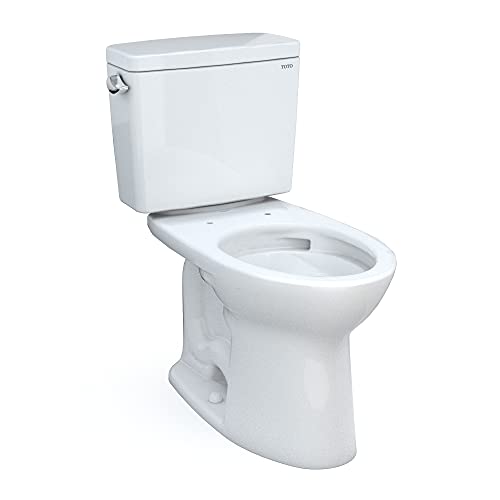
The TOTO Drake is the most widely recommended two-piece toilet in high-traffic residential and light commercial applications, with a G-Max flush system that earns a perfect 1,000-gram MaP score and uses just 1.28 gallons per flush.
The Drake has been a fixture in plumbing contractor recommendations for over a decade because it delivers exactly what the spec sheet promises: a powerful, fast, single-flush clearance that does not require a second attempt. Its G-Max system uses a 3-inch wide flush valve to rapidly drop the full tank volume into the bowl, creating the momentum needed to move heavy loads through the 2-1/8-inch glazed trapway completely. Independent MaP testing has confirmed a maximum 1,000-gram score across multiple Drake configurations.
Aggregated owner reviews consistently highlight two long-term advantages: the toilet keeps flushing reliably after years of hard use, and when parts do need replacement (typically a flapper or fill valve after 5 to 8 years), those parts are available at every hardware store and are straightforward to swap without professional help. For a bathroom that has to work every day without drama, that combination of flush power and long-term parts availability is hard to beat at any price point.
The Drake's G-Max flush is essentially the same siphon-jet principle as more expensive TOTO models, but in a two-piece form factor that is easier to ship, cheaper to buy, and just as easy to service. For a rental property or a family bathroom that gets 30-plus flushes a day, the two-piece format is a practical advantage, not a compromise.
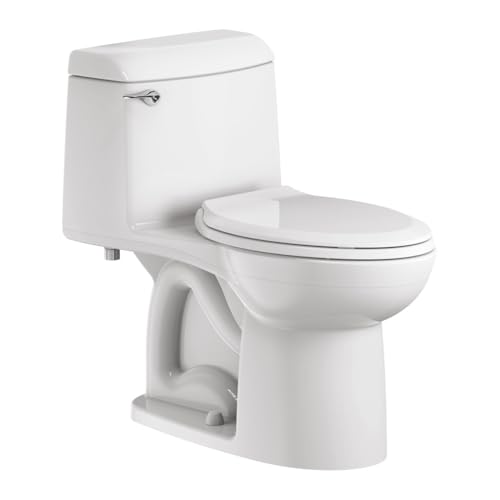
The American Standard Champion 4 has the widest fully glazed trapway of any toilet in this roundup at 2-3/8 inches, backed by a 1,000-gram MaP score, making it the single most clog-resistant residential toilet on the market.
The Champion 4's defining feature is its trapway: at 2-3/8 inches fully glazed, it is a quarter inch wider than most competitors, which sounds small until you consider that most toilet clogs occur when a partial load gets lodged at the narrowest point of the trapway. American Standard's own marketing says the toilet can pass a bucket of golf balls in a single flush, which while not a real-world metric illustrates the engineering intent: nothing should get stuck.
The trade-off is water use. The Champion 4 runs at 1.6 GPF, which means it does not qualify for EPA WaterSense certification, and in a very high-traffic application (100-plus flushes per day) the water cost over a year is meaningfully higher than a 1.28 GPF model. For most applications where the primary concern is clog avoidance, that trade-off is worth making. For settings where water billing is a significant operational cost, consider whether the Drake's 1.28 GPF and strong clog resistance is sufficient.
The Champion 4 is the toilet American Standard designed specifically after researching what causes clogs in residential settings. The 2-3/8-inch trapway is the result of that engineering focus. If the question is purely "will this toilet ever clog," the Champion 4 has the strongest published track record of any residential model.

The TOTO UltraMax II combines the same 1,000-gram MaP flush as the Drake with a seamless one-piece design and TOTO's SanaGloss CeFiONtect glaze, which dramatically reduces the cleaning time needed in bathrooms with heavy daily use.
In a high-traffic bathroom, cleaning time is a real operational cost. The gap between a two-piece toilet's tank and bowl is a consistent cleaning problem -- dirt, moisture, and bacteria accumulate in that seam, and in a heavily used bathroom it requires daily attention. The UltraMax II eliminates that gap entirely with its one-piece seamless construction. Combined with the CeFiONtect ionic glaze barrier, which creates a surface so smooth that waste particles have minimal surface adhesion, the toilet is considerably faster to clean between uses.
Flush performance matches the Drake: both use TOTO's G-Max system with a 3-inch flush valve and both post a verified 1,000-gram MaP score. The UltraMax II adds the ADA-compliant 17-1/2-inch bowl height, which is genuinely useful in shared-use facilities where diverse users need access. The additional upfront cost is the only real barrier, and over a 10-year service life in a high-traffic setting, the reduction in cleaning labor can easily justify the premium.
The CeFiONtect glaze is not marketing language -- it is a documented ionic barrier that changes the surface energy of the vitreous china. In a busy bathroom, that translates to fewer scrubbing cycles per week, which matters both for labor and for chemical wear on the glaze over time. It is one of the more genuinely useful premium features in the toilet category.
The Kohler Highline delivers a 1,000-gram MaP flush at 1.28 GPF with a notably quieter fill cycle than most competitors -- a meaningful advantage in residences, medical offices, or hospitality settings where toilet noise matters.
The Kohler Highline uses an AquaPiston flush canister instead of a traditional rubber flapper. The canister opens from all sides simultaneously, delivering water to the bowl from a 360-degree inlet rather than a single opening, which creates a more even bowl wash and a notably quieter flush sound. For a bathroom adjacent to a bedroom, medical suite, or hotel room, that noise difference is a real consideration in a high-traffic environment where the toilet is in use at all hours.
Long-term reliability data from aggregated owner reviews supports the Highline's durability credentials: owners consistently report that the toilet functions without significant maintenance for 8 to 10 years or longer. Replacement parts (AquaPiston canisters, fill valves, seats) are sold at every major home improvement retailer, which matters for a high-use fixture in a setting where unexpected downtime is disruptive.
Kohler's AquaPiston canister has about half as many moving parts as a standard rubber-flapper fill system, which means fewer potential failure points over time. In a hard-use environment, that design simplicity translates to lower maintenance frequency, which is worth considering alongside the raw flush power numbers.

The American Standard Cadet 3 achieves a 1,000-gram MaP score and EPA WaterSense certification at 1.28 GPF in one of the most accessible price brackets of any toilet with those combined credentials -- making it the strongest value pick for rental properties or multi-unit installs.
The Cadet 3 occupies an important niche: it gives property managers and builders access to verified 1,000-gram MaP performance and EPA WaterSense certification without the premium pricing of TOTO or Kohler's main lines. For a rental property owner equipping multiple bathrooms or a contractor building out a multi-unit residential project, the per-unit cost difference across 10 or 20 units is significant, and the Cadet 3 delivers the flush engineering fundamentals that matter for durable daily use.
Aggregated owner reviews indicate that the Cadet 3 is reliable over multiple years of heavy use, though some reviewers note that the china feels slightly lighter than comparable TOTO or Kohler units. For most high-traffic residential applications that is an acceptable trade-off, particularly given the straightforward parts availability and the strong flush-test credentials. See also our best toilets for rental properties guide for context on the full range of budget-oriented options.
A 1,000-gram MaP score is a 1,000-gram MaP score regardless of price bracket. The Cadet 3 earns it legitimately, and for applications where budget is a binding constraint, spending more for the same MaP performance is hard to justify on engineering grounds alone.

The Kohler Cimarron adds an ADA-compliant comfort height bowl (17-to-19 inches) to the same 1,000-gram MaP flush performance as the Highline, making it the right choice when a high-traffic space serves a mix of older adults, people with mobility considerations, and general users.
For any high-traffic bathroom in a setting where users span a wide age range -- an office, a community center, a medical facility, or a multi-generational home -- the comfort height bowl at 17-to-19 inches meaningfully improves accessibility without requiring any additional ADA hardware. The Cimarron delivers this at a price point comparable to other high-performance two-piece models while maintaining the same Kohler AquaPiston canister flush mechanism that earns the 1,000-gram MaP score.
Kohler's Class Five flushing technology, which the Cimarron shares with the Highline, is engineered to move large volumes of waste in a single flush cycle. The combination of a 3-inch flush valve, fully glazed 2-1/8-inch trapway, and 360-degree AquaPiston water delivery creates a powerful and complete bowl clearance that holds up across years of daily high-traffic use. For more on ADA-specific requirements, see our ADA compliant toilet guide.
The Cimarron is frequently specified in commercial renovation projects precisely because it meets ADA height requirements while delivering the same verified flush performance as Kohler's residential line. In a high-traffic setting that needs to be ADA-accessible, it checks both boxes without requiring a premium commercial fixture budget.
Gerber's Avalanche Elite is a heavier-duty two-piece toilet engineered with commercial applications in mind, posting a 1,000-gram MaP score and using 1.28 GPF, with a vitreous china construction that plumbers associate with longer service life under sustained heavy use.
Gerber is less well known to consumers than TOTO, Kohler, or American Standard, but it has a significant presence in commercial and professional plumbing channels because of its durability reputation. The Avalanche Elite is the model plumbing contractors most often specify when the application is a semi-commercial bathroom (restaurant, small office building, gym) where residential-grade toilets would be undersized for the use volume but a full commercial floor-mounted fixture is impractical or too expensive.
The vitreous china used in Gerber's commercial-oriented models is typically heavier than equivalent residential offerings, which contributes to both physical durability (resistance to chipping and cracking under sustained use) and acoustic damping (the toilet sounds and feels more solid). Independent MaP testing confirms the Avalanche Elite meets the 1,000-gram threshold at 1.28 GPF, and its EPA WaterSense certification makes it compliant with building codes in all states that require WaterSense fixtures.
Gerber has been supplying commercial projects for decades without the consumer marketing spend of the bigger brands. That means the fixtures tend to be evaluated on engineering merit within the plumbing trade, which is why the Avalanche consistently appears in contractor specs for demanding applications where failure is costly.
The TOTO Drake II upgrades to TOTO's double cyclone flush system, which uses two nozzles to create a centrifugal washing action across the entire bowl surface, delivering an 800-gram MaP score and one of the cleanest bowl washes in its class at 1.28 GPF.
The Drake II represents TOTO's attempt to improve bowl hygiene as much as raw flush power. Its double cyclone system uses two propulsion nozzles instead of the single siphon-jet inlet of the original Drake, creating a swirling wash that covers the entire bowl surface with each flush rather than concentrating water flow at the bottom. The result is a bowl that develops staining and ring buildup more slowly, which in a high-traffic bathroom translates to longer intervals between deep cleaning cycles.
The 800-gram MaP score is genuinely good -- it significantly exceeds the EPA WaterSense 600-gram minimum -- but if a bathroom's primary challenge is extremely heavy solid waste loads rather than bowl staining, the original Drake's 1,000-gram score gives more margin. For balanced applications where both bowl cleanliness and adequate flush power matter, the Drake II is a well-supported choice. For more on how double cyclone and other flush technologies compare, see our best double cyclone flush toilets guide.
The Drake II is often the better choice for high-traffic bathrooms where janitorial access is limited or infrequent. The double cyclone's superior bowl wash means each flush leaves less residue, which compounds favorably over a day with 30 to 50 uses compared to a single-jet model that washes the same area of the bowl each time.
The shift from 1.6 GPF to 1.28 GPF as the high-performance standard has been one of the most important developments in toilet engineering over the past decade. Early low-flow toilets from the 1990s were widely criticized for poor performance precisely because manufacturers reduced water volume without redesigning the flush mechanics to compensate. Modern 1.28 GPF toilets with 3-inch flush valves and properly engineered siphon-jet systems generate equivalent or superior flush performance to legacy 1.6 GPF models while using 20 percent less water per flush.
In a high-traffic setting with 50 flushes per day, the choice of 1.28 versus 1.6 GPF represents about 5,840 gallons of water per year per toilet. At typical municipal water rates that is a meaningful operational cost, and it is also the reason EPA WaterSense certification has become a specification requirement in many commercial and multifamily building codes. All eight toilets on this list that meet the 1,000-gram MaP threshold at 1.28 GPF demonstrate that water efficiency and flush power are not in conflict with modern toilet engineering.
Trapway engineering is one of the most consequential and least-discussed factors in toilet selection. Most toilets list their trapway diameter in the specification sheet, but fewer specify whether the trapway interior is fully glazed -- meaning the same smooth vitreous china surface as the bowl extends all the way through the waste passage from the inlet to the outlet at the floor flange. This matters because waste does not simply flow through the trapway during a flush; it is driven through by water pressure, and anything that creates drag or a catch point in the passage increases the likelihood of a partial clog.
For high-traffic applications, the standard recommendation is a fully glazed trapway of at least 2-1/8 inches. The 2-3/8-inch glazed trapway in the American Standard Champion 4 represents the widest passage available in any standard residential two-piece toilet and is the most direct engineering solution to a persistent clogging problem. See also our guide to best toilets for frequent clogs for a more focused analysis of clog-resistance features.
Brand reliability in the toilet category is not simply about upfront quality -- it is also about whether the parts needed to maintain the fixture 8 years from installation are still available and reasonably priced. A toilet with excellent initial performance but discontinued or proprietary parts that are difficult to source is a liability in a high-traffic setting where downtime matters.
TOTO, Kohler, and American Standard all maintain broad parts availability through national retail chains and online suppliers. Gerber supports its professional line through plumbing supply distributors, which are accessible to contractors and facility managers even if they are less convenient for individual homeowners. Swiss Madison and Woodbridge have grown their presence in the residential one-piece market and offer generally good performance at competitive prices, but their long-term parts ecosystems are not as deeply established as the four legacy brands for a demanding high-traffic application.
The one-piece versus two-piece question in a high-traffic context is largely about maintenance practicality rather than flush engineering. Identical flush systems (same valve diameter, same trapway, same siphon-jet design) perform identically regardless of whether the toilet is one-piece or two-piece. The differences appear in cleaning time, installation, and long-term serviceability.
In a residential high-traffic bathroom, two-piece toilets offer the practical advantages of easier installation (lighter tank, shipped separately) and the ability to replace the tank independently if it cracks or develops a slow leak. One-piece toilets like the TOTO UltraMax II add the cleaning-speed advantage of the seamless design and typically a cleaner visual footprint. For a facility where a janitor or cleaning staff needs to turn the bathroom over between users quickly, the one-piece format's reduced surface area and eliminated seam can represent a genuine time saving over hundreds of weekly cleaning cycles. For more on this comparison, see our one-piece vs two-piece toilet guide.
A MaP score of 800 grams or above is considered strong for high-traffic use; 1,000 grams is the maximum and indicates the toilet can clear the heaviest realistic waste loads in a single flush. The EPA WaterSense program requires a minimum of 350 grams for certification, but for genuine high-traffic applications, 800 grams is the practical floor.
A well-specified toilet from a major brand should provide 15 to 25 years of service in a high-traffic residential setting with normal maintenance (flapper and fill valve replacement every 5 to 8 years). In semi-commercial settings with 100-plus flushes per day, a realistic service life is 10 to 15 years before significant mechanical wear or china degradation becomes a factor.
Pressure-assist toilets create a powerful, fast flush using compressed air and are highly effective for bulk waste clearance, but they are significantly louder than gravity-fed models and require periodic pressure-vessel servicing. For most residential high-traffic settings, a well-engineered gravity toilet with a 1,000-gram MaP score is a better all-round choice. Pressure-assist is most appropriate in commercial or multi-unit settings where noise is not a concern and flush consistency under heavy load is the only priority.
Most modern commercial gravity-flush toilets use 1.28 GPF or 1.6 GPF. Flushometer-valve commercial toilets (the type without a tank, activated by a lever or sensor) typically use 1.28 to 1.6 GPF for flush toilets and 1.0 GPF for urinals. For residential-style toilets in semi-commercial applications, 1.28 GPF with a strong MaP score is both water-efficient and code-compliant in most jurisdictions.
Yes, though significantly less frequently than toilets with unglazed trapways. Clogs in fully glazed, wide-trapway toilets almost always result from flushing non-flushable items (wipes, paper towels, feminine hygiene products) rather than from organic waste. A fully glazed 2-1/8-inch or wider trapway essentially eliminates organic waste clogs but cannot prevent mechanical clogs from inappropriate flushing behavior.
The toilet fixture itself ranges from roughly budget two-piece models to premium one-piece units. Professional installation by a licensed plumber adds cost that varies by region and installation complexity. Two-piece toilets are generally faster and simpler to install than one-piece units. For a rental property with multiple units, getting competitive plumbing bids for bulk installation can significantly reduce per-unit costs.
EPA WaterSense certification requires a minimum MaP score of 350 grams at 1.28 GPF or less, which is a meaningful performance threshold but lower than what most high-traffic applications actually need. For high-traffic use, WaterSense certification confirms water efficiency but does not by itself guarantee adequate flush power -- always verify the actual MaP score separately from the certification status.
The primary consumable parts in any residential-style toilet are the flapper (or flush canister seal) and the fill valve. In a high-traffic bathroom, these parts may need replacement every 3 to 5 years rather than the typical 5 to 8 years in low-traffic settings. Annual inspection of the flapper seal, fill-valve float, and wax ring integrity is a sensible preventive maintenance cadence for a heavily used fixture.
Skirted toilets cover the exterior trapway with a smooth ceramic panel, eliminating the contoured exterior that traps dust and bacteria in standard exposed-trapway models. This makes skirted designs faster to clean and more hygienic in high-traffic settings. The trade-off is that installation typically requires a skirted-toilet mounting bracket kit rather than a standard wax ring, which adds installation complexity and cost.
Slow-close toilet seats with quick-release hinges are the most practical choice for high-traffic bathrooms: the slow-close mechanism prevents seat slamming (which cracks seats over time), and the quick-release hinge allows the seat to be detached completely for thorough cleaning in under a minute. Avoid solid-wood seats in high-traffic bathrooms as they are more susceptible to surface wear and moisture damage from repeated use.
A larger flush valve diameter allows the tank to empty faster, which generates a more powerful initial surge of water into the bowl -- and that surge is what creates the siphonic action that pulls waste through the trapway. A 3-inch flush valve empties the tank roughly 40 percent faster than a 2-inch valve, which directly translates to a more complete and reliable single-flush clearance in demanding use conditions.
Yes, in many semi-commercial settings (small offices, fitness studios, restaurant restrooms with under 50 covers). The key is selecting a residential model with a MaP score of 800 grams or above, a fully glazed trapway of at least 2-1/8 inches, and a 3-inch flush valve. A heavy-duty vitreous china construction from a brand with documented semi-commercial use history (Gerber, TOTO, American Standard) further increases the suitability for the application.
The most common failure modes in high-traffic toilets are flapper or flush-valve seal degradation (which causes running water and incomplete flushes), fill-valve wear (which causes slow tank refill between flushes), seat hinge failure from repeated impact, and vitreous china cracking from sustained thermal cycling or physical impact. Proper part replacement at the first sign of any of these issues extends the fixture life substantially.
Both brands have strong long-term reliability records in high-traffic settings. TOTO models with CeFiONtect glaze have a documented advantage in bowl-surface stain resistance over time, which reduces cleaning frequency. American Standard models have an advantage in clog resistance due to the wider Champion 4 trapway. The brands are comparable in vitreous china quality and parts availability, so the choice between them is most sensibly made on the basis of which specific performance characteristic is most important for the application.
Dual-flush toilets can work in high-traffic settings, but they require users to make a selection (half-flush versus full-flush) with each use, which introduces the possibility of under-flushing in a heavy-use scenario. For consistent single-flush performance without user decision-making, a single-flush toilet with a strong MaP score is more reliable in a high-traffic context. Dual-flush makes more sense in low-to-moderate traffic settings where water savings from the half-flush option are reliably captured.
The clearest indicators are: clogging more than once a month, needing a second flush more than 10 to 15 percent of the time, and tank-refill time exceeding 60 seconds (which causes back-to-back users to flush before the tank is full). Any of these symptoms in a high-traffic bathroom indicates that the toilet's flush mechanics are not matched to the use volume, and replacement with a higher-specification model is the most cost-effective long-term solution.
Standard MaP testing measures waste clearance at the toilet's rated GPF using a soybean-paste test media at increasing weights up to 1,000 grams. MaP Premium is a higher-certification tier that adds evaluation of staining resistance and water consumption consistency across multiple flushes. For high-traffic purposes, the standard MaP score at 800 to 1,000 grams is the most practically useful metric for flush performance assessment.
Comfort height (17 to 19 inches bowl height) is generally better for high-traffic facilities that serve adult users because it reduces physical strain for most adults and meets ADA accessibility requirements. In settings used by children as the primary audience (elementary schools, pediatric facilities), standard height (15 to 16 inches) is more appropriate. For mixed-use facilities, comfort height is the more inclusive default choice.
For most high-traffic bathrooms, the TOTO Drake is the clearest recommendation: a verified 1,000-gram MaP score, a 3-inch flush valve, a fully glazed 2-1/8-inch trapway, and a proven 10-plus-year service track record make it the most defensible all-round choice. When clog history is severe and preventing any blockage is the first priority, upgrade to the American Standard Champion 4 and its 2-3/8-inch glazed trapway. When cleaning efficiency is as important as flush power -- particularly in a visible, staffed facility -- the TOTO UltraMax II with its one-piece design and CeFiONtect glaze is worth the additional cost. All three choices are EPA WaterSense certified (or near-equivalent), independently MaP-tested, and supported by long-term parts availability from established supply chains. For a high-traffic bathroom, any of these three is a sound, defensible specification that will perform reliably for years.
Learn why toilet trapways curve like an S, how each bend blocks sewer gas, and what the shape means for clogs and…
Read the guideAlmost every US toilet has a left-side handle. Learn the plumbing and mechanical reasons behind the layout and when it actually changes.
Read the guideHome toilets rely on tanks because household water lines lack the pressure that public flushometer systems use to flush straight from the…
Read the guide