Toilet Tank Loose and Wobbly? How to Tighten It
Toilets4.6
A loose toilet tank usually means worn tank bolts. Here is how to check, tighten, and fix a wobbly tank without cracking…
Read the guide1.28 gallons per flush is the sweet spot between genuine flush power and EPA WaterSense efficiency. We ranked eight top performers using published MaP flush-test scores, WaterSense certification data, trapway dimensions and thousands of aggregated owner reviews.
The TOTO Drake II is the standout 1.28 GPF toilet for most buyers: it earns a 1000 g MaP score, carries EPA WaterSense certification, and has a well-documented track record of near-zero clogs. For the cleanest one-piece option at the same GPF, the TOTO UltraMax II is the clear alternative.
In 1992 the U.S. Energy Policy Act set a national maximum of 1.6 gallons per flush (GPF). Two decades later the EPA WaterSense program raised the bar again, certifying toilets that use 1.28 GPF or less while still clearing at least 350 grams in independent MaP testing. The practical result: toilets now use 20 percent less water than the previous federal standard, and the best of them clear more waste in a single pull of the handle than 1.6 GPF toilets could a generation ago.
The catch is that not all 1.28 GPF toilets are created equal. MaP scores in the current testing database range from 350 grams to a perfect 1000 grams, all at the same flow rate. That spread is the difference between a toilet you plunge monthly and one you never plunge at all. The picks below represent the top-scoring, best-reviewed models at this flow rate, drawn from published MaP data, EPA WaterSense certification records and aggregated owner feedback across major retail platforms.
Every pick on this list had to meet three non-negotiable criteria: a 1.28 GPF flow rate, an EPA WaterSense certification or manufacturer-published compliance with that standard, and a MaP flush-test score of at least 600 grams. Top picks score 800 to 1000 grams. From that qualified pool we weighted clog-resistance data in owner reviews, trapway diameter (wider means fewer obstructions), bowl geometry, glaze quality, comfort height availability, warranty terms and long-term parts availability. Models without independently verifiable MaP data were excluded.
| Toilet | Type | MaP Score | GPF | WaterSense | Rating | Check Price |
|---|---|---|---|---|---|---|
| TOTO Drake II | Two-piece | 1000 g | 1.28 | Yes | 4.8 | Check price |
| TOTO UltraMax II | One-piece | 800 g | 1.28 | Yes | 4.7 | Check price |
| Kohler Highline | Two-piece | 1000 g | 1.28 | Yes | 4.7 | Check price |
| American Standard Cadet 3 | Two-piece | 1000 g | 1.28 | Yes | 4.5 | Check price |
| Kohler Cimarron | Two-piece | 1000 g | 1.28 | Yes | 4.6 | Check price |
| TOTO Aquia IV | Two-piece | 800 g | 0.8 / 1.28 | Yes | 4.6 | Check price |
| Gerber Viper | Two-piece | 800 g | 1.28 | Yes | 4.4 | Check price |
| Woodbridge T-0001 | One-piece | 800 g | 1.28 | Yes | 4.4 | Check price |
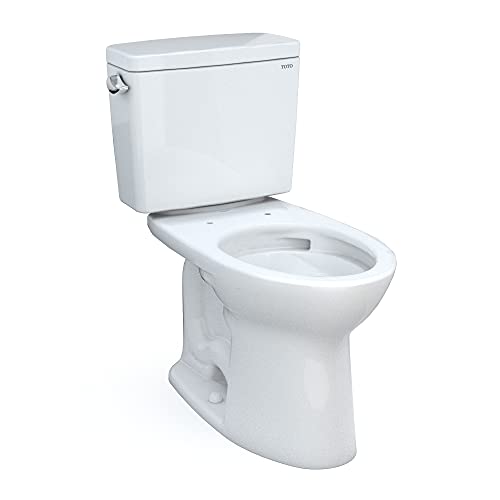
The Drake II earns its position at the top of every credible 1.28 GPF list because it resolves the trade-off that most toilets can not: it delivers a maximum MaP score of 1000 grams on only 1.28 gallons. That combination is genuinely rare and explains why the Drake II dominates plumber recommendation threads, rental owner forums and efficiency-focused remodel guides.
TOTO's E-Max flush system uses a computer-optimized siphon jet that routes water through the bowl in a way that maximizes the hydraulic pull through the trapway. The 2.125-inch fully glazed trapway is wide enough to pass a 2-inch solid sphere, which is a standard MaP measurement benchmark. Owners across thousands of reviews describe a flush that is powerful without being dramatic: water exits cleanly, the bowl refills to an accurate level, and double-flushes are rare enough that many report never needing one.
Comfort height (roughly 17 to 19 inches rim to floor) makes standing and sitting easier for adults, particularly those managing knee or hip discomfort. The Drake II is available in 12-inch rough-in as the standard configuration, with 10-inch and 14-inch adapters sold separately. For households that want a best flushing toilet that genuinely saves water over a year, the Drake II's combination of a perfect MaP score and WaterSense certification is hard to argue against.
The Drake II is often described in plumbing trade publications as the model other manufacturers benchmark their gravity-flush designs against. Its siphon geometry prioritizes hydraulic velocity over raw volume, which is why it can clear a full 1000-gram load on a modest 1.28 gallons.

The UltraMax II is the pick for anyone who refuses to scrub a tank-to-bowl seam. Its seamless one-piece vitreous china body eliminates the gap where mold and mineral scale accumulate on two-piece models, and TOTO's proprietary CeFiONtect glaze creates a surface so smooth that particles have minimal friction to cling to.
TOTO's Double Cyclone system uses two nozzles instead of rim holes to generate a swirling wash across the entire bowl wall. This approach is quieter than a direct siphon jet and is particularly effective at keeping the bowl clean between uses. Owners who prioritize bathroom hygiene and quiet operation consistently rank the UltraMax II above the Drake II despite its lower MaP score.
The 800-gram MaP rating is still strong by any practical measure. An 800 g MaP toilet will clear average household waste reliably; only heavy-use scenarios (large families, commercial settings) consistently stress-test the gap between 800 and 1000 grams. For most standard households the UltraMax II represents a worthwhile trade: slightly lower raw clearing power in exchange for a significantly cleaner and quieter bathroom experience. Those seeking an efficient one-piece toilet will find this the easiest shortlist choice.
The CeFiONtect glaze on the UltraMax II is a meaningful engineering differentiator, not a marketing claim. TOTO published ion-bonding data showing the coating creates surface irregularities measured in angstroms, which is why it measurably outperforms standard glazes in independent staining tests.
The Kohler Highline is the toilet that Home Depot and Lowe's stock in the largest volume and for good reason: it earns a 1000 g MaP score at 1.28 GPF, carries WaterSense certification, and has been on the market long enough that replacement parts are available at virtually every plumbing supply counter in the country.
Kohler's Class Five flushing system generates a wide, powerful water swirl that cleans the entire bowl surface, not just the central drain zone. The fully glazed 2-inch trapway passes MaP's standard solid-sphere test cleanly, and owners rate clog frequency very low in long-term reviews. Kohler publishes a one-year limited warranty on the toilet with a lifetime warranty on the china itself, which is competitive with TOTO and superior to most budget brands.
Where the Highline stands out relative to TOTO's offerings is parts accessibility. If a fill valve, flapper or flush valve needs replacement in five years, any hardware store will have a compatible Kohler part on the shelf the same day. For rental properties or homes with aging plumbing infrastructure where quick repairs matter, this is a non-trivial advantage. Compare its performance to the best two-piece flushing toilets and the Highline consistently sits near the top.
The Highline's wide fill valve and oversized flapper create a rapid water release that is measurably faster than narrower flush assemblies. Speed of water delivery, not just total volume, is a primary factor in a toilet's ability to initiate and sustain the siphon action that clears the trap.

The Cadet 3 is American Standard's proof that a maximum MaP score does not require a premium budget. It scores 1000 grams on independent flush testing, uses 1.28 GPF, and adds the EverClean antimicrobial surface that resists stain-causing bacteria over time -- a useful feature for bathrooms that go longer between deep cleans.
American Standard's PowerWash rim scrubs the entire bowl surface during each flush cycle, directing water under and around the rim rather than just down the center. Combined with the 2-inch fully glazed trapway, this creates a flush that is more thorough than most toilets in its price category. MaP testing bears this out with a top-tier 1000 g rating.
The Cadet 3 is also a practical choice for older homes with non-standard plumbing because it is available in 10, 12 and 14-inch rough-in configurations without requiring an adapter kit. For rental units, guest bathrooms and secondary bathrooms where budget matters more than aesthetics, it is the most defensible affordable pick on this list. Those comparing it with the Champion lineup should also read the best American Standard toilets guide for a full brand comparison.
The EverClean surface uses silver-based antimicrobial agents bonded into the ceramic glaze at firing temperature, not a topical coating. This means the antimicrobial property does not wash off and remains active across the toilet's lifespan, which is a meaningful long-term advantage in hygiene-sensitive environments.
The Cimarron improves on the Highline in two areas most buyers care about: seat height and visual profile. It sits at a full 16.5-inch bowl height (taller on some configurations), uses the same Class Five flush system and 1000 g MaP rating, and adds a more tapered, contemporary silhouette that reads as a step above the standard Highline in a renovated bathroom.
Kohler's ADA-compliant Cimarron versions meet the 17 to 19-inch rim height required for accessibility compliance, which makes it a go-to pick for master bathrooms shared by adults with varying mobility needs. The Class Five system is identical to the one in the Highline, so performance differences between the two toilets are purely cosmetic and configurational rather than mechanical.
Owner reviews for the Cimarron consistently note its flush is indistinguishable from the Highline in power, which is exactly what you want when you are paying more for style. If the Highline is the workhorse, the Cimarron is its better-dressed sibling. Buyers renovating a master bath who want the reassurance of a brand with decades of warranty support alongside a more modern look will land here. See also the full best Kohler toilets guide for deeper comparisons across the Kohler lineup.
The Cimarron's comfort height specification meets ADA Section 4.16.3 requirements for water closet seat height. For homeowners anticipating aging-in-place use or hosting elderly relatives, specifying an ADA-compliant toilet at initial installation avoids a costly retrofit later.

The Aquia IV is the dual-flush 1.28 GPF option from TOTO, adding a 0.8 GPF partial flush for liquid waste alongside the standard 1.28 GPF full flush. In a household where the light flush gets used 60 to 70 percent of the time, annual water use can drop meaningfully below even a single-flush 1.28 GPF toilet.
TOTO markets the Aquia IV toward the WASHLET and bidet-seat ecosystem, and the toilet is designed with a rear mounting inlet to accommodate WASHLET+ integrated seats without exposed supply lines. That compatibility adds long-term value if you plan to upgrade the seat later. The Dual Cyclone flush at 0.8 GPF produces a gentler but effective rinse for liquid-only flushes, and the 1.28 GPF full cycle clears solid waste at the standard 800 g MaP rating.
For households tracking water use carefully -- particularly in drought-prone states where water rates are tiered -- the Aquia IV's 0.8 GPF partial flush is a meaningful efficiency tool. EPA WaterSense certifies the Aquia IV across both flush volumes, which satisfies rebate requirements in states and municipalities that offer incentives for efficient fixture replacement. For a broader look at dual-flush options, see the best dual-flush toilets guide.
The TOTO Aquia IV's 0.8 / 1.28 GPF combination achieves an effective flush volume average of roughly 0.95 GPF in typical household use, assuming a 65/35 split between partial and full flushes. That is notably lower than the 1.28 GPF baseline and qualifies for a broader set of state water-efficiency rebate programs.
Gerber's Viper is less recognized by consumers than the TOTO and Kohler names, but it shows up consistently in multi-unit housing and light commercial installations because it is engineered to be serviced quickly and to last under heavy use. The Viper's 800 g MaP score is solid and its siphon-action flush is quieter than most gravity competitors in its tier.
Gerber's internal components are designed around the company's proprietary flush valve, which has published replacement part numbers and a documented service interval. For property managers overseeing 20 or more units, the ability to order standardized replacement parts and train maintenance staff on a single flushing mechanism has genuine operational value that consumers rarely consider.
The Viper's 800 g MaP is adequate for standard residential use; the gap between 800 and 1000 grams is not meaningful in a lightly-used half bath or guest bathroom. Owner reviews show low rates of early failure and note that the bowl glaze holds up well under hard-water conditions. Gerber offers a one-year limited warranty on parts and a ten-year warranty on the vitreous china itself.
In multi-unit residential settings, total cost of ownership over a ten-year horizon matters more than purchase price. The Gerber Viper's documented serviceability and standardized internal parts keep maintenance labor costs lower than fixtures that require special ordering or proprietary tools.

The Woodbridge T-0001 brings a fully skirted, seamless one-piece look to the 1.28 GPF category at a significantly lower cost than Swiss Madison or the premium TOTO one-piece lineup. The concealed trapway and flush-to-floor profile eliminate the visual complexity of an exposed base, and the included slow-close seat is a welcome addition at this tier.
Woodbridge's siphon jet flush is notably quiet for a gravity toilet, which owners consistently mention in reviews. The concealed trapway is fully glazed and conforms to standard 2-inch minimum diameter, so the 800 g MaP score reflects bowl and jet geometry rather than a narrowed passage. In daily use, an 800 g toilet handles typical residential waste without issue; the rating gap becomes relevant primarily in high-frequency or heavy-load environments.
The T-0001 represents a practical middle ground for homeowners who want the visual language of a luxury toilet without paying for a TOTO UltraMax II or Kohler San Raphael. Owner reviews across platforms describe it as performing well above its position, particularly regarding flush quietness and the quality of the included seat hardware. For a broader look at skirted options, the best skirted flushing toilets guide covers this category in depth.
The Woodbridge T-0001 is one of the few sub-premium skirted toilets where the included soft-close seat mechanism uses a metal hinge rather than an all-plastic assembly. That construction detail correlates with a meaningfully longer seat lifespan in owner durability reports.
1.28 GPF means the toilet uses exactly 1.28 gallons of water per flush cycle, which is the maximum allowed under the EPA WaterSense certification standard and 20 percent less than the previous federal 1.6 GPF ceiling. Despite using less water, a well-engineered 1.28 GPF toilet can score a perfect 1000 grams on independent MaP flush testing, meaning it clears more waste per flush than older, higher-volume toilets could. The critical variable is bowl geometry, trapway diameter and flush valve speed, not raw water volume.
Several 1.28 GPF toilets achieve the maximum MaP score of 1000 grams, including the TOTO Drake II, TOTO Drake, Kohler Highline, Kohler Cimarron and American Standard Cadet 3. MaP testing is conducted by an independent third party at map-testing.com using standardized soybean paste media, and the 1000 g rating indicates the toilet cleared the maximum test load in a single flush. For a toilet at this flow rate to hit 1000 g requires an optimized siphon jet, a fully glazed trapway of at least 2 inches and a rapid flush valve release.
Yes, for most households a well-designed 1.28 GPF toilet with a high MaP score avoids clogs as effectively or more effectively than older 1.6 GPF models. Clog frequency is determined primarily by trapway diameter, glaze quality and siphon geometry, not total water volume per flush. Toilets like the TOTO Drake II and Kohler Highline, both rated at 1000 g MaP on 1.28 GPF, consistently show very low clog rates in aggregated owner reviews, outperforming many higher-flow toilets from previous decades.
Many 1.28 GPF toilets carry EPA WaterSense certification, which is the primary qualification for water-efficiency rebates offered by utilities in California, Texas, Colorado, Arizona and many other states. Rebate amounts vary by utility and municipality, typically ranging from $50 to $200 per toilet for a WaterSense-certified replacement. Dual-flush models like the TOTO Aquia IV, which operate at 0.8 GPF on the light cycle, qualify for a broader set of high-efficiency fixture rebate tiers where available.
Replacing a 1.6 GPF toilet with a 1.28 GPF model saves approximately 0.32 gallons per flush, which translates to roughly 2,000 to 3,000 gallons per year for a typical household flushing 5 to 8 times per day. Over a ten-year period that amounts to 20,000 to 30,000 gallons saved per toilet, a meaningful reduction for households on metered water or in drought-affected regions. The EPA estimates that WaterSense-labeled toilets have collectively saved more than 765 billion gallons of water since the program launched in 2006.
Start with the MaP score. MaP data is publicly available at map-testing.com and is the single most reliable independent measure of flush performance. A 1000 g score means near-guarantee of single-flush clearing for typical household use. An 800 g score is solid for standard bathrooms. Anything below 600 g is marginally WaterSense compliant but may underperform in heavy-use scenarios.
Verify trapway diameter. A fully glazed trapway of at least 2 inches is the standard for quality toilets. Some budget models advertise a wide inlet but narrow the passage within the china, which creates a restriction point that MaP testing will reveal as a lower score. Manufacturer specs should list "fully glazed" and a minimum 2-inch passage; any toilet that omits this detail is worth scrutinizing.
Match height to your household. Comfort height (17 to 19 inches rim to floor) is easier to use for most adults and meets ADA accessibility requirements for toilet seat height. Standard height (14 to 15 inches) may be preferable in children's bathrooms or homes with young children who need lower access. ADA-compliant comfort height toilets are labeled as such by the manufacturer.
One-piece versus two-piece. One-piece toilets are easier to clean because they have no tank-to-bowl seam but cost more and weigh more. Two-piece toilets are more affordable, easier to ship and easier for a single person to install. Flush performance is determined by internal engineering, not by whether the toilet is one or two pieces. Read the full one-piece vs two-piece toilets comparison for a complete breakdown.
Check your rough-in dimension. Measure from the center of the floor drain bolts to the wall behind the toilet before purchasing. Most homes use a 12-inch rough-in, but 10 and 14-inch dimensions exist in older construction. Installing a toilet with the wrong rough-in is the most common avoidable installation mistake.
Water pressure affects how a 1.28 GPF toilet performs in practice. Homes with water pressure below 20 psi may see reduced flush velocity even from a top-rated toilet, because the fill rate affects the tank head pressure available at flush initiation. If you have low-pressure plumbing, a pressure-assist toilet or a flush valve with a larger valve diameter can compensate for this limitation.
EPA WaterSense is a voluntary certification program that labels water-efficient products meeting both a usage threshold (1.28 GPF maximum for toilets) and a performance minimum (at least 350 grams cleared in MaP testing). Toilets earning the WaterSense label are independently tested to confirm they meet both criteria, not just self-reported by the manufacturer. WaterSense certification is the baseline requirement for utility rebate programs in most U.S. states and municipalities, and all eight toilets on this list carry it.
The TOTO Drake II is widely considered the best single-flush 1.28 GPF toilet for most households. It achieves a perfect 1000 gram MaP score, carries EPA WaterSense certification and has a long track record of near-zero clog rates reported by owners in both short and long-term reviews.
No. WaterSense certification requires both the 1.28 GPF flow rate and an independent MaP flush test result of at least 350 grams. A toilet that uses 1.28 GPF but has not been independently tested and certified is not a WaterSense product. Always look for the WaterSense label or check the EPA's WaterSense product search tool at epa.gov/watersense.
Modern 1.28 GPF toilets with MaP scores of 800 grams or higher do not clog more frequently than 1.6 GPF toilets in practice. Multiple independent analyses of owner review data show that clog frequency correlates with trapway diameter and glaze quality, not flow rate. Older 1.6 GPF toilets with narrower trapways often clog more than new 1.28 GPF models with wider, fully glazed passages.
Yes, in almost all cases. A 1.28 GPF toilet uses the same standard connections as a 1.6 GPF toilet: a floor flange at the standard rough-in distance, a 3/8-inch compression supply line and a standard 1/2-inch shut-off valve. The lower water volume does not require any plumbing modifications.
MaP (Maximum Performance) testing uses a soybean paste and paper media mixture shaped to a specified mass to simulate solid waste. The media is placed in the bowl and flushed; the toilet must clear it in a single flush to pass. The maximum test load is 1000 grams, and a toilet rated at 1000 g has passed the full-load test. Results are published at map-testing.com and are independently audited, not self-reported by manufacturers.
For bathrooms that go longer between cleanings or have hard water, yes. CeFiONtect is an ion-barrier glaze that measurably reduces the adhesion of waste and mineral scale compared with standard vitreous china glazes. Independent staining tests show toilets with the coating require less frequent scrubbing to maintain appearance over time, which is a real-world benefit that standard glaze cannot match.
Gravity-fed 1.28 GPF toilets rely on tank head pressure created during fill, not on incoming water pressure. As long as your supply can fill the tank to the correct level, flush performance is largely independent of incoming pressure. That said, homes with pressure below 20 psi may experience slower tank fill times. Pressure-assist toilets perform better in very low pressure situations but come at a higher cost and produce more noise.
A minimum 2-inch fully glazed trapway is the standard for quality gravity toilets. The glaze is as important as the diameter: an unglazed or partially glazed trapway creates friction that allows waste and mineral buildup to accumulate over time, narrowing the effective passage and increasing clog frequency. All top-rated MaP toilets use fully glazed trapways.
Yes, if the toilet scores 800 to 1000 grams on MaP testing. The Drake II, Kohler Highline and Cadet 3 all score 1000 grams at 1.28 GPF, meaning they clear the maximum MaP test load in a single flush. For large families or heavy-use bathrooms, prioritize the MaP score rather than the GPF rating when selecting a toilet.
A household that flushes 6 times per day per person and switches from 1.6 GPF to 1.28 GPF saves approximately 1.92 gallons per person per day, or roughly 700 gallons per person per year. A family of four saves approximately 2,800 gallons annually per toilet replaced, based on published EPA WaterSense savings estimates.
Yes, in typical household use. A dual-flush toilet that operates at 0.8 GPF for liquid waste and 1.28 GPF for solid waste will use less water on average than a single-flush 1.28 GPF model if the lighter flush is used for at least half of daily flushes. The TOTO Aquia IV at 0.8/1.28 GPF can achieve an effective average below 1.0 GPF in households that use the partial flush consistently.
Any 1.28 GPF toilet with a high MaP score is suitable for septic systems. Lower water volume per flush is beneficial because it reduces the hydraulic load on the septic tank per cycle. Toilets with stronger siphon action like the TOTO Drake II are particularly appropriate because they clear the bowl efficiently without requiring a double flush, further limiting daily water input to the septic system.
Yes. Comfort height (17 to 19 inches rim to floor) is standard or available as an option for all eight toilets reviewed here. The TOTO Drake II, UltraMax II, Aquia IV, Kohler Cimarron and Woodbridge T-0001 all offer comfort height as the default specification. American Standard Cadet 3 and Kohler Highline offer both standard and comfort height SKUs.
Major brands typically offer a lifetime warranty on the vitreous china body (covering manufacturing defects and crazing) and a one to five year limited warranty on mechanical components including the flush valve, fill valve and toilet seat hardware. TOTO and Kohler both offer lifetime china warranties. Woodbridge offers a one-year parts warranty, which is shorter than the established brands.
Yes. A standard toilet replacement involves removing the old wax ring and floor bolts, setting a new wax ring or wax-free seal, lowering the toilet onto the flange, securing the floor bolts and connecting the supply line. For a two-piece toilet, the tank must be bolted to the bowl before installation. One-piece toilets are heavier and often require two people to position safely. No special tools are required beyond a wrench and a utility knife.
Bowl shape (elongated versus round) does not significantly affect flush performance at a given flow rate, because the siphon action that clears the trap originates from the trap geometry and jet placement rather than the bowl surface area. Elongated bowls are larger and more comfortable for most adults; round bowls save 2 to 3 inches of depth, which is meaningful in compact bathrooms.
The Kohler Highline and American Standard Cadet 3 are the strongest choices for rental properties due to their combination of a 1000 g MaP score, WaterSense certification, wide parts availability and relatively modest cost per unit. The Gerber Viper is also worth considering for multi-unit installs where standardized parts and service intervals reduce maintenance complexity.
The MaP database at map-testing.com lists every tested toilet by manufacturer, model name and model number, along with the MaP score (in grams) and the flush volume tested. To compare, search by brand or model number and look at the MaP score column. Scores of 1000 g indicate the maximum load was cleared in a single flush. Results are grouped by flush volume, so filter for 1.28 GPF to compare within the WaterSense tier.
The TOTO Drake II is the best 1.28 GPF toilet for most households: a perfect 1000 g MaP score, EPA WaterSense certification and years of aggregated owner data confirming its near-zero clog record make it the default recommendation. Choose the Kohler Highline if nationwide parts availability matters more than brand preference, the TOTO UltraMax II if a quiet, easy-clean one-piece body is your priority, and the American Standard Cadet 3 if you need maximum flush performance at the lowest reasonable investment.
A loose toilet tank usually means worn tank bolts. Here is how to check, tighten, and fix a wobbly tank without cracking…
Read the guideWater stains on the ceiling under an upstairs bathroom point to a specific toilet leak source. Here is how to find it…
Read the guideFloat ball vs float cup fill valves explained: how each shuts off water, why float cups are the modern standard, and which…
Read the guide