
How Much Water Does an Old Toilet Use?
Buying Guides4.6
Find out how many gallons per flush an old toilet really uses, how to check your own tank, and how much water…
Read the guideA data-backed guide to the bathroom improvements that buyers pay a premium for, from high-efficiency toilets and water-saving fixtures to flooring, lighting, and smart storage.
Research updated June 2026.
Bathroom upgrades return 60 to 75 percent of their cost at resale on average. The highest-value projects combine water-efficient toilets, updated vanities, fresh tile, and improved lighting. Replacing an aging toilet with a WaterSense-certified model is one of the lowest-cost, highest-signal upgrades buyers notice immediately.
Bathrooms are among the top two or three rooms buyers evaluate most critically during a home tour, according to the National Association of Realtors annual cost-vs-value reports. A dated or poorly maintained bathroom can reduce an offer price by more than the estimated cost of the renovation itself. Conversely, a clean, updated bathroom with modern fixtures signals whole-house care to buyers and their inspectors.
Unlike kitchen remodels, which can run well past $50,000, bathroom upgrades can be staged in tiers. A cosmetic refresh -- new toilet, vanity light, mirror, and caulk -- can cost under $1,500 and yet produce visible improvements that show well in listing photos and in person. A mid-range full remodel (tile, vanity, tub-to-shower conversion, toilet) averages around $12,000 to $18,000 in most U.S. markets and returns roughly 60 to 72 percent of its cost, according to Remodeling Magazine's 2025 Cost vs. Value Report.
This guide breaks down which specific upgrades carry the most resale weight, starting with toilets and water fixtures, then working through flooring, lighting, ventilation, and storage. Each section includes data on average costs and return benchmarks where reliable estimates exist.
Yes, replacing a visibly old or inefficient toilet has a measurable positive effect on buyer perception, and in markets where home inspectors flag pre-1994 toilets (which use 3.5 GPF or more), it can prevent a credit request during negotiations. A modern WaterSense-certified toilet using 1.28 GPF or less signals lower utility bills, which buyers increasingly price into offers. The upgrade cost is typically $300 to $700 installed, making it one of the most cost-efficient pre-sale improvements available.
Toilets manufactured before 1994 legally use 3.5 gallons per flush (GPF) or more. The 1992 Energy Policy Act mandated a maximum of 1.6 GPF for all toilets sold after January 1, 1994. EPA WaterSense certification, introduced in 2006, raises the bar further to 1.28 GPF or less while requiring models to pass independent flush-performance testing. A toilet that is visibly dated -- round bowl, high tank, yellowed vitreous china -- is one of the first details buyers and their agents comment on.
From a pure performance standpoint, the MaP (Maximum Performance) flush-testing program scores toilets on how many grams of solid waste a single flush removes, with 500 grams the baseline pass threshold and 1,000 grams or more considered premium performance. Replacing a 3.5 GPF toilet with a TOTO Drake II (rated 1.28 GPF, MaP Premium at 1,000 grams) or a Kohler Cimarron (1.28 GPF, WaterSense certified) communicates both efficiency and reliability without requiring a buyer to take your word for it -- the certification and brand reputation do the work.
For a full comparison of top-performing models, see our guide to the best flushing toilets currently available.
Real estate agents consistently report that a visibly new toilet is one of the first things buyers comment on positively in a bathroom tour. The cost is low, the signal is strong, and it eliminates a common negotiating chip for the buyer's inspector. If only one plumbing fixture gets upgraded before listing, this is it.
Based on Remodeling Magazine's 2025 Cost vs. Value data and aggregated real estate agent surveys, a mid-range bathroom remodel (new toilet, vanity, flooring, lighting, and tub resurfacing or replacement) returns approximately 60 to 72 percent of its cost at resale. Cosmetic-only updates -- painting, new fixtures, re-caulking, and toilet replacement -- return 80 to 100 percent in competitive markets because the cost basis is so low. Luxury additions like radiant floor heating or high-end spa features return under 50 percent in most mid-market homes.
| Upgrade | Typical Cost (Installed) | Estimated ROI at Resale | Buyer Perception Impact |
|---|---|---|---|
| Toilet replacement (WaterSense model) | $300 - $700 | 80 - 100%+ | High -- inspectors and buyers notice immediately |
| Vanity + mirror update | $400 - $1,500 | 75 - 90% | High -- visible focal point in photos |
| Flooring (LVP or porcelain tile) | $600 - $2,500 | 65 - 80% | High -- worn flooring is a major negative |
| Lighting upgrade | $150 - $600 | 70 - 85% | Medium-high -- transforms listing photos |
| Re-caulk + deep clean | $50 - $200 | Near 100% | Medium -- prevents inspection credits |
| Exhaust fan replacement | $150 - $400 | 60 - 75% | Medium -- inspectors test these |
| Full mid-range remodel | $12,000 - $18,000 | 60 - 72% | Very high -- transforms dated bathrooms |
| Luxury spa additions | $20,000+ | 40 - 55% | Market-dependent -- overshooting the neighborhood |
The key insight from this data is that low-cost, high-visibility upgrades consistently outperform large renovations on a percentage-return basis. A $500 toilet swap that removes an inspector's concern and photographs well produces more resale value per dollar than adding a heated towel rack to an otherwise dated bathroom.
For resale purposes, the ideal toilet is EPA WaterSense certified (1.28 GPF or less), has a MaP score of at least 500 grams (preferably 800 to 1,000 grams), features a fully glazed trapway to resist staining, and comes from a brand with strong warranty coverage. Elongated bowl models in white or bone read as contemporary without being polarizing. Avoid wall-hung or unusual designs that could raise installation questions for buyers.
Specific models worth considering in a pre-sale upgrade:
TOTO Drake II (CST454CEFG): One of the most widely recommended two-piece toilets in the mid-range segment. It carries the TOTO Tornado Flush system, a MaP score of 1,000 grams (MaP Premium), uses 1.28 GPF, and qualifies for EPA WaterSense. The Drake II's double-cyclone flushing creates a powerful rim wash without a traditional rim, making it easier to clean -- a detail buyers notice when the toilet is clean and stain-free. Check price on Amazon.
Kohler Cimarron (K-6422): Kohler's Cimarron uses an AquaPiston canister flush valve that Kohler claims delivers 90 percent more water flow than a conventional flush valve. It is WaterSense certified at 1.28 GPF and carries a 600-gram MaP score, which comfortably exceeds the 500-gram baseline. The elongated comfort-height design appeals to a broad buyer demographic. Check price on Amazon.
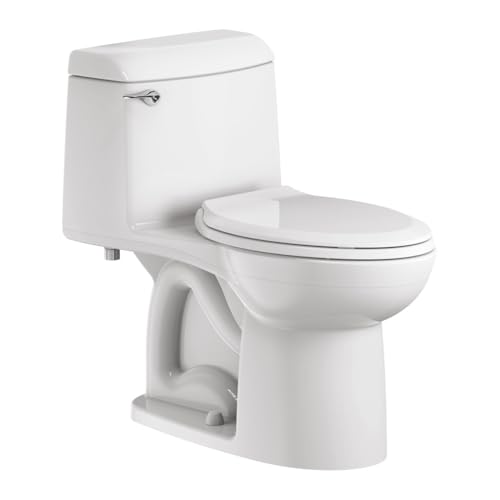
American Standard Champion 4 (2034.014): American Standard's Champion 4 is engineered around a 4-inch piston action flush valve and a large 2-3/8-inch trapway -- the largest in the industry per American Standard's published specifications. It achieves a MaP score of 1,000 grams and uses 1.6 GPF (the pre-WaterSense standard). For buyers in markets where water rates are moderate, the Champion 4's reputation for clog resistance can be a selling point. Check price on Amazon.
Woodbridge T-0001: The Woodbridge T-0001 is a one-piece dual-flush toilet with a sleek, skirted design that reads as contemporary in listing photos. It uses 1.0/1.6 GPF dual-flush and carries EPA WaterSense certification. For a cosmetically updated bathroom aiming at a modern look, the skirted trapway design (no exposed porcelain curves) photographs cleanly and is easier to clean around the base. Check price on Amazon.
See also our detailed guide to ADA-compliant comfort-height toilets if the home has or is marketed to buyers interested in accessibility.
Flooring is one of the highest-impact visual elements in a bathroom because worn, cracked, or outdated flooring is immediately visible in listing photos and during showings. Replacing deteriorated flooring with luxury vinyl plank (LVP) or porcelain tile typically returns 65 to 80 percent of material and labor costs at resale. The specific material matters less than its condition and how well it complements the rest of the bathroom's finishes.
There are four realistic flooring options for a pre-sale bathroom upgrade:
Porcelain tile: The gold standard for bathrooms because it is waterproof, stain-resistant, and carries the longest lifespan (30-plus years with proper grout maintenance). Large-format tiles (12x24 inches or larger) with minimal grout lines read as upscale and are easier to clean -- a detail buyers notice. Installed cost ranges from $8 to $18 per square foot depending on tile selection and labor market.
Luxury vinyl plank (LVP): The fastest-growing category in bathroom flooring due to its 100 percent waterproof core, comfort underfoot, and installed cost of $4 to $9 per square foot. Modern LVP convincingly replicates wood and stone visuals. For a primary bath in a mid-range home, LVP is often the highest-ROI flooring choice because the cost basis is lower than tile while the visual impact is comparable.
Ceramic tile: Lower cost than porcelain ($5 to $12 installed) with slightly less density and water resistance. Appropriate for guest bathrooms or lower-price-point homes where keeping costs down maximizes percentage return.
Natural stone: Marble, travertine, and slate look premium but require sealing, are prone to staining if not maintained, and may signal high maintenance to buyers rather than a benefit. Reserved for high-end properties where buyers expect luxury materials.
Whatever flooring is chosen, the grout condition matters as much as the material. Darkened or crumbling grout on otherwise acceptable tile will hold back a bathroom's perceived value. Re-grouting or steam-cleaning and sealing existing tile grout before listing is one of the most cost-effective preparation steps available.
Listing agents consistently report that flooring condition is among the top three buyer comments during bathroom tours, along with toilet and lighting. Worn vinyl or cracked tile communicates deferred maintenance to buyers, which spreads to their perception of the entire home. If the floor is the weak link, fix it before listing -- LVP makes this a realistic pre-sale budget project in most cases.
Lighting has an outsized impact on both in-person tours and listing photography relative to its cost. The two highest-value changes are replacing a dated vanity light bar with a modern LED fixture that provides even facial illumination, and switching to warm-white (2700K to 3000K) bulbs throughout. Recessed ceiling lights, while more expensive to add if not already present, eliminate the shadowy appearance that makes bathrooms look smaller in photos.
Bathroom lighting affects resale in two distinct ways: how the bathroom appears in online listing photos (where most buyers make a first impression) and how it feels during an in-person tour. A bathroom with a single overhead globe fixture reads as dated and casts unflattering shadows in both contexts.
The highest-leverage lighting upgrade is the vanity light. A horizontal bar fixture positioned above the mirror at face level, using warm-white LED bulbs, creates even illumination that makes the bathroom appear larger and cleaner. Fixtures from brands like Progress Lighting, Kichler, or Moen in brushed nickel or matte black finishes photograph well and align with current buyer preferences in most markets.
If the bathroom has no recessed lighting and adding it is within budget, two recessed LED fixtures (4-inch or 6-inch) flanking the vanity light dramatically improve the visual environment. This is a half-day electrician job in most single-story homes without complicated ceiling access.
One often-overlooked upgrade: replacing the exhaust fan with a combination fan-light unit. Inspectors test exhaust fans, and a unit that is undersized for the room's square footage or that runs loudly is a common inspection note. Replacing it with a properly sized quiet unit (50 to 110 CFM depending on room size, rated at 1.5 sones or less) eliminates the inspection flag and adds a practical selling point. See our guide to choosing the right bathroom exhaust fan for sizing guidance.
Buyers consistently rate storage as a top concern in bathroom evaluations. A floating vanity with a deep drawer stack, concealed plumbing, and soft-close hardware reads as contemporary and addresses buyers' storage concerns at a glance. Single-sink vanities with 48 to 60 inches of countertop provide the visual of space without the cost of a full dual-sink setup. Medicine cabinets with built-in lighting and mirrored doors add functional storage while making bathrooms appear larger.
The vanity is the bathroom's focal point -- it appears in nearly every listing photo and is what buyers look at first when they enter a bathroom. A pedestal sink that was stylish in 1995 signals dated design and zero storage, which buyers mentally price as a future expense. Replacing it with a contemporary vanity cabinet, even a modestly priced one with a solid-surface top, changes the entire feel of the room.
Key vanity specifications that correlate with positive buyer response based on aggregated real estate agent surveys:
For storage beyond the vanity, recessed niches in shower walls add visible organization space without consuming floor area. A mirrored medicine cabinet replaces a flat mirror while adding 4 to 6 inches of recessed storage depth. These additions signal thoughtful, practical design rather than pure cosmetics.
In primary bathrooms, the answer depends on the market and whether a second bathtub exists elsewhere in the home. NAR surveys consistently show that if a home has only one bathtub, removing it for a walk-in shower reduces buyer pool and can lower offers in family markets. However, in markets dominated by buyers aged 35 to 55 without school-age children, a large walk-in shower with frameless glass enclosure outperforms a tub in resale appeal. The general rule: retain at least one tub in the home, and convert a second full bath's tub to a shower if budget allows.
Tub-to-shower conversions average $3,000 to $8,000 installed depending on the tile selection and whether a frameless glass enclosure is included. Frameless glass significantly outperforms framed or curtain-rod options in buyer perception because it photographs as a premium feature and makes the bathroom appear larger.
If the existing tub is in acceptable condition but dated, a tub reglazing service ($300 to $600) can restore it to a bright white finish that photographs well without the cost of replacement. Reglazed tubs carry a 5 to 10 year lifespan under normal use, which is more than sufficient for a pre-sale refresh.
The tub-vs-shower question has shifted meaningfully over the past decade. In 2015, "remove the tub" was almost universal advice for modernizing a primary bath. Today, agents in family-oriented markets push back because a home with no soaking tub at all can eliminate buyers with young children. Assess your specific buyer demographic before committing to a conversion.
EPA WaterSense-labeled faucets (1.5 GPM or less) and showerheads (2.0 GPM or less) signal lower utility bills to buyers, particularly in markets with high water rates. While no single fixture dramatically moves the needle alone, a fully WaterSense-certified bathroom -- toilet, faucet, and showerhead -- provides a concrete, marketable efficiency story for listing descriptions. Many municipalities also offer buyer rebates on WaterSense fixtures, which can be highlighted in the listing.
Water efficiency has moved from a niche selling point to a mainstream buyer concern in the past decade, driven by rising utility rates in major metros and broader environmental awareness. A bathroom outfitted entirely with EPA WaterSense fixtures can reduce household water use by 20 percent or more compared to a bathroom with standard-flow fixtures, per EPA published data.
For faucets, WaterSense-labeled models from Moen, Delta, Kohler, and American Standard all perform within the 1.5 GPM limit without noticeable pressure reduction due to aerator design improvements. These carry similar retail prices to non-certified equivalents.
For showerheads, the WaterSense standard is 2.0 GPM, down from the pre-1992 standard of 2.5 GPM. Modern high-efficiency showerheads from Kohler, Delta, and Moen use air-infusion technology to compensate for the reduced water volume. Buyers who notice the "WaterSense" label on a showerhead -- particularly those with high utility bills in their current home -- respond positively.
See our guide to 1.28 GPF vs 1.6 GPF toilets for a detailed breakdown of water-use and performance tradeoffs between the two most common standards.
Use this sequenced checklist to prioritize bathroom improvements for resale. Items are ordered by impact-to-cost ratio, starting with the highest-leverage, lowest-cost actions.
Week 1 -- Zero or Near-Zero Cost:
Week 2 -- Under $500:
Week 3 -- $500 to $2,000:
Month 2 -- $2,000 to $10,000 (if budget justifies):
Most sellers over-invest in bathrooms at the wrong tier. They skip the $50 re-caulk and the $500 toilet swap but spend $15,000 on a full tile renovation when buyers would have been satisfied at the $2,000 level. Always start from the top of the checklist and stop when the diminishing-return threshold is crossed for your market's price range.
Dual-flush toilets can be a positive selling point in markets where buyers are cost-conscious about utilities, particularly in western U.S. states with tiered water pricing. However, buyers are more likely to respond to the WaterSense label and brand recognition (TOTO, Kohler, American Standard) than to the dual-flush mechanism itself. A single-flush WaterSense toilet from a reputable brand is equivalent in resale impact to a dual-flush model in most markets, provided the flush performance is reliable.
The Woodbridge T-0001 dual-flush is a notable exception -- its one-piece skirted design is visually contemporary in a way that the mechanism reinforces a modern impression, making it a reasonable choice where the bathroom's aesthetic is being updated simultaneously. For functional replacements in standard bathrooms, a TOTO Drake or American Standard Cadet 3 will read equally well without the added complexity of explaining dual-flush operation to buyers who may not be familiar with it.
For a detailed look at dual-flush performance and tradeoffs, see our guide to are dual-flush toilets worth it.
A mid-range bathroom remodel averaging $12,000 to $18,000 typically adds 60 to 72 percent of that cost to the home's resale value, per Remodeling Magazine's 2025 Cost vs. Value Report. Cosmetic-only upgrades in the $500 to $2,000 range frequently return 80 to 100 percent of their cost in competitive markets.
Yes. An aging or visibly dated toilet is one of the first things buyers and inspectors comment on. At $300 to $700 installed for a WaterSense-certified replacement, the cost is low and the return is high -- buyers associate a new toilet with a well-maintained home.
WaterSense is an EPA-backed certification program for water-efficient products. A WaterSense-certified toilet uses 1.28 GPF or less and must pass independent flush-performance testing to verify it clears waste effectively despite the reduced water volume. Over 4,800 toilet models carry the WaterSense label as of 2026.
MaP (Maximum Performance) is an independent flush-testing standard that measures how many grams of solid waste a single flush removes. A score of 500 grams is the baseline pass threshold; 800 grams is good; 1,000 grams is MaP Premium and indicates top-tier flushing power. Higher MaP scores correlate with lower clog frequency in real-world use.
Yes, if the existing seat is yellowed, cracked, or has a loose hinge. A new toilet seat costs $30 to $80 and takes under five minutes to install. Buyers open toilet lids during showings, and a fresh seat signals a clean, maintained bathroom even if the toilet itself stays.
Porcelain tile and luxury vinyl plank (LVP) are the two most buyer-preferred bathroom flooring materials in current market surveys. Both are waterproof, durable, and photograph well. LVP is the more cost-efficient choice for mid-range homes; porcelain tile is preferred in higher-end properties.
It depends on the market and the buyer demographic. In family markets, retaining at least one bathtub in the home is strongly advised by most agents. In urban and empty-nester markets, a large walk-in shower with frameless glass often outperforms a tub in perceived value. If only one tub exists in the home, converting it to a shower can shrink the buyer pool.
Re-caulking all bathroom joints (tub surround, toilet base, sink perimeter) combined with a deep clean and fresh bulbs costs under $100 and can return close to 100 percent in buyer perception improvement. The toilet replacement at $300 to $700 installed is the next most cost-efficient upgrade with a concrete, lasting impact.
TOTO, Kohler, and American Standard are the three brands most recognized by buyers and real estate agents in the U.S. market. A TOTO Drake II or Kohler Cimarron in a bathroom provides a brand recognition signal equivalent to seeing a known appliance brand in the kitchen. Woodbridge and Swiss Madison are increasingly recognized in the design-forward segment.
In primary bathrooms of homes priced above the local median, a double-sink vanity is a meaningful selling point. Below the median, the additional cost often outpaces the added buyer value. If the vanity space allows a 60-inch double-sink unit where a 48-inch single-sink previously sat, it is generally worth doing.
Very important, particularly for listing photos. A well-lit bathroom appears larger, cleaner, and more modern in photos and during showings. A vanity light bar upgrade and warm-white LED bulbs is a $150 to $400 change that real estate photographers and buyers respond to immediately.
Yes, if the existing color is bold, dark, or visibly faded. Neutral, warm whites and light greiges (warm gray-beige combinations) are the safest choices for maximum buyer appeal. A gallon of premium paint and an afternoon of work eliminates a buyer's concern about cosmetic customization they would have to do themselves.
Inspectors commonly check: exhaust fan function, toilet stability and absence of rocking, visible caulk gaps around the tub and toilet base, evidence of water staining under the sink, proper toilet flush and fill function, faucet and showerhead flow and leak status, and GFCI outlet presence near water sources. Addressing these before listing prevents inspection credits and deal delays.
Comfort-height toilets (also called right-height or chair-height, typically 17 to 19 inches to the rim) are generally preferred by buyers aged 40 and over and are now the default recommendation in most plumbing contexts. Installing one is not a risk for any demographic and is a slight positive for aging-in-place and ADA appeal.
One-piece toilets (tank integrated with bowl) look sleeker, are easier to clean, and photograph better in most bathroom contexts. Two-piece toilets (separate tank and bowl) are more affordable and easier to transport and install. For a pre-sale upgrade, either works -- the one-piece's cleaner visual is a marginal advantage, particularly in bathrooms being photographed for listings.
Gerber makes reliable, contractor-grade toilets with solid MaP scores (the Gerber Viper achieves 1,000 grams at 1.28 GPF) and good warranty coverage. Brand recognition among buyers is lower than TOTO or Kohler, but inspectors and contractors recognize Gerber as a quality mark. It is a strong functional choice but does not carry the brand recognition premium that TOTO or Kohler do in buyer perception.
For a household averaging five flushes per toilet per day, the annual savings from replacing a single 3.5 GPF toilet with a 1.28 GPF WaterSense model is approximately 8,265 gallons per year, per EPA WaterSense calculations. At average U.S. water rates of approximately $0.005 per gallon, that represents roughly $40 per year per toilet -- a concrete utility savings figure that can be included in listing materials.
Bidet seats have grown in mainstream recognition since 2020 and are no longer polarizing in most U.S. markets. A modest TOTO Washlet C2 or American Standard SpaLet installed on an otherwise appealing toilet can be a positive differentiator for certain buyers. However, it should not replace other more fundamental upgrades -- toilet, flooring, and lighting outrank bidet seats in buyer priority surveys.
Brushed nickel remains the most universally acceptable finish for towel bars, toilet paper holders, and faucets in mid-range homes. Matte black has surged in popularity since 2021 and appeals strongly to buyers in the 30 to 45 age range. Polished chrome reads as dated in most current contexts. Mixing finishes (chrome fixtures with brass hardware, for example) is now generally seen as dated and can prompt buyer comments.
Allow at least 2 to 4 weeks between completing bathroom upgrades and listing photos. Caulk and paint need full cure time, and any residual odors from new flooring adhesive should dissipate. Listing photos taken the day after a re-caulk or paint can show wet edges, uneven sheen, or debris that photographs poorly.
Bathroom upgrades are among the most reliable investments a homeowner can make before listing. The highest-ROI path starts with the lowest-cost items: re-caulking, deep cleaning, fresh bulbs, and a toilet replacement if the existing unit is pre-1994 or visibly dated. From there, flooring and lighting carry the most visual weight per dollar spent. Large-scale remodels can be justified in higher-price-point homes or dramatically dated bathrooms, but they rarely outperform a well-executed cosmetic refresh in pure percentage return. Prioritize WaterSense-certified fixtures from recognized brands -- TOTO, Kohler, American Standard, Woodbridge -- keep finishes contemporary and neutral, and let the checklist above guide your sequencing.
How we rank & our data sources
We do not run physical lab tests. Rankings are built from published, verifiable data and real owner feedback, never paid placement.
Researched by Marcus Bell · Last updated August 14, 2026 · Our review method
Find out how many gallons per flush an old toilet really uses, how to check your own tank, and how much water…
Read the guideA higher MaP score means stronger waste removal, but not always a better toilet. Learn what MaP really measures and when the…
Read the guideModern low-flow toilets can flush as well as older models. Learn why some struggle, how to diagnose weak flushes, and which fixes…
Read the guide