Installing a Toilet Where There Is No Flange, Just a Pipe
Toilets4.6
No flange, just a bare pipe in concrete? Here is how to install a toilet flange on a raw drain stub the…
Read the guideA plain-English breakdown of every toilet part, inside the tank and out, explaining what each component does, how they work together during one flush cycle, which parts fail first, and how flush valve diameter and trapway size translate directly into the MaP gram scores and GPF ratings that separate a powerful one-flush bowl from a constant-plunger situation. Includes three specific model picks with their full part specs.
A toilet is two cooperating machines: a tank holding the fill valve, flush valve, flapper, and float that store and release water, plus a bowl holding the rim jets, siphon jet, and glazed trapway that convert that water into a siphon. The flush valve diameter and trapway width decide flush power above all else. For most homes, the TOTO Drake pairs a 3-inch flush valve with a fully glazed 2-1/8-inch trapway to earn a certified 1,000 gram MaP score at 1.28 GPF.
Walk into any hardware store and a toilet looks like one simple object. It is not. It is two cooperating machines bolted together, held to the floor by two bolts, connected to the wall by a single supply line, and filled with about a half-dozen moving parts that most people never think about until one of them fails. Once you understand what each part is and what it does, three things become easy: diagnosing a running or weak-flushing toilet, buying a replacement with confidence by reading a spec sheet, and knowing which parts to keep on hand so a repair takes twenty minutes instead of an emergency plumber visit.
This guide covers every toilet part in the order the water actually travels: from the supply line through the tank parts, down into the bowl, through the trapway, and out to the drain. Along the way we explain how the size of two specific parts, the flush valve and the trapway, translate directly into the MaP (Maximum Performance) gram scores that independently rank toilet flush power. For the ranked list of toilets that combine the best part geometry with the best real-world flush performance, the guide to the best flushing toilets covers every major brand head to head.
We do not test toilets in a lab. All part specifications come from manufacturer published documentation, parts diagrams, and technical sheets. MaP gram scores are from the independent Maximum Performance flush-testing program at map-testing.com. Water-efficiency certifications come from EPA WaterSense records at epa.gov/watersense. Owner reliability patterns are drawn from aggregated reviews across major retail platforms.
A toilet is a tank system and a bowl system working together. Understanding the division makes every part easier to place.
The tank is the upper rectangular reservoir, and its entire purpose is to hold a precise volume of water and release it as fast as possible the moment you press the handle. Speed matters here because a flush works through sudden displacement, not through sustained flow. A gallon of water falling into the bowl in two seconds creates the pressure spike that initiates a siphon. The same gallon trickling in over thirty seconds does almost nothing. Every part in the tank exists to control that sudden, complete release. When a toilet runs, ghost-flushes, fills slowly, or flushes weakly, the cause is nearly always a worn tank part.
The bowl is where the engineering hides. Its internal channels divide the incoming water from the tank into two streams: one stream flows under the rim and out small holes to rinse the bowl walls, while a second stream fires through a single concentrated jet at the base to start the siphon in the curved trapway below. When the bowl and trapway are correctly proportioned, the fast surge fills the curved channel completely and creates a vacuum that actively pulls everything in the bowl over a weir and down the drain. That siphon action is the difference between a toilet that clears a large load in one flush and a toilet you plunge weekly. Bowl parts do not move and rarely fail, but their geometry is exactly what a MaP score measures.
These are the moving parts. They store and release flush water and are the cause of almost every toilet repair in the lifetime of the fixture.
The fill valve is the vertical assembly on the left side of the tank. After each flush, when the water level drops, a float attached to or riding on the fill valve falls with the water level and opens the valve to let pressurized supply water flow in. As the tank refills and the water level rises, the float rises with it until it reaches the set mark, at which point the valve closes completely. Older toilets use a ballcock design with a brass arm and a hollow ball; modern toilets use a cup-style float that slides on the valve body itself, which is quieter, more accurate, and far more adjustable. The Fluidmaster 400A is the most commonly sold aftermarket cup-style fill valve and fits the overwhelming majority of standard two-piece toilets. A worn fill valve causes the toilet to hiss, fill very slowly, or never quite stop running. Replacement takes about ten minutes and the part costs a few dollars. Our toilet fill valve guide walks through choosing and installing one.
The flush valve is the large opening at the bottom center of the tank, and it is the single most important part for flush power. When you press the handle, the seal over this opening lifts and all the stored water pours through it into the bowl. The diameter of that opening, the flush valve size, controls how fast the tank empties. A standard flush valve measures 2 inches across. A 3-inch valve releases water roughly twice as fast for a noticeably more powerful flush. Some high-performance toilets use a 4-inch flush valve (the American Standard Champion 4, for example) or a canister-style design that lifts a cylindrical sleeve vertically instead of opening a bottom hole. The flush valve seat is the polished ring the seal presses against. If mineral deposits or scoring make that ring rough, no seal will stop the toilet from running. Valve seat repair kits and flush valve replacement are standard DIY repairs.
The flapper is the hinged rubber or silicone disk that sits over the flush valve seat and holds water in the tank between flushes. Press the handle, the chain lifts the flapper, water rushes out. As the tank empties the flapper drops and reseals so the fill valve can refill. Flappers are the most replaced part in any toilet, by a wide margin, because rubber degrades in contact with chlorinated water, warps with temperature swings, and accumulates mineral buildup over a few years, after which the toilet runs or leaks silently into the bowl. Replacing a flapper costs under five dollars and takes three minutes without tools. A number of manufacturers now offer flapperless designs: Kohler's AquaPiston uses a canister that lifts straight up, releasing water evenly around its full perimeter, and lasting significantly longer than a conventional flapper before needing replacement. The trade-off is that canister parts are brand-specific rather than universal. Our toilet flapper guide explains how to match a replacement.
The trip lever is the external arm you press, and inside the tank it attaches to a horizontal arm that lifts the lift chain, which pulls the flapper. Side-mount, front-mount, and angle versions fit different tank configurations. Dual-flush toilets replace the lever with a two-button actuator on the tank lid: one button delivers a small partial flush (typically 0.8 to 1.0 GPF) for liquid waste, the other triggers a full flush for solids. The lift chain is simple but causes common problems: too long and it tangles under the flapper, preventing a seal. Too short and it holds the flapper slightly open and the toilet runs continuously. The correct adjustment leaves about half an inch of slack.
The float, whether a ball on an arm or a cup riding the fill valve body, signals the valve when to close. Adjusting the float height adjusts the tank water level, which affects both flush power and water use. The overflow tube is the open vertical pipe standing in the center of the tank, and it functions as a safety drain. If the fill valve ever fails to close, water flows down the overflow tube into the bowl rather than onto the floor. A small refill tube clips into the top of the overflow tube and directs a thin stream down it during each refill to restore the bowl's water level, also called the water seal. If your bowl water level is low after every flush, that refill tube has usually slipped out of position.
When comparing two toilets side by side, find the flush valve diameter first. A 3-inch valve releases water roughly twice as fast as a 2-inch valve at the same tank volume. That faster release is why TOTO's G-Max, Kohler's Class Five, and American Standard's 3-inch valve toilets post strong MaP scores at the same 1.28 GPF water limit. The flush valve diameter is one of the two part specs that directly predict performance, and it is almost always listed in the technical specifications tab on major retailer product pages.
The bowl has no moving parts, but the hidden water channels and trapway geometry decide everything about how well it clears the contents.
The rim is the top ring of the bowl. Under its inner edge runs a hidden channel, and along that channel are small holes called rim jets or rim holes. When the tank water enters the bowl, part of it flows into this rim channel and exits through the jets at an angle that sends water spiraling around the bowl walls, rinsing them with each flush. The number, diameter, and angle of rim jets affect how completely the bowl rinses. Traditional enclosed-rim designs can accumulate mineral deposits in the channel over the years, gradually blocking individual jets and producing an uneven, weaker rinse. Some modern toilets use an open-rim or rimless design that replaces the enclosed channel with a single curved inlet, eliminating the hidden crevice where mold and mineral scale accumulate and making the rim easier to clean.
The siphon jet is a single larger hole at the base of the bowl, positioned at the entrance to the trapway. While the rim jets clean the walls, the siphon jet fires a concentrated, directed stream of water straight into the trapway mouth to start the siphon as quickly as possible. A well-designed, well-aimed siphon jet is a hallmark of high-MaP toilets. It works alongside the rim jets, not instead of them. The size, shape, and alignment of the siphon jet port is part of what toilet brands engineer in their proprietary flush systems. TOTO's Double Cyclone and Tornado Flush designs, for example, replace the traditional siphon jet with two or three nozzle-style jets that spin the water in a cyclone pattern, combining bowl cleaning with siphon initiation.
The water spot is the term for the surface area of the standing pool of water at the bottom of the bowl between flushes. A larger water surface catches waste more cleanly, reduces visible staining because less bare porcelain is exposed, and contributes to a cleaner-looking bowl. Elongated bowls generally have a larger water spot than round bowls of equivalent design. Some manufacturers list the water surface dimensions in the product specs; where that data is available, a wider water spot, typically 9 by 12 inches or larger, is worth choosing over a narrower one.
The trapway is the curved, S-shaped or P-shaped channel molded into the base of the bowl that carries waste from the bowl to the closet flange and the drain line below the floor. It also holds the standing water that seals out sewer gas. Two specifications determine clog resistance: the interior diameter and the glaze. A standard trapway measures about 2 inches across the narrowest point. Toilets designed for heavy use and clog resistance use a 2-1/8 inch, 2-1/4 inch, or in the case of the American Standard Champion 4, a 2-3/8 inch trapway. A wider channel passes larger loads without catching. A fully glazed trapway has a slick ceramic coating applied to the interior surface so waste slides through instead of catching on rough bare porcelain. Both the TOTO Drake and the Gerber Viper use fully glazed trapways. Our trapway size guide compares brands and widths in detail.
These are not mechanical parts, but they appear on spec sheets and affect daily use. Bowl shape is either round (saving roughly two inches of depth, suited to small bathrooms) or elongated (adding two inches of front-to-back length for more comfort). Neither shape changes flush power; it is a space and comfort decision. Bowl height, measured from the floor to the top of the rim without the seat, is either standard (about 15 inches) or comfort height, also called chair height, which sits 16 to 18 inches for easier sitting and standing. For the full comparison, see round vs elongated toilets: how to choose and the complete 2026 guide to how to choose a toilet.
Do not rely on a toilet's marketing name when judging clog resistance. Look for the trapway diameter in the spec sheet, and look for the word "fully glazed" in the description. A 2-1/8 inch or wider, fully glazed trapway, paired with a MaP score of 800 grams or higher, is the combination that genuinely reduces clogs. A toilet can have an impressive flush-system brand name and still clog regularly if the trapway is narrow.
A handful of gaskets, bolts, and the wax ring hold the two halves together and seal the toilet to the floor flange.
On a two-piece toilet, a thick rubber gasket called the spud washer seals the joint where the tank sits on the bowl, and two or three brass bolts clamp the tank down. If this gasket dries, cracks, or the bolts loosen over years of vibration, water leaks from the joint and pools on the floor behind the toilet after a flush. One-piece toilets cast the tank and bowl as a single vitreous china unit, eliminating this joint and its leak risk entirely. That is one reason buyers choose one-piece models despite their higher weight and cost. The full design comparison is in one piece vs two piece toilets: which is better?.
The wax ring is a donut of soft wax that sits between the bottom of the toilet base and the closet flange on the floor. When the toilet is set and the mounting bolts are tightened, the weight of the fixture compresses the wax into an airtight, watertight seal. A failed, improperly compressed, or misaligned wax ring is the most common reason for water leaking from the base of a toilet and the primary cause of sewer odor in a bathroom. The ring must be replaced any time the toilet is removed, because once compressed and lifted it no longer seals reliably. Wax-free alternatives made from rubber or dense foam can be reseated and repositioned without replacement, which is increasingly popular for DIY installs.
The closet flange is the round collar fitting set into the floor that connects the toilet drain to the branch drain pipe below. Two closet bolts (also called Johnny bolts) slot into channels on the flange, point upward through holes in the toilet base, and secure with nuts and washers to hold the toilet firmly down onto the wax ring. If the flange is cracked, corroded, or sits too low after new flooring is added, the toilet rocks during use and the wax seal eventually fails. Plastic caps cover the bolt tops for a finished appearance. A rocking toilet almost always needs a flange repair before the toilet is reset.
The supply line is the flexible hose connecting the wall water supply to the bottom of the fill valve. Modern supply lines use a braided stainless steel exterior over a rubber inner tube. Old plastic supply lines crack, often without warning, and can cause a significant leak. The shutoff valve, the oval or straight handle on the wall behind or beside the toilet, cuts the water supply for repairs. It turns clockwise to close. Knowing where it is, that it exists, and that it works is the single most useful piece of plumbing knowledge in a bathroom. Test it once a year to make sure it has not seized open.
Each brand uses similar parts but different proportions and proprietary names for their engineering choices.
TOTO uses a 3-inch flush valve in the Drake and UltraMax II as part of its G-Max siphon system, and a rimless double-cyclone nozzle design in the Aquia IV and Vespin II. Both the Drake and UltraMax II use a fully glazed 2-1/8-inch trapway and reach a 1,000 gram MaP score at 1.28 GPF with EPA WaterSense certification. TOTO also applies CeFiONtect glaze to many models, a smoother-than-standard ceramic surface that reduces waste adhesion.
Kohler replaces the standard flapper on most of its modern toilets with the AquaPiston canister. This cylindrical seal lifts straight up from the flush valve seat, releasing water from 360 degrees around its rim and wearing far more slowly than a hinged rubber flapper. The Kohler Cimarron and Santa Rosa use this design. The Kohler Highline uses a standard Class Five flush system with a large flush valve for strong 1,000 gram MaP performance.
American Standard's Champion 4 uses the largest trapway of any widely available gravity toilet, at 2-3/8 inches, combined with a 4-inch flush valve, which is why it earns a 1,000 gram MaP score and rarely clogs even on difficult drain lines. The Cadet 3 takes a 3-inch flush valve and a fully glazed EverClean trapway to a 1,000 gram MaP at a lower price point. Woodbridge's T-0001 and T-0019 use dual-flush actuators and siphon jet designs suited to modern design-focused bathrooms. Swiss Madison's St. Tropez uses a wall-faced skirted design with a dual-flush system. The Gerber Viper uses a 3-inch flush valve and a fully glazed trapway to reach 1,000 grams MaP.
| Toilet Model | Best For | MaP Score | GPF | Flush Valve | Trapway | Check Price |
|---|---|---|---|---|---|---|
| TOTO Drake (CST776CEFG) | Best overall part geometry | 1,000 g | 1.28 | 3-inch G-Max | 2-1/8 in, fully glazed | Check price |
| TOTO Drake II (CST454CEFG) | Best for design + power | 1,000 g | 1.28 | 3-inch G-Max | 2-1/8 in, fully glazed | Check price |
| TOTO UltraMax II (MS604114CEFG) | Best one-piece part combination | 1,000 g | 1.28 | 3-inch G-Max | 2-1/8 in, fully glazed | Check price |
| Kohler Cimarron (K-31621) | Best for canister flush seal | 800 g | 1.28 | AquaPiston canister | 2-1/8 in, glazed | Check price |
| Kohler Highline (K-3999) | Best Kohler for MaP score | 1,000 g | 1.28 | Class Five 3-inch | 2-1/8 in, glazed | Check price |
| American Standard Champion 4 | Best for large trapway / clogs | 1,000 g | 1.6 | 4-inch | 2-3/8 in, fully glazed | Check price |
| American Standard Cadet 3 | Best value part geometry | 1,000 g | 1.28 | 3-inch | 2-1/8 in, EverClean | Check price |
| Gerber Viper | Best contractor pick | 1,000 g | 1.28 | 3-inch | 2-1/8 in, fully glazed | Check price |
Tracing the water from handle press to tank refill shows exactly what each part does and when.
You press the trip lever. Inside the tank, that lever rotates a horizontal arm that pulls the lift chain, which lifts the flapper off the flush valve seat. With the seal open, the entire stored tank volume rushes down through the flush valve opening. The diameter of that opening sets the speed: a 3-inch valve pours the water into the bowl in roughly two seconds, a 2-inch valve takes nearly four. Speed matters because the bowl needs a fast, complete surge to start the siphon.
The water enters the bowl and immediately divides. A portion flows into the hidden rim channel and exits through the rim jets to rinse the walls in a spiral. The rest fires through the siphon jet at the base, aimed directly into the trapway entrance. As both streams combine in the bowl, they fill the curved trapway completely, and that full, fast fill initiates the siphon: a vacuum that pulls the entire bowl contents over the trapway weir and down the drain in one powerful draw. Wider trapway, faster initiation. Glazed trapway, less resistance.
As the tank empties, the flapper drops and reseals against the flush valve seat. The falling water level causes the float to fall, which opens the fill valve. Supply water fills the tank through the valve's main outlet while a small refill tube sends a thin separate stream down the overflow tube to refill the bowl water level. When the float reaches the set height, the fill valve closes. The toilet is ready again in roughly sixty seconds total.
This sequence makes almost every common problem diagnosable from one part. Bowl water level low? The refill tube has slipped off the overflow tube. Toilet runs constantly? The flapper is not sealing or the fill valve will not shut off. Weak flush? Blocked rim jet, insufficient tank volume, or a 2-inch flush valve when you need a 3-inch. Water on the floor behind the toilet? The tank-to-bowl gasket is leaking. Water at the base? The wax ring has failed. Each symptom points to one location, and all of them have cheap, fast fixes. The full guide to buying a toilet around these specs is in the 2026 toilet buying guide: everything you need to know.
When reading any toilet spec sheet, go straight to two numbers: the flush valve size and the trapway diameter. Everything else marketed as a proprietary system, a named flush technology, a signature swirl, a turbo rinse, all of it describes variations on those two dimensions. A 3-inch flush valve feeding a 2-1/8-inch fully glazed trapway is behind almost every 1,000 gram MaP result on the market, regardless of the brand name printed on the tank lid. Those two specs tell you more in two seconds than a full page of marketing copy.
These three models pair the right flush valve and trapway dimensions with proven MaP scores and broad parts availability.
A 3-inch flush valve and fully glazed 2-1/8-inch trapway drive the G-Max siphon to a certified 1,000 gram MaP load at 1.28 GPF. Parts are standard and stocked everywhere.
Check price on AmazonKohler's AquaPiston canister replaces the flapper with a longer-lasting vertical seal, releasing water around the full flush valve rim for a strong, even bowl rinse at 800 grams MaP.
Check price on AmazonA 3-inch flush valve and EverClean fully glazed trapway deliver a 1,000 gram MaP result at 1.28 GPF with cheap, universal replacement parts and an unusually long 10-year warranty.
Check price on AmazonEach model below is reviewed at the part level, not the marketing level, with the specs that actually separate them.
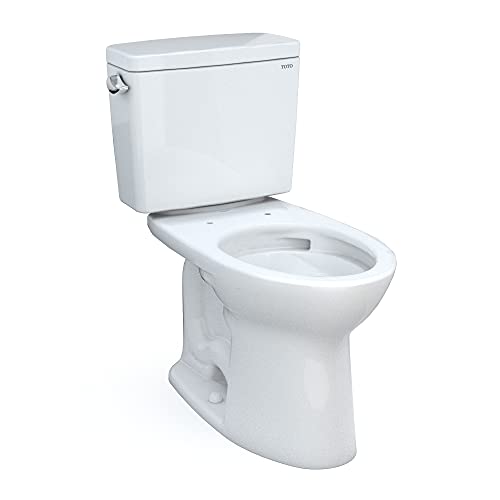
The Drake is the clearest example of how specific part choices translate directly into flush performance: a 3-inch flush valve, a computer-designed bowl, and a fully glazed 2-1/8-inch trapway combine to produce a 1,000 gram MaP result at 1.28 GPF with parts that are universally available at every hardware store.
The Drake's 3-inch G-Max flush valve is the part most worth noting. By increasing the opening from the standard 2 inches to 3 inches, TOTO allows the tank water to pour into the bowl roughly twice as fast. That speed is what initiates a strong, fast siphon before friction losses and gravity slow the surge. The computer-designed bowl directs that surge into the siphon jet and the fully glazed 2-1/8-inch trapway, where the slick ceramic surface reduces resistance and lets waste pass cleanly.
Owner review patterns across major retailers over many years consistently highlight that the Drake has used the same G-Max parts for well over a decade. Flappers, fill valves, trip levers, and tank bolts are standard and available from multiple manufacturers. The most common owner caution is that it uses a conventional rubber flapper rather than a longer-life canister seal, which means a flapper replacement roughly every three to five years. The Drake II (CST454CEFG) uses the same flush system in a slightly more contemporary tank and bowl profile.
The Drake is the teaching model for how toilet parts translate to performance. Nothing in its design is exotic: it simply uses a larger flush valve and a wider glazed trapway than most competitors at the same price, and those two dimensional choices are why it has been the benchmark for residential gravity flush performance for years. If you want to understand what makes a toilet strong, buy the Drake and read its parts diagram.

The Cimarron addresses the most replaced toilet part, the flapper, by replacing it entirely with Kohler's AquaPiston canister, a cylindrical seal that lifts straight up and distributes wear evenly, lasting significantly longer before needing replacement and providing an even full-rim water release on every flush.
Instead of a flapper hinging open on one side, the AquaPiston canister lifts straight up from the flush valve seat, releasing water around the full 360-degree perimeter of the canister base. This gives the flush a notably even, complete bowl rinse and, because the canister moves vertically rather than pivoting on a worn rubber hinge, it sees much less mechanical stress over time. The trade-off is that AquaPiston canister replacements are Kohler-specific parts rather than the generic flappers available at every hardware store, so if you are handy about repairs, account for that in your sourcing.
Owner review patterns highlight the quiet, balanced flush and the reduced upkeep compared to previous conventional-flapper toilets. The 800 gram MaP is strong and sufficient for most family bathrooms, though it trails the 1,000 gram scores of the TOTO Drake or Kohler Highline. The Kohler Santa Rosa uses the same AquaPiston system in a one-piece format for buyers who want the canister advantage without a tank-to-bowl seam.
The Cimarron is the right pick for anyone whose main frustration has been replacing flappers on their old toilet. Swapping a universal rubber flapper for a Kohler-specific canister is a reasonable trade when that canister is the part most likely to cause a running toilet on a conventional design, and the full-rim release is genuinely more even than a single-sided flapper opening.

The Cadet 3 proves the two parts that matter most for flush power do not have to cost extra: its 3-inch flush valve and EverClean fully glazed trapway deliver a 1,000 gram MaP result at 1.28 GPF, the same top-tier number as TOTO's flagship models, with universal replacement parts and a 10-year warranty that is exceptional for its price tier.
The Cadet 3 is essentially proof that flush valve size and trapway width are where the engineering budget actually matters. American Standard put a 3-inch flush valve and a glazed EverClean trapway into a value-tier toilet and the MaP result is identical to the flagships: 1,000 grams at 1.28 GPF. The EverClean surface also has antimicrobial properties verified to inhibit bacteria, mold, and mildew growth on the bowl surface.
Owner review patterns consistently note the strong flush performance for the price and the ready availability of American Standard replacement parts at every hardware retailer. The conventional rubber flapper will need eventual replacement, and a few owners note that the finish and glaze, while perfectly functional, lack the refinement of TOTO's CeFiONtect surface. The Champion 4 from American Standard steps up to a 4-inch flush valve and a 2-3/8-inch trapway for households with chronic clogging issues, at the cost of using 1.6 GPF rather than 1.28 GPF.
For outfitting a rental property or multiple bathrooms at once, the Cadet 3 is the straightforward answer. It has the two part specs that actually drive flush performance, a 3-inch valve and a glazed trapway, at a fraction of the flagship cost, and its 10-year limited warranty is the best in its price range. The parts are sold at every hardware store. There is no reason to pay more for these specific performance numbers.
After reviewing these three models and their part-by-part specs, the pattern is clear: the TOTO Drake is the pick for buyers who want the strongest, most proven part combination with maximum parts availability. The Kohler Cimarron is the pick for buyers who are tired of replacing flappers. The American Standard Cadet 3 is the pick for buyers who want a 1,000 gram MaP result without the cost of the flagship models. None of these choices requires trusting marketing language; all three are justified by the same two numbers: flush valve diameter and trapway width.
A toilet is a tank full of parts that release water and a bowl that turns it into a siphon. The fill valve and flapper are the parts you will replace over its life. The flush valve diameter and trapway width are the parts that decide whether that life is spent flushing confidently or reaching for a plunger. Start with the TOTO Drake, whose 3-inch flush valve and fully glazed 2-1/8-inch trapway clear 1,000 grams MaP at 1.28 GPF with widely available parts. Choose the Kohler Cimarron for a longer-service canister seal. Choose the American Standard Cadet 3 for the same key flush specs at a lower cost with an unusually long warranty.
The tank contains the fill valve (which refills the tank after each flush), the flush valve (the large bottom opening that releases water into the bowl), the flapper or canister seal (which covers the flush valve seat and holds water between flushes), the trip lever and lift chain (which lift the flapper when you press the handle), the float (which signals the fill valve when to close), the overflow tube (a safety drain for overfill), and a small refill tube that restores the bowl water level during each refill cycle.
The flush valve diameter is the single most important tank part for flush power, and the trapway diameter is the most important bowl feature. A 3-inch flush valve releases water roughly twice as fast as a standard 2-inch valve, creating the fast surge that initiates a strong siphon. A wider, fully glazed trapway carries that surge away without resistance. Together these two dimensions explain why toilets like the TOTO Drake and American Standard Cadet 3 reach 1,000 gram MaP scores at just 1.28 GPF.
The flapper is the hinged rubber seal that covers the flush valve opening and holds water in the tank between flushes. A lift chain connects it to the trip lever, and pressing the handle pulls the chain to lift the flapper, releasing the tank water. After it drops back, the flapper must seal completely for the tank to refill. Flappers fail when the rubber warps, degrades from chlorinated water contact, or collects mineral scale, after which the toilet runs constantly or ghost-flushes. Replacing a flapper costs a few dollars and takes under five minutes.
The fill valve refills the tank with fresh water after each flush. It opens when the float drops as the water level falls, and closes when the float rises to the set height during refill. Replace it when the toilet hisses between flushes (indicating a slow leak past a worn seal), when it fills noticeably slower than before, or when it never fully stops running despite having a good flapper. A quality replacement fill valve, such as the Fluidmaster 400A, costs a few dollars and installs in about ten minutes.
The trapway is the curved S-shaped or P-shaped channel molded into the base of the bowl that carries waste from the bowl to the closet flange and drain line. It also holds the standing water that seals the drain against sewer gas. The interior diameter matters because a wider channel passes larger waste without catching. Standard trapways are about 2 inches across. Clog-resistant models use 2-1/8-inch or larger trapways. A fully glazed interior surface reduces friction and lets waste slide through more easily, which is why both the glazing and the diameter appear on the spec sheets of strong flushers.
The flush valve is the opening at the bottom of the tank through which water rushes into the bowl. Standard flush valves are 2 inches in diameter. Most strong-performing modern toilets use a 3-inch flush valve, which releases water roughly twice as fast. The American Standard Champion 4 uses a 4-inch flush valve for maximum flow rate. Canister-style valves (used by Kohler's AquaPiston system) lift a cylindrical sleeve vertically and release water from the full perimeter of the valve opening, functioning differently from a round-hole flapper design.
MaP (Maximum Performance) is an independent testing program that measures how many grams of solid waste a toilet clears in a single flush. Scores range from 250 to 1,000 grams, with 1,000 grams being the highest tier. A score of 600 grams is adequate for a powder room with light use. A score of 800 grams is solid for most family bathrooms. A score of 1,000 grams means the toilet is at the top of what residential gravity flush toilets can achieve. The Drake, Drake II, UltraMax II, Cadet 3, Kohler Highline, and Gerber Viper all reach 1,000 grams MaP at 1.28 GPF.
The wax ring is a ring of soft wax that sits between the bottom of the toilet base and the closet flange. When the toilet is set and bolted down, its weight compresses the wax into an airtight seal against sewer gas and waste. A failed wax ring causes water to leak from the base of the toilet after flushing and is a common source of sewer odor. Replace it any time the toilet is removed from the floor, since once lifted, a compressed wax ring no longer seals reliably. Modern wax-free rubber or foam alternatives can be repositioned without replacement.
A flapper is a hinged rubber disk that pivots open on one side when the chain lifts it, creating an opening at the flush valve. A canister seal, such as Kohler's AquaPiston, is a cylindrical sleeve that lifts straight up, opening a 360-degree opening around its base. The canister design wears more evenly, lasts longer before needing replacement, and releases water from the full perimeter of the valve for a more even bowl rinse. The trade-off is that canister parts are brand-specific and cost more than a generic flapper.
The overflow tube is the open-top vertical pipe standing in the center of the tank. If the fill valve ever fails to shut off at the set water level, water flows into the overflow tube and drains into the bowl below, preventing the tank from overflowing onto the floor. If water is audibly or visibly draining down the overflow tube continuously, the float is set too high or the fill valve is faulty. The small refill tube that clips onto the overflow tube sends a thin stream down it during each refill cycle to restore the bowl's water seal.
Rim jets are the small holes under the inner rim of the bowl. A hidden rim channel channels a portion of the flush water under the rim and out through these jets, sending water spiraling around the bowl walls to rinse them clean during each flush. They clog over time because hard water deposits calcium and magnesium minerals inside the enclosed rim channel, gradually narrowing or blocking individual holes. Clogged rim jets produce a weak, uneven spiral and a bowl that does not rinse cleanly on one side. Muriatic acid or a dedicated toilet bowl cleaner applied with a brush to the holes clears most buildup.
Most standard toilet parts are universal. Flappers (sized to the flush valve diameter), fill valves, supply lines, wax rings, and closet bolts fit nearly any conventional toilet regardless of brand. The exceptions are proprietary designs: Kohler's AquaPiston canisters, certain dual-flush actuators, and some one-piece toilet flush valves require brand-specific or model-specific parts. Always identify the flush valve diameter before buying a replacement flapper, since a 2-inch flapper will not seal a 3-inch valve.
The tank volume and the fill valve's float set-point together determine how much water is stored and released each flush, expressed as GPF (gallons per flush). Standard toilets use 1.6 GPF. WaterSense-certified toilets use 1.28 GPF or less while passing EPA flush-performance requirements. Dual-flush toilets provide a partial flush (typically 0.8 to 1.0 GPF) and a full flush. The float determines the refill level: lowering the float reduces water use per flush, but setting it too low leaves too little water for a complete siphon.
The closet flange is the round fitting mounted to the floor that connects the toilet's base to the branch drain pipe below. The wax ring seals the toilet to the flange, and two closet bolts (Johnny bolts) slot into the flange and bolt the toilet down. A cracked or corroded flange, or one that sits too low after new flooring is installed, causes the toilet to rock during use and allows the wax seal to fail over time. A rocking toilet should never be ignored: the motion eventually cracks the wax seal and can crack the toilet base or the flange itself.
Keep a spare flapper and a fill valve on hand. These two parts cause the large majority of running-toilet problems and cost very little. A spare braided stainless supply line is also worth having, since old plastic supply lines crack without warning. If you have a standard 12-inch rough-in toilet, a spare wax ring takes up almost no space and eliminates a hardware store trip during any future toilet removal. Identify your toilet's flush valve diameter before buying spare flappers so you order the right size.
A fully glazed trapway has a smooth ceramic finish applied to the interior walls of the curved waste channel, identical to the glaze on the outside of the toilet. This smooth surface significantly reduces friction so waste slides through cleanly rather than catching on the slightly porous bare porcelain beneath. Every high-MaP toilet includes a fully glazed trapway, including the TOTO Drake, Gerber Viper, and American Standard Cadet 3. It is worth choosing over an unglazed trapway specifically because clog resistance is one of the most common real-world frustrations with lower-rated toilets.
Yes, partially. A dual-flush toilet replaces the single trip lever with a two-button actuator on the tank lid, and the tank uses a dual-flush valve assembly instead of a single flapper. One button triggers a short flush (typically 0.8 to 1.0 GPF) for liquid waste, and the other triggers a full flush for solids. The fill valve, bowl, siphon jet, and trapway work identically to a standard toilet. The dual-flush valve and actuator are usually model-specific replacement parts. Always check the full-flush MaP score when buying a dual-flush toilet to confirm the full button clears the bowl in one flush.
A skirted trapway, also called a concealed trapway, has a smooth ceramic panel covering the S-curve visible on the outside of the bowl, giving the toilet a clean, contemporary profile and making it easier to wipe down. It does not change the internal diameter or glaze of the trapway and therefore does not affect flush performance or clog resistance. Models like the Woodbridge T-0001, T-0019, and Swiss Madison St. Tropez use this design primarily for aesthetics and cleaning convenience.
A slowly dropping bowl water level between flushes (not after a flush) usually means the flapper is not sealing completely, allowing tank water to leak silently into the bowl. The bowl water level drops because the leaked water slowly drains down the trapway. Add a few drops of food coloring to the tank without flushing; if the color appears in the bowl without flushing, the flapper is leaking. Replace the flapper. If the color does not transfer, a crack in the trapway or porcelain may be the cause, which is rarer but requires toilet replacement.
One-piece and two-piece toilets use identical internal tank parts: the same fill valve, flush valve, flapper or canister, trip lever, and float. The difference is the exterior: a two-piece toilet has a separate tank that bolts to the bowl via a tank-to-bowl gasket and two or three tank bolts, creating a joint that can eventually leak. A one-piece toilet casts both as a single unit, eliminating that joint, reducing the leak risk, and making the toilet easier to clean. The flush system, trapway, and MaP performance are determined by the internal part dimensions, not by whether the toilet is one-piece or two-piece.
No flange, just a bare pipe in concrete? Here is how to install a toilet flange on a raw drain stub the…
Read the guideYes, you can clean a toilet with hydrogen peroxide. Learn what 3 percent peroxide removes, what it leaves behind, and how to…
Read the guideSee exactly how a toilet bowl refills to the same level every time, from fill valve to refill tube, and why that…
Read the guide