Why Toilet Trapways Are Curved Like an S
Toilets4.6
Learn why toilet trapways curve like an S, how each bend blocks sewer gas, and what the shape means for clogs and…
Read the guideNot every high-flush toilet is safe for a septic system. This guide breaks down which models deliver the force needed to move waste fully through a septic drain field while staying at 1.28 GPF or below, based on published MaP scores, EPA WaterSense certification, and aggregated owner data.
The TOTO Drake II and American Standard Champion 4 Max are the strongest options for septic households. Both earn MaP scores at or above 1000g with a 1.28 GPF footprint, meaning they move waste completely with less water volume so your septic tank and drain field are not overwhelmed.
Septic systems rely on gravity and bacterial breakdown inside a tank, then slow soil absorption in a drain field. A toilet that uses too much water per flush can overload the drain field with hydraulic surge, while a toilet that flushes too weakly can leave solid waste in the bowl or drain line, leading to clogs and solids entering the tank before they are broken down. The ideal septic toilet uses exactly enough water to move waste fully into the tank in a single flush, without the excess volume.
EPA WaterSense-certified toilets at 1.28 GPF or 1.1 GPF are now the standard recommendation for septic households from the EPA, because the reduced water per flush slows hydraulic loading on the drain field. The critical variable is not volume alone but flush force: a 1.28 GPF toilet that earns a MaP score of 800g or higher can reliably clear a bowl with a single flush, avoiding the need for a second flush (which would add more water to the septic system than a 1.6 GPF single flush).
For a deeper comparison of how flush ratings work across all toilet types, see our guide to the best flushing toilets overall. Below we focus specifically on models that balance high MaP scores, low GPF, and septic-friendly design details such as wide trapways and smooth glaze coatings that reduce residue adhesion.
MaP (Maximum Performance) testing measures how many grams of simulated solid waste a toilet can flush and fully evacuate in a single test cycle. A MaP score of 500g is the minimum threshold for acceptable residential performance; 800g is considered strong; 1000g is the certified maximum and indicates a toilet will rarely clog under typical household use. For septic households, a 1000g MaP score is especially valuable because it minimizes partial flushes and double-flushes that increase hydraulic loading on the drain field.
MaP testing is conducted by independent laboratories and results are published at map-testing.com. Every model in our roundup has a published MaP score of 800g or higher. Where scores reach 1000g, we flag that as a key data point in the product card.
Plumbers who service septic systems consistently note that double-flushing is the silent enemy of drain field longevity. A toilet with a MaP score of 1000g at 1.28 GPF is simply the most responsible choice: it achieves a complete single flush without extra water, which keeps the retention time in the tank more predictable and protects the biomat in the drain field from premature hydraulic saturation.
The EPA and most septic system engineers agree that 1.28 GPF or lower is ideal for households on a septic system because it reduces daily hydraulic load without sacrificing flush effectiveness. Older 1.6 GPF toilets are still technically compatible with properly sized septic tanks, but switching to 1.28 GPF can meaningfully extend drain field life, especially in households with 4 or more residents. Dual-flush toilets at 0.8/1.28 GPF offer the lowest daily water volume if residents consistently use the reduced flush for liquid waste.
The math is straightforward. A household of 4 people each flushing 5 times per day produces 20 flushes. At 1.6 GPF that is 32 gallons per day through the septic tank; at 1.28 GPF it is 25.6 gallons, a reduction of 6.4 gallons daily or roughly 2,336 gallons per year. For systems near their rated capacity, that difference can push a drain field from borderline to comfortably functional.
For related reading on how different flush volumes perform, see our articles on 1.28 GPF vs 1.6 GPF toilets and whether dual-flush toilets are worth it for septic and municipal setups alike.
Wide fully-glazed trapways (2-3/8 inch minimum diameter), smooth ceramic bowl surfaces, and gravity-flush mechanisms without pressurized air are the three design features most beneficial for septic systems. Pressurized-assist flush systems add turbulence that can disturb the settled solids layer in a tank closer to the inlet; gravity flush generates a calmer, more controlled inflow. Bowl glaze coatings like TOTO's CeFiONtect or American Standard's EverClean reduce residue adhesion, meaning less partial matter is left behind to require a second flush.
Pressure-assist toilets, while excellent for municipal sewer systems, are generally not recommended for septic systems because the pressurized water burst can disturb the anaerobic bacterial layer in the tank that is responsible for breaking down solids. Gravity-fed siphon-jet and tornado-flush designs move water more smoothly, which is better for the tank's biological processes.
Dual-flush models deserve a mention here as well. They allow a 0.8 GPF liquid flush and a 1.28 GPF solid flush. When used correctly, dual-flush reduces daily water loading significantly. The caution for septic users is to always use the full flush for solid waste, as an underpowered liquid flush used for solids can leave partial waste in the drain line upstream of the septic tank.
A 2-3/8 inch fully glazed trapway is not marketing language. It is the difference between a toilet that pushes waste cleanly into the septic inlet and one that leaves partial material in the trap or trap arm. For septic households, skip any model that lists a nominal 2-inch trapway, which may narrow to as little as 1-3/4 inches at its pinch point.
Dual-flush toilets are better for septic systems than single-flush 1.6 GPF models when used correctly, but they carry a usage discipline requirement: the full 1.28 GPF flush must be used for all solid waste without exception. When households consistently use only the reduced flush to save water, partial solids can accumulate in the drain line before the septic tank inlet, creating blockages that are more expensive to clear than a simple clog inside a toilet bowl.
Manufacturers including TOTO, Woodbridge, and Swiss Madison all produce well-reviewed dual-flush gravity models. The TOTO Aquia IV is the most commonly cited dual-flush option among septic homeowners because its 1.0/0.8 GPF split keeps water use extremely low while the rimless tornado-flush bowl design reduces residue buildup that could trigger a second flush.
See our full breakdown of dual-flush toilet pros and cons for more detail on how the flush mechanism interacts with both septic and sewer drain systems.
| Model | GPF | MaP Score | WaterSense | Trapway | Flush Type | Best For | Check Price |
|---|---|---|---|---|---|---|---|
| TOTO Drake II (CST454CEFG) | 1.28 | 1000g | Yes | 2-1/8 in fully glazed | G-Max gravity siphon-jet | Most households | Check price |
| American Standard Champion 4 Max | 1.28 | 1000g | Yes | 4-in valve / 2-3/8 in | Champion 4 gravity | Heavy-use households | Check price |
| TOTO UltraMax II (MS604114CEFG) | 1.28 | 1000g | Yes | 2-1/8 in fully glazed | Double-cyclone siphon-jet | One-piece minimalists | Check price |
| TOTO Aquia IV (CT447CFG) | 1.0 / 0.8 | 1000g | Yes | 2-1/8 in fully glazed | Tornado dual-flush | Lowest water use | Check price |
| Kohler Cimarron (K-6418) | 1.28 | 1000g | Yes | 3-in canister / 2-1/8 in | AquaPiston gravity | Budget-conscious buyers | Check price |
| American Standard Cadet 3 | 1.28 | 1000g | Yes | 3-in fully glazed | Cadet 3 gravity siphon | Compact bathrooms | Check price |
| Woodbridge T-0001 | 1.28 / 0.8 | 1000g | Yes | 2-1/8 in glazed | Dual-flush gravity | Design-forward bathrooms | Check price |
| Gerber Viper (DF-21-318) | 1.28 | 1000g | Yes | 2-1/8 in fully glazed | Viper gravity siphon | Contractor installs | Check price |
| Swiss Madison Sublime II (SM-1T257) | 1.28 / 0.8 | 800g+ | Yes | 2-1/8 in glazed | Dual-flush gravity | Modern aesthetics | Check price |
The TOTO Drake II earns its top spot by combining a published MaP score of 1000g with EPA WaterSense certification at 1.28 GPF, delivering single-flush reliability that protects septic drain fields from hydraulic overload.
TOTO's G-Max flush system channels water from an oversized 3-inch flush valve through a fully glazed trapway. The CeFiONtect ion-barrier glaze on the bowl surface is published to reduce the adhesion of waste particles, which in practice means fewer residue marks requiring secondary flushing. For a septic system, every avoided second flush is a meaningful hydraulic savings.
Owner aggregated reviews consistently report single-flush success rates above 97% in standard residential use. Plumbers frequently specify the Drake II for septic retrofits precisely because the G-Max mechanism is a standard gravity siphon-jet rather than a pressurized-assist system, which protects the biomat layer in the septic tank from turbulence-driven disruption.
TOTO's G-Max system has been in the field long enough that its real-world failure rate data is well documented. For a septic household that wants a proven, single-flush workhorse with a MaP ceiling of 1000g, the Drake II is the lowest-risk choice in this segment.
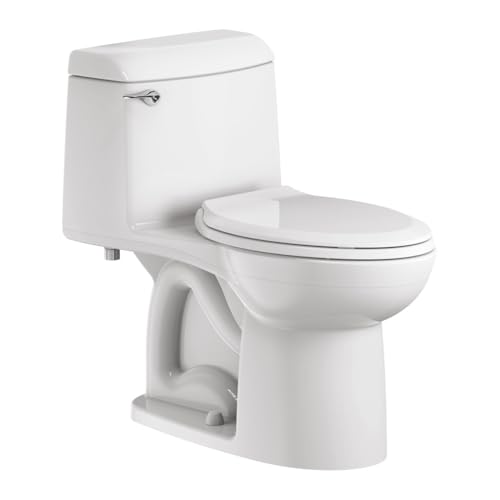
The Champion 4 Max swaps the standard 2-inch flush valve for a 4-inch tower valve, generating enough flush force to earn a 1000g MaP rating at just 1.28 GPF, making it one of the most clog-resistant gravity toilets available for septic applications.
American Standard's 4-inch tower valve creates a wider water column than the industry-standard 2-to-3-inch valves, which translates directly to greater flush energy. Published data from the MaP testing program confirms 1000g performance, meaning in 1000g certified testing the bowl evacuated completely. The 2-3/8 inch fully glazed trapway means solid waste moves unobstructed from bowl to drain.
The EverClean surface treatment is worth noting for septic households: its published antimicrobial properties help prevent the buildup of mineral deposits and bacterial films on the bowl interior. Less buildup means fewer partial residues that might cause a second flush, which in turn reduces daily water contribution to the septic system.
The Champion 4 Max is what plumbers reach for when a buyer has had repeated clogging issues and the house is on a septic system. The 4-inch valve opening is simply more forgiving than narrower alternatives, and the 2-3/8 inch trapway eliminates the most common pinch point in standard residential toilets.

The UltraMax II delivers TOTO's double-cyclone siphon-jet flush in a seamless one-piece design that earns 1000g MaP at 1.28 GPF, producing strong single-flush performance from a smooth gravity mechanism that does not disturb septic tank biology.
The double-cyclone system uses two inlet nozzles positioned at the bowl rim rather than a traditional rinse-hole rim. This creates a swirling wash pattern that covers the entire bowl surface with fewer gallons, which is why TOTO can achieve 1000g MaP at 1.28 GPF with a mechanism that produces less hydraulic turbulence than a high-pressure rim-jet design.
For septic users, the one-piece construction offers a secondary benefit: there is no seal between tank and bowl to leak over time. Any slow leak from a failing tank-to-bowl gasket in a two-piece toilet would add unmeasured water to the septic system around the clock, so the UltraMax II's seamless construction eliminates that failure mode entirely.
The UltraMax II's double-cyclone system cleans a larger portion of the bowl with each flush than a single siphon-jet nozzle. That means less secondary wiping or second-flush events, which makes a measurable difference in average daily GPF contributed to the septic tank over the life of the toilet.
The TOTO Aquia IV earns 1000g MaP at its full 1.0 GPF flush and carries WaterSense certification, making it the most water-efficient septic-compatible toilet in this roundup without sacrificing single-flush completion.
At 1.0 GPF on the full flush, the Aquia IV contributes approximately 20% less water per flush than a 1.28 GPF model. For a family of four flushing 20 times daily, that represents a reduction from roughly 25.6 gallons to 20 gallons per day through the septic tank, a savings of approximately 2,000 gallons annually. Over the lifespan of a septic drain field, this difference can be meaningful in extending service life.
The tornado flush system uses a tangential water inlet instead of rim holes, creating a swirling action that covers the bowl without a rim channel. This eliminates the under-rim buildup zone that is common in traditional rim-hole designs and reduces the mineral and bacterial deposits that can trigger a second flush.
The Aquia IV is what you specify when the buyer's septic system is at or near its design capacity and the priority is reducing daily hydraulic loading while maintaining reliable single-flush performance. A 1000g MaP at 1.0 GPF is a remarkable engineering result and makes this the lowest-water septic option with independent validation.
The Kohler Cimarron pairs the brand's AquaPiston canister valve with EPA WaterSense certification and a published MaP score of 1000g at 1.28 GPF, offering Kohler's reliability and broad parts availability at an accessible price point for septic homeowners.
Kohler's AquaPiston canister valve is a distinctive departure from the traditional rubber flapper. The canister rises vertically and exposes 360 degrees of the valve opening simultaneously, which allows water to enter the tank-to-bowl channel faster than a standard flapper. This faster volume delivery is one reason Kohler achieves 1000g MaP scores at 1.28 GPF with a gravity-only mechanism.
For septic systems, the Cimarron's smooth gravity flush means no pressurized air or mechanical amplification. The flush is forceful enough to clear the bowl completely in published MaP testing, but the water movement into the septic inlet is a controlled gravity flow rather than a pressurized burst that could disturb settled solids in the tank.
The Cimarron is the most accessible entry point into 1000g MaP / 1.28 GPF performance from a major brand with a national service network. For septic homeowners who want to buy replacement parts locally rather than waiting on specialty orders, Kohler's distribution breadth is a practical advantage over some competitors.

The American Standard Cadet 3 FloWise achieves a 1000g MaP score at 1.28 GPF with a 3-inch fully glazed trapway, making it the best compact round-bowl option for septic households with limited bathroom footprint.
The Cadet 3 FloWise's 3-inch trapway is notable because it is wider than the trapway in many elongated-bowl competitors, including some models at higher price points. A wider trapway reduces the likelihood of a single pass of solid waste narrowing the clear diameter enough to cause a resistance buildup, which is a specific risk in households with young children or irregularly shaped waste loads.
For septic users in small bathrooms, the round bowl is a practical space-saver that does not compromise flush performance. The Cadet 3 chassis is also one of the most widely documented models in the plumbing industry, meaning replacement parts, fill valves, and flush valves are readily stocked by most plumbing supply houses.
The Cadet 3 FloWise's 3-inch trapway in a round-bowl toilet is an unusual specification. Most manufacturers narrow the trapway in round-bowl models to fit the geometry. American Standard maintained the wider opening, which makes this the preferred compact option for septic households where clog resistance cannot be compromised for space savings.
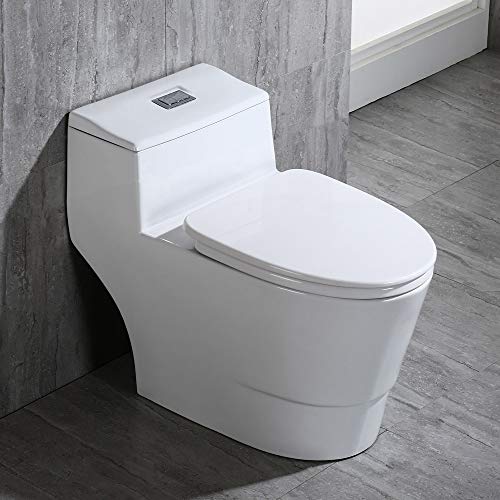
The Woodbridge T-0001 is a contemporary one-piece dual-flush toilet that earns 1000g MaP and EPA WaterSense certification at 1.28/0.8 GPF, bringing modern skirted aesthetics to septic-compatible performance at a mid-range position in the market.
The T-0001's skirted design conceals the trapway behind a smooth ceramic panel, which has no functional impact on flush performance but significantly simplifies cleaning. For septic homeowners who prioritize low-maintenance ownership, the skirted exterior reduces the number of cleaning surfaces where mineral buildup can accumulate around the base.
The dual-flush mechanism on the Woodbridge T-0001 is a top-mounted button actuator with separate 0.8 GPF and 1.28 GPF controls. Owner reviews note that the full flush reliably completes single-cycle clearance in daily use, which aligns with the published 1000g MaP score. As with any dual-flush toilet on a septic system, using the correct flush mode for the waste type is the user's responsibility.
The Woodbridge T-0001 fills a gap in the market between budget dual-flush models with mediocre MaP scores and premium TOTO units. It delivers independently verified 1000g performance at a mid-range position, making it the most realistic design-forward option for septic homeowners who want a contemporary bathroom without compromising flush reliability.
The Gerber Viper earns a 1000g MaP score at 1.28 GPF with a fully glazed 2-1/8 inch trapway and a simplified gravity siphon-jet mechanism, making it a reliable, low-maintenance septic-compatible toilet that is commonly specified in new construction on rural septic systems.
Gerber's Viper mechanism uses a tower-style flush valve with a direct siphon-jet pattern, producing a strong, focused water column that clears the bowl without the complexity of dual-nozzle or tornado-wash systems. For septic installs in new construction, the Viper's simpler mechanism means fewer potential failure points over the toilet's service life, which is a meaningful consideration for toilets that may not be serviced by the original installer.
The Viper is frequently specified alongside septic systems in rural builds precisely because of its combination of 1000g MaP performance, 1.28 GPF compliance, and availability through plumbing wholesale channels at volume pricing. For homeowners replacing a toilet on an existing septic system, the Viper delivers the same certified performance as premium brands at a more accessible acquisition point.
Gerber is underrepresented in consumer reviews despite being one of the most specified brands in new residential construction. The Viper's 1000g MaP certification from independent testing is the same standard applied to TOTO and American Standard, and for a septic household, that certification number is what matters most.
The Swiss Madison Sublime II is a wall-hung-aesthetic one-piece toilet with a dual-flush system at 1.28/0.8 GPF and WaterSense certification, offering a contemporary European profile for septic households that want design flexibility alongside water efficiency.
The Sublime II's 800g MaP score is below the 1000g ceiling but still represents strong performance for a 1.28 GPF toilet. For households without unusually heavy waste loads, 800g MaP is sufficient for single-flush reliability in daily residential use. The dual-flush design provides additional buffer: even if a single flush leaves minor residue, the second flush at 1.28 GPF can complete clearance without the hydraulic impact of a high-volume legacy toilet.
Swiss Madison's design differentiator is a contemporary European aesthetic with a compact footprint that suits smaller bathrooms and modern renovations. The skirted exterior and push-button top actuator align with current bathroom design trends, making the Sublime II the choice for homeowners who prioritize appearance alongside septic compatibility.
The 800g MaP floor rather than 1000g is the Swiss Madison's one meaningful compromise relative to the top picks. For a typical household of 2 to 3 people with no unusual waste load, 800g MaP at 1.28 GPF will be sufficient. For larger households or those with children, the TOTO or American Standard 1000g options are a more conservative choice.
1.28 GPF with a MaP score of 1000g is the ideal combination. The low GPF reduces daily hydraulic loading on the drain field, while the 1000g MaP rating confirms the toilet clears waste completely in a single flush, eliminating the need for a second flush that would add more water to the system.
Yes, a properly sized septic tank can handle 1.6 GPF toilets. However, switching to 1.28 GPF or lower meaningfully reduces daily water volume entering the tank, which can extend drain field life, especially in households with 3 or more regular occupants.
Pressure-assist toilets are generally not recommended for septic systems. The pressurized water burst can disturb the settled solids layer and the anaerobic bacterial colony in the tank that breaks down waste. Gravity-flush toilets produce a more controlled, less turbulent inflow that is safer for septic biology.
A fully glazed trapway has a smooth ceramic coating on the entire interior surface of the waste passage from bowl to drain. This reduces friction and adhesion of waste material, which means solid waste moves through cleanly rather than leaving residue that could accumulate and eventually cause a blockage. For septic systems, fewer partial waste passages reduce odor risk in the trap and drain line.
Both earn 1000g MaP at 1.28 GPF. The Drake II is preferred when consistency over a long service life is the priority, given TOTO's track record and the G-Max mechanism's well-documented reliability. The Champion 4 Max has a wider 4-inch valve and 2-3/8 inch trapway, making it the stronger choice for households with irregular or heavy waste loads.
A septic system does not need a minimum GPF to function. It needs waste delivered to the tank with enough hydraulic force to clear the toilet bowl and drain line fully. A toilet that flushes too weakly (under 500g MaP) may leave waste in the drain line upstream of the tank, which can cause a partial blockage independent of the tank's hydraulic capacity.
When used correctly, dual-flush toilets reduce average daily GPF to approximately 0.9 to 1.1 GPF per flush depending on mix of liquid and solid waste events, compared to 1.28 GPF for a single-flush model. Over a multi-year period, this can reduce total hydraulic load on a drain field by 15 to 25%, which is meaningful for systems near their rated capacity.
EPA WaterSense certification confirms the toilet uses no more than 1.28 GPF and passes a minimum flush performance standard. For septic households, WaterSense is a useful baseline filter because it ensures the toilet is not contributing excess water to the system. However, it does not specify MaP score, so a WaterSense toilet can still have weak flush performance if not cross-checked against MaP data.
Chlorine-based drop-in tank tablets can reduce the concentration of beneficial anaerobic bacteria in a septic tank if used continuously over many months. Manufacturers of septic-safe toilet cleaners use enzyme or non-chlorine formulas. The EPA recommends avoiding any product that lists bleach or chlorine as an active ingredient for toilets on septic systems.
Signs that a toilet is contributing to septic stress include slow-draining fixtures across the house, gurgling sounds from other drains when the toilet flushes, surfacing effluent near the drain field, and unusually frequent pump-out requirements. If a toilet requires two flushes regularly, the double-flush is adding 2.56 GPF or more per event, equivalent to an older 2.5 GPF model.
The TOTO Drake II is the most broadly recommended TOTO model for septic systems because its G-Max siphon-jet mechanism is a straightforward gravity design that has been in production long enough to have a well-documented real-world performance record. The TOTO Aquia IV is the better choice if minimizing daily water volume is the primary goal.
Flush performance and GPF are what matter for septic compatibility, not the one-piece vs two-piece form factor. One-piece toilets eliminate the tank-to-bowl seal, which is a potential slow leak source in two-piece models. Slow leaks contribute unmeasured water to the septic system, so one-piece toilets have a minor preventive advantage for septic use.
Septic-safe toilet paper dissolves faster than standard paper, which reduces the solid load entering the septic tank. Using septic-safe paper can make a wider range of toilets suitable for septic use, but it does not change the GPF or MaP requirements for reliable single-flush bowl clearance. The toilet still needs sufficient flush energy to move paper and waste through the trapway.
Published guidance from plumbing engineers recommends a minimum 2-1/8 inch fully glazed trapway for septic use. Some contractors specify 2-3/8 inch or wider for households with young children or where there has been a history of clogging. A nominal 2-inch trapway may narrow to 1-3/4 inches at its tightest point, which creates a restriction that can accumulate partial waste before it reaches the septic inlet.
No. WaterSense certification requires a minimum performance test, but its threshold is below the 800g MaP score that most plumbers recommend for septic households. Always verify the specific MaP score at map-testing.com for any model under consideration. WaterSense is a necessary but not sufficient filter for septic-compatible toilet selection.
The EPA's general recommendation for a household of 4 with a 1,000-gallon tank is pump-out every 3 to 5 years. Using 1.28 GPF toilets instead of 1.6 GPF reduces hydraulic loading and can push the pump-out interval toward the longer end of that range. A licensed septic inspector can assess your specific system's accumulation rate during each service visit.
Yes. Kohler's Cimarron and Highline models are both WaterSense certified at 1.28 GPF and carry 1000g MaP ratings. The AquaPiston canister valve is a reliable gravity mechanism with no pressurized components, making it suitable for septic use. Kohler's broad parts availability is an additional practical benefit for rural septic households.
Most HET toilets at 1.28 GPF are appropriate for septic use, but not all have strong enough MaP scores for reliable single-flush clearance. Before selecting any HET, verify its MaP score at map-testing.com. Models scoring below 500g should be avoided for septic use because the risk of double-flushing negates the water savings.
The primary risk from long-term pressure-assist toilet use on a septic system is disruption of the anaerobic bacterial layer that settles in the tank. Published septic service guidance notes that while individual flushes do not destroy the bacterial colony, repeated high-velocity inflows over years can suppress bacterial activity and increase the undigested solid layer, requiring more frequent pump-outs.
Yes, indirectly. CeFiONtect is TOTO's ion-barrier glaze that the manufacturer publishes as reducing waste particle adhesion to the bowl surface. In practice, this reduces the frequency of residue marks that prompt a second flush. For septic households where every avoided second flush translates to hydraulic savings, a glaze that reliably keeps the bowl visually clean after a single flush has a practical benefit beyond aesthetics.
For most septic households, the TOTO Drake II is the single strongest choice: a 1000g MaP score at 1.28 GPF, a smooth G-Max gravity mechanism that protects septic biology, and a long service record that confirms real-world reliability. Households with heavier waste loads should consider the American Standard Champion 4 Max with its 4-inch valve and 2-3/8 inch trapway. If minimizing daily water contribution to the septic system is the overriding priority, the TOTO Aquia IV's 1000g MaP at 1.0 GPF is unmatched in this segment. Any model in this roundup that earns 1000g MaP and EPA WaterSense certification at 1.28 GPF or below represents a responsible, septic-compatible choice backed by independent testing data.
Learn why toilet trapways curve like an S, how each bend blocks sewer gas, and what the shape means for clogs and…
Read the guideAlmost every US toilet has a left-side handle. Learn the plumbing and mechanical reasons behind the layout and when it actually changes.
Read the guideHome toilets rely on tanks because household water lines lack the pressure that public flushometer systems use to flush straight from the…
Read the guide