

Why Toilet Trapways Are Curved Like an S
Toilets4.6
Learn why toilet trapways curve like an S, how each bend blocks sewer gas, and what the shape means for clogs and…
Read the guideA wall hung toilet mounts its bowl to a steel carrier frame hidden inside the wall and conceals the cistern entirely behind the finished surface, so the fixture appears to float above the floor. This guide weighs every real advantage and disadvantage, from floating-floor cleaning and adjustable height to in-wall repair access and total installed cost, using published specs, MaP flush-test scores, EPA WaterSense data and aggregated owner feedback. By the end you will know exactly whether a wall hung toilet belongs in your bathroom or whether a strong floor-standing model is the smarter buy.
A wall hung toilet is worth it only when you are already opening the wall, typically during new construction or a full remodel. For most buyers the TOTO Aquia IV wall-hung paired with TOTO's DuoFit carrier is the right choice: its dual Tornado flush scores 1,000 grams on MaP, the 0.9 / 1.28 GPF dual-flush earns EPA WaterSense certification, and the adjustable-height carrier sets the bowl rim anywhere between 15 and 19 inches. If the wall is already finished, a high-MaP floor toilet is still the practical winner every time on total cost and repair simplicity.
The floating look of a wall hung toilet is striking enough that buyers regularly ask whether the design is a genuine upgrade or mostly an aesthetic statement. The honest answer is both, depending on your situation. A wall hung toilet delivers real, day-to-day advantages that a floor toilet cannot replicate: a completely open floor that wipes clean in one stroke, a bowl height you set to the inch before the wall closes, and a slim, clutter-free profile that makes even a modest bathroom feel larger. Those benefits are concrete. But so are the tradeoffs: a higher total installed cost, a wall cavity you must either have or build, and plumbing and valves hidden behind finished surfaces that are more involved to service than a standard open tank.
This guide works through every advantage and disadvantage in full. We compare wall hung toilets against floor-standing models on flushing power (MaP grams), water use (GPF and EPA WaterSense), cleaning, installation complexity, repair access, structural load requirements, cost and long-term reliability. We draw on published manufacturer specifications for models from TOTO, Kohler, American Standard, Swiss Madison and Woodbridge, independent MaP flush-test data from map-testing.com, EPA WaterSense certification records and the patterns across tens of thousands of aggregated owner reviews. We do not test these toilets ourselves or make commission-based placement decisions. The goal is a straight answer you can use to decide whether a wall hung toilet is right for your specific bathroom and situation. For a broader look at the top-ranked models across every toilet type, start with our guide to the best flushing toilets.
Understanding the system is essential before weighing the pros and cons, because the carrier and concealed tank drive most of the tradeoffs.
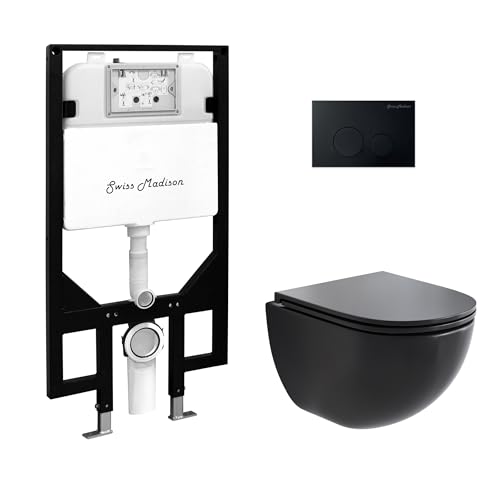
The key structural element most buyers underestimate is the carrier frame itself. On a floor toilet, the building's floor slab or subfloor carries the entire load. On a wall hung toilet, a heavy-gauge steel carrier, typically two vertical posts anchored to the studs and floor plate inside the wall cavity, carries that load and transfers it to the building's structure. The concealed cistern clips into the carrier and is plumbed in before the wall is closed. The finished surface, whether tile or drywall, covers everything, and a rectangular flush actuator plate is set into the tile for operation.
The bowl itself bolts to threaded studs that protrude through the finished wall from the carrier. Bowl height is set during the carrier installation by adjusting where the bowl studs land, which is how you achieve the adjustable-height benefit that makes wall hung toilets appealing for accessible or multi-user bathrooms. The waste exit is horizontal into the wall, connecting to an offset in the rough-in plumbing, which is why the rough-in and plumbing routes differ from a floor toilet and why a carrier install typically requires a licensed plumber. For guidance on the install side, our complete how to choose a toilet guide covers the full set of decisions involved, including rough-in, mounting style and flush type.
These are the genuine, daily-use benefits that a floor toilet cannot replicate, not marketing claims.
Because nothing touches the floor, you can run a mop, a robot vacuum or a wet cloth straight under the bowl from one side of the bathroom to the other. There is no floor base to clean around, no grout line against a pedestal, no hidden zone behind the bowl base that collects moisture and debris. In smaller bathrooms this is a real sanitation advantage, not a minor cosmetic one, and it is the single most frequently cited benefit in aggregated owner reviews for wall hung models from TOTO, Kohler and Swiss Madison.
This open-floor benefit also reduces moisture accumulation at the floor-to-toilet interface. Floor toilets develop a small zone at the base where condensation and splash land and sit, which is where discoloration and odor most often start. A wall hung toilet removes that zone entirely.
Standard floor toilets ship at a fixed rim height: typically 14 to 15 inches (standard height) or 16.5 to 18 inches (comfort or ADA height). With a wall hung toilet, the rim height is set during carrier installation anywhere in a range most manufacturers specify as 15 to 19 inches, before the wall is closed. This means you can configure the toilet precisely for the tallest user in the household, for ADA accessibility requirements, or for a child-accessible height in a family bathroom, without being locked to a factory dimension.
Kohler's in-wall carrier system and TOTO's DuoFit both allow this adjustment in the rough-in phase. Once the wall is closed the height is fixed, but it was your choice, not the manufacturer's. For buyers choosing between height options on floor models, our toilet height guide covers the full comparison of standard and comfort heights.
A wall hung toilet reclaims floor area in two ways. First, a wall hung bowl is typically 22 to 25 inches in projection from the wall, compared to 27 to 30 inches for a floor toilet counting the tank. The shorter front-to-back footprint is measurable in tight bathrooms and hallway-access half-baths. Second, because the carrier routes the waste horizontally into the wall rather than down through the floor, the rough-in offset can be adjusted during installation to push the bowl slightly closer to the wall, extracting further depth savings.
The visual effect is amplified by the open floor: fewer visual interruptions at floor level make the room read as larger. This is the same principle hotel designers use when specifying wall hung toilets for compact room bathrooms that need to feel premium.
A wall hung toilet removes every visible element except the bowl and a slim rectangular actuator plate. No exposed trapway, no tank silhouette, no floor base, no water supply line visible below the bowl. Brands like Swiss Madison St. Tropez, Kohler Veil and TOTO's Aquia IV wall-hung lean into geometric bowl shapes with clean angles that pair naturally with frameless glass, large-format tile and wall-mounted faucets. The result is a bathroom that reads as designed rather than assembled from standard parts.
Nearly every current wall hung toilet uses a dual-flush concealed cistern, operating at 0.8 or 0.9 gallons per flush on the partial flush and 1.28 gallons on the full flush. The EPA WaterSense standard requires 1.28 GPF or less and mandates a minimum 350-gram MaP score, and most premium wall hung systems from TOTO, Kohler and Swiss Madison meet or exceed both thresholds. The TOTO Aquia IV wall-hung operates at 0.9 and 1.28 GPF; the Swiss Madison St. Tropez wall-hung at 0.8 and 1.28 GPF. For a household flushing ten times per day, the partial-flush water saving against a standard 1.6 GPF toilet adds up to thousands of gallons annually.
The water efficiency advantage of wall hung toilets is real but easy to overstate. A dual-flush floor toilet like the TOTO Aquia IV standard version runs at the same 0.9 and 1.28 GPF as its wall-hung counterpart for far less total cost. If water savings is your primary driver, a high-efficiency floor toilet delivers the same EPA WaterSense performance without the in-wall carrier requirement. Choose wall hung for the aesthetics, the open floor and the height adjustability. Let water efficiency be a bonus, not the justification.
These are the concrete tradeoffs that the aesthetic advantages do not eliminate and that every buyer needs to factor in honestly before purchasing.
The purchase price of a wall hung toilet is misleading because you are buying a system, not a single fixture. You need three things: the bowl, the in-wall concealed tank or cistern, and the steel carrier frame. TOTO's DuoFit carrier, Kohler's in-wall carrier and Geberit's popular frame are sold separately from the bowl in most configurations. Add those components together and the hardware cost alone is typically two to three times the price of a comparable floor toilet. Then add the installation cost: a carrier install requires a licensed plumber for the rough-in reroute, and a wall to be framed, tiled or drywalled afterward, which is professional labor beyond a standard toilet replacement.
In a new construction or full remodel where the walls are already open and a plumber is already on-site, this added cost is manageable and the disruption is minimal. In a finished bathroom, opening the wall, building a carrier cavity, rerouting the waste line, closing and finishing the wall, and then hanging the bowl is a significant project with a budget to match. This is the single biggest reason most buyers in a finished bathroom are better served by a floor toilet.
A wall hung toilet cannot be installed without access to the wall cavity. The carrier frame must be anchored to the structural studs and floor plate, the concealed tank must be plumbed in, and all of this must happen before the wall is closed. In new construction or a gut remodel, the wall is already open and the rough-in is set during framing, making the install straightforward. In a finished bathroom, you must open the wall, which means removing tile or drywall, framing or re-framing the wall cavity to sufficient depth (a standard two-by-four wall at 3.5 inches is not deep enough; most carriers need 5 to 9 inches of finished-wall depth), running the plumbing, and then refinishing the wall completely.
This is not a weekend DIY project in an existing bathroom. It is a plumbing and carpentry job that most buyers hire out, and it typically means the bathroom is out of service for days rather than hours. Our complete toilet buying guide helps you evaluate when a wall hung toilet makes sense versus a simpler replacement.
On a floor toilet, every serviceable component sits inside the exposed tank. Fill valve, flush valve, flapper or canister, and trip lever are all visible and reachable by lifting the tank lid. Replacing a flapper takes five minutes. On a wall hung toilet, the fill valve, flush valve and all internal cistern components live behind the finished wall, accessible only through the flush actuator plate opening, which is typically a 6-by-8-inch or similar rectangular cutout in the tile. Most current carrier systems from Geberit, TOTO and Kohler are designed with this service access in mind, and minor adjustments to flush volume and fill valve height can be made through the plate opening. However, a serious internal failure in the concealed cistern can require removing the actuator plate, the access panel and potentially tile around it to reach the tank, which is a job for a plumber, not a five-minute fix.
The bowl-to-carrier connection is also different from a standard toilet. If the bowl seal leaks, diagnosing it requires checking behind the finished surface, and a corroded or damaged carrier bolt requires accessing the wall. Owner reviews for wall hung toilets from Swiss Madison and Woodbridge show a small but consistent pattern of complaints about accessing the in-wall components after installation, which is worth factoring into a long-term ownership calculation.
Floor toilets benefit from the height differential between a tank mounted 12 to 18 inches above the bowl rim and the bowl trap. That drop generates the gravitational pressure that drives the flush. A wall hung toilet's concealed tank sits lower relative to the bowl, which means the flush relies more on the engineering of the nozzles, the rim design and the trapway geometry to clear the bowl effectively. Poor-quality wall hung systems, particularly low-budget entry-level bowls with underpowered concealed tanks, can produce weaker flushes than a quality floor toilet at a fraction of the price.
MaP testing shows this pattern most clearly at the budget end. TOTO's premium Aquia IV wall-hung actually reaches the full 1,000-gram MaP ceiling, matching the best floor toilets, while Kohler's Veil wall-hung scores 800 grams. Mid-range wall hung models from Swiss Madison and Woodbridge typically score 600 grams, which still exceeds the 350-gram EPA WaterSense minimum but trails high-MaP performers like the American Standard Champion 4 (1,000 grams) or TOTO Drake II (1,000 grams). The gap that matters most is between premium and budget wall hung systems, not between wall hung and floor mounting as a category.
A wall hung toilet concentrates the entire load of the fixture and the user onto the carrier frame and the wall structure behind it. Carrier load ratings from major manufacturers range from 500 pounds (Swiss Madison) to 880 pounds (TOTO DuoFit), which is sufficient for the vast majority of users. However, the carrier must be properly anchored to structural framing, not just drywall. If the wall you plan to use is not on a structural or load-bearing path, or if the stud spacing does not align with the carrier's anchor points, framing modifications are required before the carrier can be safely installed. An improperly anchored carrier is a structural failure risk, which is why professional installation is strongly recommended.
How the two mounting styles compare on the factors that matter most when deciding which design belongs in your bathroom.
| Factor | Wall Hung Toilet | Floor Toilet (Best Comparable) | Edge |
|---|---|---|---|
| Cleaning - floor | Open floor, one-stroke mop | Clean around base | Wall Hung |
| Bowl height | Adjustable 15-19 in. | Fixed by model (14-18 in.) | Wall Hung |
| Visual profile | Floating, minimal | Tank visible, floor base | Wall Hung |
| Space saving | 22-25 in. projection | 27-30 in. with tank | Wall Hung |
| Install difficulty | Carrier + wall work | Floor flange, 1-2 hours | Floor Toilet |
| Total installed cost | Bowl + tank + carrier + labor | Single fixture + basic labor | Floor Toilet |
| Repair access | Through plate only | Open tank, easy reach | Floor Toilet |
| Flush power peak | 1000 g MaP (TOTO Aquia IV wall-hung) | 1000 g MaP (Champion 4, Drake II) | Tie |
| Water use (best) | 0.8 / 1.28 GPF dual | 0.9 / 1.28 GPF dual | Tie |
| EPA WaterSense | Yes (premium models) | Yes (most models) | Tie |
| DIY-friendly | No | Yes | Floor Toilet |
| Retrofit-friendly | Wall must be open | Drop-in on existing flange | Floor Toilet |
The most honest way to answer this question is by situation rather than by a blanket yes or no. Wall hung toilets are genuinely excellent products when they are used in the context they are engineered for. They are significantly harder to justify outside that context.
Buy a wall hung toilet if: You are building new or doing a full gut remodel and the wall will be open anyway. Your bathroom has a modern or minimalist design aesthetic where the floating look adds real coherence to the space. Adjustable bowl height matters in your household, either for ADA accessibility or multi-user comfort. The floor-cleaning benefit is a genuine daily priority, not just a theoretical one. Your budget comfortably covers the bowl, the concealed tank, the carrier frame and professional installation labor.
Skip a wall hung toilet if: The bathroom is finished and you are doing a straight toilet replacement. You need repair simplicity and want to be able to service the toilet yourself, since a floor toilet's open tank is far easier to work on than a concealed cistern behind an actuator plate. Your budget favors the toilet over the installation project, since even a premium wall hung system like the 1,000-gram TOTO Aquia IV wall-hung costs far more installed than an equally strong floor toilet. You are buying for a rental property where installation cost must be recovered over years of reduced repair calls.
The wall hung toilet's reputation as a high-maintenance choice is slightly overblown for premium systems. TOTO's DuoFit carrier and Kohler's in-wall frame are engineered with service access in mind, and the concealed cistern components are reachable through the actuator plate for routine adjustments. Where the concern is valid is for entry-level systems from brands without dedicated carrier support, where the service access cutout is small and the internal layout is not designed for easy reach. If you are buying a wall hung toilet, buy a complete system from a brand that has published service documentation for the carrier, not just the bowl.
MaP (Maximum Performance) testing is the independent standard for toilet flush power. It measures how many grams of simulated waste a toilet clears in a single flush, with 350 grams being the EPA WaterSense minimum and 600 to 1,000 grams representing strong-to-excellent performance. Wall hung toilets can face a structural disadvantage because the concealed tank sits lower relative to the bowl than a floor toilet's exposed tank, reducing the gravitational drop that drives the flush, but premium engineering can fully close that gap, as TOTO's Aquia IV wall-hung demonstrates by matching the top floor performers.
TOTO's Tornado flush technology uses two offset nozzles rather than a traditional rim channel to direct water in a centrifugal swirl pattern that scours the full bowl wall on every flush. The CeFiONtect ion-barrier glaze on TOTO's Aquia IV further reduces the surface energy of the bowl, so waste and minerals are less likely to stick between flushes. Kohler's AquaPiston canister flush on the Veil uses a 360-degree water entry into the bowl to maximize coverage. The Aquia IV wall-hung reaches the full 1,000-gram MaP ceiling and the Veil reaches 1,000 grams, both with sub-1.28 GPF water use, meeting EPA WaterSense requirements comfortably.
For context, the best floor toilets, American Standard Champion 4 (1,000 grams), TOTO Drake (1,000 grams), Gerber Viper (800 grams), reach MaP scores that the TOTO Aquia IV wall-hung now matches at the very top, even with the gravitational disadvantage of a concealed tank. If flush power is the deciding factor, a floor toilet is still simpler and cheaper to reach that same 1,000-gram ceiling, but it is no longer automatically stronger than every wall hung option. Our comparison of the one piece vs two piece toilets shows how mounting style affects flush options on floor-standing models.
Value in a wall hung toilet is calculated differently from a floor toilet because you are always pricing a system. The Swiss Madison St. Tropez wall-hung delivers a clean rimless bowl with modern geometry, a dual-flush concealed tank at 0.8 and 1.28 GPF that meets EPA WaterSense requirements, and a included carrier frame rated to 500 pounds. The 600-gram MaP score well exceeds the 350-gram minimum and handles normal household waste loads reliably. Aggregated owner reviews are positive on the visual design and the straightforward installation notes, though a subset of reviews note that the service access through the actuator plate is tighter than on Geberit-carrier systems.
Woodbridge's wall-hung offering lands in a similar tier, with a 600-gram MaP score and dual-flush operation at 0.8 and 1.28 GPF. Its carrier is also rated to approximately 500 pounds. Woodbridge reviews tend to highlight the aesthetics positively and raise occasional concerns about the included hardware quality on the carrier bolts, which is a point to verify before installation.
The physics reason for the gap, where it exists, is head pressure. A floor toilet's tank sits 12 to 18 inches above the bowl, generating consistent gravitational pressure on every flush. A concealed in-wall tank sits lower, so engineers compensate through nozzle design, faster valve opening and optimized bowl geometry. TOTO has fully solved the problem at the premium tier, with the Aquia IV wall-hung matching the best floor toilets gram for gram. Kohler narrows the gap significantly but does not fully close it. Budget manufacturers have not closed the gap at all.
In practice, 600 grams is sufficient for liquid waste and moderate solid waste loads, which covers most household use. The MaP concern becomes relevant in high-use bathrooms or for households that already experience clogging problems, in which case the 1,000-gram TOTO Aquia IV wall-hung removes the performance step-down entirely versus a top floor toilet. Our guide on the round vs elongated toilet choice covers how bowl shape affects flush dynamics and user comfort, which also applies to wall hung models that offer both options.
These three models represent the range of the category from best-overall to best-value, each in a complete system with carrier included or available.
The strongest-flushing wall hung toilet on the market, combining TOTO's dual Tornado siphon jet with a CeFiONtect-glazed bowl and the DuoFit carrier rated to 880 pounds, reaching the maximum 1,000-gram MaP score. Operates at 0.9 and 1.28 GPF with EPA WaterSense certification.
Check price on AmazonThe most complete value in the category: rimless elongated bowl, 0.8 and 1.28 GPF dual flush, EPA WaterSense certified and a carrier frame included. Design-forward rectangular profile at a fraction of the TOTO system cost.
Check price on AmazonKohler's flagship wall hung delivers 800-gram MaP performance via the AquaPiston canister flush at 0.8 and 1.28 GPF. The in-wall carrier is engineered specifically for the Veil system and includes a premium flush actuator plate.
Check price on AmazonThe bowl is only one part of the purchase. These are the five things that determine whether a wall hung toilet system performs well for the long term.
The carrier is the structural component that everything depends on. Verify the manufacturer's published load rating before purchase. Standard entry-level carriers are rated to 500 pounds, which is adequate for most users. TOTO's DuoFit carrier is rated to 880 pounds and is the most frequently cited carrier for reliability in professional plumber reviews. Kohler's dedicated in-wall frame is similarly rated. Never install a bowl on a carrier it was not designed for, even if the bolt pattern appears compatible, because load ratings are validated as a matched system.
Look for a minimum 600-gram MaP score for household use. The EPA WaterSense minimum is 350 grams, which passes flush testing but is low for solid waste. For a household with heavy use or a history of clogs, 800 grams is a strong target, and the TOTO Aquia IV wall-hung goes further, reaching the full 1,000-gram maximum. MaP scores for specific models are published at map-testing.com and searchable by brand and model number. Verify the score for the exact bowl and concealed tank combination you plan to buy, not just the bowl alone.
WaterSense certification confirms the toilet meets both the 1.28 GPF maximum and the 350-gram MaP minimum as a tested combination. For a dual-flush system, confirm the certification covers both flush volumes. TOTO's Aquia IV wall-hung, Kohler's Veil wall-hung and Swiss Madison's St. Tropez wall-hung all carry WaterSense certification on their complete system specifications.
Ask the manufacturer or check the installation manual for the dimensions of the service access opening behind the actuator plate before purchase. A larger access panel, typically 10 inches or wider, makes it possible to reach fill valve adjustment screws and flush volume settings without cutting tile. A smaller opening limits you to only the most basic adjustments and forces tile cutting or panel removal for any real repair.
Most wall hung toilets today offer an elongated bowl at 16.5 to 18.5 inches front-to-back, which is the preferred shape for comfort in adult bathrooms. Rimless designs, where the water nozzles fire directly at the bowl interior rather than through a channel under the rim, offer a cleaning advantage because there is no rim underside to accumulate scale and bacteria. Swiss Madison's St. Tropez wall-hung and several Geberit-paired European bowls use a fully rimless design. TOTO and Kohler use a modified rim with directed nozzles rather than a traditional full-rim channel.
The single most underresearched item in a wall hung toilet purchase is the concealed tank service manual. Before buying, download and read the carrier and tank installation documentation from the manufacturer's site. If the service access section is vague or the company does not publish a service manual at all, that is a signal about long-term repairability. TOTO, Kohler and Geberit all publish detailed service documentation for their in-wall systems. For entry-level brands, the absence of service docs correlates with the complaints in owner reviews about accessing the tank three years after install.
A wall hung toilet is a floating fixture whose bowl mounts to a steel carrier frame hidden inside the wall, with the tank concealed behind the finished surface. Only the bowl and a flush actuator plate are visible, giving the toilet its characteristic floating appearance.
They are worth it during new construction or full remodels where the wall is already open. In a finished bathroom they require significant demolition, professional installation and a much higher total budget, which makes a high-quality floor toilet a better value for most retrofit situations.
The total system cost, bowl, concealed tank and carrier frame, is typically two to three times a comparable floor toilet. Professional installation including the carrier mount, plumbing rough-in, wall work and finishing adds further to the total. In new construction the incremental cost over a floor toilet is lower because the wall is already open.
The bowl hang itself is straightforward, but the carrier installation requires anchoring to structural framing and rerouting the waste line to a horizontal wall exit, which is typically a licensed-plumber job. The wall work before and after is carpentry and tiling. Most buyers use professionals for at least the rough-in and carrier mount.
Look for a minimum 600-gram MaP score for household use. The EPA WaterSense minimum is 350 grams, but 600 grams handles normal solid waste reliably. For heavy-use bathrooms or households with a history of clogs, target 800 grams or higher, which the Kohler Veil wall-hung achieves and the TOTO Aquia IV wall-hung exceeds with a perfect 1,000-gram score.
The premium TOTO Aquia IV wall-hung reaches the full 1,000-gram MaP ceiling, matching the top floor toilets outright, while the Kohler Veil wall-hung scores a strong 800 grams. Budget wall hung models score 600 grams, which trails top floor performers like the American Standard Champion 4 at 1,000 grams. Flush quality depends heavily on the specific model and system, not the mounting style alone.
Carrier frame load ratings range from 500 pounds for entry-level systems to 880 pounds for TOTO's DuoFit carrier. These ratings refer to the combined static load on the mounted system. As long as the carrier is properly anchored to structural framing, all rated capacities are sufficient for normal residential use.
Routine adjustments like fill level and flush volume are accessible through the actuator plate opening on well-designed systems. Serious internal failures requiring replacement of the concealed cistern or the flush mechanism may require removing the actuator plate and possibly cutting into the wall. This is more involved than servicing a floor toilet's open tank.
A concealed cistern is the water storage tank for a wall hung toilet, built to fit inside the wall cavity within the carrier frame. It holds water, refills via a fill valve and releases on a dual-flush mechanism. Unlike a floor toilet's visible tank, it is entirely behind the finished wall surface.
Most in-wall carrier systems require a finished-wall cavity depth of 5 to 9 inches. A standard two-by-four stud wall at 3.5 inches of cavity depth is not sufficient; most installs use two-by-six framing (5.5 inches) or a furred-out wall. Verify the carrier's minimum wall depth requirement before framing or purchasing.
Yes. A wall hung bowl projects 22 to 25 inches from the wall versus 27 to 30 inches for a floor toilet including the tank. The open floor also makes a small bathroom feel larger visually. These two factors make wall hung toilets a strong design choice for tight bathrooms, provided the wall work is feasible.
Yes, and this is one of their genuine advantages. The carrier installation allows the bowl rim height to be set anywhere from 15 to 19 inches before the wall closes, making it easy to configure an ADA-compliant 17 to 19 inch rim height. A floor toilet at the correct comfort height achieves the same result but at a fixed height set by the factory.
TOTO, Kohler and American Standard are the primary brands with full carrier systems, published service documentation and strong MaP scores. Swiss Madison and Woodbridge offer value-tier complete systems. Geberit makes carriers that pair with many European and some American bowls. TOTO's Aquia IV wall-hung system is the most frequently recommended in professional plumber and owner reviews.
Wall hung toilets almost universally use a dual-flush concealed cistern at 0.8 or 0.9 gallons for a partial flush and 1.28 gallons for a full flush, both meeting EPA WaterSense requirements. Many floor toilets offer the same dual-flush performance. The water use difference is in how the dual-flush is implemented, not the mounting style itself.
The TOTO Aquia IV wall-hung leads on flush performance and system quality, with a perfect 1,000-gram MaP score and 0.9 / 1.28 GPF dual Tornado flush. The Kohler Veil wall-hung follows at a strong 800 grams with a different aesthetic. The Swiss Madison St. Tropez is the strongest value pick at 600 grams with a rimless elongated bowl.
The porcelain bowl itself is as durable as any vitreous china toilet and can last 25 or more years with normal use. The concealed cistern components, fill valve and flush mechanism have a similar lifespan to floor toilet internals, roughly 7 to 15 years for valves. The steel carrier frame, when properly anchored, has an indefinite structural lifespan.
The flush actuator plate is the rectangular panel set into the tile or wall surface above and behind a wall hung toilet bowl. Pressing the plate trips the concealed cistern's flush mechanism. It typically features two buttons or zones for partial and full flush. On well-designed systems the plate frame also serves as the service access door for the concealed tank.
Rimless wall hung toilets offer a cleaning advantage because there is no channel under the rim where scale and bacteria accumulate. The flush nozzles fire water directly at the bowl interior instead. The tradeoff is that some rimless designs splash slightly more than a traditional rimmed bowl. Swiss Madison's St. Tropez wall-hung uses a fully rimless design, while TOTO and Kohler use directed nozzle systems with a modified rim.
Yes, wall hung and wall-mounted describe the same fixture type: a toilet whose bowl mounts to an in-wall carrier frame with the tank concealed behind the finished surface. The terms are interchangeable in manufacturer specifications and retail listings.
A wall hung toilet is the right choice when you are building or gutting a bathroom and the wall is already open for framing. In that context the TOTO Aquia IV wall-hung paired with TOTO's DuoFit carrier is the best system on the market: a perfect 1,000-gram MaP score, 0.9 and 1.28 GPF EPA WaterSense dual-flush, a carrier rated to 880 pounds and adjustable bowl height from 15 to 19 inches before the wall closes. The floating look, open-floor cleaning and height flexibility are genuine, daily-use advantages that no floor toilet can match, and you no longer give up any flush power to get them. For a finished bathroom on a straight replacement, those advantages still do not justify the wall demolition and the added system cost and repair complexity. Buy the TOTO Drake II at the same maximum 1,000-gram MaP score on an open tank for half the total investment and get an equally strong flushing outcome with far simpler installation and repairs. Know which situation you are in before you shop.
Learn why toilet trapways curve like an S, how each bend blocks sewer gas, and what the shape means for clogs and…
Read the guideAlmost every US toilet has a left-side handle. Learn the plumbing and mechanical reasons behind the layout and when it actually changes.
Read the guideHome toilets rely on tanks because household water lines lack the pressure that public flushometer systems use to flush straight from the…
Read the guide