
Best Toilet Brands Ranked 2026
Brands4.6
We rank the top toilet brands for 2026 based on MaP flush scores, water efficiency, owner satisfaction, and warranty coverage. Find the…
Read the guideA deep-dive into TOTO's dual-nozzle cyclonic flushing system: the engineering, the real-world MaP scores, how it compares to gravity flush and pressure-assisted designs, and which TOTO models carry it.
TOTO Tornado Flush uses two angled nozzles to spin water in a 360-degree cyclone, scouring the entire bowl without a rim. Most Tornado Flush models score 1,000 g or higher on MaP testing, qualify for EPA WaterSense at 1.28 GPF, and produce significantly less splashback than conventional rim-hole designs.
TOTO Tornado Flush (also branded as CEFIONTECT Tornado Flush on select models) is a rimless flushing system that replaces the traditional rim-hole distribution channel with two angled propulsion nozzles. These nozzles fire water simultaneously in a single rotational direction, creating a centrifugal swirl that covers 360 degrees of the bowl surface. Because there is no hollow rim to collect mineral deposits or bacteria, the bowl stays cleaner between scrubbing sessions and the flush path is unobstructed.
Introduced to the North American market with the TOTO Aquia IV and later expanded across the Nexus, RP, and Drake II lines, Tornado Flush represents a shift away from the gravity-fed waterfall pattern used in most residential toilets sold in the United States. Standard gravity toilets release water through dozens of small holes drilled under the rim. Over time those holes clog with mineral scale, limescale, and iron deposits, reducing flush velocity and leaving dead zones in the bowl. Tornado Flush eliminates that failure mode entirely.
TOTO's engineering team designed the nozzle geometry to produce a clockwise spiral (viewed from above) that follows the natural drain path. The result is that waste is carried toward the trapway in the same rotational direction as the water column, which reduces the hydraulic work required to clear the bowl and lowers the risk of incomplete flushes.
The system uses two offset nozzles positioned at the bowl's upper perimeter. When the flush valve opens, water enters both nozzles simultaneously and exits at opposing angles that are angled slightly downward, generating a spinning sheet of water that clings to the bowl wall by centrifugal force. The spin continues until the trap is fully evacuated, meaning the scouring action persists throughout the entire flush cycle rather than ending when the initial water volume drops below the rim.
Here is a step-by-step breakdown of a single flush cycle in a Tornado Flush toilet:
The critical difference from a standard gravity flush is that in a conventional toilet most of the scouring work happens in the first two seconds when rim water cascades down. In a Tornado Flush toilet the scouring persists for the full 4 to 6 seconds of the flush cycle because the rotating water sheet maintains contact with the wall throughout. That longer contact time is one reason third-party testers consistently award Tornado Flush toilets high scores on bowl-surface cleanliness benchmarks.
Plumbing engineers who study flush hydraulics note that the rimless design is more hygienic by design, not just by marketing claim. With no underrim channel, there is nowhere for Pseudomonas aeruginosa or E. coli to colonize out of reach of standard toilet brushes. The spiral flow also delivers more kinetic energy per gallon to the trap entrance than a waterfall pattern because energy is not lost to turbulent collision at the water surface. That translates directly into the MaP scores TOTO consistently achieves.
According to published MaP (Maximum Performance) flush test data, TOTO Tornado Flush models routinely score at the maximum tested level of 1,000 grams, the threshold MaP uses to indicate a toilet can clear the full soybean-paste test load in a single flush. The TOTO Drake II 1.28 GPF, TOTO UltraMax II 1.28 GPF, and TOTO Aquia IV dual-flush all appear in MaP's searchable database at the 1,000 g rating. A score of 800 g is considered good; 1,000 g is the ceiling of MaP's current test protocol.
MaP testing was developed by the California Urban Water Conservation Council and is now managed independently at map-testing.com. The test simulates real-world flushing by using a soybean paste media formed into balls of exact weight. Each toilet is flushed a minimum of three times per load level, and the highest mass that clears 100 percent of the time is recorded as the MaP score. No toilet passes the test by luck; it must achieve 100 percent clearance across all test runs at the stated weight.
| Model | Flush Tech | GPF | MaP Score | WaterSense | Trapway (in) | Check Price |
|---|---|---|---|---|---|---|
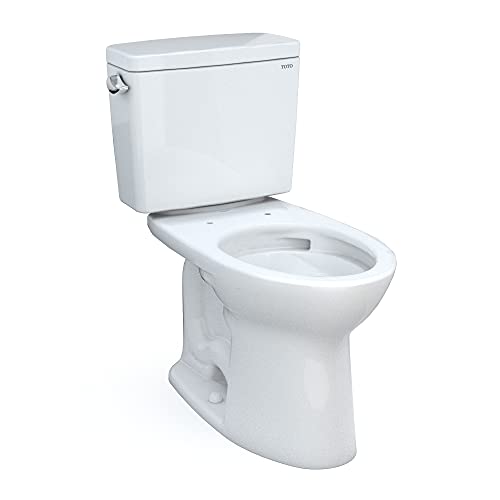
| TOTO Drake II 1.28 GPF | Tornado Flush | 1.28 | 1,000 g | Yes | 2 3/8 | Check price |
| TOTO UltraMax II 1.28 GPF | Tornado Flush | 1.28 | 1,000 g | Yes | 2 1/8 | Check price |
| TOTO Aquia IV Dual Flush | Tornado Flush | 1.28 / 0.8 | 1,000 g | Yes | 2 1/8 | Check price |
| TOTO Nexus 1.28 GPF | Tornado Flush | 1.28 | 1,000 g | Yes | 2 1/8 | Check price |
| TOTO Drake 1.28 GPF (G-Max) | G-Max (gravity) | 1.28 | 1,000 g | Yes | 2 1/8 | Check price |
| Kohler Highline Arc 1.28 GPF | Class Five (gravity) | 1.28 | 1,000 g | Yes | 2 1/8 | Check price |
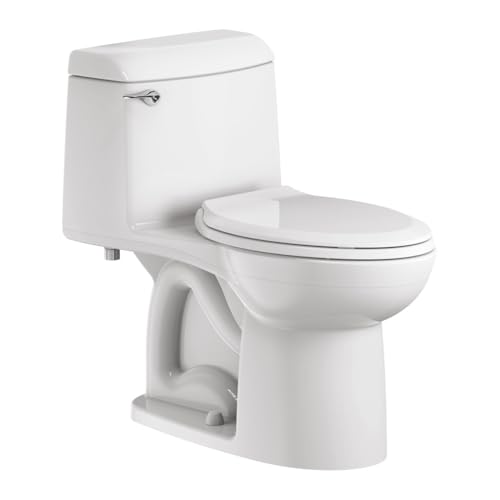
| American Standard Champion 4 | PowerWash rim (gravity) | 1.6 | 1,000 g | No | 4 | Check price |
| Woodbridge T-0001 | Dual Cyclone (gravity) | 1.28 / 0.8 | 800 g | Yes | 2 1/8 | Check price |
MaP data sourced from map-testing.com. Trapway dimensions from published TOTO, Kohler, American Standard, and Woodbridge specification sheets. Table reflects models available as of June 2026.
It is worth noting that TOTO's older G-Max system, used in the original Drake and Eco Drake lines, also achieves 1,000 g on MaP without Tornado Flush. G-Max uses a large 3-inch flush valve, a wide 2 1/8-inch trapway, and a conventional rim-hole distribution pattern. It is a proven, extremely reliable design. The reason many homeowners prefer Tornado Flush over G-Max comes down to bowl hygiene and cleaning ease rather than raw flush performance, where both systems are essentially equal at the 1,000 g ceiling.
Tornado Flush is a gravity-fed system that uses nozzle geometry to maximize the kinetic energy of water from a standard overhead tank; it does not rely on pressurized air injection. Pressure-assisted toilets (such as the American Standard Cadet 3 Pressure-Assisted or Gerber Viper) store compressed air in a sealed vessel inside the tank, then release it during flushing to add velocity. Pressure-assisted toilets are louder (typically 80 to 90 dB versus 60 to 70 dB for Tornado Flush), require adequate water pressure (25 PSI minimum), and cost more to repair when the pressure vessel ages. Tornado Flush achieves comparable or superior MaP scores with a quieter, simpler tank-based mechanism that any plumber can service with standard parts.
The practical comparison between Tornado Flush and pressure-assisted flushing matters because both technologies target buyers who want high confidence in single-flush clearance. In multi-family buildings or basement bathrooms with marginal water pressure, however, pressure-assisted systems are not always viable because the compressed-air vessel needs at least 25 PSI of static line pressure to recharge properly. Tornado Flush performs reliably at household water pressures down to roughly 10 to 15 PSI because the flushing energy comes from the tank head height rather than line pressure.
Plumbers who work on commercial properties often recommend Tornado Flush for multi-unit residential settings because the absence of a pressure vessel eliminates a component that typically fails within 10 to 15 years and requires a specialized replacement cartridge that may be discontinued. The two-nozzle ceramic manifold in a Tornado Flush bowl is integral to the vitreous china itself and does not wear out independently of the bowl. Maintenance costs over a 20-year horizon are therefore lower than for pressure-assisted alternatives.
As of June 2026, the TOTO product lines that include Tornado Flush are: Aquia IV (wall-hung and close-coupled dual-flush), Nexus, Drake II, UltraMax II, RP, and several Washlet+ integrated seat models including the Neorest NX and Neorest RH. The original Drake (non-II) uses the older G-Max system, and the Entrada uses the E-Max system; neither of these carries Tornado Flush. Buyers should confirm the spec sheet because SKU suffixes for color or rough-in variations do not always change the flush system designation.
Here is a breakdown of current TOTO families and their flush systems to avoid confusion when shopping:
If you are comparing TOTO to the broader market, our guide to the best flushing toilets covers how Tornado Flush models rank against Kohler Cimarron, American Standard Champion 4, Swiss Madison Sublime, Gerber Avalanche, and Woodbridge T-0001 across price tiers. You can also read the detailed TOTO Drake II review and the TOTO UltraMax II review for per-model analysis.
CEFIONTECT is TOTO's proprietary ceramic glaze, applied to the bowl surface at temperatures exceeding 1,150 degrees Celsius during firing. The glaze produces a surface roughness of less than 0.02 micrometers, which is smoother than untreated vitreous china by roughly a factor of three. Waste, mineral scale, and biofilm find fewer microscopic anchor points and are more easily carried away by the rotating water sheet. CEFIONTECT is not required for Tornado Flush to function, but TOTO pairs the two technologies on most premium SKUs because the cyclonic water pattern distributes the rinse evenly over the entire glaze surface.
Standard vitreous china has a surface roughness of approximately 0.05 to 0.10 micrometers at the microscopic level. That texture is invisible to the naked eye but provides enough surface irregularity for mineral deposits, soap scum, and biofilm to adhere. Over weeks of use, those deposits form a base layer that subsequent material sticks to more easily, producing the familiar brownish ring at the waterline and under the rim.
The combination of CEFIONTECT (which reduces adhesion) and Tornado Flush (which contacts 100 percent of the bowl surface per flush, not just the submerged zone) gives TOTO's premium models a meaningful cleaning advantage over competitors. Independent consumer reviews on major retail sites consistently rate TOTO Drake II and UltraMax II owners as requiring less frequent heavy scrubbing than owners of comparable Kohler Highline or American Standard Cadet 3 toilets -- though those competing models are by no means difficult to clean.
Buyers who want CEFIONTECT should look for the letter "G" in the SKU suffix (e.g., CST454CEFG, where G = CEFIONTECT glaze). Models without the G suffix have the standard TOTO glaze, which is still above average in smoothness compared to industry norms.
EPA WaterSense certification requires a toilet to use no more than 1.28 gallons per flush while meeting MaP performance criteria. Every current TOTO Tornado Flush model carries WaterSense certification. In practice, this means a household replacing two pre-1994 toilets (which used 3.5 GPF or more) with TOTO Drake II units at 1.28 GPF would save approximately 13,000 to 15,000 gallons of water per year based on EPA's published household usage models of approximately 5 flushes per person per day in a four-person home.
The Aquia IV dual-flush extends efficiency further with a 0.8 GPF half-flush for liquid waste. Using dual-flush triggers for liquid-only events is estimated to reduce the average household flush volume to approximately 1.0 to 1.1 GPF in practice. TOTO's published data shows the Aquia IV at 1,000 g on the full 1.28 GPF flush; TOTO does not publish a MaP score for the 0.8 GPF half-flush because MaP testing is conducted at a single stated flush volume and the half-flush is not designed to clear solid waste.
One common concern about 1.28 GPF toilets is the perception that less water means more clogs. The MaP data does not support that concern for high-scoring models. The issue historically arose with early conversions where manufacturers simply reduced tank fill volume without redesigning the flush valve or trapway. Tornado Flush was engineered from the start around the 1.28 GPF volume, with nozzle geometry and tank shape calibrated to that water volume. The result is a system where 1.28 gallons does more flushing work than 1.6 gallons did in many older designs because the energy delivery method is fundamentally more efficient.
Tornado Flush toilets install identically to standard two-piece or one-piece gravity toilets. The rough-in dimension (distance from the finished wall to the center of the closet flange) must match the toilet specification: TOTO offers 10-inch, 12-inch, and 14-inch rough-in versions of the Drake II. Most North American homes use a 12-inch rough-in; verify with a tape measure before ordering because returning a toilet is inconvenient and costly.
Key installation notes:
For a broader look at installation requirements across brands and bowl shapes, see our elongated vs. round toilet guide and the toilet rough-in measurement guide.
No flushing system is without criticism. Based on aggregated owner reviews across major retail platforms and plumbing forums, the most frequently cited concerns about Tornado Flush toilets include:
For comparison, Kohler's Class Five system and American Standard's Champion 4 use conventional rim-hole distribution and a larger-diameter trapway (2-3/8 inches in the Champion 4's case). The Champion 4 relies on a wide trapway rather than flush velocity for clog resistance, which is a fundamentally different design philosophy. Neither approach is universally superior; buyers in areas with hard water sometimes prefer the wide trapway design because there is no nozzle geometry to scale up.
Swiss Madison's Sublime and Woodbridge's T-0001 also use rimless bowl designs with cyclonic-style flushing, but neither publishes the same level of third-party validation data as TOTO, and their MaP scores are generally lower (typically 800 g vs. TOTO's 1,000 g). For a detailed side-by-side, see our TOTO vs. Kohler comparison.
The economic case for Tornado Flush toilets rests on three factors: water savings, reduced cleaning product use, and a relatively simple maintenance profile.
Water savings: Replacing a 1.6 GPF toilet with a 1.28 GPF WaterSense-certified model saves 0.32 GPF per flush. At 25 flushes per day in a typical four-person home, that is 8 gallons per day, 2,920 gallons per year. At a national average water rate of approximately $0.007 per gallon (including sewer fees), annual savings are approximately $20 per toilet. Over a 20-year toilet lifespan that is $400 in water cost avoidance per toilet, which partially offsets the TOTO price premium over economy-segment competitors.
Cleaning products: The CEFIONTECT + Tornado Flush combination means most owners use less toilet bowl cleaner per year. This is a secondary cost item but relevant for households with multiple bathrooms. Reduced chemical use also has a minor wastewater treatment benefit cited in EPA WaterSense program materials.
Maintenance: TOTO warranties Drake II and UltraMax II for one year on the toilet and parts. The vitreous china itself carries a limited lifetime warranty against manufacturing defects. The most common maintenance items -- fill valve and flapper -- cost $10 to $25 each and should be replaced every 5 to 7 years regardless of brand. There is no pressure vessel to replace (unlike pressure-assisted models) and no electronic components to fail (unlike wall-hung concealed-tank models with electronic flush actuators).
From a total cost of ownership perspective, a TOTO Drake II purchased for roughly double the cost of an entry-level gravity toilet pays for part of that premium through water savings and reduced maintenance complexity over a 10 to 15-year ownership period. The Tornado Flush mechanism itself does not wear out on the bowl side; the only wear items are the tank components, which are similar in cost to any other gravity toilet's service parts. Buyers who hold toilets for 15-plus years tend to find the TOTO purchase price defensible on economic grounds alone, separate from any quality-of-life benefits.
Yes. Tornado Flush bowls are rimless by design. The two angled nozzles replace the conventional hollow rim and its series of small distribution holes. The terms "Tornado Flush" and "rimless" are effectively synonymous for TOTO products, though other brands use different names for their rimless systems.
Published sound testing and owner reviews consistently describe Tornado Flush as moderate in noise. The rotating water sheet is quieter than pressure-assisted systems (which can reach 80 to 90 dB) but not dramatically quieter than a well-designed conventional gravity toilet. Most owners describe a whooshing sound rather than the rushing splash common to rim-hole toilets.
No. The rimless bowl is actually easier to clean than a conventional toilet because there is no underside of a rim to reach. A standard toilet brush covers the entire exposed surface. TOTO does recommend avoiding abrasive cleaners on CEFIONTECT bowls because harsh abrasives can scratch the glaze and reduce its non-stick properties over time.
Tornado Flush is a gravity-based system; it draws energy from the tank water column, not from supply-line pressure. Standard household water pressure of 20 to 80 PSI is sufficient. At the low end of that range, the tank may take slightly longer to refill, but flush performance is not meaningfully affected because the tank fills completely before each flush.
No. The Tornado Flush nozzle manifold is molded into the vitreous china bowl during manufacturing. It is not a retrofit component. If you want Tornado Flush, you must purchase a bowl that was manufactured with the system. Replacing only the bowl of a two-piece toilet and keeping the existing tank is technically possible but must use a compatible TOTO tank.
Yes. The Aquia IV activates the Tornado Flush nozzles on both the 1.28 GPF full flush and the 0.8 GPF half-flush. The difference between the two modes is solely the volume of water delivered, not the nozzle activation pattern. The half-flush produces a less powerful cyclone due to lower water volume, which is why it is designed for liquid waste only.
Both Tornado Flush (Drake II, UltraMax II) and Class Five (Kohler Highline Arc, Cimarron) achieve 1,000 g on MaP testing at 1.28 GPF. The primary functional difference is the bowl distribution method: Tornado Flush is rimless with two nozzles; Class Five uses a modified rim-hole pattern with a large flush valve. Bowl hygiene over the long term tends to favor rimless designs because there is no hidden underrim surface to harbor scale and bacteria.
Both models achieve 1,000 g on MaP testing and both use Tornado Flush. The UltraMax II is a one-piece toilet, which simplifies cleaning at the base and eliminates the tank-to-bowl gasket as a potential leak point. The Drake II is a two-piece unit and typically costs less. Flush performance between the two is equivalent based on published MaP data.
MaP data does not show a clog-rate difference at the 1,000 g performance level. The American Standard Champion 4 relies on a 2-3/8-inch wide trapway to pass large volumes; Tornado Flush relies on flush velocity and directional water pressure. Both achieve 1,000 g. The Champion 4 uses 1.6 GPF without WaterSense certification, while Tornado Flush models qualify at 1.28 GPF.
In TOTO's SKU system, the G suffix (e.g., CST454CEFG) indicates that the model includes the CEFIONTECT glaze. Models without the G use TOTO's standard glaze, which is above average in smoothness but does not carry the same published surface-roughness specification as CEFIONTECT. The flush mechanism is identical between G and non-G variants of the same model.
To descale Tornado Flush nozzles, fill a spray bottle with undiluted white vinegar and spray directly into each nozzle opening with the tank empty. Allow the vinegar to sit for 30 to 60 minutes, then flush. For heavy scaling, a soft-bristled bottle brush or an old toothbrush inserted into the nozzle opening can dislodge mineral buildup. Avoid metal tools that could scratch the ceramic surface.
The Woodbridge T-0001 is a dual-cyclone rimless design at 1.28 / 0.8 GPF with WaterSense certification and a 2 1/8-inch trapway. Its MaP score is typically 800 g compared to 1,000 g for Tornado Flush models. It costs significantly less than a TOTO Drake II, making it a reasonable budget-tier option. For buyers prioritizing verified flush performance, the 200 g MaP gap is meaningful.
Yes. The TOTO Neorest NX2, Neorest RH, and Neorest AH all use Tornado Flush as the bowl flushing mechanism, paired with the integrated Washlet seat, auto-open/close lid, and ewater+ bowl pre-misting system. The Neorest line represents the top of TOTO's residential product range and pairs Tornado Flush with the most complete set of hygiene and comfort features.
TOTO provides a one-year limited warranty on mechanical parts (tank, flush valve, fill valve, seat) and a limited lifetime warranty on the vitreous china bowl and tank against defects in materials and workmanship. The lifetime china warranty covers cracking and crazing from manufacturing defects but not damage from impact, improper installation, or use of incompatible chemical cleaners.
Yes, with caveats. Because Tornado Flush energy comes from the tank water column rather than line pressure, static water pressure at the supply valve affects only refill speed, not flush performance. However, if household pressure is below 20 PSI, some fill valves may not open fully and the tank will take longer than 90 seconds to refill. Replacing the fill valve with a pressure-compensating model resolves this in most cases.
Toilet replacement is a plumbing task that most confident DIY homeowners can complete in two to three hours. The key steps -- shutting off the water, removing the old wax ring, setting the new toilet, reconnecting the supply line -- require no specialized tools beyond an adjustable wrench and a putty knife. Local codes in some jurisdictions require a licensed plumber for toilet replacement; check your local requirements before proceeding.
TOTO introduced Tornado Flush in Japan in the late 2000s as part of the Washlet G series. North American availability expanded significantly with the Drake II launch around 2013 and accelerated with the Aquia IV introduction. The technology is now TOTO's primary premium flushing platform across most of its two-piece, one-piece, and wall-hung residential lines in the United States and Canada.
The cyclonic water pattern in Tornado Flush toilets travels the bowl wall rather than dropping vertically, which actually reduces upward splash compared to a waterfall-style rim flush. Owners with small bathroom floor areas near the bowl report no unusual splash. The rotating water sheet stays below the bowl rim throughout the flush cycle in normal use.
TOTO Tornado Flush is the most thoroughly validated rimless flushing technology in the North American residential toilet market. Its two-nozzle cyclonic design achieves 1,000 g on independent MaP testing at 1.28 GPF with EPA WaterSense certification across the Drake II, UltraMax II, Aquia IV, Nexus, and RP lines. The rimless bowl design eliminates the most common long-term hygiene problem in conventional toilets -- the inaccessible, scale-collecting underrim channel -- and pairs effectively with TOTO's CEFIONTECT glaze to produce a bowl that requires less frequent deep cleaning. For most buyers choosing a high-performance toilet in 2026, the Drake II or UltraMax II represent the most evidence-backed choice in their respective price segments. Buyers in hard-water areas should plan a semi-annual nozzle descaling routine, and anyone on a tighter budget should evaluate the Woodbridge T-0001 as a lower-cost rimless alternative while accepting the 200 g MaP gap.
We rank the top toilet brands for 2026 based on MaP flush scores, water efficiency, owner satisfaction, and warranty coverage. Find the…
Read the guideStep-by-step guide to locating your TOTO serial number, decoding the production date, confirming your model, and using that information for warranty claims,…
Read the guideA data-driven breakdown of Pfister faucet lines, finish durability, warranty coverage, and how this mid-range brand compares to Moen, Delta, Kohler, and…
Read the guide