

Why Toilet Trapways Are Curved Like an S
Toilets4.6
Learn why toilet trapways curve like an S, how each bend blocks sewer gas, and what the shape means for clogs and…
Read the guideThe EPA WaterSense label on a toilet is not just a sticker. It guarantees the fixture uses 1.28 gallons per flush or less AND has cleared an independent flush-performance test. This guide explains exactly what that certification means, how to read the numbers behind it, which toilets earn the label while still flushing powerfully, and how to claim the water-utility rebates that can cut your purchase cost in half.
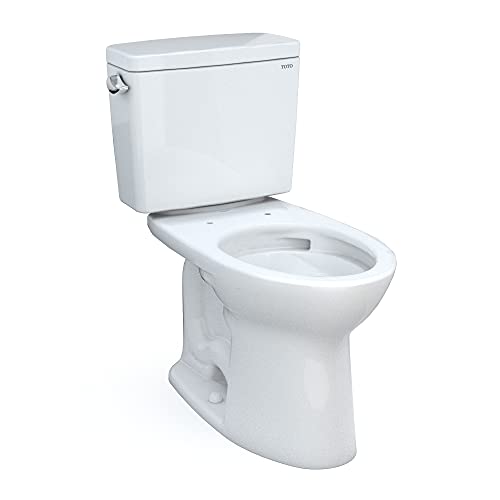
The TOTO Drake II is the best WaterSense toilet for most homes: it earns the label at 1.28 GPF while hitting the maximum 1,000-gram MaP score through its Double Cyclone siphon, proving you can save 20 percent more water than the federal limit without any loss of flush power.
Buying a toilet used to mean choosing between saving water and having a flush that actually worked. The EPA WaterSense certification program was designed to end that trade-off. Since the program launched in 2006, toilets carrying the label must pass two requirements simultaneously: consume no more than 1.28 gallons per flush (well below the 1.6-gallon federal maximum set in 1992), and pass third-party testing that confirms the bowl clears solid waste in one flush. That dual test is what separates a WaterSense toilet from the notorious first-generation 1.6-gallon "low-flow" fixtures that needed two or three flushes to clear and ended up using more water than the older 3.5-gallon toilets they replaced.
This guide covers every layer of the certification: how EPA WaterSense works, what MaP testing actually measures, how manufacturers like TOTO, Kohler, American Standard, Woodbridge, Swiss Madison and Gerber achieve the label, how to claim rebates, and which specific models give you the best combination of water savings and flush reliability. If you want the performance-first ranking across all flush types, see our guide to the best flushing toilets. For a deeper walkthrough of every spec you should compare before buying, see our toilet buying guide.
The federal Energy Policy Act of 1992 set a 1.6-gallon-per-flush maximum for new toilets sold in the United States, replacing the older 3.5-gallon standard. That legal limit cut water use dramatically in theory, but many of those early 1.6-gallon toilets flushed poorly. EPA WaterSense raised the performance bar by adding an independent flush test to the water-efficiency requirement, and it tightened the water-use limit further to 1.28 gallons per flush (labeled as HET, or High-Efficiency Toilet, in the plumbing trade).
To earn the label, a manufacturer submits the toilet for testing at an accredited third-party laboratory. The toilet must flush 350 grams of simulated waste (the residential MaP pass threshold) on no more than 1.28 gallons, and it must do so consistently across multiple test runs. Only models that pass both the efficiency and performance requirements appear on the EPA WaterSense product list, which is searchable at epa.gov/watersense. The label itself is not brand-specific; every major toilet manufacturer has WaterSense-certified models, and some budget-tier brands do too.
MaP testing was developed in the mid-2000s by water utilities and plumbing researchers to give buyers and utilities an objective, reproducible way to compare toilet flush performance. The test uses soybean paste in a standardized casing to simulate solid waste, and the toilet is flushed repeatedly at increasing load sizes until it fails. The highest weight it clears reliably becomes its MaP score. The 350-gram threshold is the minimum EPA WaterSense requires, but that number is really a floor, not a goal. Most quality toilets sold in the United States today score well above it.
Here is a practical way to read MaP scores:
A 1,000-gram MaP score is the single most useful number in a toilet specification sheet. It tells you the toilet will handle any realistic household load in one flush, which is the only way a 1.28-gallon model actually saves water over the long run. A toilet rated 1.28 GPF but scoring 400 grams on MaP will need a second flush regularly, and a second flush at 1.28 gallons equals 2.56 gallons, more water than most older 1.6-gallon toilets use. Always confirm MaP before buying a WaterSense toilet.
Those savings assume the toilet clears in one flush every time, which is why MaP scores matter so much. A WaterSense toilet that double-flushes half the time has an effective GPF far higher than its rated 1.28 gallons. The math only works when the WaterSense certification is backed by a high MaP score, which is why this guide focuses on models that combine the label with scores of 800 grams or better.
The savings timeline also improves with WaterSense utility rebates. Dozens of water utilities across the United States offer cash rebates specifically for purchasing a WaterSense-certified toilet, ranging from $25 to $200 per toilet depending on the utility and the old fixture being replaced. Some programs offer rebates for every WaterSense toilet in a building, not just one per household. The EPA WaterSense rebate finder at epa.gov/watersense makes it easy to check what is available in your ZIP code. In areas with active rebate programs, the effective out-of-pocket cost of a quality WaterSense model like the Kohler Cimarron or American Standard Cadet 3 can drop significantly below its retail tag.
The flush technology behind a WaterSense toilet matters more than the brand badge. Here is how the main approaches compare:
TOTO's Double Cyclone system, used in the Drake II, UltraMax II and Vespin II, replaces the traditional rim-hole water delivery with two angled water jets that spin the flush around the bowl before feeding the siphon. Because the water moves with directional momentum rather than just falling from above, it creates a stronger and more consistent siphon pull on the same 1.28 gallons. This is why TOTO's Double Cyclone toilets consistently hit the 1,000-gram MaP ceiling despite the reduced water volume.
Kohler's Aquapiston flush valve, used in the Cimarron, Highline and Santa Rosa, is a canister-style valve rather than a traditional flapper. Water enters the bowl from all sides rather than one direction, which reduces pressure loss during the flush cycle. The Cimarron and Highline both achieve 1,000-gram MaP scores on 1.28 GPF using this design. To understand how bowl shape affects flush choices, our guide to round vs elongated toilets covers that decision in full.
American Standard's Cadet 3 and Champion 4 use a fully glazed PowerWash rim channel that directs water at higher pressure around the bowl perimeter before activating the siphon. The Cadet 3 hits 1,000 grams on 1.28 GPF. The Champion 4 is rated at 1.6 GPF and is not a WaterSense model, but it is often compared alongside WaterSense options for its extreme 1,000-gram MaP performance.
Most other WaterSense models use a conventional gravity siphon with an optimized trapway. The Gerber Avalanche and Gerber Viper hit the 1,000-gram MaP ceiling this way. The Woodbridge T-0001 and T-0019 and the Swiss Madison St. Tropez use dual-flush valves and score around 800 grams on the full flush at 1.28 GPF. TOTO's own dual-flush model, the Aquia IV, also uses a dual-flush valve but reaches the full 1,000-gram MaP ceiling on its full flush thanks to its Tornado Flush nozzles.
| Toilet | WaterSense | Flush Technology | MaP Score | GPF | Bowl Height | Check Price |
|---|---|---|---|---|---|---|
| TOTO Drake II | Yes | Double Cyclone | 1000 g | 1.28 | Comfort 16.1 in | Check price |
| TOTO UltraMax II | Yes | Double Cyclone | 1000 g | 1.28 | Comfort 17.25 in | Check price |
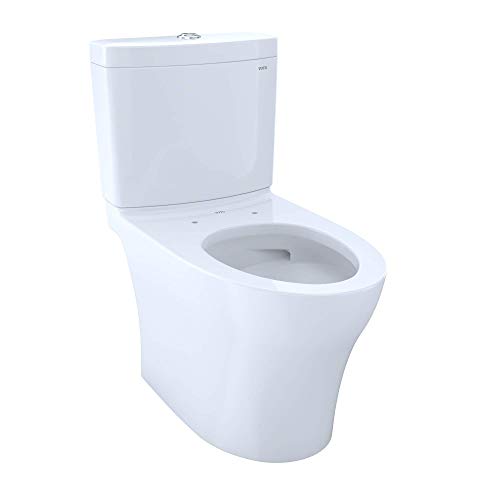
| TOTO Aquia IV | Yes | Dual Tornado | 1000 g | 0.9 / 1.28 | Comfort 16.6 in | Check price |
| Kohler Cimarron | Yes | Aquapiston Canister | 1000 g | 1.28 | Comfort 16.5 in | Check price |
| American Standard Cadet 3 | Yes | PowerWash Rim | 1000 g | 1.28 | Right Height 16.5 in | Check price |
| Kohler Santa Rosa | Yes | Aquapiston Canister | 1000 g | 1.28 | Comfort 16.5 in | Check price |
| Woodbridge T-0001 | Yes | Dual Flush Gravity | 800 g | 1.0 / 1.28 | Comfort 17 in | Check price |
| Swiss Madison St. Tropez | Yes | Dual Flush Gravity | 800 g | 0.95 / 1.28 | Comfort 16.5 in | Check price |
| Gerber Avalanche | Yes | Gravity Siphon | 1000 g | 1.28 | Comfort 16.5 in | Check price |
These are the WaterSense models that combine the label with real-world reliability. Each one has a verified EPA WaterSense listing, a published MaP score, and an established track record across aggregated owner reviews. For a broader view of how one-piece and two-piece construction affects cleaning and installation, see our guide to one piece vs two piece toilets.
1,000-gram MaP on 1.28 GPF through Double Cyclone: the most complete WaterSense toilet available.
Check price on Amazon1,000-gram MaP and WaterSense at a lower cost than comparable TOTO models, with Aquapiston reliability.
Check price on AmazonDual-flush with a 0.9-GPF light mode, WaterSense certified, and a 1,000-gram MaP score on the full flush.
Check price on AmazonDual-flush toilets use a split button or handle to select between a partial flush for liquid waste and a full flush for solid waste. When the full flush is 1.28 GPF and passes the MaP test, the toilet qualifies for WaterSense certification. In real household use, dual-flush models average an effective GPF well below 1.28 because the partial flush is used frequently, often several times a day, bringing the actual daily water use per toilet below what a single-flush 1.28-GPF model uses.
Some dual-flush models do accept a modest MaP trade-off on the full flush compared with single-flush models designed specifically around a strong 1.28-gallon siphon -- the Woodbridge T-0001 and Swiss Madison St. Tropez, for example, land around 800 grams on their full flush. The TOTO Aquia IV is the exception: it scores a full 1,000 grams on its full flush, matching the single-flush Drake II, both using 1.28 GPF at the full setting. For heavy-use bathrooms or households with a history of clogs, choosing a dual-flush model with a confirmed 1,000-gram full-flush score like the Aquia IV avoids that trade-off entirely.
Rebates for WaterSense toilets are administered by local water utilities, not the EPA itself. The EPA WaterSense program maintains a rebate finder at epa.gov/watersense that lets you search by ZIP code. Most utilities require proof of purchase and proof that the new toilet carries the WaterSense label (a photo of the label or the product literature is usually sufficient). Some programs also require proof that the old toilet is being disposed of, since replacing an older high-flush model is more valuable to the utility than replacing a standard 1.6-GPF toilet.
Rebate amounts as of 2026 range from $25 to $200 per toilet in active programs, with higher rebates often available in drought-prone regions of California, Nevada, Arizona and Texas. A few utilities offer higher rebates for replacing pre-1992 toilets that used 3.5 gallons or more per flush. Check the WaterSense rebate finder even if you believe your utility does not have a program, because programs are added regularly and coverage varies at the city and county level within the same state.
The rebate stack is underused. In areas with active programs, you can realistically offset $100 to $200 of the purchase cost of a TOTO Drake II or Kohler Cimarron. That makes the water savings essentially free from year one. Even without a rebate, a WaterSense toilet replacing a 3.5-GPF fixture pays back in water savings within three to five years in most US markets. The payback period is shorter in cities with tiered water pricing that charges more per gallon for high-volume households.
You will see both terms on product pages and in plumbing supplier catalogs. The WaterSense label is the stronger signal of real-world reliability because it requires the flush test. HET models without WaterSense have been tested only for water volume by the manufacturer. For utility rebate eligibility, most programs specify WaterSense certification, not just HET classification, so confirm the WaterSense label before purchasing if a rebate is part of your decision.
The EPA WaterSense product list at epa.gov/watersense is searchable by brand and model number. Checking this list takes 30 seconds and confirms the certification is real rather than relying on marketing copy. Some models in a product line carry the label and others in the same line do not, so check the exact model number you plan to purchase. Our how to choose a toilet guide covers this verification step alongside every other spec worth confirming before buying.
MaP scores are published at map-testing.com by brand and model number. Any WaterSense toilet should score 350 grams or above, but target 800 grams or higher for reliable one-flush clearance in a household with more than two people. Models at 1,000 grams (TOTO Drake II, TOTO UltraMax II, Kohler Cimarron, American Standard Cadet 3, Gerber Avalanche) give the widest safety margin.
Some toilet lines offer the same model at different GPF ratings depending on the flush handle or valve configuration selected. The Kohler Highline, for example, is available in both 1.28-GPF WaterSense and 1.6-GPF standard configurations. Make sure the specific SKU you add to cart matches the 1.28-GPF WaterSense version if the certification matters to you, either for rebate eligibility or for water savings.
WaterSense certification does not depend on bowl shape, but bowl shape determines whether the toilet fits your bathroom footprint and is comfortable for your household. Elongated bowls add about 2 inches in length and are considered more comfortable for adults. Round bowls save space in tight bathrooms. Our guide to round vs elongated toilets covers the trade-offs in detail. For a full overview of how to match a toilet to your bathroom, see the toilet buying guide.
WaterSense models are available in both configurations. Two-piece toilets (separate tank and bowl) are easier to ship and easier to replace individual components. One-piece toilets have a seamless body that is easier to clean because there is no tank-to-bowl seam to harbor grime. The TOTO UltraMax II and Woodbridge T-0001 are popular WaterSense one-piece options. The TOTO Drake II, Kohler Cimarron and American Standard Cadet 3 are well-regarded two-piece options.
A fully glazed trapway is worth paying for on a 1.28-GPF toilet. Because the water volume is lower than older fixtures, the trapway interior matters more for ensuring waste passes cleanly. TOTO's CeFiONtect glaze on the Drake II and UltraMax II, American Standard's EverClean antimicrobial surface on the Cadet 3, and Kohler's standard glaze on the Cimarron all reduce friction and buildup that could cause clogs on a low-flow toilet. For everything about trapway design, our how to choose a toilet article covers minimum trapway diameters by use case.
Comfort-height toilets (also called ADA height or right-height) have a seat height of 17 to 19 inches, closer to a standard chair. Standard-height toilets are typically 15 to 16 inches. Both are available in WaterSense models. Comfort height is preferred by taller adults, seniors and anyone with mobility concerns. The TOTO Drake II, Kohler Cimarron, and Gerber Avalanche are available in comfort height with WaterSense certification. Our guide on how to choose a toilet includes a section on which height works best by user profile.
TOTO offers a 1-year limited warranty on most models. Kohler's toilets typically carry a 1-year limited warranty with some premium lines at longer terms. American Standard provides a 5-year limited warranty on vitreous china (the porcelain body). Gerber carries a lifetime warranty on the vitreous china and a 5-year warranty on flushing mechanisms. Parts for all six brands covered here are widely available through big-box hardware retailers, which matters for long-term ownership of a WaterSense toilet where the flush mechanism may need service.
The single most common mistake buyers make when choosing a WaterSense toilet is trusting the GPF rating alone without checking the MaP score. A toilet at 1.28 GPF with a 400-gram MaP score will double-flush in normal household use and end up using more water than a 1.6-GPF toilet with a 900-gram score. The water math only works when both numbers are good. Prioritize WaterSense label plus 800-gram or higher MaP, then decide on construction and bowl shape.
It means the toilet has passed independent testing confirming it uses 1.28 gallons per flush or less AND clears a 350-gram solid waste load in a single flush. Both requirements must be met simultaneously. The certification is voluntary but widely adopted by all major brands including TOTO, Kohler, American Standard, Woodbridge, Swiss Madison and Gerber.
Yes, when the toilet is engineered for it. Models like the TOTO Drake II and Kohler Cimarron achieve a 1,000-gram MaP flush score on 1.28 gallons, which is the maximum test score and far above the 350-gram residential pass threshold. The key is the flush system design, not just the water volume. A well-engineered 1.28-GPF toilet flushes more powerfully than a poorly designed 1.6-GPF toilet.
The minimum pass for WaterSense is 350 grams. A good score for household use is 800 grams or above. The maximum score is 1,000 grams. For families or heavy-use bathrooms, target 1,000 grams. The TOTO Drake II, TOTO UltraMax II, Kohler Cimarron, American Standard Cadet 3 and Gerber Avalanche all reach 1,000 grams on 1.28 gallons per flush.
Replacing a standard 1.6-GPF toilet with a 1.28-GPF WaterSense model saves about 4,000 gallons per person per year. Replacing an older 3.5-GPF toilet saves about 13,000 gallons per person per year. For a family of four replacing one 3.5-GPF toilet, that is roughly 52,000 gallons annually. Savings depend on the number of daily flushes and the old fixture's actual GPF.
Yes, in many areas. Local water utilities offer rebates from $25 to $200 per toilet for purchasing a WaterSense-certified model. Use the EPA WaterSense rebate finder at epa.gov/watersense and enter your ZIP code. Programs are most active in water-stressed regions including California, Nevada, Arizona and Texas, but utilities in other states participate too.
HET is a plumbing classification for any toilet using 1.28 GPF or less, defined by ASME/ANSI standards. WaterSense is the EPA program that adds an independent flush-performance test requirement on top of the HET volume limit. All WaterSense toilets are HETs, but not all HETs carry WaterSense certification. For rebate eligibility and performance confidence, WaterSense is the more reliable label.
TOTO, Kohler, American Standard, Gerber, Woodbridge and Swiss Madison all have strong WaterSense lineups. TOTO's Double Cyclone models (Drake II, UltraMax II) lead on flush performance. Kohler's Aquapiston-equipped Cimarron and Highline are strong value picks. American Standard's Cadet 3 and Gerber's Avalanche both achieve 1,000-gram MaP on 1.28 GPF at competitive prices.
Yes. A dual-flush toilet qualifies if its full flush volume is 1.28 GPF or less and it passes the MaP flush test at that volume. The partial flush volume is not regulated by WaterSense. Certified dual-flush models include the TOTO Aquia IV (0.9/1.28 GPF), Woodbridge T-0001 (1.0/1.28 GPF) and Swiss Madison St. Tropez (0.95/1.28 GPF).
Yes. The TOTO Drake II carries EPA WaterSense certification at 1.28 GPF and achieves a 1,000-gram MaP flush score through TOTO's Double Cyclone siphon technology. It appears on the EPA WaterSense certified product list. It is one of the few toilets on the market that pairs the WaterSense efficiency requirement with the maximum possible MaP performance score.
CeFiONtect is TOTO's proprietary nano-glaze applied to the bowl and trapway interior. It creates an ultra-smooth, ion-barrier surface that reduces waste and mineral adhesion, making the bowl easier to clean and reducing the frequency of cleaning-motivated extra flushes. It does not change the GPF or MaP score but contributes to long-term maintenance efficiency. It is available on the Drake II, UltraMax II and Aquia IV.
Check the flush volume first. If your toilet uses more than 1.28 GPF it is not WaterSense certified. You can find the GPF stamped inside the tank lid or on the back wall of the tank. If it shows 1.6 or higher, it is a standard toilet. Older toilets may show 3.5 or 3.0 GPF. You can also check the EPA WaterSense product list by brand and model number at epa.gov/watersense.
The Kohler Highline is available in multiple configurations. The 1.28-GPF version with the Highline Classic or Highline Arc designation carries WaterSense certification and achieves a 1,000-gram MaP score using the Aquapiston flush valve. The 1.6-GPF standard version of the Highline does not carry the WaterSense label. Always confirm the specific GPF of the SKU you are purchasing before assuming WaterSense certification.
Yes. The American Standard Cadet 3 at 1.28 GPF carries EPA WaterSense certification and achieves a 1,000-gram MaP score using the PowerWash rim flush system. American Standard also covers the vitreous china with a 5-year limited warranty, which is longer than the typical 1-year warranty from most competitors. The Cadet 3 is one of the better-value WaterSense options at the 1,000-gram performance level.
A single-flush toilet must use 1.28 gallons per flush or less to qualify for WaterSense certification. For dual-flush toilets, the full flush must be 1.28 GPF or less. The partial flush is not subject to the WaterSense volume limit. Ultra-high-efficiency toilets (UHET) go further at 0.8 GPF or less, but WaterSense itself covers the 1.28-GPF threshold that most certified models use.
Yes, when the MaP score is high enough. For large families or heavy-use bathrooms, look for WaterSense models with 1,000-gram MaP scores: the TOTO Drake II, TOTO UltraMax II, Kohler Cimarron, American Standard Cadet 3 and Gerber Avalanche all hit the 1,000-gram ceiling on 1.28 GPF. A fully glazed trapway (TOTO CeFiONtect, American Standard EverClean) also reduces clog risk by preventing buildup inside the trap passage.
Yes. The Gerber Avalanche is EPA WaterSense certified at 1.28 GPF and achieves a 1,000-gram MaP score through a conventional gravity siphon design. Gerber is a trade-grade brand that is less well-known to retail buyers than TOTO or Kohler but has a strong reputation among plumbing contractors for reliability. The Avalanche comes with a lifetime warranty on the vitreous china and a 5-year warranty on flushing mechanisms.
Yes. The Woodbridge T-0001 carries EPA WaterSense certification. It is a one-piece dual-flush toilet with a 1.0/1.28-GPF configuration and an 800-gram MaP score on the full flush. It is popular for its modern skirted design at a competitive price point. The 800-gram MaP score is adequate for most household use but provides less safety margin than the 1,000-gram models from TOTO, Kohler and American Standard.
The most water-efficient WaterSense-certified toilets are dual-flush models whose light flush drops well below 1.28 GPF. The TOTO Aquia IV uses 0.9 GPF on its light flush and 1.28 GPF on the full flush, both WaterSense certified. The Swiss Madison St. Tropez uses 0.95 GPF on the partial flush. In households where most flushes are for liquid waste, these models achieve effective daily GPF averages well below 1.0 gallons.
The EPA WaterSense label is the most meaningful certification a toilet can carry, but it only delivers real savings when paired with a high MaP score. The TOTO Drake II (1.28 GPF, 1,000-gram MaP) is the best WaterSense toilet for most households because it proves you do not have to choose between water efficiency and flush reliability. For maximum water savings per flush, the TOTO Aquia IV's dual-flush system drops to 0.9 GPF on light use. For best value at 1,000-gram MaP, the Kohler Cimarron and American Standard Cadet 3 deliver the same top performance score at lower prices. Confirm the WaterSense listing at epa.gov/watersense before purchasing, check map-testing.com for the MaP score, and run the rebate finder to see if your utility will offset part of the cost.
Learn why toilet trapways curve like an S, how each bend blocks sewer gas, and what the shape means for clogs and…
Read the guideAlmost every US toilet has a left-side handle. Learn the plumbing and mechanical reasons behind the layout and when it actually changes.
Read the guideHome toilets rely on tanks because household water lines lack the pressure that public flushometer systems use to flush straight from the…
Read the guide