

Why Toilet Trapways Are Curved Like an S
Toilets4.6
Learn why toilet trapways curve like an S, how each bend blocks sewer gas, and what the shape means for clogs and…
Read the guideA deep comparison of the two dominant flush mechanisms -- how each works, where each excels, which brands use which, and what independent MaP testing reveals about real-world performance.
Siphonic toilets dominate North America because the siphon action pulls waste completely through the trapway, producing a powerful, quiet flush with superior clog resistance. Wash-down toilets flush with direct water pressure alone -- they use less water per flush and suit European plumbing norms but leave a smaller water surface and are rarely available in the US market.
| Feature | Siphonic (North America) | Wash-Down (Europe / Asia) |
|---|---|---|
| Flush Mechanism | Siphon action pulls waste through S-trap | Direct water pressure pushes waste through P-trap |
| Trapway Shape | S-shaped (deep seal, longer path) | P-shaped or short-path outlet at rear |
| Water Surface Area | Large (8x8 in or greater on many models) | Small (visible shelf / platform area below water line) |
| GPF Range (typical) | 1.28 GPF (HET) to 1.6 GPF | 0.8 GPF to 1.2 GPF (European standard) |
| Clog Resistance | High -- large fully-glazed trapway pulls debris | Moderate -- shorter trapway, simpler geometry |
| MaP Score Potential | Up to 1,000g (maximum rating); many score 800-1,000g | Typically not MaP-rated; European DVGW standard used instead |
| Noise Level | Moderate -- siphon break causes gurgle at end | Quieter overall -- no siphon break sound |
| Rimless Bowl Compatibility | Less common (rim jet required for siphon initiation) | Very common -- rimless design suits wash-down geometry |
| Skid / Staining Risk | Low -- waste drops into water, not onto shelf | Higher -- flat shelf design can accumulate residue |
| Odor Containment | Excellent -- deep water trap seals sewer gases | Good -- relies on P-trap depth |
| Common Brands (US) | TOTO, Kohler, American Standard, Gerber, Woodbridge, Swiss Madison | Geberit, Villeroy & Boch, Duravit (rare in US) |
| EPA WaterSense Eligible | Yes (1.28 GPF models) | Yes (where rated; less common in US program) |
| Installation in US Plumbing | Standard -- matches US venting/drain norms | Requires adapter or rear-outlet rough-in |
A siphonic toilet uses the pressure differential created by a large volume of water entering the bowl rapidly to initiate a siphon effect in the S-shaped trapway. Once the siphon begins, atmospheric pressure outside the trapway pushes waste through the curved passage even after the initial tank water is nearly spent. The flush ends with a characteristic gurgle as air breaks the siphon and the trapway refills with standing water to restore the odor seal.
The physics are straightforward but the engineering demands precision. To trigger the siphon reliably at 1.28 gallons per flush -- the current EPA WaterSense threshold -- manufacturers must shape the trapway diameter, inlet jet placement, and bowl geometry with tight tolerances. TOTO's proprietary Double Cyclone and G-Max systems, for example, use two nozzles to generate a centrifugal rinse while simultaneously flooding the trapway inlet to maximize siphon pull. Kohler's AquaPiston canister valve releases water from 360 degrees around the flush valve opening, sending water to the rim jets and the forward siphon jet at the same moment to initiate the siphon more efficiently than a traditional flapper allows.
The S-shaped trapway creates a deep water seal -- typically 3 to 5 inches -- that resists sewer-gas blowback more effectively than a shallower P-trap, and its longer curved path demands a wide, smooth bore to avoid clogging. The best flushing toilets on the market feature fully glazed trapways of 2.125 inches or wider to reduce friction along this route.
MaP (Maximum Performance) flush testing, conducted by an independent third-party laboratory, quantifies this performance objectively. A MaP score of 800g means the toilet reliably clears 800 grams of simulated solid waste in a single flush; scores range from 250g to 1,000g (maximum). The TOTO Drake II and American Standard Champion 4 both score 1,000g, giving buyers a data-based way to compare flushing power rather than relying on marketing language.
The siphon break at the end of every flush is not a defect -- it is the signal that the trapway is working as designed. If you never hear that final gurgle, the siphon may not be fully engaging, which usually indicates a water supply issue, a worn flapper, or a partially blocked trapway. Proper siphon engagement is the single biggest predictor of consistent clog-free performance in North American toilets.
A wash-down toilet relies on the weight and momentum of incoming water to push waste directly out through a short, front-facing outlet at the base of the bowl. There is no siphon effect; the trapway is a simple P-shape or near-horizontal exit. Because the flush depends entirely on gravity and water pressure, wash-down toilets can work effectively at lower GPF values but require a clean rim rinse to prevent skid marks on the flat ceramic shelf that characterizes most wash-down bowl designs.
The wash-down mechanism is older and mechanically simpler than the siphonic design. Water enters at the rim, rinses the bowl surface, and exits through the front trapway outlet -- the entire sequence takes roughly two to three seconds. Because no siphon needs to form and break, the flush is quieter and there is no end-of-flush gurgle. This matters in apartments or multi-family housing where noise between units is a concern.
Wash-down toilets are standard across Germany, France, the Netherlands, and much of Asia. The platform or "shelf" design common in older German models -- where waste lands on a dry ceramic ledge before flushing -- was historically used for health inspection. Modern European designs have largely shifted to a water-filled bowl bottom, but the short-path trapway geometry remains the defining feature of the flush mechanism.
A notable advantage of wash-down design is natural compatibility with rimless bowl technology. Because no siphon pressure needs to build, water can distribute via a simple open-top pour rather than pressurized rim jets. This eliminates hidden bacterial and lime-scale buildup, and rimless wash-down toilets from Geberit and Duravit earn strong European reviews for hygiene. See our guide to rimless toilet designs for more.
If you are renovating a bathroom with a rear-exit drain -- common in older European-style plumbing in some US coastal cities -- a wash-down toilet can be the most practical solution. Adapting a rear-outlet drain to accept a standard siphonic S-trap requires significant plumbing work, while a wash-down unit with a rear outlet slides directly into the existing rough-in. Always confirm the outlet centerline height before purchasing any European wash-down toilet for US installation.
Siphonic toilets generally offer superior clog resistance in real-world North American use because the sustained pulling force of the siphon actively draws waste through the trapway rather than simply pushing it. High-scoring MaP-tested siphonic models like the TOTO Drake, American Standard Champion 4, and Kohler Cimarron clear 800 to 1,000 grams of solid waste per flush. Wash-down toilets have shorter, simpler trapways that are less prone to internal clogs but depend more on water volume and slope to move waste out of the drain stack.
Clog resistance in a siphonic toilet depends on three variables: trapway diameter, glaze quality, and flush volume delivery rate. The American Standard Champion 4 pairs a 4-inch accelerator flush valve with a 2.125-inch fully glazed trapway to achieve a 1,000g MaP score at 1.6 GPF. The TOTO UltraMax II matches that 1,000g score at 1.28 GPF through Double Cyclone technology, proving that efficiency and clog resistance are not mutually exclusive in modern siphonic design.
Wash-down toilets are not inherently clog-prone. The shorter trapway means less distance for waste to travel before reaching the drain stack, and partial blockages are often cleared on a second flush. However, heavy-use households tend to prefer siphonic designs because the active siphon pull provides a larger margin of safety with bulky or fibrous waste. Neither flush type can reliably clear non-dispersible "flushable" wipes -- both perform best with toilet paper only.
For households with a clog history, our best toilets for not clogging guide ranks models by MaP score and trapway diameter.
In raw gallons per flush, wash-down toilets available in Europe can operate at 0.8 to 1.0 GPF, lower than the 1.28 GPF floor for EPA WaterSense certified siphonic models in the US. However, the most water-efficient toilets available to American consumers are siphonic dual-flush designs -- such as the TOTO Aquia IV -- which use 1.0 GPF for liquid waste and 1.28 GPF for solid waste, meeting WaterSense certification while delivering strong siphon performance at both flush volumes.
The EPA WaterSense program sets 1.28 gallons per flush as the maximum for High-Efficiency Toilet (HET) certification. Toilets earning this label use at least 20 percent less water than the federal standard of 1.6 GPF. All major US brands now offer WaterSense-certified siphonic models. TOTO's Aquia IV, Kohler's Highline and Cimarron in 1.28 GPF trim, American Standard's Cadet 3 Flowise, and the Woodbridge T-0001 dual-flush all carry WaterSense certification.
A household of four switching from a 1980s-era 3.5 GPF toilet to a 1.28 GPF WaterSense model saves approximately 6,000 gallons per year. Many utilities offer rebates for this upgrade; the EPA WaterSense website maintains a current list of participating programs.
Wash-down toilets can operate below 1.28 GPF because no minimum volume is required to initiate a siphon -- the mechanism simply needs enough water to push waste through the short trapway. European codes typically specify 6-liter (1.58 GPF) full flush and 3-liter (0.79 GPF) half flush for dual-flush wash-down configurations. At very low volumes, however, incomplete bowl rinse may require a second flush, partially offsetting the water saving.
For US buyers focused on water savings, the decision is less about flush type and more about single-flush 1.28 GPF versus dual-flush siphonic. See our dual-flush toilet guide for a full cost-benefit analysis.
The EPA WaterSense MaP 500 challenge -- which requires toilets to achieve a 500g MaP score at 1.28 GPF -- weeds out efficient but weak flushers. Look for this dual certification when buying a 1.28 GPF toilet. Models that carry both WaterSense and a MaP score of 800g or higher represent genuine advances in flush engineering, not just marketing claims.
Installing a European wash-down toilet in a standard US home is possible but requires careful planning. Most US bathrooms have a floor-exit drain centered 12 inches from the wall, while European wash-down toilets are designed for a rear-exit outlet at or near floor level. Making this work typically requires either a rear-outlet rough-in conversion, a specific back-to-wall toilet model designed for US plumbing, or an offset flange adapter -- none of which are simple DIY tasks.
The rough-in challenge is the primary barrier to wash-down toilet adoption in the US. American bathrooms are built around a standard 12-inch rough-in (distance from the finished wall to the center of the floor drain flange). Siphonic S-trap toilets are designed exactly for this configuration. European wash-down toilets, by contrast, have their drain outlet at the rear base of the bowl -- anywhere from 6 to 8 inches above floor level -- requiring a wall-exit drain rather than a floor drain. Connecting a rear-outlet wash-down toilet to a floor drain requires an exposed or in-wall drain pipe reroute, which in most cases means opening the wall.
There are exceptions. Some US brands offer "back outlet" or "rear discharge" siphonic models, including certain Kohler and American Standard configurations, that use a siphonic flush but exit through the wall. These are not wash-down toilets mechanically, but they share the same rough-in geometry, which makes them relevant for anyone with a rear-exit drain who still wants siphonic performance.
If your goal is the rimless bowl that characterizes many European wash-down designs, US-market rimless siphonic options have expanded significantly. Swiss Madison and Woodbridge now offer fully rimless siphonic toilets that use a single direct-flush nozzle to deliver water around the bowl without traditional under-rim jets, combining the hygienic benefit of rimless design with the flushing reliability of the siphon mechanism.
Every major toilet brand sold through US plumbing distributors and big-box retailers uses siphonic flushing as the default mechanism. The following models represent the most researched and owner-reviewed options in each segment.
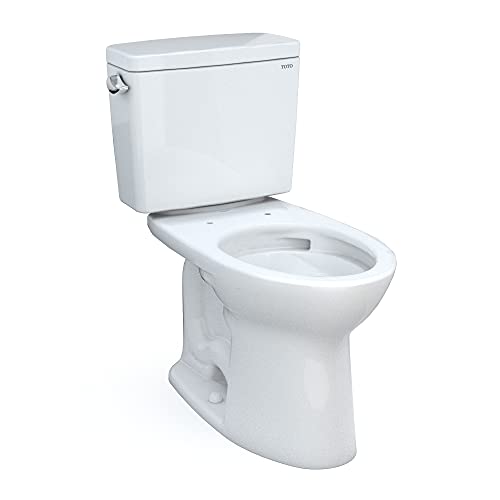
All TOTO toilets sold in the US are siphonic. The TOTO Drake (1.6 GPF, G-Max, 1,000g MaP) is among the most-specified models in US hotel renovations. The TOTO Drake II adds a SoftClose seat and comfort-height bowl. The TOTO UltraMax II achieves a 1,000g MaP score at 1.28 GPF via Double Cyclone (Tornado Flush) -- one of the most efficient 1,000g performers available. The TOTO Aquia IV is a dual-flush model at 1.0/1.28 GPF with WaterSense certification and a 1,000g MaP score.
Kohler's Highline and Cimarron are the brand's best-selling siphonic models. Both use the AquaPiston flush valve, which Kohler's published specs credit with a 90 percent more powerful flush than a standard flapper valve by delivering water from 360 degrees around the flush valve opening. The Cimarron at 1.28 GPF scores 1,000g on MaP testing. The Kohler Highline Arc in 1.28 GPF carries WaterSense certification. Kohler's Santa Rosa is a one-piece siphonic option that consistently earns strong owner reviews for quiet operation and bowl cleanliness.
Search Kohler Cimarron on Amazon
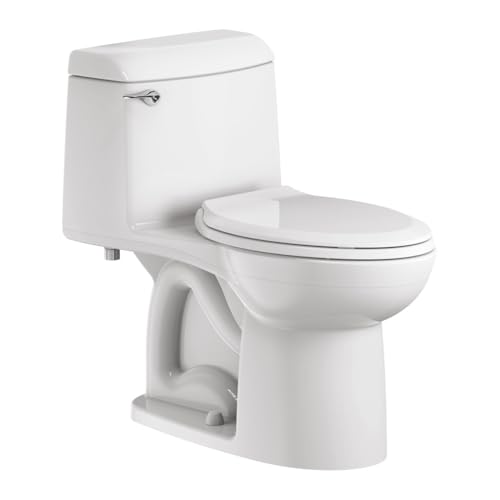
American Standard's Champion 4 is defined by its 4-inch flush valve and 2.125-inch glazed trapway. Published specs document a 1,000g MaP score at 1.6 GPF. The Cadet 3 brings the same fully glazed 2.125-inch trapway to a 1.28 GPF WaterSense-certified model, with a reported MaP score of 1,000g. Both are siphonic. American Standard's VorMax technology, used in the VorMax and VorMax Plus models, adds a single top-down jet that creates a vortex rinse before the siphon pull begins, reportedly improving bowl surface cleaning versus traditional rim-jet designs.
Search American Standard Champion 4 on Amazon
The Woodbridge T-0001 is a dual-flush siphonic one-piece toilet at 1.0/1.6 GPF with a fully glazed 2.125-inch trapway. It earns consistent owner praise for its sleek modern profile, quiet flush, and easy installation. WaterSense certification applies to the T-0001's dual-flush configuration, and aggregated reviews note reliable single-flush solid waste removal at the full 1.6 GPF setting.
Search Woodbridge T-0001 on Amazon
Swiss Madison's Wall Hung and Concorde series bridge the gap between European wash-down aesthetics and US siphonic performance through a direct-flush rimless delivery. Models operate at 1.28 GPF with a 2.125-inch trapway and carry WaterSense certification. Owner reviews consistently highlight above-average bowl cleanliness from the rimless nozzle design.
Search Swiss Madison toilets on Amazon
Gerber's Viper series is built to commercial vitreous china standards and is a common plumbing contractor specification for rental properties. Published trapway dimensions are 2.125 inches, and MaP scores range from 800g to 1,000g depending on model and GPF variant. Less visible in big-box retail, Gerber is widely available through plumbing supply distributors and earns strong marks for durability and parts availability.
Search Gerber Viper toilet on Amazon
A siphonic toilet uses vacuum pressure (siphon action) created in an S-shaped trapway to pull waste out of the bowl. A wash-down toilet uses only the weight and momentum of incoming water to push waste directly through a short, front-facing trapway outlet. Siphonic designs dominate North America; wash-down designs are standard in most of Europe and Asia.
US plumbing codes and drain specifications are built around the floor-exit rough-in geometry used by siphonic S-trap toilets. Wash-down toilets require a rear or near-floor outlet, which conflicts with the standard 12-inch rough-in that defines virtually all US bathroom construction. Additionally, ANSI and ASME flushing performance standards in the US were developed around siphonic flush testing protocols, making it difficult for wash-down toilets to earn domestic certification.
MaP (Maximum Performance) is an independent third-party flush test that measures how many grams of simulated solid waste a toilet clears in a single flush, on a scale of 250g to 1,000g. Siphonic toilets are the primary subjects of MaP testing because it was developed in North America. Top-scoring siphonic models from TOTO, Kohler, American Standard, and Gerber routinely achieve the maximum 1,000g rating. Wash-down toilets are not typically MaP-tested; their performance is evaluated under European standards such as EN 997.
Not necessarily in modern designs. While European wash-down toilets can flush at as low as 0.8 GPF, the best US siphonic toilets now operate at 1.0 to 1.28 GPF with EPA WaterSense certification and MaP scores of 800g to 1,000g. Older US siphonic toilets used 3.5 to 5.0 GPF; modern engineering has closed most of the efficiency gap between the two flush types.
Wash-down toilets are generally quieter because there is no siphon break at the end of the flush. Siphonic toilets produce a characteristic gurgle when air enters the trapway to break the siphon. Some premium siphonic models -- particularly TOTO's Tornado Flush series -- have reduced this sound through trapway geometry improvements, but wash-down designs remain inherently quieter at the end of the flush cycle.
For most North American households, yes. The active pulling force of the siphon pulls waste through the trapway with more force than gravity and water pressure alone provide in a wash-down design. Combined with large, fully glazed trapways (2.125 inches in models like the American Standard Champion 4 and Cadet 3), high-performing siphonic toilets have fewer reported clogs per flush than any other residential toilet type in owner surveys and plumbing service records.
A fully glazed trapway has a smooth ceramic glaze applied to the entire interior surface of the waste passage from the bowl outlet to the floor flange. This reduces friction, inhibits buildup of mineral deposits and waste residue, and allows waste to pass through the trapway more easily on every flush. Unglazed or partially glazed trapways are rougher at the surface level and can develop buildup over time that narrows the effective passage diameter.
No. The two flush mechanisms require fundamentally different bowl geometry, trapway shape, and rough-in configuration. A wash-down toilet cannot be retrofitted to flush siphonically. If you want siphonic performance, you need to replace the toilet with a siphonic model. The plumbing rough-in may also need to be modified if the existing drain is a rear-exit configuration designed for a wash-down unit.
TOTO's Tornado Flush (also called Double Cyclone) is a siphonic system. It delivers water to the bowl through two inlet nozzles rather than traditional rim jets, creating a centrifugal spiral that rinses the entire bowl surface while simultaneously delivering a high-volume flush to the trapway inlet to initiate the siphon. The flushing mechanism remains fundamentally siphonic -- the trapway is S-shaped and the flush ends with a siphon break.
The platform or shelf design in older European wash-down toilets -- particularly common in Germany and Austria -- was historically used to allow inspection of waste for health monitoring purposes. The flat ceramic ledge holds waste above the water line before flushing. Modern European toilet design has largely moved away from this "flachspuler" (flat-flush) bowl in favor of "tiefspuler" (deep-flush) bowls where waste falls into standing water, reducing odor and surface residue regardless of flush mechanism.
EPA WaterSense certifies toilets that use 1.28 gallons per flush (GPF) or less AND meet minimum flushing performance requirements. The performance threshold requires that certified toilets achieve at least a 350g MaP score -- though many WaterSense-certified models far exceed this minimum. Toilets earning WaterSense use at least 20 percent less water than the federal maximum standard of 1.6 GPF. More than 4,000 toilet models across all major US brands currently carry WaterSense certification.
Comfort height (also called ADA height or chair height) toilets have a rim height of 16 to 18 inches from the floor, similar to a standard chair. Standard height toilets measure 14 to 15 inches at the rim. Both heights are available in siphonic designs from all major US brands. Comfort height is the current default for most new US toilet purchases and is required for ADA-compliant accessible bathrooms. Wash-down toilets from European brands are sold in both heights as well, though rim heights may not map exactly to US comfort-height specifications.
Yes, for households that prioritize clog resistance above all else. The Champion 4's 4-inch accelerator flush valve and 2.125-inch fully glazed trapway still represent the widest single-flush solid waste clearance in the mainstream US market. Its 1,000g MaP score at 1.6 GPF is consistent across multiple test runs. The trade-off is water usage: the 1.6 GPF model uses more water than current WaterSense-certified alternatives. American Standard does offer the Cadet 3 Flowise at 1.28 GPF with a 1,000g MaP score for buyers who want both efficiency and clog resistance.
Dual-flush siphonic toilets use two separate flush volumes: a lower volume (typically 0.8 to 1.0 GPF) for liquid waste and a higher volume (1.28 to 1.6 GPF) for solid waste. Both flushes initiate the same siphon mechanism -- the lower volume is sufficient to trigger siphon action for liquid waste because there is no solid material requiring the full pulling force. The TOTO Aquia IV and Woodbridge T-0001 are widely reviewed examples of dual-flush siphonic toilets sold in the US.
Rimless toilets eliminate the under-rim channel that traditional siphonic and wash-down toilets use to deliver water around the bowl. Without this hidden channel, there are no spaces for bacteria, mold, or mineral deposits to accumulate out of sight. Cleaning a rimless bowl requires less effort and results in more consistently hygienic surfaces. The trade-off in siphonic rimless designs is that the direct-flush nozzle must deliver water with enough force and direction to rinse the full bowl surface without the rim distribution channel that traditional designs rely on.
Siphonic toilets are less sensitive to supply water pressure than many homeowners assume, because the flush is primarily driven by tank water volume rather than line pressure. A tank-flush siphonic toilet stores a full tank of water and releases it rapidly regardless of the incoming supply pressure (as long as the tank fills completely between flushes). Pressure-assist siphonic toilets -- which use compressed air to boost flush velocity -- are more pressure-dependent, typically requiring 20 to 80 PSI of supply pressure to function properly.
TOTO offers a limited lifetime warranty on the vitreous china bowl and tank, with one year on flush valve parts and seats. Kohler offers a limited lifetime warranty on all vitreous china parts. American Standard provides a limited lifetime warranty on the porcelain and a 5-year warranty on operating parts. Gerber offers a limited lifetime warranty on china and a 5-year warranty on mechanical parts. Woodbridge and Swiss Madison typically offer 5-year limited warranties. In all cases, warranties are for manufacturing defects and do not cover damage from improper installation or chemical cleaners.
In siphonic toilets, weak flush power over time most commonly results from mineral buildup in the rim jets (which reduces water flow into the bowl), a worn or warped flapper (which allows water to leak from the tank before the flush, reducing the volume available for siphon initiation), or partial blockage in the trapway from accumulated mineral scale. In all three cases, the siphon either fails to initiate fully or exhausts its driving water volume before completing the waste-clearing cycle. Cleaning the rim jets with a brush and diluted descaler, and replacing the flapper every 3 to 5 years, restores most of the original flush power.
Pressure-assist toilets use a pressurized tank cartridge (from brands like Sloan Flushmate) inside the standard porcelain tank to release water at higher velocity than gravity allows. The bowl and trapway geometry are siphonic -- the same S-shaped trapway and siphon break mechanism. The pressurized delivery simply accelerates the siphon initiation, making the flush louder but more powerful. Pressure-assist siphonic toilets are common in commercial settings and are available in consumer models from American Standard and other brands for households with persistent clogging problems.
For the vast majority of US homeowners, a siphonic toilet is the right choice and the only practical one given standard 12-inch rough-in plumbing. The siphon mechanism delivers superior clog resistance, a large water surface that keeps the bowl cleaner between uses, and through modern engineering -- TOTO's Tornado Flush, Kohler's AquaPiston, American Standard's 4-inch accelerator valve -- now achieves this performance at 1.28 GPF with EPA WaterSense certification and MaP scores up to 1,000g. Wash-down toilets offer genuine advantages in noise, rimless bowl compatibility, and very low GPF operation, but those benefits are largely inaccessible to buyers working within US plumbing infrastructure. If you are starting a new bathroom or replacing an aging toilet, focus on MaP score, trapway diameter, and WaterSense certification -- all of which guide you to the best siphonic options on the market.
Learn why toilet trapways curve like an S, how each bend blocks sewer gas, and what the shape means for clogs and…
Read the guideAlmost every US toilet has a left-side handle. Learn the plumbing and mechanical reasons behind the layout and when it actually changes.
Read the guideHome toilets rely on tanks because household water lines lack the pressure that public flushometer systems use to flush straight from the…
Read the guide