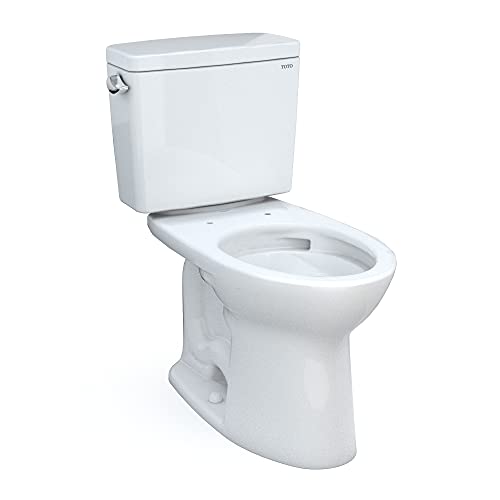


Why Toilet Trapways Are Curved Like an S
Toilets4.6
Learn why toilet trapways curve like an S, how each bend blocks sewer gas, and what the shape means for clogs and…
Read the guideWidth, depth, height, bowl shape, rough-in and code clearances: six numbers control whether a new toilet fits your bathroom. This guide gives you real manufacturer data, side-by-side charts for TOTO, Kohler, American Standard, Woodbridge, Swiss Madison and Gerber, and the exact measurements to take before you order anything.
A standard two-piece elongated toilet measures roughly 28 to 30 inches deep, 17 to 19 inches wide and 27 to 32 inches tall (seat to floor). Before ordering, confirm your rough-in (almost always 12 inches), check total depth against available floor space, and verify your bathroom meets the 15-inch minimum side clearance and 21-inch front clearance required by most building codes.
Toilet listings rarely surface the one number that will make or break your purchase. A spec sheet might show the overall height but omit the bowl height, list total depth but not clarify whether the tank is included, or quote a rough-in without explaining what happens if yours is different. A toilet that lands wrong over the drain, hits the door swing or crowds the vanity is a return trip, a restocking fee and a plumber's second visit. The goal of this guide is to make that outcome impossible by giving you every relevant dimension, explained in plain terms, before you ever look at a product page.
Everything here is sourced from published manufacturer specifications, independent MaP (Maximum Performance) flush-test data, EPA WaterSense certification records and the patterns that aggregate consistently across verified owner reviews. We do not install or test toilets ourselves. Models referenced throughout include the TOTO Drake, TOTO Drake II, TOTO UltraMax II, TOTO Aquia IV, Kohler Highline, Kohler Cimarron, American Standard Champion 4, American Standard Cadet 3, Woodbridge T-0001, Swiss Madison and Gerber. Once you have your measurements, our roundup of the best flushing toilets matches top performers to your space.
These ranges exist because toilet dimensions vary by bowl shape, one-piece versus two-piece construction, tank style and comfort-height versus standard-height designation. A compact one-piece like the TOTO UltraMax II comes in at 28.5 inches deep and 29.5 inches tall, while a taller two-piece comfort-height model like the Kohler Highline Comfort Height stretches to 31 inches tall with a similar footprint. Width is the most consistent measurement because tank width drives it, and most tanks are 13 to 20 inches across.
The table below gives real published dimensions for six of the most widely purchased toilets in the United States, drawn directly from manufacturer specification sheets. Use it to anchor your planning before measuring your own bathroom.
| Model | Type | Depth (in) | Width (in) | Height (in) | Bowl Height (in) | Rough-In (in) | Check Price |
|---|---|---|---|---|---|---|---|
| TOTO Drake II (CST454CEFG) | 2-piece, elongated | 28.25 | 19.5 | 30.13 | 16.5 | 12 | Check price |
| TOTO UltraMax II (MS604114CEFG) | 1-piece, elongated | 28.5 | 18.88 | 29.5 | 17 | 12 | Check price |
| TOTO Aquia IV (CST746CEMFG) | 2-piece, elongated | 29.5 | 19.5 | 28.75 | 16.5 | 12 | Check price |
| Kohler Highline Comfort Height (K-3817) | 2-piece, elongated | 30.25 | 20 | 31 | 17.5 | 12 | Check price |
| American Standard Champion 4 (2034.014) | 2-piece, elongated | 29.75 | 18.5 | 31 | 17 | 12 | Check price |
| Woodbridge T-0001 | 1-piece, elongated | 29.5 | 17.5 | 29.5 | 17 | 12 | Check price |
Notice that depth ranges from 28.25 to 30.25 inches across these popular models, a two-inch spread that can decide whether a door clears, a vanity fits beside it, or a closet wall leaves enough room. Height from floor to tank top runs 28.75 to 31 inches, which matters if you are mounting a shelf, a medicine cabinet or a towel bar behind or above the tank. Bowl height (floor to seat top without the seat) is the number that determines comfort, especially for users with mobility concerns.
Published depth measurements are almost always measured from the front of the bowl rim to the back of the tank, but some manufacturers measure to the back of the supply line connection instead, which adds about 1 to 1.5 inches. When your space is tight, add 1.5 inches to the listed depth as a buffer, then measure your actual opening before finalizing your choice. This is the single most common source of "it fit on paper but not in the bathroom" returns.
When measuring available floor space for depth, start at the finished back wall (not the baseboard) and measure toward the door, vanity or any edge that constrains the toilet's footprint. Your usable depth is that measurement minus any clearance you want for walking past. Building codes in most jurisdictions require at least 21 inches of clear space from the front of the toilet bowl to any wall, door, obstruction or fixture directly in front. The International Residential Code (IRC) specifies a 21-inch minimum; some local codes require 24 inches, and the ADA (Americans with Disabilities Act) guidelines call for 60 inches of clear floor space in front of an accessible toilet.
For a standard bathroom with a 12-inch rough-in, the calculation looks like this: measure from the back wall to the front obstruction, subtract your front clearance requirement (21 inches minimum), and the remaining number is your maximum allowable toilet depth. A bathroom that is 60 inches from wall to tub gives you 60 minus 21 = 39 inches of usable depth, which fits any standard toilet. A powder room that is 48 inches deep gives you 48 minus 21 = 27 inches, which means you need a round-bowl or compact elongated toilet, not a standard elongated model.
| Bowl Shape | Typical Depth Range | Best For |
|---|---|---|
| Round bowl | 25.5 to 28 inches | Small bathrooms, powder rooms, children's baths |
| Elongated bowl | 28 to 31 inches | Full baths, comfort, most adults |
| Compact elongated | 26.5 to 28.5 inches | Small spaces that still want elongated comfort |
| Square / designer | 27 to 30 inches | Modern aesthetics, depends on design |
The TOTO Entrada is a frequently recommended round-bowl model that comes in at about 26.5 inches deep, making it one of the most space-efficient choices that still carries EPA WaterSense certification at 1.28 GPF. If a round bowl feels cramped but your room cannot fit a standard elongated model, the American Standard Cadet 3 Compact Elongated is engineered to match the depth footprint of a round bowl while retaining an elongated seat profile.
Height terminology is confusing because brands use it inconsistently. "Bowl height" refers to the measurement from the floor to the top of the porcelain bowl rim, not the seat. Seat thickness adds roughly 0.5 to 1 inch, so the sitting height (floor to top of seat) is about an inch higher than the bowl height figure. When evaluating whether a toilet is right for a user with mobility concerns, arthritis or joint issues, use the seat-height figure, which is bowl height plus seat thickness.
| Height Category | Bowl Height (floor to rim) | Seated Height (approx.) | Best For |
|---|---|---|---|
| Standard height | 14 to 16 inches | 15 to 17 inches | Children, shorter adults, traditional preference |
| Comfort / chair height | 16.5 to 17.5 inches | 17.5 to 18.5 inches | Most adults, seniors, those with mobility concerns |
| ADA compliant | 17 to 19 inches | 18 to 20 inches | Wheelchair users, ADA accessible bathrooms |
Most plumbing manufacturers now offer comfort-height versions of their flagship lines. The TOTO Drake and Drake II are both available in comfort-height configurations (designated by the "E" or "EL" in the model suffix, indicating 1.28 GPF with an elongated comfort-height bowl). Kohler uses the label "Comfort Height" explicitly in model names such as the Kohler Highline Comfort Height. American Standard calls its elevated bowl option "Right Height." Gerber uses "ErgoHeight." The underlying specification is the same across brands: a bowl height at or above 16.5 inches.
For a bathroom that will serve users of multiple generations or one user who is likely to have difficulty rising from a low seat, comfort height is the right default. If the household includes young children as primary users, a standard-height toilet may be more practical because the height is easier for small legs to manage without a step stool.
The ADA requirement is 17 to 19 inches floor to seat top, which means comfort-height toilets at the lower end of their range (17.5 inches seated) satisfy ADA if the seat is thin. But ADA compliance for a full accessible bathroom involves much more than toilet height: grab bar placement, clear floor space, door width and approach direction all factor in. If you are doing an ADA renovation, check our dedicated ADA compliant toilet guide for the full specification set.
Width is the least variable of all toilet dimensions, because tank width changes relatively little across standard residential designs. The practical constraint is not the toilet's width itself but the side clearance the code requires. IRC Section R307.1 requires at least 15 inches from the toilet centerline to any side wall, vanity, bathtub or other obstacle. Because the toilet centerline sits over the drain, the rough-in measurement determines where the centerline falls, and you verify clearance from that center point outward in both directions.
If your rough-in places the drain center 15 inches from the left side wall, you have exactly the minimum required clearance on that side. Most designers recommend 18 inches from centerline to wall for comfortable use, which means a bathroom needs at least 36 inches total from wall to wall to house a toilet with comfortable side access. Many bathrooms place the toilet between a wall and a vanity, so measuring clearance to both surfaces from the drain center is essential before finalizing your layout.
| Clearance Point | Minimum (IRC) | Recommended | ADA Requirement |
|---|---|---|---|
| Center to side wall | 15 inches | 18 inches | 18 inches (transfer side 60 in clear) |
| Front of bowl to wall / obstruction | 21 inches | 24 inches | 60 inches clear floor space |
| Back wall to tank rear | No code minimum | Flush or 1 inch gap | No specific requirement |
The one-piece versus two-piece choice is more about aesthetics, cleaning ease and installation logistics than fitting in a bathroom. One-piece toilets like the TOTO UltraMax II and the Woodbridge T-0001 have a sleeker silhouette because there is no gap between tank and bowl, but they ship in a single heavy box (typically 90 to 120 pounds) that can be difficult to maneuver. Two-piece models like the TOTO Drake, Kohler Cimarron and American Standard Champion 4 come in two lighter boxes and can be assembled in the bathroom after the bowl is set, which makes installation much easier in tight spaces or on upper floors.
In terms of pure footprint, the differences are small. The TOTO UltraMax II (one-piece) measures 28.5 x 18.88 x 29.5 inches. The TOTO Drake II (two-piece) measures 28.25 x 19.5 x 30.13 inches. The two-piece is fractionally narrower in depth but slightly wider and taller. Both fit the same 12-inch rough-in and carry identical 1.28 GPF ratings with MaP scores of 1000 grams. For bathrooms where every inch of depth counts, neither type has a consistent advantage. The real depth savings come from bowl shape (round versus elongated) and whether the design is a compact elongated style.
| Feature | One-Piece | Two-Piece |
|---|---|---|
| Typical height | 27 to 30 inches | 28 to 32 inches |
| Typical weight | 80 to 130 lbs | 50 to 90 lbs (two boxes) |
| Depth range | 26 to 30 inches | 26 to 31 inches |
| Cleaning ease | Easier (no tank seam) | Harder (seam collects grime) |
| Installation ease | Harder (single heavy unit) | Easier (two lighter pieces) |
| Value at same performance | Moderate to high | Higher value per dollar |
A half-bath or powder room that is 30 to 36 inches wide presents two challenges: side clearance from the toilet centerline to both walls, and depth clearance from the tank back to the front of the bowl. If the room is 30 inches wide and the drain is centered at 15 inches from each wall, you meet the minimum code requirement but have no margin. A 36-inch wide powder room with the drain centered gives 18 inches on each side, which is comfortable. Depth in powder rooms is often the binding constraint, because the door typically opens into the same footprint the toilet occupies.
For powder rooms and tight bathrooms, the toilet options that consistently appear in verified owner reviews as successful are: the TOTO Entrada (round, 26.5 inches deep), the American Standard Cadet 3 Compact Elongated (about 27.5 inches deep), and the Swiss Madison St. Tropez (one-piece, about 26.6 inches deep). All three carry EPA WaterSense certification at 1.28 GPF. Our guide on the best toilet for small bathrooms covers these in more depth.
In very small bathrooms, the toilet rough-in placement can be adjusted during new construction or renovation by repositioning the drain before the floor is poured or tiled. If you are mid-renovation and the drain location is flexible, placing the drain center 18 inches from each side wall (rather than the minimum 15) costs almost nothing at rough-in but pays off in comfort for the life of the fixture.
Understanding how rough-in and depth interact helps when shopping for tight spaces. A 10-inch rough-in toilet is not 2 inches shallower overall than a 12-inch version; it is designed to sit closer to the wall with less tank depth, but its total floor footprint from wall to bowl front is very similar. The toilet that fits a 10-inch rough-in just sits with the tank closer to the wall. Our complete toilet rough-in guide covers 10, 12 and 14 inch options with specific model recommendations for each size.
Where rough-in does matter for depth is in the rear-of-tank clearance. A toilet intended for a 12-inch rough-in will position the back of its tank right against the wall when the drain is at 12 inches. If you install a 12-inch toilet on a 14-inch rough-in (using an offset flange), you get an unsightly 2-inch gap between the tank and the wall. If your rough-in is non-standard, the cleanest outcome is always a toilet designed for that rough-in distance, not an offset adapter, which adds a failure point.
The table below consolidates published specifications for twelve popular toilet models across six brands. Bowl height is measured from finished floor to top of bowl rim without seat. Seated height adds approximately 0.5 to 1 inch depending on seat thickness.
| Model | Config | GPF | Depth | Width | Total Height | Bowl Height | MaP Score | Check Price |
|---|---|---|---|---|---|---|---|---|
| TOTO Drake (CST744E) | 2-pc elongated | 1.28 | 28.38" | 19.5" | 30" | 15.13" | 1000 g | Check price |
| TOTO Drake II (CST454CEFG) | 2-pc elongated | 1.28 | 28.25" | 19.5" | 30.13" | 16.5" | 1000 g | Check price |
| TOTO UltraMax II (MS604114CEFG) | 1-pc elongated | 1.28 | 28.5" | 18.88" | 29.5" | 17" | 1000 g | Check price |
| TOTO Aquia IV (CST746CEMFG) | 2-pc dual-flush | 1.0/0.8 | 29.5" | 19.5" | 28.75" | 16.5" | 800 g (1.0) | Check price |
| Kohler Highline (K-3819) | 2-pc elongated | 1.28 | 30.25" | 19.75" | 29.25" | 15.13" | 1000 g | Check price |
| Kohler Cimarron (K-3609) | 2-pc elongated | 1.28 | 30" | 18.5" | 31.25" | 16.5" | 1000 g | Check price |
| Am. Std. Champion 4 (2034.014) | 2-pc elongated | 1.6 | 29.75" | 18.5" | 31" | 17" | 1000 g | Check price |
| Am. Std. Cadet 3 (2383.016) | 2-pc elongated | 1.28 | 29.75" | 18.13" | 31.5" | 16.5" | 1000 g | Check price |
| Woodbridge T-0001 | 1-pc elongated | 1.28 | 29.5" | 17.5" | 29.5" | 17" | 800 g | Check price |
| Swiss Madison SM-1T803 | 1-pc elongated | 1.1 | 26.6" | 14.6" | 27.9" | 16" | n/a | Check price |
| Gerber Maxwell (GWS21918) | 2-pc elongated | 1.28 | 29.5" | 17.75" | 30.75" | 16.5" | 1000 g | Check price |
| TOTO Entrada (CST244EF) | 2-pc round | 1.28 | 26.5" | 18.25" | 28.5" | 15" | 600 g | Check price |
A few patterns emerge from this data. First, total height is not driven by bowl height alone: the TOTO Drake has a 15.13-inch standard-height bowl yet a 30-inch total tank height, because the tank extends upward. The Kohler Cimarron has a comfort-height bowl at 16.5 inches and a 31.25-inch total height. Second, width is relatively consistent: 17 to 20 inches covers the full range of standard residential models. Third, the biggest depth spread (26.6 inches for the Swiss Madison compact to 30.25 for the Kohler Highline) is nearly four inches, which is meaningful in tight rooms.
MaP scores above 800 grams (the EPA WaterSense minimum for strong flush performance) appear across one-piece and two-piece models alike. The TOTO Drake, Drake II, UltraMax II, Kohler Highline, Kohler Cimarron, American Standard Champion 4 and Cadet 3 all earn 1000-gram MaP ratings, meaning none of your dimension choices have to come at the cost of flush power. Choose your shape, height and size first; flush performance is available across the full range.
Taking all five measurements before you shop eliminates the vast majority of return scenarios. Here is how to take each one correctly.
Rough-in: With the toilet in place, measure from the finished wall behind the tank to the center of the rear bolt caps at the toilet base. With no toilet installed, measure from the finished wall to the center of the closet flange. Round to 10, 12 or 14 inches. Our toilet rough-in measurement guide has photos of each scenario.
Available depth: Measure from the back wall to whatever is directly in front of the toilet position (door, tub, vanity, opposing wall). Subtract your minimum front clearance (21 inches for IRC, 24 inches recommended). The result is your maximum allowable toilet depth including supply line.
Side clearance: Measure from the drain center to the nearest fixture or wall on each side. You need at least 15 inches both ways. Mark the centerline on the floor with tape if it helps visualize.
Height clearance: In most bathrooms this is not a constraint unless a window sill, medicine cabinet or countertop shelf sits lower than 32 inches above the floor behind where the tank will sit. Tank tops on most two-piece models are 28 to 32 inches off the floor.
Door swing: If the bathroom door swings inward toward the toilet, stand at the toilet position and swing the door with your hand. A toilet lid open at 90 degrees typically extends 12 to 14 inches above the seat hinge point. On tight bathrooms, a soft-close seat that stops at 80 degrees rather than 90 can recover several inches of clearance.
| Measurement | What to Measure | Why It Matters | Minimum Standard |
|---|---|---|---|
| Rough-in | Back wall to drain center | Determines which toilets physically fit | Must match toilet spec exactly |
| Available depth | Back wall to obstruction minus clearance | Limits toilet depth selection | 21" front clearance required |
| Side clearance | Drain center to each side obstacle | Code compliance and comfort | 15" each side (IRC) |
| Height overhead | Floor to any overhead obstruction | Tank must fit beneath shelf/window | 32" minimum recommended |
| Door swing | Door arc radius to toilet position | Lid clearance and body clearance | No overlap with open lid |
The toilet tank is the component that most frequently causes surprises after installation because its back surface rests against or very close to the wall, and its top surface determines how high the toilet looks in the room. Two tank measurements matter beyond the height already covered: tank width and tank depth (front to back).
Tank width is essentially the toilet's overall width at the widest point, since the bowl is narrower. Standard tanks range from 13 to 20 inches wide. A 20-inch wide tank on a toilet where the drain center sits 18 inches from a side wall means the tank edge reaches 28 inches from the wall on the far side, and only 8 inches from the near wall. That 8-inch gap may or may not be enough to route a supply line and still open the shut-off valve. Always verify tank width against your side clearances, not just the centerline distance.
Tank depth (front to back) is typically 5 to 8 inches for standard gravity tanks. Pressure-assist toilets sometimes have slightly deeper or bulkier tanks because of the pressure vessel inside. This measurement matters when a window sill sits directly above where the tank will land, which is common in older bathrooms where the toilet was placed under the window to use exterior wall plumbing stacks.
Toilet seats are not universal. They come in round and elongated shapes, and within elongated there are standard and "D-shaped" profiles used by some European-influenced brands. The seat dimension that matters for fit is the bowl length: round bowls typically measure 16.5 inches from bolt holes to front rim, and elongated bowls measure 18 to 18.5 inches. A seat designed for an elongated bowl will not clip down correctly on a round bowl, and vice versa.
Seat width is less variable: most seats are 14 to 15 inches across the hinge end and 14.5 inches across the front. Bolt hole spacing is standardized at 5.5 inches center to center on virtually all North American toilets, so seat mounting is interchangeable across brands as long as bowl shape matches.
Bidet seats add meaningful height. A standard bidet toilet seat adds 2 to 3 inches to the seated height, which brings a standard-height toilet to comfort height and a comfort-height toilet to ADA territory. If seated height matters for your use case, confirm seat plus bidet seat plus bowl height before ordering a bidet.
One-piece toilets like the Woodbridge T-0001 and TOTO UltraMax II sometimes use a proprietary bolt hole spacing or a non-standard bowl shape for their included seats. Replacing the factory seat on these models can require more research. Before buying an aftermarket soft-close seat for a one-piece toilet, measure the bolt hole spread and bowl length and compare against the replacement seat spec, because generic seats sometimes fit loosely on sloped vitreous china rims.
The standard rough-in is 12 inches, measured from the finished back wall to the center of the floor drain. The vast majority of homes built after 1960 use this dimension. Some older homes have 10-inch or 14-inch rough-ins, which require specific toilet models built for that distance. Always measure before buying; never assume.
A standard elongated two-piece toilet measures 27 to 31 inches from the back of the tank to the front of the bowl. Round-bowl models are typically 25.5 to 27.5 inches deep. Compact elongated designs bridge the gap at 26.5 to 28.5 inches. Always add 1 to 1.5 inches to account for supply line fittings behind the tank.
Total height from floor to top of tank is typically 27 to 32 inches on most residential models. Bowl height (floor to rim) is 14 to 16 inches on standard toilets and 16.5 to 19 inches on comfort-height models. Seated height is bowl height plus approximately 0.5 to 1 inch for the seat itself.
Most residential toilets measure 17 to 20 inches at their widest point, which is typically the tank. Bowl width at the front is slightly narrower, usually 14 to 15.5 inches. Width matters most in relation to your side clearance: building codes require at least 15 inches from the toilet centerline to any side wall or obstruction.
The International Residential Code requires at least 15 inches from the toilet centerline to each side wall and 21 inches of clear space in front of the bowl. That translates to a minimum footprint of roughly 30 inches wide by 48 to 52 inches long (wall to the front clearance edge) for a single toilet. A functional half-bath or powder room is typically at least 36 by 66 inches to accommodate both a toilet and a small vanity.
A comfort-height toilet has a bowl height of 16.5 to 19 inches from floor to rim, placing the seated position 17 to 20 inches above the floor. This matches the height of a standard chair and reduces the effort of sitting down and standing up, which is particularly beneficial for adults over 60, taller users and anyone with knee, hip or back concerns. Kohler, TOTO, American Standard and Gerber all offer comfort-height versions of their flagship lines.
An elongated bowl adds approximately 2 inches of depth compared to a round bowl (18 to 18.5 inches bowl length versus 16.5 inches). The total toilet depth is correspondingly longer: elongated toilets run 28 to 31 inches from back wall to bowl front, round toilets run 25.5 to 27.5 inches. Elongated bowls are more comfortable for most adults; round bowls save space in tight rooms.
The IRC requires at least 21 inches of clear space from the front edge of the toilet bowl to any wall, door or fixture directly in front. Many building inspectors and designers recommend 24 to 30 inches for comfortable use. ADA-accessible toilet spaces require a 60-inch clear floor space in front of and beside the toilet for wheelchair transfers.
Not significantly. Depth and width vary less than two inches between one-piece and two-piece versions of comparable toilets. One-piece models tend to be 1 to 3 inches shorter in total height because there is no separate tank joint, but the bowl height and footprint are nearly identical to their two-piece counterparts in the same product line. The choice between one-piece and two-piece is more about installation ease, cleaning preference and aesthetics than fitting the bathroom.
ADA Standards for Accessible Design require toilet seat height (floor to seat top) to be between 17 and 19 inches. This is equivalent to the comfort-height range offered by most major brands. Bowl height must be 17 to 19 inches without the seat; adding a standard seat brings it to 17.5 to 20 inches. ADA also requires 18 inches minimum clearance from the toilet centerline to the near side wall and a 60-inch clear floor space measured from a specific point for transfer access.
Measure five things: (1) rough-in from back wall to drain center, (2) available depth from back wall to the nearest forward obstruction minus 21 inches, (3) side clearance from drain center to each side wall, (4) overhead clearance for the tank, (5) door swing radius to confirm the door misses the toilet lid. Cross-reference all five against the spec sheet of your chosen toilet before purchasing.
The minimum code requirement is 15 inches from the toilet centerline to each side wall, so a 30-inch total width with the drain centered gives exactly the minimum 15 inches on each side. This is legal but very tight. A 36-inch width with the drain centered gives 18 inches per side, which is the comfortable standard. If you are limited to 30 inches, a toilet with a narrow tank (17 to 18 inches wide) will help but will not change the code clearance requirement.
For a small bathroom where depth is the binding constraint, look for toilets under 27.5 inches deep: the TOTO Entrada round-bowl (26.5 inches), the American Standard Cadet 3 Compact Elongated (about 27.4 inches) and the Swiss Madison SM-1T803 (26.6 inches) are the three most frequently recommended by plumbers working in tight spaces. All three carry EPA WaterSense certification.
No. Rough-in is the distance from the back wall to the drain center in the floor. Toilet depth is the total front-to-back measurement of the fixture itself. On a 12-inch rough-in toilet, approximately 16 to 18 inches of depth extends in front of the drain, so the total depth is roughly 28 to 30 inches. The two measurements are related but distinct.
A standard residential tank holds 1.28 to 1.6 gallons of water (matching the GPF rating) and measures approximately 7 to 9 inches from front to back, 13 to 20 inches wide, and 12 to 15 inches tall on two-piece models. Low-profile tanks found on some comfort-height or contemporary-design toilets are shorter and wider. The tank's physical size does not directly indicate flush performance; tank design, flush valve diameter and water pressure determine how well it flushes.
Seat height (floor to top of seat when closed) equals bowl height plus seat thickness. Standard toilets sit 15 to 17 inches to the seat top; comfort-height toilets sit 17.5 to 19 inches. A standard toilet seat adds about 0.5 to 1 inch to bowl height, and a bidet toilet seat adds 2 to 3 inches. If you replace the factory seat, confirm the bowl shape (round or elongated) and the bolt hole spacing (standard 5.5 inches center to center).
Yes, indirectly. The supply line connects from the shut-off valve in the wall to the bottom of the tank. This connection typically requires 1 to 2 inches of clearance behind or beside the tank. When measuring available toilet depth, always use the listed depth plus 1.5 inches to account for the supply line elbow. If your shut-off valve is not directly behind the tank but offset to the side, confirm the supply line length and routing before installation.
Wall-hung toilets have no tank visible above the floor; the tank is concealed inside the wall in a carrier frame. The toilet bowl itself typically measures 21 to 24 inches in depth and 14 to 16 inches in width, with a finished bowl height that is adjustable during installation, typically set between 15 and 19 inches from floor to rim. The in-wall carrier frame requires a minimum wall cavity depth of about 7.5 inches. See our wall-hung toilet guide for full clearance requirements.
For seniors, the most important dimension is bowl height: comfort height (16.5 to 19 inches to rim) reduces the effort of standing up significantly. For heavier users, weight capacity (most standard toilets are rated 250 to 500 pounds when properly installed) and bowl width at the widest point (14 to 15.5 inches at the rim) matter more than overall toilet dimensions. The American Standard Champion 4 and Kohler Cimarron both have wider bowl profiles compared to many compact designs. Our guide to the best toilets for seniors covers height and weight capacity in detail.
The IRC requires a minimum of 15 inches from the toilet centerline to any side obstruction, 21 inches of clear space in front of the bowl and no specific minimum behind the tank. Local codes may be stricter: check your jurisdiction before roughing in the plumbing. For ADA-accessible bathrooms, the requirements increase substantially, including 18 inches to the side grab-bar wall, 60 inches of floor clearance in front and specific grab bar heights and positions.
Toilet dimensions are not complicated once you measure in the right order: rough-in first, then available depth after accounting for the 21-inch front clearance, then side clearance from the drain center, then bowl height for your comfort needs. Most households will land on a standard 12-inch rough-in, comfort-height, elongated toilet that is 28 to 30 inches deep and 17 to 20 inches wide. Models like the TOTO Drake II, Kohler Cimarron and American Standard Cadet 3 hit every dimension target for a full bathroom while earning 1000-gram MaP scores and EPA WaterSense certification at 1.28 GPF. For tight spaces, the TOTO Entrada and American Standard Cadet 3 Compact Elongated pull the depth under 27.5 inches without sacrificing WaterSense status. Take your five measurements, cross-reference the charts above, and the choice becomes a straightforward match.
Learn why toilet trapways curve like an S, how each bend blocks sewer gas, and what the shape means for clogs and…
Read the guideAlmost every US toilet has a left-side handle. Learn the plumbing and mechanical reasons behind the layout and when it actually changes.
Read the guideHome toilets rely on tanks because household water lines lack the pressure that public flushometer systems use to flush straight from the…
Read the guide