

Why Toilet Trapways Are Curved Like an S
Toilets4.6
Learn why toilet trapways curve like an S, how each bend blocks sewer gas, and what the shape means for clogs and…
Read the guideMaximum Performance (MaP) flush-testing and EPA WaterSense certification are the two most influential benchmarks shaping every toilet sold in North America. Understanding how they work together -- and where they pull against each other -- helps you choose a toilet that is genuinely powerful AND genuinely water-smart.
MaP scores measure how many grams of solid waste a toilet clears in a single flush; WaterSense limits how much water it uses per flush (1.28 GPF or less). The best toilets -- TOTO Drake II, Kohler Cimarron, American Standard Champion 4 -- achieve MaP scores of 800 to 1,000+ grams while meeting or exceeding WaterSense thresholds, proving efficiency and power are not mutually exclusive.
Buying a toilet without checking both MaP scores and water-use ratings is like buying a car based only on fuel economy without checking whether it can actually merge onto a highway. Both metrics matter. Both have limits. And the interaction between them determines whether your toilet will perform reliably for a decade or leave you reaching for a plunger twice a week.
This guide explains the mechanics behind each standard, shows how they are interrelated, and gives you the data you need to identify models that genuinely deliver on both dimensions. For a broader look at top performers across all categories, see our guide to the best flushing toilets on the market.
MaP (Maximum Performance) testing measures the maximum mass of simulated waste -- expressed in grams -- that a toilet can flush and clear completely in a single flush cycle. Scores range from under 250 grams (poor) to 1,000 grams (perfect, the protocol ceiling). A score of 500 grams or above is generally considered acceptable for residential use; 800+ grams is recommended for households with heavy use or a history of clogging.
The MaP testing protocol was developed jointly by the Canadian Water and Wastewater Association (CWWA) and a consortium of U.S. water utilities starting in 2003. The test uses a standardized simulated waste medium -- a miso paste and soybean casing combination designed to approximate the density, cohesion, and diameter of real human waste -- along with a specified volume of toilet paper. The objective is to determine the maximum mass a toilet can reliably evacuate without any residue remaining in the bowl or trap.
The test is conducted at a standardized static water pressure to simulate typical residential conditions. Each toilet is flushed multiple times at incrementally increasing waste loads. The highest load at which the toilet clears 100 percent of the media on every attempt is recorded as the MaP score. The test is third-party administered; manufacturers submit toilets voluntarily, and results are published publicly at map-testing.com.
| MaP Score (grams) | Rating | Best Use Case | Typical Models |
|---|---|---|---|
| Under 250 | Poor | Not recommended for residential use | Some older or ultra-budget models |
| 250 to 499 | Marginal | Light use, single-person households | Some entry-level 1.28 GPF models |
| 500 to 799 | Good | Standard residential households | Kohler Highline, Swiss Madison Clarence |
| 800 to 1,000+ | Excellent | Families, heavy use, clog-prone plumbing | TOTO Drake II, American Standard Champion 4, Kohler Cimarron |
MaP Premium certification -- a designation introduced to recognize toilets that combine high performance with low water use -- requires a minimum score of 350 grams at 1.0 GPF or less. This is the strictest benchmark in residential toilet testing and has been adopted by several water utilities as a rebate qualification threshold.
A MaP score tells you about peak flushing capacity under controlled pressure conditions. It does not tell you about long-term drain-line carry -- how far waste travels down your home's plumbing once it leaves the bowl. Drain-line carry is a separate consideration, particularly for older homes with reduced-slope drain pipes. High MaP scores are necessary but not sufficient for whole-system reliability.
EPA WaterSense is a voluntary certification program that labels toilets using 1.28 gallons per flush (GPF) or less, compared to the federal maximum of 1.6 GPF for new toilets and the 3.5+ GPF models still common in homes built before 1994. WaterSense also requires toilets to pass a minimum performance threshold -- currently a MaP score of at least 350 grams -- to prevent efficiency gains from coming at the cost of flush effectiveness.
The EPA launched WaterSense in 2006 as a market-transformation initiative modeled on the Energy Star program. For toilets, WaterSense certification requires two things: a water use at or below 1.28 GPF and a demonstrated flush performance meeting the program's minimum standard. The performance standard is tested using the MaP protocol, which is why the two systems are fundamentally linked.
According to EPA data, a WaterSense-certified toilet saves approximately 13,000 gallons of water per year compared to a 3.5 GPF toilet from the pre-1994 era, and roughly 4,000 gallons per year compared to a standard 1.6 GPF toilet. For a household of four, that represents meaningful annual utility cost savings in most U.S. markets.
| Classification | GPF Range | Annual Water Use (family of 4) | WaterSense Eligible? |
|---|---|---|---|
| Pre-1994 Standard | 3.5 to 7.0 GPF | ~30,000 to 60,000+ gallons | No |
| Federal Minimum (post-1994) | 1.6 GPF | ~17,000 gallons | No |
| WaterSense HET | 1.28 GPF | ~13,700 gallons | Yes |
| Ultra-High Efficiency | 0.8 to 1.0 GPF | ~8,500 to 10,700 gallons | Yes (if MaP ≥350) |
State-level regulations in California, Colorado, Georgia, and Texas have adopted WaterSense as a minimum standard for new construction and replacement toilets, making the certification de facto mandatory in large portions of the U.S. residential market. See our in-depth article on EPA WaterSense explained for more on the certification process.
No -- modern toilet engineering has largely decoupled water volume from flushing effectiveness. Advances in bowl geometry, trapway diameter, and flush valve design allow toilets operating at 1.28 GPF or even 0.8 GPF to achieve MaP scores of 800 to 1,000 grams that would have been impossible at those water volumes using 1990s technology. The relationship between GPF and MaP score is no longer linear.
The conventional assumption -- less water equals less flush power -- was accurate when toilet designs were essentially passive gravity systems with large tanks and simple trapways. Early low-flow mandates in the 1990s did produce a generation of underperforming toilets because manufacturers simply reduced tank size without redesigning the hydraulic system. The backlash was significant enough that Congress briefly exempted certain states from low-flow requirements.
Modern engineering has fundamentally changed this dynamic. The key innovations driving high MaP scores at low GPF include:
The American Standard Champion 4 is instructive: it uses 1.6 GPF -- the federal maximum, not a WaterSense level -- and achieves a near-perfect MaP score of 1,000 grams. Meanwhile, the TOTO Drake II achieves 800+ grams at 1.28 GPF. The comparison illustrates that WaterSense-compliant toilets have closed most but not all of the performance gap with higher-volume designs. For most households, the performance difference is negligible day-to-day.
For a deeper look at how flow rates affect real-world performance, see our guide comparing 1.28 GPF vs. 1.6 GPF toilets.
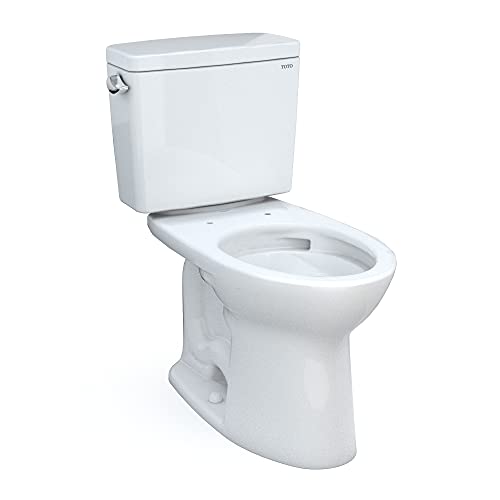
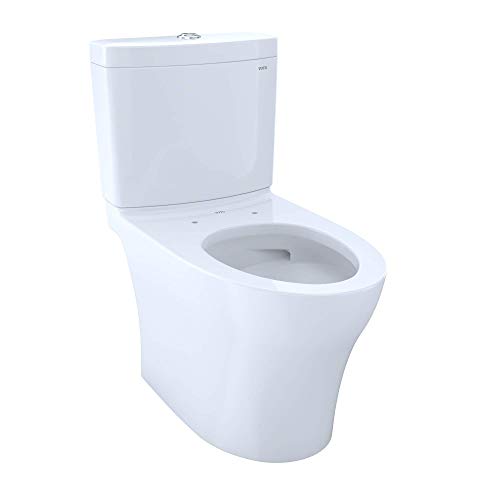
The models that best combine MaP performance with low water use include the TOTO Drake II (800 grams at 1.28 GPF), Kohler Cimarron (1,000 grams at 1.28 GPF), American Standard Cadet 3 (800 grams at 1.28 GPF), Gerber Ultra Flush (1,000 grams at 1.1 GPF), and TOTO Aquia IV dual-flush (1,000 grams at 1.28/0.9 GPF). These represent the realistic performance ceiling for water-efficient residential toilets.
| Model | GPF | MaP Score | WaterSense | Trapway Diameter | Flush Type | Check Price |
|---|---|---|---|---|---|---|
| TOTO Drake II | 1.28 | 800+ | Yes | 2.125 in. | G-Max / Double Cyclone | Check price |
| TOTO Aquia IV | 1.28 / 0.9 | 1,000 | Yes | 2.125 in. | Tornado Flush | Check price |
| TOTO UltraMax II | 1.28 | 800+ | Yes | 2.125 in. | Tornado Flush | Check price |
| Kohler Cimarron | 1.28 | 800 | Yes | 2.0 in. | Class Five | Check price |
| Kohler Highline | 1.28 | 600 | Yes | 2.0 in. | Class Five | Check price |
| American Standard Cadet 3 | 1.28 | 800 | Yes | 2.0 in. | PowerWash | Check price |
| American Standard Champion 4 | 1.6 | 1,000 | No | 2.375 in. | Champion Flushing System | Check price |
| Gerber Ultra Flush | 1.1 | 1,000 | Yes | 2.25 in. | Flushmate Pressure-Assist | Check price |
| Woodbridge T-0001 | 1.28 / 0.8 | 800 | Yes | 2.0 in. | Dual Flush Siphon | Check price |
| Swiss Madison Ivy | 1.28 / 0.8 | 600 | Yes | 1.75 in. | Dual Flush Siphon | Check price |
A few observations worth noting from this data set. First, the TOTO Aquia IV achieves a perfect 1,000-gram MaP score as a dual-flush toilet, which was once considered impossible for a non-pressure-assisted design. The Tornado Flush system's directed water jets and the bowl's steep angle account for the performance. Second, the Woodbridge T-0001 -- a popular budget-tier dual-flush model -- achieves a respectable 800-gram score at a 0.8 GPF partial flush, which places it in the high-efficiency category without a premium price.
Third and most importantly: the American Standard Champion 4's 1,000-gram score at 1.6 GPF is not necessarily better in practice than the TOTO UltraMax II's matching 1,000-gram score at 1.28 GPF. For typical household solid waste loads, 1,000 grams represents several times the actual load per flush, so the practical difference is negligible. Both toilets clear normal waste reliably; the Champion 4 simply uses 25 percent more water per flush to get there.
MaP Premium is an advanced tier within the MaP testing program that recognizes toilets achieving a minimum score of 350 grams at 1.0 GPF or less. Standard MaP testing covers all GPF levels and simply measures maximum performance; MaP Premium specifically targets ultra-high-efficiency toilets (UHETs) and serves as a qualification benchmark for water utility rebate programs and green building certifications such as LEED v4.
The MaP Premium designation was introduced to address a gap in the market: as water utilities pushed for toilets using less than 1.0 GPF, there was no independent standard to verify that these ultra-low-flow models actually worked. Some 0.8 GPF designs that appeared on the market in the 2010s had MaP scores below 200 grams -- functionally useless for household solid waste despite their impressive water-use numbers.
To qualify for MaP Premium, a toilet must:
In practice, the most competitive MaP Premium models significantly exceed the 350-gram minimum. The TOTO Aquia IV dual-flush achieves 1,000 grams at its full-flush volume (1.28 GPF) and still clears substantial loads at the 0.9 GPF partial flush. The Niagara Stealth, a 0.8 GPF gravity-fed model, achieves approximately 500 grams at its single low-flow setting -- well above the MaP Premium threshold despite using half the water of a 1.6 GPF toilet.
MaP Premium certification has become increasingly important for homeowners in drought-affected states where utilities offer cash rebates for qualifying ultra-high-efficiency toilet replacements. Water districts in California's Bay Area, Los Angeles, and parts of Texas and Arizona offer rebates ranging from $50 to $200 per toilet for MaP Premium-certified replacements. The rebate effectively offsets a significant portion of the purchase cost, making higher-end models financially competitive with budget alternatives.
For more on how high-efficiency designations interact with real-world water savings, see our article on high-efficiency toilets explained.
Brand-specific flush systems -- TOTO's Tornado Flush, American Standard's PowerWash Rim, Kohler's Class Five, and Flushmate pressure-assist -- achieve high MaP scores at low GPF through different hydraulic strategies. TOTO uses rim-jet velocity and bowl geometry; Kohler uses a wide 3-inch flush valve for a rapid water surge; pressure-assist systems use compressed air to multiply force. The result is that MaP scores at identical GPF levels can vary by 200 to 400 grams depending on flush technology.
TOTO's G-Max system, found on the Drake and Drake I, uses a 3-inch flush valve and a large 2.125-inch fully glazed trapway to achieve 800+ grams at 1.6 GPF. The successor Drake II replaces G-Max with the Double Cyclone system -- two nozzles that direct water in a centrifugal pattern, improving bowl coverage and reducing water use to 1.28 GPF while maintaining 800+ grams. The UltraMax II and Aquia IV use the Tornado Flush, TOTO's current flagship, which achieves 1,000 grams at 1.28 GPF on certain models.
The Champion 4's defining feature is its 2.375-inch trapway -- the widest of any major residential toilet -- paired with a 4-inch flush valve aperture (the "Champion" designation refers to this valve size). At 1.6 GPF, this combination achieves a perfect 1,000-gram MaP score. The Cadet 3 uses a narrower trapway but adds PowerWash Rim technology -- angled rim jets that clean the bowl while improving waste evacuation -- to achieve 800 grams at 1.28 GPF. The EverClean antimicrobial surface treatment on both models maintains hydraulic performance over time by inhibiting the biological buildup that can reduce flush effectiveness.
Kohler's Class Five flushing system pairs a 3-inch canister flush valve (the AquaPiston) with an optimized trapway and a precision-engineered bowl. The canister design opens from all sides simultaneously rather than pivoting like a traditional flapper, releasing water faster and creating a stronger initial surge. The Cimarron achieves a perfect 1,000 grams at 1.28 GPF with this system. The Highline uses the same valve but with a slightly different bowl geometry, achieving approximately 600 grams -- effective but well below the Cimarron's performance ceiling.
Pressure-assist systems like those used in the Gerber Ultra Flush store compressed air in a sealed vessel inside the tank. When the flush is triggered, the compressed air propels water into the bowl with force that gravity cannot replicate. This allows Gerber's pressure-assist models to achieve MaP scores of 800 to 1,000 grams at just 1.0 to 1.1 GPF. The trade-off is noise (pressure-assist flushes are noticeably louder than gravity-fed designs) and a higher upfront cost for the vessel cartridge replacement over time.
Woodbridge and Swiss Madison -- popular value-tier brands -- typically use licensed versions of standard siphonic flush technology without proprietary enhancements. Their 1.28/0.8 GPF dual-flush models perform credibly at the partial-flush volume for liquid waste but rely entirely on the full 1.28 GPF setting for solid waste clearance. For households where dual-flush discipline is inconsistent (common in practice), the effective average GPF in real use tends to be higher than the nominal 0.8/1.28 dual-flush specification suggests.
When selecting a toilet, use MaP score as a performance floor (minimum 500 grams for any residential toilet; 800+ grams for families or households with a history of clogs) and GPF as a water-budget ceiling (1.28 GPF for WaterSense compliance; 1.0 GPF or below for MaP Premium and rebate eligibility). Models that meet both targets simultaneously -- like the TOTO Drake II or Kohler Cimarron at 800+ grams and 1.28 GPF -- are the default recommendation for most households.
Here is a practical decision framework for applying both metrics:
Do not rely on manufacturer marketing language like "powerful flush" or "no-clog design" without verifying the published MaP score at map-testing.com. The database lists scores by brand, model number, and water volume, making it straightforward to confirm whether a specific SKU meets your performance threshold. Note that MaP scores can vary between color variants or model years of the same toilet line, so confirm the score for the exact model number you are purchasing.
Also see our guide to the toilet MaP score explained for a deeper walk-through of the testing protocol and how to read the database.
MaP testing is the most rigorous independent flush-performance standard available, but it has documented limitations that informed buyers should understand.
The miso paste and soybean casing medium used in MaP testing approximates real waste in density and cohesion but does not replicate all conditions encountered in real households. Toilet paper type (ultra-thick, double-ply, wet wipes), waste consistency, and mixed loads can produce results that diverge from MaP scores. American Standard acknowledges this in its Champion 4 marketing by noting that the 2.375-inch trapway is specifically designed to handle "anything that should be flushed," recognizing that real-world loads are less controlled than test conditions.
MaP testing is conducted at a standardized static water pressure. Homes with low incoming water pressure -- common in older urban buildings or rural properties with well systems -- may see lower real-world flush performance than MaP scores suggest. Conversely, high-pressure supply lines (above 80 PSI) can improve gravity-flush performance beyond the tested value.
MaP testing only measures bowl clearance -- whether the waste exits the toilet trap. It does not measure drain-line carry, which refers to how far waste travels down the horizontal drain pipes once it leaves the toilet. Homes with long horizontal drain runs, reduced-slope pipes (less than 1/4 inch per foot), or partially blocked drain lines may experience different results than MaP scores indicate, regardless of bowl-clearance performance.
MaP testing is conducted on new toilets under controlled laboratory conditions. Mineral deposits, scale buildup inside the trapway, worn flappers, reduced tank refill water level, and degraded rim jets can all reduce effective flush performance below the rated MaP score over time. A toilet rated at 800 grams new may effectively perform closer to 500 grams after five years of hard-water use without cleaning and maintenance.
The practical implication of MaP's limitations is that a toilet with a MaP score of 800 grams under test conditions provides a meaningful performance buffer above the 500+ grams needed for typical household loads. A toilet tested at exactly 500 grams has no buffer -- any real-world deviation from test conditions (lower pressure, mineral buildup, atypical waste loads) can push it below the reliability threshold. This is why most plumbers and remodeling contractors recommend 800+ grams regardless of household size.
The economic argument for WaterSense-certified toilets depends on your local water rate, household flush frequency, and the cost differential between efficient and standard models. Here is the framework:
Assuming 5 flushes per person per day at the U.S. average of $0.004 per gallon (national average, which varies significantly by municipality):
| Replaced Toilet (GPF) | New Toilet (GPF) | Annual Gallons Saved (2 adults) | Approx. Annual Savings |
|---|---|---|---|
| 3.5 GPF (pre-1994) | 1.28 GPF | ~8,000 gal | ~$32/yr |
| 1.6 GPF (federal standard) | 1.28 GPF | ~2,600 gal | ~$10/yr |
| 1.6 GPF | 1.0 GPF (MaP Premium) | ~4,380 gal | ~$17/yr |
| 1.28 GPF | 1.0 GPF (MaP Premium) | ~1,825 gal | ~$7/yr |
At national average water rates, the payback period on a WaterSense toilet replacing a 1.6 GPF model is typically 15 to 25 years based on water savings alone. The financial case is stronger in high-rate markets (San Francisco, New York City, parts of Texas) where water costs two to four times the national average, or when utility rebates are available. Replacing a pre-1994 toilet makes strong financial sense in almost any market.
The practical takeaway: do not buy a less-capable toilet solely to save water if clog-related service calls become necessary. A single plumber visit to address a chronic clog issue costs more than the lifetime water savings from choosing a lower-GPF model.
Dual-flush toilets offer two flush volumes -- typically 0.8 or 1.0 GPF for liquid waste and 1.28 or 1.6 GPF for solid waste -- and are theoretically more efficient than single-flush designs because the lower volume handles a significant portion of daily flushes. In practice, the efficiency gain depends entirely on user behavior.
Studies by water utilities in Australia (where dual-flush is the dominant design) and in U.S. pilot programs have found that in households where occupants consistently use the partial flush for liquid waste, average effective GPF drops to approximately 0.95 to 1.05, representing a 20 to 35 percent reduction in toilet water use compared to a single-flush 1.28 GPF toilet. However, in households where occupants default to the full flush for all waste types (a common real-world behavior, particularly in shared or rental occupancies), the effective GPF is essentially equal to the full-flush volume.
For MaP scoring purposes, dual-flush toilets are typically scored at the full-flush volume. The partial-flush MaP score is sometimes published separately and is frequently not tested at all. The Woodbridge T-0001 and TOTO Aquia IV are notable exceptions -- both have published MaP scores at both flush volumes, allowing a complete assessment of dual-flush performance.
Dual-flush toilets require the user to make a decision on every flush. In households with children, elderly residents, or guests, the decision is often skipped in favor of the full flush. If water conservation is the primary goal and consistent partial-flush use cannot be relied on, a single-flush 1.0 GPF MaP Premium toilet may deliver more consistent real-world savings than a 0.8/1.28 dual-flush design.
For a full comparison of flush options, see our guide on dual-flush vs. single-flush toilets.
MaP stands for Maximum Performance. The MaP testing program is a North American initiative that measures the maximum mass of simulated solid waste -- in grams -- that a toilet can clear in a single flush. It is administered by a consortium of water utilities and published publicly at map-testing.com.
A higher MaP score means the toilet can handle heavier solid waste loads before failing to clear completely. For most households, any score above 500 grams is sufficient for normal use. Scores of 800 to 1,000 grams provide a meaningful performance buffer for larger families, heavy use, or older plumbing systems prone to slow drain conditions.
EPA WaterSense requires a minimum MaP score of 350 grams. This threshold was set to ensure that efficiency gains from reduced water use do not come at the cost of flush reliability. In practice, virtually all major-brand WaterSense toilets significantly exceed the 350-gram minimum.
The EPA defines high-efficiency toilets (HET) as those using 1.28 GPF or less -- the WaterSense threshold. Ultra-high-efficiency toilets (UHET), sometimes designated as MaP Premium, use 1.0 GPF or less. The federal standard for new toilets since 1994 has been a maximum of 1.6 GPF.
Most water utility rebate programs require either WaterSense certification (1.28 GPF) or MaP Premium certification (1.0 GPF, 350+ gram MaP score) depending on the rebate tier. Some programs specifically require MaP Premium for the highest rebate amounts. Always check your local utility's rebate criteria before purchasing.
Yes, in most real-world conditions. Modern 1.28 GPF toilets from TOTO (Drake II, UltraMax II), Kohler (Cimarron), and American Standard (Cadet 3) achieve MaP scores of 800 grams or higher -- well above the typical household load. The 1.6 GPF American Standard Champion 4 achieves 1,000 grams, a margin above the 1.28 GPF models, but the practical performance difference during normal household use is negligible for most users.
Standard MaP testing measures flush performance at any water volume and reports the maximum grams cleared. MaP Premium is a specific designation within the MaP program for toilets that achieve at least 350 grams at 1.0 GPF or less. MaP Premium is designed to certify that ultra-high-efficiency toilets actually work, and it serves as the qualification benchmark for the strictest utility rebate programs and LEED v4 certification.
Published MaP scores are freely available at map-testing.com. You can search by brand, model name, or model number. The database includes the GPF at which each test was conducted and the resulting score. Always search by the exact model number rather than the product family name, as scores can differ between models within the same product line.
The TOTO Drake II is more water-efficient. The original Drake uses G-Max technology at 1.6 GPF (with some versions at 1.28 GPF); the Drake II uses Double Cyclone technology at 1.28 GPF throughout the product line while maintaining an 800+ gram MaP score. For new purchases, the Drake II is recommended unless the Drake is significantly less expensive or a specific model configuration is required.
Some dual-flush models -- particularly older designs and some value-tier imports -- use 1.6 GPF for the full flush because their bowl geometry and trapway diameter require the higher volume to achieve reliable solid waste clearance. Models with smaller trapways (under 2.0 inches) or less optimized bowl profiles cannot achieve adequate MaP scores at 1.28 GPF and require the full 1.6 GPF setting for reliable performance.
Yes. MaP testing is conducted at standardized pressure. Homes with low incoming water pressure (below 40 PSI, common in multi-story buildings and older municipal systems) may see real-world flush performance below the rated MaP score because the tank refills more slowly and may not reach the full design water level before the next flush. A pressure-regulating valve at the home's main line can address chronic low-pressure issues.
The American Standard Champion 4 achieves a MaP score of 1,000 grams (the protocol ceiling) at 1.6 GPF. It is not WaterSense certified because it exceeds the 1.28 GPF threshold. American Standard does offer the Champion 4 MAX variant, which operates at 1.28 GPF and achieves a MaP score of 1,000 grams, qualifying for WaterSense and most utility rebate programs.
The EPA estimates that replacing an older 3.5 GPF toilet with a 1.28 GPF WaterSense model saves approximately 13,000 gallons per person per year. Replacing a 1.6 GPF toilet with a 1.28 GPF WaterSense model saves approximately 1,300 gallons per person per year. Actual savings depend on household flush frequency and local water rates.
Not always. Pressure-assist toilets achieve high MaP scores at very low GPF (0.8 to 1.0 GPF) through compressed-air amplification. However, top-tier gravity-flush designs from TOTO (Tornado Flush) achieve 1,000-gram MaP scores at 1.28 GPF -- effectively matching pressure-assist performance at a slightly higher GPF. Pressure-assist has the edge at 1.0 GPF and below; at 1.28 GPF, the best gravity designs are competitive.
Yes. The Woodbridge T-0001 has a published MaP score of approximately 800 grams at the 1.28 GPF full-flush setting and is WaterSense certified. It is one of the better-performing value-tier dual-flush toilets in terms of the ratio of MaP score to retail cost, though its 1.75-inch trapway is narrower than premium competitors from TOTO and American Standard.
The Kohler Cimarron achieves a perfect MaP score of 1,000 grams at 1.28 GPF and is EPA WaterSense certified. It uses Kohler's Class Five flushing system with an AquaPiston canister flush valve and a 2.0-inch fully glazed trapway. It is one of the most consistently recommended 1.28 GPF toilets in terms of the combination of MaP score, build quality, and availability of replacement parts.
Yes, MaP scores are directly comparable across brands and models because they use a standardized testing protocol administered by a neutral third party. A score of 800 grams from TOTO means the same thing as 800 grams from Kohler or American Standard -- both toilets cleared 800 grams of simulated waste under the same conditions. This makes MaP the most useful single metric for cross-brand flush performance comparison.
The Gerber Viper is a gravity-flush toilet operating at 1.28 GPF and is WaterSense certified. It does not qualify as MaP Premium because it operates above the 1.0 GPF threshold. Gerber's pressure-assist models, such as the Ultra Flush series, operate at 1.0 to 1.1 GPF and are designed to meet MaP Premium criteria.
MaP scores reflect performance at time of testing on a new toilet. Real-world performance can decline due to mineral scale buildup inside the trapway and rim jets, flapper wear (reduced flush volume when the flapper closes too quickly), reduced fill-valve performance, and calcium deposits on the jet holes. Regular cleaning of the rim jets, annual flapper inspection, and descaling in hard-water areas help maintain performance closer to the original MaP rating.
California's CALGreen code requires a maximum of 1.28 GPF for all new residential toilets. Colorado, Georgia, and Texas have adopted similar standards. New York City requires 1.28 GPF in new construction and major renovations. Several states have pending legislation to adopt WaterSense as a minimum standard. WaterSense compliance is federally voluntary but state-mandated in a growing portion of the U.S. market.
MaP testing and WaterSense certification are complementary, not competing, standards -- one measures what a toilet can clear, the other limits how much water it uses to do it. The best toilets available in 2026 prove these goals are compatible: the TOTO Drake II, Kohler Cimarron, American Standard Cadet 3, and TOTO Aquia IV all achieve 800 to 1,000 grams on MaP while using 1.28 GPF or less. For most households replacing a toilet today, targeting a WaterSense-certified model with a published MaP score of 800+ grams is the right framework -- it delivers reliable daily performance, qualifies for utility rebates, and uses 20 percent less water than the 1.6 GPF federal standard without any sacrifice in real-world flush power.
Learn why toilet trapways curve like an S, how each bend blocks sewer gas, and what the shape means for clogs and…
Read the guideAlmost every US toilet has a left-side handle. Learn the plumbing and mechanical reasons behind the layout and when it actually changes.
Read the guideHome toilets rely on tanks because household water lines lack the pressure that public flushometer systems use to flush straight from the…
Read the guide