

Why Toilet Trapways Are Curved Like an S
Toilets4.6
Learn why toilet trapways curve like an S, how each bend blocks sewer gas, and what the shape means for clogs and…
Read the guideTank elevation is the single biggest determinant of gravitational potential energy in a toilet system. This guide explains the physics, the data, and which real-world models convert height into reliable clearing power.
Tank height directly controls the gravitational head pressure driving water into the bowl. Every additional inch of vertical rise adds roughly 0.036 PSI of static head. Toilets with tanks positioned 15 to 18 inches above the rim consistently outscore shorter-tank designs on MaP flush tests, clearing 500 to 1,000 grams of solid waste reliably at 1.28 GPF.
Every gravity-flush toilet operates on a simple principle: water stored above the bowl falls under gravity, converts potential energy into kinetic energy, and scours the bowl while carrying waste through the trapway and into the drain stack. No pump, no pressurized vessel, no compressor. The mechanism relies entirely on column height and volume working together.
The relevant formula is straightforward: P = rho x g x h, where P is pressure in pascals, rho is water density (approximately 1,000 kg/m3), g is gravitational acceleration (9.81 m/s2), and h is the vertical height of the water column in meters. Convert to imperial: one inch of water column equals approximately 0.036 PSI of static pressure at the inlet. A tank with its water surface 15 inches above the bowl rim delivers roughly 0.54 PSI of head before the flush valve opens. Raise that to 18 inches and you get 0.65 PSI. That 0.11 PSI gap is measurable and consequential in terms of bowl wash velocity.
What matters practically is not just static head but flow rate at the moment of flushing. When the flapper opens, water accelerates through the flush valve and into the rim jets or siphon jet. The velocity of that water stream is proportional to the square root of the head pressure (Torricelli's theorem), so even modest height differences compound into meaningful flow velocity changes. A tank 3 inches taller than a competing design produces water that enters the bowl roughly 10 percent faster at the siphon jet, creating a stronger siphon pull and more complete evacuation.
Plumbing engineers frequently note that residential gravity-flush toilets operate in a pressure regime where the trapway diameter and flush valve size matter as much as raw head height. A wide-open 3-inch flush valve on a tank only 14 inches above the rim can outperform a restrictive 2-inch valve on a taller tank. Height is the foundation; valve engineering is the multiplier. Models like the TOTO Drake II and American Standard Champion 4 pair optimized valve geometry with sufficient tank elevation to reach MaP scores at or above 1,000 grams.
Yes, tank height is a significant contributor to MaP (Maximum Performance) flush test results. MaP testing measures the maximum grams of solid waste a toilet can clear in a single flush, and toilets with greater gravitational head consistently score in the 800 to 1,000+ gram range. Lower-tank or compact designs often score in the 500 to 700 gram range unless compensated by engineered flush valve technology. The relationship is not perfectly linear because trapway geometry, bowl shape, and valve design all intervene, but no gravity-flush toilet achieves a 1,000-gram MaP score with less than approximately 14 inches of effective tank height above the waterline.
Tank height and gallons-per-flush (GPF) ratings are related but distinct variables. EPA WaterSense certification requires 1.28 GPF or less, and manufacturers achieve this while maintaining flush performance by maximizing gravitational head rather than increasing water volume. A taller tank at 1.28 GPF can deliver more siphon force than a squat tank at 1.6 GPF because the velocity head compensates for reduced volume. This is why TOTO's Tornado Flush and American Standard's PowerWash systems use optimized rim jet angles alongside adequate tank elevation to pass EPA WaterSense at 1.28 GPF with MaP scores above 800 grams.
Standard two-piece toilets typically position the tank waterline 14 to 16 inches above the bowl rim, with the exterior tank top reaching 28 to 32 inches from the floor. One-piece toilets often have lower tank profiles (12 to 14 inches of effective head) because their integrated design compresses vertical space. High-tank and close-coupled designs deliberately maximize the 15 to 18 inch head range. The TOTO Drake series, Kohler Highline, and American Standard Champion 4 all maintain 15 to 17 inches of effective head height, which correlates directly with their consistently high MaP scores.
Pressure-assisted toilets supplement gravity with compressed air (typically 25 to 80 PSI vessel pressure), effectively eliminating dependence on tank height entirely. They are louder and more expensive to service but can achieve powerful flushes even in low-ceiling installations. Tornado-flush systems (used by TOTO) use dual angled rim jets to create centrifugal bowl wash, partially compensating for moderate tank heights. Standard gravity-flush toilets without these augmentations are most sensitive to tank height variation, making it the dominant performance variable in budget and mid-range models from Woodbridge, Swiss Madison, and Gerber.
Rough-in distance (the measurement from the finished wall to the center of the drain flange, typically 10, 12, or 14 inches) affects the trapway length and siphon path but does not directly reduce the tank's gravitational head. However, a longer siphon path in a 14-inch rough-in toilet introduces more friction loss, which partially offsets the kinetic energy delivered by the falling water column. Toilets designed for 10-inch rough-ins often use a compressed trapway that can reduce siphon pull; pairing them with a taller tank tank or an efficient 3-inch flush valve helps recover lost performance.
Understanding how height translates to performance requires seeing the full system. A gravity-flush toilet consists of four interacting subsystems: the tank (reservoir and head), the flush valve (flow gate), the rim jets and siphon jet (delivery nozzles), and the trapway (siphon pathway). Each component either amplifies or attenuates the energy that tank height provides.
The relationship between tank height and siphon initiation is non-linear. Below a threshold head pressure, the siphon may fail to form completely, leaving waste in the trapway. Above that threshold, additional height provides diminishing returns because the siphon is already fully established. Most standard gravity toilets cross the siphon formation threshold at around 12 inches of head. The range from 14 to 18 inches is the performance sweet spot where added height reliably improves bowl wash completeness and waste clearance distance in the drain stack.
The clearest illustration of tank-height physics is the historical comparison between Victorian high-tank toilets (with tanks mounted 6 to 8 feet above the floor on wall brackets) and modern close-coupled designs. High-tank systems were devastating in their clearing power despite using only 3 to 4 gallons per flush, because the 5 to 7 foot head created far more pressure than any modern installation. Their abandonment was driven by aesthetics and plumbing code changes, not performance.
In the modern market, the gap between high-profile two-piece toilets and ultra-low-profile one-piece designs tells the same story at a smaller scale. The TOTO UltraMax II one-piece toilet has a tank profile roughly 2 to 3 inches lower than the TOTO Drake II two-piece, yet matches its MaP score exactly (1,000 grams for both in independent testing) because TOTO compensates with its Tornado Flush technology. Without that engineering compensation, the height difference would produce a measurable performance penalty.
| Model | Type | Approx. Tank Height Above Rim (in) | Flush Volume (GPF) | Published MaP Score (g) | EPA WaterSense | Check Price |
|---|---|---|---|---|---|---|
| TOTO Drake II (CST454CEFG) | 2-piece | 17 | 1.28 | 1,000 | Yes | Check price |
| American Standard Champion 4 (2034.014) | 2-piece | 16 | 1.6 | 1,000 | No | Check price |
| Kohler Highline Classic (K-3493) | 2-piece | 16 | 1.28 | 800 | Yes | Check price |
| TOTO UltraMax II (MS604114CEFG) | 1-piece | 14 | 1.28 | 800 | Yes | Check price |
| American Standard Cadet 3 (2403.128) | 2-piece | 15 | 1.28 | 800 | Yes | Check price |
| Woodbridge T-0001 | 1-piece | 13 | 1.28 / 0.8 | 600 | Yes | Check price |
| Swiss Madison Concorde (SM-1T257) | 1-piece | 13 | 1.28 / 0.8 | 500 | Yes | Check price |
| Kohler Cimarron (K-6418) | 2-piece | 16 | 1.28 | 1,000 | Yes | Check price |
| Gerber Viper (DF-21-318) | 2-piece | 15 | 1.28 | 800 | Yes | Check price |
| TOTO Aquia IV (CWT4463047MFG) | Dual-flush 2-piece | 14 | 1.0 / 0.8 | 600 | Yes | Check price |
Note: MaP scores reflect published testing data. "Approx. Tank Height Above Rim" is derived from published toilet dimension specifications and may vary by 1 to 2 inches across production runs. Always verify current specs with the manufacturer.
The tank height dimension published in specification sheets assumes a standard floor-mounted installation on a level floor. Real installations introduce variability. Sloping floors, wax ring compression depth, and the difference between rough-in toilet heights all shift the effective head by small amounts. More significantly, the water level inside the tank can vary by 1 to 2 inches from the factory setting, and many installers adjust float valve height without realizing the performance consequence.
Setting the tank water level at the fill line marked on the tank interior is not cosmetic guidance. That line represents the water volume the toilet was MaP-tested with. Lowering the water level by 1 inch to "save water" reduces both head pressure and volume, and the combined effect on MaP score can be a 100 to 200 gram reduction in effective clearing capacity. Raising the water level above the overflow tube causes continuous running without improving flush power because excess water exits through the overflow before the flush cycle.
One of the most common service calls plumbers receive for "weak flushing" turns out to be a tank water level set too low, either by a previous repair or by the original installation. Before assuming the toilet is defective or the trapway is partially blocked, verify the tank water level is at the manufacturer's fill line. Correct this first. It costs nothing and solves the problem in a significant share of weak-flush complaints, particularly in homes with older float-ball mechanisms that have drifted over time.
Dual-flush toilets present an interesting challenge for the height-efficiency relationship. Their liquid-waste flush cycles (typically 0.8 GPF) use such low volume that the kinetic energy from the falling water is greatly reduced compared to a full 1.28 GPF cycle. At 0.8 GPF through a 14-inch head, the bowl wash is sufficient to remove liquid waste but marginal for mixed or solid waste. This is why dual-flush toilets like the TOTO Aquia IV and Woodbridge T-0001 score lower on full-cycle MaP testing than comparably priced single-flush designs at 1.28 GPF.
Buyers choosing dual-flush should expect the half-flush to be used only for liquid waste, with the full flush used for all solid waste. Using the half-flush indiscriminately is the most common source of partial clogs in dual-flush installations. The physics are clear: at 0.8 GPF through a moderate-height tank, there is limited margin to siphon a fully loaded trapway.
If water conservation is the priority but strong flush performance is also required, the better path is often a single-flush 1.28 GPF EPA WaterSense toilet with high tank elevation, such as the Kohler Cimarron or TOTO Drake II, rather than a dual-flush design where users frequently use the wrong cycle.
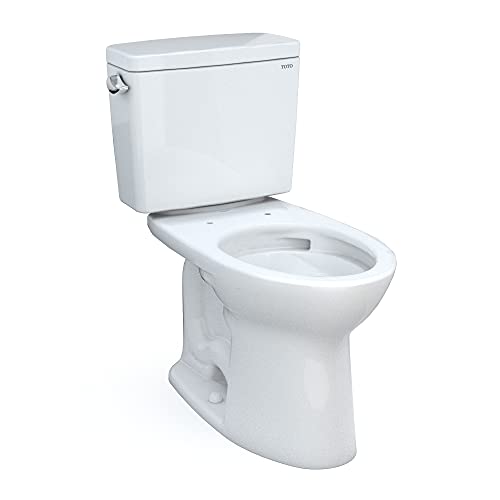
TOTO has built its Drake and Drake II lines around a 17-inch effective head height in the two-piece configuration, combined with its G-Max and then E-Max flushing systems. The Drake II's 1.28 GPF with 1,000-gram MaP is a direct product of that height paired with a fully glazed 2 1/8-inch trapway and large siphon jet. TOTO's one-piece UltraMax II trades 3 inches of head height for Tornado Flush technology, recovering the performance penalty through centrifugal bowl wash rather than increased pressure. Explore the full best flushing toilets guide for a broader brand comparison.
Kohler maintains strong tank height geometry in the Highline and Cimarron lines. The Cimarron in particular uses a large 3-inch flush valve to compensate for a moderately tall (16-inch) tank, achieving 1,000-gram MaP at 1.28 GPF. The combination of a wide-open valve and sufficient head makes the Cimarron one of the most consistent performers in its price tier. See the Kohler Cimarron review for detailed analysis.
American Standard achieves high MaP scores through a different philosophy. The Champion 4 uses a 4-inch piston-action accelerator flush valve rather than a conventional flapper, which opens the full bore of the valve nearly instantaneously and compensates for a standard 16-inch head height by maximizing flow rate rather than maximizing pressure. The result is the same 1,000-gram MaP score but with a 1.6 GPF volume requirement, making it ineligible for EPA WaterSense. The Cadet 3 at 1.28 GPF scores 800 grams and represents American Standard's WaterSense-compliant offering. Read the American Standard Champion 4 review for more detail.
Woodbridge competes primarily in the one-piece space where its tank profiles are limited to 12 to 13 inches of effective head. The T-0001's dual-flush mechanism scores approximately 600 grams at full flush in aggregated consumer report data, adequate for most households but not recommended for high-use family bathrooms where consistent solid waste clearing is needed. The Woodbridge T-0001 review covers its full trade-offs.
Gerber is frequently overlooked in mainstream comparisons but produces genuinely competitive gravity-flush designs. The Viper series maintains a 15-inch head height with a fully glazed 2 1/8-inch trapway and consistently achieves 800-gram MaP scores at 1.28 GPF. Gerber toilets have strong contractor adoption rates and carry solid warranty terms that improve their long-term cost of ownership.
Swiss Madison designs prioritize visual minimalism and low-profile installation, which means their one-piece models accept lower effective head heights. Performance reflects this trade-off, with most Swiss Madison models scoring in the 500 to 600 gram MaP range. These toilets are appropriate for powder rooms, guest bathrooms, or any installation where aesthetic priority outweighs maximum flush power.
Tank height determines the energy input to the flush cycle. The trapway determines how efficiently that energy is converted into complete waste evacuation. A fully glazed, wide-diameter trapway presents minimal friction to the siphon flow, allowing the head pressure to do its full work. An unglazed or narrow trapway absorbs energy in friction losses and can fail to complete the siphon even with adequate head pressure.
The minimum trapway diameter that plumbing codes require is 1 7/8 inches (the largest sphere that must pass). High-performance designs push this to 2 1/8 inches, a difference that sounds minor but represents a cross-sectional flow area increase of approximately 27 percent. Combined with glazing that reduces surface friction by 30 to 40 percent compared to unglazed ceramic, a wide glazed trapway can make a moderate-head-height toilet outperform a taller-tank toilet with a restrictive trapway.
When evaluating toilets, look for two specifications together: tank height (or overall toilet height as a proxy) and trapway diameter. A toilet with 15 or more inches of effective head AND a 2 1/8-inch fully glazed trapway is far more likely to achieve 800 or more grams on MaP testing than a toilet with superior head height but a 1 7/8-inch unglazed trapway. Check the fully glazed trapway guide for models that combine both advantages.
High-use family bathrooms: Prioritize maximum tank height and MaP score. Two-piece toilets in the TOTO Drake II, Kohler Cimarron, or American Standard Cadet 3 configuration offer the best head-height-to-WaterSense performance ratio. Target 1,000-gram MaP where possible, 800 grams as a minimum.
Powder rooms and low-traffic guest baths: One-piece aesthetics are a reasonable trade-off here. Swiss Madison and Woodbridge designs with 500 to 600 gram MaP scores will perform adequately for liquid waste and occasional solid waste without the performance demands of a primary bathroom.
Water-restricted areas: EPA WaterSense certification at 1.28 GPF is the standard floor. In areas with rebate programs or mandatory conservation requirements, prioritize high-head-height designs that achieve WaterSense without sacrificing flush power. The TOTO Drake II and Kohler Cimarron are the most commonly recommended models in this category.
Older homes with marginal drain slopes: Inadequate drain slope (less than 1/4 inch per foot) reduces the assistance gravity provides to waste transport after the flush. In these installations, maximizing siphon velocity at the trapway exit is more important than average, making a high-head-height toilet a functional necessity rather than a premium choice.
Commercial and institutional settings: Flushometer-valve designs (pressure-powered by the supply line rather than a tank) are standard in commercial settings because they eliminate the tank entirely. For residential commercial-equivalent performance, pressure-assisted toilets from Sloan or American Standard approximate flushometer power without the supply-line pressure requirements that flushometers need.
Gravitational head refers to the vertical height of the water column in the tank above the bowl's waterline. This height creates potential energy that converts to water velocity when the flush valve opens. More head height means higher water velocity entering the bowl and a stronger siphon pull through the trapway.
Published MaP testing data shows that toilets with at least 15 inches of effective head height (tank waterline above bowl rim) consistently score 800 grams or higher. For 1,000-gram performance at 1.28 GPF, 16 to 17 inches of head combined with a wide flush valve and fully glazed trapway is the typical configuration.
Toilet height (seat height from the floor, typically 15 to 17 inches) is not the same as tank height above the bowl rim. ADA-compliant "comfort height" toilets have raised seat heights but similar tank-to-rim dimensions as standard toilets. Comfort height does not inherently improve or worsen flush performance; tank geometry above the bowl is what matters.
The TOTO Drake II uses the Tornado Flush system at 1.28 GPF and achieves a 1,000-gram MaP score, while the original Drake used 1.6 GPF G-Max technology. The Drake II delivers equivalent or better MaP performance at lower water consumption due to optimized flush valve geometry and similar tank elevation, making it the stronger choice on both efficiency and performance metrics.
MaP (Maximum Performance) testing is an independent protocol that measures the maximum grams of solid waste a toilet can clear in a single flush. Scores range from under 500 grams (marginal) to 1,000 grams (maximum tested). For gravity-flush toilets specifically, the MaP score is the most reliable indicator of real-world clog resistance because it directly measures the outcome of all the physical variables: head height, flush valve efficiency, siphon jet size, and trapway design.
Yes, within limits. If the water level is below the fill line marked on the tank interior, raising it to that line will restore the flush power the toilet was designed and tested for. However, raising the water above the overflow tube (the vertical tube in the center of the tank) causes water to run continuously into the bowl. The overflow tube position represents the maximum safe water level.
Generally yes, when comparing equivalent flush valve technology and GPF ratings, because one-piece designs typically have 2 to 4 inches less effective head height due to their integrated low-profile tank geometry. Models like the TOTO UltraMax II partially compensate with Tornado Flush technology, but budget one-piece toilets without engineering compensation score 100 to 300 grams lower on MaP testing than comparable two-piece designs.
EPA WaterSense is a voluntary labeling program that certifies toilets using 1.28 GPF or less while maintaining minimum performance standards. To earn certification, a toilet must pass flush testing confirming adequate waste removal at the reduced water volume. Achieving WaterSense at 1.28 GPF without sacrificing MaP score is where tank height geometry becomes critically important.
Yes. A 3-inch flush valve has a cross-sectional flow area approximately 2.25 times larger than a 2-inch valve. This allows the tank to discharge water at a much higher initial flow rate when the flapper opens, creating a stronger surge into the bowl. Kohler's Class Five flushing technology and the American Standard Cadet 3 both leverage this larger valve diameter to achieve high MaP scores at 1.28 GPF.
A glazed (porcelain-coated) trapway interior has a smooth surface that reduces friction losses as water and waste move through the siphon path. Unglazed trapways have a rougher ceramic surface that can slow the siphon flow and provide attachment points for waste buildup. Fully glazed trapways are standard in premium models from TOTO and Kohler and increasingly common in mid-range American Standard and Gerber products.
Commercial flushometer-valve toilets connect directly to the water supply line at 30 to 80 PSI line pressure, using that pressure instead of a tank to drive the flush. They flush instantly, reset in seconds, and can handle high use cycles without waiting for a tank to refill. The trade-off is that they require minimum 15 to 20 PSI supply pressure at the valve, plumbing that residential installations often cannot guarantee consistently.
The siphon jet is a forward-facing hole at the bottom of the bowl, aimed directly into the trapway entrance. Its purpose is to initiate the siphon by directing a concentrated stream of water into the trapway, accelerating waste transport. Rim jets are smaller holes distributed around the underside of the bowl rim; they distribute water across the bowl surface for washing. Both are fed by the same flush cycle, but the siphon jet is the primary driver of waste clearance.
The Kohler Highline Classic (K-3493) is a solid mid-range choice with 16 inches of effective head and EPA WaterSense certification at 1.28 GPF. Published MaP scores for the Highline Classic are generally in the 800-gram range, appropriate for most residential primary bathrooms. It lacks the 3-inch flush valve of the Cimarron, which explains the score difference between the two Kohler models.
The porcelain bowl and tank body of a gravity-flush toilet can last 50 or more years. Flush performance typically degrades only due to mechanical component wear: flapper deterioration (replace every 5 to 7 years), mineral deposits clogging rim jets (clean with white vinegar annually in hard water areas), or float valve wear that allows water level to drop below the fill line. Systematic maintenance of these components preserves factory-level flush power indefinitely.
Yes. Many water utilities across the United States offer rebates ranging from $25 to $200 per toilet for replacing pre-1994 models (3.5 GPF or higher) with EPA WaterSense-certified 1.28 GPF or lower models. The EPA WaterSense website maintains a rebate finder tool. Participating utilities include many California water districts, the Denver Water district, and utility providers across the Southwest where water conservation incentives are strongest.
The Gerber Viper is a two-piece 1.28 GPF design with a fully glazed 2 1/8-inch trapway and consistent 800-gram MaP scores. It is typically priced below TOTO and Kohler comparable models and has strong adoption among professional plumbers who value its reliability and straightforward parts availability. Gerber carries a limited lifetime warranty on the vitreous china bowl and tank, comparable to TOTO and Kohler warranty terms.
Basement bathrooms often have marginal supply pressure due to head losses from the main supply line, and drain lines may have shallower slopes. Pressure-assisted toilets add 25 to 80 PSI of vessel pressure independent of supply line pressure, making them more consistent performers in basement installations. However, they are louder and their pressure vessels typically need replacement every 10 to 15 years. For a light-use basement guest bath, a high-head gravity-flush model is generally sufficient. For primary bathrooms in basement suites, pressure-assisted is worth the premium.
No. The Aquia IV is a dual-flush design optimized for water conservation at 1.0 GPF (full flush) and 0.8 GPF (light flush). Its published MaP score is approximately 600 grams at full flush, versus 1,000 grams for the Drake II at 1.28 GPF. The Aquia IV's lower score reflects both its reduced flush volume and its lower effective tank head height in the dual-flush configuration. It is an excellent choice for water conservation priority, not maximum clearing power.
Annual tasks: clean rim jets with white vinegar to remove mineral deposits; verify the water level is at the fill line; inspect the flapper for warping or deterioration and replace if necessary. Every 5 to 7 years: replace the flapper and fill valve assembly proactively. Every 10 to 15 years: check the flush valve seat for mineral pitting, which can prevent a clean seal and cause phantom flushing or reduced tank fill that lowers effective head pressure.
Yes, several upgrades are feasible. Replacing a 2-inch flapper with a 3-inch flapper assembly (if the tank supports it) increases flow rate. Installing a Fluidmaster or Korky high-performance fill valve improves refill accuracy to maintain proper water level. For significant power gains on older toilets, replacing the entire flush valve with a tower-style valve (like those used in TOTO designs) can improve flow dynamics. If the toilet's inherent head height is insufficient, however, these upgrades have limited impact and replacement may be more cost-effective.
Tank height is the foundation of gravity-flush performance, but it works as a system. The toilets that convert gravitational potential energy most efficiently combine 15 to 17 inches of effective head above the bowl rim with a 3-inch or tower-style flush valve, a fully glazed 2 1/8-inch trapway, and optimized siphon jet geometry. For most family bathrooms the TOTO Drake II and Kohler Cimarron represent the strongest published-data case for high-head, WaterSense-certified gravity flushing. For water conservation without performance sacrifice, verify both the GPF rating and the MaP score before purchasing. A 1.28 GPF toilet with a 1,000-gram MaP score saves water and prevents clogs; a 1.28 GPF toilet with a 500-gram MaP score merely checks the certification box.
Learn why toilet trapways curve like an S, how each bend blocks sewer gas, and what the shape means for clogs and…
Read the guideAlmost every US toilet has a left-side handle. Learn the plumbing and mechanical reasons behind the layout and when it actually changes.
Read the guideHome toilets rely on tanks because household water lines lack the pressure that public flushometer systems use to flush straight from the…
Read the guide