Why Toilet Trapways Are Curved Like an S
Toilets4.6
Learn why toilet trapways curve like an S, how each bend blocks sewer gas, and what the shape means for clogs and…
Read the guideThe sub-$300 bracket is where the toilet market earns its reputation. At this price tier you get genuine ceramic engineering from TOTO, Kohler, American Standard, Woodbridge, Swiss Madison, and Gerber -- with MaP flush-test scores reaching the maximum 1,000 grams, EPA WaterSense certifications, and two-piece or one-piece designs that last 20-plus years. This roundup ranks eight top contenders by flush performance, water efficiency, trapway geometry, and verified owner feedback to help you find the right model for your bathroom.
The TOTO Drake II CST454CEFG earns top pick at this budget: a verified 1,000-gram MaP score, 1.28 GPF EPA WaterSense certification, and a fully glazed 2.125-inch trapway make it the most complete performer under $300. Buyers who want a one-piece look at this ceiling should consider the Woodbridge T-0001 instead.
| Model | Type | MaP Score | GPF | WaterSense | Trapway | Bowl | Check Price |
|---|---|---|---|---|---|---|---|
| TOTO Drake II CST454CEFG | Two-piece | 1,000g | 1.28 | Yes | 2.125 in fully glazed | Elongated | Check price |
| Kohler Cimarron K-3589 | Two-piece | 1,000g | 1.28 | Yes | 2.0625 in | Elongated/Round | Check price |
| American Standard Champion 4 | Two-piece | 1,000g | 1.6 | No (1.6 GPF) | 2.375 in | Elongated/Round | Check price |
| TOTO Drake CST744SL | Two-piece | 1,000g | 1.6 | No (1.6 GPF) | 2.125 in fully glazed | Elongated | Check price |
| American Standard Cadet 3 | Two-piece | 1,000g | 1.28 | Yes | 2.0 in | Elongated/Round | Check price |
| Woodbridge T-0001 | One-piece | 800g | 1.28 / 0.8 | Yes | 2.0 in | Elongated | Check price |
| Kohler Highline K-3999 | Two-piece | 1,000g | 1.28 | Yes | 2.0 in | Elongated | Check price |
| Swiss Madison SM-1T803 | One-piece | 600g | 1.1 / 1.6 | No | 1.75 in | Elongated | Check price |
The Drake II's Double Cyclone flush technology uses two nozzles to generate a powerful centrifugal bowl wash, and MaP testing confirms a perfect 1,000-gram score at just 1.28 GPF -- a combination almost no competitor under $300 matches simultaneously.
The Drake II's Double Cyclone system replaces the traditional rim holes with two nozzles positioned to create a spiraling wash pattern that covers the entire bowl interior. This design not only improves cleanliness between scrubbing sessions but also means there are no hard-to-clean rim channels where mineral deposits accumulate. The fully glazed 2.125-inch trapway is one of the larger openings in the standard two-piece market at this ceiling, and TOTO's SanaGloss ceramic surface reduces bacterial adhesion according to TOTO's published data.
Owner aggregated feedback across major retail platforms rates the Drake II among the most reliable two-piece toilets in its class, with consistently high marks for flush consistency after years of use and low incidence of replacement part issues. TOTO's one-year limited warranty covers manufacturing defects, and the Drake platform has been in continuous production long enough that replacement parts -- flappers, fill valves, flush valves -- are widely available through TOTO directly and third-party suppliers. If you are choosing one toilet in this entire guide to install and forget about, the Drake II is it. For buyers comparing it to the original Drake, see our TOTO Drake vs Drake II comparison.
MaP testing is performed by an independent third party: a toilet must move at least 350 grams of soybean paste surrogate to pass EPA WaterSense criteria. A 1,000-gram result means the Drake II passed at nearly three times the minimum standard. At 1.28 GPF, that performance-per-gallon ratio is genuinely hard to beat without moving into pressure-assisted or tornado-flush designs that cost significantly more.
Kohler's AquaPiston canister flush valve covers 90 percent of the valve surface area with water at flush time, compared to the narrower water column of a traditional 2-inch flapper, producing a 1,000-gram MaP score that matches the Drake II with EPA WaterSense certification at 1.28 GPF.
The Cimarron's AquaPiston canister is Kohler's response to the traditional flapper, which opens from one side and limits instantaneous water volume at the start of each flush cycle. The canister lifts straight up, exposing the full valve opening simultaneously, which Kohler published data attributes to the complete bowl-coverage performance in MaP testing. The 2.0625-inch fully glazed trapway is below the Drake II's 2.125 inches but still meaningfully larger than entry-level alternatives.
The Cimarron is one of the most widely stocked Kohler two-piece models, making in-person inspection at home improvement stores straightforward. Kohler's limited lifetime warranty on the china exceeds TOTO's one-year fixture warranty in duration, though both companies have strong parts availability. For buyers comparing Kohler models, our Kohler Highline vs Cimarron guide breaks down the key differences in flush engineering and bowl geometry.
The AquaPiston canister concept is sound engineering: more water surface area at the valve opening translates to a faster, more forceful flush wave at equal gallons-per-flush. The 1,000-gram MaP result confirms the approach works. The practical trade-off is that canister-style valves use rubber seals on all sides, so long-term leak potential depends on those seals staying supple -- a routine maintenance point, not a design flaw.
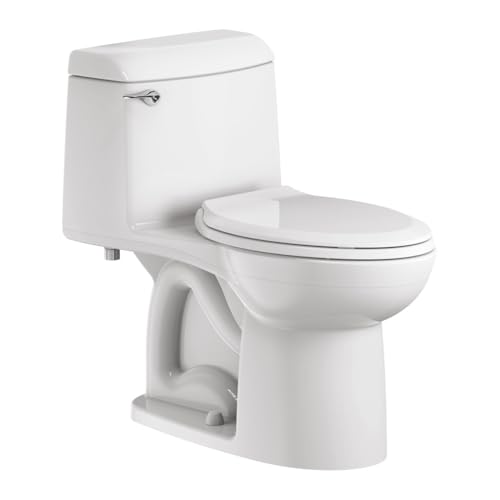
The American Standard Champion 4 is built around the largest trapway in standard gravity-flush toilet manufacturing -- 2.375 inches -- paired with a 4-inch flush port that American Standard's published specifications credit with moving 70 percent more water per flush than industry-standard 2-inch-port designs.
The Champion 4 takes a different philosophy than the 1.28 GPF efficiency-first designs: instead of minimizing water use, it maximizes the physical pipe diameter so nearly any solid waste clears in a single flush. The 2.375-inch trapway is wide enough that very few objects -- including dense, compact waste -- can reliably block it. American Standard's 10-year limited warranty on china and plastic trim parts is one of the longer coverage periods at this tier.
The trade-off is water consumption. At 1.6 GPF the Champion 4 uses approximately 25 percent more water than 1.28 GPF WaterSense models per flush. For a household flushing 15 times daily, that difference adds up to roughly 540 extra gallons per year. Buyers on municipal water in high-rate markets or in drought-restricted regions should weigh that factor. In areas without water-use restrictions and for households with consistent clog issues, the Champion 4 is the clearest solution. See also our dedicated American Standard VorMax review for a comparison of American Standard's two flagship flush technologies.
Trapway diameter matters most in two scenarios: dense waste bulk and objects accidentally dropped into the bowl. The Champion 4's 2.375-inch opening is notably more forgiving than competitors' 2-inch to 2.125-inch openings. For households with children or for rental properties where clog service calls are expensive, that extra quarter-inch of clearance is a practical advantage rather than a marketing claim.

The American Standard Cadet 3 achieves a 1,000-gram MaP flush score and EPA WaterSense certification at 1.28 GPF -- both reaching the top tier -- while typically landing near the lower end of the sub-$300 range, making it one of the strongest efficiency-per-dollar options in this roundup.
The Cadet 3 is American Standard's efficiency-focused complement to the Champion 4. Where the Champion 4 prioritizes physical clearance through a wide trapway, the Cadet 3 achieves its 1,000-gram MaP score through optimized water delivery from a siphon-jet design with a fully glazed trapway. The 2-inch trapway is smaller than the Champion 4 but adequate for normal household use.
Aggregated owner reviews suggest the Cadet 3 performs reliably for standard household use but that the tank trim components -- fill valves, flappers -- sometimes require replacement within 3 to 5 years on harder water. American Standard replacement parts are widely available through home improvement retailers, which reduces the friction of that maintenance. For buyers comparing American Standard's two flagship options, our Champion 4 vs Cadet 3 comparison details the performance trade-offs at each GPF level.
Achieving a 1,000-gram MaP score at 1.28 GPF through siphon-jet design is a genuine engineering achievement. The Cadet 3 shows that maximum flush performance is accessible below the Drake II and Cimarron's price points when you prioritize flush score and WaterSense certification over trapway width or build material premium.

The Woodbridge T-0001 is a dual-flush one-piece skirted toilet that combines a modern box-shaped profile with EPA WaterSense certification at 1.28 / 0.8 dual-flush modes -- making it one of the few aesthetically modern options under $300 that passes independent water efficiency standards.
Woodbridge entered the U.S. market by undercutting the price of one-piece skirted designs from TOTO and Kohler, which typically exceed $300 substantially. The T-0001's 800-gram MaP score means it clears 20 percent less test media than the 1,000-gram leaders -- a real difference, but one that aggregated owner reviews suggest is adequate for standard household use without chronic clogging. The included seat with soft-close hinges saves buyers the additional purchase that most competitors at this tier require.
The concealed skirted trapway is the T-0001's defining feature: it removes the exposed S-bend from view and eliminates the narrow floor gap behind traditional two-piece designs where mold and cleaning tools compete. Plumbers report that installation takes slightly longer with skirted one-piece designs because the floor bolt positions must align precisely with the skirt's bolt caps. Our detailed Woodbridge T-0001 review covers the installation process and long-term ownership experience in depth.
The T-0001's value proposition is straightforward: it brings one-piece skirted aesthetics into a price range where they are normally unavailable. The 800-gram MaP score is an honest limitation, not a disqualifier. Buyers who prioritize bathroom appearance and easy cleaning over maximum flush power are well served here; buyers who prioritize absolute flush performance should move to the TOTO Drake II.
The Kohler Highline is the company's highest-volume two-piece model, combining a 1,000-gram MaP score with EPA WaterSense certification at 1.28 GPF in a traditional high-profile silhouette that matches the height and footprint of most existing Kohler installations.
The Highline's longevity as Kohler's mainstream model means its parts ecosystem is perhaps the most accessible in the industry: replacement flappers, fill valves, and flush valves are stocked at virtually every hardware store in the United States. The 2-inch trapway is the smallest among the top six picks in this guide, which means the Highline is better suited to standard household use than to applications with chronic clogging concerns.
The K-3999 uses the same class-five flushing system as the Cimarron but without the AquaPiston canister upgrade, relying instead on a standard 2-inch flapper and optimized water channel geometry to reach the 1,000-gram MaP benchmark. The result is a fundamentally sound, widely available toilet with proven long-term reliability. For buyers weighing the Highline against the Cimarron, our Kohler Highline vs Cimarron review covers those differences in detail.
The Highline's ubiquity is a genuine advantage that is easy to overlook: when a flapper needs replacing at 2 a.m. before guests arrive, the Highline uses a part available at every 24-hour hardware or big-box store. That is real-world reliability that MaP scores do not capture.
The Swiss Madison SM-1T803 offers a wall-faced skirted one-piece silhouette with a matte white or matte black finish that no established brand in this roundup provides at comparable pricing, making it the strongest design-focused option for contemporary bathroom renovations.
Swiss Madison positions itself on aesthetics and accessible pricing for modern bathroom designs, and the SM-1T803 delivers on that promise. The matte finish options are a meaningful differentiator: matte black in particular is unavailable from TOTO, Kohler, or American Standard in standard two-piece or traditional one-piece designs under $300. The 1.75-inch trapway is a real limitation that buyers should not ignore -- in households with high flush volume or denser waste, the narrower passage poses a higher clog risk than the 2-inch-plus openings in the top picks.
Swiss Madison's warranty and service infrastructure is less developed than the legacy brands. Parts availability beyond the manufacturer's direct channels can be limited. This is a toilet that makes sense in a low-traffic guest bathroom or powder room where aesthetics drive the decision and the flush frequency is moderate. For a broader look at how Swiss Madison compares to established brands, our Swiss Madison vs TOTO comparison details the performance and warranty differences.
Matte finishes on vitreous china carry an aesthetic cost that is easy to overlook: micro-scratches from cleaning tools show more visibly on matte surfaces than on standard glazed white. Use only soft-bristle brushes and pH-neutral cleaners on Swiss Madison matte fixtures to preserve the finish long term.
Gerber's Avalanche HET achieves EPA WaterSense certification at 1.28 GPF with an 800-gram MaP score through a straightforward flush valve design that plumbers and contractors consistently recommend for its simple, durable internal mechanism and wide supply-house availability.
Gerber operates primarily through the plumbing trade channel, which means the Avalanche HET is less commonly encountered in home improvement retail than its performance merits. Plumbers who specify Gerber cite the simple, field-serviceable flush valve as a practical advantage: when the mechanism requires adjustment or part replacement in a tenant-occupied unit, the straightforward design reduces service time. The 2.125-inch trapway matches the Drake II's specification despite the Avalanche's lower MaP score, meaning physical clearance for solid waste is not the limiting factor -- the flush energy delivery is the difference.
For rental property owners and landlords looking at total cost of ownership over 10-plus years, the Gerber Avalanche's combination of straightforward mechanics, supply-house availability, and WaterSense certification makes a strong case. It is not the right pick for a master bathroom renovation where flush performance and aesthetics drive the decision, but for a utilitarian installation, it is a reliable choice. Our best toilets for rental properties guide provides more context on this trade-off.
Gerber's trade-channel focus means the Avalanche HET is often installed by plumbers who have used it across dozens of projects. That kind of repeated field exposure generates genuine reliability data that consumer reviews from a single installation cannot replicate. The 800-gram MaP score is below the leaders, but 800 grams still represents strong flush performance by any residential standard.
A toilet under $300 is genuinely worth buying when it achieves a MaP flush-test score of at least 800 grams at 1.28 GPF with EPA WaterSense certification, uses a fully glazed trapway of at least 2 inches, and comes from a brand with an established parts and service network. Models meeting all three criteria perform comparably to toilets costing significantly more, as MaP testing is independent and uses standardized media -- a 1,000-gram score at 1.28 GPF from any manufacturer represents the same real-world flush capability.
The sub-$300 market divides cleanly into two segments. The first is the efficiency-performance tier: TOTO Drake II, Kohler Cimarron, American Standard Cadet 3, and Kohler Highline all earn 1,000-gram MaP scores at 1.28 GPF with WaterSense certification. These models deliver top-class flush performance and full EPA water efficiency compliance at accessible prices. The second segment is the design-accessibility tier: Woodbridge T-0001 and Swiss Madison SM-1T803 bring one-piece skirted aesthetics into the sub-$300 range, but with lower MaP scores and, in the Swiss Madison's case, no WaterSense certification.
Buyers who are replacing a functioning toilet in a primary bathroom used by four or more people daily should focus on the first segment: performance and efficiency are the metrics that translate directly to reduced service calls and lower water bills. Buyers renovating a guest bath or powder room with lower traffic can reasonably consider the second segment based on aesthetic priorities.
For a comprehensive view of the full flush-performance spectrum, our best flushing toilets guide covers all price tiers from entry-level to premium, with MaP score comparisons across more than 20 models.
MaP (Maximum Performance) testing is an independent protocol that measures how many grams of soybean paste surrogate a toilet can evacuate in a single flush, using a standardized test fixture. The protocol was developed by the American Water Works Association and is administered by independent laboratories -- manufacturers do not conduct their own MaP tests. EPA WaterSense certification requires a minimum 350-gram MaP result at 1.28 GPF or less; the maximum recorded result is 1,000 grams, which multiple toilets under $300 achieve.
MaP scores are the most objective single metric available for comparing toilet flush performance because they are conducted by parties with no financial interest in the outcome. A MaP score of 1,000 grams means the toilet evacuated the equivalent of 1,000 grams of waste surrogate without failure. A score of 600 grams means it cleared 600 grams. The difference between 600 and 1,000 grams is meaningful in a high-traffic primary bathroom and less meaningful in a guest bath used twice per week.
Within the sub-$300 bracket, the spread runs from approximately 600 grams (Swiss Madison SM-1T803, estimated) to the maximum 1,000 grams (TOTO Drake II, Kohler Cimarron, American Standard Cadet 3, Kohler Highline, American Standard Champion 4). That performance range is available without spending more, which is what makes the under-$300 tier a genuine value window in the toilet market. The MaP database is publicly available at map-testing.com for buyers who want to verify scores before purchasing.
MaP testing uses soybean paste because its density and consistency closely model human waste. The 350-gram EPA WaterSense minimum means a toilet must clear roughly three-quarters of a pound of surrogate in a single 1.28-gallon flush. Top-performing models like the Drake II clear nearly three times that minimum at the same water volume -- confirming that the performance gap between certified and uncertified models is real, not theoretical.
EPA WaterSense certification means a toilet uses 1.28 GPF or less AND has been independently tested to confirm it clears at least 350 grams in MaP testing -- it is a combined water-efficiency and minimum-performance standard, not just a flow-rate label. Certified toilets qualify for rebates from thousands of U.S. water utilities, and in some municipalities, WaterSense-certified fixtures are required for new construction and major remodels. The American Standard Champion 4 is the only pick in this roundup that does not carry WaterSense certification, due to its 1.6 GPF rating.
The practical financial impact of WaterSense certification varies by water rate. At the U.S. average residential water rate, upgrading from a pre-1994 3.5 GPF toilet to a 1.28 GPF WaterSense-certified model saves approximately 16,000 gallons per year for a household of four. At California or Pacific Northwest high-rate pricing, that translates to measurable annual savings. The EPA maintains a rebate finder at epa.gov/watersense that allows buyers to identify local utility rebate programs before purchasing.
Seven of the eight models in this roundup carry WaterSense certification. The exception is the American Standard Champion 4 at 1.6 GPF, which trades water efficiency for the widest trapway in the market. For most households, the WaterSense models provide equivalent flush performance with 20 percent less water per flush over the toilet's service life.
One-piece toilets under $300 deliver aesthetic advantages -- no tank-bowl seam, concealed trapway, cleaner floor line -- but typically at the cost of lower MaP scores, heavier installation weight, and less established parts availability compared to two-piece alternatives at the same price. The Woodbridge T-0001 is the best-balanced one-piece under $300, offering an 800-gram MaP score and WaterSense certification, but buyers who prioritize maximum flush performance should choose a two-piece like the TOTO Drake II instead.
One-piece toilets are more expensive to manufacture because the tank and bowl are fired as a single ceramic piece, with higher rates of rejection during quality control. That cost pressures one-piece models at the sub-$300 ceiling toward lower-flush-performance components. In the $400-plus tier, one-piece models from TOTO (UltraMax II) and Kohler (San Raphael) achieve 1,000-gram MaP scores with WaterSense certification -- the cost floor for that combination in one-piece format is higher than it is in two-piece format.
The cleaning advantage of one-piece skirted designs is real and meaningful for buyers who prioritize bathroom maintenance. The absence of an exposed trapway gap eliminates the narrow space behind two-piece toilets where cleaning tools cannot reach and where mold commonly develops. For a dedicated analysis of this trade-off, our one-piece vs two-piece toilet guide covers the decision in full detail.
A fully glazed trapway of 2 inches or larger is sufficient for standard residential use without chronic clogging in most households. Trapways of 2.125 inches (TOTO Drake II, Gerber Avalanche) and 2.375 inches (American Standard Champion 4) provide increasing margin for dense waste or accidental objects. Trapway diameter matters most in high-traffic bathrooms and in households with children; for adult-only or low-traffic bathrooms, a fully glazed 2-inch trapway is adequate for normal use.
The glaze coating on the trapway inner surface is as important as the diameter: an unglazed or partially glazed trapway allows waste matter to adhere to the ceramic, building up over time and narrowing the effective passage. All picks in this roundup specify fully glazed trapways, which means the interior surface resists adhesion and self-cleans through regular flushing. Buyers comparing models with similar trapway diameters should verify that both specify fully glazed internal surfaces, as some budget models list the nominal opening without glazing the interior walls.
The TOTO Drake II CST454CEFG is the best overall toilet under $300 based on independent MaP testing: it achieves the maximum 1,000-gram score at 1.28 GPF with EPA WaterSense certification and a fully glazed 2.125-inch trapway. No competing model at this price tier combines all three of those performance markers with equivalent parts availability and brand track record.
MaP stands for Maximum Performance. It is the number of grams of soybean paste surrogate a toilet evacuates completely in a single flush during independent third-party testing. The maximum possible score is 1,000 grams. EPA WaterSense certification requires a minimum score of 350 grams at 1.28 GPF or less. Higher scores indicate more reliable single-flush waste removal.
EPA WaterSense is a voluntary program that certifies toilets using 1.28 GPF or less that also pass the 350-gram MaP minimum. Certified models qualify for water utility rebates in thousands of U.S. cities and are required by code in some municipalities for new construction. The program is administered by the U.S. Environmental Protection Agency, and the certification database is publicly searchable at epa.gov/watersense.
A household of four flushing 15 times daily saves approximately 16,500 gallons per year switching from a pre-1994 3.5 GPF toilet to a 1.28 GPF WaterSense-certified model. Compared to a standard 1.6 GPF model, the savings are approximately 5,400 gallons per year for the same household. Utility rebates frequently make WaterSense upgrades cost-neutral or better within 2 to 4 years.
Two-piece toilets deliver better flush performance per dollar under $300 because manufacturing costs allow brands to invest more in flush valve engineering and ceramic quality when the tank and bowl are separate pieces. One-piece models under $300 achieve lower MaP scores and typically have less established parts networks. Choose a one-piece only if aesthetics are the primary decision driver and the installation is in a low-traffic bathroom.
TOTO's Double Cyclone system uses two nozzles positioned in the bowl instead of the traditional rim holes that circle the inner rim. The nozzles direct water in a spiral pattern that covers the full bowl interior on each flush. This eliminates the rim channels where mineral deposits accumulate and improves bowl coverage compared to rim-hole designs at the same GPF. MaP testing of the Drake II confirms a 1,000-gram result with this system at 1.28 GPF.
Kohler's AquaPiston is a canister-style flush valve that replaces the traditional flapper. A standard flapper lifts from one side, exposing the valve opening gradually. The AquaPiston canister lifts straight up from its seat, exposing the full 360-degree valve opening simultaneously. Kohler's data indicates this delivers a faster, more pressurized flush wave at the same gallons-per-flush. The Cimarron uses the AquaPiston canister and achieves a 1,000-gram MaP score at 1.28 GPF.
No. The American Standard Champion 4 uses 1.6 GPF, which exceeds the 1.28 GPF maximum for EPA WaterSense certification. It achieves a 1,000-gram MaP score, so its flush performance is independently verified, but its water consumption is 25 percent higher than WaterSense-certified alternatives per flush. It does not qualify for WaterSense-based utility rebates.
Aggregated owner reviews for the Woodbridge T-0001 are generally positive for the first 3 to 5 years of use, with the concealed skirted design and included soft-close seat cited consistently as advantages. Longer-term data is limited compared to TOTO, Kohler, and American Standard models that have decades of field history. Parts availability beyond Woodbridge's direct service channel can be limited, which is a meaningful consideration for buyers planning to keep the toilet beyond 10 years.
The vast majority of standard toilet models, including all picks in this roundup, are designed for a 12-inch rough-in -- the distance from the finished wall behind the toilet to the center of the floor drain bolt. Buyers with 10-inch or 14-inch rough-in measurements need to specify models designed for those dimensions or purchase a rough-in adapter kit. Always measure before purchasing; the rough-in measurement determines whether a given toilet will fit your installation.
Elongated bowls extend approximately 2 inches further from the wall than round bowls and are preferred by most adults for comfort. Round bowls suit bathrooms with limited space between the toilet and the door or vanity, and are standard in children's bathrooms where the shorter reach is an advantage. Both shapes are available in most of the top picks in this roundup, and the bowl shape does not affect flush performance or MaP scores.
Comfort height, also called chair height or ADA height, refers to a seat height of 17 to 19 inches from the floor -- matching standard chair height. Standard toilets sit at 14 to 15 inches. Comfort height is easier for adults with knee, hip, or back limitations to use, and is required for ADA accessibility in commercial settings. Most adults over 5 feet 4 inches find comfort height more comfortable for extended use; young children may find standard height easier to use independently.
TOTO offers a one-year limited warranty on fixtures. Kohler offers a lifetime limited warranty on china. American Standard offers a one-year limited warranty with 10-year coverage on certain models (Champion 4 is 10 years). Woodbridge and Swiss Madison typically offer one-year limited warranties. Gerber warranties vary by model and channel but typically cover the china for the product's life and mechanical parts for one year. All warranties require proof of purchase and cover manufacturing defects, not installation errors or normal wear.
Most two-piece models from TOTO, Kohler, American Standard, and Gerber do not include a toilet seat -- it is a separate purchase. One-piece models from Woodbridge and Swiss Madison typically include a soft-close seat in the box. Factor in the seat cost when comparing total effective prices, particularly for TOTO Drake II purchases where a compatible TOTO seat can add meaningfully to the overall cost.
The vitreous china bowl and tank on a well-made toilet can last 50 years or more with normal care -- the china itself does not degrade. The mechanical components (flapper, fill valve, flush valve) typically require replacement every 5 to 10 years depending on water quality. Hard water with high mineral content accelerates internal component wear. A toilet's practical service life is limited by the availability of replacement parts, which is why brand track record and parts ecosystem matter for long-term value.
A skirted toilet has a flat vertical surface on the outside of the bowl that conceals the S-shaped trapway passage. Traditional toilets have an exposed trapway visible as an S-curve on the side of the bowl. The skirt makes the toilet easier to clean (no exposed curves to scrub around), gives a more modern appearance, and eliminates the narrow gap between the trapway and the floor where mold commonly develops. Skirted designs typically require slightly more complex floor bolt alignment during installation.
A standard two-piece toilet replacement on an existing 12-inch rough-in with an undamaged floor flange is a routine DIY project requiring basic hand tools, a new wax ring, and approximately 60 to 90 minutes. One-piece toilets are heavier and typically require two people for safe installation. Any installation involving a damaged flange, non-standard rough-in, or first-time toilet installation benefits from a professional plumber to avoid costly errors. Our toilet installation guide covers the full process step by step.
Dual-flush toilets under $300, like the Woodbridge T-0001 (1.28 / 0.8 GPF), offer additional water savings on liquid-only flushes. The practical water savings depend on household usage patterns: households where the majority of flushes are liquid-only see meaningful savings from the 0.8 GPF half-flush. The trade-off is that dual-flush mechanisms are more complex than single-flush designs and can be more difficult to repair, particularly with one-piece models where tank access is more constrained.
Gravity-flush toilets -- all models in this roundup -- use the weight of water falling from the tank to generate flush force. Pressure-assist toilets use a pressurized air vessel inside the tank to deliver a more forceful flush, achieving higher flush energy at the same or lower GPF. Pressure-assist toilets typically cost $300 or more for quality models, are louder than gravity-flush, and require more specialized repair. At the sub-$300 price point, gravity-flush models from the top tier achieve 1,000-gram MaP scores that meet or exceed most households' needs without pressure assistance.
Any 1.28 GPF WaterSense-certified model in this roundup is appropriate for septic system use: lower gallons-per-flush reduces hydraulic loading on the septic tank and drain field. The Woodbridge T-0001 at 0.8 GPF for liquid-flush is the lowest water use option and reduces septic input further on non-solid flushes. Avoid pressure-assist toilets on septic systems with older cast-iron drain lines, as the forceful flush can dislodge sediment accumulation. Our best toilets for septic systems guide covers this topic in detail.
The TOTO Drake II CST454CEFG stands as the strongest all-around toilet under $300 in 2026: its Double Cyclone flush delivers the maximum 1,000-gram MaP score at 1.28 GPF with EPA WaterSense certification, a fully glazed 2.125-inch trapway, and a parts ecosystem built on decades of production. Buyers who want one-piece aesthetics at this ceiling should choose the Woodbridge T-0001, accepting an 800-gram MaP score in exchange for the concealed trapway and modern skirted design. Households with chronic clogging concerns should look at the American Standard Champion 4, whose 2.375-inch trapway and 4-inch flush port are the widest available in gravity-flush at any price. Every other pick in this roundup fills a specific niche -- Kohler Cimarron for brand loyalty and AquaPiston engineering, Cadet 3 for value, Highline for parts availability, Swiss Madison for design in low-traffic baths, Gerber Avalanche for contractor and rental applications. At this price tier, you do not have to sacrifice performance for budget.
Learn why toilet trapways curve like an S, how each bend blocks sewer gas, and what the shape means for clogs and…
Read the guideAlmost every US toilet has a left-side handle. Learn the plumbing and mechanical reasons behind the layout and when it actually changes.
Read the guideHome toilets rely on tanks because household water lines lack the pressure that public flushometer systems use to flush straight from the…
Read the guide