Why Toilet Trapways Are Curved Like an S
Toilets4.6
Learn why toilet trapways curve like an S, how each bend blocks sewer gas, and what the shape means for clogs and…
Read the guideRestaurant and cafe restrooms face demands that no residential bathroom can match: peak-hour rushes of 60 to 150 flushes, diverse users, unpredictable waste loads, limited cleaning windows between lunch and dinner service, and local health department inspections that make restroom performance a legal and reputational concern. The right toilet for a food-service establishment is not simply a "powerful" residential unit -- it must combine a verified MaP flush-test score of 800 grams or above, a fully glazed trapway wide enough to clear any load without a second flush, EPA WaterSense efficiency to control utility costs, and a bowl surface that cleans quickly between service rushes. This guide ranks the eight best options using published specifications, independent MaP testing data, and aggregated owner reviews from food-service operators and facility managers.
For most restaurant and cafe restrooms, the TOTO Drake with its G-Max flush system delivers the best balance of verified 1,000-gram MaP performance, 1.28 GPF water efficiency, and a fully glazed 2-1/8-inch trapway -- making it the toilet least likely to clog during a lunch rush and easiest to maintain over a 10-to-15-year commercial service life.
A restaurant restroom clog during peak service is not a minor inconvenience. It takes a staff member off the floor, creates a health code exposure, and leaves a lasting impression on customers. The toilets that prevent this outcome share a specific engineering profile: wide, fully glazed trapways that move every waste load in a single flush cycle, flush valves that generate enough water velocity to complete the siphon even after back-to-back use, and surfaces that resist staining long enough to survive the gap between a noon rush and a 6 PM cleaning.
This article focuses on residential-style gravity-flush toilets suited to small and medium food-service establishments (cafes, bistros, fast-casual restaurants, bars, and food halls). Full commercial flushometer systems installed by mechanical contractors are a separate category; this guide addresses the decision most restaurant operators actually face when replacing an existing toilet or fitting out a new restroom with a standard floor drain and supply connection.
For a comprehensive look at flush performance across all residential and semi-commercial categories, start with our pillar guide to the best flushing toilets.
| Toilet | Best For | MaP Score | GPF | Trapway | Stars | Link | Check Price |
|---|---|---|---|---|---|---|---|
| TOTO Drake Two-Piece | Overall best for restaurants | 1,000 g | 1.28 | 2-1/8 in. glazed | 4.8 | Check price | Check price |
| American Standard Champion 4 | Maximum clog resistance | 1,000 g | 1.6 | 2-3/8 in. glazed | 4.6 | Check price | Check price |
| TOTO UltraMax II | Fastest cleaning between service | 1,000 g | 1.28 | 2-1/8 in. glazed | 4.8 | Check price | Check price |
| Kohler Cimarron | ADA compliance + power | 1,000 g | 1.28 | 2-1/8 in. glazed | 4.6 | Check price | Check price |
| Gerber Avalanche Elite | Commercial-grade china | 1,000 g | 1.28 | 2-1/8 in. glazed | 4.5 | Check price | Check price |
| TOTO Aquia IV Dual Flush | Water savings in moderate volume | 800 g | 1.0/1.28 | 2-1/8 in. glazed | 4.5 | Check price | Check price |
| Kohler Highline | Quiet reliable workhorse | 1,000 g | 1.28 | 2-1/8 in. glazed | 4.7 | Check price | Check price |
| American Standard Cadet 3 | Budget cafe restroom | 1,000 g | 1.28 | 2-1/8 in. glazed | 4.4 | Check price | Check price |
Restaurant restrooms operate in a category between residential and full commercial use. They are not equipped with the heavy-duty flushometer valves and institutional vitreous china of hospital or stadium installations, but they cannot be treated like a guest bathroom that gets used a handful of times per week. The operational reality is that a busy lunch restaurant may generate 80 to 150 toilet flushes between 11 AM and 2 PM in a single-stall restroom, with no opportunity for a thorough cleaning until the 3 PM lull.
The engineering features that matter for this use case are: flush valve diameter (3 inches allows the tank to drain fast enough to generate a reliable siphon even after repeated back-to-back flushes), trapway clearance (fully glazed and at least 2-1/8 inches to eliminate the surface friction that causes debris to catch), bowl glaze quality (a surface with low porosity and high resistance to chemical attack from cleaning products will maintain its cleanable condition over years of heavy use), and ADA bowl height. Public restrooms in commercial establishments are subject to ADA accessibility requirements, and a comfort height bowl at 17 to 19 inches is both legally appropriate and genuinely more comfortable for the majority of adult users.
The single most preventable problem in restaurant restrooms is a toilet with a 2-inch flush valve and a narrow, partially glazed trapway. That combination cannot keep up with peak-service flush loads, and the partial glazing means organic deposits build up in the passage over months, progressively reducing effective trapway diameter until even a mild waste load causes a partial clog. Specifying a toilet with a documented 3-inch valve and a fully glazed trapway eliminates the majority of avoidable service calls.
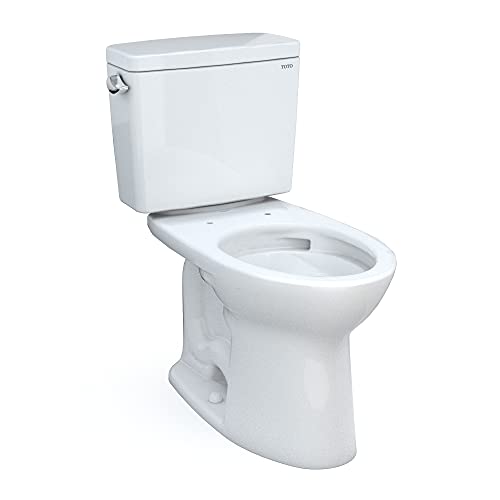
The TOTO Drake is the most widely specified residential-style toilet in food-service restroom applications: its G-Max flush system posts a verified 1,000-gram MaP score at 1.28 GPF, supported by a 3-inch flush valve and a fully glazed 2-1/8-inch trapway that have been demonstrated across thousands of heavy-use installations to clear any typical waste load without a second flush.
The Drake's G-Max flush mechanism is the core reason it appears in so many restaurant and cafe restroom specifications. The system uses a large 3-inch valve opening that allows the tank to drain rapidly into the bowl, generating the hydraulic head needed to fully engage the siphon and completely evacuate the trapway in a single cycle. Independent MaP testing has confirmed this performance at the 1,000-gram maximum across multiple Drake configurations, including both standard and comfort-height variants.
For a restaurant operator, the practical significance is that the Drake will handle the full range of waste loads generated during peak service without requiring a second flush or leaving residue in the trapway that accumulates into a clog over time. At 1.28 GPF, it is also EPA WaterSense certified -- relevant both for building code compliance in states that require WaterSense fixtures in commercial applications and for water utility costs. In a restaurant restroom generating 120 flushes per day, the difference between 1.6 GPF and 1.28 GPF represents over 12,000 gallons of water savings per year per toilet.
The Drake is the toilet plumbing contractors most frequently specify when a restaurant owner says "just give us something that will rarely clog and is easy to fix." That combination of verified flush performance, wide parts availability, and straightforward serviceability is exactly what food-service operators need. The comfort height variant (which brings bowl height to 17-1/2 inches for ADA compliance) is the version to specify for any public-access restroom.
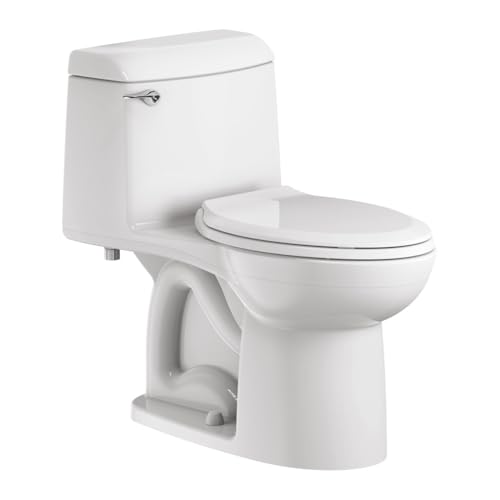
The American Standard Champion 4 carries the widest fully glazed trapway of any standard two-piece residential toilet at 2-3/8 inches, backed by a verified 1,000-gram MaP score -- making it the most clog-resistant option in this category and the right choice when a restaurant has already experienced repeated plunger calls during service.
American Standard designed the Champion 4's trapway specifically to eliminate clogging as a failure mode. The 2-3/8-inch fully glazed passage is a quarter inch wider than the 2-1/8-inch trapways found in most competing toilets, and that extra clearance -- while small in absolute terms -- meaningfully reduces the probability of any organic waste load catching at the narrowest point of the passage. For a restaurant that has been calling a plumber during lunch service, this is the specification change that directly addresses the root cause.
The trade-off is water efficiency. The Champion 4 uses 1.6 GPF, which does not qualify for EPA WaterSense certification and carries a higher per-flush water cost than the 1.28 GPF alternatives. In a restroom generating 100 flushes per day, the difference between 1.28 and 1.6 GPF represents over 11,680 additional gallons per year. For operators in states with water surcharges or mandatory WaterSense compliance in commercial renovations, the Drake or Kohler Highline's 1.28 GPF performance is the more practical choice. For operators whose only goal is never experiencing a clog during service, the Champion 4 is the direct solution. See our detailed comparison at best toilets for frequent clogs.
The 2-3/8-inch trapway in the Champion 4 exists because American Standard's engineers studied where clogs actually occur and designed the passage to be wide enough that organic waste cannot bridge the gap. It is not a marginal improvement -- it is the most direct engineering solution to a specific problem. If clogging prevention is the absolute top priority, the Champion 4 is the right specification regardless of the GPF trade-off.

The TOTO UltraMax II combines the same verified 1,000-gram MaP, 3-inch flush valve, and fully glazed trapway as the Drake with a seamless one-piece construction and TOTO's CeFiONtect ionic glaze -- the combination that minimizes cleaning time between service rushes in a restroom where appearance is part of the brand experience.
In a restaurant or cafe context, cleaning time is a genuine operational cost. A server or barista pressed into restroom-check duty between the lunch rush and afternoon service cannot dedicate 10 minutes to scrubbing a toilet bowl; they need to spray, wipe, and leave in under two minutes. The UltraMax II's CeFiONtect glaze is a fired ionic coating that changes the surface energy of the vitreous china, making it significantly harder for waste particles and biological matter to adhere. TOTO's published data and aggregated owner reviews both support the observation that CeFiONtect bowls develop staining and ring buildup substantially more slowly than uncoated vitreous china surfaces.
The one-piece design adds to the cleaning speed advantage by eliminating the gap between tank and bowl that collects moisture, grime, and bacterial buildup in two-piece models. In a high-traffic food-service restroom, that gap in a standard two-piece toilet requires specific attention with every cleaning -- the UltraMax II simply does not have that problem. For a fine-dining establishment or a specialty cafe where the restroom is part of the brand presentation, the UltraMax II's cleaner aesthetic and faster cleanability are worth the additional upfront cost relative to the Drake.
CeFiONtect is not a surface coating applied after firing -- it is baked into the glaze during kiln processing, which means it does not wear off with cleaning chemicals the way some aftermarket bowl coatings do. For a restaurant toilet cleaned daily with commercial cleaners for 10 to 15 years, that durability distinction matters in long-term performance.

The Kohler Cimarron delivers a 1,000-gram MaP score at 1.28 GPF with an ADA-compliant 17-to-19-inch comfort height bowl and Kohler's AquaPiston canister flush mechanism -- a reliable, quieter-than-average flush that makes it well suited to restaurant restrooms adjacent to dining areas.
Public-access restrooms in commercial food-service establishments in the United States are required to meet ADA accessibility standards, which include a toilet seat height between 17 and 19 inches from the finished floor. The Cimarron's comfort height bowl (17-1/2 inches in most configurations) satisfies this requirement while delivering the same 1,000-gram MaP flush performance as other high-specification residential models. For a restaurant operator fitting out a new restroom or replacing a non-compliant fixture, the Cimarron specifies both ADA compliance and confirmed flush power in a single selection.
Kohler's AquaPiston canister flush mechanism is an operational advantage in a restaurant context because it is notably quieter than comparable siphon-jet designs. A toilet adjacent to a dining area that generates a loud flush and fill cycle every few minutes is a customer experience issue; the AquaPiston's 360-degree inlet and slower fill profile reduces this noise signature meaningfully. The canister design also has fewer moving parts than a flapper-and-fill-valve system, which translates to lower maintenance frequency in hard-use conditions.
In commercial renovation projects, the Cimarron consistently appears in specifications because it satisfies ADA requirements without needing a specialty commercial fixture. Most plumbing contractors have installed it enough times to complete the job efficiently, which keeps labor costs down compared to less common commercial alternatives.
Gerber's Avalanche Elite is the toilet the commercial plumbing trade specifies when china durability and long service life under sustained heavy use are the primary requirements -- delivering a verified 1,000-gram MaP score at 1.28 GPF with heavier vitreous china construction than most residential alternatives.
Gerber has supplied institutional and commercial plumbing projects in North America for decades without the consumer marketing presence of TOTO, Kohler, or American Standard. The Avalanche Elite is evaluated and specified within the plumbing trade based on engineering merit rather than brand recognition, which is why it consistently appears in commercial restroom specifications for restaurants, gyms, and small office buildings where the toilet is expected to perform without significant maintenance for 10 to 15 years.
The heavier vitreous china in Gerber's commercial line is a genuine differentiator. Residential-grade china is fired to a standard weight that is adequate for residential use cycles; Gerber's commercial-oriented models use thicker china that better withstands the thermal cycling created by repeated flushing with cold water against a warm bowl, and the physical impact of sustained heavy use. For a restaurant operator making a 10-year fixture decision, the Avalanche Elite's durability profile is the relevant consideration alongside its verified flush performance.
Gerber is the brand commercial plumbing contractors reach for when the fixture needs to last without callbacks. The Avalanche Elite's heavier china and commercial-grade manufacturing tolerances mean it tends to hold up better under the thermal cycling and cleaning chemical exposure of a restaurant restroom than lighter-weight consumer-oriented alternatives.

The TOTO Aquia IV offers a dual-flush system at 1.0 GPF (liquid waste) and 1.28 GPF (solid waste), with an 800-gram MaP score on the full flush and a clean, wall-hung-compatible skirt design that makes it one of the more stylish and water-efficient options for a contemporary cafe restroom.
The TOTO Aquia IV occupies a specific niche in the restaurant toilet selection: it delivers strong water savings in a moderate-volume restroom where the operator has a genuine goal of reducing the water utility bill, and where the restroom aesthetic is part of the design concept. Specialty coffee shops, craft beverage establishments, and modern farm-to-table restaurants frequently have restrooms designed to match the visual brand, and the Aquia IV's clean skirted profile and contemporary push-button flush interface fit that context better than a utilitarian two-piece model.
The 800-gram MaP score on the full flush is below the 1,000-gram standard of the top three picks but is a strong performance figure for a dual-flush design. In a restroom that is not managing extreme waste loads -- a standard cafe or light-traffic restaurant restroom -- the Aquia IV's full flush is adequate for the majority of use cycles. The dual-flush option is most valuable when a meaningful portion of flushes are liquid-only, where the 1.0 GPF partial flush delivers genuine water savings over time. For more context, see our best dual flush toilets guide.
The Aquia IV is the toilet TOTO designed for commercial-adjacent residential and light commercial use where design is a specification criterion alongside performance. If the restroom is visible, photographed, and part of the brand experience, the Aquia IV's skirted exterior and two-button interface suit that context in a way that a Drake two-piece does not.
The Kohler Highline delivers a verified 1,000-gram MaP flush at 1.28 GPF with Kohler's AquaPiston canister mechanism -- producing a notably quieter fill cycle than comparable siphon-jet designs, which makes it the most practical choice when the restroom is adjacent to or acoustically connected to the dining area.
Restaurants and cafes that share a wall between the restroom and the dining area frequently report that toilet flush and fill noise is an ambient issue that affects customer experience, particularly in quieter settings like fine dining or specialty coffee. The Kohler Highline's AquaPiston canister mechanism addresses this directly: the canister opens from all sides simultaneously rather than from the single inlet of a conventional flapper, distributing water into the bowl more evenly and creating a quieter, more controlled flush. The tank refill cycle is also measurably quieter than most comparable gravity-flush designs.
Flush performance is not compromised to achieve this quietness: the Highline earns a 1,000-gram MaP score and carries EPA WaterSense certification at 1.28 GPF. It is also the most widely distributed toilet on this list by retail channel count, which means that when a flapper needs replacing at 11 PM before a health inspection in the morning, a hardware store nearby almost certainly stocks compatible Kohler parts. That serviceability advantage is worth more in a food-service context than it might appear at the specification stage.
The AquaPiston canister is a genuinely quieter mechanism than the standard flapper valve -- not by a marginal amount, but audibly so across a room. For a 40-seat restaurant where the restroom door opens toward the dining room, that noise reduction is a real quality-of-experience difference for customers seated near the back.

The American Standard Cadet 3 delivers a verified 1,000-gram MaP score and EPA WaterSense certification at 1.28 GPF in one of the most accessible price brackets of any toilet with those combined credentials -- making it the strongest option when a food-service operator needs to upgrade from a failing fixture without significant capital expense.
For a small cafe or food truck with a single staff restroom, or a new food-service operator fitting out on a tight opening budget, the Cadet 3 provides the essential engineering credentials -- 1,000-gram MaP, 1.28 GPF, fully glazed 2-1/8-inch trapway -- without the premium pricing of the other options on this list. A MaP score of 1,000 grams is a MaP score of 1,000 grams regardless of price bracket, and the Cadet 3 earns it through published independent testing, not marketing claims.
The primary limitation is china weight and construction grade. Aggregated owner reviews note that the Cadet 3 feels lighter and sounds less solid than comparable TOTO or Kohler fixtures, which reflects the different manufacturing approach between American Standard's value and premium lines. For a low-to-moderate volume food-service restroom, this is an acceptable trade-off. For a high-volume restaurant expecting 150-plus daily flushes, the additional investment in a TOTO Drake or Gerber Avalanche Elite is worth the durability premium over a 10-year service horizon. See our guide to the best toilets for small bathrooms for additional compact options that suit cafe-size restroom footprints.
The Cadet 3's MaP score is not inflated by the lower price -- it represents real, tested flush performance. For a food-service operator whose first priority is avoiding clog incidents and whose second priority is staying within a replacement budget, the Cadet 3 satisfies both criteria legitimately.
Water use regulations for commercial restroom toilets are not uniform across the United States. The federal floor of 1.6 GPF applies in all new construction, but a significant and growing number of states have adopted stricter mandates. California's Title 20 regulations require 1.28 GPF or below in all new commercial installations. Texas has adopted a 1.28 GPF requirement for commercial projects receiving certain municipal water rebates. Many municipalities offer rebates for WaterSense-certified fixture upgrades in commercial properties, which creates a financial incentive beyond the regulatory requirement.
For practical purposes, the 1.28 GPF models on this list (the TOTO Drake, UltraMax II, Kohler Cimarron, Kohler Highline, Gerber Avalanche Elite, and American Standard Cadet 3) are compliant in all U.S. jurisdictions and eligible for WaterSense rebate programs. The American Standard Champion 4 at 1.6 GPF is federally compliant but not WaterSense certified and may not satisfy local requirements in stricter jurisdictions. Before finalizing any commercial toilet specification, confirm the current local code with the authority having jurisdiction (AHJ) for the project.
The building industry distinction between "residential" and "commercial" fixtures primarily affects procurement channel, warranty scope, and vitreous china grade rather than fundamental plumbing code compliance. A residential-style gravity-flush toilet that meets the GPF requirement for the jurisdiction and is maintained in good working repair satisfies the functional requirements of most local health codes for a food-service restroom.
Where full commercial fixtures are specifically required -- typically in large-scale foodservice operations (stadiums, hospitals, high-volume mall food courts) -- the specification will be for a flushometer-valve wall-mounted or floor-mounted commercial toilet, which is installed by a licensed mechanical contractor as part of a commercial plumbing system. That is a separate category from the residential-style toilets in this guide, which address the decision most independent restaurant operators actually face. For guidance on toilets for rental properties with similar semi-commercial use patterns, see our best toilets for rental properties guide.
Restaurant restroom maintenance falls into two categories: sanitation cleaning (which is governed by local health codes and typically requires multiple daily checks during service hours) and mechanical maintenance (which follows the toilet's own service schedule). The mechanical schedule is accelerated compared to residential use: a flapper or flush canister seal that might last 7 to 8 years in a home bathroom may need replacement after 3 to 5 years in a restaurant restroom generating 80 to 150 daily flushes.
The practical maintenance advantage of selecting a toilet from TOTO, Kohler, or American Standard is parts availability. When a fill valve fails on a Friday evening before a Saturday brunch service, the operator needs a replacement that is available at a local hardware store or through an emergency plumber's truck stock. All three brands maintain distribution networks that make this possible. Gerber parts are available through professional plumbing supply distributors, which are accessible to licensed plumbers during emergency calls.
ADA compliance is not optional for restaurant and cafe restrooms. The Americans with Disabilities Act applies to any facility that serves the public, and a restaurant or cafe's restroom that is accessible to customers must include at minimum one accessible stall with a compliant toilet. The toilet seat height requirement (17 to 19 inches from the finished floor) is met by comfort-height toilets from all major brands: TOTO's comfort height models, Kohler's comfort height designation, American Standard's Right Height line, and Gerber's comfort height configurations all meet this specification.
For a single-stall restroom that serves as the only restroom for a food-service establishment, the entire restroom must be ADA accessible, meaning the toilet must be at comfort height, grab bars must be properly installed, and the door must meet width and hardware requirements. For multi-stall restrooms, a specific percentage of stalls must be accessible. Confirm current ADA Standards for Accessible Design requirements (2010 ADA Standards) with a licensed architect or accessibility consultant for any commercial project. See our detailed ADA compliant toilet guide for full technical specifications.
The TOTO Drake is the most widely recommended choice for restaurant restrooms based on its verified 1,000-gram MaP score, 3-inch flush valve, fully glazed 2-1/8-inch trapway, and 10-plus-year track record in semi-commercial applications. For restrooms with a specific clog history, the American Standard Champion 4's 2-3/8-inch trapway provides the maximum clog resistance of any residential-style toilet currently in production.
Not in most small to medium food-service applications. A residential-style gravity-flush toilet that meets the local GPF requirement and is maintained in working order satisfies health code standards for most restaurant and cafe restrooms. Full commercial flushometer-valve fixtures are generally required only in high-volume institutional settings (stadiums, hospitals, large food courts) rather than in independent restaurant operations.
A minimum MaP score of 800 grams is recommended for a restaurant restroom; 1,000 grams is the maximum achievable score and provides the widest safety margin for unpredictable waste loads during peak service. The EPA WaterSense 350-gram minimum is adequate for certification purposes but insufficient for genuine commercial restroom performance requirements.
Federal law requires a maximum of 1.6 GPF for toilets in new commercial construction. Many states (including California and others under EPA WaterSense adoption agreements) require 1.28 GPF or less for commercial installations and renovations. Always confirm the applicable local code before specifying a fixture for a commercial project.
Most local building codes and health department regulations require licensed plumbing work in commercial properties. A toilet replacement in a restaurant restroom is typically a permitted plumbing job in most jurisdictions, even if it is a like-for-like fixture swap. Always confirm local permit and licensing requirements before proceeding, as non-compliant work can create liability during health inspections.
Specify a toilet with a fully glazed trapway of at least 2-1/8 inches and a MaP score of 800 grams or above. Post signage prohibiting disposal of paper towels, sanitary products, and other non-flushable items. Provide an accessible waste bin in every restroom stall. Inspect the flush mechanism monthly and replace worn flappers or canister seals promptly -- a weakened flush is the most common cause of partial clogs in otherwise adequate fixtures.
EPA WaterSense certification itself is not universally legally required, but many state and local codes have adopted WaterSense-equivalent standards (1.28 GPF or below) for commercial installations. Some municipalities offer rebates for WaterSense-certified fixture replacements in commercial properties. Check local code requirements and available utility rebate programs before specifying any commercial toilet.
The 2010 ADA Standards for Accessible Design require a toilet seat height between 17 and 19 inches from the finished floor in accessible stalls. All comfort-height toilet variants from TOTO, Kohler, American Standard, and Gerber are designed to meet this range. Always confirm the specific seat height (not just the bowl rim height) for the model being specified, as seat height can vary by up to 1 inch from the rim measurement.
A well-specified toilet from a major brand should provide 10 to 15 years of reliable service in a restaurant or cafe restroom with proper maintenance. The consumable components (flapper or canister seal, fill valve) will typically need replacement every 3 to 5 years under commercial-volume use. The vitreous china bowl and tank are designed to last the full service life of the fixture without cracking under normal use conditions.
The TOTO UltraMax II is the strongest one-piece option for restaurant and cafe restrooms: it delivers a 1,000-gram MaP score at 1.28 GPF with CeFiONtect ionic glaze that reduces cleaning time between service rushes, and its seamless design eliminates the tank-bowl seam that accumulates bacteria and grime in high-use settings. The ADA-compliant 17-1/2-inch bowl height makes it suitable for public-access restrooms.
Skirted toilets, which cover the exterior trapway with a smooth ceramic panel, are faster to clean and more hygienic in high-traffic settings because they eliminate the contoured exterior surface where dust, moisture, and bacteria accumulate. The trade-off is more complex installation requiring a skirted-toilet mounting bracket. For a restaurant restroom where cleaning speed is important, a skirted design like the TOTO Aquia IV offers a practical maintenance advantage over an exposed-trapway two-piece model.
A 3-inch flush valve allows the tank to drain significantly faster than a 2-inch valve, generating the hydraulic surge needed to reliably complete the siphon cycle and evacuate the trapway in a single flush. In back-to-back use conditions typical of a restaurant peak service, a 3-inch valve maintains consistent flush performance even when the tank has not had a full refill cycle between uses. Every toilet on this list uses a 3-inch or equivalent flush valve specification.
Pressure-assist toilets create a faster, louder flush using compressed air in the tank and can handle heavy waste loads consistently, but they are significantly noisier than gravity models and require periodic pressure-vessel inspection and servicing. For most restaurant applications -- particularly where the restroom is adjacent to the dining area -- a well-specified gravity-flush toilet with a 1,000-gram MaP score is the better all-round choice. Pressure-assist is most appropriate in isolated, high-volume service applications where noise is not a concern.
TOTO offers a limited lifetime warranty on vitreous china and a one-year warranty on mechanical parts for most residential models used in commercial applications. Kohler offers a limited lifetime warranty on vitreous china and flush mechanisms. American Standard provides a limited lifetime warranty on vitreous china with a one-year mechanical warranty. Gerber's commercial-line warranty terms should be confirmed with the distributor at the time of specification, as they can differ from the residential warranty terms published on the consumer website.
Measure the rough-in distance (from the finished wall to the center of the floor drain) before selecting a replacement -- most existing installations have a 12-inch rough-in, but some older buildings have 10-inch or 14-inch configurations. Confirm the local GPF requirement. Verify that the replacement model meets ADA bowl height if the stall is a required accessible stall. Check that the supply line connection type matches the existing shut-off valve. For guidance on measuring, see our how to measure toilet rough-in article.
Most commercial restroom disinfectants are safe for vitreous china when used as directed. Avoid extended-contact use of highly acidic cleaners (below pH 3) or highly alkaline cleaners (above pH 12) on vitreous china surfaces, as prolonged exposure can etch the glaze over time and reduce the non-stick properties of coated surfaces like TOTO's CeFiONtect. Quaternary ammonium (quat-based) disinfectants are widely used in food service and are safe for standard vitreous china under normal contact times.
Toilet fixture counts for commercial food-service establishments are governed by the local plumbing code (typically the International Plumbing Code or a state-adopted equivalent) and are calculated based on occupant load and seating capacity. Requirements vary by jurisdiction, but a common standard is one toilet per 75 seats of occupant capacity for both men's and women's restrooms in a restaurant. Consult the local building official or a licensed plumber for the specific requirement applicable to the establishment.
Dual-flush toilets can function in moderate-volume restaurant settings (under 80 flushes per day) but are not ideal for high-volume peak-service conditions. The requirement for users to select the appropriate flush mode introduces the risk of under-flushing, and the partial flush at 0.8 to 1.0 GPF may not provide adequate siphon force for heavy waste loads. For a high-volume restaurant, a single-flush toilet with a verified 1,000-gram MaP score is a more reliable specification than dual-flush.
A fully glazed trapway of at least 2-1/8 inches is the practical minimum for a restaurant restroom toilet. The American Standard Champion 4's 2-3/8-inch fully glazed trapway provides the highest clog resistance available in a standard residential-style fixture. The glazing is as important as the diameter: an unglazed or partially glazed trapway develops surface friction and deposit buildup over time that progressively reduces effective clearance, increasing clog risk in a high-volume setting.
TOTO recommends avoiding highly abrasive cleaning products (scouring powders, steel wool) and extended contact with very acidic or alkaline cleaners on CeFiONtect-coated surfaces. Standard non-abrasive commercial disinfectants and toilet bowl cleaners used at normal contact times are safe for CeFiONtect. The glaze is baked into the ceramic during manufacturing and is substantially more durable than aftermarket bowl coatings, making it well suited to the chemical exposure of a commercial cleaning regimen.
For the majority of restaurant and cafe restrooms, the TOTO Drake (comfort height variant) is the clearest specification: a verified 1,000-gram MaP score, a 3-inch flush valve, a fully glazed 2-1/8-inch trapway, EPA WaterSense certification at 1.28 GPF, and a decade-plus service record in semi-commercial applications make it the toilet most likely to perform without incident through a dinner rush on a Saturday night. When clog incidents are already happening and prevention is the only goal, upgrade to the American Standard Champion 4 for its unmatched 2-3/8-inch trapway. When the restroom is a visible part of the brand and cleaning speed between service periods is an operational constraint, invest in the TOTO UltraMax II with CeFiONtect glaze. All three options are independently MaP-tested, code-compliant in all U.S. jurisdictions, and supported by long-term parts availability -- the specific criteria that matter most when a toilet is expected to perform reliably through thousands of covers per month.
Learn why toilet trapways curve like an S, how each bend blocks sewer gas, and what the shape means for clogs and…
Read the guideAlmost every US toilet has a left-side handle. Learn the plumbing and mechanical reasons behind the layout and when it actually changes.
Read the guideHome toilets rely on tanks because household water lines lack the pressure that public flushometer systems use to flush straight from the…
Read the guide