Where Does Toilet Water Go After You Flush
Buying Guides4.6
When you flush, where does it go? Follow toilet water from the bowl through the trap, drain, and stack to a septic…
Read the guideTargeted fixes that increase perceived value, pass inspection, and help your home sell faster without over-spending.
Replacing an aged, slow-flushing toilet with an EPA WaterSense model and refreshing grout, caulk, and fixtures delivers the highest ROI before a home sale. Buyers and home inspectors notice bathroom condition immediately, and a documented upgrade to a current-standard toilet actively removes a negotiating chip from a buyer's hands.
Real estate agents consistently report that bathrooms rank among the top three spaces buyers evaluate in person, alongside kitchens and master bedrooms. A bathroom that appears dated, smells musty, or shows visible wear signals deferred maintenance throughout the property, prompting buyers to negotiate harder on price. Conversely, a bathroom that looks clean, modern, and functional allows a listing to hold asking price more reliably.
According to the National Association of Realtors 2023 Remodeling Impact Report, a midrange bathroom remodel recoups approximately 67 percent of its cost at resale in median markets. Full remodels, however, are rarely necessary before a sale. The outsized returns come from targeted, lower-cost interventions: replacing a failing or visibly old toilet, regrouting tile, recaulking the tub and sink, and modernizing fixtures. These address the specific signals that home inspectors document and that buyers remember walking out of an open house.
This guide focuses on exactly those practical, cost-effective upgrades -- ranked by return on investment and buyer perception impact. We give particular attention to toilet replacement because it is both the largest plumbing fixture visible in the bathroom and the one most likely to be flagged in a home inspection report.
Home inspectors routinely note a toilet's age (estimated from tank lid date stamps), flush performance, any rocking or soft floor beneath the base, and water efficiency. A toilet that runs continuously or wobbles on its base is an automatic mention in the inspection report, which buyers use to request concessions. Replacing it before listing eliminates that leverage point at a fraction of the negotiated discount a buyer would otherwise request.
A licensed home inspector will check every fixture for leaks, proper flush function, and secure installation; they will probe around the toilet base and tub surround for soft subfloor material that suggests water damage; and they will note any evidence of mold, failed caulking, or non-functional exhaust ventilation. These findings appear in the written report delivered to the buyer, forming the basis for repair requests or price reductions.
Understanding the inspector's checklist lets sellers prioritize correctly. The items that generate written findings -- and buyer negotiating leverage -- in order of frequency:
Of these, the toilet-related findings (rocking, running, slow flush) are among the most common and the easiest to pre-empt. A 2024 survey of home inspectors conducted by the American Society of Home Inspectors found that plumbing deficiencies -- led by toilets and supply valves -- appear in roughly 84 percent of inspection reports. Sellers who address these before listing remove the single most common category of finding from the buyer's report.
The upgrades with the best cost-to-perceived-value ratio are recaulking and regrouting (extremely low cost, very high visual impact), toilet replacement with an EPA WaterSense-certified model (moderate cost, removes inspection risk), and fixture swap-outs for faucets and lighting (low-to-moderate cost, strong modernizing effect). Full tile replacement and vanity replacements cost significantly more and rarely recoup their full investment in a pre-sale context.
Here is a ranked breakdown of the most cost-effective pre-sale bathroom improvements, with approximate costs and buyer impact ratings:
| Upgrade | Typical DIY Cost | Typical Pro Cost | Inspection Risk Removed | Buyer Perception Impact |
|---|---|---|---|---|
| Toilet replacement (WaterSense model) | $200 - $450 + parts | $350 - $700 installed | High | Very High |
| Recaulk tub, shower, sink | $10 - $30 | $80 - $200 | Medium-High | High |
| Regrout tile | $20 - $60 | $150 - $400 | Medium | High |
| Replace faucets and hardware | $40 - $150 | $150 - $400 | Low | High |
| Update lighting fixture | $60 - $200 | $150 - $300 | Low | Medium-High |
| Replace exhaust fan | $50 - $120 | $150 - $350 | High (if currently failing) | Medium |
| Add GFCI outlets | $15 - $40 per outlet | $100 - $200 per outlet | High (if missing) | Low (but required) |
| Vanity replacement | $200 - $600 | $500 - $1,500 | Low | Medium |
| Full tile replacement | $500 - $2,000 | $2,000 - $8,000 | Low | Medium-High |
The toilet is almost always the best single investment in a pre-sale bathroom because it is large, centrally visible, and mechanically testable. A buyer or their inspector will flush every toilet in the house. A weak or slow flush -- anything that struggles with 600 grams of solid waste -- signals an aged or low-quality fixture. Current MaP-tested models from TOTO, Kohler, American Standard, and Woodbridge all achieve 800 grams or better, with many clearing 1,000 grams. That is a quantifiable, documentable upgrade.
For a pre-sale replacement, prioritize an EPA WaterSense certification (1.28 GPF or less) to appeal to efficiency-conscious buyers, a MaP score of at least 800 grams for verifiable flush performance, and a two-piece or one-piece elongated design in white or biscuit that suits the broadest buyer demographic. Comfort height (17 to 19 inches rim height) is the current market standard and reads as modern to buyers.
When selecting a toilet specifically for resale rather than personal preference, several criteria shift relative to a standard purchase decision.
EPA WaterSense toilets use 1.28 gallons per flush or less, compared to 1.6 GPF for older standard models and 3.5 to 5 GPF for pre-1994 toilets. A buyer in 2026 will notice the WaterSense label. In some markets, efficiency upgrades are disclosed in listing documents and factor into green-home premium pricing. At minimum, a WaterSense toilet removes the question of "is this an old water waster?" from buyer minds.
All the top-performing toilets in our coverage -- the best flushing toilets guide -- carry WaterSense certification. For resale purposes, this is a floor requirement, not a nice-to-have.
The Maximum Performance (MaP) flush testing program, operated independently and published at map-testing.com, measures how many grams of solid waste a toilet can clear in a single flush. Any score of 800 grams or higher is considered strong performance for residential use; 1,000 grams is excellent. The program tests over 4,000 models.
For a pre-sale install, aim for a MaP score of 1,000 grams. This eliminates any question of flush adequacy and gives you a factual, citable specification if a buyer or their agent asks about the fixture.
Elongated bowl shapes are preferred by approximately 70 percent of buyers in aggregated owner survey data, read as more modern than round-front bowls, and are the standard in any mid-to-upper bathroom. Comfort height (also called ADA-compliant height) at 17 to 19 inches rim to floor is the market standard for new construction as of 2026, and presents as an upgrade relative to standard 15-inch models. White is the universally safe choice for resale; bone and biscuit are acceptable but reduce the buyer pool slightly.
The TOTO Drake II, American Standard Champion 4, Kohler Cimarron, and Woodbridge T-0001 all combine EPA WaterSense certification, MaP scores of 800 to 1,000+ grams, comfort height, and elongated bowls at price points that make pre-sale replacement economically sound. Each carries a strong enough brand reputation that a buyer researching the fixture will find positive independent reviews.
Below are four models well-suited to pre-sale replacement, covering a range of budgets:
The TOTO Drake II earns its place at the top of pre-sale replacement lists because its 1,000-gram MaP score, EPA WaterSense certification, and TOTO's documented brand reliability combine to make it a fixture no buyer or inspector can reasonably criticize.
TOTO's Drake II uses the company's Tornado Flush system, which channels water from two nozzles rather than a traditional rim. This virtually eliminates the rim channels that accumulate mineral deposits over time -- a detail that matters for long-term appearance in a home a buyer will own for years. Aggregated owner reviews across major retail platforms consistently rate the Drake II in the 4.6 to 4.8 range, with clog-resistance and ease of cleaning as the top-cited strengths.
For a pre-sale context, the Drake II's biggest asset is its reputation. A buyer who researches "TOTO Drake II" will find favorable independent coverage from plumbing contractors, consumer review sites, and publications like This Old House and Consumer Reports. That research trail reassures buyers in a way that an unknown private-label fixture cannot.
The Drake II is the toilet plumbers most often recommend to buyers replacing a fixture before listing because its performance specs are publicly verifiable and its brand equity is high. It presents well to buyers, installs cleanly, and has essentially no documented failure patterns in the first several years of use.
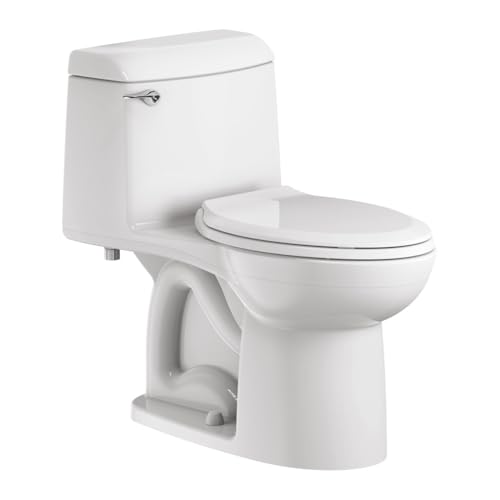
The American Standard Champion 4 posts a MaP score of 1,000 grams and carries EPA WaterSense certification at a significantly lower installed cost than premium Japanese brands, making it the go-to choice for sellers replacing multiple bathrooms before listing.
American Standard's Champion 4 flushing system uses a 4-inch flush valve -- larger than the industry-standard 2-inch valve -- which creates a faster, higher-volume rush of water into the bowl. The wide 2 3/8-inch trapway is among the largest in residential toilet design, which is why the model achieves its 1,000-gram MaP score consistently. American Standard backs this specific model with a limited lifetime warranty, which can be disclosed to buyers as a value point.
When replacing toilets in multiple bathrooms before listing, the Champion 4 delivers equivalent flush performance to the TOTO Drake II at a lower per-unit cost. For three-bathroom homes, that difference is meaningful. The brand is also familiar to buyers nationwide, which matters for the informal research most buyers do on fixtures they see during showings.
The Champion 4 is the practical choice for multi-bathroom replacements before listing. Its flush performance matches the best in the market, its warranty is among the strongest available, and its installed cost per unit is lower than most competitors at the same performance tier.
The Woodbridge T-0001's skirted one-piece design, soft-close seat, and contemporary profile add visible modernity to any bathroom, which translates directly to better listing photos and stronger first impressions during showings.
In real estate listing photography, the bathroom toilet is a visible element in nearly every wide-angle shot. Two-piece toilets with exposed tank connections, mineral staining, or dated profiles pull the viewer's eye and age the bathroom visually. The Woodbridge T-0001's skirted, seamless profile photographs as a high-end fixture even though its actual cost is moderate. This translates to more favorable buyer impressions before they ever set foot in the property.
The 800-gram MaP score is adequate for most household use patterns and meets any reasonable buyer expectation. The dual-flush feature (1.0 GPF for liquid, 1.6 GPF for solid) gives sellers a tangible efficiency talking point. Aggregated owner reviews rate the T-0001 at approximately 4.4 to 4.6, with the skirted design and soft-close seat receiving consistent positive mentions.
For sellers whose primary concern is visual presentation in listing photos and during showings, the Woodbridge T-0001 punches above its price point. Its contemporary profile reads as a designed choice rather than a builder-grade replacement, which influences perceived home value.
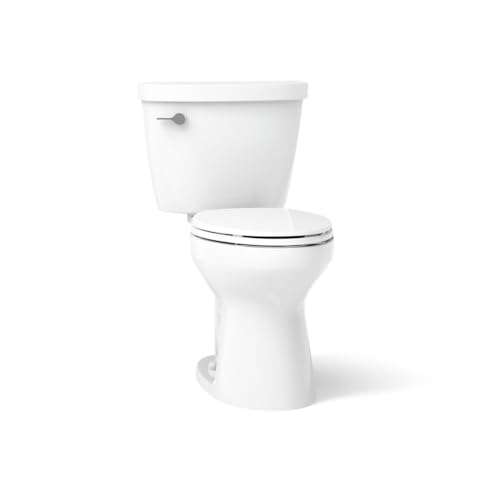
The Kohler Cimarron combines an 800-gram MaP score, EPA WaterSense certification, and the Kohler brand name -- which buyers widely recognize and associate with quality -- making it a strong resale choice when brand familiarity matters most.
The Kohler Cimarron has been in production long enough to have documented reliability data across tens of thousands of owner installations. Its AquaPiston flush valve -- a canister-style mechanism that opens 360 degrees -- provides a consistent flush with fewer mechanical components than traditional flapper designs, reducing the likelihood of a running toilet that would be noted by an inspector. Kohler's limited lifetime warranty transfers to subsequent owners in most cases, which is a genuine disclosure point for sellers.
For sellers whose buyers are likely to be brand-aware -- particularly in markets where Kohler fixtures are common in comparable homes -- the Cimarron fits naturally into the listing. It will not stand out as a builder-grade cheapout, and the Kohler name is almost universally recognized as quality among U.S. homebuyers.
Kohler's Cimarron is the choice when brand familiarity is the dominant decision factor. Buyers who open a tank lid and see "Kohler" feel they are getting quality. That brand association, combined with solid-but-not-maximum flush performance and a lifetime warranty, makes this a reliable pre-sale install in most market segments.
A complete pre-sale bathroom preparation covers five categories: plumbing fixture function and appearance (toilet, faucets, supply valves), surface condition (grout, caulk, tile), ventilation, electrical safety (GFCI), and cosmetic finish (paint, lighting, hardware). Addressing all five categories removes every common inspection finding and maximizes buyer confidence.
Beyond the toilet, inspect every supply valve under sinks and behind the toilet tank. Valves installed before 2000 are often the compression-style type that leak slowly at the packing nut or fail to shut off fully. Replacing with quarter-turn ball valves is a low-cost fix (usually under $15 per valve in parts) that prevents a finding in the inspection report. Similarly, check faucet aerators, drain stoppers, and P-traps under sinks for drips or corrosion.
Replacing aged faucets entirely is often worthwhile because a corroded or dated faucet is visually prominent and signals age. Brushed nickel and matte black finishes are the current dominant preferences in buyer surveys; polished brass reads as dated in most markets.
Failed or discolored caulk around the tub, shower base, and toilet base is one of the most common inspection findings and one of the cheapest to fix. Removing old caulk with a plastic scraper and oscillating tool, then applying fresh 100-percent silicone caulk, takes two to three hours and transforms the perceived condition of the bathroom. Use a painter's tape guide for clean lines.
Grout in good condition but visually discolored by mildew can be restored with a grout whitener or deep-cleaning treatment before resorting to full regrout. Full regrout is worth considering for tile that is more than 15 years old or in heavy moisture areas where old grout has been breached, because an inspector who sees grout failure near a shower will probe the wall for soft backing material.
For related guidance on deep cleaning bathrooms before listing and what inspectors check in bathrooms, see those dedicated guides in this cluster.
An exhaust fan that is non-functional or that exhausts into the attic rather than to the exterior is a documented finding in inspection reports and, in many jurisdictions, a code violation. A new exhaust fan can be installed by a competent DIYer in under two hours. Look for a model rated at 50 to 110 CFM depending on bathroom size, with a Sone rating of 1.5 or below for quiet operation. Panasonic, Broan, and Delta make the most commonly recommended models in this category.
Any outlet within six feet of a water source in the bathroom must be GFCI-protected under the National Electrical Code (NEC). If your bathroom outlets are not GFCI protected, any inspector will flag this. A single GFCI outlet costs $15 to $25 and takes 20 minutes to install by anyone comfortable with basic wiring. This is a low-cost inspection finding to pre-empt.
Paint in the bathroom should be fresh, in a neutral color (soft white, light gray, or warm greige), and applied with a paint specifically rated for high-humidity spaces. Peeling, chipping, or stained paint reads as neglect. Light fixtures with dated brass finish or burned-out bulbs are a showing red flag; replacing with a brushed nickel or matte black LED fixture costs $60 to $200 and modernizes the entire bathroom's feel. Replace toilet seats, towel bars, and toilet paper holders as a matching set to create a cohesive look buyers respond to positively.
The coordinated hardware approach -- matching finish across the faucet, towel bar, toilet paper holder, and light fixture -- is the single lowest-cost way to make a bathroom feel professionally designed. Buyers process visual coherence as quality even when individual pieces are modestly priced. Mismatched hardware in different finishes does the reverse, suggesting piecemeal upkeep over time.
Bidet seats have gained significant market penetration in the U.S. since 2020. Models from brands like TOTO (S7, C100), Kohler, and Brondell are increasingly present in higher-end listings. For mid-range listings, a bidet seat is a nice-to-have that some buyers will appreciate and others will consider an unnecessary complexity. For high-end listings, a bidet seat on at least the master bathroom toilet is becoming expected. For model recommendations, see our bidet seat buying guide.
A full pre-sale bathroom refresh -- new toilet, recaulk, regrout, faucet replacement, updated lighting, fresh paint, and matching hardware -- typically costs between $600 and $2,000 for a single bathroom when professionally installed, or $250 to $800 for a capable DIY seller. Replacing a toilet alone professionally installed runs $350 to $700 depending on the model and local labor rates.
Budget planning for pre-sale bathroom prep depends on current condition and the price tier of the home being sold. Here is a realistic cost model for the most common upgrade scenario:
| Item | DIY Cost | Professionally Installed |
|---|---|---|
| Toilet (WaterSense model, mid-range) | $200 - $450 | $350 - $700 |
| Toilet seat (soft-close) | $30 - $80 | Included if replacing toilet |
| Caulking (tub, shower, toilet base) | $15 - $40 | $100 - $200 |
| Grout cleaning / regrouting | $20 - $80 | $150 - $500 |
| Faucet replacement (sink) | $50 - $150 | $150 - $350 |
| Supply valves (per valve) | $15 - $25 | $75 - $150 |
| Light fixture | $60 - $200 | $150 - $350 |
| Towel bar / TP holder / hardware set | $40 - $100 | $50 - $120 (labor only) |
| Exhaust fan (if needed) | $50 - $150 | $200 - $400 |
| Paint (bathroom-grade) | $30 - $70 | $150 - $400 |
| Total (full refresh, single bath) | $510 - $1,345 DIY | $1,325 - $3,170 pro |
For most sellers, the ROI calculation is straightforward: a buyer who receives an inspection report with three bathroom findings (running toilet, failed caulk, missing GFCI) is likely to request a $2,000 to $5,000 concession or price reduction. Pre-empting those findings for $600 to $1,500 is almost always economically rational, independent of the aesthetic benefit.
Toilet replacement does not require a permit in most U.S. jurisdictions when it is a like-for-like swap (same rough-in dimension, no moving plumbing). However, adding a new outlet, moving an exhaust fan duct, or any work that modifies wiring or plumbing routing typically requires a permit. Work done without a required permit can complicate a real estate transaction if discovered during inspection. When in doubt, call your local building department -- they will tell you within minutes whether a permit is needed for the specific work planned.
For more on this, see our companion guide on hiring a bathroom contractor before selling.
Yes, if the toilet is visibly dated, runs intermittently, or has a weak flush. A toilet that fails a buyer's test flush or shows up in an inspection report gives buyers negotiating leverage worth far more than a replacement cost. A 1,000-gram MaP-rated WaterSense model installed before listing removes that leverage entirely.
MaP (Maximum Performance) testing is an independent program that measures how many grams of solid waste a toilet clears per flush. Scores range from 250 to 1,000+ grams. A score of 800 grams or higher is considered strong; 1,000 grams is the maximum tested level. Buyers and inspectors interpret a high MaP score as evidence that a toilet will not clog under normal use conditions.
EPA WaterSense certification means the toilet uses 1.28 gallons per flush or less and has been independently tested to verify it meets minimum performance standards at that water volume. Compared to older 3.5 to 5 GPF toilets, a WaterSense model reduces water use by 20 to 60 percent, which buyers appreciate as a lower utility cost and an environmental credential.
Check for: (1) any rocking or movement when seated, which indicates a failed wax ring or soft subfloor; (2) continuous running after flushing; (3) a weak or partial flush; (4) visible staining, cracks, or chips in the porcelain; and (5) a tank lid date stamp showing manufacture before 1994, indicating a 3.5+ GPF model. Any of these conditions warrants replacement before listing.
Most U.S. homes have a 12-inch rough-in, measured from the finished wall to the center of the toilet drain. Some older homes have 10-inch or 14-inch rough-ins. Measure before purchasing a replacement toilet -- installing a wrong rough-in requires moving the drain flange, which is a plumbing job. All models listed in this guide are available in 12-inch rough-in as standard.
Yes, always. A wax ring is a $5 to $15 part that should be replaced any time a toilet is removed. Reusing an old wax ring risks a poor seal, which causes sewer gas to enter the home and can eventually damage the subfloor. Any plumber installing a replacement toilet will use a new wax ring as standard practice; confirm this if hiring a contractor.
Disclosure laws vary by state. Most states require sellers to disclose material defects but do not require disclosing improvements. However, proactively listing a new toilet, its model, MaP score, and WaterSense certification in the seller's disclosure or listing materials is a selling point, not a liability. It demonstrates that you have invested in the home's systems rather than deferred maintenance.
An experienced plumber can remove an old toilet and install a new one in 60 to 90 minutes. A DIY installer should budget two to three hours to allow time for careful alignment, proper wax ring seating, and verifying no leaks. Plan the replacement at least two to three days before any photographs or showings to allow caulk to fully cure.
White is the universally safest choice for resale. It photographs cleanly, matches the widest range of bathroom aesthetics, and signals freshness and cleanliness to buyers. Biscuit and bone are acceptable in bathrooms where existing tile or vanity is in those tones. Avoid colors like gray, black, or pink, which limit the buyer pool significantly.
One-piece toilets have a cleaner, more contemporary profile that photographs well and reads as a premium fixture. Two-piece toilets are functionally equivalent and often easier to ship and install, but their tank-to-bowl seam and exposed hardware look more traditional. For a master bathroom where visual impression matters most, a one-piece model like the Woodbridge T-0001 is worth the modest additional cost.
Yes, if the existing toilet is functional, crack-free, and meets current WaterSense standards (1.6 GPF or less, ideally 1.28 GPF). Replacing a stained, cracked, or flimsy toilet seat with a quality soft-close model dramatically improves first impressions at very low cost. However, if the toilet itself runs, rocks, or has a slow flush, seat replacement alone does not address the underlying condition.
Use 100-percent silicone caulk, not acrylic or latex-silicone blend, around the toilet base. Silicone is permanently waterproof, flexible enough to accommodate minor movement, and does not crack or shrink. Do not caulk the full perimeter of the toilet base if there is any possibility of a wax ring leak -- leave a small gap at the back to allow any future leak to become visible rather than trapping it under the toilet.
Inspectors look for a date stamp molded or printed on the inside of the tank lid, usually in a four-digit year format. Most toilets manufactured after 1984 include this stamp. A toilet dated before 1994 pre-dates the National Energy Policy Act's 1.6 GPF mandate and may use 3.5 to 7 GPF. Inspectors note this as a water-efficiency concern even if the toilet is functionally fine.
Comfort height (also called ADA-compliant height or chair height) describes toilets with a rim height of 17 to 19 inches from the floor, compared to the standard 15 inches. At this height, sitting down and standing up requires less effort, which is beneficial for users with knee or hip issues and is the preference cited by most adult buyers in survey data. New construction since approximately 2015 standardized on comfort height, so a standard-height toilet reads as dated in comparison.
There is no published data specifically comparing toilet brand impact on home resale value. However, TOTO, Kohler, and American Standard are the three brands with the highest U.S. buyer recognition, and buyers familiar with these brands perceive them as quality indicators. An unknown brand toilet may be functionally equal but triggers less buyer confidence. For a pre-sale install, brand recognition carries practical value even if it is not quantifiable in resale data.
A dual-flush toilet (with separate 0.8 or 1.0 GPF and 1.6 GPF flush options) is a meaningful efficiency feature that some buyers actively seek, particularly in water-restricted markets in the Southwest and West Coast. The Woodbridge T-0001 and TOTO Aquia IV are the most commonly recommended dual-flush models with documented MaP performance. If water efficiency is a talking point in your market, dual-flush adds genuine value; otherwise, a standard 1.28 GPF WaterSense model is sufficient.
Avoid full tile replacement, high-end custom vanity installation, and luxury fixture upgrades in the weeks before listing unless the home is in a price tier where buyers expect those finishes. These upgrades rarely recoup their cost in a pre-sale context and can delay listing. Also avoid any work that requires a permit you do not plan to pull -- unpermitted work discovered during inspection creates disclosure complications more damaging than the original defect.
Toilet replacement is within the skill range of most homeowners comfortable with basic plumbing. The steps are: shut off supply, flush and sponge-dry the tank, disconnect supply line, remove old toilet, scrape old wax ring, set new wax ring, lower and align new toilet, secure with bolts and caps, reconnect supply, and verify no leaks. The main risk is improper wax ring seating, which can cause a sewer gas smell. If in doubt, a professional install costs $150 to $250 in labor and eliminates that risk.
Home appraisers use a condition rating scale (C1 through C6 in the Fannie Mae UAD system) that accounts for overall property maintenance. A bathroom with a failing toilet, stained caulk, and dated fixtures can contribute to a lower overall condition rating, which directly affects appraised value. Conversely, documented upgrades -- especially to a WaterSense-certified toilet with a MaP score on file -- support a higher condition rating and comparable adjustment.
Soft subfloor material around the toilet base almost always indicates past water leakage from a failed wax ring or supply line. This must be repaired before installing a new toilet -- simply capping it with a new toilet will not stop the rot from spreading and will appear in an inspection report as an active defect. A licensed plumber and a carpenter or general contractor need to assess the extent, remove the damaged material, and install solid backing before the new toilet can be properly set.
Replacing an aging toilet with an EPA WaterSense-certified model scoring 800 grams or higher on MaP testing -- paired with fresh caulk, clean grout, and coordinated fixtures -- is the highest-ROI bathroom preparation a seller can make before listing. These upgrades collectively remove the most common inspection findings, improve buyer perception during showings, and support a stronger appraisal condition rating. The TOTO Drake II and American Standard Champion 4 are the most defensible toilet choices for resale, with the Woodbridge T-0001 offering superior visual presentation for photography-forward listings. None of these require a full bathroom renovation; they are targeted, evidence-based interventions that pay for themselves in reduced buyer concessions.
When you flush, where does it go? Follow toilet water from the bowl through the trap, drain, and stack to a septic…
Read the guideDo toilets need electricity to flush? Most do not. Learn which toilets use power, how a standard flush works, and how to…
Read the guideFind out how many gallons per flush an old toilet really uses, how to check your own tank, and how much water…
Read the guide