Common Shower Problems and How to Fix Them (2026)
Showers4.6
Step-by-step fixes for the shower problems homeowners run into most often, from weak water pressure and temperature swings to leaking valves, slow…
Read the guideAn accessible shower is judged on different terms than a standard one: fall risk, one-hand operation, scald protection, and compatibility with grab bars and a walk-in or curbless base. We compared handheld reach, control type, anti-scald valve technology, and mounting compatibility from Delta, Moen, Kohler, and other established brands to find the shower setups best suited to elderly users and wheelchair or walker-assisted bathrooms.
For most accessible bathrooms, the Delta 7-Setting Handheld with Grab Bar Combo is the best overall pick, pairing a slide-bar handheld with an integrated, code-rated grab bar in a single install. The Moen Handshower with Pressure-Balance Valve is the top choice for scald protection, and the Kohler Purist Handshower is the best higher-end pick for a walk-in shower renovation.
| Model | Best For | Key Spec | Notes | Check Price |
|---|---|---|---|---|
| Delta Handheld with Grab Bar Combo | Best overall | 2.0 GPM, WaterSense certified | Integrated grab bar rated for 500 lb load | Check price |
| Moen Handshower with Pressure-Balance Valve | Best scald protection | 2.0 GPM, ASSE 1016 rated | Anti-scald pressure-balance technology | Check price |
| Kohler Purist Handshower | Best higher-end walk-in pick | 2.0 GPM, WaterSense certified | Low-profile design suits curbless bases | Check price |
| Delta ADA Slide Bar with Grab Bar | Best for seated shower use | 2.0 GPM, ADA-compliant mount | Slide bar doubles as a certified grab bar | Check price |
| Moen Home Care Shower System | Best full accessibility kit | 2.0 GPM, WaterSense certified | Handheld, grab bar, and valve sold as a set | Check price |
| Kohler Thermostatic Anti-Scald Valve | Best precise temperature control | 2.0 GPM, ASSE 1016/1070 rated | Thermostatic mixing holds set temperature | Check price |
| Kingston Brass ADA Shower System | Best budget accessible system | 2.0 GPM, WaterSense certified | Complete ADA-oriented trim kit at lower cost | Check price |
An accessible shower reduces fall risk and allows one-hand operation for someone who may have limited grip strength, balance issues, or mobility aids. That means a handheld wand on a slide bar rather than a fixed overhead head, a single-lever valve rather than two separate handles, and a control that requires minimal twisting or reaching. Anti-scald protection matters more here than in a standard bathroom, since a slower reaction time to sudden temperature change increases injury risk. A curbless or low-threshold shower base and properly rated grab bars complete the setup, but the fixture itself, valve, showerhead, and mounting hardware, is what this guide focuses on.
An anti-scald valve, technically a pressure-balance or thermostatic mixing valve, automatically compensates for sudden pressure changes elsewhere in the home, such as a toilet flushing or a washing machine filling, that would otherwise cause a spike in water temperature. Pressure-balance valves meeting ASSE 1016 limit temperature swings during those pressure changes. Thermostatic valves meeting ASSE 1016 or 1070 go further, holding water at a precisely set maximum temperature regardless of pressure fluctuation. For an elderly user with slower reflexes or reduced sensation, either standard is a meaningful safety upgrade over a standard single-handle valve without scald protection.
A lever handle is the correct choice for an accessible shower, not a round knob. A lever can be operated with a closed fist, a forearm, or limited grip strength, since it only requires pushing rather than a full grasping and twisting motion. Round knobs demand fine motor control and hand strength that arthritis, stroke recovery, or general age-related grip weakness can make difficult or impossible. ADA guidelines for accessible design specifically call for lever, push-type, or other operable-with-one-hand controls that do not require tight grasping, pinching, or twisting of the wrist.
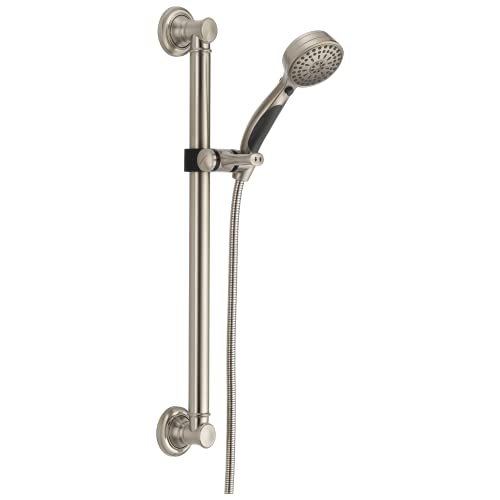
The Delta Handheld with Grab Bar Combo is the best overall accessible shower pick, combining a slide-bar handheld with a code-rated grab bar in a single fixture.
Retrofitting an existing shower for accessibility usually means adding a grab bar and a handheld separately, which doubles the wall penetrations and the chances of missing a stud. The Delta combo unit solves that by integrating a slide-bar handheld mount directly into a grab bar rated for a 500-pound static load, so a single, properly blocked installation covers both the safety hardware and the shower control.
The handheld wand slides along the same bar a user grips for support, which means it can be repositioned to a lower height for a shower seat or a bench without needing a second fixture. The single-lever valve pairs with it for one-hand operation, and the reduced number of wall penetrations lowers the chance of a poorly anchored fixture down the line.
For an aging-in-place bathroom remodel, we favor combined grab-bar-and-slide-bar units over installing the two separately. Fewer wall penetrations means fewer chances for an installer to miss the stud, and the combined unit is one less product to verify for proper anchoring later.

The Moen Handshower with Pressure-Balance Valve pairs a simple handheld wand with ASSE 1016-rated scald protection for households with elderly or vulnerable users.
A pressure spike from a flushing toilet elsewhere in the house is a genuine scalding risk for someone with slower reflexes, and the ASSE 1016-rated pressure-balance valve on this Moen system compensates automatically, holding the hot-to-cold ratio steady even when supply pressure fluctuates. The rotational limit stop is a separate, low-tech safety layer, a physical adjustment that caps how far the handle can turn toward hot regardless of who is using the shower.
The handheld wand detaches from its fixed bracket for a caregiver assisting with a seated bath, while still functioning as a standard fixed-position shower when parked. Installation does require a compatible pressure-balance valve body behind the wall, which is sometimes a retrofit project rather than a drop-in swap if the existing valve is a simple compression type.
The rotational limit stop is a detail worth calling out specifically, since it is a physical, tamper-resistant safety layer that works even if someone forgets to check the water temperature first. For a household with an elderly resident living alone, that redundancy matters.
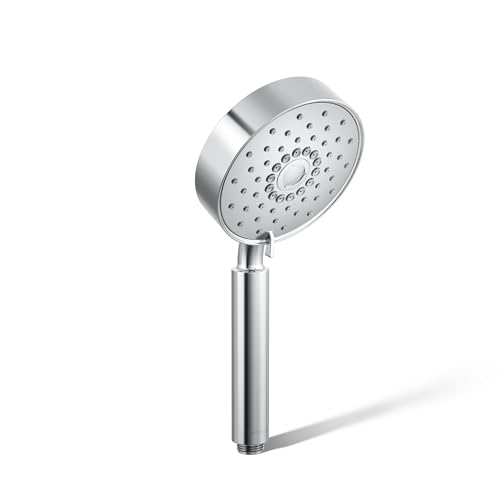
The Kohler Purist Handshower brings a low-profile, minimalist design to a walk-in or curbless shower renovation without sacrificing accessible operation.
A full walk-in or curbless shower renovation is often paired with a higher design budget, and the Purist line gives that project a fixture that functions exactly like the more utilitarian picks on this list without visually announcing itself as an accessibility retrofit. The slim slide-bar track sits closer to the wall than bulkier accessible systems, which matters in a curbless shower where every fixture is fully visible with no door or curtain to conceal it.
The single-lever valve uses a low-torque cartridge, meaning it turns smoothly with minimal applied force, a genuine benefit for a user with arthritis or reduced grip strength even though the design does not read as a specialized accessibility product. Buyers should budget for a separate, properly rated grab bar, since this fixture does not include one.
For a buyer renovating a full bathroom around aging in place, we point them toward the Purist when the goal is a barrier-free shower that looks like a design upgrade rather than a medical retrofit. Function and appearance are not mutually exclusive here.

The Delta ADA Slide Bar with Grab Bar is built for seated shower use, with a bar rated to double as certified support hardware.
A shower bench or transfer seat changes where the handheld wand needs to park, and this Delta system's ADA-compliant bar is long enough to move the wand down to seated height without leaving an unreachable fixed showerhead above. Because the bar itself is built to the ADA structural load standard for grab bars, a user can also lean on it for balance during a standing-to-seated transition, a function a standard slide bar is not rated for.
Correct installation is what makes the rated load capacity real. The bar must anchor into wall studs or code-rated blocking, not just drywall anchors, so this is a project for a licensed installer familiar with accessible bathroom hardware rather than a weekend DIY swap.
The distinction between a slide bar and an ADA-rated grab bar is not cosmetic, it is a structural rating difference. If a shower bench or seated bathing is part of the plan, this is the category of product to specify, not a standard slide bar that happens to look similar.

The Moen Home Care Shower System bundles a handheld, grab bar, and valve into one coordinated kit built specifically for accessible bathrooms.
Sourcing a handheld, a properly rated grab bar, and a compatible valve separately means confirming compatibility three separate times, and this Moen kit removes that friction by shipping all three as a matched set specifically engineered for accessible bathrooms. That matters most for a contractor or family managing an aging-in-place remodel on a schedule, where returning a mismatched part can delay the entire project.
The trade-off is a more utilitarian look than the Kohler Purist or a similarly styled premium line, though the finish is at least consistent across all three pieces rather than mixed from different sources. For a straightforward accessibility retrofit where function matters more than design statement, that trade-off is a reasonable one.
When a family is coordinating an accessibility remodel on a deadline, often around a hospital discharge or a scheduled surgery, a matched kit like this removes a real source of delay. Compatibility is confirmed before it ships, not discovered during installation.

The Kohler Thermostatic Anti-Scald Valve holds water at a precisely set maximum temperature, the strongest scald protection standard available for a residential shower.
Where a pressure-balance valve reacts to a pressure change after it happens, a thermostatic valve actively holds the water at a preset temperature using an internal thermostatic element, which is the more precise of the two anti-scald technologies. Meeting both ASSE 1016 and ASSE 1070 standards, this valve is built to the same specification level used in commercial and institutional accessible bathrooms, not just residential minimums.
Because it is a valve rather than a full showerhead system, it pairs with any of the handheld or fixed heads elsewhere on this list, including the Delta and Moen grab-bar combo units. The separate temperature dial and volume control also means a caregiver can preset a safe maximum temperature that a user cannot override, an added layer of protection for households supporting someone with dementia or reduced awareness of water temperature.
For a household supporting an elderly resident with cognitive decline, we recommend the thermostatic valve over pressure-balance alone specifically because the preset temperature cannot be accidentally overridden. That is a meaningful safety difference, not just a marketing distinction between the two valve types.

The Kingston Brass ADA Shower System delivers a complete accessible shower trim kit at a lower price point than premium brand equivalents.
Not every accessible bathroom remodel has a premium-brand budget, and this Kingston Brass kit covers the core accessibility fundamentals, a slide-bar handheld and a single-lever valve, at a meaningfully lower price than the Delta or Moen combo systems above. For a caregiver or family managing a remodel cost alongside other care expenses, that price difference is often the deciding factor.
The trade-off is real: this kit does not include a pressure-balance or thermostatic valve, so buyers prioritizing scald protection should pair it with a separate anti-scald valve, such as the Kohler thermostatic option above, or verify the home's existing valve already meets ASSE 1016. The single-lever operation and slide-bar flexibility still deliver the core accessibility benefits at a lower total cost.
When budget is the primary constraint, this is where we tell families to spend and where to add separately. The slide-bar handheld and single-lever valve are the fundamentals worth getting right here; a dedicated anti-scald valve can be added afterward without redoing the whole system.
A handheld wand on a slide bar, paired with a single-lever valve and an anti-scald pressure-balance or thermostatic valve, covers the core accessibility needs for most elderly users. The Delta Handheld with Grab Bar Combo is the strongest overall pick because it also integrates a rated grab bar in the same install.
An anti-scald pressure-balance valve (ASSE 1016) or thermostatic valve (ASSE 1016/1070) is strongly recommended, though not universally required by residential code. These valves compensate for sudden pressure or temperature changes that pose a higher injury risk to users with slower reflexes.
Yes. A lever handle can be operated with a closed fist or limited grip strength, while a round knob requires fine motor control and grasping strength that arthritis or reduced hand function can make difficult.
Only if it is specifically rated as such. A standard slide bar is designed to hold a handheld wand, not to support a person's weight. Look for products explicitly rated to a structural load standard, such as the ADA 250-pound minimum, if the bar needs to double as support hardware.
Look for a WaterSense-certified 2.0 GPM flow, the federal maximum for efficient showerheads. Flow rate itself does not affect accessibility, but WaterSense certification is a reliable marker of a well-engineered, modern fixture.
A pressure-balance valve (ASSE 1016) reacts to sudden pressure changes to prevent a temperature spike. A thermostatic valve (ASSE 1016/1070) actively holds water at a preset maximum temperature using an internal thermostatic element, offering more precise and consistent control.
Not necessarily. Accessible shower fixtures like a slide-bar handheld or anti-scald valve can be installed in a standard shower base or tub-shower combination. A curbless or low-threshold base is a separate upgrade that addresses entry, not the fixture itself.
Yes, in most cases. Swapping a fixed showerhead for a slide-bar handheld and upgrading to a single-lever anti-scald valve can typically be done without demolishing the shower surround, though a grab bar addition requires opening the wall to reach studs or blocking.
ADA guidelines call for grab bars to withstand a minimum 250-pound static load. Some manufacturers rate their hardware higher, up to 500 pounds, which provides an additional safety margin for a user leaning heavily on the bar during a transfer.
Generally yes. A handheld wand allows a seated or assisted user to direct the spray manually, adapts to different heights without repositioning a fixed mount, and is easier to use for someone who cannot stand comfortably for an extended period.
Delta, Moen, and Kohler all offer dedicated accessible or ADA-oriented shower lines with WaterSense-certified flow rates and documented anti-scald valve options. Kingston Brass offers a lower-cost alternative for the core fixtures.
Yes, this is a meaningful safety feature for households supporting an elderly resident with dementia or reduced temperature sensitivity. A thermostatic valve with a settable maximum temperature limit, like the Kohler pick above, allows a caregiver to cap the hottest setting a user can reach.
An accessible shower is built around fewer, more deliberate decisions than a standard one: a lever-operated single-handle valve, a handheld wand on a slide bar, anti-scald protection rated to ASSE 1016 or 1070, and grab-bar hardware rated to an actual structural load standard rather than a decorative towel bar mistaken for support. The Delta Handheld with Grab Bar Combo covers the most ground in a single install for most households, the Moen pressure-balance system is the strongest standalone scald-protection pick, and the Kohler Purist line suits a full curbless renovation that still needs to look like a design choice rather than a medical retrofit.
Step-by-step fixes for the shower problems homeowners run into most often, from weak water pressure and temperature swings to leaking valves, slow…
Read the guide
A water-saving showerhead has to solve the same problem a water-saving faucet does, cutting flow without leaving the spray feeling thin, since…
Read the guideA practical framework for deciding between a shower head, a full shower system, and an enclosure upgrade, plus how to match flow…
Read the guide