
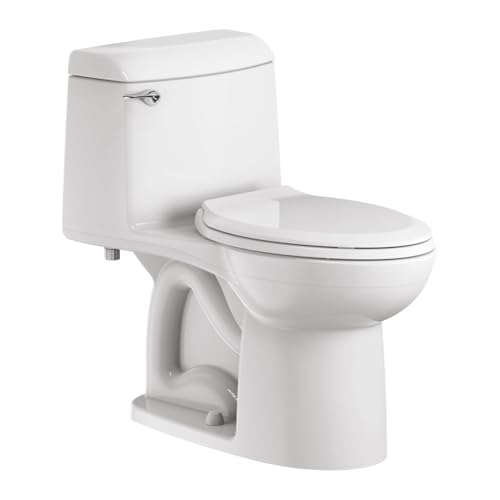
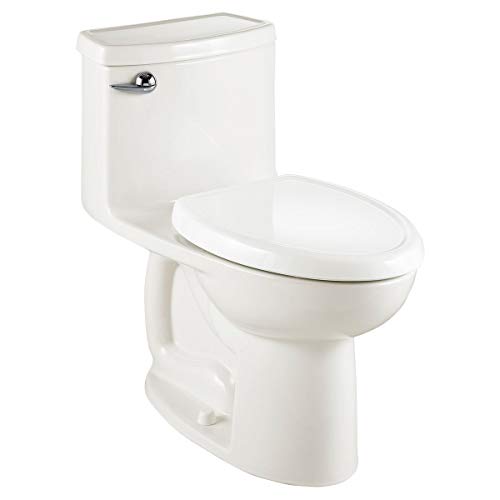

TOTO Drake Two-Piece Toilet vs Kohler Highline Two-Piece Toilet: Which Should You Buy?
Comparisons4.6
We compared the TOTO Drake and Kohler Highline two-piece toilets: both hit MaP 1000 at 1.28 GPF. See flush systems, verified specs…
Read the guideShould you step down to 1.0 gallons per flush or stick with the EPA WaterSense standard of 1.28 GPF? This guide breaks down real flush performance data, annual water savings, MaP test scores, and which flow rate makes sense for your household.
1.28 GPF toilets (EPA WaterSense certified) deliver reliable flushing for most households with strong MaP scores. 1.0 GPF toilets save roughly 22% more water but require precision engineering to avoid double-flushing. For most buyers, 1.28 GPF is the safer, high-performance choice; 1.0 GPF suits low-waste households or strict drought-region mandates.
GPF stands for gallons per flush -- the volume of water a toilet uses each time you push the handle. Federal law under the Energy Policy Act of 1992 capped residential toilet flush volume at 1.6 GPF. Since then, manufacturers and regulators have pushed that ceiling lower in two meaningful tiers: the EPA WaterSense standard at 1.28 GPF (20% below the federal maximum) and the ultra-high-efficiency tier at 1.0 GPF (37.5% below the federal maximum).
Understanding where your household falls on the water-use spectrum -- and whether your plumbing and waste load can support ultra-low-flush performance -- is the real decision you need to make before choosing between these two ratings.
| Metric | 1.0 GPF (Ultra HET) | 1.28 GPF (WaterSense HET) |
|---|---|---|
| Federal compliance | Yes (below 1.6 GPF cap) | Yes + EPA WaterSense certified |
| Daily water use (4 flushes/person) | 4.0 gal/person | 5.12 gal/person |
| Annual savings vs 1.6 GPF (1 person, 4 flush/day) | 876 gal/yr | 708 gal/yr |
| Typical MaP score (grams of waste cleared) | 500-800 g (varies widely) | 800-1000 g (more consistent) |
| Double-flush risk | Higher without premium flush valve | Lower |
| Available models (major brands) | Fewer; mostly TOTO, Kohler select | Wide -- all major brands |
| Toilet paper clog risk | Moderate to high in older drains | Low |
| Best for | Drought regions, low-waste users | Most households nationwide |
The EPA WaterSense program certifies toilets that use 1.28 GPF or less while meeting minimum flush performance thresholds -- specifically a MaP score of at least 350 grams under third-party testing. Because 1.28 GPF is the program's upper efficiency limit, the vast majority of water-efficient toilets sold today carry this rating, giving consumers the broadest selection of certified, tested models.
WaterSense-certified toilets must pass independent laboratory testing to verify both water volume and waste removal capacity, which is why the label signals genuine performance rather than just a marketing claim.
Launched by the EPA in 2006, WaterSense has become the de-facto benchmark for residential water efficiency. Toilets earning this certification must use no more than 1.28 gallons per flush AND clear a minimum of 350 grams of solid waste in standardized MaP tests. That last requirement is critical: it means WaterSense toilets cannot sacrifice flushing power to hit their water target.
Because 1.28 GPF is the program ceiling, virtually every major manufacturer -- TOTO, Kohler, American Standard, Gerber, Swiss Madison, Woodbridge -- builds their entire efficient lineup around this number. Models like the TOTO Drake II (1.28 GPF, MaP 1000 g), the Kohler Cimarron (1.28 GPF), and the American Standard Cadet 3 (1.28 GPF) have earned both the WaterSense label and consistently high MaP scores, making them the benchmark of what a well-engineered efficient toilet should do.
Published MaP data consistently shows that the strongest 1.28 GPF models -- particularly those with pressure-assisted or larger trapway designs -- clear waste more reliably than the median 1.0 GPF model. The engineering investment required to achieve 1,000-gram MaP performance at 1.28 GPF is more achievable than at 1.0 GPF, which is why the WaterSense tier has attracted deeper R&D from every major brand.
Switching from a 1.28 GPF toilet to a 1.0 GPF model saves 0.28 gallons per flush -- roughly 22% per use. For a household of four adults flushing an average of five times per day each, that translates to about 2,044 additional gallons saved per year compared to 1.28 GPF, or roughly 7,300 gallons saved per year compared to an older 3.5 GPF toilet.
Whether that saving justifies the performance trade-offs depends on local water rates and whether your household ever needs a second flush to clear waste, since a single double-flush event at 1.0 GPF uses 2.0 gallons -- more than one 1.28 GPF flush.
The math on annual savings is straightforward, but the double-flush caveat is one that many buyers overlook. If a 1.0 GPF toilet triggers a second flush even 10% of the time, its effective average rises to 1.1 GPF -- narrowing the gap with 1.28 GPF considerably. Premium models like the TOTO Aquia IV (0.8/1.0 GPF dual-flush) are engineered specifically to minimize this, using wide 3-inch flush valves and fully-glazed 2-1/8 inch trapways to move waste on minimal water.
| Flush Rate | Daily Gallons (Household) | Annual Gallons | Annual Savings vs 1.6 GPF |
|---|---|---|---|
| 1.6 GPF (old standard) | 32.0 | 11,680 | -- |
| 1.28 GPF (WaterSense) | 25.6 | 9,344 | 2,336 gal/yr |
| 1.0 GPF (Ultra HET) | 20.0 | 7,300 | 4,380 gal/yr |
In drought-restricted areas of California, Texas, or the Southwest, some water utilities offer rebates specifically for 1.0 GPF and HET toilets beyond the WaterSense threshold. If your local utility has such a program, the financial case for ultra-low-flush becomes stronger.
It depends almost entirely on the specific model. The best 1.0 GPF toilets -- like the TOTO UltraMax II (MaP 1000 g at 1.0 GPF) -- match the flushing power of strong 1.28 GPF models because they pair ultra-low water volume with wide trapways, fully-glazed flush paths, and high-momentum flush valves. Budget 1.0 GPF toilets without this engineering may score as low as 400-600 grams on MaP tests, which is acceptable but not impressive.
MaP score, not GPF rating alone, is the right number to compare when evaluating flushing performance, because a well-engineered 1.0 GPF toilet can outperform a poorly-engineered 1.28 GPF model.
The Maximum Performance (MaP) testing protocol, conducted by independent laboratories and published at map-testing.com, is the most reliable public dataset for comparing flush strength across models. Scores reflect the maximum grams of soybean paste (a standardized waste analog) cleared in a single flush. Here is how leading models at both GPF ratings compare:
| Model | GPF | MaP Score (g) | Trapway | WaterSense | Check Price |
|---|---|---|---|---|---|
| TOTO UltraMax II (MS604114CEFG) | 1.0 | 1,000 | 2-1/8 in fully glazed | Yes | Check price |
| TOTO Aquia IV (dual-flush) | 0.8 / 1.0 | 1,000 (full flush) | 2-1/8 in | Yes | Check price |
| TOTO Drake II (MS454124CEFG) | 1.28 | 1,000 | 2-1/8 in fully glazed | Yes | Check price |
| Kohler Cimarron (K-6422) | 1.28 | 1,000 | 2-1/8 in | Yes | Check price |
| American Standard Champion 4 | 1.28 | 1,000 | 4 in flush valve / 2-3/8 in trapway | Yes | Check price |
| American Standard Cadet 3 | 1.28 | 800 | 3 in flush valve | Yes | Check price |
| Woodbridge T-0001 | 1.28 | 800 | Skirted, fully glazed | Yes | Check price |
The takeaway from MaP data: the top-tier 1.0 GPF models from TOTO are legitimately excellent flushers. But they represent premium engineering at a premium price. The same MaP 1,000-gram performance is more broadly available across the 1.28 GPF tier, including from mid-range models.
When comparing toilets across GPF ratings, always check the published MaP score for the exact model number -- not just the brand or line name. The same product family (for example, the TOTO Drake series) may include models at different GPF ratings with different scores. The Drake II at 1.28 GPF and the UltraMax II at 1.0 GPF both score MaP 1,000, but that level of engineering is not universal across the 1.0 GPF market.
1.0 GPF toilets are most beneficial for households in drought-regulated regions (particularly California, Nevada, Colorado, and parts of Texas), homes with adults-only occupants who generate lighter waste loads, and buyers who prioritize maximum water efficiency and are willing to invest in a premium model with confirmed MaP performance. They are less ideal for families with young children, older plumbing with shallow drain slopes, or households where the toilet is used frequently throughout the day by multiple people.
Newer drain-line installations with modern 1/4-inch-per-foot slope are generally better suited to 1.0 GPF toilets than older homes with shallower grades, where the reduced water volume may not carry waste fully through the horizontal drain run.
The engineering reality of 1.0 GPF is that less water means less hydraulic push through the drain line. In most modern construction with properly sloped drains, this is not a problem. In older homes -- particularly those built before 1980 with drain lines running at shallow grades -- the reduced volume may increase the frequency of slow-clear situations or, in extreme cases, partial blockages.
This is not an argument against 1.0 GPF toilets generally. It is a reason to assess your specific plumbing conditions before selecting the ultra-low-flush tier. If you live in a newer build, a home with recently-relined drains, or a single-story layout with a short run to the main stack, 1.0 GPF performance concerns largely disappear -- especially with a premium model.
Poorly-engineered 1.0 GPF toilets with narrow trapways or subpar flush valve sizing can be more prone to clogs than strong 1.28 GPF designs, primarily because the lower water volume provides less hydraulic force to clear the trapway and drain line. However, premium 1.0 GPF models with fully-glazed 2-1/8-inch trapways and wide flush valves -- such as the TOTO UltraMax II -- exhibit clog rates similar to top-performing 1.28 GPF toilets based on aggregated owner reviews.
Trapway diameter, glaze quality, and flush valve engineering matter more than GPF rating alone when predicting real-world clog resistance.
Aggregated reviews across major retail platforms consistently flag clogging as a concern for lower-priced 1.0 GPF models lacking sufficient trapway engineering. The pattern is clear: brand-name 1.0 GPF models with published MaP scores above 800 grams show strong owner satisfaction on clog resistance; no-name 1.0 GPF models with vague specifications draw significantly more clog complaints.
For buyers considering a 1.0 GPF toilet, the checklist should include: a fully-glazed trapway of at least 2 inches in diameter, a flush valve of at least 3 inches, a published MaP score (ideally above 800 grams), and ideally a WaterSense certification that confirms independent third-party testing.
If you are evaluating overall flushing reliability across brands, the best flushing toilets guide covers top performers at both GPF ratings with full MaP and owner data.
Below are the strongest-performing models at each flow rate based on MaP data, manufacturer specifications, and aggregated owner feedback. All links go to Amazon search results for current availability.
TOTO UltraMax II (MS604114CEFG): The benchmark for ultra-high-efficiency single-flush toilets. Scores MaP 1,000 grams at 1.0 GPF using TOTO's Tornado Flush system with dual nozzles and a fully-glazed 2-1/8-inch trapway. One-piece design, elongated bowl, SoftClose seat included. WaterSense certified. Check price on Amazon
TOTO Aquia IV (dual-flush 0.8/1.0 GPF): A wall-hung or floor-mount dual-flush option that uses just 0.8 GPF for liquids and 1.0 GPF for solids -- the most water-efficient flush combination commercially available in the U.S. MaP 1,000 grams at full flush. Two-piece design with concealed trapway and WaterSense certification. Check price on Amazon
Kohler Highline Arc (1.0 GPF variant): Kohler's AquaPiston canister flush valve technology provides a strong, consistent flush at reduced volume. Two-piece elongated design with a fully-glazed trapway. WaterSense certified. Available in multiple finishes. Check price on Amazon
TOTO Drake II (MS454124CEFG): Consistently one of the highest-rated WaterSense toilets for flush power, with MaP 1,000 grams at 1.28 GPF. Two-piece elongated design with TOTO's E-Max flush system, fully-glazed 2-1/8-inch trapway, and an optional SoftClose seat. Widely considered the reliability standard in the 1.28 GPF tier. Check price on Amazon
American Standard Champion 4 (1.28 GPF): Known for its oversized 4-inch flush valve and 2-3/8-inch fully-glazed trapway -- the widest combination in the standard consumer market. MaP 1,000 grams. Engineered specifically for maximum clog resistance and remains one of the top-reviewed toilets for households with heavy use. Check price on Amazon
Kohler Cimarron (K-6422): MaP 1,000 grams with Kohler's AquaPiston flush valve. Clean two-piece design, 12-inch rough-in, WaterSense certified. Well-reviewed for quiet operation and consistent performance. Good value in the mid-range 1.28 GPF segment. Check price on Amazon
Woodbridge T-0001 (1.28 GPF): One-piece skirted design with a fully-glazed trapway, soft-close seat, and WaterSense certification. Popular for modern bathroom aesthetics and ease of cleaning. Owner reviews report reliable flushing with minimal maintenance. Check price on Amazon
Gerber Viper (1.28 GPF): Commercial-grade ADA-compliant design with a 3-inch flush valve, 2-1/8-inch fully-glazed trapway, and WaterSense certification. Less marketed to consumers than TOTO or Kohler but consistently appears in plumber recommendations for reliability. Check price on Amazon
For households replacing a toilet in a standard North American 12-inch rough-in bathroom, the TOTO Drake II at 1.28 GPF represents the clearest alignment of MaP performance, widespread availability, part accessibility, and long-term reliability. Buyers stepping down to 1.0 GPF should focus exclusively on models with published MaP scores at or above 800 grams -- treating any model without a confirmed MaP number as an unknown risk.
Choose 1.0 GPF if:
Choose 1.28 GPF if:
For related buying decisions, see our guides on dual-flush toilet benefits, 1.28 GPF vs 1.6 GPF toilets, and EPA WaterSense certified toilet reviews.
1.0 GPF uses less water per flush, but "better" depends on the model and your household. A premium 1.0 GPF toilet like the TOTO UltraMax II can flush just as well as top 1.28 GPF models. A budget 1.0 GPF toilet may clog more often, negating water savings through double-flushing. MaP score is the better comparison metric than GPF alone.
Yes. WaterSense requires toilets to use 1.28 GPF or less and clear at least 350 grams in MaP testing. A 1.0 GPF toilet that passes MaP testing can and does receive WaterSense certification -- the TOTO UltraMax II and Aquia IV are both certified examples.
High-Efficiency Toilets (HET) use 1.28 GPF or less, qualifying for EPA WaterSense certification. Ultra High-Efficiency Toilets (Ultra HET) are a subset using 1.0 GPF or less. Both exceed federal law (1.6 GPF max), but Ultra HET provides an additional 22% water savings over standard HET.
In most cases yes, particularly in homes built after 1990 with drains sloped at 1/4 inch per foot. Homes with older, shallower-sloped drains or long horizontal runs may see sluggish clearing. A licensed plumber can assess your drain slope before you commit to the ultra-low-flush tier.
For a household of four adults flushing five times per day each, switching from 1.28 GPF to 1.0 GPF saves approximately 2,044 gallons per year. That equals about 0.28 gallons saved per flush multiplied by 20 flushes per day multiplied by 365 days.
Budget 1.0 GPF models with narrow trapways can clog more than well-engineered 1.28 GPF models. Premium 1.0 GPF toilets with fully-glazed 2-inch-plus trapways and verified MaP scores above 800 grams show clog rates comparable to top 1.28 GPF models based on aggregated owner reviews.
TOTO offers the strongest 1.0 GPF lineup including the UltraMax II and Aquia IV. Kohler makes select 1.0 GPF variants of the Highline. American Standard and Gerber have limited 1.0 GPF offerings. The 1.28 GPF tier has far broader brand and model availability.
Yes. 1.0 GPF is legal in all U.S. states and exceeds federal efficiency requirements. Some states such as California and Texas have tightened standards beyond the federal 1.6 GPF maximum, and in those markets 1.0 GPF toilets may specifically qualify for rebate programs.
MaP (Maximum Performance) testing measures how many grams of soybean paste -- a standardized solid waste analog -- a toilet can clear in a single flush. Scores range from under 250 grams to 1,000 grams (the highest rating). A score of 600+ is considered good; 800+ is very good; 1,000 is the top rating. MaP scores are the most reliable public data for comparing flush power across models and brands.
Many water utilities in drought-prone areas of California, Nevada, Arizona, Texas, and Colorado offer rebates for WaterSense-certified and Ultra HET toilets. Rebate amounts typically range from $50 to $200 per toilet. Check your local water utility's website for current programs before purchasing.
The TOTO Drake II is a two-piece 1.28 GPF toilet with MaP 1,000 grams and Tornado Flush. The UltraMax II is a one-piece 1.0 GPF toilet also scoring MaP 1,000 grams with Tornado Flush technology. Both are top performers; the Drake II offers simpler tank serviceability while the UltraMax II uses less water and has a cleaner one-piece profile.
The American Standard Champion 4 (1.28 GPF) is specifically engineered for clog resistance, with a 4-inch flush valve and 2-3/8-inch fully-glazed trapway -- the widest combination in the standard consumer segment. It scores MaP 1,000 grams and consistently receives top marks from owners for heavy-use reliability.
It depends on usage patterns. A dual-flush toilet at 0.8/1.28 GPF used with 70% half-flushes averages around 0.94 GPF -- better than a single-flush 1.28 GPF. But a dual-flush toilet where users default to the full flush most of the time offers minimal efficiency gain. The TOTO Aquia IV at 0.8/1.0 GPF is the strongest dual-flush option for confirmed water savings.
The GPF rating is typically stamped inside the tank lid or on a label inside the tank. You can also find it in the toilet's model number documentation. If neither is visible, the manufacturing date can help: most toilets made after 2013 in WaterSense-active states are 1.28 GPF; 1.0 GPF models are less common and usually a newer premium purchase.
The Swiss Madison Concorde and most Swiss Madison models are rated at 1.28 GPF, not 1.0 GPF. Swiss Madison focuses on the WaterSense 1.28 GPF tier with modern skirted one-piece designs rather than competing in the ultra-low-flush segment.
Premium 1.0 GPF models with high MaP scores can work in light-traffic commercial settings. High-traffic commercial environments typically benefit from 1.28 GPF toilets with large flush valves (American Standard or Gerber commercial-grade models) due to the consistent performance demands of heavy, multi-user use throughout the day.
For reliable household performance, look for a MaP score of at least 600 grams in a 1.0 GPF toilet. Models scoring below 500 grams may require double-flushing under real household conditions, negating water savings. The TOTO UltraMax II at MaP 1,000 grams is the clear benchmark for what the best 1.0 GPF engineering can achieve.
Some 1.0 GPF pressure-assisted models are louder because they use compressed air to boost flushing power at reduced water volume. Gravity-fed 1.0 GPF models like the TOTO UltraMax II are comparably quiet to gravity-fed 1.28 GPF toilets. If noise is a concern, check whether the model uses gravity or pressure-assisted flushing before buying.
For most households, 1.28 GPF is the right GPF rating: it delivers proven, MaP-verified flushing power across a wide range of models from every major brand, with enough water savings to satisfy EPA WaterSense standards and local efficiency requirements. 1.0 GPF is a genuine step forward in water efficiency -- saving roughly 22% more per flush -- but it rewards buyers who choose premium engineering carefully. If you are in a drought-restricted region, committed to maximum efficiency, and willing to select a model with a confirmed MaP score above 800 grams (preferably the TOTO UltraMax II or Aquia IV), 1.0 GPF delivers real water savings without meaningful flush performance trade-offs. In any other scenario, the 1.28 GPF tier offers deeper model selection, broader price competition, and a lower risk of double-flush disappointment.
We compared the TOTO Drake and Kohler Highline two-piece toilets: both hit MaP 1000 at 1.28 GPF. See flush systems, verified specs…
Read the guideHome / Comparisons / TOTO Drake vs TOTO Drake II TOTO Drake Two-Piece Toilet vs TOTO Drake II Two-Piece Toilet: Which Should…
Read the guideA data-driven look at resale impact, long-term availability, and which color choice makes more sense for your bathroom and your budget.
Read the guide