

Where Does Toilet Water Go After You Flush
Buying Guides4.6
When you flush, where does it go? Follow toilet water from the bowl through the trap, drain, and stack to a septic…
Read the guideA state-by-state breakdown of maximum gallons-per-flush limits, EPA WaterSense standards, and what every homeowner and contractor needs to know before buying or replacing a toilet in 2026.
Most states follow the federal 1.6 GPF maximum, but California, Colorado, Texas, Georgia, and several others mandate 1.28 GPF or less for new construction and replacement toilets. EPA WaterSense certification at 1.28 GPF is the safest universal choice and satisfies every active state law as of 2026.
GPF stands for gallons per flush -- the volume of water a toilet uses to clear the bowl in a single cycle. State laws regulate GPF because toilets account for roughly 30 percent of indoor residential water use, making them the single largest water consumer in most homes. Reducing GPF from 3.5 (pre-1994 standard) to 1.28 saves tens of thousands of gallons per household per year.
Before the federal Energy Policy Act of 1992, toilets routinely consumed 3.5 to 7 gallons per flush. That law capped residential toilets at 1.6 GPF nationwide starting in 1994, a mandate that remains the federal baseline today. But water scarcity pressure -- especially in drought-prone western and southern states -- pushed many jurisdictions to set stricter local limits.
Understanding which standard applies in your state matters for three practical reasons. First, selling or installing a non-compliant toilet can result in fines or failed inspections. Second, utility rebate programs typically require WaterSense-certified models at 1.28 GPF or below. Third, performance has caught up: modern 1.28 GPF toilets from brands like TOTO, Kohler, American Standard, and Gerber routinely score 1,000 grams or above on MaP (Maximum Performance) flush testing, matching or exceeding older high-flow units.
The shift from 1.6 GPF to 1.28 GPF is less dramatic than it sounds. MaP flush-test data published at map-testing.com consistently shows that certified 1.28 GPF toilets can clear 500 to 1,000 grams of solid waste in a single flush -- well above the real-world load in most households. The engineering improvements in siphon jet bowl design and pressure-assist mechanisms mean efficiency and flushing power are no longer trade-offs.
California, Colorado, Georgia, Texas, and several other states have enacted laws or building codes requiring toilets in new construction or replacement situations to use no more than 1.28 GPF. Hawaii mandates 1.28 GPF statewide, and Massachusetts has adopted a 1.28 GPF requirement for commercial buildings. The patchwork of state and local rules means buyers should always verify the code for their specific city or county.
Below is a comprehensive state-by-state reference table current as of June 2026. Federal law (1.6 GPF) is the floor in states not listed with a stricter standard.
| State | Max GPF (Residential) | Effective Since | Notes |
|---|---|---|---|
| California | 1.28 GPF | 2016 | Title 20 appliance standard; applies to new construction and replacement |
| Colorado | 1.28 GPF | 2016 | Adopted via state plumbing code; Denver Water rebates available |
| Georgia | 1.28 GPF | 2010 | Georgia Water Stewardship Act; one of the earliest state mandates |
| Texas | 1.28 GPF | 2012 | Water Code Chapter 372; applies to new construction, major renovation |
| Hawaii | 1.28 GPF | 2015 | Statewide; all residential and commercial new installs |
| Massachusetts | 1.28 GPF | 2018 | Commercial and residential new construction; rebates via Mass Save |
| New York | 1.28 GPF | 2018 | NYC Local Law 84 preceded state rule; statewide plumbing code now aligns |
| Nevada | 1.28 GPF | 2014 | NRS Chapter 704B; Southern Nevada Water Authority rebates |
| Arizona | 1.28 GPF | 2017 | Phoenix and Tucson adopted ahead of state plumbing code update |
| Oregon | 1.28 GPF | 2015 | Oregon Plumbing Specialty Code; Portland Water Bureau rebates |
| Washington | 1.28 GPF | 2016 | WAC 51-56; applies to new construction only in most counties |
| Florida | 1.6 GPF | 1994 (federal) | No stricter state rule; some utilities offer WaterSense rebates voluntarily |
| Illinois | 1.6 GPF | 1994 (federal) | Chicago adopted 1.28 GPF for commercial; residential follows federal |
| Ohio | 1.6 GPF | 1994 (federal) | Follows federal standard; no active state legislation as of 2026 |
| Pennsylvania | 1.6 GPF | 1994 (federal) | Philadelphia Water offers rebates for WaterSense units voluntarily |
| Michigan | 1.6 GPF | 1994 (federal) | No current plans for stricter state rule as of 2026 |
| Virginia | 1.28 GPF | 2020 | Virginia Uniform Statewide Building Code; Fairfax Water rebates active |
| North Carolina | 1.28 GPF | 2012 | Session Law 2009-216; Water Efficiency Act requires WaterSense for state projects |
| Maryland | 1.28 GPF | 2019 | Maryland Building Performance Standards align with EPA WaterSense |
| Connecticut | 1.28 GPF | 2017 | CGS Section 16a-38; applies to all plumbing fixtures sold in-state |
States not listed above generally default to the federal 1.6 GPF maximum. However, individual cities and counties within those states may have adopted stricter codes. Always check with your local building department before purchasing a replacement toilet for a permitted renovation project.
EPA WaterSense is a voluntary certification program that labels toilets using 1.28 GPF or less that also pass independent MaP flush-performance testing. A WaterSense-certified toilet satisfies the stricter 1.28 GPF limit in every state that has enacted one, making it the single safe choice regardless of where you live. WaterSense also qualifies buyers for utility rebate programs in hundreds of municipalities.
The WaterSense label was introduced by the EPA in 2006 to identify products that use at least 20 percent less water than the federal standard while maintaining equivalent or better performance. For toilets, this means a maximum of 1.28 GPF combined with a MaP score of at least 350 grams -- though most certified products score far higher.
WaterSense certification is not automatic. Manufacturers must submit toilets to an EPA-recognized third-party laboratory for MaP flush testing, and the product must pass both the water-volume limit and the flush-performance minimum before the label can be applied. The EPA publishes a searchable database of all certified products at epa.gov/watersense, updated regularly.
WaterSense certification is increasingly a baseline expectation, not a premium feature. As of 2026, nearly every toilet sold by TOTO, Kohler, American Standard, Gerber, Woodbridge, and Swiss Madison in the U.S. residential market carries WaterSense certification. If a toilet is not WaterSense-certified, treat that as a red flag -- it likely means the manufacturer has not submitted it for independent performance verification.
Dual flush toilets use two different GPF settings -- typically 0.8 GPF for liquid waste and 1.28 GPF for solid waste. State laws that cap toilets at 1.28 GPF generally measure compliance against the full flush volume, so a dual flush model with a 1.28 GPF full flush satisfies those requirements. Some codes specify an average flush volume (the effective flush volume, or EFV) that blends both buttons.
The American Standard H2Option, TOTO Aquia IV, and Woodbridge T-0001 are popular dual flush models. All three carry WaterSense certification and use 1.0 GPF or less for the partial flush and 1.28 GPF for the full flush. When compliance is measured by effective flush volume (typically weighted as one-third full flush plus two-thirds partial flush), these models fall well below 1.28 GPF on average.
Dual flush toilets are particularly well-suited to California, Colorado, and Nevada, where water agencies sometimes offer enhanced rebates for EFV values below 1.1 GPF. Check with your local utility for the specific rebate schedule, as many programs are funded annually and can change from year to year.
For a deeper look at how dual flush options stack up against single flush efficiency, see our guide on dual flush vs single flush toilets.
The TOTO Drake II, TOTO UltraMax II, Kohler Cimarron, American Standard Cadet 3 Flowise, and Gerber Viper are among the most consistently recommended 1.28 GPF toilets for complying with strict state laws. All carry WaterSense certification and achieve MaP scores of 800 grams or higher, making them reliable performers that satisfy both efficiency mandates and real-world flushing demands.
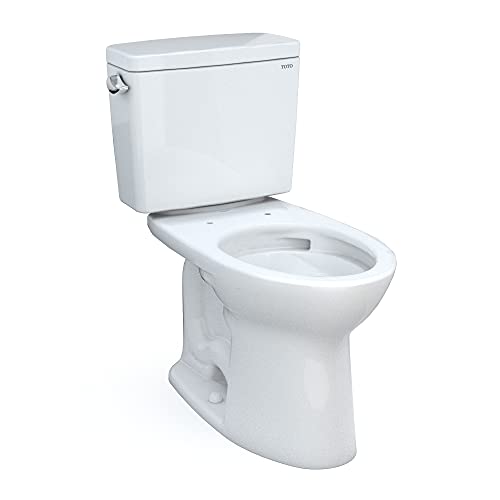
The TOTO Drake II is one of the most widely installed 1.28 GPF toilets in states with strict water laws. It uses TOTO's Double Cyclone flushing technology, which powers two nozzles instead of the traditional rim holes to create a centrifugal washing action. MaP testing puts it at 1,000 grams -- the maximum score in the test protocol. The Drake II is a two-piece unit, which keeps the purchase price lower and makes component replacement easier. See our full review in the best flushing toilets guide.
For buyers who prefer a one-piece design with a lower profile, the TOTO UltraMax II delivers the same Double Cyclone flushing in a skirted elongated configuration. It is SanaGloss-coated for easy cleaning and achieves a 1,000 gram MaP score. The one-piece construction eliminates the gap between tank and bowl that can collect grime on two-piece models -- a practical advantage for high-traffic bathrooms.
Check TOTO UltraMax II on Amazon
The TOTO Aquia IV brings dual flush capability to TOTO's lineup at 1.0 and 1.28 GPF. It uses TOTO's CEFIONTECT ion-barrier glaze and Tornado Flush technology, which sweeps water from two nozzles in a circular motion. MaP score for the full flush is 800 grams. It is well-suited to California Title 20 compliance and earns higher rebates from water agencies that calculate EFV. Read more in our dual flush toilets guide.
The Kohler Cimarron uses AquaPiston canister flush technology, which allows water to enter the bowl from all 360 degrees rather than just the front or sides. Published MaP scores for the Cimarron range from 800 to 1,000 grams depending on configuration. It is available in elongated and round-front options, and Kohler's AquaPiston canister is less prone to the flapper degradation that plagues older flushing mechanisms. Kohler provides a limited lifetime warranty on the vitreous china.
Check Kohler Cimarron on Amazon
American Standard's Cadet 3 Flowise is specifically engineered for states with 1.28 GPF mandates. It features a fully glazed trapway (2-3/8 inch diameter) and PowerWash rim scrubbing technology. Published MaP data places it at 800 grams. The EverClean antimicrobial surface treatment is applied to the bowl interior to inhibit the growth of stain and odor-causing bacteria. This model is a common choice for multi-family housing projects in Texas and Georgia.
Check American Standard Cadet 3 Flowise on Amazon
The Kohler Highline is one of the most widely specified toilets in U.S. new construction and renovation. Its tall chair-height bowl (17 to 19 inches) meets ADA accessibility requirements, and the 1.28 GPF version carries WaterSense certification. AquaPiston technology provides consistent flush performance. The Highline is available in more than a dozen finish colors, making it a flexible fit for bathroom remodels. For a broader look at accessible options, see our ADA compliant toilet guide.
Check Kohler Highline on Amazon
The American Standard Champion 4 is notable here as a 1.6 GPF model -- and it is worth mentioning precisely because it is not the right choice for states with 1.28 GPF mandates. It uses a 4-inch flush valve and 2-3/8 inch trapway for a MaP score of 1,000 grams, making it a powerful performer. But buyers in California, Texas, Georgia, Colorado, and the other restricted states listed above must choose the WaterSense-certified alternatives instead. The Champion 4 remains a valid option in federal-baseline states for buyers who prioritize raw flush power over maximum water savings.
Check American Standard Champion 4 on Amazon
Gerber is a smaller brand compared to TOTO and Kohler but earns consistently high marks in plumbing contractor surveys for build quality and parts availability. The Gerber Viper uses a 3-inch flush valve and fully glazed 2-1/8 inch trapway. WaterSense certified at 1.28 GPF and MaP-tested at 800 grams. Gerber's parts availability through commercial plumbing distributors makes the Viper a practical choice for rental properties where long-term maintenance matters.
The Woodbridge T-0001 is a popular budget-friendly one-piece dual flush option. It uses 0.8 GPF for liquid waste and 1.6 GPF for solids. Note: the 1.6 GPF full flush setting means the T-0001 does not satisfy strict 1.28 GPF state mandates unless the effective flush volume calculation is applied. Buyers in California and similar states should verify local code interpretation before specifying this model. It earns strong aggregated owner reviews for the contemporary skirted design and ease of cleaning.
Check Woodbridge T-0001 on Amazon
Swiss Madison has grown quickly in the U.S. market by offering contemporary wall-hung and one-piece designs at accessible price points. The Sublime II is a one-piece elongated toilet rated at 1.28 GPF with WaterSense certification. It is not yet widely covered in MaP testing data as of 2026, so buyers relying on MaP scores for performance verification should note that gap. Aggregated owner reviews are positive for the slim silhouette, but the brand's warranty service network is less established than TOTO or Kohler. For more on installation considerations, see our toilet installation guide.
Check Swiss Madison Sublime II on Amazon
To verify local GPF rules beyond your state standard, contact your city or county building department directly, review the local plumbing code (most are posted on municipal websites), or ask your licensed plumber before pulling a permit. Major cities like Chicago, Los Angeles, and Denver have historically adopted stricter standards ahead of their state governments, and some utility rebate programs effectively function as soft mandates by making non-compliant toilets ineligible for financial incentives.
The fastest practical approach is to check the WaterSense product database at epa.gov/watersense before purchasing. If a toilet is WaterSense-certified at 1.28 GPF, it satisfies every state and municipal standard currently in force in the United States as of 2026. No further code research is required for compliance purposes.
For permit purposes, your licensed plumber or general contractor is responsible for specifying code-compliant fixtures. If you are purchasing a toilet without a permit (for a like-for-like replacement in some jurisdictions), the WaterSense label still provides the best protection against inadvertently violating state product standards.
State and local GPF rules are almost always enforced at the point of sale for toilets sold by retail chains and plumbing distributors within the state. California, in particular, prohibits the sale of non-compliant toilets within state lines, not merely their installation. This means even buying a 1.6 GPF single-flush toilet for personal use in California is technically unlawful under Title 20. Manufacturers and retailers are responsible for the state-by-state product filtering, but consumers benefit from understanding the rule so they can verify compliance independently.
In most states with a 1.28 GPF mandate, the rule applies to any new toilet installed after the effective date, including replacement of an existing toilet, not only new construction. California, Georgia, and Texas all explicitly include replacement installations. However, enforcement in single-family residential settings without a permit is limited in practice. When a permit is pulled for a bathroom renovation, inspectors will verify fixture compliance.
Georgia's Water Stewardship Act of 2010 was one of the first laws to explicitly extend the 1.28 GPF requirement to all toilet replacements, not just new construction. The Act was driven by the Atlanta metropolitan area's recurring drought conditions and has served as a model for subsequent state legislation.
The practical implication: if you are replacing a toilet in a bathroom renovation that requires a building permit anywhere in the states listed in the table above, you must specify a 1.28 GPF or lower model. Submitting a permit application showing a 1.6 GPF toilet will trigger a code violation flag in most of those jurisdictions.
The federal Energy Policy Act of 1992 set a maximum of 1.6 GPF for residential toilets, effective from 1994. That limit remains the federal floor in 2026. States are permitted to set stricter limits, but no state may allow toilets exceeding 1.6 GPF in new installations.
Yes. MaP (Maximum Performance) flush testing is the independent benchmark used to evaluate real-world flushing ability. The test uses soybean paste media to simulate solid waste. Leading 1.28 GPF toilets from TOTO, Kohler, and American Standard routinely score 800 to 1,000 grams -- well above the 350 gram minimum required for WaterSense certification and above the typical household load.
MaP (Maximum Performance) testing, conducted by a third-party lab and published at map-testing.com, measures how many grams of simulated solid waste a toilet can flush in a single cycle without a double flush. A score of 800 grams or above is generally considered excellent for residential use. The protocol is the most reliable independent measure of flush performance available to consumers.
No. California Title 20 prohibits the sale of single-flush toilets exceeding 1.28 GPF within the state. Retailers operating in California are required to remove non-compliant toilets from their inventory for sale within state lines. Some dual flush toilets with a 1.6 GPF full flush may be restricted depending on EFV calculation.
Yes, as of 2026. EPA WaterSense certifies toilets at a maximum of 1.28 GPF, which equals or exceeds the strictest state standard currently in force anywhere in the United States. A WaterSense-certified toilet satisfies California, Texas, Georgia, Colorado, Hawaii, and all other states with 1.28 GPF mandates.
Pressure-assist models use compressed air in a sealed tank to boost flush velocity, which can improve performance at lower water volumes. Some commercial and multi-family buildings in drought states specify pressure-assist toilets for their superior performance at 1.0 to 1.1 GPF. However, they are noisier than gravity-feed models and cost more to maintain, so they are less common in residential applications where a high-MaP gravity toilet performs adequately.
Hundreds of U.S. water utilities offer rebates for replacing older toilets with WaterSense-certified models. Typical rebate amounts range from $25 to $200 per toilet depending on the utility and program funding available. The EPA WaterSense Rebate Finder at epa.gov/watersense lists programs by zip code. Denver Water, Southern Nevada Water Authority, and the Metropolitan Water District of Southern California run some of the largest programs.
For a household averaging five flushes per person per day with two people, switching from 1.6 GPF to 1.28 GPF saves approximately 2,336 gallons per year. For a four-person household, that figure rises to roughly 4,672 gallons per year. Savings are higher in households replacing older pre-1994 toilets that used 3.5 to 7 GPF.
Yes. Texas Water Code Chapter 372 applies the 1.28 GPF requirement to both residential and commercial new construction and major renovations statewide. Texas also mandates that state agencies and institutions purchase only WaterSense-certified fixtures when replacing existing toilets, regardless of whether construction work is occurring.
The TOTO Drake II and TOTO UltraMax II are both WaterSense-certified at 1.28 GPF and achieve MaP scores of 1,000 grams. Both are widely installed in California residential projects. The Aquia IV dual flush (1.0/1.28 GPF) qualifies for the highest rebate tiers from California utilities that calculate rebates based on effective flush volume.
No. The American Standard Champion 4 is a 1.6 GPF single-flush toilet and does not satisfy the 1.28 GPF requirements in California, Colorado, Texas, Georgia, Hawaii, Nevada, Arizona, Oregon, Washington, New York, Virginia, North Carolina, Maryland, or Connecticut. It remains a valid choice in federal-baseline states where 1.6 GPF is still permitted.
Search the EPA WaterSense product database at epa.gov/watersense/pp/find-water-sense-products. You can filter by product category (toilets), brand, and model name. The database is updated regularly by the EPA as manufacturers submit and renew certifications. Alternatively, look for the WaterSense label printed on the toilet's packaging and on the model's specification sheet.
Yes. GPF regulations apply to all toilet types regardless of installation method, including wall-hung, floor-mounted, one-piece, two-piece, and pressure-assist models. Wall-hung toilets like the TOTO Maris and Swiss Madison Sublime are available in WaterSense-certified 1.28 GPF configurations that comply with all state mandates.
In states with active GPF mandates, a building inspector can require the removal and replacement of a non-compliant toilet as a condition of final inspection approval. This creates significant cost and delay. In the most restrictive states like California, the sale of non-compliant toilets is itself a violation at the retailer level, making it increasingly unlikely you would encounter one through a licensed plumbing supplier.
No. Composting and incinerating toilets use no water and are classified differently under state plumbing codes. They are subject to separate permitting requirements and environmental health regulations. The GPF standard applies only to water-flush toilets connected to a drain-waste-vent plumbing system.
As of June 2026, no U.S. state has enacted or publicly proposed a residential toilet limit below 1.28 GPF. Some commercial and institutional building codes in water-stressed cities specify dual flush or ultra-low-flush systems that achieve effective flush volumes below 1.0 GPF, but no statewide residential standard below 1.28 GPF has been enacted.
Yes. As of 2026, Kohler's U.S. residential toilet lineup is dominated by 1.28 GPF WaterSense-certified models, including the Highline, Cimarron, Wellworth, Santa Rosa, and Veil. Kohler retired most of its 1.6 GPF-only configurations from active production for the U.S. market. Some legacy 1.6 GPF models remain available as special order or through clearance channels.
Effective flush volume is a weighted average of a dual flush toilet's two flush settings, calculated as one-third full flush plus two-thirds partial flush. For example, a toilet with a 1.28 GPF full flush and 0.8 GPF partial flush has an EFV of roughly 0.96 GPF. Some state rebate programs and commercial plumbing codes use EFV rather than maximum GPF to assess water efficiency.
In many jurisdictions, a like-for-like toilet replacement (same flange, no structural work) does not require a building permit. However, state product regulations still apply at the point of sale regardless of permit status. In California, selling a 1.6 GPF toilet for in-state installation is prohibited whether or not a permit is involved. In practice, hardware stores and plumbing suppliers in restricted states stock only compliant models.
Most states publish their plumbing codes through the state building or public safety department website. California's Title 20 appliance standards are at energy.ca.gov. Texas's Water Code Chapter 372 is searchable at statutes.capitol.texas.gov. For other states, search "[state name] plumbing code GPF" combined with "building standards" on the state government domain. The EPA WaterSense website also maintains a map of state and local water efficiency requirements.
The safest, most future-proof toilet purchase in 2026 is any WaterSense-certified model at 1.28 GPF or below. This single specification satisfies every state law currently in force across the United States, qualifies for most utility rebate programs, and -- thanks to improved siphon jet bowl engineering and MaP-verified flush performance -- delivers reliable flushing power that matches or exceeds older 1.6 GPF and 3.5 GPF units. Among current models, the TOTO Drake II and TOTO UltraMax II at 1,000 gram MaP scores represent the highest independently verified performance at 1.28 GPF. For buyers in California, Nevada, or Colorado where effective flush volume drives rebate eligibility, a dual flush model like the TOTO Aquia IV or American Standard H2Option offers the best combination of compliance, savings, and performance.
When you flush, where does it go? Follow toilet water from the bowl through the trap, drain, and stack to a septic…
Read the guideDo toilets need electricity to flush? Most do not. Learn which toilets use power, how a standard flush works, and how to…
Read the guideFind out how many gallons per flush an old toilet really uses, how to check your own tank, and how much water…
Read the guide