Why Toilet Trapways Are Curved Like an S
Toilets4.6
Learn why toilet trapways curve like an S, how each bend blocks sewer gas, and what the shape means for clogs and…
Read the guideToilet bowl shape is one of the first decisions you face when shopping for a new toilet, and it is also one of the most misunderstood. Round bowls measure about 16.5 inches from the bolt holes to the front rim. Elongated bowls stretch that to 18 to 18.5 inches, creating an oval, chair-like seat that most adults find noticeably more comfortable. Neither shape flushes harder than the other. We compare both on comfort, floor footprint, cleaning, accessibility, real MaP flush-test scores and aggregated owner ratings so you can match the right bowl shape to your bathroom and your household.
For most adult primary bathrooms, the TOTO Drake II elongated is the best bowl shape choice: its 18-inch oval bowl delivers measurably more seating comfort than a round bowl, achieves a full 1,000-gram MaP score at 1.28 GPF, and earns EPA WaterSense certification, all without the space penalty mattering in rooms with standard clearance. Choose round only when your bathroom depth forces it.
Every toilet sold in North America comes in one of two bowl shapes, and the choice you make at the showroom affects how the toilet feels every single day for the next decade or more. Bowl shape changes comfort, floor footprint, cleaning ease and accessibility. What it does not change is flush power. A round and an elongated version of the same toilet line share the same tank, the same flush valve and the same trapway, so they post identical MaP flush-test scores and burn the same gallons per flush. That is the most important fact in this guide, because it frees you to pick the bowl shape on the factors that actually differ, instead of chasing flush myths.
This comparison covers every real trade-off between round and elongated bowls: the exact dimensions, the comfort science, the footprint math, the cleaning realities, the accessibility standards and the specific models worth buying in each shape. If you want the broadest ranking of every toilet regardless of bowl shape, our pillar guide to the best flushing toilets covers that. This page is focused entirely on the bowl-shape decision and the models that execute it best.
We compare manufacturer-published specifications, MaP (Maximum Performance) flush-test gram scores, gallons per flush, EPA WaterSense listings, bowl dimensions, trapway diameters and aggregated owner ratings across major retailers including Amazon, Home Depot and Wayfair. We note where specific models deviate from category averages. We do not test toilets in a lab, and we do not report prices, which change constantly. All model recommendations are based on published technical data and the patterns in aggregated owner feedback.
If you look straight down at the bowl from above, a round toilet has a nearly circular opening while an elongated toilet has a pronounced oval that extends further toward the front of the bathroom. That extra front length, always 1.5 to 2 inches depending on the manufacturer, is the entire structural difference. Nothing behind the bowl changes: the tank sits at the same position, the rough-in is the same distance from the wall, the flush valve is the same, and the trapway diameter is the same. TOTO, Kohler, American Standard, Woodbridge, Gerber and Swiss Madison all sell round and elongated versions of their core lines, and the round version is simply the model with a shorter front section, not a cheaper or weaker-flushing variant.
The 2-inch difference sounds small on paper but produces a meaningful real-world effect in two directions. In a tight bathroom, 2 extra inches of bowl projection can block a door swing or leave you with insufficient standing clearance in front of the toilet. In a primary bathroom where adults use the toilet every day for years, those same 2 inches mean the difference between sitting on a small circular platform and sitting on an oval surface that supports more of the thigh and distributes weight more comfortably. Neither effect is trivial. They just pull in opposite directions, which is why the decision requires you to measure your bathroom before you commit.
How the two bowl shapes differ across every factor that buyers actually ask about. Flush specs assume the same model line sold in both shapes, which is how virtually every major brand configures their lineup. The winner column is tinted where one shape has a clear, practical edge.
| Factor | Round Bowl | Elongated Bowl |
|---|---|---|
| Bowl length (bolt to front rim) | About 16.5 in | About 18 to 18.5 in |
| Bowl shape from above | Nearly circular | Oval / egg-shaped |
| Seating comfort for adults | Smaller Adequate, not roomy | Roomier Chair-like weight distribution |
| Seating fit for young children | Better scaled Smaller opening, more secure | Larger opening, may need reducer seat |
| Floor depth / footprint | Compact Saves roughly 2 in of depth | Projects further, needs 24+ in clearance |
| Door and vanity clearance | Fits tighter spaces, less conflict | Requires measuring front clearance first |
| Flush power (MaP score) | Same as elongated in the same line | Same as round in the same line |
| Water use (GPF) | Identical to elongated, 1.28 or 1.6 | Identical to round, 1.28 or 1.6 |
| EPA WaterSense availability | Available in both shapes | Available in both shapes |
| Cleaning ease | Slightly smaller surface | Open oval, fewer tight interior angles |
| Accessibility (ADA / aging in place) | Suitable at comfort height | Preferred for mobility and ADA use |
| Seat replacement options | Must match round shape | Widest seat selection, bidet seats available |
| Typical price | Slightly lower Less material used | Small premium in most lines |
| Model selection | Good, narrows in premium lines | Widest, the default in most model lines |
| Best use case | Powder rooms, kids' baths, tight spaces | Primary baths, adults, accessible remodels |
The comfort argument for elongated is one of the most consistent findings in aggregated owner reviews across every major brand. The oval shape extends further forward, which means there is more contact area between the seat and the user, and that translates directly into less strain over extended sitting. Biomechanically, the longer front-to-back dimension is closer to what ergonomic furniture designers call a "seated thigh support length" for the average adult, which is why elongated became the standard in new construction long before it was the dominant market option.
Round bowls are not uncomfortable in an absolute sense. They work well for most users in a brief-use scenario, a guest bath, a powder room, a toilet a child uses more than adults. But in a primary bathroom where the average adult household uses the toilet five or more times a day, the cumulative comfort advantage of the elongated bowl is real and sustained. That is why most buyers who have the floor space choose elongated for main bathrooms without hesitation, and why round tends to be positioned as the space-saver option rather than the comfort choice. We discuss how bowl shape interacts with seat height in the context of complete toilet selection in our complete toilet buying guide.
This is the most common misconception in toilet shopping, and it leads buyers to make the wrong trade-offs. Some assume the larger elongated bowl requires more water or flushes less efficiently because there is more surface to cover. Others assume the rounder, more cylindrical bowl focuses the water jet better. Neither claim holds up against the engineering data. The flush is initiated by the tank, directed by the rim jets or wash-down ports, and evacuated through the trapway, and all three of those components are unchanged between bowl shapes in virtually every product line on the market.
The authoritative measure is the MaP (Maximum Performance) test score, published by the independent MaP testing program and searchable at map-testing.com. The score records how many grams of solid waste a toilet clears in a single flush. Scores above 600 grams are considered good for everyday use, 800 to 1,000 grams is the range for high-performance or heavy-use households. When you look up any major toilet model on the MaP database, you will find a single score listed per SKU, not one for round and a different one for elongated, because the score does not vary by bowl shape. Let the MaP score and GPF rating decide which toilet model you buy, and let your floor space and comfort needs decide which bowl shape of that model you order. If flush performance across different flush systems interests you, our toilet buying guide covers G-Max, Double Cyclone, Tornado, Champion 4 and other flush systems in detail.
The interior cleaning difference between round and elongated is subtle enough that most owners do not cite it as a buying factor in either direction. What they do cite consistently is the bowl finish and the trapway design. A bowl with a factory-applied nano-glaze such as TOTO's CeFiONtect or Kohler's Polished finish resists staining and requires fewer scrubs per week than an unglazed surface, regardless of shape. A rimless bowl, increasingly common on mid-range and premium models from brands like Swiss Madison and Woodbridge, eliminates the under-rim ledge where bacteria accumulate and where standard brushes cannot reach.
On the exterior, the cleaning story is almost entirely about skirted versus unskirted design rather than round versus elongated. A skirted toilet hides the trapway curves behind a smooth vertical panel, turning the side profile into a simple wipe-down surface. The TOTO Vespin II, Woodbridge T-0019 and Swiss Madison St. Tropez all offer skirted elongated bowls where the outside takes seconds to wipe. If cleaning is your top priority, pair the elongated shape with a rimless design and a fully glazed bowl rather than treating shape as the primary cleaning variable. We cover the skirted option and other exterior designs in the broader context of the toilet buying guide.
The ADA (Americans with Disabilities Act) specifies a seat height of 17 to 19 inches for accessible toilets, which corresponds to what the toilet industry calls comfort height or ADA height. That height requirement is independent of bowl shape, but elongated and comfort height are almost always paired in practice because the combination produces the largest and most accessible seating surface available on a standard floor-mounted toilet. Most aging-in-place remodels and accessible bathroom designs specify elongated for this reason, and the recommendation is consistent across occupational therapists, certified aging-in-place specialists and the major accessibility standards.
Round bowls at comfort height do exist and do meet ADA height requirements, but the smaller seating surface makes them less desirable for users who are transferring from a wheelchair or relying on grab bars to lower and raise themselves. The additional front-to-back length of an elongated bowl gives a better landing target and more postural stability once seated. For anyone specifying a toilet for a household member with mobility challenges, elongated comfort height is the correct default, and it should be confirmed against the specific rough-in and clearance requirements of the accessible bathroom layout.
The elongated versus round decision is really a space measurement, not a preference survey. Pull out a tape measure before you look at a single toilet. Measure from your finished back wall to where the front of a new toilet would sit, then add the bowl length of each shape (16.5 in for round, 18 to 18.5 in for elongated) and see how much clearance remains. If you have at least 24 inches of open floor in front of the toilet and the door swings clear, you have room for elongated and should choose it for the comfort benefit. If the clearance is tighter, round is not a compromise, it is the correct engineering answer for your space. Buy the shape that fits, then choose the model with the highest MaP score available in that shape.
Six proven models selected for their published MaP flush scores, EPA WaterSense efficiency, aggregated owner ratings and reliable brand support. Three for elongated use cases, three for round. Every model can be compared in our full roundup of the best flushing toilets.
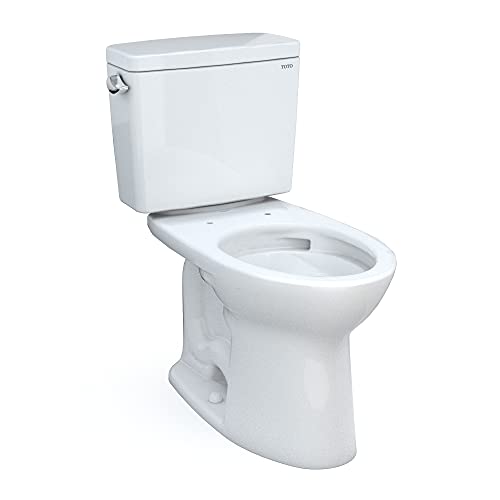
The Drake II is the clearest argument for choosing elongated over round: an 18-inch oval bowl with Double Cyclone siphon flushing that achieves a full 1,000 grams on MaP at 1.28 GPF, certified by EPA WaterSense, with TOTO's CeFiONtect glaze on every bowl surface to resist staining and buildup.
The Drake II's Double Cyclone system uses two rim nozzles rather than the traditional rim holes to send two powerful water streams around the bowl in a cyclonic pattern, producing a full bowl wash and a strong siphon with 1.28 gallons. Owner reviews consistently note that the bowl stays clean between scrubs and that the flush handles heavy loads without repeated cycling. The elongated bowl here is genuinely roomier than the round Drake, and the CeFiONtect glaze means that extra bowl surface stays cleaner with less effort than an unglazed competitor.
TOTO manufactures the Drake II in both standard and comfort height, with elongated as the dominant configuration and round available in standard height only. Comfort height elongated is the version most buyers choose for primary bathrooms. If you also want TOTO's WASHLET bidet seat compatibility, the elongated bowl is required for every WASHLET model TOTO produces, making it the functionally necessary shape for that upgrade path.
The Drake II elongated comfort height is the strongest single recommendation for anyone who can confirm their bathroom fits an elongated bowl. The 1,000-gram MaP score, WaterSense certification, CeFiONtect glaze and WASHLET compatibility add up to a toilet that outperforms models costing significantly more. Measure your clearance, confirm it fits, and stop shopping.

The UltraMax II brings the same Double Cyclone siphon and 1,000-gram MaP score as the Drake II into a seamless one-piece elongated body, combining the comfort of an 18-inch oval bowl with the cleaning simplicity of a single-unit design that eliminates the tank-to-bowl seam.
The UltraMax II is the one-piece counterpart to the Drake II, using the same Double Cyclone two-nozzle rim jets and identical flush performance but fusing the tank and bowl into a single vitreous china casting. The seam between tank and bowl on a two-piece toilet is one of the harder spots to clean, and eliminating it is the core value proposition here. Aggregated owner reviews strongly praise the ease of wiping down the seamless exterior, particularly in households where the main bathroom gets daily attention.
The elongated bowl on the UltraMax II measures 18 inches from bolt holes to front rim and sits at comfort height. TOTO finishes it with CeFiONtect glaze on all bowl surfaces, which the brand claims creates a smoother, more particle-resistant surface than standard vitreous china. In practice, owner reviews corroborate that claim at the aggregate level, noting the bowl stays visibly cleaner between uses than previous unglazed models they owned. The trade-off over the Drake II is weight during install and the slightly higher price.
The UltraMax II is the right pick when you want the Drake II's flush numbers and a faster cleaning routine, and you have a helper or a plumber handling the install. If you are doing it solo and weight is a concern, drop back to the two-piece Drake II without losing a single gram of flush performance.

American Standard's Champion 4 elongated uses a 4-inch flush valve and a 2.375-inch fully glazed trapway, both notably larger than the industry norm, to achieve 1,000 grams on MaP at 1.6 GPF, making it the elongated bowl choice for households that experience frequent clogs or move heavy waste loads.
The Champion 4's defining feature is its oversized flush valve. Most toilets use a 2 or 3 inch valve; the Champion 4 opens a 4-inch flapper, releasing water faster and more forcefully, which translates to a powerful siphon that clears the trapway completely in one flush. American Standard pairs that valve with a 2.375-inch fully glazed trapway, the widest in the standard gravity-flush category, which allows solid waste to pass without restriction. Owner reviews consistently report that this toilet does not clog, even in households that previously replaced toilets specifically because of chronic clogging.
The elongated bowl here runs at a genuine comfort height and is sized to accommodate standard elongated bidet seats and comfort-height accessories. One honest trade-off: the Champion 4 uses 1.6 GPF rather than 1.28, which means it is not EPA WaterSense certified and uses about 25 percent more water per flush than the TOTO Drake II. For households where clog prevention outweighs water savings, it remains one of the most reliable elongated choices in its price category. The Cadet 3, American Standard's other flagship, is available in elongated at 1.28 GPF with WaterSense certification for buyers who want the brand's proven quality at lower water use.
The Champion 4 elongated is the right answer for one specific situation: a household that has clogged multiple previous toilets and wants a mechanical solution rather than plunger practice. In every other scenario, the TOTO Drake II's 1.28 GPF and identical MaP score is the more balanced choice.

The Kohler Highline round-front is the most proven compact-bowl toilet on the market: Kohler's Class Five flush system achieves high MaP scores at 1.28 GPF with WaterSense certification, all in a 16.5-inch bowl that saves the roughly 2 inches of floor depth that makes the difference in tight bathrooms.
The Highline is Kohler's workhorse model and has been in continuous production long enough that installer reviews are extremely consistent: reliable flushing, straightforward installation and solid parts availability for repairs. The Class Five flush system uses a large 3.25-inch canister valve that delivers water rapidly to the bowl, generating a powerful siphon that owner reviews consistently describe as quiet and complete. At 1.28 GPF with WaterSense certification, the Highline round is one of the most water-efficient compact-bowl toilets available.
Kohler sells the Highline in round and elongated versions, both using the same Class Five flush. Choosing round saves about 2 inches of floor depth without any flush penalty, which is exactly the trade you are making. The round bowl is well-suited to children's bathrooms because the smaller 16.5-inch opening is scaled more appropriately to a child's body, and the lower price point of the round version versus the elongated makes it a sensible choice for secondary and rental bathrooms where premium comfort is less critical than budget and footprint.
The Highline round is the textbook answer when space forces your hand to round: same flush, lower profile, and a brand with a repair-parts supply that will outlast most owners' tenure in a home. Do not overthink it. If the tape measure says round, this is the one.
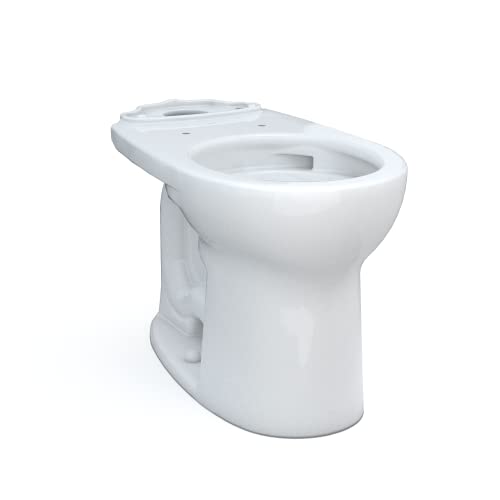
The TOTO Drake in round configuration is the definitive proof that bowl shape does not control flush performance: the same G-Max flush system that achieves up to 1,000 grams on MaP in the elongated Drake functions identically in the round version, at a slightly lower price point and with a smaller floor footprint.
The Drake is TOTO's entry point into the G-Max flush system, which uses a large flush valve and a wide-diameter trapway coated in CeFiONtect glaze to generate a powerful siphon and resist buildup inside the trap. In the round configuration, the Drake uses the standard-height bowl at roughly 15 inches, which is appropriate for most general-purpose secondary bathrooms. Owner reviews of the round Drake mirror those of the elongated version in flush reliability and low maintenance, confirming once again that bowl shape does not move the performance needle in this line.
One honest note: the Drake round in its most common configuration uses 1.6 GPF, not 1.28, which puts it outside EPA WaterSense eligibility in that configuration. TOTO does offer a 1.28 GPF Eco Drake configuration that closes that gap. Buyers who want the round Drake and water savings should specifically search for the Eco Drake or the Drake with the E-suffix model designation, which carries the lower GPF and the WaterSense certification. The flush system is the same; only the tank fill volume differs.
The Drake round is a compelling value for a second bathroom or a rental where you want TOTO's flush system and bowl glaze without the elongated footprint or the Drake II price. Specify the Eco configuration at 1.28 GPF to get WaterSense certification and save a meaningful amount of water over the fixture's lifetime.

The Woodbridge T-0001 in round configuration offers a fully skirted one-piece design with a dual-flush system (1.0 and 1.6 GPF), bringing a modern seamless look and easy exterior cleaning to the compact round footprint, at a price that undercuts TOTO and Kohler comparably spec'd models.
Woodbridge has built a strong reputation for delivering skirted one-piece designs at substantially lower prices than TOTO or Kohler skirted models, and the T-0001 round is one of their most accessible options. The dual-flush push-button mechanism on top of the tank lets users select a 1.0 GPF partial flush for liquid waste or a 1.6 GPF full flush for solid waste, which produces real water savings in households that use the light flush consistently. The fully skirted exterior, with a smooth vertical panel hiding the trapway curves, makes wiping down the outside of the bowl as fast as it is with any one-piece design.
Aggregated owner reviews note that the Woodbridge T-0001 flushes reliably and looks premium for the category, but a small number of owners report that the internal flush mechanism needed adjustment within the first year of use. Woodbridge's 1-year warranty covers this, and the T-0001's straightforward dual-flush internals are among the simpler to service within the skirted one-piece category. For buyers who want the company's round skirted design with a different configuration, the T-0019 offers the same skirted body in elongated.
The T-0001 round is worth considering in the specific case where you need a compact footprint and a modern skirted look, and budget rules out TOTO's Santa Rosa or Kohler's Santa Rosa equivalents. Just keep the 1-year warranty window in mind and test the flush mechanism thoroughly in the first few weeks.
After comparing six strong models across both bowl shapes, the pattern is clear: the bowl shape you choose should be dictated by your floor plan and your household, not by flush ambitions. Measure first, then pick the shape. Once the shape is locked, choose the specific model based on MaP score, GPF rating, WaterSense certification and trapway design. The elongated Drake II and the round Kohler Highline represent the best value at their respective use cases, and both outperform what their price suggests. If you have specific structural or accessibility constraints, see the full buying context in our one-piece vs two-piece comparison and our complete toilet buying guide.
A structured decision process that handles the most common situations. Follow these steps in order rather than skipping to the bowl-shape choice.
Measure from the finished wall behind the toilet to the nearest obstacle in front of the toilet, whether that is a door, a vanity, a cabinet or the opposite wall. Standard guidelines recommend a minimum of 24 inches of clear space in front of a toilet, though 30 inches is more comfortable. A round bowl will project roughly 27 to 28 inches from the finished wall on a standard 12-inch rough-in. An elongated bowl will project roughly 29 to 30 inches. If your measurement leaves less than 24 inches of clearance in front of an elongated bowl, choose round.
If the bathroom is a primary adult bathroom, elongated is almost always the right answer on comfort alone, assuming step 1 permits it. If the bathroom is primarily a children's bathroom, a powder room for guests, or a secondary bathroom used briefly, round is a legitimate and practical choice. If the bathroom needs to serve someone with mobility limitations, choose elongated paired with comfort height as a default unless your space assessment rules it out.
Once you know which bowl shape fits, filter models by EPA WaterSense certification (1.28 GPF or lower) and look up the MaP score at map-testing.com. Aim for 600 grams minimum, 800 grams or above for heavy use. Bowl shape will not appear in the MaP database as a variable, because it is not one. Choose the highest MaP score available in your chosen shape and budget range.
After settling bowl shape, decide on body style. One-piece elongated or round toilets offer easier cleaning and a lower profile at a higher price. Two-piece versions in both shapes cost less and are lighter to install. Flush performance is the same within a model line. For the detailed trade-off, our guide to one-piece vs two-piece toilets covers the decision fully.
If you have 24 or more inches of clear floor in front of the toilet position: choose elongated for comfort. If you have less than 24 inches: choose round, no exceptions. Then pick the specific toilet model by its MaP score, not by brand loyalty or advertising claims about flush power.
MaP (Maximum Performance) is the independent flush-testing protocol that measures how many grams of solid waste a toilet can clear in a single flush without a repeat cycle. Scores are published per SKU and are searchable at map-testing.com. The test was developed in cooperation with water utilities and uses a soybean paste simulant with toilet paper to approximate real waste loads. It is the most widely cited third-party performance measure in the toilet industry and the most reliable way to compare flush strength across brands without relying on manufacturer marketing claims.
The score thresholds that matter in practice: 500 grams is the minimum many utilities recommend for approval in water-efficiency programs. 600 grams handles average single-adult use reliably. 800 grams is the threshold most plumbers and reviewing organizations use to define "strong" flushing. 1,000 grams, the test maximum, means the toilet cleared the largest waste load the MaP test delivers in a single flush with no failures. Models that reach 1,000 grams include the TOTO Drake (both bowl shapes), TOTO Drake II (elongated), TOTO UltraMax II (elongated), American Standard Champion 4 (elongated), Gerber Viper (elongated) and Gerber Avalanche (both shapes). The Kohler Highline, Cimarron and Memoirs consistently post 800-plus gram scores. If clog resistance and heavy-duty flushing are key, start the model search at 800 grams and only consider lower scores for light-use secondary bathrooms.
Within a model line, the round version typically carries a modest price advantage over the elongated version. The gap is usually narrow, but it does exist consistently across TOTO, Kohler, American Standard, Gerber and Woodbridge. For secondary bathrooms, rentals, or spaces where the round bowl is the correct fit, that savings is real and the flush performance trade-off is zero. For primary bathrooms where the floor space exists for elongated, paying the small premium for the longer bowl is justified by the daily comfort benefit over years of use.
Value is also a function of total cost of ownership. Both bowl shapes in the same model line use the same internal components, so parts availability and repair costs are identical. A toilet that reaches a 1,000-gram MaP score and uses 1.28 GPF delivers its value over a decade of reliable performance, regardless of whether it is round or elongated. The worst value outcome is choosing the wrong shape for the space, then replacing the toilet earlier than expected because the clearance was too tight or the comfort was consistently inadequate. Measure first, buy once. Our full breakdown of specs, certifications and models for every use case is in the complete guide to choosing a toilet.
Choose elongated if your bathroom gives you at least 24 inches of clear space in front of the toilet and adults use it daily. The TOTO Drake II elongated is the best all-around choice: 1,000-gram MaP, 1.28 GPF, WaterSense certified, CeFiONtect glaze, WASHLET ready. Choose round only when your floor plan forces the issue: the Kohler Highline round is the most dependable compact-bowl option, with Class Five flushing, WaterSense certification and Kohler's proven parts support. Both shapes flush equally hard in the same model line. The bowl shape determines comfort and footprint, never flush power. Measure your bathroom first, choose your shape second, and then let the MaP score and GPF rating decide the model.
A round bowl measures approximately 16.5 inches from the center of the floor bolt holes to the outermost point of the front rim. An elongated bowl measures 18 to 18.5 inches along the same axis. That is a difference of roughly 1.5 to 2 inches, which affects how far the front of the toilet projects into the room, not the width or the height of the fixture.
No. Flush power is determined by the flush valve diameter, the tank water volume and the trapway diameter, none of which change with bowl shape. The round and elongated versions of the same toilet line use the same tank and flush system and post the same MaP scores. Bowl shape is a comfort and footprint decision, not a flush decision.
Elongated bowls are more comfortable for most adults. The 18 to 18.5 inch oval provides a larger seating surface that supports more of the thigh and distributes body weight more evenly, which most adults find noticeably more comfortable than the smaller 16.5 inch round bowl. The difference is most pronounced for taller and larger adults and for daily primary bathroom use.
Round is better for small bathrooms. A round bowl projects about 2 inches less into the room than an elongated bowl on the same rough-in. In a bathroom where front clearance is limited, a powder room, a half bath or a tight basement bathroom, that 2 inches can determine whether a door swings freely or whether there is enough standing room in front of the toilet.
Yes. Water use is set by the flush system and tank fill volume, not the bowl shape. The round and elongated versions of a model line use the same tank and post the same GPF rating. Both can be EPA WaterSense certified when they meet the 1.28 gallon per flush efficiency standard. Bowl shape has no bearing on the water consumption figure.
Usually yes, as long as the rough-in distance matches and there is enough floor depth in front of the toilet for the longer bowl. Most toilets use a 12-inch rough-in. Measure the available clearance from the wall to any door, vanity or opposite wall, confirm an elongated bowl fits, and verify the rough-in before ordering. An elongated bowl projects about 2 inches further into the room than the round model it replaces.
Elongated bowls have a marginal interior cleaning advantage because the oval shape has fewer tight corner angles. However, the bigger cleaning factors are a fully glazed trapway such as TOTO's CeFiONtect, a rimless bowl design and a skirted exterior, none of which are specific to bowl shape. Focus on those features for cleaning ease rather than round versus elongated.
Elongated bowls are the standard recommendation for ADA and accessible bathrooms, particularly when paired with a comfort-height seat of 17 to 19 inches. The larger seating surface is easier to transfer onto and rise from, and the elongated shape is the industry default for aging-in-place and accessibility-focused toilet specifications. The ADA specifies seat height, not bowl shape, but elongated is the practical industry standard for that application.
The toilet itself carries a modest price premium for elongated over round within the same model line. Replacement seats and bidet seats are also available in a wider range of styles and price points for elongated bowls because elongated is the more common format. Round seats are widely available too, but premium bidet seat options are fewer in round than elongated.
No. The rough-in distance from the finished wall to the center of the floor drain bolts is identical for round and elongated versions of the same toilet. Standard rough-in is 12 inches, and both bowl shapes are available in that configuration, as well as 10 or 14 inch rough-ins for some models. Only the front projection of the bowl changes with shape.
Round bowls are often a better fit for young children because the smaller 16.5-inch opening is more proportional to a child's body, making the toilet feel more secure and less intimidating. For a bathroom used primarily by young children, a round, standard-height toilet is the most practical specification. Families with both adults and children often choose elongated for the main bathroom and round for a secondary kids' bathroom.
Aim for at least 600 grams for light-use bathrooms and 800 grams or above for primary or heavy-use bathrooms. Scores up to 1,000 grams are achievable in both round and elongated configurations. Verify the MaP score at map-testing.com by looking up the specific model number, since the score is published per SKU and applies equally to both bowl-shape variants of a line.
No. Seat height, whether standard at around 15 inches or comfort height at 17 to 19 inches, is independent of bowl shape. You can find round and elongated toilets in both standard and comfort height. The two decisions, bowl shape and seat height, should be made together but are governed by different factors: shape by floor clearance, height by user needs and accessibility requirements.
No. Toilet seats must match the bowl shape. A round bowl requires a round seat, and an elongated bowl requires an elongated seat. An elongated seat will not align correctly on a round bowl and will overhang the front in a way that is unstable and uncomfortable. Always confirm the bowl shape before ordering a replacement seat, bidet seat or soft-close seat lid.
Most major lines offer both shapes, though premium and designer models sometimes come only in elongated. TOTO, Kohler, American Standard, Woodbridge, Gerber, Swiss Madison and Gerber all offer round and elongated configurations across their core model lines. The round version is typically the lower-priced, smaller-footprint option, and the elongated is the wider-comfort default for primary bathrooms.
Elongated bowls have the widest bidet seat compatibility. Most electronic bidet seats, including TOTO WASHLET models and offerings from brands like Brondell and BioBidet, are designed primarily for elongated bowls with round versions offered selectively. If a bidet seat is part of your plan, confirm the elongated bowl fits your bathroom clearance before you commit, since almost every bidet seat upgrade path runs more smoothly on an elongated bowl.
Measure from the finished wall behind the tank location (not the rough-in distance, but the finished wall surface) to the nearest obstacle in front of the toilet position, whether that is a swinging door, a vanity cabinet or the opposite wall. The front of an elongated bowl on a standard 12-inch rough-in will typically land about 29 to 30 inches from the finished back wall. If less than 24 inches of clear floor remains after that projection, choose round.
Neither shape has a clear impact on home resale value by itself. Buyers and appraisers pay more attention to overall bathroom condition, fixture age and water efficiency than to bowl shape. In a primary bathroom, an elongated comfort-height toilet is the expected norm in modern construction, so installing one does not raise eyebrows. A round toilet in a primary bathroom is unlikely to hurt resale, but an elongated choice is more universally expected.
Learn why toilet trapways curve like an S, how each bend blocks sewer gas, and what the shape means for clogs and…
Read the guideAlmost every US toilet has a left-side handle. Learn the plumbing and mechanical reasons behind the layout and when it actually changes.
Read the guideHome toilets rely on tanks because household water lines lack the pressure that public flushometer systems use to flush straight from the…
Read the guide