
Best English Bathroom Vanities (2026)
Bathroom Remodeling4.6
Painted shaker-front cabinets in soft sage, navy and cream with polished brass or nickel hardware, bringing understated country-house elegance to a bathroom…
Read the guideFurniture-style cabinetry, raised-panel doors, and turned-leg detailing built to anchor a bathroom around a timeless silhouette.
Research updated June 2026.
The Kohler Damask 36-Inch Vanity is the strongest traditional bathroom vanity for most buyers: a furniture-style cabinet with raised-panel doors, solid wood face frame construction, and a coordinated marble or quartz top option in a warm, classic finish.
Traditional bathroom vanities favor furniture-style cabinetry with raised-panel doors, turned or tapered legs, decorative molding, and warm wood finishes like espresso, cherry, or antique white over the flat-front, handle-less cabinets common in modern vanity design. The goal is a vanity that reads as a standalone piece of furniture rather than a built-in fixture.
This guide covers traditional-style vanity cabinets in the 24 to 60 inch range from Kohler, American Standard, and Kingston Brass, along with guidance on pairing countertop material and sink style. If you are renovating a full bathroom, see our best flushing toilets guide for a matching traditional-style toilet.
A traditional bathroom vanity uses raised-panel or beadboard cabinet doors, turned or tapered furniture legs (or a furniture-style toe kick), decorative crown or base molding, and a warm wood-tone or painted finish such as espresso, cherry, or antique white. The overall design references freestanding furniture pieces repurposed as bathroom cabinetry, a look that predates the built-in vanity cabinet standard in most modern homes.
Solid wood face frames with plywood cabinet boxes are the construction standard for quality traditional vanities, offering better long-term moisture resistance and structural stability than particleboard or MDF-only construction. Check whether the vanity specifies solid wood doors versus wood-veneer over MDF doors, since veneer construction is more prone to swelling at exposed edges in humid bathroom environments over many years.
Traditional vanities pair most naturally with natural stone (marble, granite) or engineered quartz countertops with a traditional edge profile, such as a bullnose, ogee, or beveled edge, rather than the flat, minimal edges common on modern vanity tops. Marble is the most historically accurate choice for traditional design but requires periodic sealing to resist staining; quartz offers comparable classic aesthetics with lower maintenance requirements.
Traditional vanities are most commonly paired with a drop-in oval vitreous china sink or an undermount oval sink, both covered in our traditional bathroom sinks guide. Vessel sinks, while popular in transitional and contemporary vanity styling, are less commonly paired with strict traditional cabinetry, since a vessel sink's raised profile can visually clash with a vanity's classic proportions.
Traditional vanities range from compact 24 to 30 inch single-sink cabinets suited to powder rooms and secondary bathrooms up to 60 to 72 inch double-sink cabinets for primary bathrooms. Drawer and door configuration varies significantly between models; buyers prioritizing storage should confirm the specific drawer count and depth rather than assuming based on overall cabinet width alone.
| Model | Style Fit | Key Spec | Best For | Check Price |
|---|---|---|---|---|
| Kohler Damask 36-Inch Vanity | Traditional raised-panel, single sink | Solid wood frame, marble/quartz top | Best overall traditional vanity | Check price |
| Kingston Brass Wilshire 30-Inch Vanity | Traditional single-door, compact | Solid wood face frame | Powder rooms and small bathrooms | Check price |
| Kohler Tresham 60-Inch Double Vanity | Traditional double-sink | Solid wood frame, quartz top | Primary bathrooms, two-person use | Check price |
| American Standard Colony 30-Inch Vanity | Traditional value-tier | Wood-veneer frame | Budget-friendly traditional vanity | Check price |
| Kingston Brass Copenhagen Console Vanity | Traditional open-shelf console | Solid wood, open base shelf | Smaller bathrooms wanting airy footprint | Check price |
| Kohler Verdera Traditional Framed Mirror Cabinet | Traditional companion piece | Solid wood frame, mirrored door | Pairing storage above a vanity | Check price |

The Damask combines raised-panel doors, a solid wood face frame, and turned bun feet with a coordinated marble or quartz top option, delivering the most complete furniture-style traditional vanity package at 36 inches wide.
The Damask's raised-panel doors and turned bun feet are the most recognizable traditional design cues in Kohler's vanity lineup, giving the cabinet a genuine furniture presence rather than a built-in cabinetry look. The face frame is solid wood rather than a veneer overlay, which holds up better to humidity swings over a bathroom's decade-plus service life.
Because the Damask is offered in multiple widths within the same design language, larger primary bathrooms can select a 48-inch or wider version while powder rooms use the 24-inch variant, maintaining stylistic consistency throughout a home with multiple bathrooms.
Solid wood face frame construction is the single most important durability indicator in a traditional vanity, since face frames absorb the most repeated stress from door and drawer use over years of daily operation. The Damask's solid wood frame is a meaningful upgrade over cabinets using MDF or particleboard face frames.

The Wilshire delivers raised-panel door styling and a solid wood face frame at 30 inches wide, a practical footprint for powder rooms and guest bathrooms where floor space is limited but a genuine traditional look is still a priority.
Compact traditional vanities like the Wilshire prove furniture-style detailing is not exclusive to large primary bathroom cabinets. The 30-inch width fits most powder room and secondary bathroom footprints while still delivering raised-panel doors and a solid wood frame.
Owner reviews consistently highlight the antique white finish as a strong pairing with pedestal-adjacent traditional sink styling, since the lighter finish reads as classic without the heavier visual weight of darker espresso tones in smaller rooms.
In a compact bathroom, cabinet finish color has an outsized visual impact relative to the room's total square footage. Lighter traditional finishes like antique white tend to keep smaller powder rooms feeling proportionate, while still delivering full traditional detailing.

The Tresham 60-inch delivers full double-sink capacity with a solid wood frame, raised-panel doors, and a quartz top option, built for primary bathrooms where two people need simultaneous counter and storage space.
Double-sink traditional vanities require adequate bathroom width to avoid crowding, generally at least 66 to 72 inches of wall space to allow comfortable clearance around both sink positions and any adjacent fixtures.
The Tresham's four-drawer configuration is a genuine practical advantage for two-person households, allowing each user a dedicated drawer rather than sharing limited storage, a detail that owner reviews consistently rate as a top satisfaction driver in double-vanity purchases.
Double vanities are frequently purchased primarily for the aesthetic of matching sinks, but the real long-term satisfaction driver in owner reviews is dedicated storage per user. The Tresham's four-drawer layout directly addresses this, making it a stronger practical choice than double vanities with shared central storage only.
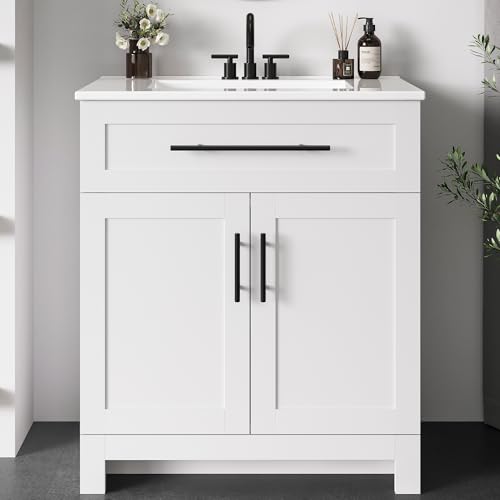
American Standard's Colony vanity brings simplified traditional door paneling to an accessible price point, using a wood-veneer face frame over an engineered wood box, a reasonable trade-off for buyers prioritizing cost over solid wood construction.
Wood-veneer construction is more susceptible to edge swelling in consistently humid environments than solid wood, so this vanity performs best in bathrooms with adequate exhaust ventilation to control moisture buildup after showers.
The included cultured marble top kit is a genuine convenience for budget renovations, removing the separate countertop sourcing and fabrication step that solid wood traditional vanities typically require.
For a rental property or short-term-ownership renovation, the Colony's lower cost and bundled countertop kit make sense despite the veneer construction trade-off. For a long-term primary residence, the added cost of solid wood construction is a worthwhile investment against future moisture-related repairs.

The Copenhagen console vanity uses turned wood legs and an open lower shelf instead of enclosed cabinet doors, giving a lighter visual footprint than a fully enclosed traditional vanity while still delivering a solid wood construction and classic silhouette.
An open-shelf console vanity trades enclosed storage for visual lightness, a deliberate choice for bathrooms where floor space feels tight and a fully boxed cabinet would visually dominate the room. Turned wood legs are a strong traditional design cue on their own, independent of door paneling.
Owner reviews note that open-shelf storage requires more intentional organization, since baskets or bins are typically needed to keep the open shelf from looking cluttered, an additional purchase to budget for during installation.
Open-console traditional vanities work best in bathrooms with a separate linen closet or medicine cabinet handling the bulk of storage needs, since the open shelf alone rarely replaces the storage capacity of an enclosed cabinet vanity.

Kohler's traditional framed medicine cabinet uses a wood frame surround matching the profile of raised-panel vanity doors, providing recessed or surface-mount mirrored storage that completes the traditional vanity wall without introducing a mismatched modern frame.
A mismatched mirror or medicine cabinet above an otherwise well-chosen traditional vanity is a common and easily avoidable styling error. Selecting a frame profile and finish that matches the vanity's door style closes this gap and completes the intended traditional look.
Recessed mounting requires confirming wall cavity depth (typically at least 3.5 inches for standard stud depth) before purchase; surface-mount versions avoid this constraint but project further from the wall.
Coordinating the medicine cabinet frame with the vanity door style is one of the most overlooked but visually impactful details in a traditional bathroom renovation. A mismatched modern mirror above a raised-panel vanity undercuts the cohesive classic look the vanity itself was chosen to deliver.
Solid wood face frames use actual wood boards for the cabinet's structural front frame, offering better long-term moisture resistance and structural stability. Wood-veneer construction applies a thin wood layer over MDF or particleboard, which is more prone to swelling at exposed edges in humid bathroom environments over many years, though it is typically less expensive.
Natural stone (marble, granite) or engineered quartz with a traditional edge profile such as bullnose, ogee, or beveled pairs most naturally with traditional vanity cabinetry. Marble is the most historically accurate choice but requires periodic sealing, while quartz offers comparable classic aesthetics with lower maintenance.
A double-sink vanity typically requires at least 66 to 72 inches of wall width to allow comfortable clearance around both sink positions without crowding adjacent fixtures. Always measure your specific bathroom layout before selecting a double-sink vanity.
It varies by manufacturer and model. Some traditional vanities are sold as a complete kit with a matching cultured marble or quartz top included, while others sell the cabinet and countertop separately, allowing buyers to select a custom stone top from a local fabricator.
A drop-in oval vitreous china sink or an undermount oval sink pairs most naturally with traditional vanity cabinetry. Vessel sinks are less commonly paired with strict traditional cabinetry since their raised profile can visually clash with a vanity's classic proportions.
A raised-panel door has a center panel that sits slightly higher than the surrounding frame, creating dimensional shadow lines. It is one of the most recognizable traditional cabinetry details, as opposed to the flat, single-plane slab doors common in modern cabinetry.
In most cases, yes, as long as the new vanity's cabinet depth and sink/faucet hole positions are compatible with the existing supply and drain rough-in locations. Always compare the new vanity's specifications against the existing plumbing layout before purchase.
A console vanity rests on decorative legs with an open lower area instead of enclosed cabinet doors, giving a lighter visual footprint. It sacrifices enclosed storage for a more furniture-like, airy appearance, and is a good fit for smaller bathrooms or those with separate storage elsewhere.
Select a mirror or medicine cabinet with a wood frame profile and finish color that matches the vanity's door style and finish. Coordinated collections from the same manufacturer, such as Kohler's traditional framed medicine cabinets, are designed specifically to pair with matching vanity lines.
An exhaust fan rated for the bathroom's square footage, run during and for at least 20 minutes after showers, is the primary defense against humidity damage to wood vanity cabinetry. Bathrooms with wood-veneer vanities benefit even more from consistent ventilation than those with solid wood construction.
Standard bathroom vanity cabinets are 32 to 34 inches tall before the countertop is added, with comfort-height vanities reaching 36 inches to match standard kitchen counter height. Traditional vanities are more commonly found at the standard 32 to 34 inch range, consistent with historical fixture proportions.
For most primary bathrooms, the Kohler Damask 36-inch vanity delivers the best combination of solid wood construction, raised-panel styling, and turned-leg detailing. Powder rooms and secondary bathrooms are well served by the compact Kingston Brass Wilshire, while two-person primary bathrooms should look to the Kohler Tresham 60-inch double vanity. In every case, confirm cabinet construction (solid wood versus veneer), countertop material, and sink hole spread compatibility before finalizing a purchase.
How we rank & our data sources
We do not run physical lab tests. Rankings are built from published, verifiable data and real owner feedback, never paid placement.
Researched by admin · Last updated July 3, 2026 · Our review method
Painted shaker-front cabinets in soft sage, navy and cream with polished brass or nickel hardware, bringing understated country-house elegance to a bathroom…
Read the guide
French bathroom vanities lean on ornate carved detailing, cabriole or turned legs, marble tops and polished brass or gold hardware rather than…
Read the guideBlack or greenish growth on the cabinet floor under a bathroom sink almost always comes from one of three sources: condensation dripping…
Read the guide