Bathroom Vanity Buying Mistakes to Avoid
Bathroom Remodeling4.6
The vanity that looks perfect online can still fail once it reaches your bathroom. Here are the measurement, plumbing, and planning mistakes…
Read the guideA primary bathroom vanity anchors the room's daily routine and its storage, which is why size, double-sink capacity, and drawer organization matter here more than in any other bathroom in the house. We compared real vanity dimensions, materials, and configurations to find the options built for a primary bathroom's daily demands, from a compact 48-inch single-sink unit to a full 72-inch double vanity.
Research updated June 2026.
A 60-inch double-sink vanity with a quartz countertop is the best overall configuration for most primary bathrooms shared by two people, giving each person their own basin and enough drawer storage for separate daily routines. A 48-inch single-sink vanity is the right call for a primary bathroom used by one person or with limited floor space, and a floating vanity is the top choice for a primary bathroom that wants a modern, visually open look.
A primary bathroom vanity carries more daily weight than a vanity anywhere else in the house. It stores the toiletries, skincare products, and grooming tools used every morning and night, and if it is shared by two people, its layout directly determines whether getting ready together is easy or a constant negotiation over counter space and drawers. That makes vanity selection for a primary bathroom less about matching a guest bathroom's simple, low-maintenance choice and more about genuinely planning for daily storage and workflow.
Because of that daily-use pattern, we weighted size and storage configuration above nearly everything else for this list. A double-sink vanity, generally 60 inches or wider, is the standard upgrade for a primary bathroom shared by two adults, since it gives each person a dedicated basin and drawer space rather than requiring shared access to a single sink. A single-sink vanity still makes sense for a primary bathroom used by one person, a smaller footprint room, or a household that prefers to prioritize counter space over a second basin. For sink options to pair with any of these vanities, see our best sinks for a primary bathroom guide.
A primary bathroom vanity benefits most from generous drawer and cabinet storage paired with a countertop material like quartz or granite that resists daily wear from skincare products and grooming tools. If the bathroom is shared by two people, a double-sink configuration of 60 inches or wider is the standard upgrade, giving each person a dedicated basin and storage space.
A 60 to 72-inch double-sink vanity is the standard size for a primary bathroom shared by two adults, giving each person roughly 30 to 36 inches of basin and counter space. A single-sink vanity between 36 and 48 inches works well for a primary bathroom used by one person or a smaller room where floor space is limited.
Quartz and granite are the best countertop materials for a primary bathroom vanity because both resist staining, scratching, and heat damage from daily use of hair tools, skincare products, and grooming items. Quartz is nonporous and never needs sealing, while granite offers a natural stone look but benefits from periodic resealing to maintain its stain resistance.
Seven real vanity configurations chosen for daily storage capacity, durability, and style in a primary bathroom.
| Vanity Type | Best For | Key Spec | Notes | Check Price |
|---|---|---|---|---|
| 60-Inch Double-Sink Vanity with Quartz Top | Best overall for two-person use | 60 in, quartz counter, two basins | Dedicated storage and basin per person | Check price |
| 48-Inch Single-Sink Vanity | Best for one-person or smaller rooms | 48 in, single basin | Generous storage without a double-vanity footprint | Check price |
| Floating Wall-Mount Double Vanity | Best modern open look | 60 in, wall-mounted, two basins | Visually opens a primary bathroom floor | Check price |
| 72-Inch Double-Sink Vanity with Granite Top | Best maximum storage | 72 in, granite counter, two basins | Largest footprint, most drawer space | Check price |
| 36-Inch Vanity with Full-Extension Drawers | Best compact single-sink storage | 36 in, full-extension drawers | Fits smaller primary bathrooms | Check price |
| Furniture-Style Double Vanity | Best traditional design statement | 60 in, furniture-style legs and detailing | Suits a higher-end traditional primary bath | Check price |
| Budget Vanity Combo with Mirror | Best budget upgrade | Varies, includes sink and mirror | Lower cost complete vanity package | Check price |
Each pick is ranked on daily storage capacity and durability first, then style and footprint.
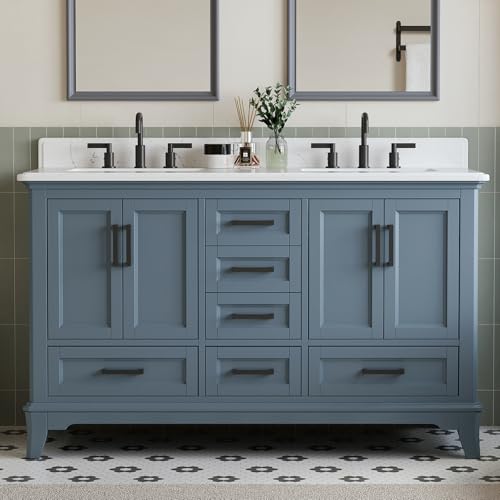
A 60-inch double-sink vanity with a quartz countertop is the best overall configuration for a primary bathroom shared by two people, giving each person a dedicated basin and enough drawer storage for separate routines.
A 60-inch double-sink vanity is the standard upgrade for a primary bathroom shared by two adults because it solves the single biggest daily friction point: two people needing counter space, storage, and a sink at the same time. Each basin sits roughly 28 to 30 inches from the other, giving enough separation that two people can get ready simultaneously without bumping elbows.
Quartz is the countertop material we recommend most for this configuration because it is nonporous and never needs sealing, unlike natural stone, which matters given how much daily contact a primary bathroom counter sees from skincare products, hot styling tools, and grooming items. The multiple drawers and cabinet doors typical of a 60-inch vanity give each person their own dedicated storage zone, reducing the daily hunt for shared items.
For a primary bathroom used by two people, this is the configuration we recommend as the default starting point. The dedicated basin and storage per person is the detail that resolves more daily friction than almost any other bathroom decision, and quartz is worth the upgrade over laminate for how much daily wear this counter takes.

A 48-inch single-sink vanity is the right call for a primary bathroom used by one person or with limited floor space, delivering generous storage without a double-vanity footprint.
Not every primary bathroom needs, or has room for, a double-sink vanity. A 48-inch single-sink vanity gives a genuinely generous amount of counter space around one basin, more storage than a compact 36-inch model, while fitting into primary bathrooms where a full 60-inch double vanity would crowd the room or block a door swing.
For a primary bathroom used by one person, or a couple with staggered morning schedules who do not need simultaneous sink access, a well-sized single-sink vanity is often the more practical and cost-effective choice. The extra width beyond a basic 30-inch vanity leaves real room for a tray of skincare products or a hair dryer without cluttering the sink area.
We recommend a 48-inch single-sink vanity over a cramped double vanity whenever the primary bathroom's floor plan is tight. A generously sized single sink with real counter space beats a double vanity that leaves both people elbow to elbow.

A floating wall-mount double vanity gives a primary bathroom a modern, visually open look while still delivering two-sink daily functionality for a shared bathroom.
A floating vanity mounts directly to the wall with no cabinet base touching the floor, which makes a primary bathroom feel noticeably larger and more open, especially in a room with a smaller footprint. Because the floor beneath it is fully visible and accessible, cleaning is also faster than working around and under a traditional floor-standing cabinet base.
Despite the visually lighter look, a 60-inch floating double vanity still delivers the same two-basin daily functionality as a floor-standing double vanity, just without the bulk. Installation requires the wall to have blocking rated for the mounted weight, which is worth confirming or adding during a full primary bathroom remodel rather than treating it as a simple retrofit.
For a primary bathroom remodel chasing a genuinely modern, spa-like look, a floating double vanity is one of the most effective single upgrades. It delivers the same daily two-sink function as a floor-standing vanity while making the whole room read as larger and more current.

A 72-inch double-sink vanity is the maximum-storage configuration for a primary bathroom with the floor space to support it, giving each person the most drawer and counter room on this list.
For a primary bathroom with generous wall space, a 72-inch double vanity gives noticeably more separation between the two basins than a standard 60-inch model, roughly 36 to 40 inches apart rather than 28 to 30, which meaningfully reduces the daily crowding two people can feel at a narrower vanity. The extra width also often leaves room for a center section, useful as a seated makeup or grooming station.
Granite brings a natural stone look with distinctive veining that quartz's manufactured consistency cannot replicate, though it does require periodic resealing, typically every one to two years, to maintain its stain resistance against daily skincare and grooming product exposure. For a primary bathroom remodel with the space to support it, a 72-inch vanity is the configuration that maximizes daily storage and comfort.
When a primary bathroom has the wall space, we recommend sizing up to 72 inches rather than settling for a standard 60-inch double vanity. The extra separation between basins and the additional storage genuinely improve the daily experience for two people sharing the room.

A 36-inch vanity with full-extension drawers packs genuine daily storage into a compact footprint, making it the right choice for a smaller primary bathroom that still needs real organization.
The detail that makes this vanity work well for daily use despite its compact size is full-extension drawer hardware, which slides completely out rather than stopping partway, giving full access to everything stored inside rather than forcing you to dig around items at the back. That matters more in a smaller vanity where every inch of storage needs to be genuinely usable.
Soft-close hardware on both the drawers and cabinet doors holds up well to the multiple daily open-and-close cycles a primary bathroom vanity sees, avoiding the loud slam and eventual hardware wear that standard hinges develop over years of daily use. For a compact primary bathroom or an ensuite off a smaller bedroom, this configuration delivers real daily organization without demanding double-vanity floor space.
When a primary bathroom is too small for a double vanity, we look specifically for full-extension drawers rather than assuming any 36-inch vanity will do. The difference in actual daily usability between full-extension and standard drawer slides is significant in a compact footprint.

A furniture-style double vanity brings decorative legs, molding, and traditional detailing to a primary bathroom that wants its vanity to read as a genuine piece of furniture rather than a builder-grade cabinet.
A furniture-style vanity uses decorative turned or tapered legs, applied molding, and hardware detailing borrowed from traditional furniture design, giving a primary bathroom vanity a genuinely finished, high-end look rather than the flat-front, builder-grade appearance of a standard cabinet. For a primary bathroom remodel leaning traditional or transitional, that detail changes how the whole room reads.
Despite the more decorative design, it still functions as a full double-sink vanity with real drawer and cabinet storage, just organized around the furniture-style silhouette rather than a flush modern front. Pairing it with a natural stone countertop like marble or granite completes the traditional, higher-end look many primary bathroom remodels are aiming for.
The furniture-style vanity is what we recommend when a primary bathroom's overall design leans traditional and a flat modern cabinet front would look out of place. It is a genuine design upgrade that still delivers full double-sink daily function.

A budget vanity combo that includes the cabinet, countertop, sink, and mirror in one package is the most affordable way to fully outfit a primary bathroom without pricing out each component separately.
A vanity combo bundles the cabinet, countertop, sink, and a matching mirror into one purchase, which typically costs less than sourcing each piece separately and removes the guesswork of matching finishes across multiple products. For a primary bathroom remodel on a tighter budget, that combination of cost savings and simplified decision-making is a real advantage.
The tradeoff is usually the countertop material: many budget combos use cultured marble, a manufactured material that looks similar to natural stone but is less resistant to scratching and heat than quartz or granite. For a primary bathroom where budget is the top constraint, that tradeoff is often worth accepting in exchange for a complete, coordinated vanity package.
The vanity combo is the sensible answer when a primary bathroom remodel needs a complete vanity and the budget does not stretch to custom or premium-material components. You are trading some countertop durability for real savings and a simpler purchasing decision.
Across all seven configurations, the primary bathroom pattern is consistent: size the vanity to how many people actually use the room daily, prioritize a durable, low-maintenance countertop material like quartz or granite, and choose full-extension, soft-close drawer hardware wherever storage matters. A primary bathroom vanity rewards spending on genuine daily functionality, since it is the fixture that shapes the room's entire morning and evening routine.
The right configuration depends on how many people share the bathroom, your available wall space, and how much you want the vanity to double as a design statement. These checks cover the decisions that matter most.
A 60 to 72-inch double-sink vanity is worth the investment for a primary bathroom shared by two adults, while a well-sized 36 to 48-inch single-sink vanity is often the more practical and cost-effective choice for one person or a smaller room.
Quartz is the most consistently low-maintenance choice, since it is nonporous and never needs sealing. Granite offers a natural stone look but requires periodic resealing, typically every one to two years, to maintain its stain resistance against daily product exposure.
Regardless of vanity size, full-extension drawers that slide completely out give genuine access to everything stored inside, and soft-close hardware holds up better to the multiple daily open-and-close cycles a primary bathroom vanity experiences than standard hinges.
A furniture-style vanity with decorative legs and molding suits a traditional or transitional primary bathroom, while a floating wall-mount vanity suits a modern or minimalist remodel. Choose the style that matches the room's overall design direction rather than selecting the vanity in isolation.
A 60 to 72-inch double-sink vanity is the standard size for a primary bathroom shared by two adults, while a 36 to 48-inch single-sink vanity works well for one person or a smaller room.
Two sinks are the standard upgrade for a primary bathroom shared by two adults, giving each person a dedicated basin. A single, larger sink works well for a primary bathroom used by one person or with staggered schedules.
Quartz and granite are the most durable choices, resisting daily staining, scratching, and heat damage from skincare products and hair tools better than cultured marble or laminate.
Yes, for a primary bathroom remodel wanting a modern, visually open look. It requires wall blocking rated for the mounted weight, so confirm that with a contractor before committing to the design.
A standard 60-inch double vanity places the basins roughly 28 to 30 inches apart, while a 72-inch vanity increases that separation to about 36 to 40 inches, reducing daily crowding for two people getting ready at once.
Full-extension drawers slide completely out of the cabinet rather than stopping partway, giving full access to everything stored inside. This matters most in a compact vanity where every inch of storage needs to be genuinely usable.
Granite countertops typically need resealing every one to two years to maintain their stain resistance, while quartz, being nonporous, never requires sealing.
A furniture-style vanity uses decorative legs, applied molding, and hardware detailing borrowed from traditional furniture design, giving it a more finished, high-end look than a flat-front builder-grade cabinet.
Vanity combos that bundle the cabinet, countertop, sink, and mirror are a cost-effective option for a budget-conscious primary bathroom remodel, though they often use cultured marble countertops that are less durable than quartz or granite.
Yes. A 72-inch double vanity needs a genuinely large primary bathroom to avoid crowding the room and blocking door swings or walkways. Measure the available wall space carefully before sizing up.
No, they do not need to match. A primary bathroom vanity can prioritize size, storage, and durable materials for daily use, while a guest bathroom vanity has more flexibility to focus on cost and space efficiency.
A primary bathroom vanity anchors both the room's daily storage and its overall design, which is why size and countertop durability matter more here than in any other bathroom in the house. A 60-inch double-sink vanity with a quartz top leads for most two-person households, a well-sized single-sink vanity is the smart pick for one person or a smaller room, and a floating vanity delivers the modern, visually open look many primary bathroom remodels are built around.
How we rank & our data sources
We do not run physical lab tests. Rankings are built from published, verifiable data and real owner feedback, never paid placement.
Researched by admin · Last updated July 11, 2026 · Our review method
The vanity that looks perfect online can still fail once it reaches your bathroom. Here are the measurement, plumbing, and planning mistakes…
Read the guide
A small bathroom vanity has to deliver real storage in a fraction of the footprint a primary bathroom gets to work with,…
Read the guide
In Gulf Coast, Florida, Hawaii, and Pacific Northwest bathrooms, ambient humidity attacks a vanity cabinet even when nothing ever splashes on it…
Read the guide