Bathroom Vanity Buying Mistakes to Avoid
Bathroom Remodeling4.6
The vanity that looks perfect online can still fail once it reaches your bathroom. Here are the measurement, plumbing, and planning mistakes…
Read the guideIn Gulf Coast, Florida, Hawaii, and Pacific Northwest bathrooms, ambient humidity attacks a vanity cabinet even when nothing ever splashes on it directly. This guide covers which cabinet core materials actually resist that constant humidity cycling, why ventilation matters as much as the cabinet itself, and how to see past marketing language that calls a coated particleboard vanity "moisture resistant" when the core material has not changed at all.
Research updated June 2026.
For genuinely humid climates, a plywood cabinet box is the realistic minimum, sealed solid wood or marine-grade plywood is the top tier if you can find or special-order it, and moisture-resistant MDF is an acceptable mid-tier when true marine-grade construction is not available. None of these materials substitute for adequate bathroom ventilation -- a good exhaust fan run consistently protects a vanity more than any single material upgrade does on its own.
Humidity attacks a vanity cabinet differently than a direct water spill does. A spill is a single event that either gets wiped up or causes localized damage at one spot. Ambient humidity, the kind that saturates the air in a poorly ventilated bathroom every time someone showers, cycles the entire cabinet through repeated swelling and drying, day after day, for as long as the vanity is in the room. That repeated cycling stresses joints, veneer edges, and finish adhesion in ways a single spill never does, which is why a vanity that survives fine in a dry climate can fail within a few years in a humid one.
This guide covers the cabinet core materials that hold up to that cycling, the ventilation baseline that determines how hard any material has to work, and the hardware and finish details that matter specifically in humid and coastal climates. It pairs with our best toilet for hot humid climate guide and the broader bathroom vanity buying guide.
Ambient humidity causes wood-based cabinet materials to absorb and release moisture continuously as bathroom air fluctuates between a steamy post-shower state and a drier baseline, and this repeated expansion and contraction cycle is what damages joints, veneer edges, and finish adhesion over time, not any single exposure. A cabinet rated "water-resistant" against direct splashes may still perform poorly under this cycling if the underlying core material was never designed for sustained ambient humidity in the first place.
This distinction matters because most retail vanity marketing describes surface-level water resistance, such as a sealed finish that repels a splash, without addressing whether the core material underneath handles months of humidity cycling without swelling at the joints.
"Water-resistant" and "humidity-resistant" are not the same claim, even though marketing often blurs the two. A finish can repel a direct splash perfectly while the particleboard core beneath it still absorbs ambient moisture through the unfinished interior surfaces, drawer boxes, and cut edges that never got sealed during manufacturing.
Marine-grade plywood, built with void-free veneer layers and waterproof adhesive originally developed for boat hulls, is the top-performing cabinet core for humid and coastal climates, but it is rarely used in stock retail vanities and usually requires a custom cabinet shop or marine-supply source. Sealed solid wood, such as teak or cedar finished with a proper multi-coat marine varnish, performs nearly as well but requires periodic re-sealing maintenance as the finish wears. Standard plywood is the realistic and widely available middle ground: its cross-laminated construction resists swelling far better than particleboard, even without a marine-grade rating.
Moisture-resistant MDF, sometimes labeled exterior-grade or moisture-resistant MDF with a wax additive in the core, is a reasonable budget-to-mid-tier option that outperforms standard interior MDF and particleboard, though it still falls short of plywood's structural resistance to swelling. Standard particleboard is the weakest choice for any climate with sustained humidity and should be avoided for vanities in Gulf Coast, Florida, Hawaii, or similarly humid regions regardless of price.
Most "moisture-resistant" claims on mass-market vanities describe a coating or finish applied to ordinary MDF or particleboard, not a genuinely different core material. Read the specification sheet for the actual core material name, such as "plywood" or "moisture-resistant MDF," rather than relying on marketing terms like "water-resistant" alone, which say nothing about the core.
| Cabinet Core | Humidity Performance | Typical Price Tier | Availability |
|---|---|---|---|
| Marine-Grade Plywood | Excellent | Premium, often custom | Rare in stock vanities |
| Sealed Solid Wood | Very Good, needs re-sealing | Premium | Limited, specialty brands |
| Standard Plywood | Good | Mid-Range | Widely available |
| Moisture-Resistant MDF | Fair to Good | Budget to Mid-Range | Common, check specs |
| Standard Particleboard | Poor | Budget | Very common, avoid for humid climates |
Ventilation arguably matters more than cabinet material choice, because even a marine-grade plywood vanity will suffer finish degradation, hardware corrosion, and surrounding mold growth in a bathroom with no functioning exhaust fan, while a mid-tier moisture-resistant MDF vanity in a well-ventilated bathroom can outlast expectations. ASHRAE guidance and most bath fan manufacturers recommend sizing an exhaust fan to at least 1 CFM per square foot of bathroom floor area, with a minimum of 50 CFM even in small bathrooms, and running the fan during the shower and for roughly 20 minutes afterward to fully clear residual humidity.
A bathroom that relies only on opening a window, or on a fan that is undersized or rarely used, will keep ambient humidity elevated for hours after a shower, and every hour of elevated humidity is additional cycling stress on the vanity cabinet regardless of what material it is built from.
Before spending more on a premium cabinet material, check whether the bathroom's exhaust fan is adequately sized and actually gets used consistently. Our bathroom exhaust fan guide covers CFM sizing in detail, and upgrading an undersized or broken fan is often the higher-return fix compared to upgrading vanity material alone.
Stainless steel or solid brass hardware resists the corrosion and pitting that zinc-plated or lower-grade chrome-plated hardware develops under sustained humidity, especially in coastal areas with salt-air exposure. A catalyzed lacquer or two-part conversion varnish finish holds up to ambient humidity better than thermofoil, which can delaminate faster when prolonged humidity combines with heat from a nearby shower or hair tool. Soft-close hinges with corrosion-resistant internal springs are worth confirming in the product specification, since standard steel springs can weaken or seize in consistently humid bathroom air over several years.
These picks emphasize plywood or solid wood construction, catalyzed finishes, and, where relevant, design features that reduce moisture exposure at the cabinet base.

Solid wood and plywood construction with a catalyzed finish gives this vanity better resistance to sustained humidity cycling than MDF or particleboard alternatives at a similar size.
Confirm the exhaust fan is sized and used consistently before relying on cabinet material alone to protect the vanity over the long term.
In consistently humid bathrooms, wipe down the cabinet exterior after showers when practical, especially at the toe kick and lower door edges where condensation tends to settle first.
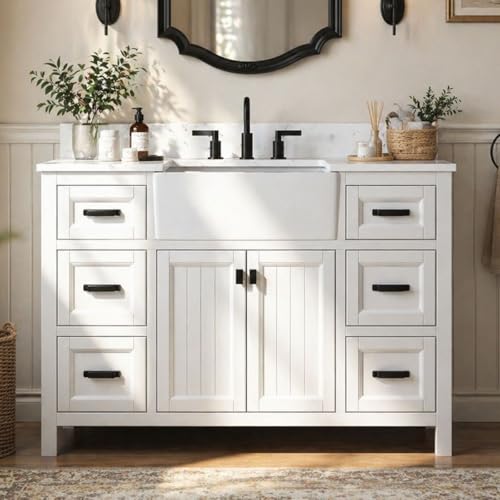
A larger farmhouse-style vanity with solid wood elements, giving primary bathrooms in humid regions more storage without dropping to a weaker particleboard core at this size.
The raised-panel farmhouse door style has more joints than a flat slab door, so confirm the finish is a genuine catalyzed or conversion varnish rather than a single-coat paint, which shows movement cracks at the joints faster in humid cycling.
Furniture-style and farmhouse vanities with decorative legs and corbels need a full interior moisture barrier and consistently finished exterior surfaces, including the toe kick, to perform well long-term in humid climates. Confirm this in the product description before buying.
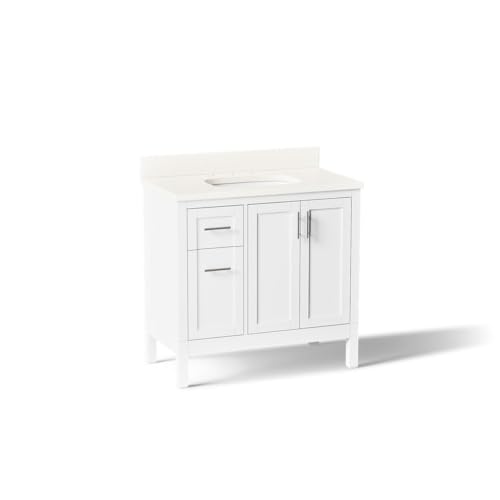
A widely stocked plywood-box vanity that avoids the long lead times and custom-order process that true marine-grade options often require, while still outperforming particleboard alternatives in humid conditions.
For most humid-climate homes outside of extreme coastal or tropical conditions, a widely available plywood-box vanity paired with adequate ventilation is a practical middle ground between particleboard and a custom marine-grade order.
If you are unsure whether your climate justifies a marine-grade or custom order, start with a quality plywood-box vanity and confirm your exhaust fan is properly sized first. Most humid-climate vanity failures trace back to poor ventilation rather than the cabinet material alone.
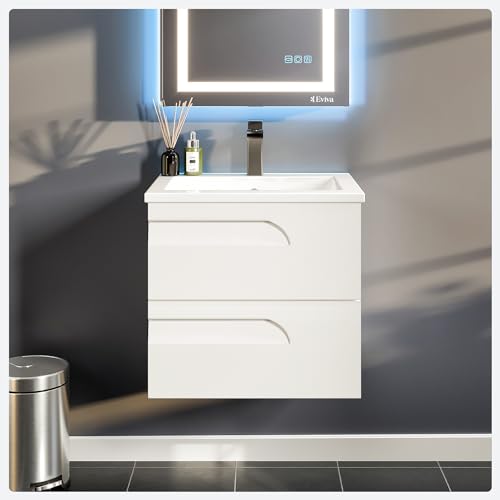
A wall-mounted design that keeps the cabinet base off the floor entirely, reducing the splash-and-mop-water wicking exposure that a floor-level toe kick experiences in a humid bathroom.
Removing the toe kick's constant floor contact does not replace good ventilation, but it does eliminate one specific, chronic moisture exposure point that ground-mounted vanities in humid bathrooms experience continuously.
Floating vanities require verified stud support and are best installed by a licensed contractor, particularly in humid climates where any structural blocking added inside the wall should also be moisture-appropriate material.
Marine-grade plywood is the top-tier choice mainly justified for extreme coastal or tropical exposure. For most humid climates, standard plywood or moisture-resistant MDF paired with adequate ventilation performs well without the cost and lead time of a marine-grade custom order.
Check the product specification sheet for the actual core material name, such as plywood, moisture-resistant MDF, or particleboard. If the listing only uses marketing terms like "water-resistant" without naming the core material, assume it is standard particleboard or MDF with a surface coating, not a different structural material.
To a meaningful degree, yes. A properly sized exhaust fan, run consistently during and after showers, reduces the ambient humidity cycling that damages any cabinet material. It will not make particleboard perform like plywood, but it substantially extends the realistic lifespan of a mid-tier material like moisture-resistant MDF.
Most bath fan manufacturers and ASHRAE guidance recommend at least 1 CFM per square foot of bathroom floor area, with a minimum of 50 CFM even in small bathrooms. Run the fan during the shower and for about 20 minutes afterward to clear residual humidity fully.
Yes. Sealed solid wood performs very well but requires periodic re-sealing with marine varnish or an equivalent finish as the coating wears, typically every few years depending on exposure. Plywood with a catalyzed lacquer finish generally requires less ongoing maintenance to maintain its humidity resistance.
Stainless steel and solid brass hardware resist pitting and corrosion better than zinc-plated or lower-grade chrome-plated hardware under sustained humidity, especially with salt-air exposure in coastal areas. Confirm hardware material in the product specification rather than relying on finish appearance alone.
Thermofoil performs adequately in moderate humidity but is more prone to delaminating from its MDF substrate when sustained humidity combines with heat, such as from a nearby shower or hair styling tools used close to the cabinet. Catalyzed lacquer generally holds up better under that combined stress.
A floating vanity removes the cabinet's continuous floor contact, which reduces one specific moisture exposure point at the toe kick where mop water and splashes accumulate. It does not address ambient air humidity, which still requires proper ventilation regardless of mounting style.
Look for swelling or delamination at the bottom edges of doors and drawer fronts, cabinet floor discoloration or soft spots near the plumbing, and doors or drawers that no longer close flush. These are the typical early signs of humidity cycling damage in particleboard and lower-grade MDF cabinets.
A small dehumidifier can help in bathrooms with no exterior window and a chronically high ambient humidity baseline, but it should supplement, not replace, a properly sized and consistently used exhaust fan, which removes humidity at the source more efficiently during and after showers.
Countertop material selection is less climate-dependent than cabinet core material, since sealed engineered quartz or solid surface performs consistently well regardless of climate. The cabinet box underneath is where humid-climate material choice matters most.
For humid climates, a plywood cabinet box is the practical minimum, and sealed solid wood or marine-grade plywood is the top tier if your budget and timeline allow it. Read the specification sheet for the actual core material rather than trusting marketing terms like "water-resistant," and confirm your bathroom's exhaust fan is properly sized and gets used consistently, since ventilation protects the vanity as much as, and sometimes more than, the cabinet material itself.
How we rank & our data sources
We do not run physical lab tests. Rankings are built from published, verifiable data and real owner feedback, never paid placement.
Researched by admin · Last updated July 21, 2026 · Our review method
The vanity that looks perfect online can still fail once it reaches your bathroom. Here are the measurement, plumbing, and planning mistakes…
Read the guide
A small bathroom vanity has to deliver real storage in a fraction of the footprint a primary bathroom gets to work with,…
Read the guide
Homeowners with hard water or well water often shop for a "hard water resistant vanity," but the honest answer is that the…
Read the guide