


Why Toilet Trapways Are Curved Like an S
Toilets4.6
Learn why toilet trapways curve like an S, how each bend blocks sewer gas, and what the shape means for clogs and…
Read the guideA data-driven guide to the lowest-GPF toilets on the market, how EPA WaterSense certification works, what MaP flush scores actually tell you about real-world performance, and which models from TOTO, Kohler, American Standard, Woodbridge, Swiss Madison and Gerber deliver the deepest water savings without sacrificing flush power.
The TOTO Aquia IV is the most eco-friendly toilet for most households, using 0.8 gallons for liquid waste and 1.28 gallons for solids while scoring a perfect 1,000 grams on the MaP flush test and carrying full EPA WaterSense certification. For a single-flush model, the TOTO UltraMax II at 1.28 GPF with a 1,000-gram MaP score offers the best balance of savings and raw flush power.
Toilets are the single largest consumer of indoor water in a typical American home, accounting for roughly 24 to 31 percent of all household water use according to EPA data. An older 3.5-gallon-per-flush (GPF) toilet used by a family of four burns through around 20,000 gallons per year on toilet flushing alone. Swap it for a modern 1.28 GPF WaterSense-certified model and that figure drops to about 7,400 gallons per year, a reduction exceeding 60 percent. A dual-flush toilet with a 0.8 GPF liquid mode cuts even deeper, depending on household usage patterns.
What makes this guide different from a simple spec sheet is the focus on the relationship between water volume and flush effectiveness. The single biggest mistake consumers make when shopping for an eco-friendly toilet is assuming that a lower GPF number automatically means better environmental performance. In reality, a toilet that uses 1.28 gallons but requires a second flush because it left waste behind has consumed 2.56 gallons, which is worse than a clean 1.6-gallon single flush. That is why this guide pairs every GPF figure with an independent MaP (Maximum Performance) flush-test gram score, so you know whether a toilet's water savings are genuine or theoretical.
For a full comparison of flush power across all categories, the best flushing toilets guide covers every style and price tier. This guide stays focused specifically on water efficiency: what the numbers mean, which models earn their eco credentials honestly, and how to calculate the real impact on your water bill and environmental footprint.
GPF stands for gallons per flush, the volume of water a toilet releases in a single flush cycle. The current federal maximum is 1.6 GPF, established by the Energy Policy Act of 1992. EPA WaterSense certification requires 1.28 GPF or less. Toilets with dual-flush mechanisms typically offer a partial flush of 0.8 or 1.0 GPF alongside a full flush of 1.28 or 1.6 GPF, allowing users to choose the correct volume for the type of waste.
Before 1992 the federal standard did not exist at all, and many toilets used 3.5, 5, or even 7 gallons per flush. The 1.6 GPF federal limit was a massive step forward, reducing toilet water use by more than half across the national housing stock. The second major shift came in 2006 when the EPA launched the WaterSense program, which certifies toilets at 1.28 GPF or less and also requires that those toilets pass the MaP flush test at a minimum threshold of 350 grams. In practice most WaterSense-certified toilets on the market today score 600 to 1,000 grams on the MaP test, because manufacturers quickly learned that a toilet that does not flush reliably gets returned regardless of its water savings.
The GPF number you see on the box is the maximum flush volume, not a behavioral average. In a dual-flush toilet, the partial flush is used for most daily flushes. Research from water utilities suggests that approximately 70 to 75 percent of toilet uses in a household involve liquid waste only. If your dual-flush toilet uses 0.8 GPF for liquid waste and 1.28 GPF for solid waste, your effective average across all flushes will be approximately 0.93 GPF, which is significantly lower than the 1.28 GPF number printed on the specification sheet. That average is what determines your actual water savings and water bill impact over time.
Flush volume and flush performance are not competing forces if the toilet is designed well. Modern gravity-fed toilets with fully glazed 2-1/8-inch trapways, siphon jets optimized for the bowl shape, and precision-molded rim channels can achieve 1,000-gram MaP scores at 1.28 GPF. The engineering challenge was solved over a decade ago. What keeps some budget 1.28 GPF toilets from performing well is shortcuts in the bowl geometry or an undersized trapway, not the GPF limit itself. Always verify the MaP score before buying any toilet marketed as eco-friendly.
EPA WaterSense is a voluntary certification program that labels toilets using 1.28 GPF or less that have also been independently tested to confirm they can flush at least 350 grams of test media in a single flush, meeting both water efficiency and performance thresholds. Certified toilets must be tested by an accredited third-party laboratory, and the EPA audits manufacturers periodically to maintain the label. Consumers can verify any specific model on the EPA WaterSense product search database at epa.gov/watersense.
The WaterSense label does two things at once. First, it guarantees a hard water-use ceiling: no WaterSense toilet can use more than 1.28 GPF on a single flush. Second, it guarantees minimum performance: the 350-gram MaP test floor ensures the toilet can handle a reasonable solid waste load without clogging or requiring multiple flushes. The 350-gram floor is a baseline, not a target. High-performing models like the TOTO Drake II, TOTO UltraMax II, Kohler Cimarron, and American Standard Cadet 3 all score a perfect 1,000 grams at 1.28 GPF, giving them a flush strength comparable to or exceeding older 3.5-gallon toilets.
The WaterSense program also calculates aggregate national savings. By EPA estimates, widespread adoption of WaterSense toilets could save more than 360 billion gallons of water annually across the United States. At the household level, replacing a pre-1994 toilet with a WaterSense-certified model saves the average family roughly 13,000 gallons per year, which translates to approximately $130 in water and sewer savings per year at average US utility rates. Many state and local utilities offer rebates of $50 to $200 per toilet for WaterSense replacements, making the payback period very short.
It is worth noting that the WaterSense label applies to complete toilet fixtures, not just flush valves. If you purchase a WaterSense tank and bowl separately, the combination needs to be on the EPA's certified models list to confirm the pairing was tested as a unit. Mixing a WaterSense tank with a non-certified bowl, or vice versa, may produce a combination that does not perform to the expected standard. For more details on certifications and rebate programs, see our guide to WaterSense toilets explained.
The 350-gram MaP floor for WaterSense certification is intentionally conservative, because the program was designed for broad adoption across all price points. Shoppers who want genuine confidence that an eco-friendly toilet will not require double-flushing should look specifically for models with MaP scores of 600 grams or higher. That score represents clearing roughly 1.3 pounds of solid waste in a single flush, which covers virtually all real-world household use cases. A 1,000-gram score, the maximum MaP tests for, means the toilet will almost never require a second flush under normal household conditions.
For a toilet operating at 1.28 GPF or below to perform reliably in a household setting, a MaP score of at least 500 to 600 grams is recommended, with 800 grams or above being strongly preferred. At 500 to 600 grams a toilet handles typical daily use without double-flushing. At 800 to 1,000 grams, the toilet provides a flush margin wide enough to handle heavier waste loads, larger households, and the occasional off-brand toilet paper without incident.
The MaP (Maximum Performance) testing protocol is run by an independent organization and uses soybean paste formed into precise measured quantities as a test media, simulating the density and viscosity of human solid waste. The test measures the maximum single-flush capacity in grams before failure, meaning the point at which the toilet requires more than one flush to clear the bowl. The maximum test threshold is 1,000 grams, which is why you will see toilets listed as "1,000 g" on the MaP database, indicating that they cleared the maximum load without failure in all test runs.
When comparing low-GPF toilets, the MaP-to-GPF ratio is the most useful efficiency metric. A toilet that achieves a 1,000-gram MaP score at 1.28 GPF is doing far more work per gallon than one that scores 400 grams at 1.28 GPF. Below is a comparison of the leading eco-friendly toilet models by this metric.
| Model | GPF (Full / Partial) | MaP Score | WaterSense | Trapway | Owner Rating | Check Price |
|---|---|---|---|---|---|---|
| TOTO Aquia IV | 1.28 / 0.8 | 800 g | Yes | 2-1/8 in fully glazed | 4.7 | Check price |
| TOTO UltraMax II | 1.28 | 1,000 g | Yes | 2-1/8 in fully glazed | 4.8 | Check price |
| TOTO Drake II | 1.28 | 1,000 g | Yes | 2-1/8 in fully glazed | 4.8 | Check price |
| Kohler Cimarron (1.28) | 1.28 | 1,000 g | Yes | 2-1/8 in fully glazed | 4.6 | Check price |
| American Standard Cadet 3 (1.28) | 1.28 | 1,000 g | Yes | 2-1/8 in fully glazed | 4.5 | Check price |
| Kohler Highline (1.28) | 1.28 | 800 g | Yes | 2-1/8 in fully glazed | 4.5 | Check price |
| Swiss Madison St. Tropez | 1.28 / 0.8 | 600 g | Yes | 2 in | 4.4 | Check price |
| Woodbridge T-0001 | 1.6 / 1.0 | 800 g | 1.28 variant | 2-1/8 in | 4.5 | Check price |
| Gerber Ultra Flush (1.28) | 1.28 | 1,000 g | Yes | 2-1/4 in fully glazed | 4.5 | Check price |
The TOTO Drake and Drake II are worth calling out separately because they come in both 1.28 GPF and 1.6 GPF configurations. If you are specifically buying for water savings, confirm the 1.28 GPF variant: the part numbers for the 1.28 and 1.6 GPF versions differ by only one character and retailers sometimes list them interchangeably. For more background on how the TOTO lineup is structured by flush volume and flush technology, see the TOTO WaterSense toilets guide.
A family of four replacing a 3.5 GPF toilet with a 1.28 GPF WaterSense-certified model typically saves between 12,000 and 15,000 gallons of water per year, reducing toilet water use by roughly 63 percent. At the US average combined water and sewer rate of approximately $0.01 per gallon, that represents about $120 to $150 in annual utility savings per toilet. A dual-flush toilet averaging 0.93 GPF across all flushes could push those savings slightly higher depending on usage patterns.
The math behind toilet water savings is straightforward once you establish a baseline. The average American flushes a toilet approximately five times per day. At four people in a household that is 20 flushes per day or 7,300 flushes per year. At 3.5 GPF, that totals 25,550 gallons per year from toilet flushing alone. At 1.28 GPF the same household uses 9,344 gallons, saving 16,206 gallons annually. At a dual-flush effective average of 0.93 GPF, the total drops to 6,789 gallons, saving more than 18,700 gallons per year.
The savings compound further when you account for sewer charges. Most municipal utilities charge for sewer service as a multiplier of water consumption, typically 100 to 150 percent of the water rate. A household saving $120 in water costs might therefore save an additional $120 to $180 in sewer charges, for a total annual benefit of $240 to $300 per toilet. Over a 15-year toilet lifespan, one WaterSense toilet replacement represents $3,600 to $4,500 in total utility savings, not counting the value of local rebates that often reduce the initial purchase cost by $50 to $200. Our toilet water use calculator guide walks through the calculation with adjustable household variables.
On a larger scale the EPA estimates that if all US households replaced toilets manufactured before 1994 with WaterSense-certified models, the national water savings would exceed 520 billion gallons per year. That is approximately 1.6 trillion liters, enough to supply drinking water to more than 5 million Americans for an entire year. Individual choices about toilet efficiency aggregate to genuinely meaningful outcomes at the population level.
The payback calculation for a WaterSense toilet replacement almost always favors acting sooner rather than later when the existing toilet is pre-1994 vintage. Even a mid-range WaterSense toilet costing $300 installed pays back the investment within three to five years through water and sewer savings, and the toilet will last another 15 to 25 years after that. The environmental math is even more favorable in drought-stressed regions of the western US, where water carries additional scarcity premiums not reflected in the utility rate.
Dual-flush toilets are more water efficient than single-flush models in most households, but only if users consistently use the partial flush for liquid waste. Research from the Australian Building Codes Board and multiple US water utilities found that households using dual-flush correctly reduce toilet water use by an additional 20 to 30 percent compared to single-flush 1.28 GPF toilets. However, a dual-flush toilet where users habitually press the full-flush button for every use saves no more water than a single-flush 1.28 GPF model would.
The mechanism behind a dual-flush toilet is fundamentally different from a single-flush gravity model. In a standard gravity-feed single-flush toilet, water is released from the tank by lifting a flapper valve, allowing the full tank volume to enter the bowl and create a siphon that evacuates waste through the trapway. In a dual-flush toilet, the flush is typically controlled by a tower-style flush valve or a canister valve. Pressing the partial-flush button releases roughly half the tank volume, which is sufficient to clear liquid waste from a properly designed bowl without engaging the full siphon. Pressing the full-flush button releases the entire tank volume for solid waste removal.
The partial-flush effectiveness depends heavily on bowl geometry. Not all dual-flush bowls are designed to clear liquid waste efficiently on 0.8 gallons. Models from TOTO, particularly those using the Tornado Flush or Cyclone technology, use dual rim jets that create a centrifugal rinse of the entire bowl surface with minimal water, making the partial flush genuinely effective. Cheaper dual-flush toilets with a single rim opening may leave a weaker rinse on 0.8 gallons, causing users to habitually press full-flush instead, which negates the water savings.
Another practical consideration is dual-flush reliability over time. The tower-style flush valves used in most dual-flush toilets have more moving parts than a traditional flapper valve. Some owners report that after five to eight years the flush selector mechanism can become stiff or fail to engage the correct flush volume, requiring a valve replacement. TOTO and Kohler dual-flush valves are generally more durable than generic replacements. For more on the tradeoffs involved, see our guide comparing dual flush vs single flush toilets.
TOTO and Kohler consistently earn the highest long-term reliability ratings in aggregated owner reviews for eco-friendly toilets, with TOTO leading on flush mechanism durability and Kohler leading on parts availability. American Standard and Gerber offer strong reliability at lower price points. Swiss Madison and Woodbridge are well-regarded for value-tier one-piece eco models but have shorter track records for 10-plus-year performance data.
Reliability in an eco-friendly toilet comes from three mechanical factors: the quality of the flush valve that controls water release, the durability of the fill valve that refills the tank after each flush, and the long-term integrity of the bowl glaze that resists mineral buildup and staining. Each of these factors has a direct impact on sustained water efficiency over the toilet's lifespan, because a leaking or malfunctioning flush valve can silently waste 30 to 200 gallons per day, erasing years of savings in weeks.
TOTO's WASHLET+ toilets and most TOTO Drake and UltraMax models use a G-Max or Tornado Flush mechanism with a tower-style flush valve that the company redesigned in the early 2010s specifically for extended durability. Aggregated owner reviews across major retail platforms show a very low incidence of valve failure within the first 10 years. The TOTO Aquia IV Tornado Flush valve is particularly well reviewed in this regard. TOTO also uses CeFiONtect glaze on many models, an ion-barrier surface that reduces mineral adhesion and keeps the bowl cleaner with less water usage for bowl rinsing over time.
Kohler's Class Five flushing technology, used in the Cimarron and Highline series, has been in production since 2001 and has an extensive track record across millions of installed units. Kohler replacement parts are widely available through hardware retail channels, which is an important sustainability consideration: a toilet that can be repaired with off-the-shelf parts at low cost will remain water-efficient in service for decades, while a toilet requiring proprietary parts that become discontinued will be replaced early and create unnecessary waste. American Standard's Champion 4 and Cadet 3 lines have similar broad parts availability.
Gerber is less well known to consumers but highly regarded by professional plumbers for build quality and trapway design. The Gerber Ultra Flush line uses a 2-1/2-3/8-inch fully glazed trapway, one of the largest available in a residential single-flush toilet, which contributes to both flush effectiveness and long-term clog resistance without requiring additional water. Gerber toilets are generally available through plumbing supply channels rather than home centers, which explains their lower consumer visibility relative to their actual quality standing.
When evaluating an eco-friendly toilet for long-term ownership, check the warranty terms carefully. TOTO offers a one-year warranty on most residential models. Kohler offers a one-year warranty on non-vitreous components but a limited lifetime warranty on the vitreous china. American Standard offers a limited lifetime warranty on the china and a one-year warranty on mechanical components. The warranty length matters less than parts availability: a toilet with widely stocked replacement fill valves, flush valves, and trip levers can be maintained at low cost for 20 to 30 years, making it the most eco-friendly choice of all.
Selecting an eco-friendly toilet requires matching the toilet's water savings profile to your household's actual usage patterns and bathroom constraints. The following framework covers the key decision points in sequence.
Step 1: Establish your rough-in measurement. The rough-in is the distance from the finished wall to the center of the floor drain flange, measured before the toilet is installed. Standard rough-in is 12 inches, but 10-inch and 14-inch rough-ins exist in older homes. Confirming this before shopping is critical because most eco-friendly toilet models are designed for 12-inch rough-ins, and the WaterSense-certified options for 10-inch or 14-inch installations are more limited. Our toilet rough-in measurement guide explains the process.
Step 2: Choose between single flush and dual flush. If everyone in your household is reliable about using the partial flush for liquid waste, a dual-flush toilet at 0.8/1.28 GPF is the more water-efficient choice. If you have young children, guests who may not know the difference, or a household where consistency is uncertain, a high-performance single-flush 1.28 GPF toilet will deliver predictable savings without the behavioral requirement.
Step 3: Set a minimum MaP score target. For a household of one to two adults with no significant dietary factors, a 500-gram MaP minimum is workable. For households of three or more, households with heavy dietary fiber intake, or any household replacing a toilet that has historically clogged, target 800 grams minimum. For septic systems, the lower water volume of a 1.28 GPF toilet is generally beneficial, but confirm with your septic service provider that your tank size and drain field can handle the flow rate pattern of your preferred model.
Step 4: Confirm WaterSense certification for rebate eligibility. Most utility rebate programs require EPA WaterSense certification documentation at time of rebate application. The specific model number must appear on the EPA WaterSense product list. Save the model number and purchase receipt. Check your local water utility's website or call customer service to confirm rebate availability before purchasing, as programs change seasonally and may have funding limits.
Step 5: Compare toilet height and bowl shape to user needs. Water-saving features are wasted if the toilet is uncomfortable enough that household members prefer to use a different bathroom with an older toilet. Standard height is 14 to 15 inches at the rim. Comfort height is 16 to 18 inches, similar to a chair. Comfort height is preferred by taller adults and those with mobility limitations. Bowl shape (elongated vs round) affects both comfort and bathroom footprint. Most eco-friendly models are available in both configurations.
A closer look at the specifications and performance characteristics of the most frequently recommended eco-friendly toilet models, based on published manufacturer data, MaP testing results, and aggregated owner feedback.
TOTO Aquia IV Dual Flush: The Aquia IV uses TOTO's Tornado Flush mechanism, which delivers water through two nozzles that create a centrifugal swirling action covering the entire bowl surface rather than a single rim-jet cascade. This design allows the 0.8-gallon partial flush to adequately rinse the bowl while using less water than competing designs. The full 1.28-gallon flush scores a perfect 1,000 grams on the MaP test, putting it right alongside the category's top performers. The Aquia IV is available in a skirted one-piece design with concealed trapway, making it easy to clean around the base. TOTO's CeFiONtect glaze option on this model reduces biofilm adhesion, which means less frequent cleaning with fewer chemical cleaning agents and lower bowl water usage for rinsing over time.
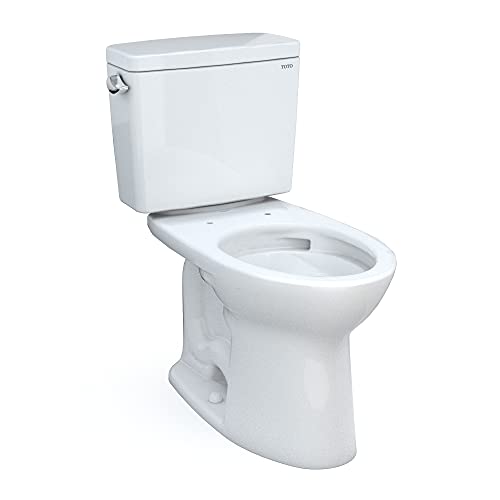
TOTO Drake II 1.28 GPF: The Drake II uses the same Tornado Flush cylinder design with a 1.28-gallon single flush that achieves the maximum 1,000-gram MaP rating. It is a two-piece toilet, making it easier to move through doorways during installation and cheaper to ship, which contributes to a lower retail cost than comparable one-piece models. The Drake II is one of the most widely distributed toilet models in North America and has an exceptional parts and service ecosystem. If long-term repairability is a sustainability priority, the Drake II's parts availability is difficult to match at any price. Its SanaGloss glaze (a variant of CeFiONtect) contributes to bowl cleanliness with less chemical use over time.
Kohler Cimarron 1.28 GPF: The Cimarron uses Kohler's AquaPiston flush valve, a canister design that opens 360 degrees to release water into the bowl from all sides simultaneously rather than from a single flapper opening. Kohler claims this produces a 90 percent stronger flush than traditional gravity designs at the same water volume. The independent MaP test confirms 1,000 grams at 1.28 GPF. The Cimarron is available in an Elongated Comfort Height configuration, a combination that accounts for the majority of sales, and Kohler offers it in more finish colors than most competitors. The Kohler Highline is a similar Class Five flush toilet at a lower price point, scoring 800 grams at 1.28 GPF, making it a strong budget eco option.
American Standard Champion 4 and Cadet 3: American Standard's Champion 4 carries the brand's EverClean antimicrobial surface and uses a 4-inch flush valve, the largest in the residential category, which generates high-velocity flush flow at 1.28 GPF. The Champion 4 at 1.28 GPF typically scores 800 to 1,000 grams depending on the specific variant. The Cadet 3 is a slightly more compact option with a 3-inch flush valve that reliably scores 1,000 grams at 1.28 GPF at a lower purchase cost than the Champion 4. Both models are WaterSense certified in their 1.28 GPF configurations and are widely stocked in hardware retail for easy parts sourcing.
Woodbridge T-0001 Dual Flush: The Woodbridge T-0001 is a dual-flush one-piece skirted toilet that has attracted considerable consumer interest for combining a modern elongated one-piece aesthetic with a budget-friendly price. Its dual-flush mechanism operates at 1.0 GPF partial flush and 1.6 GPF full flush, which is less aggressive on water savings than the 0.8/1.28 GPF pairing on the TOTO Aquia IV. Woodbridge does offer a 1.28 GPF variant that qualifies for WaterSense certification. The standard T-0001 model is therefore most eco-friendly when the WaterSense-labeled variant is specifically selected. MaP score for the Woodbridge T-0001 is 800 grams, adequate for most household applications.
Swiss Madison St. Tropez Dual Flush: The Swiss Madison St. Tropez is a modern skirted one-piece design from a brand that has grown rapidly in the value-oriented market. Its dual-flush operates at 0.8/1.28 GPF with full WaterSense certification. The MaP score for the St. Tropez is approximately 600 grams, lower than the top performers but acceptable for a light-to-moderate-use bathroom. Swiss Madison toilets are noted for their clean modern aesthetic and competitive pricing, but they have a shorter performance history than TOTO or Kohler. Owner reviews are generally positive for single-bathroom households without heavy use demands.
Gerber Ultra Flush 1.28 GPF: The Gerber Ultra Flush uses a 2-1/2-3/8-inch fully glazed trapway, among the largest available in residential single-flush toilets, paired with a 1.28-gallon flush that scores 1,000 grams on the MaP test. Gerber is particularly favored by plumbing contractors for installation in high-traffic and rental properties because of its long mechanical reliability record and low callback rate. The Ultra Flush is not as widely available in consumer retail channels as TOTO or Kohler, but can typically be ordered through plumbing supply distributors with standard lead times.
The most water-efficient toilets are dual-flush models with 0.8 GPF partial flush and 1.28 GPF full flush, such as the TOTO Aquia IV. Used as designed, the effective average across all daily flushes is approximately 0.93 GPF. Composting toilets use no water at all but are not suitable for conventional home plumbing systems and typically require permits.
Yes, in a single-flush toilet rated at 1.28 GPF, the tank releases 1.28 gallons with every flush. In a dual-flush toilet listed at 1.28/0.8 GPF, the 1.28-gallon full flush and the 0.8-gallon partial flush are selectable by the user. The maximum rated volume for that model is 1.28 gallons, which is what must meet the EPA WaterSense threshold.
Yes, provided the toilet has a MaP score of 600 grams or higher. Most leading 1.28 GPF WaterSense-certified models from TOTO, Kohler, American Standard, and Gerber score 800 to 1,000 grams on the independent MaP test, which represents clearing significantly more solid waste than a typical single use. A low MaP score at 1.28 GPF is the real risk, not the GPF number itself.
A WaterSense-certified toilet uses 1.28 GPF or less and has been independently tested to confirm it achieves at least 350 grams on the MaP flush test. A standard 1.6 GPF toilet does not carry that certification and uses 25 percent more water per flush. Over the course of a year for a family of four, that difference amounts to approximately 3,500 additional gallons consumed.
Many water utilities offer rebates of $50 to $200 per toilet for replacing an older model with a WaterSense-certified replacement. Rebate availability varies by utility district. Check your local utility's website or the EPA WaterSense rebate finder at epa.gov/watersense to confirm current program availability in your zip code before purchasing.
Eco-friendly toilets from established brands with MaP scores of 800 grams or higher are no more prone to clogging than older high-volume toilets. In fact, models like the TOTO Drake II and Kohler Cimarron at 1.28 GPF produce a sharper, more focused flush that clears waste faster than the diffuse high-volume flush of older 3.5-gallon models. Budget eco toilets with poor bowl geometry and low MaP scores are more clog-prone, but that is a design quality issue, not a water-volume issue.
TOTO offers the Drake in both 1.28 GPF and 1.6 GPF variants, and the model numbers differ by the suffix. The 1.28 GPF Drake bears an "EL" or "CST776" designator depending on the specific model year and bowl configuration. Confirm the GPF specification in the full model number listed on the product detail page or in the manufacturer's published specification sheet before purchasing.
MaP (Maximum Performance) testing is an independent third-party flush-performance protocol administered by Veritec Consulting Inc. and Koeller and Company. Tests are conducted at accredited plumbing testing laboratories. The test measures how many grams of soybean paste a toilet can clear in a single flush before failure. Results are published at map-testing.com and are freely searchable by brand and model number.
The TOTO Aquia IV typically achieves a lower effective average GPF than the Drake II because of its dual-flush 0.8/1.28 GPF design. The Drake II is a single-flush 1.28 GPF toilet, so every flush uses 1.28 gallons. If your household uses the partial flush consistently, the Aquia IV saves more water. If your household habitually uses the full flush on every use, the Drake II provides comparable water consumption and a higher 1,000-gram MaP score.
TOTO's CeFiONtect glaze reduces the adhesion of waste and mineral deposits to the bowl surface. Owners report less frequent need for toilet bowl cleaning, which means fewer toilet flushes used purely to rinse cleaning chemicals. The glaze does not directly reduce flush volume, but it can reduce the number of additional rinse flushes a household performs per week, contributing marginally to overall water savings over time.
The one-piece versus two-piece configuration does not affect water usage. The flush volume is determined by the tank capacity and flush valve design, not the toilet's physical construction. Two-piece toilets are easier to transport and often less expensive. One-piece toilets eliminate the tank-to-bowl gasket joint that can wear and leak over time, which is a minor long-term water-saving advantage for one-piece designs.
A silently leaking toilet flapper that allows a slow tank drain into the bowl wastes approximately 200 gallons per day according to EPA estimates, or more than 70,000 gallons per year. This single source of water waste exceeds the annual toilet flush savings from upgrading an entire household to WaterSense-certified toilets. Fixing a leaking flapper is therefore the highest-priority water conservation action in any home with an older toilet.
For septic systems, lower water volume per flush is generally beneficial because it reduces hydraulic loading on the tank and drain field. A 1.28/0.8 GPF dual-flush toilet such as the TOTO Aquia IV is well suited to septic use. Confirm with your septic service provider that the hydraulic load from your chosen flush volume is compatible with your system's capacity, particularly if the system is older or at design capacity.
True 0.8 GPF single-flush toilets are extremely rare in residential applications in the US, because achieving reliable solid waste clearance on 0.8 gallons with a single-mode toilet requires very specialized bowl geometry and flush valve engineering. The 0.8 GPF rating appears most commonly as the partial-flush setting in dual-flush toilets. The Niagara Stealth, available in 0.8 GPF single-flush configuration, is a notable exception that uses a vacuum-assisted flush mechanism to achieve clearance on very low water volume.
Visit epa.gov/watersense and use the product search tool, filtering by "toilet" in the product category. Enter the full model number of the toilet you are considering and confirm it appears as a certified product. If a retailer describes a toilet as WaterSense compliant but the model number does not appear on the EPA database, the certification claim should not be trusted for rebate purposes.
For households replacing a toilet manufactured before 1994, the reduction is significant and bill-visible. Replacing a single 3.5 GPF toilet used by four people saves approximately 10,000 to 16,000 gallons per year, which at average US water and sewer rates of $0.01 per gallon represents $100 to $160 in annual savings per toilet. For households already on 1.6 GPF toilets, upgrading to 1.28 GPF saves a smaller but still meaningful 10 to 15 percent of toilet water use.
Beyond flush volume, eco performance is enhanced by a fully glazed trapway that resists buildup and reduces clog-driven double-flushing, an antimicrobial or ion-barrier bowl glaze that reduces cleaning frequency and chemical use, a high-quality fill valve that refills precisely to the set water level without overfilling, and a long service life supported by widely available replacement parts that keep the toilet in efficient service for decades rather than requiring early replacement.
Yes, the Kohler Highline is available in a 1.28 GPF WaterSense-certified configuration alongside the original 1.6 GPF version. The 1.28 GPF Kohler Highline uses the same Class Five flushing technology as the Cimarron and achieves an 800-gram MaP score. Confirm the 1.28 GPF designation in the model number when ordering, as 1.6 GPF Highline models are still widely stocked and do not carry WaterSense certification.
No, the water savings at any given GPF rating are the same regardless of whether the flush mechanism is pressure-assist or gravity-feed. A pressure-assist toilet at 1.28 GPF uses exactly the same volume of water as a gravity toilet at 1.28 GPF. Pressure-assist toilets use compressed air to amplify flush velocity, which improves solid waste clearance and reduces clogging, but does not change the water volume consumed per flush.
The vitreous china bowl and tank of a well-maintained WaterSense toilet can last 30 to 50 years or more. The mechanical components, including the fill valve, flush valve, and trip lever, typically require replacement every 10 to 15 years depending on water quality and usage frequency. A toilet with widely available replacement parts can be kept in fully efficient, clog-free service for the life of the fixture with periodic mechanical maintenance at low cost.
The most eco-friendly toilet for the majority of households is the TOTO Aquia IV, because its dual-flush 0.8/1.28 GPF design, full EPA WaterSense certification, and 1,000-gram MaP score together deliver the lowest realistic annual water consumption without requiring a second flush. For households that prefer single-flush simplicity with maximum flush power, the TOTO Drake II or TOTO UltraMax II at 1.28 GPF achieve a 1,000-gram MaP score while still saving 20 percent more water per flush than the federal 1.6 GPF maximum. The Kohler Cimarron and American Standard Cadet 3 offer the same 1,000-gram performance at 1.28 GPF for buyers seeking wider retail availability and lower purchase cost. Whichever model you choose, confirming the EPA WaterSense certification number before purchasing ensures you can claim any available utility rebate and secures a manufacturer-verified flush performance floor on the toilet you install.
Learn why toilet trapways curve like an S, how each bend blocks sewer gas, and what the shape means for clogs and…
Read the guideAlmost every US toilet has a left-side handle. Learn the plumbing and mechanical reasons behind the layout and when it actually changes.
Read the guideHome toilets rely on tanks because household water lines lack the pressure that public flushometer systems use to flush straight from the…
Read the guide